fbpx

March 26, 2026

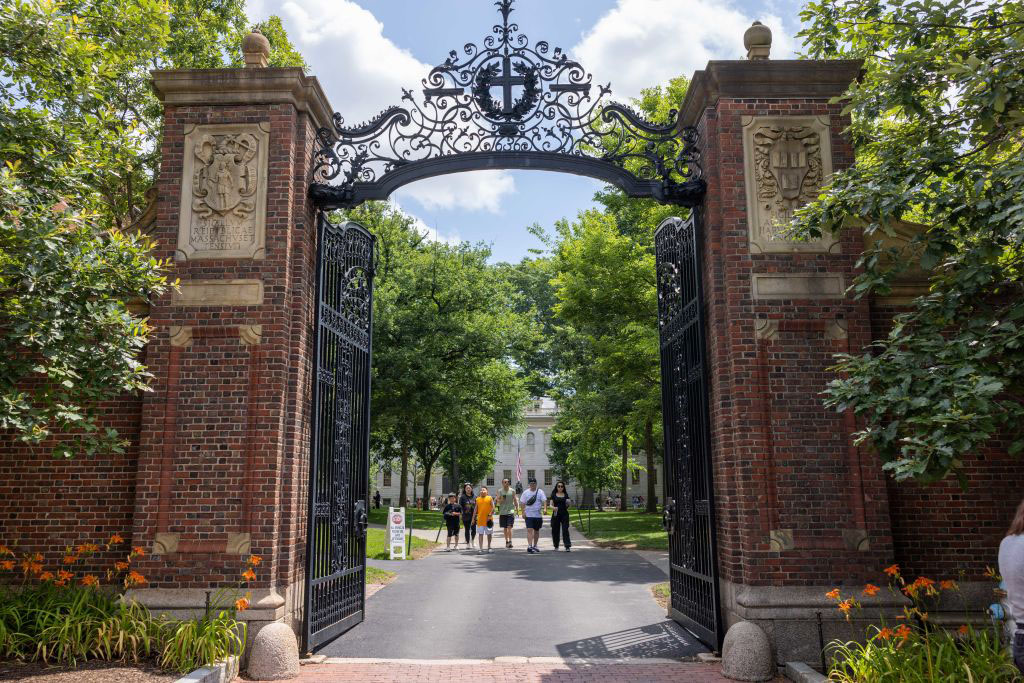
Harvard’s New Jewish Problem

There was a time when Harvard’s “Jewish problem” was that many young Jews wanted to attend, but the university limited the number it would admit.

But the tables have turned. A new report has revealed that Jewish undergraduate enrollment at Harvard is down to just 7% of the student body, the lowest figure in more than a century.

The university is so worried that the dean of admissions and financial aid, William Fitzsimmons, announced that he will be making a special effort to target potential students in Jewish day schools. It will not make his task an easier that the faculty committee on Admissions and Financial Aid has among its members anti-Israel extremists such as Ali Asani and Maya Jasanoff.

Jewish students’ diminishing interest in Harvard no doubt is related to the prominence of such anti-Israel faculty members, and the well-known scenes of campus mobs cheering the mass murder of Israeli Jews and calling for the annihilation of the Jewish state. It’s not hard to understand why that would make prospective enrollees uneasy.

Harvard was not particularly hospitable to Jews in the 1920s, either, but for different reasons.

The American children of European Jewish immigrants, pursuing the American dream through education and hard work, gradually rose to about 25% of the Harvard student body in the years following World War I. That did not sit well with Harvard President A. Lawrence Lowell and his colleagues.
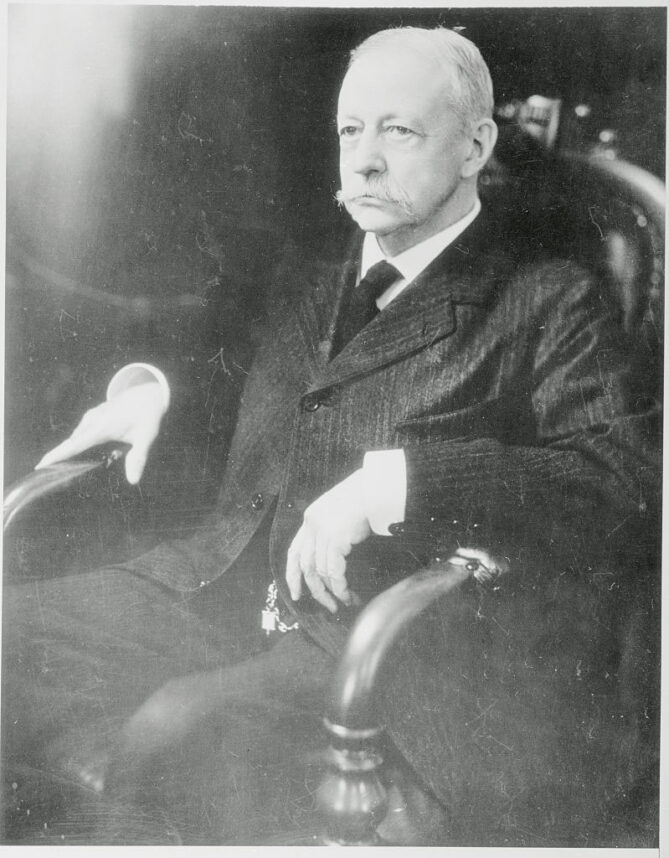
A. Lawrence Lowell (Bettmann / Contributor/Getty)

In a letter to an alumnus in 1922, Lowell blamed campus antisemitism on the Jews. The anti-Semitic feeling among students is increasing, and it grows in proportion to the increase in the number of Jews,” the Harvard president wrote. “If their number should become 40 per cent of the student body, the race feeling would become intense…All this seems to me fraught with great evils for the Jews, and very great peril for our community.”

That was why Lowell went to the Harvard Board of Overseers in 1922 with a proposal to reduce the number of Jewish students on campus to 15% of the student body. 

Until then, admissions had been determined on the basis of merit, that is, grades and test scores. Lowell and the board devised new criteria that would allow “careful discernment of differences among individuals,” as Lowell put it.

Under the new rules, a Harvard admissions officer could reject an application based on the applicant’s “character.” Also, the applicant would be required to state his “race and color” and “religious preference,” and would have to explain if either of his parents had ever changed their names—so that the admissions officer would know whose “character” required special scrutiny. 

Applicants from New York City were classified according to whether their family name and photograph indicated they might be Jews. They were classified as “J1” (definitely Jewish), “J2” (probably Jewish), or “J3” (possibly Jewish). Thus Jews could be singled out for rejection without anybody having to explain that it was because they were Jews.

Franklin D. Roosevelt, who served on the Harvard board in the 1920s, later boasted of his role in this episode. He and his fellow-board members decided that “the number of Jews should be reduced one or two per cent a year until it was down to 15%,” President Roosevelt explained to Henry Morgenthau, Jr., the only Jewish member of his cabinet, in 1941. “You can’t get a disproportionate amount of any one religion.”

Lowell and FDR also shared an indifference to the plight of Jews in Nazi Germany. In his book The Third Reich in the Ivory Tower, Prof. Stephen Norwood described Lowell’s rejection of an offer by a charitable foundation in 1933 to pay the salary of a refugee scholar from Nazi Germany if Harvard would hire him. Lowell accused the foundation of trying “to use the College for purposes of propaganda.”

James G. McDonald, the League of Nations High Commissioner for Refugees from Germany, requested an appointment with Lowell in March 1934. Lowell’s secretary told McDonald—according to the latter’s diary— “that he wasn’t interested in German refugees,” and “that he was tied up the whole day,” so therefore “couldn’t see me.” But when Hitler’s foreign spokesman, Harvard alumnus Ernst “Putzi” Hanfstaengl, visited the campus three months later, Lowell found the time to have a friendly meeting with him.

In those days, Harvard rejected the Jews. Today, the Jews are rejecting Harvard. The plummeting Jewish enrollment actually began long before October 7, 2023, although the outpouring on campus of pro-Hamas sentiment following the massacre, and the administration’s tepid response, accelerated the trend.

According to a study by the Harvard Jewish Alumni Alliance, in the years preceding October 7, Harvard’s history, political science, and social sciences departments offered a torrent of courses “promoting the view that the Palestinian people are innocent victims of Jewish (white) oppression and that known terrorist groups are simply ‘political movements’.” It was that biased curriculum which planted the seeds for the eruption of pro-Hamas protests on camps in the autumn of 2023.

Following the October 7 massacres, dozens of student groups at Harvard endorsed Hamas, more than 100 faculty members joined the pro-Hamas “Faculty for Justice in Palestine” group, and the recommendations of the university’s task force on antisemitism were ignored, prompting some of its members to resign. The administration appointed, as the new co-chair of the task force, a faculty member who had accused Israel of “ethnic cleansing” and “apartheid.”

Ironically, then, A. Lawrence Lowell’s prediction in 1922 that the campus environment would become hostile to Jews has indeed come true—not because the Jews provoked the bigots, as Lowell expected, but because anti-Jewish bigots, masquerading as anti-Zionists, were emboldened by the university itself to let their true feelings show. The dwindling Jewish application numbers are a natural response.


Dr. Medoff is founding director of The David S. Wyman Institute for Holocaust Studies and author of more than 20 books about Jewish history and the Holocaust. Follow him on Facebook to read his daily commentaries on the news.

Harvard’s New Jewish Problem Read More »

Obligation – A poem for Parsha Tzav

Tzav — Command (Leviticus 1:1–5:26)

Tzav – as in Mitzvah
as in commandment
as in, it is our obligation
to be holy.

It is not enough
to pick up trash
and feel good about it.
We are commanded

to be the kind of people
who pick up trash
regardless of how
it makes us feel.

Community service credit
is not our end goal
Personal holiness credit is.
Have you checked your account?

There is a light
and it never goes out.
We are the keepers
of this light.

Not its owners –
It’s keepers… The light
is for everyone.
Do your part.

That’s an order.


Rick Lupert, a poet, songleader and graphic designer, is the author of 29 books including “God Wrestler: A Poem for Every Torah Portion.” Visit him at www.JewishPoetry.net

Obligation – A poem for Parsha Tzav Read More »

Why Cornell President Michael Kotlikoff Is My Man of the Year

In 2011, when Cornell partnered with the Technion Institute of Technology to create a global innovation hub on Roosevelt Island in New York City, it became one of the great academic success stories of our time.

Nearly 15 years later, Cornell Tech has educated more than 2,700 students and undertaken groundbreaking research on AI and other new technologies. Critical to this mission has been the Joan and Irwin Jacobs Technion-Cornell Institute, which brings together engineers, computer scientists, designers, clinicians and entrepreneurs to develop new technologies, launch startups and generate real-world impact through three research hubs focused on health, media and urban challenges.

The partnership is humanity and academia at their very best.

Of course, it’s also a perfect opportunity for Israel haters to try to take it down.

You read that right.

Resolution 61 from the Cornell Undergraduate Student Assembly calls for the termination of this extraordinary partnership, citing “ethical and legal concerns regarding the Technion’s involvement in military research and technologies” and arguing that “continued collaboration conflicts with Cornell’s values and mission.”

It’s important to take a step back and consider the fanatical chutzpah of Israel-haters and Jew-haters these days. They have zero fear of consequences. Nothing is beneath them when it comes to demonizing the Jewish state.

“We are witnessing the rise of a new vanguard of ideological enforcement,” fifth year Ph.D. student Derek A. Berman writes in the Cornell Daily Sun. “Like the student-led purges of the 20th century, these representatives are drunk on hubris, convinced they are moral arbiters of a conflict they only understand through 30-second social media clips. They’ve fallen prey to a grand manipulation — an infiltration of American academia by anti-Israeli actors seeking to win on campus what they cannot win on the battlefield.”

Berman notes the selective nature of their calls for “justice”:

“Where are the resolutions for the Christians being slaughtered in Nigeria? Where’s the outrage for upwards of a million Muslim Uyghurs in Chinese ‘re-education’ camps today? Their silence on these atrocities proves the Assembly’s moral compass points true north only when the Jewish state is involved.”

Faced with such brazen antisemitism and antizionism, all too often universities have been intimidated into toothless responses. Maybe they think it’s so unpopular to be pro-Israel these days they better respond with kid gloves.

Cornell president Michael Kotlikoff didn’t respond with kid gloves. Instead, he took the gloves off.

“I reject this resolution, which fundamentally conflicts with Cornell’s principles of academic collaboration and our core commitment to academic freedom,” he wrote in response to Resolution 61.

“Cornell Tech deepens, enriches, and strengthens the ability of our students, faculty, and staff to pursue knowledge and advance the university’s academic mission. The Joan and Irwin Jacobs Technion-Cornell Institute, the core international partnership upon which Cornell Tech is based, is an extraordinarily valuable collaboration focusing on education and research in health tech, media tech, and urban tech, and supporting the development of new startup companies.”

It means nothing to Israel haters that 128 startups have already emerged from the partnership’s Runway program, creating more than 700 new jobs, or that founders have created technologies ranging from an AI-powered smart baby monitor and a genomic pathogen-detection platform to augmented-reality collaboration tools, among countless other innovations.

Indeed it’s sad that Kotlikoff’s common sense rejection of Resolution 61 should be so noteworthy. At the same time, it’s a warning sign of how far the hysteria against Jews and Israel has gone, especially in academia.

The examples are too numerous to list. Just this week, Corey Miller, assistant professor of medicine at my alma mater, McGill University, connected the dots between three slogans scrawled on a bathroom stall: “Free Palestine,” “Jews out of McGill Med,” and “Kill all Jews.”

The coexistence of the slogans, Miller wrote, “shows how anti-Zionist rhetoric sits comfortably alongside explicitly eliminationist language. At first glance, they might look like disconnected expressions of rage. In fact, they are a logical sequence, one that reveals something essential about what it means to hate Jews today.”

The outrageous resolution to terminate the Cornell-Technion partnership, just like the calls to “globalize the intifada” and “from the river to the sea,” are all connected in their anti-Jewish venom to the three slogans on the McGill bathroom wall.

These slogans “are not three ideas, they are one, expressed with increasing honesty,” Miller writes. “When a worldview leaves Jews with no place among the nations and no place among our neighbors, the writing on the wall is clear.”

We have a tendency to use words like rage and fury to describe the growing animosity toward Jews and Israel.

Miller goes a step further.

“The bathroom wall did not reveal incoherent rage. It revealed something far more chilling: clarity.”

Cornell president Kotlikoff used clarity in his rejection of Resolution 61, going as far as calling out its hypocrisy.

“I am deeply troubled by the selective manner in which this resolution singles out the Technion, alone of Cornell’s many international partners, for censure,” he wrote. “Cornell currently maintains 159 active agreements with institutions in 59 nations and regions; all of these institutions have some government affiliation, and many conduct research with military and security applications…None of these publicly available facts are mentioned in the resolution; only our partnership with an Israeli institution is targeted for erasure.

“The political bias evident in this selective approach is deeply disturbing, and the resolution is incompatible with both the Student Assembly’s purpose and Cornell University’s core values. I reject it fully and forcefully.”

Kotlikoff didn’t dilly dally. He was clear and forceful in his response, providing a crucial example for other college leaders who are facing a similar anti-Israel and anti-Jewish onslaught.

That is why he is my man of the year.

Why Cornell President Michael Kotlikoff Is My Man of the Year Read More »

Deer Valley Resort is transforming before the 2034 Winter Olympics

Thank you Bored Panda for publishing my article, “11 Reasons This Utah Ski Resort Has Been Part Of My Winter Memories Since Childhood

I grew up in Los Angeles, but winter meant Utah. My dad loved skiing so much that all of us learned — not casually, but confidently. If we were going to the mountains, we were skiing in Park City. When the 2002 Winter Olympics came to Utah, I watched the world discover what we already knew. I tried the bobsled at Utah Olympic Park as part of my “50 Challenges Before 50” project. I skied with Fuzz Feddersen, the Olympic aerialist at Deer Valley, with the “Ski with a Champion” program and wrote about it for Travel + Leisure. Now, as Utah prepares for the 2034 Winter Olympics, Deer Valley isn’t just preparing — it’s transforming. This is the largest ski resort expansion in industry history.
More info: lisaniver.com | Facebook | Instagram | youtube.com

#1 Building Toward 2034

Building Toward 2034
Photo: Deer Valley Resort
Utah returns to the global stage for the 2034 Winter Olympics — and Deer Valley is building accordingly. If you watched the 2002 Winter Olympics unfold here, you know what that energy feels like. Now it’s coming back. So come ski it this season. Or start making your plans — book the lesson, plan the trip, circle 2034 on your calendar. For me, Deer Valley has always been more than just a ski resort — it’s part of my personal history with winter in Utah. But what’s happening now is something entirely new. As the resort prepares for the 2034 Winter Olympics, the mountains I grew up skiing are evolving into something even bigger, with an expansion that will redefine what a modern ski destination can be.

#2 The 4.8-Mile Run That Keeps Going

The Green Monster now delivers a 7,725-meter (4.8-mile) descent — a true endurance cruiser.
The 4.8-Mile Run That Keeps Going
Photo: Author Lisa Niver and her dad

#3 Fresh Corduroy — Without The First Alarm

Fresh Corduroy — Without The First Alarm

Through its Expanded Excellence approach, select runs are groomed overnight — then intentionally held and opened at noon from mid-mountain gondola access. The result? Perfect corduroy that skis like first chair, even if you didn’t set a 7 a.m. alarm. You can chase sunrise turns if you want. Or you can sleep in, enjoy a long breakfast, and still drop into pristine ribbed snow later in the day. It’s not just more terrain. It’s more choice in how you ski it. Yes, now there’s fresh corduroy at lunch. When I was little, lifts were just transportation. Now they’re engineering statements — faster, warmer, smarter. Now new peaks are accessible and the mountain feels more connected.

#4 A Brand-New East Village Base

A Brand-New East Village Base
Photo: REEF Capital Partners

At the base of the gondola, the East Village will anchor the next era of Deer Valley. The Four Seasons Resort Deer Valley and the Waldorf Astoria Deer Valley are scheduled to open in 2027, as well as the Deer Valley East Village Lodge and Park Peak Lodge. This isn’t just terrain expansion. It’s a reimagining of the entire arrival experience.

#5 A Lift That Makes 4,300 Acres Feel Seamless

The Pinyon Express high-speed six-pack with bubble covers and heated seats links existing Flagstaff Mountain terrain to new beginner-friendly alpine trails near Park Peak. The flow across the mountain feels intentional — not stitched together.
A Lift That Makes 4,300 Acres Feel Seamless

#6 The 15-Minute Gondola That Redefines Arrival

The Deer Valley East Village Gondola spans nearly three miles and rises 2,570 vertical feet. It travels at 1,400 feet per minute — about 40% faster than a conventional express lift — carrying guests from the new East Village base to Park Peak in just 15 minutes. Heated seats. Floor-to-ceiling glass. Cabins arrive every 12 seconds. It’s one of the most advanced gondola systems in the United States.
The 15-Minute Gondola That Redefines Arrival

#7 A Year-Round Mountain Community Is Taking Shape

A Year-Round Mountain Community Is Taking Shape

What’s happening here isn’t just a ski resort expansion — it’s the creation of an entirely new mountain destination. Deer Valley’s East Village includes numerous development projects led by REEF Capital Partners, such as Cormont at Deer Valley, Marcella Landing, and the private Marcella Club — which will feature a championship golf course designed by Tiger Woods. Together, these developments add homes, lodging, dining, and year-round recreation to support the next era of Deer Valley Resort as the mountain prepares for the 2034 Winter Olympics. And it’s not just about winter. Locals already know Deer Valley shines in summer too — with hiking trails through the Wasatch, outdoor concerts under the stars, wildflowers across alpine meadows, and cool mountain air when the desert heat kicks in. The East Village is also just minutes from Jordanelle State Park, where boating, paddleboarding, and other water recreation add another layer to the mountain escape.

#8 It Has More Than Doubled In Size

It Has More Than Doubled In Size

Deer Valley now spans 4,300 skiable acres with 202 runs, marking the most ambitious expansion ever undertaken in North American skiing. This isn’t incremental growth. It’s a reinvention.

#9 10 New Lifts Already Changed The Mountain

10 New Lifts Already Changed The Mountain

Since December 2024, Deer Valley has added 10 new lifts, dramatically reshaping how skiers move across the mountain. The resort now operates 31 total lifts. One new lift will arrive next season — the Hail Peak Express. This lift out of the Deer Valley East Village will add 7 more runs and 135 more acres, bringing the resort to 209 runs and 4,435 skiable acres.

#10 Snowmaking On An Olympic Scale

Snowmaking On An Olympic Scale

Four automated pumphouses support the snowmaking infrastructure, along with 1,044 automated HKD low-energy snow guns and 155 automated TechnoAlpin fan guns. The system is connected through 80 miles of combined steel and HDPE piping. With an average annual snowfall of 300 inches, the resort ensures reliable conditions — because consistency is carefully engineered, not left to chance. Utah snow has always been extraordinary. What’s different now is the infrastructure behind it.

#11 2,600 Vertical Feet In One Shot

From the top of Revelator Express to the base of Vulcan Express, Redemption offers the longest sustained fall-line vertical on the mountain.
2,600 Vertical Feet In One Shot
Photo: author, Lisa Niver, skiing with Kris “Fuzz” Feddersen, a three-time Olympic freestyle aerialist who leads the “Ski with a Champion” program 


Skiing Deer Valley Expanded Excellence March 2026:

Ski day with Riley at Deer Valley Resort — and wow, this mountain keeps evolving. Last year I saw the new terrain and heard about the expansion plans. This year we skied Green Monster, rode the East Village gondola, and watched the future rise with the Four Seasons Resort and Residences Deer Valley and Waldorf Astoria Deer Valley under construction. I love Deer Valley year-round. I’ve been here in summer for concerts under the stars and hiking in the Wasatch, and now I’m back carving turns in winter. This place has always been special to me, and with the Expanded Excellence transformation, it feels like the next chapter is unfolding right in front of us. Also loving my brand new Black Crows skis from Utah Ski & Golf — smooth, fast, and perfect for these groomers. And yes, I’m still rocking my bright yellow jacket from my adventure with Quark Expeditions in Antarctica… because if it works in the polar south, it definitely works on a powder day in Utah. From summer trails to winter corduroy, Deer Valley keeps getting better. Already counting the days until the next visit — and grateful to have it all with my Ikon Pass. ⛷️❄️ ❄️

On AOL: 11 Reasons This Utah Ski Resort Has Been Part Of My Winter Memories Since Childhood

Deer Valley Resort is transforming before the 2034 Winter Olympics Read More »

Excess Should Be Diminished by Dayyenu, Restraint

Excess and restraint will not tear you apart
if you make quite sure you apply each modality
in a way that’s restrained, so that each plays a part
in preventing excess that distorts your totality.

That restraint should supersede excess
is a rule regarding what may pain you
should be observed for things we love, to love more less
than what’s enough according to the haggadah’s “Dayyenu,”

the opposite of the  afikoman’s message,
which encourages the finder of what once had been concealed
instead of asking for some more requesting lessage,
“enough” the ace he’s hoping to him will be dealed.

Zachary Woolfe (“Astringent Modernist Meets Instrument of Old,” NYT, 3/9/11) reviews a recital at the Austrian Cultural Forum:

In the second of seven poems set by Gyorgy Kurtag for voice and cimbalom in 1981, Amy Karolyi writes, “Excess and restraint: these two will in the end tear me in two.” It’s the kind of despairing text that has always appealed to Mr. Kurtag, but it’s not true of him. His defining characteristic is to bring together excess and restraint to revel in their simultaneous presence — not to tear his work in two, but to give it unremitting tension.


Gershon Hepner is a poet who has written over 25,000 poems on subjects ranging from music to literature, politics to Torah. He grew up in England and moved to Los Angeles in 1976. Using his varied interests and experiences, he has authored dozens of papers in medical and academic journals, and authored “Legal Friction: Law, Narrative, and Identity Politics in Biblical Israel.” He can be reached at gershonhepner@gmail.com.

Excess Should Be Diminished by Dayyenu, Restraint Read More »

A Bisl Torah — Don’t Try So Hard

Why is Passover the most widely celebrated Jewish holiday?

One might point to the dramatic story. Another might suggest the emphasis on family and community gathering. I don’t think anyone would name the food selection as a reason for Passover observance.

Dr. Shuly Rubin Schwartz, Chancellor of the Jewish Theological Seminary, points out that Passover “…draws people in and the barrier to entry is low. The seder represents both a living Judaism and a practical Judaism that anyone can both access and contribute to.” Think about the seder itself. Most people take turns reading. The tunes of the songs usually stay the same. The story of fleeing slavery and yearning for freedom is understandable, relatable, timeless.

Passover resonates, which challenges Passover hosts near and far: don’t try so hard. Keep the barriers to entry low and let Passover speak for itself. Just one great question can spark conversation, transforming dinner into a classroom. Asking a child (or adult!) to dress up like Moses and explain his fear in being chosen allows everyone to connect to the courage needed to make pivotal decisions. Finding the guest that is willing to define narrowness (Mitzrayim/Egypt) in 2026 will have guests leaving, wondering about their own narrow straits.

In choosing just one or two different elements, Passover itself becomes the starring role. Giving space to remember who was at the seder last year and who we are missing. Exclaiming over the genius afikomen hiding places that are usually the same each year. Bonding with guests in tasting the first bite of matzah or the “traditional” jelly candy fruits that we can’t seem to avoid. Passover traditions, new and old, cause thousands of Jews to return each year, eager to learn, eat, celebrate, and share in the festival, together.

May it be a Passover in which all can participate. Engaging for the guests and a little less pressure on the hosts.

Shabbat Shalom


Rabbi Nicole Guzik is senior rabbi at Sinai Temple. She can be reached at her Facebook page at Rabbi Nicole Guzik or on Instagram @rabbiguzik. For more writings, visit Rabbi Guzik’s blog section from Sinai Temple’s website.

A Bisl Torah — Don’t Try So Hard Read More »

Rabbis of LA | How Rabbi Shapiro Balances the Rabbinate and His Love of Music

“I always have loved music,” Zach Shapiro, the senior rabbi of Temple Akiba, Culver City, and a popular Jewish Journal blogger, said. “But there never was a question of whether I would be a rabbi. I wanted to leave the music to those who really could bring people on a spiritual journey through music.”

Raised in Boston, he was only 11 years old when he found his career. His rabbis at Temple Israel suggested he go to summer camp at Olin Sang Ruby Union Institute – one of the premier Reform Jewish summer camps in the United States. “My rabbis sent me there,” he recalled, “to get a robust Hebrew immersion.”

His camp introduction shocked him. In a good way.

“I was floored by meeting musicians, rabbis and educators,” he said. “I came away that summer saying ‘Hmm, maybe I want to be a rabbi.’” While Rabbi Shapiro has established his musical bona fides at Akiba over the last 20 years, he is modest about his talent. “There are people who really are good at music, like Cantor Lonne Frailich, my partner here.”

Raised in a Jewishly committed setting with two older sisters, he is quick to note that “I didn’t grow up in any kind of rabbinic family or dynasty.” Maybe not, but the Shapiros were committed Jews. “We had a strong Reform Jewish background,” he noted, and the family had a decades-long history as members of Temple Israel.

In high school, he taught himself how to play guitar; he keeps a guitar within easy reach of his desk. He continued learning at Temple Israel in the high school program while getting involved with youth groups.

As graduation neared, “I asked my rabbis, ‘If I want to be a rabbi, what should I major in in college?’ They said ‘Get a good, well-rounded liberal arts education. Don’t major in Judaic Studies because then you will come out of college knowing nothing but Judaism. You want to have a more worldly view.’” So Rabbi Shapiro majored in Spanish at Colby College in Waterville, Maine.   

He graduated in 1992, the same year he applied to Hebrew Union College-Jewish Institute of Religion. He was accepted and spent his first year in Jerusalem before transferring to HUC in Cincinnati, where the historic rabbinical program is in its 147th year.

“So coming into the rabbinate, why did I want to do it?” Rabbi Shapiro asked aloud. “It evolved from seeing young, energetic rabbis with a love of music to realizing that my goal in life is to bring goodness into the world. If I get to do it with the treasures of Judaism, oh, my gosh, that is awesome.”

He holds only happy memories about growing up at Temple Israel of Boston. “My father,” he recalled, “almost always was on a committee or on the board. My mother also was active. She was a lawyer, and she is still living. My father was an entrepreneur. We were active in our synagogue.”

What do people misunderstand about being committed to the Reform movement? He turned reflective before answering. “If someone calls me up and says ‘I grew up in a very Orthodox household,’ I know what they mean,” he said. “Same if they tell me they grew up in a Conservative household.

“But if they say ‘I grew up very Reform,’ it might mean something different to me than it means to them because often — not always — for them ‘very Reform’ means secular, nonreligious, nonparticipatory. For me, ‘very Reform’ means very involved. And committed to your Jewish community.”

Did Rabbi Shapiro learn this life lesson at home or from his synagogue? “I think a combination,” he said. “It takes a whole village – whether it’s my parents or the congregation, I grew up learning how to become a Jewish professional. I realized more and more, being a Reform Jew means being engaged in Judaism.”

Has that perception changed or improved over the years? “Look,” he said, “I think 100 years ago, even 50 years ago, people actively sought to become members of Reform congregations or Conservative or Reconstruction congregations because of an ideology. They really cared about the ideology that their movements espoused.”

That’s not the case anymore. “Today, by and large, people join a congregation because of the community that is there, because it is close to them, because they like the leadership. … That seems to override the ideology of the movement.”

Why does he think that happened? He had an answer at the ready: “Ask my friend and colleague Dr. Steve Windmueller [professor emeritus at HUC] about this. This is what he lives for, studying these kinds of demographics.” In the non-Orthodox world, he said, “there has been a breaking down of some of the walls that used to separate us other non-Orthodox movements. Our prayers might look a little bit different, but our daily life looks very similar. And so we are seeing a lot of coming together.” What distinguishes Reform Judaism these days? “Friday night still is our big service whereas for Conservatives, Saturday morning is.”

Growing up, how did wanting to be a rabbi and his deep passion for music affect the future rabbi’s life? “When I was very young, our congregation in Boston was still High Reform,” said Rabbi Shapiro, “meaning organ, and a choir that was up in the loft. It was really a performative style.  … And so this musical journey I spoke about before, saw a tremendous transformation for how we pray. So now when you go into a synagogue, you won’t see an organ anymore. You’ll see a piano, guitars, other kinds of instruments that might form a band. Through the ‘70s when Debbie Friedman began to transform the way we pray, it started in the camps but came to the synagogues, and synagogues realized that the rabbi, the cantor and the choir were active, and the congregation was just sitting there.  But the encouragement of congregants to open their souls and to actively allow their voices to lift — that has made a big difference”

However, a significant change was on the way. 

Fast Takes with Rabbi Shapiro

Jewish Journal: What is your favorite Shabbat moment?

Rabbi Shapiro: Lighting candles with my family.

J.J.: Do you have any unfulfilled goals?

Rabbi S.: Writing more children’s books. I wrote one in 2009, an alphabet story about the animals in Noah’s Ark.

J.J.: What is the best book you ever have read?

R.S.: I am a big fan of Pat Conroy’s books. “The Lords of Discipline” came out in 1980, and at that time in my life, it was such a moving book.

Rabbis of LA | How Rabbi Shapiro Balances the Rabbinate and His Love of Music Read More »

A Moment in Time: The Power of Connection

Dear all,

I spent much of this week in the Bay Area at the CCAR (Central Conference of American Rabbis) annual convention, alongside colleagues committed to asking the hardest questions about Jewish life right now.

Through presentations, plenaries, and prayer, we wrestled with the realities facing our communities—and searched for ways to respond with clarity, courage, and hope.

With all the powerful ideas and tools we encountered, the image that has stayed with me most wasn’t from a lecture hall. It was a bus — connected to a power line overhead.

Why this image?

Because it felt like a metaphor for everything.

We don’t move on our own. Not fully. We draw power from something beyond ourselves.

Sometimes we need a jolt of energy to motivate us.

Sometimes we need an invisible hand to accompany us.

Sometimes we need to channel our energy in just the right way.

Sometimes we need to stay on track.

Sometimes we need to connect.

Sometimes we need to disconnect.

Sometimes we need to be reminded that our engines need nourishment.

Sometimes we need to take a moment in time to “use the force” – because it is always there, whether we realize it or not.

Yes, the power is constant. The question is whether we are.

This week, the convention was my power line. It steadied me, energized me, and reminded me that none of us is meant to carry this work alone.

What will be your connection this week?

With love and Shalom,

Rabbi Zachary R. Shapiro

A Moment in Time: The Power of Connection Read More »

A Moment in Time: “Passover – Opening the Door for Elijah”

Dear all,

As families gather for the Passover Seder next week, we step into rituals that stretch back hundreds—even thousands—of years. And yet, each year, we are asked to encounter them not as relics of the past, but as living practices unfolding in our own time.

Near the close of the Seder, we open the door for Elijah the prophet. In Jewish imagination, Elijah moves quietly from home to home, bearing the promise that redemption is not a distant dream, but a possibility already stirring.

Whatever we believe about Elijah, the ritual itself is unmistakably clear: we are called to open—our doors, our eyes, our hearts, our minds, our hands—in this moment in time.

How many times have we shut our doors, closed our eyes, hardened our hearts, narrowed our minds, and tightened our hands?

Imagine what might happen if we dared to open the door. What might change—within us and beyond us—if we chose, even now, to open?

This Seder, I invite you not just to open the door, but to truly look—carefully and courageously—for Elijah.

And here is the deeper truth: Elijah may not be waiting outside.

Elijah may be waiting within you.

Ron, Maya, and Eli join me in wishing you and all you love a meaningful Passover season.

With love and Shalom,

Rabbi Zachary R. Shapiro

A Moment in Time: “Passover – Opening the Door for Elijah” Read More »

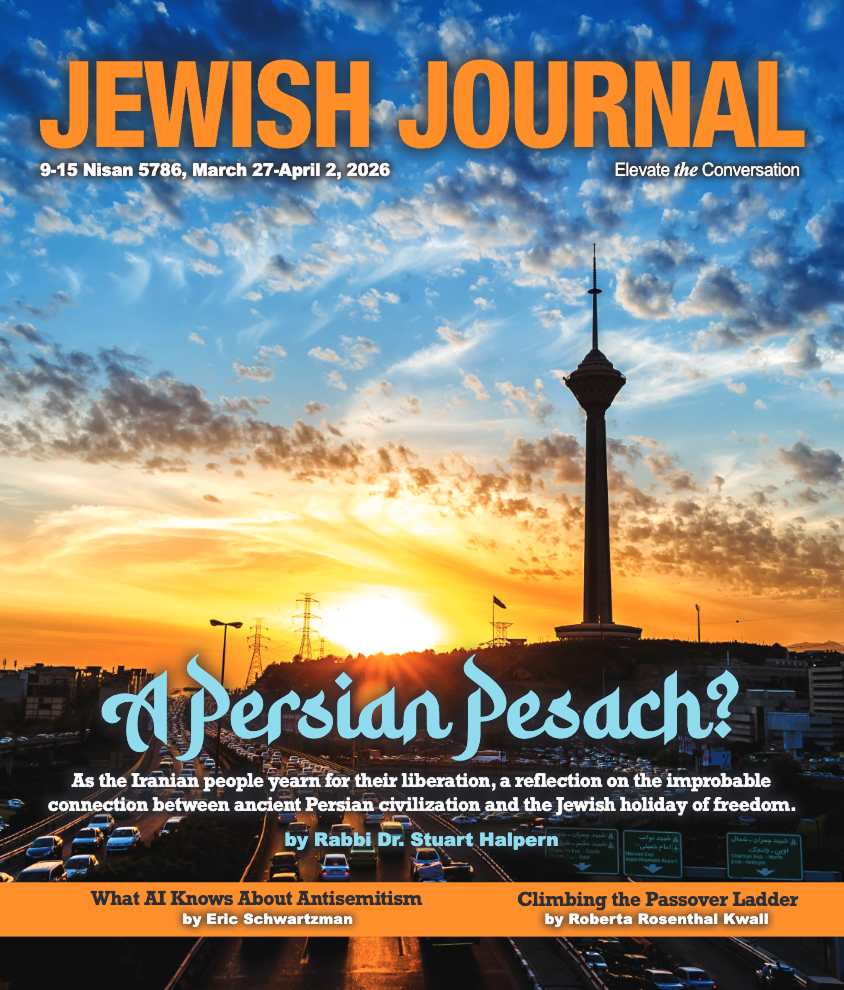
Print Issue: A Persian Pesach? | March 27, 2026

CLICK HERE FOR FULLSCREEN VERSION

Print Issue: A Persian Pesach? | March 27, 2026 Read More »