“I always have loved music,” Zach Shapiro, the senior rabbi of Temple Akiba, Culver City, and a popular Jewish Journal blogger, said. “But there never was a question of whether I would be a rabbi. I wanted to leave the music to those who really could bring people on a spiritual journey through music.”
Raised in Boston, he was only 11 years old when he found his career. His rabbis at Temple Israel suggested he go to summer camp at Olin Sang Ruby Union Institute – one of the premier Reform Jewish summer camps in the United States. “My rabbis sent me there,” he recalled, “to get a robust Hebrew immersion.”
His camp introduction shocked him. In a good way.
“I was floored by meeting musicians, rabbis and educators,” he said. “I came away that summer saying ‘Hmm, maybe I want to be a rabbi.’” While Rabbi Shapiro has established his musical bona fides at Akiba over the last 20 years, he is modest about his talent. “There are people who really are good at music, like Cantor Lonne Frailich, my partner here.”
Raised in a Jewishly committed setting with two older sisters, he is quick to note that “I didn’t grow up in any kind of rabbinic family or dynasty.” Maybe not, but the Shapiros were committed Jews. “We had a strong Reform Jewish background,” he noted, and the family had a decades-long history as members of Temple Israel.
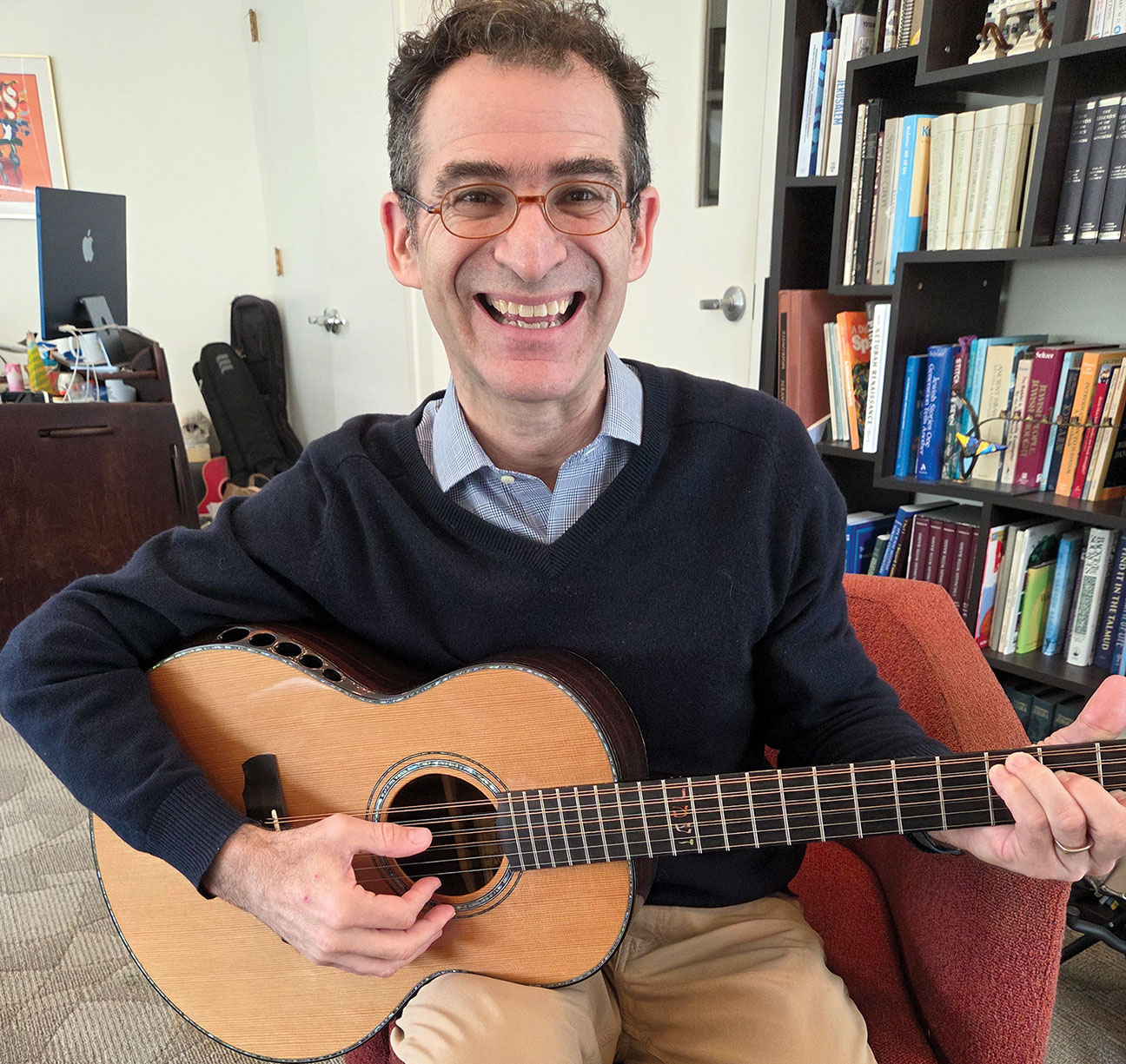
In high school, he taught himself how to play guitar; he keeps a guitar within easy reach of his desk. He continued learning at Temple Israel in the high school program while getting involved with youth groups.
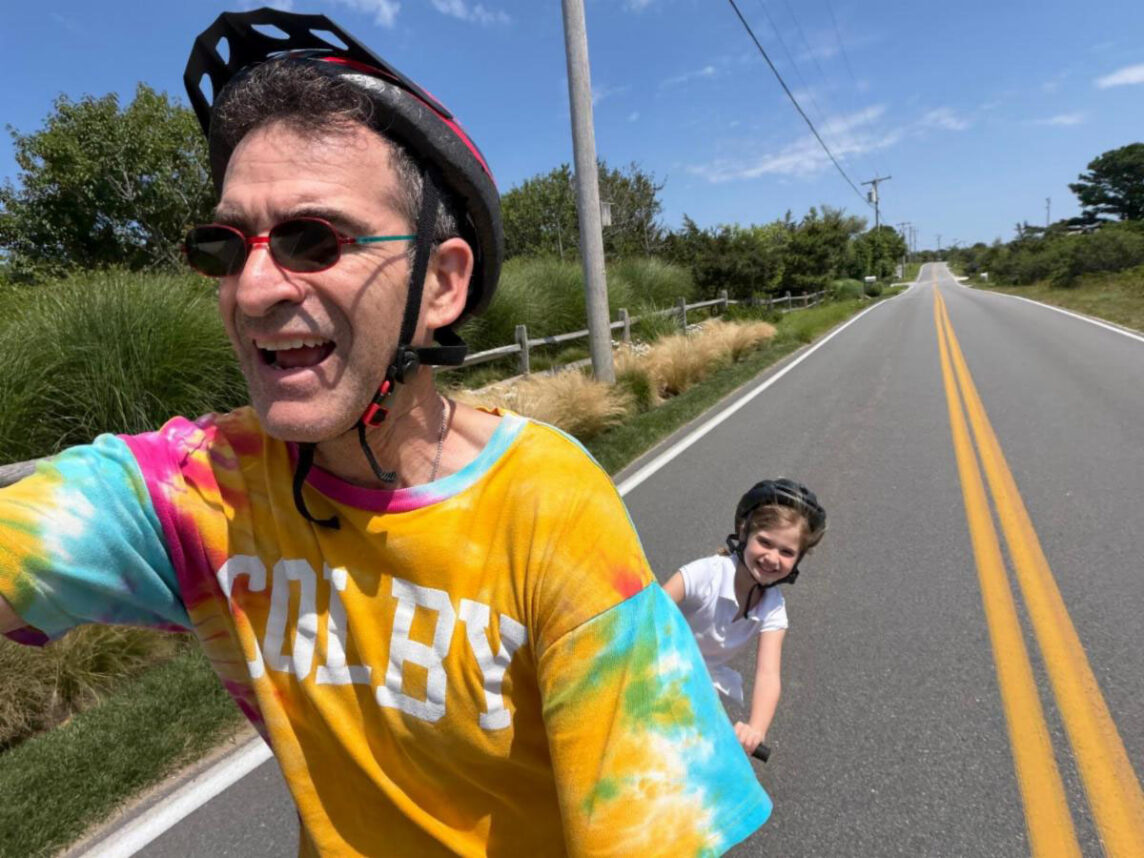
As graduation neared, “I asked my rabbis, ‘If I want to be a rabbi, what should I major in in college?’ They said ‘Get a good, well-rounded liberal arts education. Don’t major in Judaic Studies because then you will come out of college knowing nothing but Judaism. You want to have a more worldly view.’” So Rabbi Shapiro majored in Spanish at Colby College in Waterville, Maine.
He graduated in 1992, the same year he applied to Hebrew Union College-Jewish Institute of Religion. He was accepted and spent his first year in Jerusalem before transferring to HUC in Cincinnati, where the historic rabbinical program is in its 147th year.
“So coming into the rabbinate, why did I want to do it?” Rabbi Shapiro asked aloud. “It evolved from seeing young, energetic rabbis with a love of music to realizing that my goal in life is to bring goodness into the world. If I get to do it with the treasures of Judaism, oh, my gosh, that is awesome.”
He holds only happy memories about growing up at Temple Israel of Boston. “My father,” he recalled, “almost always was on a committee or on the board. My mother also was active. She was a lawyer, and she is still living. My father was an entrepreneur. We were active in our synagogue.”
What do people misunderstand about being committed to the Reform movement? He turned reflective before answering. “If someone calls me up and says ‘I grew up in a very Orthodox household,’ I know what they mean,” he said. “Same if they tell me they grew up in a Conservative household.
“But if they say ‘I grew up very Reform,’ it might mean something different to me than it means to them because often — not always — for them ‘very Reform’ means secular, nonreligious, nonparticipatory. For me, ‘very Reform’ means very involved. And committed to your Jewish community.”
Did Rabbi Shapiro learn this life lesson at home or from his synagogue? “I think a combination,” he said. “It takes a whole village – whether it’s my parents or the congregation, I grew up learning how to become a Jewish professional. I realized more and more, being a Reform Jew means being engaged in Judaism.”
Has that perception changed or improved over the years? “Look,” he said, “I think 100 years ago, even 50 years ago, people actively sought to become members of Reform congregations or Conservative or Reconstruction congregations because of an ideology. They really cared about the ideology that their movements espoused.”
That’s not the case anymore. “Today, by and large, people join a congregation because of the community that is there, because it is close to them, because they like the leadership. … That seems to override the ideology of the movement.”
Why does he think that happened? He had an answer at the ready: “Ask my friend and colleague Dr. Steve Windmueller [professor emeritus at HUC] about this. This is what he lives for, studying these kinds of demographics.” In the non-Orthodox world, he said, “there has been a breaking down of some of the walls that used to separate us other non-Orthodox movements. Our prayers might look a little bit different, but our daily life looks very similar. And so we are seeing a lot of coming together.” What distinguishes Reform Judaism these days? “Friday night still is our big service whereas for Conservatives, Saturday morning is.”
Growing up, how did wanting to be a rabbi and his deep passion for music affect the future rabbi’s life? “When I was very young, our congregation in Boston was still High Reform,” said Rabbi Shapiro, “meaning organ, and a choir that was up in the loft. It was really a performative style. … And so this musical journey I spoke about before, saw a tremendous transformation for how we pray. So now when you go into a synagogue, you won’t see an organ anymore. You’ll see a piano, guitars, other kinds of instruments that might form a band. Through the ‘70s when Debbie Friedman began to transform the way we pray, it started in the camps but came to the synagogues, and synagogues realized that the rabbi, the cantor and the choir were active, and the congregation was just sitting there. But the encouragement of congregants to open their souls and to actively allow their voices to lift — that has made a big difference”
However, a significant change was on the way.
Fast Takes with Rabbi Shapiro
Jewish Journal: What is your favorite Shabbat moment?
Rabbi Shapiro: Lighting candles with my family.
J.J.: Do you have any unfulfilled goals?
Rabbi S.: Writing more children’s books. I wrote one in 2009, an alphabet story about the animals in Noah’s Ark.
J.J.: What is the best book you ever have read?
R.S.: I am a big fan of Pat Conroy’s books. “The Lords of Discipline” came out in 1980, and at that time in my life, it was such a moving book.