fbpx

December 3, 2025

Pro-Palestinian Protest Turns Violent at Wilshire Boulevard Temple Event

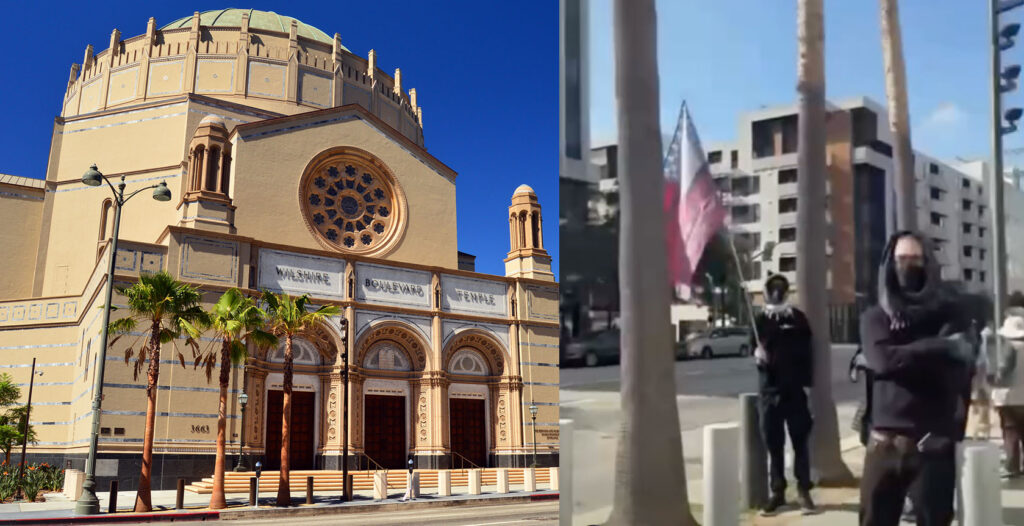
UCLA medical student Eliana Jolkovsky arrived on Wednesday, December 3, at Wilshire Boulevard Temple and saw a group of about 15 protesters, their faces masked by keffiyehs, chanting, “Baby Killers,” “Zionist Pigs,” and “Occupation no more.”

Jolkovsky, who is also a Jewish activist with 30,000 followers on Instagram, asked one of the demonstrators why they were protesting in front of the synagogue.  “We are protesting in front of a site that holds genocide supporters, and they are trying to bring it to K-town,” said the masked woman.

Wilshire Boulevard Temple is a historic synagogue located at 3663 Wilshire Blvd. in Koreatown. Founded in 1862, it is the oldest synagogue in Los Angeles.

Inside the historic temple that morning there was a lecture for the Korean community.

“We couldn’t hear the speakers because they were chanting so loudly outside,” said Jolkovsky in a phone interview with the Journal. “The event was done in coordination with the Korean community. I was very shaken up. The Koreans in the group were even more shaken up than we were and said to us, ‘So this is what you experience?’”

The lecture that day was meant to promote bridge-building, learning, and dialogue between the Israeli, Jewish, and Korean communities where the historic temple is situated.

“It was meant to teach the Korean community the safety strategies that the Jewish community uses when facing hate crimes and the surge of antisemitic rhetoric,” said Jolkovsky. “We wanted to unite the Jewish and Korean communities and share our knowledge with them because there is still anti-Asian hate.”

The lecture started at 9:30 a.m., but about an hour and a half into the event, two females in the audience suddenly stood up and began yelling.

“They screamed anti-Israel phrases at the top of their lungs,” recalled Jolkovsky. “Everyone told them to get out, this is not the place. We said there are children downstairs at the nursery and this is a place of worship, but they didn’t care.”

Security soon escorted them out, but seconds later, out of the blue, Jolkovsky heard the sound of shattering glass. One of the protesters, who had pretended to come for the lecture, smashed a glass vase inside the synagogue before being taken out as well.

The shards of broken glass nearly hit Jolkovsky and others in attendance.

“There were pieces of glass everywhere. It seemed like some protesters entered through different doors and pretended to be part of the event, but this guy smashed a glass vase and it shattered all over the floor. He said, ‘Genocidal terrorist, s**k my d—k,’ and other profanities.

“Security took him out, and then another girl started yelling about dead babies in Palestine. I turned around and saw that the wall behind me was all windows, and there was a man with a baby strapped to his chest and a stroller in front of him. He was yelling at us, and his toddler was scared and crying and didn’t know what was happening. It was really cowardly to hide behind his baby.”

Lawrence Peck, an advisor at the North Korea Freedom Coalition, told the Journal that he believes the protesters belonged to specific groups based on their online activity.

“Based on their social media posts calling for and promoting the protest at the synagogue, it appears that two of the groups involved were Nodutdol and Koreatown 4 Palestine. These groups have been holding protest rallies in Koreatown in which they condemn Israel and defend North Korea,” he said.

Mayor Karen Bass denounced the vandalism, calling the action “abhorrent and [something that] has no place in Los Angeles.”

“I received reports that individuals interrupted a private event at the historic Wilshire Boulevard Temple in Koreatown, calling attendees antisemitic names and damaging property inside the temple,” Bass wrote in a statement. “I spoke with Rabbi Nickerson to ensure he and his congregation know that the City of Los Angeles stands with them and fully condemns these attacks. I am grateful to the LAPD officers who addressed this disturbance. Additional LAPD officers have been deployed to patrol near areas of worship.”

LAPD Officers arrested two people, one for battery and another one for vandalism.

The Jewish Federation of Greater Los Angeles released this statement:

“Earlier today, at an event being held at Wilshire Boulevard Synagogue intended to promote bridge building, learning and dialogue between the Israeli, Jewish, and AAPI communities, an antisemitic protest occurred that disrupted this peaceful gathering. Several arrests were made following the incident.

“Our Community Security Initiative (CSI) was present and participating on a panel there at the time.

“CSI is working with our local law enforcement partners to make sure those who caused the incident will be held accountable and our houses of worship continue to remain safe and protected.

“We are outraged and condemn this antisemitic behavior in the strongest of terms. There is no place in our community — or anywhere — for antisemitism and hate disguised as dissent.”

Rabbi Joel Nickerson of Wilshire Boulevard Temple released this statement:

“Today we saw a disturbing outbreak of hate outside Wilshire Boulevard Temple that resulted in arrests for battery and the destruction of property. These individuals targeted the Jewish community and chose to disrupt a community event on synagogue property that was focused on advancing public safety in Koreatown.

“We appreciate the strong support we have received from elected leaders and law enforcement and look forward to working with them to ensure that those responsible for this hateful and illegal conduct are held accountable. No one should be targeted in the City of Los Angeles on account of their faith.”

Rabbi Yossi Elifort of Magen Am, a security operation actively involved with with the community, released this statement:

“Events like this highlight why Magen Am believes in empowering our community to secure itself, and professionally manages our multiple layers of community events, institutional security, and patrol/response teams. Our community deserves to live and practice in peace, and we’ve built the capacity to accomplish these goals. It’s time we all come together and unite behind a future of a strong, resilient, secure Jewish community.”


Pro-Palestinian Protest Turns Violent at Wilshire Boulevard Temple Event Read More »

Rosner’s Domain | Bibi’s Pardon: Quid Pro Nothing

Prime Minister Netanyahu seeks a pardon. He asked the president, Isaac Herzog, to end his long-running corruption trial. Why? “For the good of the country.” What other reason can there be? One should never suspect that Netanyahu expects the trial to end for his own good. It can only be “the country.” 

The trial is a headache. It has dragged on for many years, and the public can barely follow the many details. Supporters of Netanyahu believe he was framed; opponents believe he is corrupt to the core. Most believe that the country would be in better shape when the controversial trial ends. Even Donald Trump pushed for the trial to end. 

So the question isn’t about the “if,” it is about the “how.” Netanyahu, in his lawyers’ long letter to the president, and in his own short video explaining this sudden, surprising move, offered nothing in exchange for a pardon. That’s a problem, both legal and fundamental. Legally, the president pardons criminals. Netanyahu denies any criminality in his actions and doesn’t offer even a slight admission of guilt. He didn’t even use vague terms such as “mistakes were made,” or “I should have been more careful.” He denies all allegations and still asks for a pardon. It’s not clear that such a request can be granted, but maybe what we see here is just the beginning of a negotiating process. Netanyahu begins by giving nothing and expects to give something when a deal is hammered out.

The basic question about any deal is simple: does it or doesn’t it include a concrete, enforceable process that marks the end of the Netanyahu era? All other concessions are insignificant. If Netanyahu says “I’ve sinned” and then keeps his hold on power – only his supporters would back the deal. If he doesn’t say I’ve sinned and yet departs, the same opponents would not complain. For his supporters, the same rule holds true.  What he says doesn’t much matter as long as he can stick around. 

The idea that the “good of the country” will be served by ending the trial isn’t farfetched. The trial is polarizing. The trial makes it essential for Netanyahu to keep his coalition intact – as the worst-case scenario for him is to face the court when he no longer has the intimidating presence of the PM. Releasing him from the trial would also release him from certain political shackles. His plea for pardon hints that if the trial is over, his hands will be freer to rein in the radicals in his own camp who aim to revolutionize the judicial system – a hint that some see as a sweetener and others as a threat.

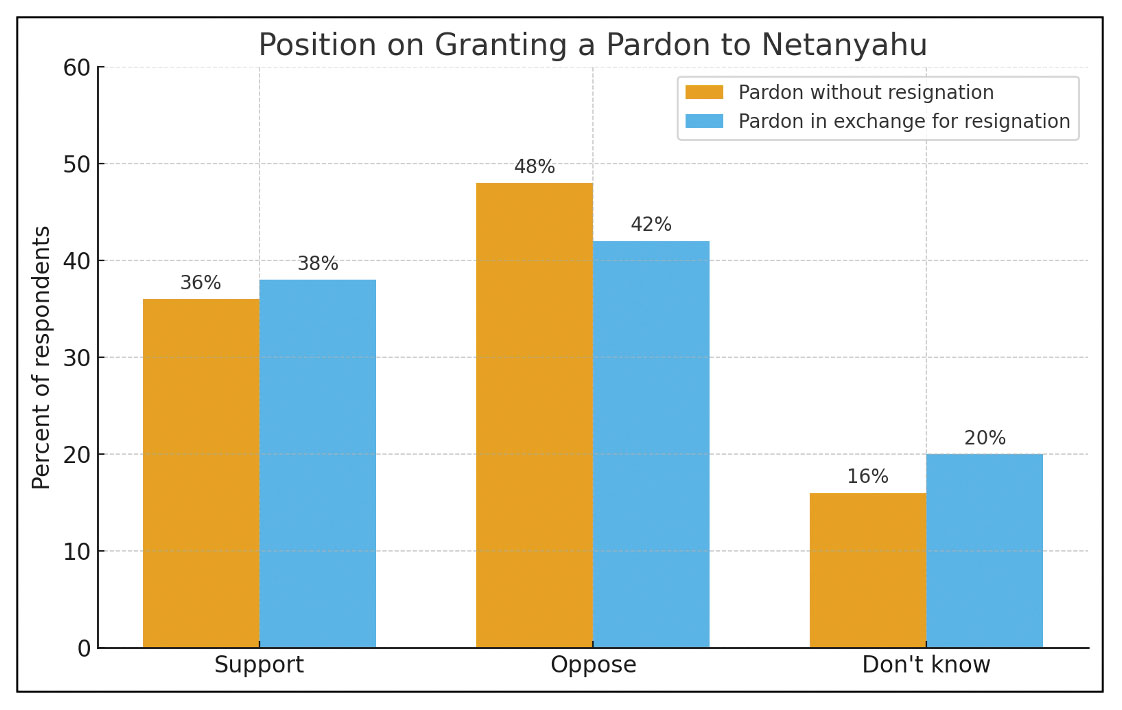
The public is split. When presented with a for and against question, it is about 40% for each side, with a fairly large group still undecided. When presented with a more sophisticated choice, the group that supports a pardon remains about the same size, but the other 60% are split. A minority wouldn’t accept any deal that puts an end to the trial – a majority would accept a deal that includes retirement. 

That’s the game that the PM, the president and the legal elite are going to play in the coming weeks. Netanyahu doesn’t signal any willingness to retire. That’s not his goal. In fact, a former official who worked with Netanyahu in the past told me earlier this week that “You should seriously consider another decade with him still around” (Netanyahu is currently 76, so, why not …). The legal elite would gladly accept a deal that includes retirement, but doesn’t show any willingness to compromise for any less. The president has the key to square this circle of competing interests and ambitions. Can he extract from the PM something significant enough to put the legal elite at ease? Can he convince the state lawyers and the justices to accept the little that Netanyahu is willing to give?

A lot depends on Netanyahu’s assessment of his legal and political position. If he believes that the trial is likely to end with him in jail, and that in the next election he is likely to lose – the pressure is on him to find a way out of it before it’s too late. If, on the other hand, he believes that whatever happens now he gains – because either he is off the hook without any concessions, or he has a useful tool with which to win the next election (hammering those who wouldn’t agree to end the trial) – then the pressure is on the other side to prevent even more damage to Israel. It is a high stakes game, and Netanyahu was the one to raise. It is not the president’s time to call.

Something I wrote in Hebrew

Explaining antisemitism to Israelis:

Antisemitism will not be directed only at the Jews who remain in Diaspora communities. Antisemitism will be directed at all Jews. It will harm the State of Israel. It is already harming the State of Israel. When a popular podcaster feels free to host a guest who admires Hitler and allows him to hint that the State of Israel is maliciously influencing the American arena, he is not only endangering the Jews who live in the United States; he is also endangering pro-Israel activity in the United States and, as a ripple effect, American aid, American support, the American backing… This is a point that must be stressed, because Israelis are not accustomed to antisemitism. For them, antisemitism is something that belongs in the foreign-news section, to what happens to Jews elsewhere… That is a mistake we would be wise not to repeat. 

A week’s numbers

Ch.12 News survey, on the day Netanyahu asked to be pardoned.


A reader’s response

Deborah asks (following last week’s article): “When Israelis move rightward, do they also change their views on the economy?” My response: No. Right-Left in Israel isn’t about economic issues. They might change their minds on economic issues but not as part of this dynamic. 


Shmuel Rosner is senior political editor. For more analysis of Israeli and international politics, visit Rosner’s Domain at jewishjournal.com/rosnersdomain.

Rosner’s Domain | Bibi’s Pardon: Quid Pro Nothing Read More »

Revisiting Un-Jews Who Undo the Deepest Jewish Bonds

In June, 2021, shortly after so many o-so-self-righteous Jewish Studies and Israel Studies professors bashed Israel during Hamas’ bombardment, the former prisoner-of-Zion and human rights activist Natan Sharansky and I called them “un-Jews” in Tablet Magazine. Neither of us have ever written anything that has been so mischaracterized, although many tell us now we were ahead of the curve.

As we made clear in our piece, the ”un” referred to an act– un-doing the core consensus uniting Israel, Zionism and the Jewish people.

We did not go after mainstream critics of Israeli policy or young, confused Jews, desperately trying to fit in with social-justice-obsessed peers (That’s where we were most misquoted.) We targeted the big fish, the hipster rabbis, professors, and community leaders “trying to disentangle Judaism from Jewish nationalism, the sense of Jewish people, while undoing decades of identity-building.”

We were particularly appalled by the sloppiness of a petition dozens of Jewish Studies and Israel Studies scholars signed during the May, 2021 war. Echoing social justice talk, these super-credentialed polemicists defined Zionism as “a diverse set of linked ethnonationalist ideologies… shaped by settler colonial paradigms… that assumed a hierarchy of civilizations” and “contributed to unjust, enduring, and unsustainable systems of Jewish supremacy.”

We didn’t call them ex-Jews or non-Jews, “because many of them are and remain deeply involved Jewishly, despite their harsh dissent.”  Then, as now, “un-Jews” run Jewish Studies departments, serve as rabbis, host Shabbat dinners. And they flaunt their anti-Zionism as “a superior form of Judaism, stripped of its unsavory and unethical ‘ethnocentric’ and ‘colonialist’ baggage.”

Today — 1200 October 7 deaths, 251 kidnappings, another 600 Israeli soldier deaths, and one massive, pride-inducing, world-changing, peace-making Israeli victory-in-process later — the “un-Jews” continue to undo timeless Jewish connections. They claim to have convinced the younger generation. Some Jewish professors rejoice that “the Zionist Consensus Among US Jews Has Collapsed.” They delight that one of three New York Jews voted for Zohran Mamdani, whose anti-Zionism is “central” to his identity, and who echoes centuries of Jew-haters by blaming “the Jews” for the thing he most detests, such as police brutality.

And “un-Jews” come to speak at Israeli universities — which I am proud to say are open to hearing their anti-Zionist, genocide-charging, settler-colonialism-alleging, oppressed-oppressor rubbish – then grovel to Palestinians, apologizing for breaking their BDS boycott. 

Undoubtedly, anti-Semitism on the “Woke Right” is also detestable. But every prominent right-wing Jew I know of, and many non-Jewish Republicans, have denounced this hatred from within their ranks. What’s disturbing is how little of that self-policing is happening on the left, where antisemites and anti-Zionists roam freely.   

In such an environment, many worried when the JPPI, the Jewish People Policy Institute, the Global Thinktank of the Jewish People, asked its “Voice of the Jewish People” Index what these representative 745 American Jews think about Mamdani, and Zionism, and Israel. 

Well, buckle your seatbelts and prepare to unfurl your blue-and-white flags – we’re delivering some good news today, or at least not-so-bad news.

The JPPI survey finds that 67% of Jews believe Mamdani’s election will lead to a decline in the security of New York’s Jewish community. And 99% of Jews fear anti-Semitism surging. Sixty-two% recognize it both from right and left, 17% see it from the right, and 20% see it from the left. Most important, 70% call themselves “Zionist” while another 12% say they support Israel – including 52% of strong liberals and 71% of liberal-leaners identifying as “Zionist.”

With 82% thus Zionist and pro-Israel, and a quarter of American Jews under 34, that doesn’t leave as many young anti-Zionist Jews as we’re supposed to fear.

In short, the “un-Jews” don’t just undo Jewish connections, they punch way above their weight — and remember, as one pro-Israel Democratic member of Congress told me recently, “Manhattan is an island.” These Jewish Israel-bashers benefit from the fact that the media, social media and academic echo chambers overly-broadcast their views. And “un-Jews’” primacy in the institutions American Jews most worship, from the media to academia, and including some pulpits, makes it worse – as does the fact that, as the LA Jewish Journal’s own David Suissa wisely notes: “American Jews are afraid of their young.” 

Finally, anti-Zionist Jews stand out. That their betrayal is particularly painful especially after October 7, amplifies their voice and leads most to exaggerate their popularity – and momentum. 

By contrast, most American Jews, young and old alike, felt a surge in identification after October 7. Most American Jews can recognize a sexist, homophobic, rape-friendly, Jew-hating, anti-Western terrorist enemy. And most American Jews are proud to have a strong, thriving, democratic Jewish state, that, for all its flaws, defended itself when attacked so unconscionably, then made itself, America, and the West stronger and safer by crushing Hamas and Hezbollah, defeating Iran, and triggering the collapse of Syria’s Assad dictatorship.

True, there are warning signs – and much confusion – amid a massive media bombardment. Two of three Jews rate Benjamin Netanyahu as only a “fair” or “poor” leader. Nearly 40% of American Jews find Israel guilty of genocide – a stunning number amid the overall support and the legal need for a genocide to be intentional and systematic. But 44%, including 31% of Reform Jews, want their Jewish community to reject anti-Zionist Jews.

The answer to all this confusion is clear. First, stop playing defense, stop apologizing, stop letting fear of “losing our youth” set the agenda. Instead, play to our strengths, sing a new loud, proud song of Zion, helping our young people understand what it means to be part of alt-neu, old-new, nation restoring alt-neuland. Every Jew should understand that, no matter when they were born, they are also an additional 77-years-old as part of the Israeli adventure, and an additional 3,500-years-old as part of the Jewish adventure.

Second, we need Zionist education initiatives transcending anti-anti-Semitism, emphasizing Identity Zionism, reinforcing our common peoplehood platform, shared fate, and common values, no matter what our partisan political differences. We need to recognize this young generation as Generation Birthright – open to experiencing Israel and Israelis as awe-some – not a generation defined by Bibi or any politicians or partisan stances. 

Finally, we need to tell it like it is. Call out the “un-Jews” who are undoing Jewish identity by hijacking Jewish community resources to demonize Israel and repudiate Zionism. Salute the Zionists, who are not only on the right side of history but are the ones truly demonstrating courage, to be counter-cultural, to defy the mob and the trends. And let’s build a proud Jewish Zionist tent, rooted in our homeland, our story, our ideals; a tent open on all sides, welcoming left and right, looking forward while also looking backward to learn who we were and who, together, we want to become. 


Gil Troy is an American presidential historian and a Senior Fellow at the JPPI, the Global Thinktank of the Jewish People. Last year he published, “To Resist the Academic Intifada: Letters to My Students on Defending the Zionist Dream” and “The Essential Guide to October 7th and its Aftermath.” His latest E-book, “The Essential Guide to Zionism, Anti-Zionism, Antisemitism and Jew-hatred” was just published and can be downloaded on the JPPI  Jewish People Policy Institute – Website. 

Revisiting Un-Jews Who Undo the Deepest Jewish Bonds Read More »

We Need Real Solutions to Our Housing Crisis, Not the Fool’s Gold of the 50-Year Mortgage

A new study by the National Association of Realtors has revealed a startling trend in the U.S. housing market: the median age of all homebuyers has climbed to 59, while the median age for first-time homebuyers now stands at 40 years. These figures challenge the traditional notion of homeownership as a rite of passage for young adults and cast a harsh spotlight on the growing barriers to entry in today’s market. 

As policymakers and lenders scramble for solutions, one proposal recently floated by the current administration is the 50-year mortgage — a concept that, on closer inspection, may do more harm than good.

The idea behind a 50-year mortgage is simple: by stretching payments over half a century, monthly costs become more manageable, theoretically allowing more buyers to afford homes saving on average about $200-$300 a month. Proponents argue this could open doors for those struggling with affordability and make the dream of homeownership more attainable. But this approach fails to address the root causes of the crisis and risks exacerbating already dire conditions. 

Extending mortgage terms to 50 years might lower monthly payments, but it comes with significant downsides. First, longer mortgages increase the pool of eligible buyers, which in turn drives up demand. In a market with limited housing supply, this added demand inevitably pushes home prices higher, effectively nullifying any initial savings. Buyers end up paying more for the same homes, while their overall debt burden balloons. 

Moreover, the minimal monthly savings come at the expense of much greater interest payments over the life of the loan. Homebuyers will pay tens or even hundreds of thousands of dollars more in interest, with little real improvement in affordability. In practice, the 50-year mortgage simply stretches the pain over a longer period, without meaningfully reducing it.

With the median first-time homebuyer now at age 40, a 50-year mortgage means carrying debt until age 90 — well beyond the typical retirement age. For many, this will mean never fully owning their home during their working years or even in retirement. The psychological toll of perpetual indebtedness is profound, undermining the sense of security and accomplishment that homeownership is supposed to provide. 

Upon closer analysis, this model benefits banks, which collect far more interest over decades, but leaves consumers trapped in a cycle of debt. The broken promise of homeownership, much like the broken promise of higher education finance, morphs into a lifetime financial obligation, with equity building at a glacial pace. Instead of empowering families, the 50-year mortgage threatens to make homeownership a distant, possibly unattainable goal for the majority of Americans.

The growing reliance on extended mortgage terms deepens the divide between existing homeowners and those trying to enter the market. Current homeowners, sitting on appreciating assets, see their wealth increase as demand and prices climb. Meanwhile, new buyers and renters face steeper barriers and greater risks, locked out of true ownership and forced to pay ever-rising rents or take on crushing debt.

This dynamic worsens the “K-shaped”economy, where one segment of the population grows richer while another struggles to keep up. Banks and financial institutions profit handsomely from prolonged interest payments, while ordinary Americans watch the possibility of building wealth through homeownership slip further from reach.

In essence, no amount of creative financing can resolve the core issue at the heart of America’s housing crisis: an acute shortage of homes. The only sustainable path to affordability is a dramatic increase in housing supply, on a scale akin to the Marshall Plan that rebuilt Europe after World War II. This means investing in new construction, removing barriers to development, and reimagining zoning laws to allow for more diverse and affordable housing options.

Such a bold initiative would not only help stabilize prices but also restore hope to millions of aspiring homeowners. By focusing on supply, policymakers can address the crisis at its source, rather than offering temporary fixes that ultimately worsen the problem. Former California Senate Majority Leader Bob Hertzberg (D-N. Hollywood) keenly understands that there is no substitute for increasing the supply of homes. His vision for the “Middle-Class Homeownership Act,” if passed, would offer those at the middle and bottom of the “K” a real chance to gain their footing in actual homeownership. Yet, proposals that merely put lipstick on the pig of decades of failed policy and exclusionary zoning will ultimately see the chasm between those who have profited from asset appreciation and those who have been left off the prosperity ladder continue to widen.

The latest data on homebuyer ages paints a sobering picture of America’s housing market and the Los Angeles Jewish community is not immune to the trends of outmigration and permanent rentership that our current highly broken housing market create. Proposals like the 50-year mortgage may seem innovative, but they fail to tackle the underlying shortage that drives unaffordability. Instead, they risk saddling buyers with lifelong debt, enriching banks and entrenched owners while leaving new entrants and renters behind. Only a transformative, supply-driven response can break this cycle and restore the promise of homeownership for future generations. The time for half-measures is over—the housing crisis demands bold action now.


Lisa Ansell is the Associate Director of the USC Casden Institute and Lecturer of Hebrew Language at Hebrew Union College-Jewish Institute of Religion Los Angeles.

We Need Real Solutions to Our Housing Crisis, Not the Fool’s Gold of the 50-Year Mortgage Read More »

Friend or Folly?

It’s been several months since I’ve graduated college. Naturally, my friends and I have begun to slowly drift away from each other. We have moved out of dorm rooms and into apartments. Most of us are working full-time jobs or are engrossed in graduate studies. Many are married and some even have kids. In short, we are full-fledged adults; too busy and tired to hang out with friends like we used to. It’s a harsh reality, but one that is common at this stage of life. However, after I watched the heartwarming reunification of former hostages Evyatar David and Guy Gilboa-Dalal, I started thinking more about my slow and steady shift into a solemn state of social solitude. I started thinking more about the importance of friendship. Friend or folly? Should I be changing course?

The two friends, Evyatar and Guy, spent most of their 741 days in captivity together, but they were separated from one another two months before their release. Guy described how being separated from Evyatar greatly exacerbated his pain and suffering. The only silver lining was that their separation made their reunion in the hospital all the more special.

The rabbinic sages rarely talk about friendship as an inherent value. Statements like “acquire for yourself a friend” (Avot 1:6) and “better are two than one” (Ecclesiastes 4:9) are typically understood in a utilitarian way. Likewise, most of the friendships in the Torah appear to serve purely pragmatic purposes. Abraham formed business relationships with Aner, Eshkol and Mamre, and Judah did the same with Hirah the Adullamite. Job had friends, but they provided him no comfort or solace when he needed them the most. Medieval sages like Maimonides in his work on ethics and character development, Hilchot De’ot, and Rabbi Jonah of Gerona in his commentary on Tractate Avot, also described the Torah’s view on friendship in practical terms. The Talmud blames the children of Reuven for befriending Korach and joining in his rebellion against Moses and Aaron. Likewise, King David begins his Psalms with a hymn about those who distance themselves from the communes of the wicked and instead cling to the values of the Torah. As Rabbi Menachem ben Shlomo HaMeiri noted, friends are influential and one instinctively conforms to their practices. All of these sources and examples appear to comprise the prevailing view among rabbinic sages throughout the generations: there isn’t much value to friendships for friendship’s sake. Friend or folly? The Torah appears to say “folly.”

In response to the overwhelming evidence, Rabbi Lord Jonathan Sacks wrote an article titled, “Faith and Friendship,” intending to flip the script. Rabbi Sacks argued that friendship is a fundamental Torah value. He posited that friendships improve psychological well-being, physical health, and spiritual growth. Most importantly, Rabbi Sacks states that “[God] is not just a supreme power. He is also a friend.”

While the message resonates with me, perhaps his argument is insufficient. Rabbi Sacks conflated the friendship one has with God with the friendship one has with family, and conflated those with the friendship one has with friends. He paints a black-and-white picture of what in truth is a colorful panorama of many different types of relationships that enhance different facets of one’s life.

In Rabbi Joseph Soloveitchik’s seminal work, “The Lonely Man of Faith,” Rabbi Soloveitchik describes the duality of man as evidenced by the two creation stories in the first two chapters of Genesis. There is Adam I who represents the utilitarian drives of man and develops pragmatic alliances, and there is Adam II who represents the existential component of man and develops covenantal relationships. The relationships formed by figures like Abraham, Judah, and Job were Adam I relationships. That is why when Job needed existential comfort, his friends were obsolete. Their relationship was superficial and could provide no comfort for his distressed soul. Likewise, Abraham and Judah’s friends come and go in the Torah, leaving no lasting imprint. In Talmudic and legal medieval works friendship is typically described in a legalistic and formulaic fashion as well.

Nevertheless, there are also Adam II types of relationships in Jewish tradition. Perhaps the greatest example is the relationship that David had with Jonathan. In Tractate Avot (5:16) their friendship is described as a love that is dependent upon nothing. It is an existential bond that compelled Jonathan to defy his father’s command in order to protect his dear friend, David. The relationship between Rabbi Yochanan and Resh Lakish can also be understood in this manner. Rabbi Yochanan could not bear living on this earth without his dear friend, Resh Lakish – “either friendship or death” (Ta’anit 23a).

The relationship between husband and wife is also a covenantal one: “within the covenantal community … Adam and Eve participate in the existential experience of being, not merely working, together” (“Lonely Man of Faith”). At the wedding ceremony there is a blessing that describes the celebratory cause for the union: “Blessed are you, lord our God, king of the universe, who has created joy and gladness, groom and bride, delight, exultation, happiness, jubilation, love and brotherhood and peace and friendship” (Tractate Ketubot 8a). The ultimate source of joy is not the jubilation, love, nor even the peace; it is the friendship. The greatest joy a bride and groom provide for one another is the existential bond that they develop. It is the unwavering friendship that enables them to tackle any challenge and that makes the moments of joy all the more joyful.

In Eli Sharabi’s book, “Hostage,” he describes how his source of encouragement was who he was surviving for. In the dungeons of Gaza he would reminisce about the Shabbat table when he was a child. It would “bring to life the whole cast of characters waiting for [him].” His siblings. His wife. His daughters. He would imagine embracing them. He would imagine their “souls … enveloping [him] in light, whispering: Shabbat shalom, Eli. Shabbat Shalom.”

There is also a third type of relationship. The everlasting friendship with God, “rayati,” “my friend” (Song of Songs 5:2). Rabbi Soloveitchik wrote that Abraham, Isaac and Jacob “made friends with whom they participated in the majestic endeavor. However, axiologically, they valued only one involvement: their covenantal friendship with God.” Faith in God is rooted in friendship with God. 

Friend or folly? The now-iconic embrace of Evyatar David and Guy Gilboa-Dalal demonstrates that the answer is resoundingly “friend.” Friendship is the bedrock of faith, and the ultimate Torah value. True existential bonds with friends, family, and, most importantly, God (Psalms 27:10), are what make life worth living. Authentic friends are there for us at our lowest lows and our highest highs. God understood that “it is not good for the human to be alone” (Genesis 2:18), so we were granted the power to have faith and find comfort in another. As Rabbi Sacks put it, “faith is the redemption of solitude … [and] in the highest sense, about friendship.” 


Ezra Seplowitz is a rabbinical student at Yeshiva University and is currently a Sacks Research Fellow.

Friend or Folly? Read More »

The Cantonese-Speaking Hasid and the American Dream

Mitchell “Moish” Silk is the highest-ranking Hasidic Jew ever to serve in a U.S. administration, and he got his start washing dishes in a Chinese restaurant as a kid. As Silk’s memoir, “A Seat at the Table: An Inside Account of Trump’s Global Economic Revolution,” captivatingly details, his unique story is a testament to the power of faith and the promise of America. 

Growing up in Chicago and Florida in semi-observant Jewish homes, Silk picked up Cantonese working in a Chinese restaurant while attending the local public high school. He then learned Mandarin by the time he graduated from Georgetown University in the early ’80s

A National Academy of Sciences fellowship enabled Silk to teach in China and to work there as an intern at one of the few international law firms.

By then fully observant, Silk happily subsisted on vegetables and cans of tuna in a country with virtually no kosher food. “I had some of my best years from the Yiddishkeit standpoint when I was in China and when I was in Hong Kong [in the late 1980s],” he explained to Tablet Magazine’s Armin Rosen in a 2023 profile. “I just felt like I looked much more inward because of my outward circumstances.”

As “A Seat at the Table” details, Silk served as a gabbai in one of Hong Kong’s oldest synagogues, built a sukkah that withstood a typhoon, and helped lead its Jewish burial society before he and his family moved back to the United States in the late ’90s. He developed extensive legal expertise in banking, finance, energy and infrastructure, and was eventually recruited to the White House to advise the U.S. government on its trade policy with China.  

As “A Seat at the Table” details, Silk served as a gabbai in one of Hong Kong’s oldest synagogues, built a sukkah that withstood a typhoon, and helped lead its Jewish burial society before he and his family moved back to the United States in the late ’90s. 

Silk served as assistant secretary for international markets at the U.S. Department of the Treasury during the first Trump term. There he played a senior role in the trade negotiations with China and spearheaded the $94 billion program that saved the airline industry during COVID, among many other accomplishments. All the while, he drew from his unique personal and professional background.

His frequent-flying work often left observance of Jewish law a challenge — one that Silk never backed away from. One Friday afternoon in the midst of a time crunch, he found himself stuck in a Seoul airport over Shabbat, not wanting to violate the holy day by getting on a flight. Content to stay in the airport for 25 hours, but with the Friday sun setting, he desperately scrounged around the Duty Free shops to find some kosher food. All he could manage was coffee, Pringles, and vodka. So he had vodka for kiddush Friday night, Pringles instead of his customary potato kugel, coffee in the morning, and some more vodka instead of his usual cholent. “My Shabbos in the Seoul airport wasn’t exactly classic,” he reflects, “but it reminded me that Judaism’s timeless traditions celebrate progress even when humans fall short of perfection.”

On another occasion, returning from Washington, D.C. to Brooklyn, N.Y. for the Rosh Hashanah holiday, Silk spent many hours thinking through a proposed solution to a problem facing the Treasury Department. At the holiday’s end and after his return to DC, he pitched his idea to the Secretary of the Treasury. Alas, it was declined. His colleague tried to offer support by arguing that Silk had spent two full days in synagogue working through this proposal in his mind. To this, the Secretary of the Treasury responded, “Well in that case, he needs to repent!”

Looking back warmly on his time in government, the author, who subsequently published a translation of the Hasidic work “Kedushas Levi” by Levi Yitzchak of Berditchev (1740-1809) with ArtScroll, sees his experience as a testament to unique nature of America: “I still miss walking into the Treasury compound and serving our great country, sitting under the watchful gaze of that extraordinary etching of President Lincoln, and looking out at the East Gate of the White House just a short 30 yards from my window. Even more, I miss the stimulation of grappling with a pressing issue and coming up with a solution and implementation in service to the United States of America. To the extent that I have achieved any success, whether in the private sector or in government service, I attribute that to the blessings the good Lord has showered on me, the incredible support of my extraordinary family, a ton of really hard work, and the unique opportunities that our great country offers. Only a country that adopts a national motto of ‘In G-d We Trust’ and advertises it on all of its currency would support the freedom to serve in the government and stay guided by my faith.”

“A Seat at the Table” is a memoir of a model American and a model Jew. Mitchell Silk’s story is a timeless testimony to the potential of all Jews to draw from our ancient wisdom while operating proudly in the public sphere.


Rabbi Dr. Stuart Halpern is Senior Adviser to the Provost of Yeshiva University and Deputy Director of Y.U.’s Straus Center for Torah and Western Thought. His books include the newly released “Jewish Roots of American Liberty,” “The Promise of Liberty: A Passover Haggada,” “Esther in America,” “Gleanings: Reflections on Ruth” and “Proclaim Liberty Throughout the Land: The Hebrew Bible in the United States.”

The Cantonese-Speaking Hasid and the American Dream Read More »

On Hate, Condescension and Political Extremism

To understand the full nature of the political and social rift within Israeli society, it is necessary to explore the realm of emotions. Much of the extreme language employed by both sides rests on emotions, and the intensity of some of the central social actors, such as Justice Minister Yariv Levin, can also be understood as having an emotional base. What sort of emotions are we talking about? We can get a sense of these emotions from some recent statements of Likud spokespeople, first a tweet from Minister of Environmental Protection Idit Silman, and second, an off-the-cuff remark by MK Tally Gottlieb. 

Silman responded to criticism of the disruptive behavior of a Likud activist as follows:

“Mordechai David is simply holding up a small mirror to the radical, protesting left – and they are in panic and shock. They cannot understand how this is happening to them, the privileged children of the gods. These arrogant elitists are unable to digest the fact that what is permitted to do to right-wing public officials and their families may also be done to radical left-wing activists who incite.”

On the surface, the heart of Silman’s argument is reciprocity – if the left engages in disruptive, intrusive behavior, so can the right. Nevertheless, she devotes considerable attention to what sociologists call stratification, charging left-wing activists with being “privileged,” “arrogant elitists,” etc. Although not ostensibly germane to her logical argument, one gets the impression that this is her real message. This messaging comes up repeatedly among Likud and right-wing spokespeople in manifold ways. Thus during the recess in the court proceedings in which prominent left-wing (or “liberal”) activist Shikma Bressler sued Likud MK Gottlieb for defamation, Gottlieb remarked in an aside to one of the spectators, “she [Bressler) thinks we are baboons.” More confrontational Likud ministers and Knesset members, such as Dudi Amsalem and Miri Regev, routinely take this Juno-faced defensive/offensive posture.

The populist right accuses the left of exuding condescending superiority or elitism, while exhibiting considerable anger and offense at being looked down upon. This kind of rage can have severe consequences. As Charles Dickens observed in “A Tale of Two Cities,” it can lead to the guillotine. Surely, it provides energy for the Judicial Reform (or Revolution) project in Israel. Levin and other coalition members appear to be motivated as much by resentment as by their vision of a new Israeli legal dispensation. 

Does the left, in fact, treat its opponents with disdain and disrespect, negating their honor and significance? Over the years, there have been incidents of well-known figures from the left publicly referring to Likud and right-wing supporters with disdain and disrespect. Dudu Topaz, a well-known Israeli entertainer, gave a speech during the 1980 election campaign in which he referred to the Likud supporters as “riff raff” and implied that all they were good for in the military was guard duty. Thirty-five years later, the well-known artist and humorist, Yair Garbuz, referred to traditional right-wing adherents as “amulet kissers,” implying that they were superstitious, ignorant and irrational. But these incidents are exceptions; most leftists are too well-mannered to make blatant derogatory remarks. Still, do they reveal something true about the underlying attitudes of the current “liberal” sector? 

On some level, there certainly is a tendency among some of the historically “liberal” elites to emit an air of superiority, but it’s not a personal, but rather a cultural, trait embedded in Zionism itself. 

Zionism was a movement with objectives on several levels. Of course (especially since the late 1930s), it focused on creating a Jewish state, but it had major social and cultural goals as well. These were encapsulated in the figure of the “New Jew.” The creation of a Jew who was sovereign in their own land with their own language. The New Jew was self-reliant and productive, secular and rational, engaging in agriculture and industry, not the “huckster” trades of the Jewish minority – willing and able to defend themselves. 

The new institutions of the incipient state, such as the Histadrut, the Kibbutzim and Moshavim, the Palmach, etc., more or less realized this idea. The superior self-regard with which this class held itself can be seen in the very terminology with which it designated itself: Halutzim. This was generally translated as “pioneers,” to make it familiar to American readers. However, a more accurate translation is “vanguard.” It designates a revolutionary elite leading the way to a transformed Jewish people. 

This transformed population filled the leadership positions in the nascent State of Israel. Immigrants who came afterwards had a more difficult time joining this governing elite of transformed New Jews. Some had difficulty because of their religious or traditional proclivities. Others simply did not want to be transformed in this fashion. Many arriving from North Africa and the Middle East were deemed unworthy, and it was believed that they could not be transformed. Stratification among the Jewish population of Israel organized itself around this issue in the state’s first decades. The upper strata, termed “the first Israel,” enjoyed prestige and as a result was able to create for itself advantageous economic and social arrangements. 

The lower strata, the “second Israel,” suffered disdain and condescension, which only exacerbated their lack of access to prestige, income, and property. Religious and traditional people, as well as Mizrahim, can attest to the patronizing attitude they encountered, to varying degrees, in their dealings with the old elites in the army, the universities, the media, etc. 

The protest against this culminated in Likud’s 1977 victory – the “government turnover” election. The Likud became the ruling party for the next 40 or so years (and still counting). Yet, a modus vivendi was reached between the contending sectors. The Likud, representing the untransformed or partially transformed second Israel, controlled the government and political system, while the New Jews became the “establishment,” controlling the economy, the high-tech sector, the universities, the media, the justice system, and the defense apparatus. Netanyahu was careful to include representatives of the old elites in all the governments that he formed. 

The current government is an exception to this pattern. It rests entirely on parties that represent untransformed or only partially transformed populations, and it has pursued a revolutionary agenda abrogating the division of labor between the institutional establishment of the New Jews and the government of more traditional untransformed Jews. Its agenda, of which the “Judicial Reform” is a central piece, is to hollow out the independent power centers of the old establishment. As is the case with other revolutionary governments, it continues while in power to exhibit symbols of protest. Thus, it continues to attack the liberal elites, who are also largely its political opponents, as “privileged,” “arrogant” and the like. It is unrealistic to expect it to abandon its polarizing discourse and rhetorical style. It uses its protest against the historical stratification system of Israel, along with the intense emotions that it generates, for political mobilization of its “base.”

Nevertheless, the government’s current situation is not entirely happy. The Oct. 7 attack and the ensuing war obviously put the government in a defensive and awkward position. The largest security failure in Israel’s history happened during its watch. Beyond that, more subtle issues are arising. The war exposed its inherently ambivalent attitude toward Israel’s fabled intelligence and security agencies and the Air Force. The government celebrated the phenomenal success of these bodies in the war against Hezbollah, Iran and Syria. Yet, these bodies are run by the very transformational elites at whom the government directs its protest and resentment. The solution the government has found is to blame them for the Oct. 7 attack and step up the attacks on them as undermining the government and the state of Israel. One gets the impression that because the operations against Iran, Hezbollah and Syria were so successful, it had to redouble its attacks against the Shin Bet, the IDF and the Air Force. 

A deeper problem may be that the government does not seem to have a clear idea of what a nontransformative Zionist Israeli state would look like. For the time being, it concentrates its energy negatively  – on attacking the old elite and dismantling its power centers. But it has not really articulated a positive vision. And to the extent that its members do have positive visions, they contradict each other. The Haredim, for example, see a blanket draft exemption for all Haredim (whether they study Torah or not) as a fundamental demand. However, this demand is strenuously opposed by the Religious Zionists. If the coalition wants to continue to rule coherently, it needs to open a conversation regarding its ultimate vision of the Jewish state. Ultimately, such a conversation would have to include the old transformative elites, who continue to contribute to Israel’s economic, technological, military and cultural success. 

Perhaps, if all sectors of the Israeli population participate in such a foundational conversation, which would, as it were, re-found the ideological and cultural basis of the Jewish state, the wounded pride, condescension, disdain and hatred can be overcome. 


Shlomo Fischer is a senior fellow at the Jewish People Policy Institute

On Hate, Condescension and Political Extremism Read More »

Feld Entertainment’s Juliette Feld Grossman on Disney on Ice’s Return to LA

Irvin Feld, a record producer, was holding concerts in large public arenas featuring the likes of Frank Sinatra and The Beatles. In 1956, he joined the Ringling Bros. and Barnum & Bailey circus, working as a manager and booking agent – and just 11 years later, he went on to buy the circus.

Today, Irvin’s family has continued the entertainment legacy, producing shows like Monster Jam, Monster Energy AMA Supercross, and Disney on Ice, which is returning to the Crypto.com Arena December 18 through 21. It features characters from “Frozen 2,” “Moana,” “The Lion King,” and “Moana,” along with a sing-along from Goofy and Donald to get attendees into the holiday spirit for the first time in Southern California.

Juliette Feld Grossman

Juliette Feld Grossman, Irwin’s granddaughter, is now CEO of the company, which she runs with her sisters Alana and Nicole. Their father Kenneth, the former CEO and now Chair of the Board of Directors, provides guidance.

“I am fortunate to work alongside my father and continue to learn from him and our incredible team,” Juliette said. “We have a lot of longevity within the company, as well as creativity and openness in across the team.”

Since joining Feld Entertainment, Juliette has led the launch of Marvel Universe LIVE! And did the planning, marketing, and branding for Monster Jam® and Monster Energy AMA Supercross. She enjoys what she does – including putting together Disney on Ice, which is happening during Hanukkah this year – because it’s a family activity.

“Disney On Ice is a great holiday tradition because it’s fun for the entire family and creates moments of togetherness,” she said. “This is the most rewarding part of what we do. It’s so gratifying to bring families closer together and create these special moments that become lifelong memories.”

Over the years, Disney has created more and more Jewish themes and characters, as well as Hanukkah merchandise. The TV show “Elena of Avalor” featured a Latin-Jewish princess named Princess Rebecca, while a “Frozen” short included a Jewish family with a menorah playing dreidel. There are also Hanukkah Minnie Mouse ears and blankets, mugs, and backpacks showing menorahs and dreidels.

When it comes to integrating her Jewish values into her work, Juliette said, “I often think of ‘L’dor V’dor’ as we are a multi-generational company that creates experiences for multiple generations of fans. Our properties endure over time because they resonate with each generation and form core experiences for families.”

She continued, “It’s a great honor and legacy to uphold. I am privileged to get to work with fantastic characters, songs, and stories that bring so much joy to families.”

Feld Entertainment’s Juliette Feld Grossman on Disney on Ice’s Return to LA Read More »

It All Began in a Small Jerusalem Apartment: 35 Years of Ogen. One Loan, One Family, One Dream at a Time.

-Advertorial-

Thirty-five years ago, a single person in a small Jerusalem apartment had a simple but radical idea: that the best way to help people in need was not through charity, but through opportunity. That person was Professor Eliezer Jaffe z”l, who believed that financial independence, not dependency, is the highest form of tzedakah.

In 1990, as new immigrants arrived from the former Soviet Union and Ethiopia, Jaffe saw that what they needed most was a fair chance. With support from early donors abroad, the Israeli Free Loan Association, later to become Ogen, was born.

The early years were modest. Loans were small, the staff tiny, and the ambition enormous: to provide interest-free credit to those shut out of the traditional banking system. What began as one man’s conviction grew into a movement rooted in dignity and self-reliance. From that single initiative, Ogen has evolved into Israel’s leading nonprofit social lender, providing more than 2.5 billion shekels in affordable loans across 83,000 loans to families, small businesses, and nonprofits.

At every major moment in Israel’s recent history, Ogen’s model of recycling philanthropic capital into new loans enabled it to operate as Israel’s Financial First Responder. When waves of immigration transformed the country in the 1990s, Ogen helped thousands of new Israelis plant roots and begin careers. As the Second Intifada shook Israel in the early 2000s, Ogen stood with families in crisis and helped small businesses stay afloat through one of the nation’s most turbulent periods. During the COVID-19 pandemic, it became a lifeline as one of the few financial organizations still operating nationwide, offering zero and low-interest loans to households, small businesses, and nonprofits.

What made Jaffe’s idea unique was the belief that philanthropy could be recycled, not consumed. Instead of one donation helping one family once, each shekel would be recycled again and again with repayments very high. Over time, philanthropic capital blended with other sources of capital (impact investments, credit lines and bonds) forming a sustainable pool of credit that grows instead of depletes. Today this model is the foundation for what will become Israel’s first social bank.

When the events of October 7 shattered lives and livelihoods across the country, Ogen provided fast social loans to families, reservists, evacuees, nonprofits and entrepreneurs facing sudden crisis. Each challenge expanded its mission, building an ecosystem of financial inclusion: mentoring entrepreneurs, guiding families in debt, and channeling private capital toward public good.

But statistics only tell part of the story. The real story is written in the lives of people who, with a little help, found the strength to rebuild. Three stories, demonstrating so much opportunity:

1. Dr. Fadi, a dentist from East Jerusalem, nearly lost everything after investing his savings to expand his clinic, only to face an unexpected funding gap that halted construction. Ogen’s $197,000 low-interest loan enabled him to complete the work, hire staff, and reopen. Today, his clinic serves a predominantly Haredi community, providing accessible care and local jobs, while the repaid capital will support the next entrepreneur in need.

2. In Israel’s north, Natali and Eliyahu began rebuilding their home after rocket fire destroyed it while Eliyahu was on reserve duty and Natali faced evacuation and uncertainty alone. With government assistance slow to arrive, Ogen’s interest-free loan and ongoing guidance helped them restore stability and direction. Their children are back in school, and their home is once again filled with laughter.

3. For Misganaw, a young Israeli-Ethiopian reservist returning from more than 150 days of service, the transition home was fraught with financial and emotional uncertainty. Through Ogen’s Reservists Track, he and his partner received tailored guidance and an interest-free mortgage loan. The support helped them transform months of service into a foundation for long-term stability.

These experiences capture what Ogen has always stood for: the belief that finance can be a tool for healing, resilience, and empowerment, especially in times of crisis. What began as an act of faith in people’s potential has evolved into an engine for inclusive growth, combining credit, mentorship, and financial education.

Over the past decade, Ogen has broadened partnerships, launched impact bonds, and opened specialized divisions for small businesses, families, and individuals. It now blends philanthropic capital with other sources of capital, multiplying every donated shekel into several more. Yet at its core, Ogen still lives by the conviction that guided Professor Jaffe: when we trust people and give them the tools to stand on their own, they rise.

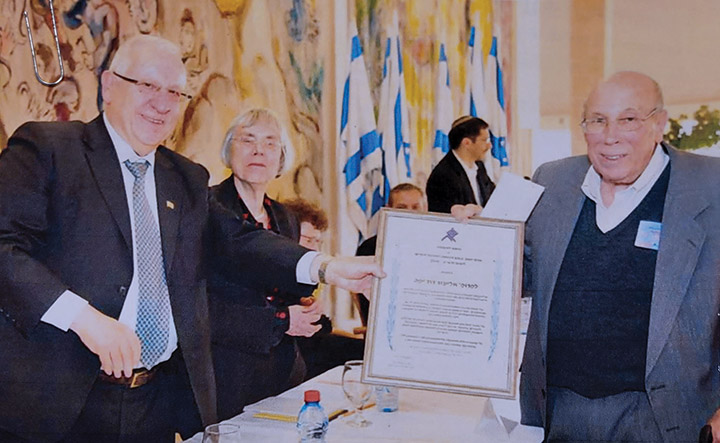
Ogen Founder Prof. Eliezer Jaffe z”l (right) with former Israeli President Reuven Rivlin, receiving the 2012 Knesset Award for Quality of Life

Thirty-five years on, that mission feels more urgent than ever. The men and women who left their jobs, their homes, and their families to defend Israel are now returning to rebuild it. They gave their time and courage to the country, and now it is our turn to give them the stability to move forward, not with charity, but with opportunity, dignity, and belief.

Israel has always been built by its people, those who see beyond the crisis of the moment and choose to invest in tomorrow. As Ogen marks its 35th year, I am proud to be part of this story and am passionate about rebuilding a better future here. One loan, one family, one dream at a time. 

Please visit: https://bit.ly/OgenIsraelSupport

It All Began in a Small Jerusalem Apartment: 35 Years of Ogen. One Loan, One Family, One Dream at a Time. Read More »