fbpx

September 17, 2025

The God I Found

The God I found in the Talmud

The God I found in the sea  

The God I found under my tallit 

The God I found at summer camp 

The God I found in each face on the subway 

The God I found in loud music 

The God I found in crowded city nights 

The God I found in quiet snowy mornings 

The God I found in motherhood 

The God I found in my child 

The God I found in pink grapefruits 

The God I found in ripe yellow peaches 

The God I found in shouting 

The God I found in heat 

The God I found in new friendship 

The God I found in poetry 

The God I found in leftover challah for breakfast 

The God I found in kissing my husband 

The God I found in chocolate ice cream 

The God I found in labor pains, three times 

The God I found in giving in to the large ice cold Coca Cola at the Braves Game 

The God I found in having a safe home 

The God I found in wind that catches me

The God I found in jumping 

The God I found in too-hot showers

The God I found in a firm bed

The God I found in the vibration the shofar leaves on my lips and in my body, for days 

The God I found in Jerusalem and in Riverdale 

The God I found on the Amtrak northeast corridor 

The God I found on the shelf with my sparkly earrings 

The God I found in pasta with melted cheese 

The God I found in a siddur small enough to cup with one hand 

The God I found in the horizon 

This God I found is loving and kind and supportive and brave and encouraging and judgmental and discerning and hopeful and comforting and challenging and close and patient and majestic and holy and exciting and wondrous and mysterious and


Avi Killip is a poet and rabbi who serves as the Executive Vice President at Hadar. Avi is host of the Responsa Radio podcast. 

The God I Found Read More »

Ten Secrets to Academic Success | Turn It Off! Managing Social Media, Middle East Minefields, and Political Difference

Others in the series:

#1: Remember Why You’re Going to College

#2: Give Yourself the College Orientation You Deserve

#3: Great Debates About Great Books Yield Deep Knowledge, Sharp Minds and Constructive Citizens

#4 Make for Yourself a Teacher – Acquire a Friend


A prominent 30-something journalist triggered a social media firestorm. Unfairly bullying her for expressing what once was a mainstream, reasonable opinion, the Woke Cancel Culture Commissars kept pummeling. Reading one hateful tweet after another (this was pre-X), she described feeling so overwhelmed, she spent the weekend in bed.

Reading her account, I shouted into my iPhone – “turn the darned thing off.” That’s really the best advice I can give modern students. It’s also a great advertisement for Judaism’s Sabbath restrictions – the “thou shalt nots” that are actually “thou shalts” too: opportunities freeing us for the unexpected by banning the habitual.

“Turn it off” – returns the power to you, while exposing the digital world as an artificial and, frequently, a delusional universe. We let social media sway us, bewitch us, even browbeat us, without realizing how freeing it can be to avoid it – or minimize it, at least.

“Turn it off” – returns the power to you, while exposing the digital world as an artificial and, frequently, a delusional universe. We let social media sway us, bewitch us, even browbeat us, without realizing how freeing it can be to avoid it – or minimize it, at least.

“Turn it off” – challenges you, as my previous installments have urged, to plunge into mind-expanding, soul-expanding books, seek life-changing teachers, and make forever friends. These are the timeless experiences of student life. And these should be your priorities at university.

Spurning social media also gives you a chance – admittedly just a chance – to approach the Israel discourse and political discussions overall more civilly. It’s lazy only to blame social media for our polarizing politics. Hopefully, you’re already learning to doubt single-causal explanations. Life is complicated. Still, the medium’s brevity and anonymity coarsen politics – especially when compounded by manipulative mechanistic algorithms feeding our biases and fomenting conflict. 

Moreover, tragically, regarding Jews, Israel, and Zionism, hundreds of millions of people worldwide feed a systematic campaign flooding social media with anti-Israel assaults. The fake news and modern blood libels bombard critics of Israel and supporters. Jeff Morris, Jr., a high-tech investment whiz, reported in late October 2023 that after analyzing “the tactics and data,” he saw “that much of TikTok is being controlled by anti-Israel bot farms, paid commenters/likers/sharers – much of which is paid for by Hamas’s supporting organizations.” 

For skeptics claiming Jews are paranoid, consider this. If Australia’s anti-Israel government just exposed Iran’s worldwide manipulations by expelling Iranian operatives for violently attacking Jewish institutions, could the Iranians and Palestinian terrorists possibly restrain themselves from attacking Jews, Israel and Zionism on social media? Perhaps Jews aren’t paranoid but nara-poid – thinking people are out to get them … because they are!

Tragically, the anti-Israel insanity is just an extreme case of a widespread problem.  Traditionally, students sought students and professors with different viewpoints, wanting to learn from a range of perspectives, while benefiting from healthy debates. Today, surveys by FIRE and other organizations find students skittish – for good reasons. Fifty-six percent of students fear damaged reputations because someone misunderstands something they say, while 26% report feeling pressure to avoid addressing controversial topics in their classes. Perhaps most heartbreaking, a quarter of enrolled students say they are more likely to self-censor, after spending time in college, than when they first enrolled.

The fish stinks from the head down. Years ago, Woke professors started treating speech they detested as violence – and rationalizing violence against those who deviate from the party line. Twenty-one percent of students find their administration’s stance on free speech unclear, with 27% doubting administrators would defend speakers’ rights to speak freely if others silenced controversial views. And, as I noted in earlier installments, many professors today are rewarded for committing educational malpractice. They politicize their classrooms – with many spreading mind-numbing, doctrinaire posts too. 

Fortunately, a backlash is developing. Northwestern University in Chicago just received a $20 million gift from Jennifer and Alec Litowitz for its “Center for Enlightened Disagreement” to “promote constructive engagement and discourse in an increasingly polarized world based on the interconnected pillars of research, curriculum, outreach and conversation.” 

Hmm: Isn’t that every educator’s mandate? 

Similarly, the Trump Administration demands “viewpoint diversity” – we used to call that a balanced curriculum. 

I’m stuck. What’s crazier, needing to liberate the liberal arts from a simplistic orthodoxy, or trusting the government to impose a range of opinions rather than standing by to let free thought flourish?

That’s where you, today’s students come in. You can wait for the institutional change – which will take years. You can trust your professors – and careful shopping helps. But, please, be the change – for your sake. It’s a process. We often only quote Ethics of the Father 1:2 partially — to “make for yourself a teacher, acquire yourself a friend.” Its conclusion, like a good equation, states: “and judge every person favorably.”

Great books, great teachers, great friends, introduce you to my two favorite “Ts” – humiliTY and complexiTY – while distancing you from my least favorite “Cs” – inconsistenCY and hypocriSY. Some of my closest friends-for-life are lifetime sparring partners. I learn from them how to sharpen my arguments but also what other, good people, equally smart and caring, think. 

Dwight Eisenhower warned his successor John Kennedy – whom he disdained – that only tough dilemmas end up in the Oval Office: easy decisions get made elsewhere. It’s unnerving today to see how sure people are, from both extremes, about really hard questions, in America, Europe, Israel. That makes them very unforgiving of others for being bad, not just coming to the wrong conclusions or having different political priorities. 

In 1975, the statesman and soon-to-beSenator Daniel Patrick Moynihan (D-N.Y.) said: “The central conservative truth is that it is culture, not politics, that determines the success of a society. The central liberal truth is that politics can change a culture and save it from itself.” That insight is doubly valuable. First, it teaches to be less judgmental and more accepting, honing that ability to acknowledge complexity and recognize different people’s differing priorities and assumptions. But second, it still explains many tensions between left and right today, while challenging us all to break out of partisan shackles, conventional wisdom, and tired assumptions. 

Let’s generate new ideas – or even fresh alliances and new, enduring, cross-the-aisle friendships – starting now!

Gil Troy, a senior fellow in Zionist thought at the Jewish People Policy Institute, is an American presidential historian. Last year he published, “To Resist the Academic Intifada: Letters to My Students on Defending the Zionist Dream” and “The Essential Guide to October 7th and its Aftermath.” His latest, “The Essential Guide to Zionism, Anti-Zionism, Antisemitism and Jew-hatred” was just published and can be downloaded on the JPPI Website. 


Ten Secrets to Academic Success | Turn It Off! Managing Social Media, Middle East Minefields, and Political Difference Read More »

Aliyah Post-Oct. 7: A New Sense of Urgency

On Oct. 7, 2023 Maayan Schoen was spending the Simchat Torah holiday in Efrat, Israel with friends when the sirens began blaring, sending everyone rushing to bomb shelters. Reflecting on her experience that day, she said it reminded her of “what we learned about the 1973 Yom Kippur War,” when all the men were called up to serve in their military units directly from synagogue. Israel was again caught off guard while celebrating a Jewish holiday.

The wartime experience in Israel changed everything for Schoen. A Yale graduate with a degree in humanities, shemoved to Israel, where she worked for Jerusalem’s deputy mayor and served as a counselor at a girls’ seminary. Before Oct. 7, Schoen wasn’t sure whether to officially make aliyah or follow her dad’s advice and return to the U.S. for law school. It was Israel’s overwhelming spirit of volunteerism that convinced Schoen to further contribute to the war effort by becoming an Israeli citizen.

Schoen’s story is in line with a historical trend. Following Israel’s previous major wars in 1967 and 1973, there was a significant jump in aliyah. Since the current war began on Oct. 7, there has been a surge in new aliyah applications from North America and around the world. Jews are choosing this moment to move to Israel not in spite of the war, but because of it. Motivated by a mix of religious ideals, rising antisemitism abroad and a search for meaning and community, these immigrants are arriving during one of modern Israel’s most volatile periods. This wave could reshape Israel’s demographics and carry long-term societal implications.

This trend is reflected in recent data on interest in making aliyah from Jewish communities around the world. While overall numbers have increased only slightly, the number of new applications has surged since the war began. According to The Jerusalem Post, the number of immigrants from France saw the sharpest rise, up 352% compared to the previous year. Canada and Great Britain had increases of 87% and 62% respectively. In the U.S it rose by 60%.

Although not everyone who opens an aliyah file ultimately moves to Israel, it serves as an indicator of growing interest. Marc Rosenberg, vice president of Diaspora partnerships at Nefesh B’Nefesh, said the aliyah process typically takes 12 to 18 months from application to relocation due to logistical challenges. This lag may explain the historical pattern of aliyah surges two to three years following major Israeli wars.

After the Six-Day War in 1967, aliyah numbers from the U.S. skyrocketed by over 1,000%. This increase did not occur immediately after the war, but two years later. According to the Jewish Agency, it rose from 438 in 1967 to 609 in 1968 and then spiked to 5,739 in 1969. If the historical trend continues, there will be an increase in aliyah beginning in the next year or two, following the current war.

Rosenberg said there are different motivations for people to make aliyah including both “push” and “pull” factors. “Historically, Jews from North America and Canada felt ‘pulled’ toward aliyah by an idealistic longing to live in Israel. … For the first time, many North American Jews now feel ‘pushed’ away due to the surge in campus antisemitism following Oct. 7.” 

Isaac Dayan experienced both of these factors when he made aliyah in August 2024 with his wife and four children, ages 5 to 12. Raised with religious Zionist ideals, he and his wife had already spent time in Israel, and aliyah had always been their dream. The events of Oct. 7 accelerated their timeline. Dayan described how rising antisemitism in the U.S. motivated his family to begin the application process just one month after the war began.

While the families who make aliyah tend to be religious, Nefesh B’Nefesh notes that 65% of singles making aliyah are not Orthodox. For Alana Goldman, a 22-year-old from a Reform household, the journey to aliyah looked different. Although she attended Hebrew school and had a Bat Mitzvah, she did not feel a personal connection to Israel. That changed after she went on a Birthright trip after her freshman year at UNC Chapel Hill. When she returned to campus in the fall of 2023, she became involved in Israel advocacy.

Her world changed on Oct. 7. Goldman’s Israeli boyfriend left to join the IDF; she lost friends over disagreements about the war in Israel. On the last day of classes, she witnessed pro-Palestinian protesters attempting to tear down the American flag and replace it with a Palestinian one A group of fraternity members protected the American flag. She called it “the first time all year that classmates who weren’t even Jewish stood up for Israel.”

After graduation, Goldman decided to return to Israel and get a master’s degree in nonprofit leadership at Hebrew University in Jerusalem. For her, aliyah was in part a practical decision. Goldman wanted to work while studying for her master’s, and she realized that by formally making aliyah, she could work in Israel and receive an aliyah benefits package. In October 2024, Goldman made aliyah and began working at Hebrew University. 

To attract more international students, Israeli universities are expanding their English language degree programs. Naama Oryan, director of international marketing at Hebrew University, highlighted the university’s new international BA program, which offers students the opportunity to take classes taught in English.

Yael Levin, associate provost at the University’s Rothberg School for International Students described the diverse motivations of the program’s first cohort: “Some sought to explore their Jewish identities after seeing their life at home and on campuses abroad shaken by antisemitism and gross harassment and violence. Others felt called to contribute to a nation at war. … Some were inspired by their admiration for the Hebrew University.”

Interest in aliyah has grown among younger people. According to the Jewish Agency, nearly one-third (31%) of this year’s immigrants are between the ages of 18 and 35. Nefesh B’Nefesh reports that approximately 4,000 North Americans make aliyah annually, about 1,300 of them under 30. Rosenberg explains that this age group is experiencing their “Odyssey years,” a period of personal exploration and growth. 

At 26, Alex Shuster’s connection to Israel deepened beyond his childhood roots in a “Reform/Chabad-lite” household. He first visited for his Bar Mitzvah and later attended Jewish day school.  After graduating Babson College in 2022, Shuster joined a Birthright trip visiting holy sites. Feeling unfulfilled and disconnected working a mundane job, Shuster found a new purpose when Birthright invited him on the first volunteer trip scheduled after Oct 7. He didn’t hesitate, saying, “If not now, when?”

In Israel, Shuster found a stronger social community than he had back home. He also underwent a personal transformation. He prioritized health and fitness and rediscovered his connection to Judaism. Since making aliyah in November 2024, he has started Ulpan classes. Learning Hebrew has allowed him to follow the Torah and truly understand it for the first time.

Dr. Hila Zaban, a sociologist and senior lecturer at Kinneret Academic College, studied the Baka neighborhood of Jerusalem between 2008 and 2013, focusing on its large population of English speakers.  Oct. 7 will likely serve as a catalyst, she said, forcing Jews abroad to solidify their Jewish identity. One contrast to the earlier waves is that while they were mostly secular, liberal Jews in those years, there’s now a growing influx of religiously observant Jews who identify as center-to-right politically. 

For Dr. Zaban, organizations like Nefesh B’Nefesh have been “a game changer” for North American aliyah. There have also been unintended consequences. Nefesh B’Nefesh has also contributed to increasingly homogeneous Anglo enclaves, reshaping neighborhood synagogues and schools and driving up local real estate prices. 

A major wave of aliyah from North America is not guaranteed. Many Jews abroad now see Israel as a “Plan B,” a backup option in case antisemitism worsens in their home countries. Dr. Zaban predicts that North American Jews will purchase second homes in Israel as a precaution, preparing for all eventualities before fully committing to make aliyah. As she puts it, “It’s a very Jewish thing to be prepared.” 


Ariel Greenwald (@ArielGreenwald on X) is a writer based in New York. She recently completed a Journalism Fellowship with Tablet Magazine.

Aliyah Post-Oct. 7: A New Sense of Urgency Read More »

But That’s OK!: The Spiritual Practice of Letting Life Be Easy

“Yeah, but that’s ok! Don’t worry, Ima!”

My oldest daughter Sybil is quite sassy. She’ll be five on Yom Kippur this year and I swear, yes swear, she’s already 22 going on 35. They say toddlers are “threenagers.” Well somehow I ended up with a 20-year-old who still wears a diaper at night. (Only at night — and even that we are praying will soon come to an end.)

Sybil is, of course, one of my greatest teachers — when I allow her to be. My current curriculum is talking less (try that, especially as a rabbi), sitting down next to her rather than towering over her, smiling rather than scowling, playing rather than cleaning (which is very hard for a Virgo who has never had more stuff in her life than with two kids) and most of all: pivoting, yielding, allowing — whatever you want to call it — relaxing.

She often says to me, “Ima (mama in Hebrew), it’s OK. Don’t worry.” Which is basically, “Chill out lady — it doesn’t have to go the way you planned or even the way you think it should.” Get out of the way and enjoy it just like this. Cue: talk less, sit down, play, smile.

How many of you are enrolled in this same obnoxious, frustrating, often-infuriating curriculum? How many of you wish Dr. Becky, popular parenting guide for DFK’s — deeply feeling kids — would meet your child — or your boss, or your spouse — and try calmly breathing and counting to three before reacting?

I’ve tried. I’m in therapy. I practice breathing. I even do EMDR — rapid eye movement therapy — where I hold my head still and move my eyes left, then right, until my nervous system shifts from the red-hot zone to yellow, then finally back to green, where I sense my calm return.

None of this is easy. But I know it is healing very old patterns — trauma, fight and flight, the scars that get in the way of the mom I aspire to be, the someday spouse I aspire to be, the rabbi, the Jew, the soul I was given to be in this world.

This is the avodah, the sacred work of being alive. And we have support — tools, thousands of years of wisdom, and a community of Jews literally sitting next to us, willing to grow together. As Rabbi Donniel Hartman says, “Greatness is in using our instability to grow.” I don’t know about you, but I’ve got plenty of instability to work with.

This time of year also helps. Our tradition teaches that in Elul and the High Holy Days, “HaMelech basadeh — the King is in the field.” The Holy One leaves the palace, gets off the high horse, and comes close — to be accessible, intimately present in our daily lives. This is a season of closeness with God, with ourselves and with one another. Just look around: here we are, gathered from near and far, considering our souls, telling the truth about what we have done and what we have not.

And here’s the thing: it’s not only that we long for God. The tradition says God longs for us. God already wrote the check. We just need to sign our name.

God got off God’s horse. The question is, can we? Would we rather be right, or would we rather be happy?

My teacher, Rabbi Mickey Rosen of blessed memory, used to say: “The good news is the sacred is everywhere in our daily lives. The bad news is we have to look for it.”

The Baal Shem Tov told it this way: Once there was a king who longed for his people, but they were too busy to visit. So the king built a magnificent castle and invited them in. The truth was, the castle was only an illusion. Anyone with the courage to approach would discover the walls were not real, the gates were unlocked, the way wide open. But most people took one look at the walls and gave up.

“So it is with us,” the Baal Shem Tov said. We start out seeking God, but too quickly we believe the obstacles are real and we give up. Until one day, someone asks, “What if this wall is only an illusion?” She reaches out, and the wall disappears.

What if? That’s the turning point.

What if the walls are gates?

What if the experience of loss, rejection or scarcity is actually an invitation to connection?

What if the thing that feels impossible is precisely the doorway we’ve been waiting for?

As Sybil says: “Yes, that’s OK. Don’t worry.” I hear her invitation, “Ima, what if life were easy?”

Nature also shows us this way of being and invites us to join her. The river flows. The mountain crumbles when it must. The flower lets its petals fall without fear. A glacier drifts without a map, yet exactly where it belongs. 

The poet Mary Oliver writes in her Morning Poem:

“Every morning the world is created …  each pond with its blazing lilies is a prayer heard and answered — lavishly, every morning — whether or not you have ever dared to be happy, whether or not you have ever dared to pray.”

And so I pray — for myself, for all of us — that as the world grows more complex, filled with hate and war, hunger and fear, we remember as Oliver says, “If it is [our] nature to be happy [we] will swim away along the soft trails for hours, [our] imagination alighting everywhere.”

Sounds nice to swim away along soft trails, doesn’t it?

Especially this year, may we keep asking: What if?

What if it were easy?

What if I choose joy?

What if I let go and trust the flow?

What if Sybil is right, once again?  

“It’s OK, Ima. Don’t worry. It’s easy.” 


Rabbi Alyson Solomon is a courage coach, prayerful poet and consultant. She is the author of two books: Thank You, Modeh Ani & Listen, Sh’ma and producer and singer of: Thank You For This BodyRabbi Alyson’s courses and programs are for people and organizations hungry to align their inner world with their worldly productivity and performance. Build, deepen and apply your own custom spiritual tool box, enriched by 4000 years of Jewish wisdom, curated by RAS. thisisras.com

But That’s OK!: The Spiritual Practice of Letting Life Be Easy Read More »

The Sound of Our Stories: Reclaiming Jewish Narrative

For my wife, when the blast of the shofar cuts through everything else, that ancient sound isn’t just a religious ritual — it’s a reigniting of who she is as a Jewish person. It’s more than ceremony; it’s a state of being, a call that reminds us not just of our obligations, but of our identity itself.

As we enter 5786, this season of teshuvah — of washing away what clings to us and beginning anew — we face a profound challenge that goes beyond personal reflection and renewal. The story of the Jewish people is being rewritten, and we are not the ones holding the pen.

The power of antisemitic narratives has seeped into mainstream discourse with alarming effectiveness. To the uninformed and ill-intended the stories are believable and palpable, and leave many Jews feeling bereft and uncertain. When the entertainment industry boycotts Israeli filmmakers, when the International Association of Genocide Scholars passes resolutions against Israel, we respond as we must — with counter-narratives, with counter-facts, with our own scholars and creatives pushing back. But the genie is out of the bottle and there is no putting it back. 

The uncomfortable truth: countering a narrative you didn’t write is not a strategy for success. It is not about Jews being bad at PR, or being outspent. When we exert all our energy reacting to hatred and lies, we cede the fundamental power of something we mastered millennia ago — storytelling itself.

I liken the current situation to a storm on the ocean. Do not underestimate it, it has the power to kill. Its violent force consumes every moment with its battering waves and howling winds. But not far below the surface, the deep ocean currents continue their ancient circulation around the globe.

Those currents take approximately 500 years to circumnavigate the earth. The last time the same body of water touched the eastern seaboard of America, Christopher Columbus was sailing the surface. It seems like a long time — until you realize the Jewish people have made that journey at least seven times in our documented civilization. We have weathered many storms. We know something about moving through deep waters.

This is the power of the Jewish story: it’s not about memes or tweets or moments of viral gratification. When the shofar blows, it is about who we are at a fundamental level, rooted in 3,500 years of values, tradition, and enduring identity. As brand guru Eitan Chitayat says, “The Jewish people have the best brand.” The solution therefore isn’t to fight harder against the narratives of inferior and hateful brands, it’s to tell our own story better.

Every Jewish person has a story. Whether you can trace your lineage back to Maimonides through centuries of learning and tradition, or you converted to Judaism in Los Angeles two years ago and are celebrating your third Rosh Hashanah as a Jew (me), you are an inheritor of the same long history. Everyone has their own unique story to tell as a Jew living in the world today.

When I converted and Rabbi Adam Kligfeld insisted I take the name David Ben Avraham v Sara, I protested. I had other ideas. But he reminded me there is no greater honor than to be the son of Abraham and Sarah—not just inheriting Abraham’s lineage as the first person to choose Judaism, but becoming an inheritor of the entire Jewish story that began right there.

That’s who we all are: inheritors and authors simultaneously. We carry forward an ancient narrative while writing new chapters with our own lives, our own choices, our own ways of being Jewish in this moment.

This Rosh Hashanah, as the shofar calls us back to ourselves, we need to remember that we are more than our reactions to antisemitism. We are more than they care to identify by. We are more caring than indifferent, more embracing than exclusive, more healing than harming, more building than breaking, more living than surviving, more hopeful than afraid.

This is who we are. We are the Jewish people — many stories, but one people. We flow in the same deep enduring current.

It is time to stop letting others define us and start defining ourselves — to be authentic, confident, and never hide who we are. We may need to defend ourselves but the Jewish story is not a counter-narrative, it is the foundational and defining narrative of West European civilization.   

As we enter this new year, let the sound of the shofar remind us: we are not just responding to the storm on the surface. We are the deep current itself, and we have been moving through these waters for thousands of years.

The question isn’t whether we’ll survive this moment. The question is: what story will we choose to tell?

L’shanah tovah u’metukah — may this be a good and sweet year, filled with our own authentic voices. 


Stephen D. Smith is CEO of Memory Workers and Executive Director Emeritus of USC Shoah Foundation. 

The Sound of Our Stories: Reclaiming Jewish Narrative Read More »

Water Gate and a Curious Rosh Hashanah Custom

The origins of a beloved Rosh Hashanah ritual are as murky as a fish-filled pond.

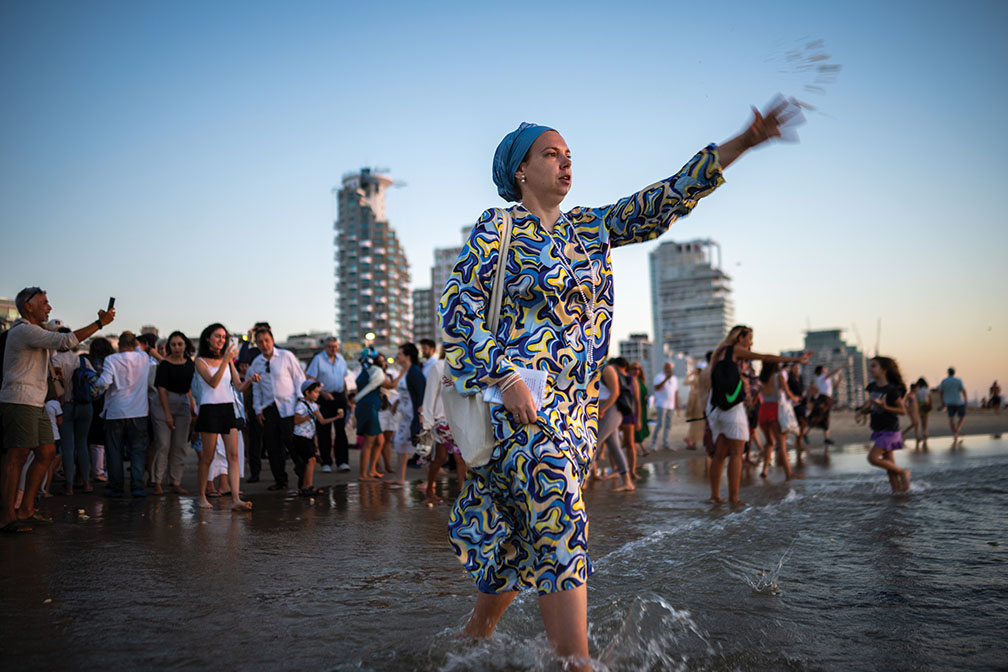
Tashlich, from the Hebrew word for “tossing away,” is the centuries-old practice of gathering at a local body of water on Rosh Hashanah afternoon to recite a short prayer articulating our spiritual desire to cast our sins into the deep. 

How the now-popular practice emerged remains a mystery.

The penultimate verse in the biblical book of the eighth century BCE prophet Micah describes a time when God “will take us back in love; He will cover up our iniquities. You will cast all their sins into the depths of the sea.” But it wasn’t until over a millennium and a half later, during the time of the medieval German rabbi known as the Maharil, Rabbi Yaakov Moelin (1365–1427), that there are written accounts of Jews physically acting out the metaphor of this verse – by shaking out crumbs from their clothes in order to feed the fish in the local river. 

The Maharil objected to that crumby part. After all, giving food to creatures that aren’t your pets on Shabbat and holidays is muktzah, forbidden labor. But the purpose of the practice? He posited that it is meant to recall the Binding of Isaac, whose central role in Rosh Hashanah is reflected in the blowing of the shofar, the ram’s horn that recalls the animal sacrificed in lieu of Abraham’s beloved son. 

How so? 

Rabbinic legend has it that Satan placed a lake to block Abraham’s path on the way to the fateful near-sacrifice of Isaac on Mount Moriah, and the water rose up to the patriarch’s neck. Abraham prayed successfully to God to dry up the river so he and his son could continue on their way toward the mountain. So too, goes the theory, Jews demonstrate their unyielding commitment to the divine commandments, come Hell or high water.

The 16th century Polish sage Rabbi Moshe Isserles, known as the Rema, added no less than three additional explanations. Gazing into the local stream is meant to evoke Jacob’s blessing to his son Joseph that his family should multiply like fish in the sea, a hope for a fruitful year ahead for the Jewish nation/family. Secondly, just as fish, the rabbis taught, are impervious to the cynical glare of the “evil eye,” so too should we communally be free from its ill effects. Rabbi Isserles’s last suggestion was that in gazing at the grandiosity of a large body of water, one can’t help but be awed by God and repent from disappointing Him.

The Rema’s student Rabbi Mordechai Jaffe wasn’t satisfied with his teacher’s suggestions and added his own. He mused that perhaps the meditation is a warning, meant to remind us that just as fish can get ensnared by fisherman’s netting, so too we can all be entrapped by iniquity.

Subsequent scholars have offered sundry theories, from the monarchical to the messianic. 

Just as kings were anointed next to bodies of water in ancient times, so too we, on this holiday marking God as our Ultimate Monarch, assemble in homage next to water.

Perhaps it is meant to reflect our aspiration for the Temple in Jerusalem to be rebuilt. After all, as the Second Temple was being joyously dedicated by the community of exiles who had returned to the Holy Land, the Book of Nehemiah tells us “the entire people assembled as one man in the square before the Water Gate, and they asked Ezra the scribe to bring the scroll of the Teaching of Moses with which the Lord had charged Israel.” We stand next to water now to recall the Water Gate then.

Then again, still others proposed ritual-by-the-lake is a lesson in humility. Just as water stays low to the ground, we too must keep our egos from rising.

Whatever Tashlich’s true origin, perhaps it was inevitable that we mark Rosh Hashanah by assembling next to water. As the third Lubavitcher Rebbe, known as the Tzemach Tzedek, noted, the Hebrew word for year “shanah” means both “repetition” and “change.” Like a constantly flowing river, we aspire, both individually and collectively, for steadfast forward progress and refreshing self-transformation.


Rabbi Dr. Stuart Halpern is Senior Adviser to the Provost of Yeshiva University and Deputy Director of Y.U.’s Straus Center for Torah and Western Thought. His books include the newly released “Jewish Roots of American Liberty,” “The Promise of Liberty: A Passover Haggada,” “Esther in America,” “Gleanings: Reflections on Ruth” and “Proclaim Liberty Throughout the Land: The Hebrew Bible in the United States.”

Water Gate and a Curious Rosh Hashanah Custom Read More »

For the New Year and After, 11 Reasons to Be Happy

I promise, this won’t be treacly — something you read in one of those books people keep in their bathrooms, or on a get-well card at the drugstore. There was a time in the not-too-distant past when I might have been self-conscious about sharing this essay — but not now, not this morning anyway.

I’ve woken up in a bedroom at my mother’s home in Minnetonka, Minnesota. I’d been in New York City and made plans to visit her for a few days on my way back to the West Coast. She’s 92 now; she’ll soon be turning 93 — God willing — and seeing her, sitting with her and talking with her, holding her close and cooking for her is no longer something to take for granted, as if it ever should have been.

After clearing the dishes last night, she and I spoke in the kitchen for a long time.At one point she turned to me and said, “It’s hard getting old.”

“Tell me about it,” I said.

She looked over at me for a moment, perhaps wondering if my reply was glib. “Mom, I really want to know what you’re feeling.”

Here’s the important part — the thing that has stayed with me since yesterday evening, and will likely influence my thinking for the rest of my life.

“I’m not the person I was before.” She gauged my reaction after she’d said that, perhaps wondering if she were saying too much, sharing too much truth. I looked at her, said nothing, and must have given her the idea that I was eager to take in what she had to say, to feel for myself what she was feeling.

“I have no more plans. My whole life was about making plans: doing this, doing that, setting up this meeting, starting that organization, traveling here or there, meeting with this person or that. Now, at my age, I don’t have the energy for any of it. I don’t know what I’m doing here anymore.”

Even now, as I write this, I am struck by the notion of plans, of goals, of the very idea of there being a future — a future based on ideas I want to bring to fruition. The idea of life and life-energy; the will to think and to act in ways that make manifest the seed of my imagination. How often do I fail to see how wondrous this very human capacity is? Even, and perhaps especially now, when the world feels so dire, when there seems to be a prevailing sense of confused desperation — there is a need in me to search beyond it, to ascertain that the projection of reality I glean from the news is only a frail husk of something infinitely more real.

Nothing I will share now is difficult to obtain. None of it costs anything. And none of it is, on its face, novel. What’s needed is context. It is this: the myriad things you and I take for granted have within them multiple layers, multiple universes of meaning and of beauty. We pass over them each day. In our search for safety, for acknowledgment, for the world to be shaped and to respond as we demand, we overlook the world as it is; we fail to see them as they are — as they are meant to be seen.

As promised: 11 reasons to be happy now.

1. You can eat a sweet, crisp apple.

I once learned from Matt, my dear friend and genius musician, that the discoloration on the skin of an apple comes from the leaves of the tree shading it in varied and beautiful ways. He also told me to eat my next apple — core, stem, seeds, and all. I have never eaten an apple since without feeling a renewed reverence for apples, the presence of my friend Matt and the meaning he holds in my life.

2. You can write a letter and mail it to a friend.

So many people are lonely now — very lonely or a little lonely. Resist the temptation to avoid letting them know how much they mean to you. Get over your embarrassment for such things.

3. You can rise before dawn, step outside, and look up at the last of the stars.

Feel your smallness. Embrace your significance.

4. You can say to yourself: “I am alive. I am standing on a globe, which floats without falling into the darkness of space.”

Pause and consider how strange this is.

5. You can meet the eyes of a stranger and offer help or a smile.

When you see a person on the street today, in a store, or someone who looks needy, help them in some way, or offer them a smile. Understand that, like a piece of music, the world is not overwhelmingly huge, but rather it is comprised of the smallest things.

6.. You can move your hand at will.

Put your hand in front of you, where you can see it. Move your fingers. Note how they respond instantaneously.

7. You can marvel at bodily functions.

Next time you pee, stop and think about exactly what is happening. If this makes no sense, stop and consider why the miraculousness of this isn’t penetrating.

8. You can contemplate the mystery of every human life.

Look at any person and reflect that a human being — each one capable of love, intuition, hopes and boundless creativity—began through the joining of a man and a woman; entered the world from the body of a woman; and whose beginning was the collision of two tiny cells.

9. You can breathe.

Breathe in deeply and slowly exhale through your nose. Forgive yourself for the many times you’ve neglected to notice how you are able to do this.

10. You can take the thoughts in your head and bring them into physical reality.

Take a pen or a pencil. Write something — anything. A novel or a single word. Marvel at this.

11. You can imagine.

Imagine something, anything: a whale diving into the ocean with only its massive tail visible, or the face of someone you love. Again, marvel at this.

And so, what does this mean? It means that I have seen my mother in a way I hadn’t seen her—with a clarity and a graciousness that I hadn’t before. And in so doing, I have begun to see other things — other taken-for-granted things — in a similar way.

Why is this important?

It’s important because it is true. More truthful than the things we imbibe from the news. More important than the prejudices we are fed, the caustic thinking we embrace as our own and fail to see how alien it actually is. And mostly, because we matter. We matter to the proper functioning of the world. Because whether we are “important” in the eyes of the world or just a normal person trying our best to live out our lives, we not only “matter,” we are essential to the functioning of the world. We matter because we are miraculous beings alive at this very moment — this stage of miracles and endless possibilities.

Why Eleven Reasons?

I chose the number 11 deliberately. In Jewish mystical thought 10 often represents completeness—the Ten Commandments, the 10 sefirot, the 10 fingers by which the world is grasped. Eleven hints at what lies beyond completion, the hidden depth that both crowns and sustains the whole.

To see the ordinary as extraordinary, to reach just past what feels like an ending — or even hopelessness — this, too, is reason for happiness. Eleven is a quiet reminder that there is always more than meets the eye, a crown of wonder beyond all the counted things. 


Peter Himmelman is a Grammy and Emmy nominated performer, songwriter, film composer, visual artist and award-winning author. 

For the New Year and After, 11 Reasons to Be Happy Read More »

Healing Our Collective Trauma in the New Year

Your heart beats fast. You can feel it thumping in your chest. A wave of heat comes over you. Beads of sweat form on your forehead. Your breath quickens. It feels rapid and shallow. Your arms and legs are tense. The muscles in your shoulder and neck feel tight and strained.

Have you ever felt that way?

It’s natural. It’s your body’s way of responding to threat or danger. Your body is preparing you to fight the threat, run from danger, or freeze in the hopes that the threat will leave you alone and move away.

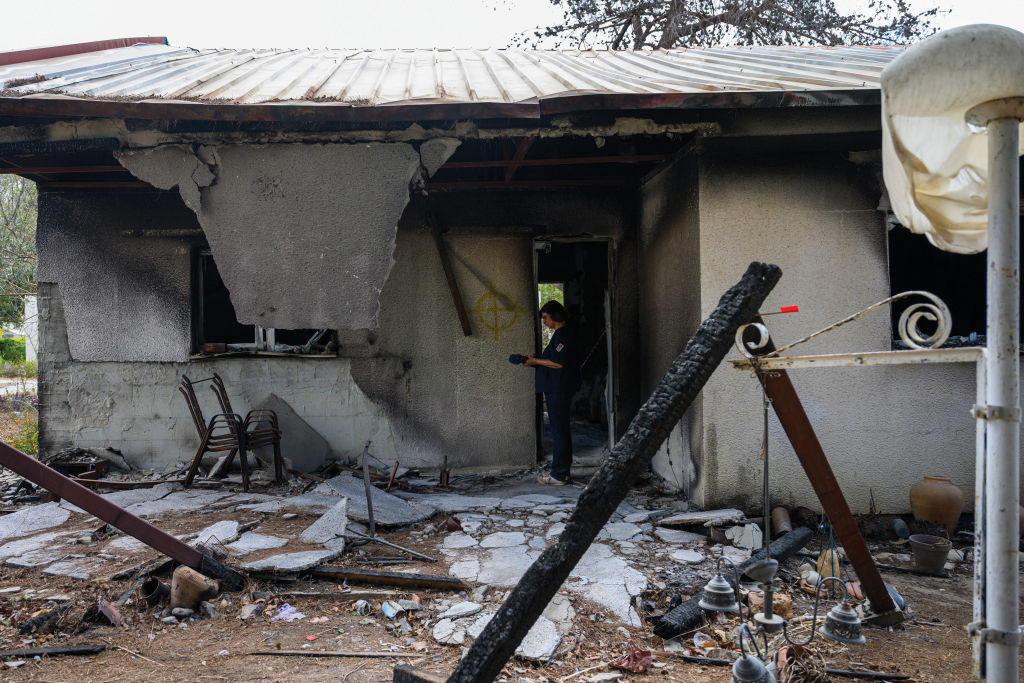
We, as a people, have been in this very fight, flight or freeze mode for almost two years. It began the morning of Oct. 7, 2023, when our Jewish family in Israel was brutally attacked and cruelly targeted for death and destruction. When our family members were butchered, burned, tortured, raped and captured for ransom.

Horrific beyond words. Terrifying beyond description. We’re still living the trauma of that October morning  today — 700 days later. The pain, trauma and fear are still with us. They’re in the cells of our bodies. We remain tense and hypervigilant, scanning the environment for another sign of attack. Even here in America, 7,600 miles away.

We are justified in our fears. They’re valid. Just four months ago, two young people in Washington, D.C. — a beautiful couple soon to be engaged — were gunned down as they left a Jewish museum. Doubly tragic, this couple was dedicated to peace and reconciliation between Israelis and Palestinians.

We are justified in our fears. They are valid.

Only this past June, 15 people were wounded, one of whom later died, in the serene, idyllic city of Boulder, Colorado. A man with a homemade flamethrower sprayed fire against an innocent crowd gathered in a park. He torched an 88-year-old Holocaust survivor among the 15 innocent victims of the attack.

What are we to do with this ongoing trauma and continued threat? How are we to heal our bodies and minds of their justified fears of another attack — in Israel, America, Europe — anywhere in the world where Jewish people live and are targeted by antisemitism and people who hate?

I don’t pretend to have all the answers. I’m no expert in responding to baseless hatred. To the would-be terrorist. To the person lurking in the shadows, intent on violence.

I do, however, know something about calming our bodies and minds when we feel threatened, when the threat has passed, or when it’s not imminent, even though the trauma remains. Because I’ve been studying mind-body science for over 30 years. I’ve been practicing it just about every day during the past three decades. Yet, so much more importantly, Judaism has been teaching it for over three thousand years. 

The Jewish world needs these practices and teachings now to meet the moment we’re in. The moment we’ve been in for close to two years, since Oct. 7. Truth be told, we’ve all been in this traumatized state even longer — since Oct. 27, 2018, when the Pittsburgh synagogue shooting occurred.

We’re on a journey of collective recovery. Wise, loving compassion and kindness will guide our steps and give us the healing that we need.

Judaism offers us each day — and especially at this time of year, during these Yamim Noraim, these High Holy Days of Awe — a path of compassion. God, the Source of life, is the Source of our compassion. Our tradition teaches that compassion is one of God’s primary attributes. As the Torah says, Adonai, El Rachum v’Chanun. “The Eternal is a God of compassion and grace” (Exodus 34:6).

This beautiful Hebrew word rachum comes from the Hebrew word rechem which means “womb.” A mother’s womb that surrounds her child with warmth, nourishment and support. So too, in this moment of our deep need for healing from the trauma of antisemitism, we surround ourselves with healing warmth and support.

Where does it come from?

It comes from family, friends and community. Loving community that embraces our collective pain and trauma, and holds it in its arms, cradling our suffering, like a mother cradles a crying baby in her arms — to soothe her and him.

That’s what we need from one another. That’s what we have to give one another: Compassion. Rechem. Rachum. Rachamim.

Modern neuroscientists describe compassion as the heartfelt desire to alleviate suffering. It is built into our brains and bodies as mammals. We all have it. We all can turn to it and use it. We move from the fight, flight or freeze mode of our sympathetic nervous system into the soothing, compassionate, care system of our parasympathetic nervous system in our bodies.

We move from fear to love. From fear to compassion. We reach out and connect with each other in bonds of kindness, love, and caring. And we heal. We heal our broken and constricted hearts through the innate wholeness and openness of one another. The great Hasidic master Rebbe Menachem Mendel of Kotzk taught: “There is nothing so whole as a broken heart.”

We offer our broken hearts to God.  We share our broken hearts with one another. We turn toward our trusted neighbors, friends, family members, community members and allies — and we connect with them. We sit or stand in their presence. We talk. We listen. We laugh. We cry. We celebrate. We mourn. We give. We receive. And as Jews, of course, we eat and drink together.  

We offer our broken hearts to God.  We share our broken hearts with one another. We turn toward our trusted neighbors, friends, family members, community members and allies — and we connect with them. We sit or stand in their presence. We talk. We listen. We laugh. We cry. We celebrate. We mourn. We give. We receive. And as Jews, of course, we eat and drink together.

We do all the things that friends and family and community do with one another to relate, connect and heal. We heal our collective trauma and renew our collective nervous systems with connection, lovingkindness and compassion.

There is at least one more important path to our recovery that also moves us from fight-or-flight to calm and safety, from sympathetic to parasympathetic nervous system activation in our bodies and minds. That is the age-old Jewish spiritual practice of blessing and gratitude.

It’s called hakarat hatov. Literally, “seeing the good.” Seeing the blessings in our lives — in gratitude.

Judaism guides us to wake up each day in gratitude, to begin anew each day in appreciation of all the good that surrounds us — all the good which is within us.

Prominent voices in the Jewish world have rightly lamented that we felt abandoned on Oct. 7 and the days that followed. Many people turned a blind eye to our shocking suffering: friends, former allies, teachers and students on college campuses, local school boards, local, national and international leaders. Not all, but many of them hardened their hearts like Pharoah of ancient Egypt. They hardened their hearts to the unfathomable pain of our broken hearts.

We felt abandoned, alone, our trauma invalidated. All true. And, at the very same time, when we turned toward the good, hakarat hatov — when we lifted our tear-soaked eyes to perceive the goodness surrounding us, we could see many people standing right beside us, offering us their love, compassion, and kindness.

We saw the brave souls near Nova, like Bedouin minibus driver Youssef Ziadna and Israeli farmer Oz Davidian, who risked their lives and families to save our young sisters and brothers under brutal attack right outside Gaza. Closer to home, the courageous security guards here in America who stood watch — and continue to do so — over us, our families and Jewish institutions, risking their lives and families to keep us safe and protected.

God bless them. We see their goodness.

We recognize all the Jewish and Jewish adjacent organizations in Israel, America, and around the world, who worked and continue to work day and night, tirelessly, to keep our people safe, comfort us, and help us to heal.

God bless them. We recognize their wise and loving acts.

We acknowledge all our Jewish and non-Jewish friends and neighbors who spoke to us — and who continue to — in sympathy, solidarity and understanding. Their warmth and succor help us feel safe and soothe our troubled spirits.

God bless them. We see the beauty of their souls. We are deeply grateful.

We appreciate how our Jewish community and the thousands of Jewish communities across the planet are a source of love, friendship and support during these difficult times. 

We are enveloped by at least 100 blessings each day, as the Talmud reminds us (Menachot 43b).

There is still much healing that needs to be done. So we can feel safe. So we can truly begin again, as these High Holy Days beckon us to do.

In this new year, we can begin again when we acknowledge and embrace our fear and pain. We will begin again when we open our hearts to compassion, lovingkindness, appreciation, and the good will of those who are standing right beside us — whether they be near or far, Jew or gentile, human or Divine.

May God bless us for a new year of health and safety, for goodness, wholeness, and healing.

Shanah tovah u’metukah. Wishing you a good and sweet year. 


Rabbi Rick Schechter is the spiritual leader of Temple Sinai of Glendale, California.

Healing Our Collective Trauma in the New Year Read More »

Rosh Hashanah, Rebirthed and Renewed

Each year we come back to the same place, once again, moving through the contemplative time of the month of Elul, preparing for the coming Holy Day, Rosh Hashanah, the New Year. It is a circle that repeats yet also elevates, a sphere that rises a little higher from the year before. It is a familiar journey yet totally different from year to year.

Rosh Hashanah is the 1st day of Tishrei, however, the rabbis teach that it is six days before the New Year begins that we celebrate Creation, the time in which the Light of the Divine, the all-encompassing infinite light enters the world yet it is on Rosh Hashanah that we celebrate the birth of the human being.  Both are a recognition of G-d’s ability to bring life into existence. Tradition teaches it is with words that the Creation comes into being while the human is formed, as Torah teaches, “And HaShem, our G-d, formed the Adam from dust of the earth and then blew into the nostrils the soul of Life and the Adam became a Living being.” All of Creation is spoken into existence while the human is intimately formed by Hashem and connects each one of us through the breath/spirit of G-d, enlivening the human with a spark of the Divine. 

There are so many levels of honoring and celebrating this coming moment. We attempt to detoxify the past, everything from discretions to missed opportunities to the awareness that whatever was not fulfilled has another opportunity, a clean slate and a fresh start. On another level it is having an opportunity to be mindful of where one is in their life, their challenges, their successes, for themselves and their relationships with others. 

On a more Kabbalistic level there is a very different goal and awareness. It is in the understanding that the original Adam, the human, is androgenous with male and female qualities. On Rosh Hashanah we honor and remember the wholeness of being, male and female, when they were joined together as one.  Then, the separation occurs. Once they were joined at the back, they are then able to be “face to face,” each with their own unique identity.

Hassidic commentary points out that at the New Year we go back to that original time, the moment of wholeness of being human, in his/her original form, a time of simplicity and being connected to the original light of the Holy One. Once separated, on their course and journey, life becomes encrusted with “garments,” those things that we attract, attach, and/or surround ourselves with that bring, not only reality, but complication and distance from the infinite light that filled the world at its beginning. We unknowingly create separation from the Holy One and G-d’s deep desire to be in proximity which each one of us.

At this time when so many are filled with toxicity, trauma, complexity and chaos from all that occurs in the world and especially in this country, we have layers of shmutz on our N’shamahs that have caused us to lose touch with the beauty and simplicity that Rosh Hashanah is here to remind us. Rosh means head, shanah means year but also change and renew. We all desperately need to renew our deep well of pure, uncomplicated and simple way of being. We need to rediscover the excitement and amazement of life by going back to the beginning, which is what Rosh Hashanah, on one very deep level, is about. 

Rosh Hashanah is also called The Day of Remembrance when we are to recall and remember, through the head of our consciousness, the place of awareness and understanding, that it is the birthday of the human, a time of renewal, letting go of the destructive forces that prevent seeing the positive and the possibility of hope and light shining through.

The sound of the shofar, with all of its depth of meaning, is also a simple call from G-d to come back, “return,” rediscover the glory of the pure self, being renewed and rebirthed, once again, as in the beginning, whole, integrated, and one with our Creator.


Eva Robbins is a rabbi, cantor, artist and the author of “Spiritual Surgery: A Journey of Healing Mind, Body and Spirit.”

Rosh Hashanah, Rebirthed and Renewed Read More »

Don’t Hate Debate TV Is Using AI to Address the Hot Topics of Today

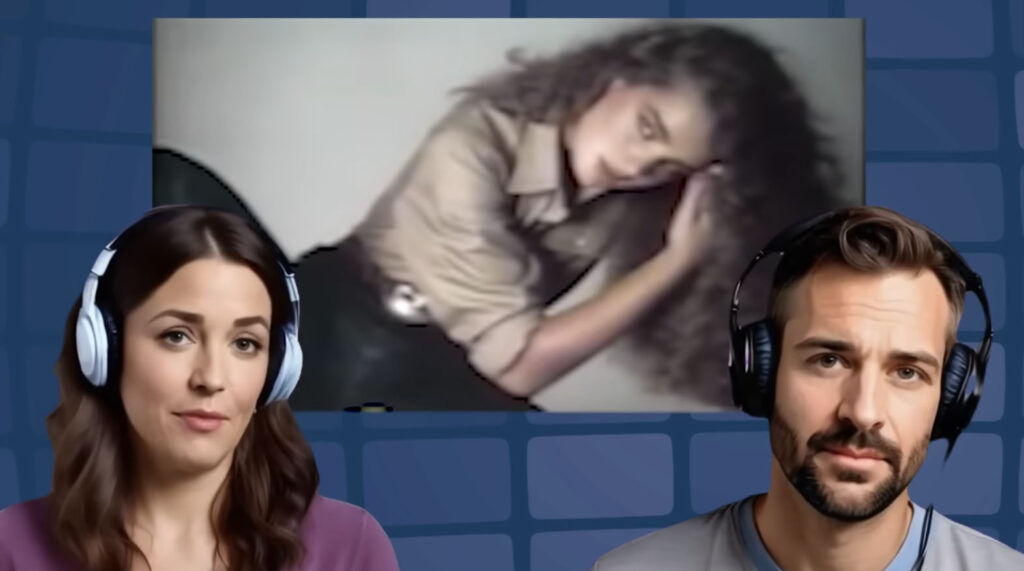
“The backlash isn’t about sex this time. It’s about dog whistles, idealized Americana, and exclusionary beauty standards” a woman says to the camera.

“Wait. We’re canceling denim now because a blonde girl in jeans is too American? What’s next: apple pie and sunsets?” a man replies.

These two are part of a debate on YouTube about the Sydney Sweeney jeans ad. The video, titled, “DEI, Culture Wars & Fashion Explode: The Jeans vs Genes Debate From Brooke Shields to Sydney Sweeney,” has 23,000 views. While the man and woman, called Civil Sally and Blunt Ben, are steadfast in their views, there is one catch: both are AI.

This video was created by Don’t Hate Debate TV, which posts AI debates for Gen Z to watch and think about. Led by Robin Lemberg, DHD TV covers the hot topics of today featuring the Sally and Ben, who debate in a calm and collected manner. They touch on topics like free speech, Israel-Palestine, gun rights, AI dating, and pop culture, and are putting out content that synthesize headlines from the left, right, and center so viewers can weight different points of view.

“I created DHD TV because Gen Z is what I call the ‘feelings generation,’” said Robin Lemberg, who also founded The Heart Monitors, a project dedicated to tracking and understanding antisemitism in America. The majority feel numb, unseen, unheard, and unable to have discussions with friends when they disagree. They don’t read the news in traditional ways, but two-thirds of them say they want to have discussions. They just don’t know how. We tried formal closed debates on campuses, we tried influencers and comedians — and none of it worked. In fact, it often did the opposite. That was the wake-up call.”

The goal is to make differing perspectives accessible, and to model how to disagree without dehumanizing. So far, the results have been positive.

“Since our Sydney Sweeney launch, I’ve produced 34 pieces of original content with a tiny, courageous team of Gen Zers,” said Lemberg. “The response: more than 250,000 organic views, over 1,000 hours of watch time (to me, the most important number), and subscriber growth now topping 100+ per day since the Kirk assassination.”

Now, to honor the memory of Charlie Kirk, who would engage in civil debates on college campuses, DHD TV is releasing a new video a week after his murder that features Sally and Ben talking about him.

“Kirk wasn’t RFK, but for Gen Z and Gen Alpha he represented something, and they will remember where they were when it happened,” said Lemberg. “Influencers on all sides are calling for change. My hope is that DHD TV can be part of that change, by showing that fierce disagreement and civility can exist in the same frame.”

For Lemberg, Judaism taught her that this is exactly what the world needs right now.

“At the heart of Judaism is the commitment to civility.”

“At the heart of Judaism is the commitment to civility. In fact, that’s where this idea began,” she said. “Jewish values are everyone’s values. I’ve spoken extensively about Brand Judaism: we have twelve tribes, we are divided on Israel, and yet we argue and engage with both our brains and our hearts at every gathering. Debate has, in essence, ensured our survival. That tradition is the root of Don’t Hate Debate TV.”

Don’t Hate Debate TV Is Using AI to Address the Hot Topics of Today Read More »