Do you remember your first day of school? The squeaky new shoes, the bright clean new backpack, the freshly sharpened pencils? Accompanying these were all the feelings of joy and excitement, mixed with some trepidation. A new school year brings that and so much more. A new year of school looks very different today in some ways, but some things don’t change. As someone who has worked in higher education for over 20 years, I still find myself getting emotional for the first day of school, meeting new students for the first time. Last week, Hebrew Union College’s rabbinical school Virtual Pathway students gathered for our first week of school, a four-day intensive on our historic Cincinnati campus. As our twenty three students arrived, ten from our January inaugural class, and thirteen newly enrolled students, I felt that joy and excitement rise within me. I was thrilled we were able to offer a program I have felt for years our Jewish community deserved and needed: a tailored program for second career students, agnostic of place or space, where they would grow and thrive as spiritual leaders for the Jewish people.
Over the course of designing this program, some raised concerns about what kind of experiences these virtual students would have as they embark on their rabbinical studies while studying at home, from their disparate local communities across the country. In one of the first conversations I had with the entering class, one student said to me, “I have been waiting for this moment for years. I wanted to be a rabbi for so long, but life, circumstances and the inability to move to another part of the country always prevented me from applying. Now, here I am, ready to learn, ready to lead. I could not move to a campus, but everyone around me, my community, my family, and even the person who walks my dog, are ready to support my studies, and are waiting to hear all about what I learn.”
I came away from that conversation buoyed with optimism about the future of the rabbinate and rabbinical school education. In my years working at Northeastern University, I experienced the ways good disruption involves answering a challenge in the field and offering new opportunities for life-long learners. This move to a virtual pathway for second career students by a legacy Jewish seminary has the potential to transform the rabbinate and the Reform movement more broadly, and it is important to the Jewish People as a whole.
Our global Jewish community is thirsty for connectivity around our shared peoplehood – especially after October 7th. Our collective hearts seek those who might offer us inspiration, wisdom, and good guidance. We are seeking teachers who will illuminate ways forward with rich textual insights and heart warming worship. As we witness increased antisemitism across North America, our Jewish community is turning to those who will teach, guide, and lead us as we stand up together with love and pride in our identity and heritage.
Future rabbinical students, individuals who want to make a career change but are at a stage of life when they are unable to upend their lives and move, can leverage this incredible opportunity to deepen their knowledge and develop the tools and skillsets to inspire Jewish communities with the wisdoms of our tradition. The addition of a virtual pathway to Hebrew Union College’s rabbinical school gives remote students access to a world-class faculty and rigorous curriculum, the hallmark of its rabbinical education. Practitioners will apply their learnings in real-time within their communities, from sharing books by faculty and introducing a new tune to a prayer, to incorporating practices into their daily lives. The students will bring the excellence of Hebrew Union College into their environments immediately. The design principle here of applied wisdom is grounded in our innovative new rabbinical school curriculum, which integrates the mastery of academic subjects with practical application and provides the leadership skills and spiritual preparation rabbis need to thrive in today’s communities, while ensuring high standards of professional, ethical conduct. Every session, every class, allows the students to ask, “how will I teach this, and how will I apply this to my work as a rabbi?”
This new approach opens up access to rabbinical education for a wider, more diverse audience of learners. Inside Higher Education recently reported that by 2034, the number of people over 65 will outnumber those under 18. More and more, we find that alongside communities who seek clergy to meet the needs of young adults and young families, our Jewish communities are also seeking leaders who understand this fourth stage of life, who themselves are living their fourth stage of life. The rabbinate is transforming and requires a more personalized, modular, and flexible curriculum, such as a virtual pathway, to meet our learners and our communal needs where they are, as they continue to grow as life-long stewards of education.
At Northeastern, where the co-op experience was the cornerstone for experiential learning, classroom instruction blended with real-world applications. As I engage with the new rabbinical school virtual pathway, I see parallels from my previous work to the design of this program, where local mentors and community resources enrich the educational experience, deepening the connection between these students, the institution, and alumni in the field.
As students in our virtual pathway engage with local mentors, Hebrew Union College’s rabbinical program will be infused with new expertise and practices from an expanded array of partners contributing to the vital work of raising up rabbis to meet the moment. Research in graduate virtual education demonstrates that the most successful online educational graduate programs are those where there is a brick-and-mortar school alongside a virtual option. When the two programs inform each other with rich insights, experiences, and practices, the entire community benefits in support of cultivating future rabbis to serve the Reform movement and beyond.
In these challenging but hopeful times, we continue to come together as a Jewish community, supporting one another in our diverse journeys across faith and leadership. For some of us this might include forging new futures as clergy, Jewish educators, or Jewish organizational professionals. Rabbis are our guides, our mentors, and the people we turn to, inspiring us, being present, and inviting us to reclaim our shared heritage with pride.
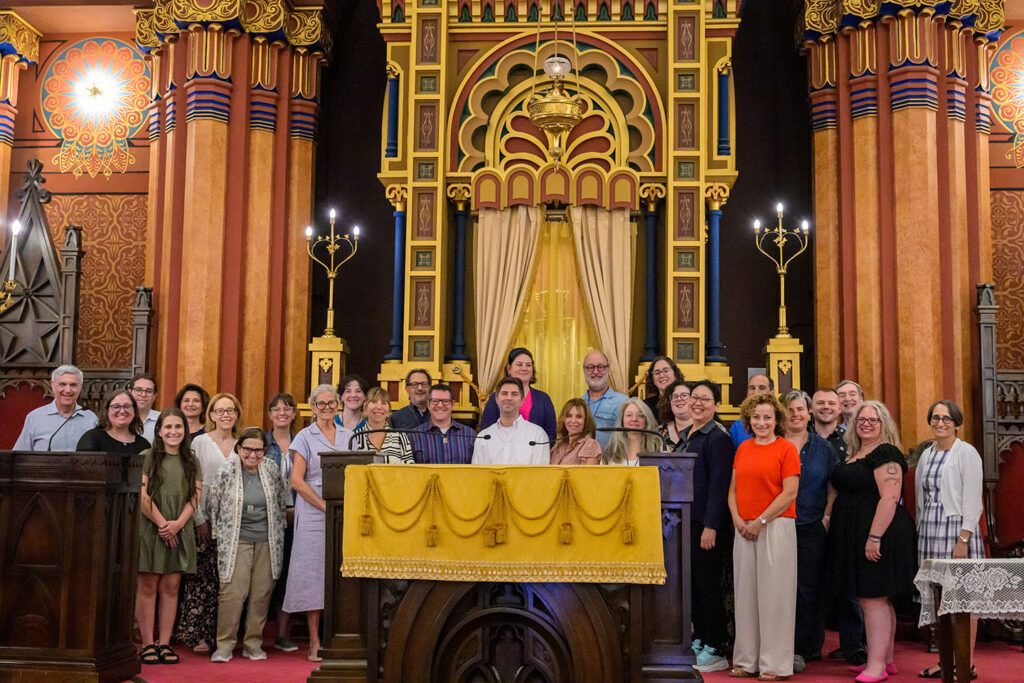
As we gathered with the students of our Hebrew Union College Virtual Pathway of our Rabbinical School, on our first day of class, and walked into the Scheuer Chapel on our Cincinnati campus for worship, a hush came over the students and some teared up. These students, in this solemn and historically meaningful space, joined a long chain of tradition of future Reform rabbis, fulfilling their lifelong calling. Together, across our in-person and virtual pathways, with the richness of an integrative curriculum, sensitivity of spiritual nurturing and responsibility of professional leadership skills, we can cultivate a generation of rabbis who lead by empowering our communities, wherever we connect with them, to flourish, bridge generations, and rekindle the flame of our tradition. Now is the time for all educational institutions to step up, not shy away from expanding or restructuring to provide diverse and creative methods of education that are essential for the wide-ranging group of learners in the country.
Rabbi Dr. Karen Reiss Medwed, Ph.D., is Interim Vice Provost for Academic Initiatives and Seminary Support at Hebrew Union College, and Teaching Professor Emerita of Northeastern University