fbpx

July 3, 2025

Q&A: Local Iranian Jewish Journalist Expresses Optimism for Iran’s Future

Karmel Melamed, an Iranian American journalist based in Los Angeles, has been closely watching recent events between Israel and Iran.

A contributor to several Jewish news outlets, including The Jewish Journal, Melamed has written extensively about his hope for regime change in Iran, which would mean the toppling of the Islamic Republic’s longtime supreme leader, Ayatollah Ali Khamenei, followed by the election of a democratically elected government. 

In a recent phone interview with The Journal, Melamed discussed what a secular Iran might look like. Striking an optimistic tone, the Iranian Jewish journalist spoke about his hope that a peace accord — which he calls the “Cyrus Accords” — could create a new future for the region. Additionally, he commented how his dual identity as an Iranian Jew places him in a unique position to serve as a bridge-builder.

The conversation has been edited for clarity.

Jewish Journal (JJ):  

You’ve previously written about the Cyrus Accords. What is that?


Karmel Melamed (KM): 

When I talk about the Cyrus Accords, we are assuming this current regime in Iran is gone and a secular, democratically elected government is in place. This is the scenario I’m talking about. The Ayatollahs [high-ranking Shia clerics] are out, and people have voted for a secular, democratic government to represent them.

The Cyrus Accords would be like the Abraham Accords [a normalization agreement between Israel and several Arab countries, including Bahrain and United Arab Emirates] but with Iran and Israel. It would fully normalize relations between both countries, establish full economic cooperation between those two countries and I believe that would occur way faster than a deal with Syria or Lebanon or with any of these Arab countries because the majority of the sentiment of the people of Iran is one of affection that they feel toward the Jewish people, even toward Israelis. 

I have interviewed countless people inside Iran, activists in Europe and America and Iranian activists and they’ve said point blank: we’re counting the days until the Cyrus Accords, a day of friendly relations between Iran and Israel, takes shape. They see Israel as their ancestral, historic friends, going back to the days of [Biblical leader] Cyrus the Great.

JJ: Who are you talking to inside Iran?

KM: Various opposition activists. I can’t say their names because their safety is at risk, but these are young people under the age of 35, making efforts to fight the regime any way they can. They’ve reached out to me over the years through social media or through Iran opposition activists in America and are connected to me through those ways.

JJ: What gives you confidence both sides would want the Cyrus Accords?

KM: I personally believe the foundations of the peace were poured in the late 1950s, 60s and 70s, between Iran and Israel. From 1958-1979, Iran had de facto relations with Israel — it was not formal; it was kind of a behind-the-scenes friendship, largely thanks to [late diplomat] Meir Ezri [who served as] Israel’s unofficial ambassador to Iran [between 1958 and 1975].

Those foundations have already been poured. Iranians were traveling to Israel for medical treatment by the hundreds during this time period, so I believe that based on that contemporary history, the foundations of peace were laid. They went dormant after the 1979 revolution, but it could very easily be revived.

It’s not like the Emirates, Bahrain or Morocco, where people need to meet each other, and contacts need to be made. It’s already happened [between Israel and Iran] in the 20th century.

You’ve got a huge population in Iran, 80% under the age of 40, who know nothing about the [1979] revolution. They’re Gen-Z and have YouTube and social media, and they’re looking at Israel as a tech hub, and looking at the freedoms Israel has, and these great developments they have, and they’re saying to themselves, “Why not us? We have no beef with Israelis or the Jews. We want that.”

JJ: What’s been your reaction to the statements of Reza Pahlavi, the son of the last Shah of Iran, who in the wake of Israel’s successful attack has called for a leadership transition in Iran? 

KM: He has been promoting this for a long time. He and his wife, Yasmine, made a historic visit to Israel [in 2023]. It was the first time in 43 years that an Iranian figure, a well-known Iranian figure, had traveled to Israel, and he went to the Western Wall, he prayed there, embraced Iranians of the Jewish faith that live in Israel, embraced Israelis and he said, “We want peace with you”

Most likely, he will be spearheading this effort if he becomes, you know, a leading political figure in Iran. And the signs are pointing to that indeed he will. He may be leading a transitional government until an elected government is established in free elections.

JJ: What are you hoping to see going forward?

KM: I’m looking to see the collapse of the regime, the end of this 40-year nightmare. The Iranians are yearning, much like the people of Eastern Europe during the Cold War, for freedom. They’re yearning for peace and better lives for themselves. 

I’m looking forward to the day when this regime is gone, this evil regime is gone, and the people are free, can live free lives and enjoy happiness, and the whole region can breathe. After so many years of war and terrorism that has been funded by this Ayatollah regime, there is a growing contingency in the Arab world tired of this regime and happy Israel is acting in this neighborhood. This regime has been an obstacle to their improvement and betterment.

Even though I am a reporter from the Iranian Jewish community, I look forward to being an ambassador between the two nations. As an Iranian Jew, I have a unique position of being in both words, the Jewish-Israeli world and the Iranian world. I have both identities. I share both identities. I have a unique role as a bridge builder, as a peace builder, as someone who speaks both languages, knows both people, so I look forward to bringing both sides together, and I think others in the Iranian community look forward to that as well, not just politically, but in business and academia. I look forward to that role. 

This is something that’s been dormant for 46 years and it’s about time we in the Jewish world start reaching out to our Iranian friends as they are embracing a hand of friendship to us.

Q&A: Local Iranian Jewish Journalist Expresses Optimism for Iran’s Future Read More »

A Deafening Silence

On June 1, 2024, Karen Diamond joined a peaceful Run for Their Lives rally in Boulder, Colorado. The march was in support of the Israeli hostages still being held in Gaza. Karen was 82. She was a beloved member of her community. 

During the rally, a man named Mohamed Sabry Soliman approached the crowd with Molotov cocktails and shouted antisemitic slurs as he launched fire into the group of demonstrators. Fifteen people were injured. Karen was critically burned. After three weeks in the hospital, she died from her injuries.

A Jewish woman burned to death on American soil. The violence wasn’t random. It was ideological, premeditated, and still, almost no one says her name. There is no national mourning, no sweeping op-eds in major publications. Karen Diamond’s death came and went in near silence—exactly the kind of silence that makes the next attack easier.

This lack of outrage echoes the deafening silence that followed the greatest crime in human history.

In December 1945, as the world began to comprehend the full scope of the Holocaust, something remarkable happened in Munich. Holocaust survivors gathered to establish the Central Historical Commission, to bear witness to what they had endured. Over the next few years, commissions were set up in Poland, Hungary and France. More than 5,000 testimonies were collected, fifty years before the Shoah Foundation was founded—voices crying out from the ashes, demanding the world remember.

But they were silenced.

The British Government among other post-war powers was seeking stability. Fearful of complications, it actively quashed discussion of the Holocaust. It halted the production of Sidney Bernstein and Alfred Hitchcock’s 1945 documentary, Concentration Camps Factual Survey, which was not released until 2017.

Survivors were told to move on, to integrate quietly, to stop dwelling on the past. This was not survivors choosing silence. This was the world choosing to silence them.

The pattern is the same today. When Jews die because of hatred, the response is the same calculated hush-hush. Pennsylvania Governor Josh Shapiro’s home was set on fire during Passover. Paul Kessler was killed at a pro-Israel rally. Jewish protesters were assaulted at Coachella and Boulder. Each incident met the same fate: an awkward pause, followed by collective forgetting.

We know that public mourning—and outrage—is possible. When George Floyd was murdered, the world responded. Streets were renamed. Murals were painted. Protesters filled cities across continents. There was moral clarity—black men should not die in our streets because they are black. It was raw, emotional, and urgent.

But when Jews are burned, beaten, or killed—moral clarity is replaced by cold calculation. When Jews die it must somehow be their fault. George Floyd’s death justifiably raised the question, “Do Black lives really matter?” Karen Diamond’s death now begs the question, “Do Jewish lives matter too?”

This year, antisemitism has been legitimized from major cultural platforms. At Coachella, stage screens declared “F*** Israel. Free Palestine.” At Glastonbury, Bob Vylan shouted “Death to the IDF” to tens of thousands. Macklemore released a music video equating the Holocaust with Israeli military actions.

This performative protest creates the atmosphere where real violence becomes acceptable—and where such violence is met with silence.

Meanwhile, actual genocides are ignored. In Sudan, civilians are slaughtered and buried in mass graves. In Iran, women are sentenced to death for removing hijabs. Gay men are publicly hanged. Where are the festival stages for them?

The danger of selective outrage is that it creates a hierarchy of empathy. Some deaths matter. Others don’t.

Karen Diamond did not die in the stench of the death camps. She was murdered on a Sunday afternoon in a park in Colorado. She was using her voice on behalf of Jewish victims held as hostages in Gaza peacefully.

The Holocaust survivors who gathered in 1945 understood something we’ve forgotten: silence after atrocity accomplishes the goals of the perpetrators—to silence the crime. When they were systematically silenced after WWII it wasn’t just their stories that were lost—it was their moral compass too.

Karen Diamond’s life began while the inferno of Jewish death was burning during the Holocaust. It ended in the flames of anti-Jewish hate that consume the world today. This time, in her name, we will not be silenced.


Stephen D. Smith is CEO of Memory Workers and Executive Director Emeritus of USC Shoah Foundation. 

A Deafening Silence Read More »

Nothing Fishy About These Barbecue Recipes

Summer is perfect for grilling and chilling. Whether you are planning a Fourth of July barbecue, an outdoor Shabbat or picnic-style meal, “light and delicious” is the goal.

“Whenever possible, we eat Shabbat dinner outside in the summer,” chef Danny Corsun, director of Culinary Judaics Academy (CJA), told The Journal. “Outdoor eating means outdoor cooking, so that means using the grill.”

Corsun said their grilled fish and vegetables are often accompanied by everyone’s favorite barbecue staple, coleslaw. “When I make ahi tuna burgers, I not only make the coleslaw as a side dish, I use the sauce from the slaw recipe in and on the burgers,” he said. “CJA’s coleslaw recipe is a different take on the classic and offers up even more flavor with this ‘special sauce’ as the family calls it.”

CJA’s Grilled Ahi Tuna Burgers


1 lb of sushi grade ahi tuna (no skin)

1 egg

½ large sweet onion, finely diced

1 tsp garlic-herb powder

1 tsp Italian seasoning

1 tsp Cajun/blackening seasoning

1 tsp salt

½ tsp ground pepper to taste

¼ cup panko breadcrumbs

2 Tbsp of CJA’s “Special Sauce” (recipe below)

2 Tbsp olive oil

Regular or slider buns for serving


Preheat your grill to 400°F.

In a saucepan over low to medium heat, sauté the onions in olive oil. Add salt and pepper to taste. Set aside. 

Cut tuna into large chunks and put into a food processor. Pulse the processor to cut up the tuna. Note: You still want the tuna in smallish pieces, so do not over-process or else the texture of the burgers will come out mealy.

Transfer the tuna to a large bowl and add the egg, seasonings, sautéed onion, special sauce and breadcrumbs. Mix everything together, incorporating all of the ingredients.

Spray your hands with nonstick spray and start forming the tuna mixture into small slider patties (or big if you’re going for the larger size burger). If the mixture is too dry to form into patties, add a little more of the special sauce.

Spray a sheet pan with nonstick spray and start lining up your burgers about two to three inches from one another. Place the pan into the grill and close the top and cook for about 2-3 minutes. It is important not to overcook these burgers! Ahi tuna is best when served on the rarer side. There’s nothing worse than dry tuna … Not only does it taste horrible, but you’ve spent so much money on this great product, it’s a waste to overcook it! So keep a very close eye on these.  

Return to the grill and with a metal spatula, flip the burgers on to the grill itself. They should have the consistency to do this now and not fall apart. Grill the burgers on one side, making grill marks for another one to two minutes and then flip to the other side to get grill marks there as well. While you do this for 45 seconds to 1 minute, take this opportunity to quickly toast your buns. Remove the burgers and serve on the lightly toasted bun with your condiment of choice: more of the special sauce, mustard, pickles, grilled pineapple etc. Enjoy!

Culinary Judaics Academy Coleslaw 

Cole Slaw (Courtesy CJA)

12 oz bag of mixed cabbage/coleslaw

½ cup mayonnaise

2 tsp Worcestershire sauce

2 tsp soy sauce

1 tsp reduced balsamic vinegar

1 Tbsp whole grain mustard

1 tsp garlic herb seasoning

1 cup of roasted almonds

½ cup of dried cranberries (optional)

Salt and pepper to taste (optional)


Combine the mayo, Worcestershire sauce, soy sauce, reduced balsamic vinegar, mustard, garlic herb powder, salt and pepper in a bowl and whisk together until creamy.

 Put the coleslaw mix in another bowl. Slowly add half of the sauce mixture into the bowl and thoroughly incorporate. Add in the rest of the sauce 1 tablespoon at a time until you achieve the consistency you like; some like their slaw on the creamier side while others like it a tad drier. Once fully incorporated, if using them, add in the optional roasted almonds and dried cranberries. This adds a bit of texture and tartness/sweetness to the slaw, but is completely up to your personal tastes as the slaw is outstanding just on its own. 


Debbie Kornberg, cooking instructor and founder of SPICE + LEAF, loves the ease of cooking on the grill.

Her sweet and savory salmon teriyaki kebabs really make a splash. Note these can also be made with halibut, sea bass or grouper.

“These kebabs are a colorful mix of fresh veggies, juicy pineapple and tender fish that always wow my guests,” Kornberg told the Journal. 

They’re perfect for nonmeat eaters, yet still packed with protein. 

“Best of all, they come together easily, so you can spend less time cooking and more time enjoying the friends and family you are hosting,” she said.

Teriyaki Fish Kebabs

(Serves 4) 

Teriyaki Fish Kebabs
(Courtesy Debbie Kornberg)

3 garlic cloves, minced

1 Tbsp SPICE + LEAF Salmon Blend

¼ cup brown sugar

¼ cup soy sauce (can also use coconut aminos)

¼ cup mirin (a Japanese wine cooking vinegar)

2 Tbsp sesame oil

1.5 lbs salmon (or halibut, sea bass or grouper), cut into 1.5” cubes

Green bell peppers, cut into squares

Red onion, cut into squares

Whole mushrooms

Wood or metal skewers

Whole cherry tomatoes

Pineapple rings

Combine garlic, salmon blend, brown sugar, soy sauce, mirin and sesame oil in a bowl. Mix well. Place fish cubes into marinade, cover and place in the refrigerator for 30 minutes to 2 hours.

Using skewers, alternate 3-4 fish pieces with green peppers, red onion, tomatoes and mushrooms.  

Take remaining teriyaki sauce from the marinade bowl and place into a small pot. Bring to a boil. Once cooked, use as sauce to baste kebabs once on the grill.

Heat up the grill to a high temperature, about 425°F. Coat fish kebabs and pineapple rings with cooking spray so they do not stick to the grill. Once the grill is hot, place kebabs and pineapple on it for about 3 to 4 minutes; keep the lid open to get some nice grill marks. Reduce heat to 350°F and baste kebabs regularly with remaining sauce. 

Turn kebabs so they are cooked on all sides. When fish is fully cooked, remove from the grill; about 12 to 15 minutes. Cook pineapple rings until nice grill marks appear on both sides. Serve together. YUM!

Nothing Fishy About These Barbecue Recipes Read More »

Refreshing Summer Salads

The deep bond between my mother and her sister Mercedes endured despite decades of living on different continents, with my mother living in Los Angeles and my aunt in Haifa. Luckily for me, the connection extended to the next generation. Whenever my cousins and I have the rare opportunity to reunite, it’s as if no time has passed. There’s a deep love between us. 

This last May, with tensions rising in the Middle East, Neil and I found ourselves in Jerusalem for planning meetings for the future museum at the Sephardic Educational Center in the Old City. But we managed to steal a day away and headed north to visit my cousins in Haifa.

That Friday, my cousin Ruthie hosted a family lunch, with her sisters, Mimi and Anat and all their children and their spouses and grandchildren filling the house. We even got to meet Ruthie’s adorable new baby granddaughter. 

The table overflowed with everyone’s culinary contributions and the aromas, colors and flavors made me feel like I was in my own kitchen. There were all the favorites — potato pastel, stuffed peppers, albondigas (meatballs), schnitzel, homemade beef burekas, fish, chicken, not to mention the many salads. Of course it was familiar. Our mothers were sisters. What else did I expect?

Among the many dishes, one salad stood out — fresh, vibrant, and completely unforgettable.

My cousin Anat made it. In my mind, Anat is still “my little cousin,” even though she’s the mother of two daughters who have completed their army service and a teenage son. As children we’d play at our grandparents’ house in Jerusalem. I didn’t speak Hebrew and she didn’t speak English or French, but somehow we connected through play and laughter.

Nowadays, Anat and her husband really enjoy cooking together. For our lunch, they made a long meat bureka with a pretty pattern on top and some wonderful salads. But it was her herb salad that caught our attention. The salad was full of color and texture and packed with the fresh earthy flavors of chopped parsley, mint, dill and cilantro. There was  a bit of nutty, chewy cooked bulgur. Roasted sunflower seeds added crunch and dried cherries for a little pop of sweetness. There was a classic, simple lemon and olive oil dressing which enhanced the amazing flavors. Neil and I couldn’t stop eating it. Anat told me that it’s a “forest salad” that is on the menu at the Carmel Forest Spa Hotel. I knew right then and there that I’d be making this at home and sharing the recipe here. 

That lunch was more than just a meal — it was a gathering of generations, a tribute to the women who raised us, and a reminder that family traditions live on in both our hearts and our kitchens. (I’m sure our mothers were smiling down on all of us.) 

—Rachel 

Forest Herb Salad

Bright, earthy and deeply refreshing, this salad brings together the forest-like aroma of fresh herbs with a sweet and nutty crunch.

1 bunch fresh parsley, roughly chopped

1 bunch fresh mint, roughly chopped

1 small bunch fresh dill, roughly chopped

1 small bunch fresh cilantro, roughly chopped

1/4 cup roasted sunflower seeds or pumpkin seeds

¼ cup roasted pine nuts

½ cup dried cherries, chopped if large

½ cup farro (optional), follow cooking instructions on package (can substitute in quinoa, bulgar, brown rice, couscous)

Juice of 1–2 lemons (to taste)

1/3 cup olive oil

1 Tbsp pomegranate syrup

Salt and pepper to taste 

Soak the herbs and dry them well.

In a large bowl, combine the chopped herbs, seeds, dried cherries, and cooked grain.

In a small bowl, whisk together the lemon juice, olive oil, pomegranate syrup , salt, and pepper.

Pour the dressing over the salad and toss well to combine.

Let sit for 5-10 minutes before serving to allow the flavors to meld.

Serving Tip:

Serve chilled or at room temperature as a side to grilled meats, fish, or as part of a Shabbat meal or mezze table.


When my nephew Yosef announced his engagement to the beautiful Rivka, there was no doubt in my mind that we would fly to Israel for the wedding.

Growing up, Yosef and his sister Devorah lived in New York, where the summers are unbearably hot. Every summer, they would spend most of their summer vacation visiting in my home. It was a privilege for which I will always be grateful.

The young couple planned a beach wedding at a stunning venue in Ashdod. But Iran’s ballistic missiles forced a change in plans.

They stood under the chuppah and behind them was a view of the sun setting over the hills of Jerusalem. As the rabbi said in his speech — this chattan and kallah weren’t meant to marry in Ashdod, but like the lines of the song, on the outskirts of Jerusalem, in the mountains of Judah. Those powerful words put everything in perspective for me. I felt tremendous joy watching this young couple, so in love, so happy, so devoted, starting their lives together.
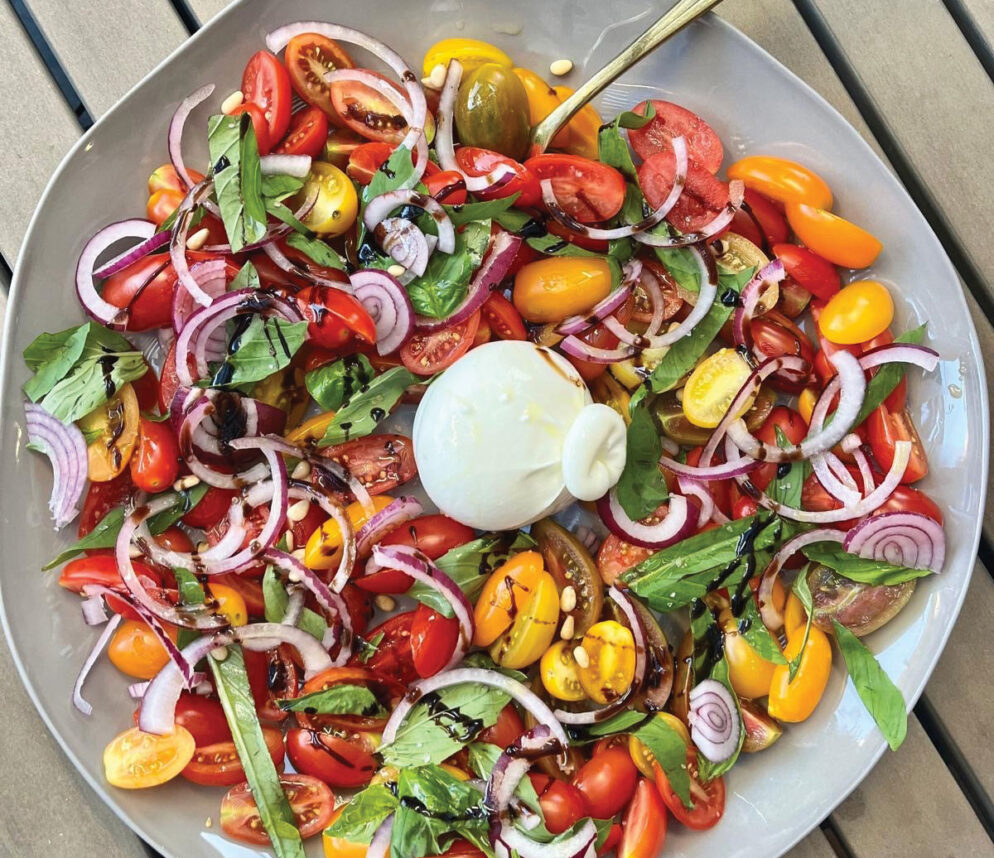
Later that crazy first week of war in Israel, our good friends Michal and Udi hosted us for dinner. Michal is an insanely talented cook. She served us the most incredible gourmet meal. Herb crusted salmon, cod in a red sauce, crispy potatoes, a cabbage salad dressed in tahini and soy sauce. But the showstopper was her Burrata Caprese Salad.

It’s a simple salad made with colorful, sweet, tangy cherry tomatoes, earthy herby basil and spicy purple onion dressed with a really good extra virgin olive oil, fresh squeezed lemon juice and a sweet balsamic vinegar glaze. But the rich, milky, buttery subtly sweet burrata that makes this salad heavenly. The soft, fresh mozzarella exterior and creamy, decadent, buttery interior are an ethereal contrast to the tangy tomatoes, the grassy basil and sweet bite of the onion.

Luckily, we got to enjoy most of the meal before the sirens demanded that we take shelter in their mamad.

We loved this salad so much that our daughter Alexandra made it again and again on our very eventful summer vacation.

Praying for the peace of Jerusalem and may we only share the happiest occasions.

—Sharon

Burrata Caprese Salad

1 lb tricolor cherry tomatoes, halved lengthwise

1 small red onion, thinly sliced

1 bunch basil, torn

1 ball burrata cheese

1/4 cup olive oil

1 lemon, juiced

Salt and pepper, to taste

Generous drizzle of balsamic glaze

Arrange cherry tomatoes, purple onion and basil around the edges of a shallow bowl. Dress the salad with olive oil, lemon juice, salt and pepper.

Place burrata in the center.

Drizzle with balsamic glaze.


Sharon Gomperts and Rachel Emquies Sheff have been friends since high school. The Sephardic Spice Girls project has grown from their collaboration on events for the Sephardic Educational Center in Jerusalem. Follow them
on Instagram @sephardicspicegirls and on Facebook at Sephardic Spice SEC Food. Website sephardicspicegirls.com/full-recipes.

Refreshing Summer Salads Read More »

Table for Five: chukat

One verse, five voices. Edited by Nina Litvak and Salvador Litvak, the Accidental Talmudist

The people spoke against God and against Moses, “Why have you brought us up out of Egypt to die in this desert, for there is no bread and no water, and we are disgusted with this rotten bread.”

– Num. 21:5


Rabbanit Alissa Thomas-Newborn

Congregation Netivot Shalom and New York-Presbyterian

The insult against the manna is that it is not heavy or filling. The Hebrew describes it as the least valuable bread, extremely light. Why is this a criticism? Or HaChaim answers that when someone travels by foot, they need to eat a heavy meal so it digests with the walking. If a person’s stomach feels empty, travel by foot is much more burdensome. The people were complaining that they did not feel full. Was the manna not satiating? Our rabbis teach that as a Divine food, it filled them without that unpleasant “stuffed” feeling. Like the difference between eating a protein salad versus a heavy pasta or meat dish. Their perception of feeling lighter after eating manna led to the psychological experience of feeling less full. Thus, the complaints were less about reality than perception. Without fail, they were provided with food daily, but still they worried. Our commentaries teach that the people complaining here are only from the original generation that left Egypt. Why? This is a slave mentality. Looking over one’s shoulder, never truly trusting or allowing oneself to be satiated or shift from just surviving to thriving. This truth resonates beyond a literal slave. We can all get caught up in surviving such that we forget to feel satiated. In doing so, we miss the opportunity to find fullness in moments of “lightness.” Let us ask: Physically, spiritually, and psychologically, how often do we seek out perceived satiation, overlooking that which is truly filling?


Rabbi Shlomo Seidenfeld 

Freelance Rabbi, Scholar-in-Residence Aish/JMI

I tell people that if my love of the Jewish people was ever at risk it was the four summers I spent as a waiter in a Kosher restaurant in the Catskills. Every day was a chorus of complaints and cajoling. The food was too hot, not hot enough or it suffered from some other life-altering defect. The whole experience left a sour taste in my mouth. 

But my experience begs the question. How do we reconcile the demanding and complaining nature of the Jewish people with its concurrent mission to be G-d’s torch-bearers in the world; to be “a light unto the nations”? What did G-d see in us that persuaded him to overlook what appears to be an undesirable part of our nature? 

The answer is deceptively simple. He didn’t see defects. He saw the holy potential and nature of a people who would stubbornly, fiercely and compassionately pursue the Jewish mission in all its glory.

To be sure, each quality can be expressed in a holy way and an unholy way and the stakes are high. In every interaction and in every context we are either sanctifying G-d’s name or desecrating it. So my friends, let’s live lives of holy stubbornness and let’s demand the best of ourselves. Humanity and waiters deserve nothing less.


Rabbi Chanan Gordon

International Inspiration Speaker, Senior Lecturer, Gateways 

In Parsha Chukat, Numbers 21:5, the Torah describes the Jewish People’s lack of gratitude for the selfless leadership of Moses who had delivered them out of the dark days of slavery in Egypt with the following words – “Why did you bring us out of Egypt to die in the wilderness? There is no food and no water, and we are disgusted with this lechem haklokel (rotten bread).’” 

In Psalm 78, we learn of a very different description of the manna i.e., “Man ate lechem abirim (‘the bread of angels’) — He sent them provision to the full.” This begs the question: Was the manna rotten bread as Jewish People described it or was it bread of angels as the psalm indicates? 

The Talmud in Maseches Yoma 75b responds — At first the manna was like the ‘bread of angels’ and miraculously absorbed into the limbs so there was no need to go to the bathroom. Once the Jewish People started complaining and called the manna “lechem haklokel,” G-d removed the miracle and made it a food that would have refuse. 

The word “Judaism” contains the root “hodu” – meaning “to give thanks.” One of the messages the Jewish People is tasked with is to teach gratitude to the world. G-d does not owe us anything. Life is a gift. Complaining is the antithesis of gratitude. When things are going well, we should always be grateful; and inevitably, when challenges arise, we should be graceful but never ungrateful.


Rabbi Jonathan Leener

Prospect Heights Shul, Brooklyn, N.Y.

At first glance, their response seems painfully immature. They had just witnessed the grandeur of God’s might — the sea split, the manna fell, Sinai thundered. How could they fall so quickly into fear and complaint? 

But perhaps what we see is not rebellion, but regression — a reversion to childlike helplessness in the face of overwhelming change. In the language of the soul, this is not just about thirst or hunger. It is a cry over something deeper: the unraveling of a certain kind of closeness with God. The God who once carried them like infants is now asking them to walk on their own. And that terrifies them. 

They are not just afraid of the land ahead — they are afraid of growing up. The intimacy of the desert is beginning to fade, and they do not yet know how to find God in responsibility, in struggle, in distance. 

But regression is not failure. It is the soul gathering itself before it moves forward. In life’s mysterious unfolding, we often move backward in order to move ahead. The Hasidic masters understood this as a yeridah l’tzorech aliyah — a descent for the sake of ascent. We go down so that we can rise even higher.


Rabbi David Eliezrie 

President of Rabbinical Council of Orange County, Senior Rabbi at Chabad Beth Meir HaCohen, Yorba Linda

Throughout history the Jewish people have questioned their circumstances. As Rashi points out, this time they even challenged both G-d and Moses — seeing Moses as the embodiment of Divine authority in the world. At the core of this lies a profound debate: How do we define right and wrong? Is morality determined by human intelligence and conscience, or by the ideals given by G-d at Mount Sinai? 

A common modern argument is, “Do as you please, as long as you don’t harm others and you’re happy.” As Americans, we are fortunate to have the Bill of Rights — the promise of “life, liberty, and the pursuit of happiness.” In Judaism, however, the focus is not on rights but on responsibilities. Morality is not shaped by our fleeting desires, but by Divine instruction of the Torah. Instead of simply following our feelings, we are called to aspire to higher ideals. 

This approach can be uncomfortable, it asks us to measure our actions not by the whims of the moment, but by the enduring principles of the Torah. It challenges us to confront moral questions differently — not as self-appointed arbiters of good and bad, but as individuals striving to align our actions with the teachings of Sinai.

Jews of ancient times questioned G-d and Moses, so too do people today wrestle with these same issues. The lesson is timeless: the essence of life is to strive to do what is good according to the Torah, rather than simply following the impulses of the moment.

Table for Five: chukat Read More »

Print Issue: Reclaiming American Values | July 4, 2025

CLICK HERE FOR FULLSCREEN VERSION

Print Issue: Reclaiming American Values | July 4, 2025 Read More »

Sephardic Torah from the Holy Land | A Dilemma in Damascus

Halakha and ethics: a case study.

There was a custom in Damascus in the 17th century, that for the purposes of tax assessment, the properties of the wealthy were evaluated up to 3000 grushim (the currency at that time), thereby creating a situation that any properties or financial holdings above 3000 grushim were tax exempt. In modern economic terms: a tax ceiling. The rationale for this was that if they collected taxes on the wealthy beyond this amount, the wealthy would hide their properties and financial holdings. This was accepted in the community for many years.

The middle class and poor grew tired of this privilege for the wealthy, and requested to annul the tax ceiling. The wealthy responded by saying that this was the “custom of the community” for many years, and that they had no intention of making any changes. “If the community became poorer, that’s their tough luck, but the wealthy should not bear the burden.”

Sounds familiar, right?

Rabbi Shmuel Vital, a young rabbinic prodigy, kabbalist and halakhic judge (dayan) in Damascus, contemplated whether or not to get involved in this dispute. “Why should I get involved? Does it not say in Pirkei Avot, ‘He who shuns the office of judge rids himself of enmity, theft, and false swearing’”?

Rav Vital further contemplated: “If I remove myself from this situation, our community will be destroyed through unpreventable disputes. If I speak up, I will surely acquire for myself enemies. But my duty as a rabbi, as a representative of God’s teachings, is to speak the truth, and to make a halakhic decision that may not please everyone, but would ultimately reflect mercy towards the needy.”

“In principle” writes Rabbi Vital, “the original custom should be upheld, and it cannot be changed unless the entire community – including the wealthy – agree together to change it. This is the principle of the halakhic system.”

“However,” he says, “all of this applies when we are speaking about what we would consider a ‘proper custom.’ But when we are speaking about a custom that was designed to favor the wealthy and create financial losses upon the poor, would such a custom find favor in God’s eyes? Would God view favorably a ‘custom’ that takes a middle class person who has only 100 grushim in savings, from which he must sustain his family, and pay taxes on the entire amount? This, while a wealthy person with 10,000 grushim in savings, from which he eats, holds lavish parties and continues to amass savings, pays on only 3000 grushim, and is exempt from paying on the rest? The rich get richer, while the poor continue in the path of poverty? This is the trait of Sodom!”

Rabbinic courage, leadership and integrity at its finest.

Shabbat Shalom


Rabbi Daniel Bouskila is the international director of the Sephardic Educational Center.

Sephardic Torah from the Holy Land | A Dilemma in Damascus Read More »