fbpx

July 2, 2025

Why Jews Must Reclaim American Values

When my organization was searching for a new name to reflect a renewed mission — promoting Enlightenment values in K–12 education against a rising tide of radical ideology — I briefly considered calling the nonprofit the “American Values Institute.” Ultimately, we chose the North American Values Institute. But before deciding, I sought the counsel of several trusted advisors, including a politically savvy rabbi. He warned me off the name. “American Values is coded right,” he said. “If your goal is to appeal to mainstream Jews and build a broad coalition against radicalism, that name could backfire. It sounds too MAGA.”

He wasn’t wrong. But the fact that he was right revealed a deeper problem. If the phrase American values — once shorthand for the animating ideals of liberal democracy, a phrase Jewish liberals and conservatives alike once spoke with confidence — had become traif, if even invoking it risked alienating our own community, then we were already on the defensive. The radicals we were up against came armed with destructive but coherent ideologies — ideas like “settler colonialism” and “decolonizing the curriculum,” which recast American history as irredeemably oppressive. And yet we had made even basic affirmations of American civic ideals taboo. If we couldn’t say what this country stands for, how could we resist those determined to tear it down — and bring the American Jewish community down with it?

What Are American Values?

By American values, I don’t mean partisan slogans or nostalgic idealism. I mean the foundational principles that define our liberal democracy: “E pluribus unum,” out of many, one; equality of opportunity; the rule of law as a neutral framework for justice; freedom of thought and expression, even when ideas are unpopular; merit and personal responsibility; and an enduring commitment to civic tolerance. These values once served as common ground for American Jews across the political spectrum — and they are worth reclaiming.

A Source of Dynamism

American values have powered the world’s most dynamic democracy. Unlike nations defined by ethnicity or ideology, the United States has relied on a civic creed — an allegiance to shared principles, not shared blood. These ideals created conditions for innovation, upward mobility, and pluralism. They don’t guarantee perfection, but they enable self-correction. In a world of brittle orthodoxy and tribal division, American values remain uniquely generative — able to foster both dissent and unity, merit and inclusion, loyalty and liberty. Even when we failed to live up to them we were able to fall back on them.

A Shield Against Antisemitism

These values are also a shield. For American Jews, they have provided the framework for safety, dignity, and flourishing. In the early 20th century, as Jews fled persecution in Europe, American principles — constitutional protections, economic mobility, and civic freedom — enabled our integration and success. In contrast, Europe’s blood-and-soil nationalisms cast Jews as outsiders, no matter their contributions.

Yet the values that have protected us are under attack. In “A Paradigm Shift in Countering Antisemitism,” my co-authors Fern Oppenheim, Eran Shayshon and I argued that much of today’s communal response to antisemitism has become ineffective in the face of an ideological shift in numerous institutions, particularly education. When the American value of “E pluribus unum” gives way to tribalism, Jews become easy targets. When the rule of law is dismissed as systemic oppression, Jewish institutions lose their protections. When freedom of expression is sacrificed to ideological conformity, Jewish voices are silenced. When merit is reframed as privilege, Jewish achievement becomes suspect. 

The Jewish community has been asking Americans to take a stand against hostility against Jews when we should be emphasizing the need to stand up for core civic values. Particularistic Jewish concerns just aren’t that relevant to most Americans but growing anti-Americanism is. The vast majority of Americans are proud of these civic values and detest efforts by radical activists to overturn them. What’s needed is an American Jewish civics strategy that reconceives Jewish security in the American idea itself. We should expose the bad actors who are spreading anti-Americanism on both the left and the right and work with others to make the case for a return to American values. This requires us to entirely rethink both our messaging and our alliances.

The Decline of American Values

Somewhere along the way, American values fell out of favor — even among Jews. In the late 1990s, working for the American Jewish Committee in Washington, D.C., I began to notice that the standard rhetoric among civil rights groups started to shift away from one seeking opportunity to one asserting oppression. Gone were the days of Martin Luther King Jr.’s color-blind aspirations for the “content of one’s character” in favor of a more austere condemnation of the system that perpetuated white supremacy. 

In March 2001, I wrote a memo headed “Immigration and American Values,” in which I argued that these ideological trends might acculturate a generation of immigrants into a hostile interpretation of American values. I shared the memo with my colleagues. “In its more radical form, multiculturalism is not merely neutral toward American values, it is openly hostile,” I stated. “Some ideologues go beyond claims of discrimination and make the case that racism is deeply embedded in the American value system itself … echoes of this can, unfortunately, be heard even among some of our partners in the civil rights community.

As Nathan Glazer observed in “We Are All Multiculturalists Now,” “the melting pot is no more.” Where Americans once sought assimilation, we began pursuing multiculturalism. Multiculturalism, he warned, emerged from the failure to fully integrate Black Americans — ultimately becoming “the price America is paying” for that failure. In schools and institutions, this shift prioritized difference over unity, elevating ethnic identity and grievance over common civic ideals.

After Vietnam and Iraq, and amid growing distrust of national institutions, words like liberty and merit came to sound outmoded — or partisan. Many Jewish leaders, eager to show solidarity with other marginalized groups, shed the language of classical liberalism for a newer, grievance-based vocabulary. The old Jewish strategy — fighting antisemitism by appealing to universal principles — gave way to advocacy centered on identity and vulnerability.

But this pivot came at a cost. When institutions define legitimacy by identity and grievance, Jews are put in an impossible bind: too successful to be victims, too distinct to be insiders. By aligning with ideological frameworks that treat merit and civic identity as forms of oppression, we ceded the moral high ground.

Efforts to recognize historic exclusion and affirm cultural identity are not inherently at odds with American values. But when those efforts morph into rigid ideological frameworks that view merit, national identity, and free expression as forms of oppression, they stop promoting justice and start undermining liberal democracy itself.

Of course, efforts to recognize historic exclusion and affirm cultural identity are not inherently at odds with American values. But when those efforts morph into rigid ideological frameworks that view merit, national identity and free expression as forms of oppression, they stop promoting justice and start undermining liberal democracy itself. That is the trap too many American Jews fell into.

How the Vacuum Was Filled

This vacuum created by the declining salience of American values was quickly filled by radical activists who had long accused America of being a force for evil in the world and Israel of colonialism and apartheid. Until recently, however, they had made little progress. What changed was the cultural framework. Once elite institutions adopted binaries of oppressor and oppressed, DEI programs and activist coalitions amplified anti-Zionist narratives as righteous causes. Israel became not just a controversial state but a symbol of Western sin. Jews, by extension, became suspect once more.

Young Americans today are more likely to believe antisemitic tropes than any previous generation. Support for Israel has declined. The “swayable middle” has shrunk. Jewish students are being pushed out of progressive spaces not despite their values, but because they still believe in things like open dialogue, shared national identity, and coexistence.

Where We Go from Here

The response cannot be to double down on grievance-based advocacy. We don’t need a new place in the pyramid of victimhood — we need a renewed commitment to American Values. If our opponents organize around shared resentment, we must create our own “intersectional framework” around shared values. That means:

1. Build Coalitions Around Shared Civic Values

Rather than seeking safety through shifting identity hierarchies, Jews must partner with people — of all races, faiths, and backgrounds — who still believe in pluralism, debate, individual rights, and the Constitution. In the mid-20th century, Jewish civil rights leaders achieved exactly that by appealing to American ideals — not only as victims of injustice, but as defenders of the liberal order. That strategy worked. We should revive it to advance a society based on the principles of the early civil rights movement. Jewish parents should join forces, for example, with Hindu, Chinese and Black parents, among others, who are concerned about the degradation of the schools by radical activists. 

2. Embrace a Civics-Based Power Politics 

There has been a radical progressive takeover of numerous city governments, especially in already blue areas where Jews have congregated. The policies embraced by these ideological mayors and prosecutors not only marginalize Jews, but invariably generate higher crime rates and economic decline. Jews need to form coalitions of the civically minded to win elections and wrestle away power from the extremists. 

A prime example of this approach is the Chicago Jewish community’s response to the 2023 election of Mayor Brandon Johnson, a former Chicago Teachers Union organizer backed by its most radical faction. Once in office, Johnson pushed an ideologically driven plan to borrow funds for teacher raises — prompting the mass resignation of the Chicago Board of Education and the dismissal of the school CEO. In early 2024, Johnson cast the tie-breaking vote in favor of a one-sided city council resolution calling for a ceasefire in the Israel-Hamas war, a move condemned by the Jewish United Fund as deeply disrespectful to Jewish Chicagoans still reeling from Oct. 7.

Rather than fall back on traditional community-relations tactics and special pleading, Chicago Jewish leaders recognized that the city’s power structures had been ideologically captured and  that they had lost their sense of place in their own city. In response, they convened a diverse coalition of civic leaders to launch the Common Ground Collective (cgcollective.org), a political initiative designed to restore balance and common sense to city governance.

The initiative has raised millions of dollars. By organizing voters and supporting alternatives to extremist officials, it marks a strategic pivot: not pleading for inclusion, but building political capacity to replace those who endanger the city’s — and the Jewish community’s—future. In the wake of recent mayoral primaries, the New York Jewish community should take heed.

3. Confront Ideological Capture in Institutions

We must stop pretending all diversity initiatives are benign. Too many now embed ideologies that breed ideological conformity, engender anti-American sentiment, marginalize Jews, and rewrite history. Jewish organizations should stop enabling these frameworks and start demanding transparency, especially in schools: What is being taught? What do terms like “equity” or “oppression” mean in practice?

Silence in the face of institutional capture is not neutrality — it’s complicity. Reform means rejecting any initiative that traffics in identity reductionism or enforces ideological conformity.

4. Reframe Antisemitism as a Civic Crisis

Antisemitism is not a parochial grievance — it’s a societal warning sign and a civic emergency. It signals a breakdown of pluralism, law, and tolerance. Jewish advocacy should start reminding America that attacks on Jews are attacks on the very principles that protect everyone. When Jews are singled out, whether in radical DEI programs, academic boycotts, or threats on campuses and in the streets, it constitutes a broader assault on pluralism, civil society, and the rule of law—one that demands a collective response.

Antisemitism is not a parochial grievance — it’s a societal warning sign and a civic emergency. It signals a breakdown of pluralism, law and tolerance. Jewish advocacy should start reminding America that attacks on Jews are attacks on the very principles that protect everyone.

5. Reinvest in Civics Education

Jewish institutions must be leading voices in restoring civic literacy. We should start with ourselves. Young Jews need to know not just the traumas of our past, but the ideals that allowed our families to flourish here. We are raising a generation afraid to say who they are — not in Tehran, but on Ivy League campuses. That is a sign of civic collapse. We must model civic renewal and lead the way in  bringing back civics education to our schools.

6. Model Communal Confidence and Leadership

Jews are not interlopers in this country. We helped build it. If we act like outsiders begging for protection, we’ll be treated as such. If we stand confidently for our values, we’ll find allies we never knew we had.

Too many Jewish leaders fear that speaking the language of liberty, merit and civic unity will sound politically charged. But retreating from these values only cedes moral ground to those who want to redefine America — and exclude Jews in the process.

Too many Jewish leaders fear that speaking the language of liberty, merit and civic unity will sound politically charged. But retreating from these values only cedes moral ground to those who want to redefine America — and exclude Jews in the process. We must stop asking where we fit within others’ ideological movements and start articulating a civic vision of our own.

That is how we replant the flag. That is how we build a secure and thriving future for Jews and for all Americans.


David Bernstein is the Founder and CEO of the North American Values Institute (NAVI).

Why Jews Must Reclaim American Values Read More »

Rosner’s Domain | What Are We Waiting For?

Israel is waiting for something. It could be big – last time we were waiting we got a war with Iran. It could be small – a trick whose main aim is preservation of the coalition or delaying the Netanyahu trial. It could be a triumph – the return of all hostages. It could be a disappointment – a realization that Hamas was able to survive as the ruling entity in Gaza. It could be a novelty – peace with the new, mysterious Syria maybe? It could be controversial – normalization with the Saudis in exchange for acceptance of something on the Palestinian front. 

It could be all of the above, or none of the above, or some of the above, or just a mirage. We are waiting. What other choice do we have?

On Sunday, PM Netanyahu asked to postpone his testimony at his trial. He is too busy to attend. The judges said no. He asked again. They said no. He brought in two senior officials, the head of military intelligence and the head of Mossad. They testified behind closed doors. The judges changed their minds. Netanyahu is off the hook, for now. How were his judges convinced to release him from having to testify? We can only assume that they heard something serious enough to convince them that yes, the PM is busy. With what? See the above detailed list for options. Of course, there are other options. We are waiting to see what they are.

In the cabinet meeting, the IDF commanders told the ministers something akin to “we aren’t sure what else you want us to do in Gaza.” They didn’t say “Mission Accomplished” the way George W. Bush did in the midst of the Iraq war.  They did say “mission accomplished” in the smaller sense: we did what we said we’d do. We occupied the territory you asked us to occupy. We operated, with questionable success, the plan to feed Gazans without the involvement of Hamas. If you want us to do more, tell us exactly what to do, and we’d tell you what the price of your new asks will be. This – the IDF told the ministers – is going to be a mission with a steeply declining return of our investment in resources, manpower and blood.

Some of the ministers weren’t pleased. The frustration showed, and it is not ungrounded. Israel wanted to end the war with Hamas on its knees. Hamas is not yet on its knees. It still controls, to a certain degree, what remains of Gaza – the small areas in which people are allowed to live. Frustrated ministers said: we told you what we want – Hamas on its knees and the hostages back. A reluctant IDF says: true, and we tell you that getting what you want is going to cost a lot more than you are willing to pay. And if it’s not – if you’re willing to pay the very high cost that will be needed, please give us new instructions in writing, lest we find ourselves the scapegoat when the public gets upset with the new mission.

Netanyahu knows better than to pick a fight with the military. He knows better than to give new orders in a way that could be incriminating. He knows better than to think that he could win a battle with the IDF. 

He also knows better than to think that Israel can just call it quits and have an agreement in Gaza that is so clearly short of what Israel aimed at – the end of Hamas in Gaza. What would be his best option? To have a diversion – an achievement grand enough to be worthy of the frustration of not quite finishing the job in Gaza. Imagine peace with Syria with Israel not having to leave the Golan Heights. Imagine peace with Saudi Arabia with Israel not having to accept a plan for a two-state solution. Imagine the hostages coming back – and peace with Syria – and normalization with the Saudis – and American commitment to keeping Fordow inaccessible for Iran (I don’t think this option is on the table).  

Imagine something dramatic enough, promising enough, to sweeten the bitter pill of realization that Hamas, while weakened, devoid of support, isolated, lacking resources, is still standing, or limping. 

Imagine something dramatic enough, promising enough, to sweeten the bitter pill of realization that Hamas, while weakened, devoid of support, isolated, lacking resources, is still standing, or limping. And know: it is indeed a bitter pill to swallow. Not even Israelis who wanted the war to end a while ago, not even Israelis who said time and again that getting back the hostages is more important for them than toppling Hamas, will be comfortable with a Gaza that is still under the influence of Hamas. Not even they would deny that at some point, when there’s opportunity, or a viable plan, the quest to uproot Hamas must be renewed. But as things stand now, it seems that most Israelis, and at least some members of their government, are ready to swallow the pill – alongside a powerful sweetener. 

Thus – we wait.

Something I wrote in Hebrew

When Trump tweeted against the Netanyahu trial, I wrote this:

There is, of course, also the problem itself, which many Israelis recognize. Not the problem of the tweets, the problem of the trial: Trump has a point. There is a difficulty with Netanyahu’s trial. There is a difficulty with a prime minister who has to take the witness stand and at the same time lead a complex war. You might say: let him resign! There is a problem with that, too. He is the prime minister the public elected. You might say: he is a criminal! Not true. He is on trial, nothing more. And nothing less, of course. It is easy for some of the prime minister’s supporters to forget, that Netanyahu’s trial … would not have come about if it were not for the prime minister’s wanton conduct. Criminal? That’s for the court to decide. Wanton? Definitely. Netanyahu, by his conduct, enabled his trial. So even if someone believes that the lawsuit against him is petty, unnecessary, dangerous and evil, Netanyahu has more than a shred of responsibility for the fact that he is on trial. 

A week’s numbers

Maariv poll from last Friday. With time, these impressions could still change.


A reader’s response

Uri Yoffie writes: “Did they ever pass the exemption law for Haredim?” Answer: No, but they say they are working on it. Maybe this too is something that is awaiting the sweetener (see left hand column).


Shmuel Rosner is senior political editor. For more analysis of Israeli and international politics, visit Rosner’s Domain at jewishjournal.com/rosnersdomain.

Rosner’s Domain | What Are We Waiting For? Read More »

Dawn of a New Era in the Middle East

The Middle East stands at a pivotal moment, where shifting alliances and bold actions are reshaping the region’s future. At the heart of this transformation is Israel’s resolute stance against Iran and its network of proxies, a strategy that has not only bolstered its own security but also positioned it as a cornerstone of stability in an otherwise volatile region. Its assertive posture has solidified Israel’s image as a reliable and capable security partner, fostering unprecedented cooperation with Arab states and laying the groundwork for a reimagined Middle East. But the next steps were made that much more likely/possible when America brought down the Midnight Hammer.

June 21, 2025 will be remembered as a turning point — not just in regional geopolitics, but in the long and unfinished battle for global security. For over four decades, the Islamic Republic of Iran has waged an unrelenting campaign of terror and intimidation against the U.S., its allies, and the foundational norms of the international order. From the 1979 hostage crisis to funding a sprawling network of proxy militias, from nuclear blackmail to cyberattacks to assassination plots on U.S. soil, Iran has treated American diplomacy as delay and Western restraint as weakness.

But appeasement is not peace, and terrorism is not a misunderstanding to be managed. It is strength that preserves freedom, and on Jun. 21, in a decisive feat, America finally gave the world a chance for real and lasting calm. The ceasefire that President Trump brokered is the second crucial step in that process, not the end of the story but the start of a new chapter.  

For the first time in a long time, all parties understand the stakes. Iran had been operating under the assumption that it could escalate, threaten and inch toward the nuclear threshold without consequence. The international community, desperate to avoid confrontation, too often played along. With one calibrated strike, the United States made clear that the costs of continuing down that path are real, immediate and devastating. And that clarity creates space for a new type of deal — one that is serious, enforceable and conditional. The kind that doesn’t rely on wishful thinking or secret side bargains, but on verifiable limits, snapback mechanisms, and nonnegotiable consequences for cheating. Now that everyone knows what happens when diplomacy fails, things that were once off the table — regional deescalation, missile limitations, proxy curbs, etc. — might just become negotiable after all. In this new reality, Iran understands that its breakout window is not a source of leverage; it’s a trigger for unified response. And unlike in years past, it knows that American warnings are not theoretical, which is a healthy starting point for talks. 

And the ripple effects of this moment don’t stop with Iran. This new reality is also creating momentum on other fronts — most notably in Gaza. For months, critics argued that Israel’s continued military campaign to dismantle Hamas terror infrastructure was making diplomacy impossible. But the ceasefire with Iran just proved the opposite: that negotiations become possible, urgent and grounded only when there is real and credible enforcement of red lines.

Just as Iran now understands that nuclear escalation carries unacceptable costs, Hamas is starting to understand that its own strategy of endless intransigence and hostage diplomacy won’t work forever. There’s now a real chance that the ceasefire with Iran will open the door to a durable deal in Gaza — one that prioritizes demilitarization, the return of the hostages and an end to Hamas’ political control. Not because Hamas wants peace, but because it no longer has a viable alternative. Terrorists and rogue regimes don’t make deals because we ask nicely. They make deals when the other choice is worse. The ceasefire with Iran isn’t proof that force is failure — it’s proof that force, when used responsibly and decisively, creates space for real diplomacy.

The ceasefire with Iran isn’t proof that force is failure—it’s proof that force, when used responsibly and decisively, creates space for real diplomacy.

This is the peace-through-strength moment the Middle East has needed for years. And if we stay the course, it could be the start of something big. The geopolitical alignment that made the Abraham Accords possible is only accelerating. The shared threat from Iran has long driven quiet cooperation between Israel and many of its Sunni Arab neighbors. Now, with the United States demonstrating resolve and Israel showing staying power, that quiet coordination is primed to become public and official, and the implications are profound. The Accords opened the door to economic cooperation, technological innovation, and cultural exchange, creating a counternarrative to decades of conflict. Trade between Israel and its new partners has flourished, with the UAE alone reporting billions in bilateral trade since 2020. Joint ventures in cybersecurity, agriculture and renewable energy show the potential for a region united not by ideology but by mutual benefit. 

Of course, challenges still remain, and the Israel-Palestine conflict, while less central to the new regional dynamic, still complicates a broader Arab-Israeli rapprochement. Yet America and Israel’s proactive stance offers a blueprint for addressing these issues. By maintaining pressure on Iran and fostering partnerships based on shared security and economic goals, Israel is helping to redefine the Middle East as a region where pragmatic alliances can triumph over historical animosities.

Oct. 7, 2023 was the darkest day in modern Jewish history. But since Al-Aqsa Flood was launched, the tide has turned. The future of the region hinges on whether this momentum can be sustained. But for now, out of the darkness, a new sun rises in the (Middle) East.


Dr. Mark Goldfeder, Esq. is director of the National Jewish Advocacy Center and a law professor at Touro University. Follow him @markgoldfeder on X/

Dawn of a New Era in the Middle East Read More »

Jessica Fishenfeld: Bagels, Banter and Banana Bread

A search for a good bagel in Los Angeles led actor and singer Jessica Fishenfeld on a delicious endeavor. Her show, “Bagels and Banter,” is a fun and fabulous foodie series on YouTube.

“I wanted my own show where I can talk to people and talk about bagels,” Fishenfeld told The Journal. “And this [is the] organic creation that came about.”

Fishenfeld, who moved to LA two years ago, was born and raised in New York and “took for granted the fact that we have the best bagels there,” she said. “I always had my go-to place.”

For Valentine’s Day 2024, Fishenfeld decided she wanted a bagel, so she and her husband decided to check out The Bagel Factory in Redondo Beach. They had good reviews and recommendations, so they figured it was worth a try.

Fishenfeld filmed the experience.

“He thinks it was his idea, I think it was my idea,” she said. Fishenfeld created a video review. It’s what got the ball … er bagel … rolling.

Note: Fishenfeld got lucky on her first try. “Bagel Factory is on my Bagel Queen Jess approved list of bagels,” she said.

As a newbie to bagels in LA, Fishenfeld figured she could review other bagel places in the area and clue others into her discoveries.

“People were really latching onto this and loving it,” she said. A fan of Jerry Seinfeld’s “Comedians in Cars Getting Coffee,” and a people-person who loves hosting, Fishenfeld found a great topic with the perfect stage!

“Even with my reviews, I was bringing a friend with me [to get] their opinion too,” she said. “It just makes it more fun.”

Fishenfeld teamed up with director/filmmaker friends she met on a commercial shoot, and the next level of “Bagels and Banter” was born.

Bagels get reviewed in three categories: texture, bagel flavor and toppings.

“What I found in LA is that most of these new wave bagel places — mostly the sourdough bagel places — will have elaborate toppings, like with heirloom tomatoes; it’s this gorgeous spread,” she said. “I need to get underneath that because my first line of judgment is the bagel itself.”

Fishenfeld doesn’t want to be fooled by great toppings; that’s why it has its own category and it can affect the overall score.

“I need to know what that bagel tastes like,” she said. “Like if they cut corners on quality, if it could have been a normal sandwich or if this could have been toast. … They have to be up to my standards to get a good review from me.”

By the way, if you have a large amount of bagels that you want to keep fresh — you went to the bagel shop and stocked up — Fishenfeld said to put them in the freezer right away. Then, to defrost them, set your oven to 400° and put the bagel in while the oven is heating up.

“It will naturally heat up for about 10 minutes,” she said. “Cut it open and you’ve got a fresh tasting, crispy on the outside, chewy on the inside bagel.”

Fishenfeld is very traditional when it comes to her bagel tastes.

“My favorite bagels are New York-style,” she said. “They need to be crispy on the outside, chewy on the inside and they [have] to have its own flavor.

“It’s hard to describe exactly what that flavor is, but I’ve tasted some bagels that kind of taste like water … they don’t taste like much; I need to know that I could enjoy the flavor of this bagel on its own without any toppings.”

A bad bagel, she explained, resembles something you would get at the supermarket; it’s the same consistency from outside to inside; it’s soft everywhere, spongy, flavorless.

Fishenfeld recalled the first time she ever ate her absolute favorite bagel, which comes from a place on Long Island. She was at her high school boyfriend’s house, when his mom brought bagels from Hand Rolled Bagels in New Hyde Park.

“It was the most luxurious tasting bagel I had ever had,” she said. “They’re a tinge sweeter than other bagels that I had tried and they were just so puffy and big; the outer coating was leathery, but also crispy, it was a really nice contrast to the inside.

And I was like, ‘I can never stop eating this bagel … It was like an awakening for me.”

While Fishenfeld likes to try a variety of flavors and toppings on her excursions, her go-to is a sesame bagel with tuna fish.

“I’ll do a veggie light tuna if they offer that, because I like to get my veggies in there and pretend like it’s healthy,” she said.

Fishenfeld has had on-site bagel baking experiences. However, her favorite thing to make at home is her mom’s banana bread. The recipe, which has won competitions, comes with variations and strong food memories.

“She would make this banana bread for me to bring to school, and she would always give me two pieces [so there was one for me to share],” Fishenfeld said. “Everyone at school would always be like, ‘Ooh, who is she going to give the second piece of banana bread to?’ It became a whole thing.”

That recipe is below.

“Sometimes I’ll do a chocolate chip banana bread or you can do an apple walnut around the holidays; I’ll do like a pumpkin cranberry,” she said. “It’s very versatile because the base recipe is the plain banana bread, but you can add so many things to it.”

Learn more at JessicaFishenfeld.com, subscribe to @bagelsandbanter on YouTube and follow @jecafish and @bagelqueenjess on Instagram.

For the full conversation, listen to the podcast:

Watch the interview:

Mom’s Banana Bread:

Preheat oven to 350°F

Mix wet ingredients together first:

3 ripe bananas, mashed

2 eggs, beaten

2 Tbsp any oil

1/2 tsp vanilla extract

Add dry ingredients to wet mixture:

1/4 cup sugar (any type)

1 1/2 cups flour (all-purpose, ww, or gf)

1 1/4 tsp baking powder

1/2 tsp baking soda

1/2 tsp cinnamon

Options for add-ins (you can mix and match):

1 cup chocolate chips

1 cup chopped walnuts

1 cup chopped apple

1 cup cranberries/raisins

1 cup pumpkin

Pour mixture into greased loaf pan (8″x 4″) or baking pan (8″x 8″ or a bit larger), either glass or metal

Bake at 350°F for 40-60 minutes until golden brown. Timing depends on the oven and pan depth — check at 40 minutes.


Debra Eckerling is a writer for the Jewish Journal and the host of “Taste Buds with Deb.Subscribe on YouTube or your favorite podcast platform. Email Debra: tastebuds@jewishjournal.com.

Jessica Fishenfeld: Bagels, Banter and Banana Bread Read More »

The Fall of Pride. And the March Into Mayhem

During this year’s Pride Month, a dissonant chorus has grown louder within our community — chants for “Queers for Palestine,” “Dyke Intifada,” “Fags for Hamas.” At first glance, these slogans sound like radical solidarity. But a closer look reveals a harrowing betrayal of everything LGBTQIA+ people have fought —and died for. 

Pride is built on advocacy for equal human rights, healthcare and marriage, the celebration of LGBTQIA+ identity, homophobia and resistance to queer oppression, and affirming identities in defiance of cultures that try to silence the community into hiding and shame.

To those raising fists in solidarity with the “Free Palestine” movement in the Western world and chanting “resistance by any means necessary,” we ask: Does your “resistance support” include the execution of queer people? The rape of women at music festivals? The murder of peace activists and aid workers? The murder of babies? The slaughter of young adults at a peace-loving music festival? 

Do these actions uphold the principles intended to defy oppressive cultures that silence vulnerable communities?

When Palestinians in Gaza march in defiance of Hamas and the Western world marches against Israel which is fighting a defensive war against Hamas — isn’t supporting Palestinians the goal worth fighting for?  “Free Palestine from Hamas” is the chant we should shout.

Hamas is a political and military group which murdered their political opponents in Gaza in 2006 and never allowed elections again.  Hamas is condemned by Middle East countries Jordan, Egypt, the United Arab Emirates, Saudi Arabia and Bahrain for mass murder and connections with The Muslim Brotherhood.  Hamas siphons billions of dollars intended for humanitarian aid to keep their leadership in luxury in Qatar while also preventing the infrastructure building projects the money is intended for to build military operations under hospitals, schools and homes in Gaza. Hamas continually executes cynical and twisted strategies that sacrifice Palestinians after they initiate terrorist attacks.  They intentionally use the high body count to convince uneducated Westerners to donate money to keep leadership living large, Palestinians oppressed and the military capability growing so they can advance the terror sponsored by the Islamic Republic of Iran. They make it clear in their own charter and materials that Israel is just the first stop in Western domination.

Palestinian leadership terrorizes the people they rule, and specifically the LGBTQ+ community. Israel has been providing safe harbor for LBGTQ+ Palestinians and Arabs across the Middle East for over a decade to escape honor killings, state and militia torture, discrimination without legal protection and forced exile.

• Consider the violent murder of Ahmed Abu Markiya in 2022 by Palestinian Mohammed Abu Eisheh. Ahmed fled to Israel in 2020, seeking safety in Israel because of threats to his life for his sexuality.

• The Human Rights Watch have documented many honor killings where gay and gender non-conforming Palestinians are killed by family members to “preserve family honor.” These go unprosecuted.

• OutRight Action International documents LGBTQ+ arrests, torture and complete disappearance for “immorality”

Hamas is not a liberation movement. It is a terrorist organization designated by the U.S., Canada, UK, EU, Australia, New Zealand, Japan, Paraguay, Switzerland, Argentina and Israel.  Hamas governs Gaza through fear, religious extremism, and brutal violence including the execution of LGBTQ+ people. Hamas was kicked out of Jordan (a Muslim ally country that shares a border with Israel) in 1999 for mass murder and overthrowing the government.  Hamas was expelled in 2014 from Egypt (another Muslim and Christian ally country that shares a border with Israel). Hamas glorifies the deaths of civilians, including its own. 

And yet, in 2025, major Pride organizations are embracing its slogans and talking points while failing to condemn its atrocities—including the massacre of over 1,200 people in Israel on October 7, 2023, while additionally kidnapping  251 hostages who were tortured in Gaza many of whom were queer activists, artists, and allies. These were peace-loving civilians from Israel, Argentina, Germany, US, France, Russia, China, Sri Lanka, Tanzania, Philippines,  Thailand and Nepal. As of June 17, 2025, there are still 53 hostages in captivity in Gaza.

This is not about denying Palestinian suffering. Supporting Palestinian dignity and safety should be a moral imperative. But that imperative is corrupted when it requires aligning with a genocidal ideology that explicitly calls for the execution of gay people and the annihilation of Jews and Western civilization.

You can support Palestinian rights without romanticizing Hamas. You can mourn for Gaza without vilifying Israel. You can demand justice without abandoning moral clarity.

We are seeing moral confusion uniquely enabled by social media: where trauma meets tribalism, where empathy is hijacked by propaganda – and the algorithm feeds engagement — not education. Our community’s hard-earned capacity for coalition-building—our superpower—has become a vulnerability. Online, where the speed of outrage often outpaces discernment, we risk becoming pawns in narratives that actively seek our destruction.

Consider this:  Israel is the only country in the region where LGBTQ+ rights are legally protected and culturally visible. In many Middle East countries homosexual behavior is punishable by death.  In Gaza and Iran — Hamas’ top ideological and financial backer — LGBTQ+ people are routinely arrested, tortured, and executed. Meanwhile, Israel is the only country in the region with full protection under the law.  They can live openly, marry, adopt children, have full inheritance rights, serve in the military and in public office. Gay marriage has been legal since 1988 in Israel (it wasn’t legalized in the U.S. until 2015). Israel hosts three Pride parades — Tel Aviv hosts one of the world’s largest. LGBTQ+ Palestinians and Middle East citizens seek safety in Israel—not despite its existence, but because of it.

And women’s rights? In Israel there’s legal gender equality.  Freedom of dress, safe abortion access.  Women are at all levels of political, business and military leadership. Women in Israel have more legal rights, protections, and freedoms than women in the 22 Muslim countries in the Middle East. There are stark differences in every category: legal status, personal freedoms, political participation, workplace rights, and protections from violence.

Arab Muslims in Israel have more individual civil rights and freedoms than Arab Muslims living in most of the 22 Muslim-majority countries in the Middle East. This includes legal, political, religious, gender, and LGBTQ+ rights.

Israel is the only Jewish majority state in the world. Though unlike the other 22 majority Muslim ethnostates in the Middle East, Israel stands alone as uniquely diverse, democratic and equal. There is religious, ethnic, cultural and linguistic diversity not seen anywhere else. Jews, Muslims, Christians, Druze, Baha’i, Samaritans live side by side.  Israel has citizens from the Middle East, North Africa, Europe, Ethiopia, India, Thailand, Philippines.

There are 7.2 million Jews, 2 million Arabs—living together with equal civil rights, representation in the Supreme Court + Knesset (Parliament).   Compare that to the  22 Muslim countries with 400 million Muslims, 14 million Christians (10 million in Egypt alone), and fewer than 20,000 Jews in all countries combined.

Israel has peace treaties with Egypt, Jordan, UAE, Morocco, Sudan, and Bahrain.

Jews original and continuous homeland exists in a region dominated by colonial authoritarian extremist regimes who have made very public their goal of exterminating 100% of the Jews to exert complete dominance in the region.

Jews have lived in Israel for thousands of years before Christianity and Islam existed — and over half of the Jews in Israel are Mizrahi Jews. Israel is home to nearly 50% of the tiny global Jewish population. Jews are 0.2% of the entire world population.

Why, then, have so many queer activists chosen to turn their backs on the only place in the region where our rights are protected?  This strategy is intentional and well funded.

Jews in the Middle East represent what extremists have tried — and have never succeeded at erasing — Jewish indigeneity that predated them. 

Liberation that demands the elimination of others is tyranny and terrorism in disguise. Liberation requires you don’t only listen to the loudest voices, but that you understand the full depth of what you’re supporting. Loudness and rightness often have no relationship.

Solidarity means applying our values evenly. It means recognizing that anti-queer hatred and antisemitism are often two heads of the same monster. And it means standing with those who stand with us—not with those who dance on our graves.

Pride must not fall — for our community — and for the allies that support us.


Cousins and proud members of the Queer community, Jacob Fenton serves on the Board of Directors of JFEDLA and chairs its Entertainment, Media & Communications Network. Gabriel Goldberg is an advisor to The Shoshana Project and travelled to Israel to celebrate Pride this year.  At the time of article completion, Gabriel was still in Israel after Tel Aviv Pride was cancelled due to the Israel-Iran war

The Fall of Pride. And the March Into Mayhem Read More »

Why Jews Must Stand Up for America

Jews have long been known as “the canary in the coal mine,” society’s heads-up for danger. If the canary is in trouble, it’s a sure sign there’s danger ahead for the coal mine. What starts with the Jews, in other words, never ends with the Jews.

Traditionally, that has been our best argument for focusing on antisemitism: Let’s nip this poison in the bud before it infects the whole country.

Today in America, however, we’ve gone way past that alert phase. The canary and the coal mine have merged and are both in trouble. As much as we’ve seen an alarming rise in antisemitism, we’ve seen an equally alarming rise in anti-Americanism.

When I say “anti-Americanism,” I don’t mean criticism of policies, sharp political disagreements or offensive speech, which are part of our tradition.

No, what I mean is more like contempt for the country; a sense of utter rejection. People who accuse America of being “irredeemably racist,” for example, strike me as decidedly anti-American, castigating a whole nation as irredeemable.

In recent years, we’ve seen signs everywhere of this “anti” movement. People are anti-Western, anti-colonialist, anti-white patriarchy, anti-Israel and, naturally, anti-enemy number one, America. These anti movements don’t try to improve anything. Being anti is the point; taking things down is the point.

Not surprisingly, we’ve also seen a decline in pro-Americanism. Having pride in America is now typically seen as a “MAGA thing,” good for yahoos who drive pick-ups and drink Schlitz. If you’re one of those college-educated elites who is anti-MAGA, and you associate MAGA with America, well, it’s not that big a leap to becoming anti-America.

This notion of politicizing patriotism is a tragedy, a sign that our societal bonds are corroding. Without shared ideals that bring us together, how can a nation hope to move forward without imploding?

We can’t even agree on our foundation story.

When The New York Times launched the 1619 Project to much fanfare a few years ago, in the wake of the George Floyd murder and Black Lives Matter protests, it reframed the story of America around its original sin– the arrival of a boat of slaves in 1619.

At the time, the mood of virtue signaling was so widespread, no one dared challenge this controversial reframing. The Project spread throughout schools and even won a Pulitzer Prize.

But a prize for what exactly? For replacing America’s birth year of 1776, when the foundational ideals of liberty and justice were forged by our Founding Fathers?

The 1619 Project rejected the American way of self-correction and accountability in the service of progress. Instead, it challenged the very foundation of our nation.

Should we be surprised, then, that people brazenly call America “irredeemably racist,” a country worthy of contempt?

Jews are in a tight spot. On the one hand, we must protect the Jewish “canary” and fight against the Jew-hatred rising throughout the country.

But at the same time, we can’t ignore the much larger American “coal mine” that has been so good to us and whose very identity is now being challenged by political and cultural forces.

Jews and America are bonded at the hip. As they shaped our nation, our Founders were not shy about quoting the Old Testament and the Prophets. Few groups have given back to this country as much as the Jews. As America goes, the Jews go.

If America is “irredeemably racist,” then so are the Jews. If America is in trouble, then so are the Jews. If more and more people are becoming anti-American, you can bet they’re also becoming anti-Jewish.

With America’s 250th birthday coming up next year, the Jewish community can show its gratitude to America by doubling down on our pride in this country; a country that is flawed but always driven, as President Obama would say, to build a “more perfect union.”

Jews have an opportunity to lead the way in reviving 1776 as our birth year. The New York Times was wrong. What defines America is not the sin of slavery that began in 1619 but the aspirational ideals that were established in 1776 – ideals that laid the foundation for progress in all areas, including the abolition of slavery.

As you’ll see in our cover story this week, we believe it’s time for a “Jews love America” campaign. What’s good for America is good for the Jews, and what’s good for the Jews is good for America.

Why Jews Must Stand Up for America Read More »

The Fourth of July and ‘Four Score’

Was a rabbinic sermon on the Fourth of July the inspiration for the famous beginning of Abraham Lincoln’s greatest address? 

Portrait of Sabato Morais, from the 1906 Jewish Encyclopedia
(Public Domain)

Independence Day in 1863 fell on a Saturday. Sabato Morais, born in Italy to a family of Sephardi Jews, was the religious leader of Mikveh Israel Congregation in Philadelphia, by then having served in the position for over a decade. Rabbi Morais was faced with a unique calendrical quandary that Shabbat morning, however. While most Americans would be happily celebrating the nation’s birthday, on the Hebrew calendar the date was the 17th of Tammuz, a tragic day that marks the beginning of the three-week period, culminating with Tisha b’Av, during which Jews mourn the destruction of the Temple in Jerusalem. 

Additionally, that morning the outcome of the battle of Gettysburg was not yet clear. News of the North’s victory would only be printed in special-edition newspapers later that afternoon. As the historian Marc Saperstein has put it, “When he prepared the text of his sermon and when he delivered the words from the pulpit, it was still unclear to the preacher and his congregants whether the Confederate armies that had penetrated into Pennsylvania would break through the Union lines and threaten Philadelphia, Baltimore or Washington, D.C.” Morais, of course, hoped that he and his coreligionists would receive good news soon, as he sought to balance explication of the Jewish significance of the sad day with optimism for restored American peace and unity. 

The Union League of Philadelphia, formed to support the policies of President Lincoln, had specifically requested from Morais to mention the Fourth of July in his speech. They had asked all local clergymen to center their remarks on the verse from Leviticus that adorns the Liberty Bell, “Proclaim liberty throughout the land, unto all the inhabitants thereof.”

Morais, however, chose instead to focus his remarks on King Hezekiah’s words spoken during the Assyrian’s siege of Jerusalem: “This is a day of trouble, of rebuke and derision” (Isaiah 37:3), alluding to the fearful battle that was taking place some 90 miles away. He did, however, per the request, acknowledge that “I am not indifferent, my dear friends, to the event which, four score and seven years ago, brought to this new world light and joy.” 

The strikingly archaic phrase was borrowed from the King James Bible, from which the rabbi had learned English. Its translation of Psalms 90:10 reads: “The days of our years are threescore years and ten; and if by reason of strength they be fourscore years, yet is their strength labor and sorrow; for it is soon cut off, and we fly away.”

Morais concluded by praying to God that He “Uplift us from the dust into which our sins have cast us. Raise the horn of our salvation. Encircle Pennsylvania with Thy mighty shield, protect the lives of her inhabitants … Then this day which has brought us trouble, rebuke and derision, will henceforth be celebrated with a joyful heart, with glory and national happiness.”

In Lincoln’s Gettysburg Address, delivered in November, he would begin with the immortal line “Four score and seven years ago our fathers brought forth on this continent, a new nation, conceived in Liberty, and dedicated to the proposition that all men are created equal.” However, as Saperstein has noted, months prior, three days after Morais’ July 4th sermon, the president spoke to a small group, and according to the New York Times, said, “How long ago is it? — 80 odd years — since on the Fourth of July for the first time in the history of the world a nation by its representatives assembled and declared as a self-evident truth that ‘all men are created equal.’”

Morais’ sermon was subsequently printed in the newspapers, a common practice at the time. It is quite possible that Lincoln was struck by the usage of “four score” then, and adapted it for his address a few months later.

As the renowned American Jewish historian Jonathan Sarna has remarked, “We do know that some of Morais’ ser­mons were sent to Lin­coln and that he read them. Good politi­cians are known for bor­row­ing phras­es that will res­onate with the pub­lic. So it is pos­si­ble.”

This July Fourth, then, while all Americans have good reason to celebrate, members of the Jewish faith can take particular pride in one of their rabbis likely inspiring America’s most beloved president’s famous phrase.


Rabbi Dr. Stuart Halpern is Senior Adviser to the Provost of Yeshiva University and Deputy Director of Y.U.’s Straus Center for Torah and Western Thought. His books include “The Promise of Liberty: A Passover Haggada,” which examines the Exodus story’s impact on the United States, “Esther in America,” “Gleanings: Reflections on Ruth” and “Proclaim Liberty Throughout the Land: The Hebrew Bible in the United States.”

The Fourth of July and ‘Four Score’ Read More »

Zohran Mamdani and the Paradox That Isn’t

I’ll just say it: I would like to support a $30 an hour minimum wage. Rent freezes that help struggling people. Free public transportation so meager paychecks aren’t eaten away simply getting to jobs. I’ll also confess that I don’t understand basic economics, which may be why I feel a tug of sympathy for such policies even after people who do understand economics—people I respect, whose good will I believe in—explain why they don’t work and will in fact make living conditions worse for the people they’re supposed to help. I want them to succeed and have a religious kind of faith that the money exists for them. When your country’s debt is $36.2 trillion and growing by $8.5 billion a day, every hour the nation survives seems a miracle. So why not free childcare?

Which means that despite my better judgment, I understand some of the enthusiasm for Zohran Mamdani, who won the Democratic primary for New York City mayor last week. Clearly much of his fan base is thrilled about Mamdani’s support for BDS, and his vow to arrest Benjamin Netanyahu if he sets foot in the Big Apple. Yet they don’t necessarily love these things—they may be motivated by closer-to-home, economic, seemingly virtuous concerns. 

But there it is: On the one hand, stirring rhetoric about hope and justice and helping the downtrodden; on the other hand, an obsession with malevolent, bloodthirsty Israel that can only be called antisemitism. Is this a paradox? Or is one actually the corollary of the other? 

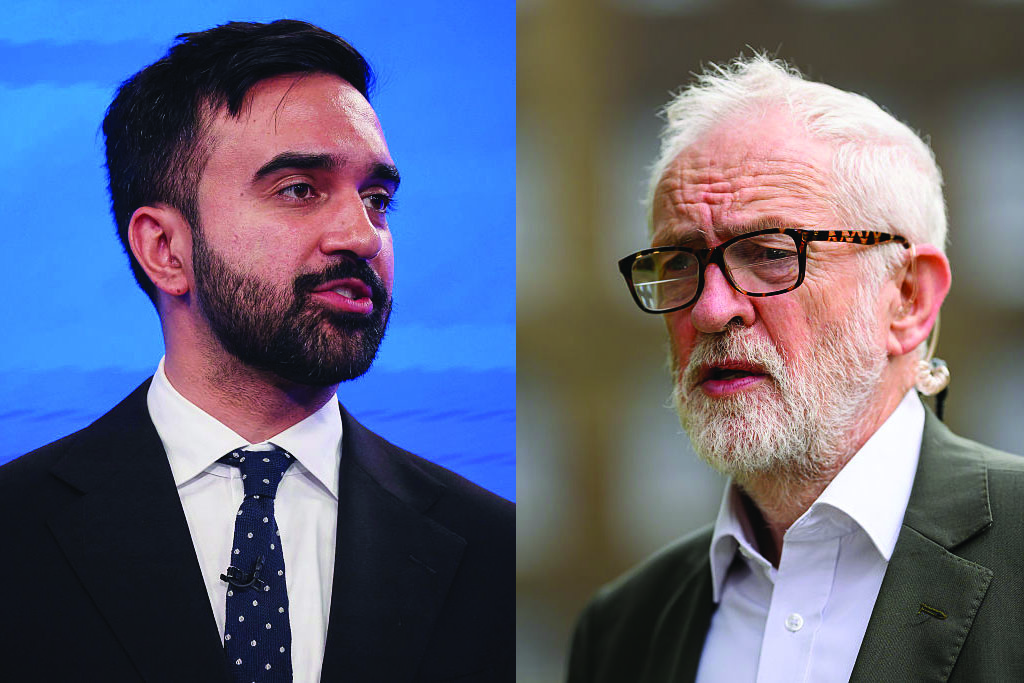
These are questions near to my heart. Not many  years ago, while living in London, I joined the Labour Party to support Jeremy Corbyn. After doing the unimaginable, however—fact-checking my anti-Zionist beliefs—I realized with horror, however belatedly, that Corbyn was, as British Jews said, an antisemite. 

Like Mamdani, Corbyn talked about socialism, and as a socialist I was thrilled. But also like Mamdani, Corbyn said it was a moral imperative to side with the Palestinians against Zionism, and I’d finally realized this was just a cover for antisemitism—that vilifying Zionism is itself a form of antisemitism. 

I’d been a socialist my entire adult life. Weird as my political group looked to outsiders, it gave my life an intense sense of purpose. It allowed me to transcend—I imagined—my life of privilege, through vicarious solidarity with the world’s powerless. It gave me a thrilling mythology, heroes and martyrs who’d fought under the red banner for the liberation of mankind. I still wanted the promise of socialism—just without the Jew-hatred. Surely that’s possible?

I returned to school, and I wrote my master’s thesis about antisemitism and the left. The facts were unassailable: Socialism and antisemitism have always gone hand in hand. Hostility to Jews is implicit in Marxism’s very project: a mobilization of the oppressed against the rich capitalists, who have always been identified (rightly or not) with the Jews.  

Hostility to Jews is implicit in Marxism’s very project: a mobilization of the oppressed against the rich capitalists, who have always been identified (rightly or not) with the Jews. 

Marx wrote revoltingly about Jews. Late nineteenth-century European Socialists flirted occasionally with antisemitic movements, seeing them as incipiently anti-capitalist. The Communists did the same while the Nazis gained in popularity, and after the war took to executing Soviet Jews as “Zionist agents.” The Trotskyists, members of the Marxist tendency I’d belonged to for so many years, sometimes criticized Stalinist and Islamist antisemitism but were among the most vitriolic anti-Zionist antisemites of all. 

Having learned this history, I hoped to convince the left to recognize its antisemitism and take it seriously. I still considered myself to be on the left—part of the community of good people, the compassionate souls who care about the poor and oppressed. I found, however, that by expressing alarm about antisemitism, I’d exiled myself from their warming companionship. Apparently carping about this subject made me that loathsome thing, a right-winger. 

The more tolerant of my London university mates listened with seeming sympathy when I explained why I thought Corbyn was antisemitic. But really, they were just waiting for my lips to stop moving. They had one, maybe two, burning questions to ask me. Maybe it’s true, they’d say. Maybe Corbyn does have a blind spot about antisemitism. But surely you aren’t going to vote for the Tories? How much does antisemitism matter, really, compared to all the other terrible things in our society? 

I might have pointed them to Dostoyevsky. In “The Brothers Karamazov,” his character Ivan poses a question. “Imagine,” Ivan says, “that you are creating a fabric of human destiny with the object of making men happy in the end, giving them peace and rest at last. Imagine that you are doing this but that it is essential and inevitable to torture to death only one tiny creature—that child beating its breast with its fist, for instance—in order to found that edifice on its unavenged tears. Would you consent to be the architect on those conditions?” Ivan’s brother Alyosha answers no. I’d think that any moral person would. 

And yet the socialist vision is premised on something along these lines, with the Jews being that child beating its breast—not necessarily weak and pitiable, not necessarily tortured to death, but removed from the rest of society, condemned, and marked for, potentially, torture and extermination.

Socialists claim they target Jews because Jews are rich and powerful; others in history have loathed Jews for being poor and weak. Hated for being capitalists, and hated for being Communists. The pretext doesn’t matter. Antisemitism—all antisemitism—claims an entire people must be designated  “it” in order that the rest of humanity may achieve total emancipation and fulfilment. 

There’s no way to erect a just society on this basis, and any movement that doesn’t see this is rotten to its core. The antisemitism on the socialist left–Mamdani, Corbyn and the rest—isn’t an unfortunate excess, or a “blind spot,” but the unforgivable feature that gives the whole game away.

The protests of British Jews were instrumental in bringing down Corbyn—I was lucky to be there to see it happen. Widespread suspicion that the Labour leader was a bigot brought the party into more disrepute than it was worth, and ultimately a new leader had to be found. The British left is still shot through with antisemitism; in these nightmarish post-October 7 days, it’s worse than ever. The UK government under the new Labour leader, Keir Starmer, has been increasingly hostile to Israel and tolerant of the antisemitic hordes marauding through British streets. Corbyn still tweets and pontificates in Parliament about the diabolical Zionists, and he still has a devoted following. His power is a shadow of what it used to be, though, and that’s a victory worth noting. 

Mamdani can be defeated too, and he must. It falls to New Yorkers to put forward and mobilize around a worthy alternative candidate, but it’s everybody’s responsibility to fight the poison of antisemitism. Even—or especially—when it comes cloaked in virtue.


Kathleen Hayes is the author of ”Antisemitism and the Left: A Memoir.”

Zohran Mamdani and the Paradox That Isn’t Read More »

Magical Economic Thinking

Has any politician ever taken Econ 101?  If so, did anyone pass?

On the Republican side, why don’t they get the idea that mutually advantageous trade leads to lower prices, higher employment and enhanced economic growth?  That non-partisan, empirical analyses show that some government programs are extraordinarily effective, a prime example being SNAP (the Supplemental Nutrition Assistance Program), which stands to lose significant funding as part of President Trump’s “Big Beautiful Bill.” And let’s not forget the Trump administration’s threat to the long-standing partnership between the federal government and research universities that has unequivocally paid for itself in terms of economic and health benefits.  

Scary stuff, but not as scary in my mind as the increasingly popular ideas among Democrats that undermine an economic system that has served so many in this country so well for so long.  

Remember when the debate between market and command economies seemed settled? The colossal failure of the Soviet Union and its satellite countries, and the growth in wealth in China after it abandoned socialism for capitalism, surely signaled the death knell for the notion that government ownership of the means of production and distribution was a viable alternative to capitalism. Except it didn’t. How ironic would it be if previously socialist economies adopt the price system as a resource-allocating mechanism while the once proudly capitalist countries move in the opposite direction?  

The results of a Pew Research Center survey from the summer of 2022 showed that while 73% of Americans aged 65 and over viewed capitalism favorably, only 40% of those in the 18 to 29 age group felt the same. Most shockingly, only 29% of Democrats aged 18 to 29 had a positive view of capitalism, while twice as many (58%) viewed socialism positively. It follows that one in three Democrats of all ages, and 42% of those aged 18 to 29, reported that they liked politicians who identify as “Democratic Socialists.”  

These numbers confirm what we already know — Bernie Sanders and Alexandria Ocasio-Cortez are rock stars among young Democrats. Their “Fighting Oligarchy” tour was the hottest ticket since Taylor Swift’s Eras tour.

That brings us to the curious case of Zohran Mamdani, the 33-year-old Democratic nominee for mayor of New York. He embraces the democratic socialist playbook: additional taxes on corporations and on affluent New Yorkers, freezing rents on a million apartments, free childcare for every child aged 6 weeks to 5 years, free buses for all 1.1 million riders, an increase in the minimum wage to $30 per hour by 2030 and the creation of city-owned grocery stores, one in each of the five boroughs, 

Why stop there? How about the city government running restaurants, or department stores? Aren’t governments famous for providing goods and services at lower cost and higher quality than the private market?  In a word:  no.

Talk about magical thinking! How convenient to ignore basic facts, such as that almost two of every three Americans own pieces of those “greedy” corporations through their mutual funds and retirement savings accounts, or that the richest New Yorkers already face federal, state and local taxes approaching the level that results in significant labor disincentives. Or that governments are notoriously inefficient.  

Perhaps one reason Mamdani hates Israel so much is that Israel has a vibrant, entrepreneurial, capitalist economy. And recall that Sanders chose to spend his honeymoon in the Soviet Union (nobody goes there for the weather).   

Capitalism isn’t perfect, but the alternative leads to reduced economic growth and prosperity.  

Capitalism isn’t perfect, but the alternative leads to reduced economic growth and prosperity. Maybe if Mamdani, Sanders and friends had spent more time working in the real world (rather than for the government), they would understand that. 

Will a larger share of a shrinking economic pie satisfy the needs and desires of the alienated lower and middle classes? I doubt it.

And I am assuming that many Gen X, Millennials and Gen Z will stand by their convictions and not dirty themselves by accepting the $84 trillion dollars in wealth transfers that is on their way from their capitalism-loving, baby boomer parents. Who needs that money, after all, when you can shop in government-subsidized stores, live in subsidized housing and avail yourself of free childcare and transportation?  


Morton Schapiro served for more than 22 years as President of Northwestern University and Williams College, where he was also Professor of Economics.

Magical Economic Thinking Read More »

‘As a Jew,’ I Love America

These days, when I hear someone begin a sentence with “As a Jew…” I brace myself. Often, what follows is some form of condemnation—of Israel, or of America itself. “As a Jew, I cannot abide the ‘genocide’ in Gaza.
 Or: “As a Jew, I can no longer support America ...” — with the blank filled in by whatever grievance is currently in vogue.

But with the Fourth of July approaching — the date marking the founding of a country that has given more to the world than any other — perhaps it’s time to say something different. Perhaps it’s time to say something grateful.

As a Jew, I love America.

Aside from Israel, this country has been the most supportive and welcoming place for Jews in all of history. That support hasn’t always been perfect or uninterrupted. But look at the arc: America welcomed Jewish immigrants fleeing pogroms, and again after the Holocaust. It gave sanctuary and dignity to survivors. It stood by Israel — more than any other nation. And most importantly, it allowed Jews to speak, dissent, pray, create, and thrive.

When my wife and I moved to New York City for a two-year sabbatical just before COVID, I remember being struck by how few American flags were being flown. I heard people say, the flag has been co-opted by the right.” Or: “It’s regressive, jingoistic to fly the flag of any nation — including the American flag,” which represents so much oppression.

I have a friend who grew up in Argentina under the lingering shadow of the Perón years. While he was still young, the country fell into the grip of a brutal military dictatorship — what came to be known as the Dirty War. He remembers adults gathering in hushed mourning for their sons and daughters, university students who had vanished — abducted, tortured, sometimes thrown from helicopters into the sea. They called them “The Disappeared.” The trauma of that era made patriotism feel impossible to him.

That friend once asked me, “Are you a patriotic American?”

“Yes,” I told him. “I am.”

He was surprised. He wondered how a thinking person could be patriotic toward any country.

I’ve thought about that question for years, and I’m thinking about it again now, as we approach the 249th anniversary of America’s founding.

For many Jews, the idea of flying the American flag now feels unfashionable—even suspect. “How can you be proud of a country that elected a monster as president?” But here’s one answer: in America, you have the right to say that. You can criticize your leaders — in the pages of this magazine, on social media, on street corners, or in private conversations. No one will disappear you for it.

That’s what freedom looks like. And like a heartbeat, it’s something we take for granted until it’s gone.

Yes, our institutions are fraying. Yes, our politics are fractured. But is it too late to fix them? I don’t believe so. The system may be broken — but the mechanism to repair it still exists.

I’ve traveled to China. I’ve been to the Soviet Union. The freedoms we enjoy — even now — did not and do not exist in those places.

Somehow, it has become fashionable—especially in academia —to distance ourselves from America. The ideology of oppressor vs. oppressed, long used to malign Israel, is now turning against Jews themselves. But the question we should be asking is not: “How else can we disparage this country?” It is: “How can we help strengthen it? “How can we unify around its most profound and aspirational principle—one nation, under God, indivisible, with liberty and justice for all”?

The Lubavitcher Rebbe called America a malchus shel chesed    a “kingdom of kindness.” He believed this nation, founded on the ideal of religious freedom, was a place where Jews could live not only materially, but spiritually. 

The Lubavitcher Rebbe — Rabbi Menachem Mendel Schneerson — called America a malchus shel chesed — a “kingdom of kindness.” He believed this nation, founded on the ideal of religious freedom, was a place where Jews could live not only materially, but spiritually. In his words:

“This country is unique in the annals of history in that it was founded upon the principle of freedom of religion… and in practice, Jews have been able to flourish here more than anywhere else in the Diaspora.”

He didn’t idealize America — he believed in its potential. He often encouraged Jews to be engaged citizens, to vote, to write to their senators, and to take part in public life as a form of spiritual service.

And that belief has borne fruit. More than 3 million Jews found refuge here fleeing the pogroms of Eastern Europe. After the Holocaust, the U.S. opened its doors to more than 400,000 displaced persons, many of them Jews. America was the first to recognize the State of Israel. It is the country where Jewish schools, synagogues, Chabad houses, yeshivot and kosher pizza shops have flourished in towns and cities across the nation.

Jews weren’t just allowed to survive in America. We thrived — and in the process, helped shape the country itself.

In literature, we had Saul Bellow, Philip Roth, Cynthia Ozick. In science, names like Richard Feynman and Jonas Salk — who helped eliminate polio from the planet. In law and civil rights: Justices Ruth Bader Ginsburg and Felix Frankfurter. Rabbi Abraham Joshua Heschel, who marched arm-in-arm with Dr. King. In music and the arts: Leonard Bernstein, Paul Simon, Steven Spielberg, Barbra Streisand. And in business, from Estée Lauder to Sergey Brin.

These aren’t footnotes. They represent a mere fraction of the contributions American Jews have made — each name, a chapter in a much larger story — one that continues to shape the character of this nation. 

And for me, it’s always been personal.

My dad was a U.S. Marine — not something many Jews can say. I remember him singing “From the Halls of Montezuma …” around the dinner table. By the time I was four or five, I knew the words. We hung the American flag on the Fourth of July and again on Veterans Day. That wasn’t performative. It was instinctual. Grateful.

Years later, I found myself working with wounded veterans, using music as a tool for healing. Some people were surprised. What’s a musician doing working with the military? But I never hesitated. My pride in being an American gave me no pause. It’s also why I’ve taught at the U.S. Army War College — not despite being a Jew, but perhaps, because of it.

When someone in your family falls ill, you don’t walk away from the whole family. You rally around them. You fight to preserve what’s essential. You believe in helping them get better. America is our home. Our flawed, beautiful, battered, and still-standing home. We don’t need to agree with everything in it to love it. 

And we should never be ashamed to say, as Jews, that we do.


Peter Himmelman is a Grammy and Emmy nominated performer, songwriter, film composer, visual artist and award-winning author. 

‘As a Jew,’ I Love America Read More »