fbpx

April 24, 2025

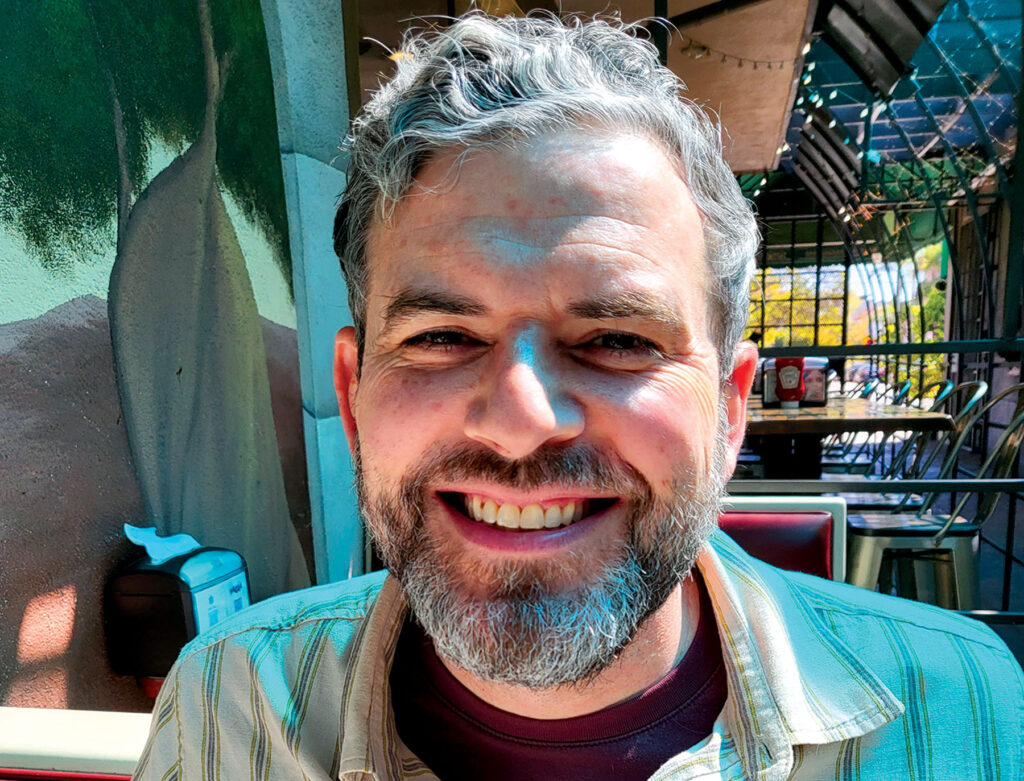
Actor Yuval David Refuses to Go Back in the Closet for Being Jewish or LGBTQ

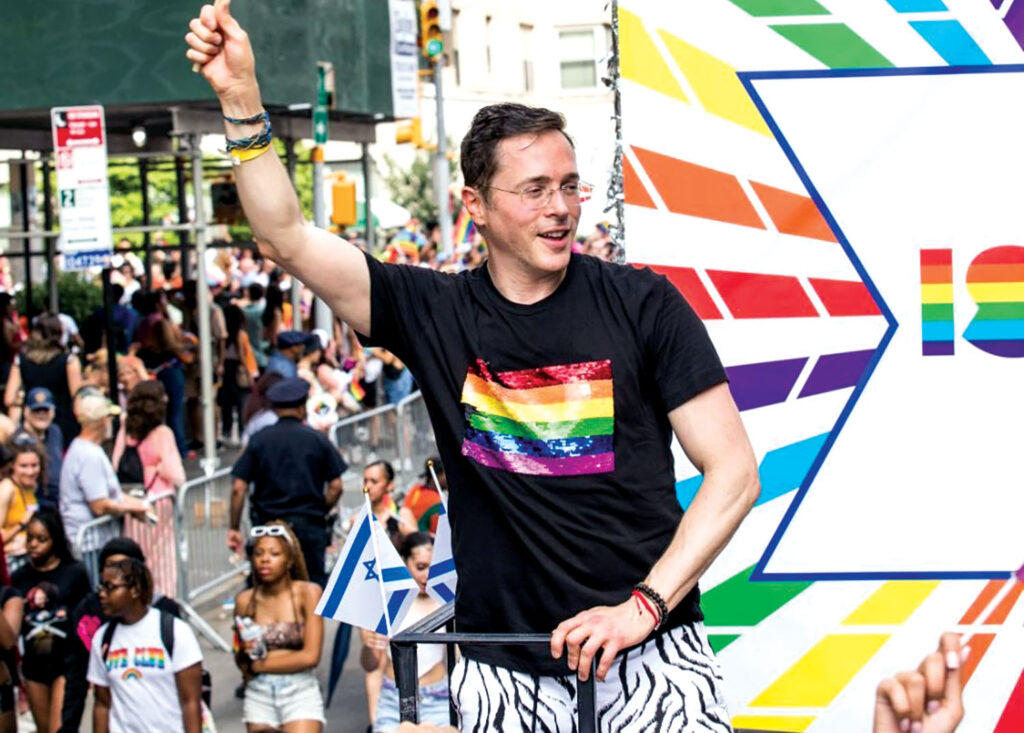
Actor, host and filmmaker Yuval David is planning to attend the Dyke March in New York City on June 28 waving both the Israeli and Pride flags. Some would call it brave; others, stupid and dangerous. However, David, isn’t going to let fear stop him. He’s done this before — and he was attacked, both verbally and physically.

In a phone interview with The Jewish Journal, he said he isn’t going to let anyone push him back into the closet, “not for being LGBTQ and not for being proudly Jewish.” Unfortunately, he added, that many in his community have been forced to make a choice to either be a Zionist and support Israel, or be part of the gay community. There is no in-between.

Many in the LGBTQ community are known to be pro-Palestinian and anti-Zionist — so much so that the Dyke March effectively banned Jews from this year’s event by saying they had “banned Zionists.” Given that eight out of 10 Jews identify as Zionists, this means many Jewish participants would need to hide any visible Jewish symbols, including a Star of David or the Israeli flag.

Yuval David, a leading LGBTQ and Jewish activist, has paid a hefty price for his activism. “I have a very supportive family and I’ve learned who my real friends are,” he said. “I’ve lost the vast majority of my friends in the U.S. because they proved themselves to be anti-Israel and anti-Zionist — which, for anybody who understands, means anti-Jewish.”

David, an Emmy award winner, has appeared on shows such as “Days of Our Lives” and “Madam Secretary,” said he no longer receives the same career opportunities he once had.

“I’m called too political or controversial because I stand up for Jewish people, against antisemitism and for the State of Israel. But I also stand up for the U.S. and democracy. We are in a decade — or even more — where people in the public eye are expected to have social and political opinions, and comment about them. How come only after Oct. 7, am I considered too political, even though I’ve been talking about it before?”

As to how the LGBTQ community became so supportive of the pro-Palestinian cause, and as a result, so antagonistic toward Israel, he offers a few explanations. The first, he said, is that the Jewish movement ignored the radical queer community and the progressive, far-left extremists.

They dismissed it as a small movement not worth the time and effort to engage with. As a result, the Islamist movement was free to ingrain itself in the LGBTQ space and win them over, feeding them a false narrative of shared oppression. People in the gay community quickly identified with their messaging and catchy slogans.

“They used these people as useful idiots who will support them without understanding that this actual movement is against them. The placard strategy is: if something rhymes, it must be true and if it sounds like a nursery rhyme, then it’s easy to understand.”

David had been waving the red flag, as he calls it, about the growing anti-Israel and anti-Zionist sentiments within the LGBTQ movement since 2016. He had alerted leaders in both the U.S. and Israel, speaking with organizational heads and anyone willing to listen, but no action was taken. Year after year, he witnessed a dwindling Jewish presence at Pride marches. It wasn’t that Jews weren’t there; they simply chose to hide that part of their identity. For a community that spent decades fighting to come out of the closet, it’s deeply ironic — and disturbing — to force anyone who openly identifies as pro-Israel into the closet. But David isn’t surprised. He’s seen this coming for years.

 “I’ve seen many Jews and Jewish organizations who choose not to be involved or attend certain events like the Pride Parade throughout the year because they recognize that they are shunned and aren’t safe,” he said. “I’m also seeing people who say, ‘We have the right to be in these spaces,’ and we face the ramifications of showing up, where chants like ‘Jews Ruin Pride,’ ‘Zionists Go Home,’ are prevalent.”

Then, he said, there are those who reluctantly make the choice to side with their LGBTQ community rather than their Jewish identity in order to fit in with the majority.

“It is very isolating and lonely, but I also learned who my real friends are. There are those who are just as supportive of me now as ever before and others who are more supportive now. It’s a good way to know who your real friends are and who shouldn’t be. This is a very important life lesson.”

“There are those who are just as supportive of me now as ever before and others who are more supportive now. It’s a good way to know who your real friends are and who shouldn’t be. This is a very important life lesson.”

Another positive outcome from this experience, he said, is that his community of friends is now much richer than before. They don’t necessarily share the same political views or opinions, but they respect one another and are able to engage in meaningful conversations. “We share the same values and know we have the right and ability to coexist and debate and have representation,” he said. “That’s what equality is all about.”

David hopes to see many proud Jews join him at the Dyke March in June, but he also knows there might be just a few of them. “I’m afraid but that’s why I’m showing up,” he said. “I’m afraid for the power that they have and I’m afraid for other LGBTQ Jews who aren’t safe. We are at war on a socio-political level and we must step up. Each one of us needs to recognize that we are a soldier of sorts for our people. We can not only rely on the IDF to fight and risk their lives for us. Every one of us needs to engage in the battle, whether it’s on college campuses, outside of Jewish businesses, in schools and on public streets.”

David suggests that one way to amplify the Jewish voice and strengthen the community is by actively supporting allies on social media. “There are coordinated efforts by those who oppose us to target our social media accounts and manipulate algorithms against us,” he said. “That’s why it’s so important for us to empower one another by following and supporting our allies online.”

Actor Yuval David Refuses to Go Back in the Closet for Being Jewish or LGBTQ Read More »

No Animal Is Loathsome to Me – A poem for Parsha Shemini

Regarding all crawling creatures that only crawl on the ground—i.e., the snake, who moves about bent over; any creature that moves about only on its belly; the scorpion, who walks on four legs; and any creature that walks on more than four legs, including any creature that has many legs—you may not eat these, for they must be considered loathsome. ~ Leviticus 11:42

No offense, meat eaters and representatives
of the vegetable community, but I’m a vegetarian.
It’s been thirty-eight years since a

formerly living creatures intentionally passed through
my lips to be broken down by my biological processes
and keep me alive another day.

I remember it well and knew nothing else for
those first eighteen years when my mother
(may she rest in Syracuse) occasionally provided

the structure, guidance, and materials for my
daily nourishment. I don’t care how many legs
you’ve got – I am not going to eat you.

Even if you have no legs and spend your time
moving from place to place on your stomach
occasionally trying to convince one of the first people

to eat what they were told they shouldn’t
you’re safe from my carnivorous desires.
I want to pet all the animals. Even the scaly ones.

Every second not writing these poems is spent
watching videos of people hugging bears or
convincing wild foxes to live inside and be dogs.

It is my main job to convince the world’s animals
I am their friend and they can count on me
for safe harbor and nourishment.

My wife and my bank account are not on board with this.
So I’ll stick with these public declarations and my
kosher-style allegiance to these ancient words.

Oh, wigglers and crawlers – you with the many legs
and stomach touching the ground, you with fur, and you
with cloven hooves. You’re forever safe with me.


Rick Lupert, a poet, songleader and graphic designer, is the author of 28 books including “God Wrestler: A Poem for Every Torah Portion.” Visit him at www.JewishPoetry.net

No Animal Is Loathsome to Me – A poem for Parsha Shemini Read More »

Instructions for Selling Off Grief

Take the pulse of the universe.
Pave a neural network acquitted of pain back, back.

Let go of tears,
but resist resisting breath.

Swallow against
paralysis.

Pinkie pointed up saluting God, Aphrodite,
any irrelevant divinity.

Tiny fist holds the handle of the white
ceramic branded with Eloise in black.

At high tea for the grand occasion of turning ten, I easily delighted at pink hot chocolate pooling over the lip, spilling into the mouth.

Meek belly the size of my adult knee
steeling itself against the translucent table.

Surrounded by art, antiques antiquated, my black skirt grazing thighs,
turquoise sequins spangling my top, whiting my skin out of its shade. 

I teetered on digits stacked side by side
at The Plaza beside my parents handling miniature cakes, unreal colors in miniature wrappers.   

The minuteness of being a wee blade blowing wild,
a wick in the world sparkling with style.

I posed before storefronts, hands clasping my small waist,
black loafers tap-dancing on tiles. 

I sat myself inside the thought:
I was Eloise, a model.

I was everything suffusing elegance, the rim of adolescence
without knowing the words, their definitions.

I knew my mother would always be my womb, that I was in her womb: protected, inviolable.

Until my pinky fell from the sky,
the Eloise mug crushing underfoot.

I could not be bolted back as though
nothing had happened.

Swallow against
paralysis.

Let go of tears,
but resist resisting breath.

Take the pulse of the universe.
Pave a neural network acquitted of pain back, back.

Take it from me,
my grief, I mean —it’s for sale.

Instructions for Selling Off Grief Read More »

Should We Stop Helping Africa?

Right now, Israel is going through one of the most painful and complex moments in its modern history. Our name is being dragged through the mud. Antisemitism is rising in ways we never imagined we’d see again in our lifetimes. And for those of us working every day to make a real, lasting difference in the world — it hurts.

It hurts to feel like the world has turned its back on us.

And in moments like these, I’ve asked myself — quietly, painfully: Should we stop?

Should we stop helping? Stop giving? Should we pull back from our work in Africa, where my organization, Innovation: Africa, has spent the last 17 years bringing clean water and solar energy to remote villages — reaching more than 5.7 million people so far?

There are days it feels tempting. After all, many of the people we help have never heard of Israel. Many probably never will. And with so much hatred directed at us—what’s the point?

But here’s what I keep coming back to:

We don’t help because it’s popular.

We don’t give because we’re loved.

We do it because it’s who we are.

We are still that people

Like so many other Israeli and Jewish organizations, we keep showing up. We keep doing the work — even when it’s hard. Even when no one is watching.

In some of the most remote places in Africa — places with no running water, no electricity, no schools — I’ve seen what Israeli innovation can do. Solar energy powers pumps that pull clean water from the ground. Israeli drip irrigation helps families grow crops. Communities are transformed. Dignity is restored.

Sometimes, we don’t just improve lives — we save them.

And yes, in some of those villages, I’ve seen Israeli flags waved in gratitude. Not because we asked. Not because they knew our story. But because they felt our intention.

So again, I ask: Should we stop?

Or should we remember that we’re part of a bigger story—one that goes all the way back to our beginnings?

In Genesis 12:3, God speaks to Abraham and makes a promise: “And through you, all the families of the earth shall be blessed.”

This is who we are. This is our calling. Our responsibility.

We don’t get to stop being a blessing when it’s inconvenient.

We don’t get to turn off our compassion because the world turns its back.

We don’t get to stop being a blessing when it’s inconvenient. We don’t get to turn off our compassion because the world turns its back.

That verse — that promise — doesn’t come with conditions. It’s not about applause or approval. It’s about doing what’s right, even when it’s hard. Especially when it’s hard.

The world might not stand with us — but we still stand for something

I know the pain many of us are feeling right now. I feel it too. We see the hate. We hear the silence from those we thought were our friends. And yes, it can be exhausting to keep giving when we feel so judged.

But this is the time to remember who we are.

Our greatest export isn’t just technology. It’s our values. Our purpose.

It’s tikkun olam, in the truest sense.

So no, we won’t stop. Not now. Not ever.

Because this is what it means to be a light unto the nations.

Because even if the world forgets who we are — we won’t.

Let them say what they will.

We’ll keep drilling wells.

We’ll keep saving lives.

We’ll keep showing up with humility, with kindness, and with strength.

Not because we have to.

Because we were chosen to.


Sivan Yaari is founder & CEO of Innovation: Africa.

Should We Stop Helping Africa? Read More »

UC Rejects Ethnic Studies Admissions Requirement

The University of California (UC) Faculty Assembly voted down a proposal to make a semester of ethnic studies an admissions requirement on April 23.

According to EdSource, a nonprofit journalism organization that covers education, the final vote count in the assembly was 29 against, 12 in favor and 12 abstentions. If passed, the proposal would have been presented to the UC Regents for approval.

The proposal, known as Area H, had garnered controversy; EdSource reported that Area H had been in the works for almost five years and would have promulgated “liberated ethnic studies” that was reflected in the initial ethnic studies model curriculum draft that the state government scrapped. AMCHA Initiative Executive Director Tammi Rossman-Benjamin wrote in an April 21 op-ed for The Journal that Area H promoted “a narrow ideological framework that casts Jews as “privileged” oppressors and portrays Zionism — a movement central to the identity of most Jews — as inherently evil.” Rossman-Benjamin also noted that “leading proponents of Area H have declared anti-Zionism a foundational principle of ethnic studies, condemned UC administrators for labeling Hamas’s Oct. 7 massacre as terrorism, and demanded the retraction of statements mourning Israeli victims.”

“(The) leading proponents of Area H have declared anti-Zionism a foundational principle of ethnic studies, condemned UC administrators for labeling Hamas’s Oct. 7 massacre as terrorism, and demanded the retraction of statements mourning Israeli victims.”- Tammi Rossman-Benjamin

Area H originated from an Oct. 2020 UC Berkeley student petition; the Board of Admissions and Relations with Schools (BOARS) initially approved it unanimously, only to reverse course in November 2023 following a years-long campaign from faculty proponents of liberated ethnic studies, according to Rossman-Benjamin. But the Academic Senate Chair moved forward with it anyway.

While state law requires high schools to provide ethnic studies courses in the fall of 2025 and make it a requirement for graduation in 2029-30, it has yet to receive state funding; an adviser to Gov. Gavin Newsom (D) told EdSource that “it will not be a priority for 2025-26, amid uncertain revenues.”

EdSource described the Faculty Assembly meeting debating the matter, which lasted 45 minutes, as being “heated.”

Some celebrated the result. The AMCHA Initiative lauded the Faculty Assembly for reaffirming “its commitment to academic integrity, fairness, and inclusion” in an email that also urged people to sign a petition calling on the California Jewish Legislative Caucus to repeal AB 101, the state law mandating ethnic studies that has yet to be funded.

Judea Pearl, chancellor professor of computer science at UCLA, National Academy of Sciences member and president of the Daniel Pearl Foundation, thanked everyone that “who helped achieve this victory, and may our high school students remain protected from the poison of political indoctrination” in a post on X.

“This initiative is sponsored by an extreme far-left faculty activist group, which would make their perverted version of ‘ethnic studies,’ which furthers the BDS agenda and targets and discriminates against Jews and vilifies Israel, a mandatory course for all high school students aspiring to attend UC,” S.A.F.E Campus, a nonprofit focusing on combating antisemitism on campuses, posted on X.

UC Rejects Ethnic Studies Admissions Requirement Read More »

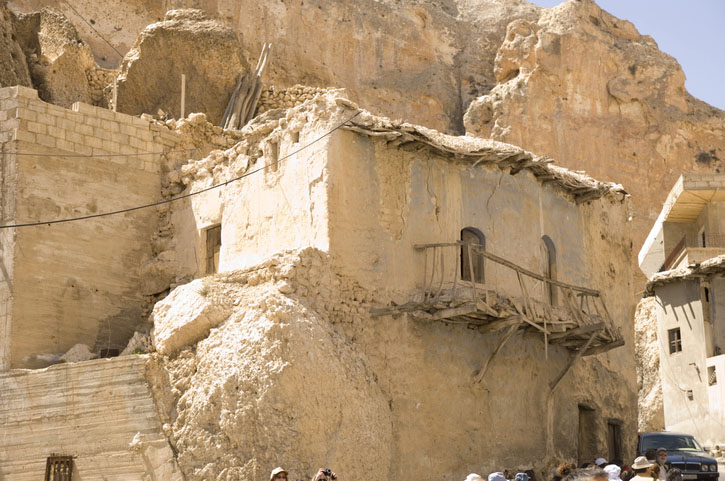
Praying for Peace in Aramaic and Hebrew in Maaloula

If you are ever in Damascus
and long for somewhere cooler,
the question that you ought to ask is:
“How do I find Maaloula?”

It’s cool, you’ll like the mountain breezes,
it’s quaint and it’s archaic,
the villagers feel close to Jesus
for they speak Aramaic.

Example.  When they say: “Our Father
who art in heaven,” they
don’t use the Arabic, but rather
words Jesus used to pray.

I wonder, if they learned the Talmud
would they put on a hat,
or would they use a safety helmet
in case they fell down flat
upon their faces, since they’re speaking
a language that is dead?
Would Jesus know what they are seeking
when they say “daily bread”?

Their tongue is virtually extinct,
linguistic dinosaurus;
its meanings hardly are distinct
unless you’ve a thesaurus.

Can they, I ask, adjudicate
in Aramaic laws,
like Jews who still Talmudicate
in words the world ignores?

I hope they can, and that they manage
to keep their language stable,
to add to English, French and Spanish,
their Babel to the cable.
No word has an equivalent,
like x’s algebraic,
I hardly am ambivalent
about old Aramaic.

In Talmud study and my prayers
I use this ancient language
whose death would cause Maaloulian heirs
and Jews enormous anguish.

Shlama rabba the words expressed
by Jews since they oppose
its opposite, which that they detest,
bilingually wars’ foes,
shalom the Hebrew leitmotif
recalled by Jews, balladish,
concluding with complete belief
in peace, the core of Qaddish.


The penultimate verse of the Qaddish is for shlama rabba, two Aramaic words that mean “great peace.” The last verse is a prayer for shalom, the Hebrew word for peace:

יְהֵא שְׁלָמָא רַבָּא מִן שְׁמַיָּא וְחַיִּים עָלֵינוּ וְעַל כָּל יִשרָאֵל. וְאִמְרוּ אָמֵן: [קהל: אמן]
Let there be shlama rabba, great peace, from heaven and life on us and on all Israel, and let us say amen
עוֹשה שָׁלוֹם בִּמְרומָיו הוּא יַעֲשה שָׁלום עָלֵינוּ וְעַל כָּל יִשרָאֵל וְאִמְרוּ אָמֵן: [קהל: אמן]
Let him make shalom, peace, in His high places, He will make shalom, peace, on us  and on all Israel, and they will say amen.

In “Ancient Syrian Town Seeks Interfaith After Long War.”” NYT, 4/15/25, Ben Hubbard and Hwaida Saad write:

Inside a centuries-old monastery atop a mountain in western Syria, a priest swung an incense holder on a chain, led his flock in melodic chants and delivered a timeless sermon on the importance of loving one’s neighbor.

But when the congregation gathered for coffee after the service, their current worries surfaced, about how peaceful Syria’s future would be.

Would the Islamist rebels who ousted the strongman Bashar al-Assad in December ban pork and alcohol, impose modest dress on women or limit Christian worship? Would the new security forces protect Christians from attacks by Muslim extremists?

“Nothing has happened that makes you feel that things are better,” said Mirna Haddad, one of the churchgoers.

“Hanging these bells provided relief to people,” Father Barkil said. “In the end, they are the voice of God.”


Gershon Hepner is a poet who has written over 25,000 poems on subjects ranging from music to literature, politics to Torah. He grew up in England and moved to Los Angeles in 1976. Using his varied interests and experiences, he has authored dozens of papers in medical and academic journals, and authored “Legal Friction: Law, Narrative, and Identity Politics in Biblical Israel.” He can be reached at gershonhepner@gmail.com.

Praying for Peace in Aramaic and Hebrew in Maaloula Read More »

A Bisl Torah~Freedom in the Familiar?

If one reason why we refrain from chametz is to experience a hint of suffering, when do we begin to feel a sense of freedom?

Some may say freedom arrives with the first taste of pizza. But I begin to feel relief when I change over my kitchen, putting my coffee maker, mixer, and toaster back in their rightful places. There is freedom in the familiar.

However, this week ushers in Yom HaShoah, when we remember the six million that perished at the hands of the Nazis. I heard twin sisters share their story. Their parents survived the war by fleeing to Shanghai. The sisters grew accustomed to living in ghetto conditions, sometimes five families sharing one tiny room. They lived in dire straits until the family left for Minnesota; the girls were then eight years old. The sisters explained they did not understand freedom until they walked into a home in which the plumbing was inside and under the roof. Freedom felt strange, uncomfortable even. While there was no desire to return to their prior lives, the road forward was scary and confusing. What was this new and shiny future?

Perhaps we have the Passover experience all wrong. The refraining from chametz may be the beginning of freedom; the opportunity to do something different, to change our routine, elevate our minds through what we put in our mouths. We assume the familiar feels freeing, but really, it is the first step into the unknown that may bring a sense of possibility we have yet to experience.

Freedom comes when we do not settle back into our familiar habits but instead, choose to forge a brighter path forward: An uncharted road, a journey unexplored. But redemption awaits those of us that are willing to walk ahead.


Rabbi Nicole Guzik is senior rabbi at Sinai Temple. She can be reached at her Facebook page at Rabbi Nicole Guzik or on Instagram @rabbiguzik. For more writings, visit Rabbi Guzik’s blog section from Sinai Temple’s website.

A Bisl Torah~Freedom in the Familiar? Read More »

A Moment in Time: “Breaking the Limit”

Dear all,

My car lets me know when I’m going over the speed limit.

So do my kids.

Here I was going 38 in a 35 zone.

”Daddy, you’re breaking the law and you might get a ticket and go to jail.” Eli said.

”Don’t worry, daddy,” Maya chimed. “I’ll visit you and bring you a sandwich.”

The very nature of humanity is breaking boundaries. Without reaching for the fruit, we would still be in the Garden of Eden. Without yearning for freedom, we would still be slaves in Egypt. Without wrestling with God, we would still be adolescent in our thoughts.

Yes, we break limits.

But we also need to be mindful at each moment in time when it’s appropriate and when it isn’t. Sigh – I wish there were a science to this. It would make life much easier.

But it would not necessarily make life more fulfilling.

And so, we reach and we yearn and we wrestle. And sometimes we break a limit. And sometimes we stay within. And sometimes we will get a ticket (or cause an accident.). And sometimes we will discover our highest potential.

And this morning? This morning I was able to get the kids to school on time!

With love and Shalom,

Rabbi Zach Shapiro

A Moment in Time: “Breaking the Limit” Read More »

Israel Bonds Event, FIDF Founder’s 98th Birthday, JFSLA Receives Grant

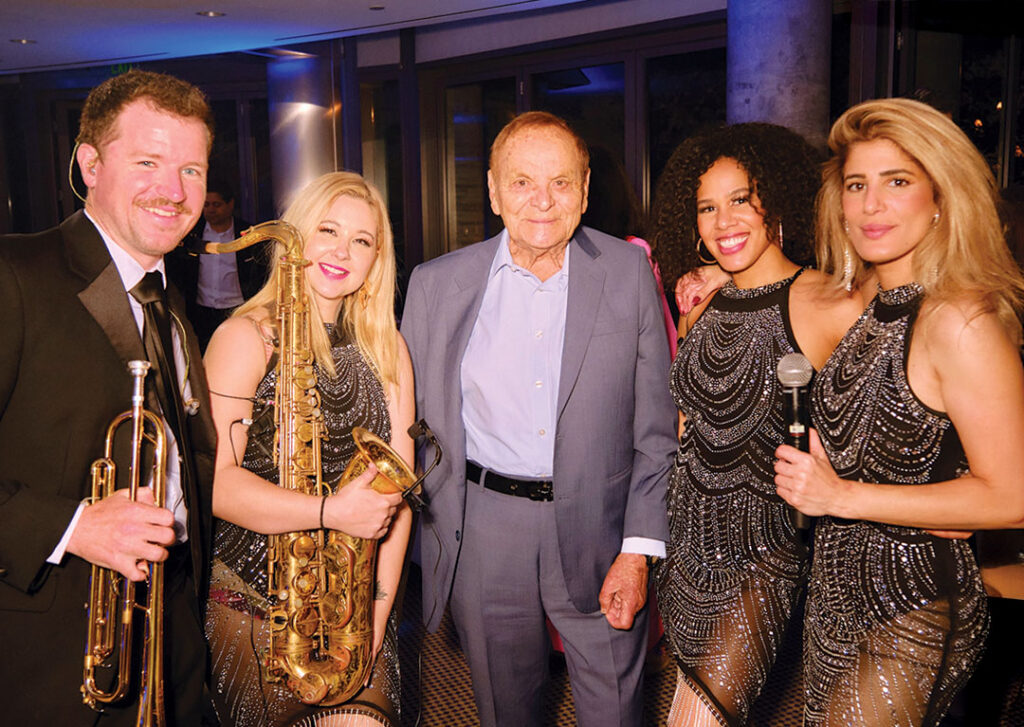
Leo David, founder of Friends of the Israel Defense Forces (FIDF) in Los Angeles, marked his 98th birthday with a lavish celebration at the Skirball Cultural Center. The event, held on April 6, was attended by friends and family who enjoyed a vibrant pre-reception featuring an array of gourmet sushi and live music, setting the tone for the festive evening.

Guests were then ushered into the main hall, where tables were elegantly arranged around a spacious dance floor, creating an intimate yet grand atmosphere. One of the evening’s highlights was a mesmerizing hour-long performance by samba dancers, which concluded with guests joining in a joyful and spirited conga line.

Adding to the international flair, the Moments Band from Israel delivered an energetic and soulful musical performance that kept the celebration going strong.

David walked around the tables, greeting friends—including Roz and Jerry Rothstein of StandWithUs, philanthropist Naty Saidoff, Maccabi World Union CEO Eyal Tiberger and philanthropist David Wiener — all of whom share David’s passion for supporting Israeli causes. Members of the Israeli Consulate were also in attendance, including Consul General of Israel in Los Angeles Israel Bachar.

David’s annual birthday celebration has become a cherished tradition over the past decade, bringing together loved ones and community leaders to honor his remarkable life and the lasting impact of his philanthropy.

By Ayala Or-El, Contributing Writer


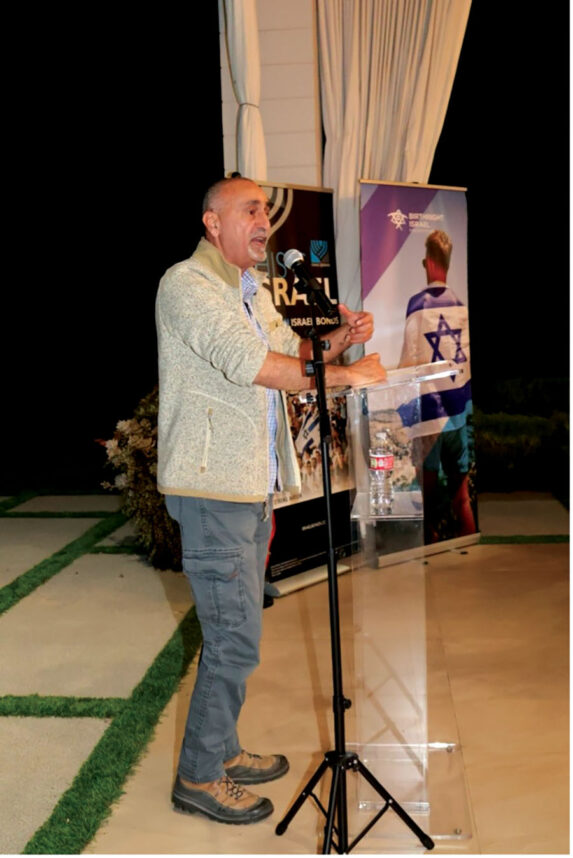
Taglit Birthright Israel Vice President of Educational Strategy Zohar Raviv addressing the audience. Photo courtesy of Miller Ink

Zohar Raviv, renowned Jewish thought-leader and international vice president of educational strategy at Taglit Birthright Israel, spoke at an event on Jewish identity and resilience with Israel Bonds Los Angeles and Shvilim, the Jewish gap year program, on April 7 at a home in Encino.

Attendees included Israel Bonds Advisory Council Members Melanie and David Ryngler and Boris Epstein as well as Israel Bonds Women’s Division Chair Alyse Golden Berkley.

“Oct. 7 is not an event that defines my identity. What defines my identity is the way Jewish people responded to that event. Resilience, camaraderie, responsibility, faith in each other,” Raviv said, during his address to the crowd. “The wars of Israel are not Jewish events; they are interruptions to the Jewish story. What happened on Oct.  7 is not a Jewish event; it’s an event that was imposed on us. The way we responded to that event — with honor, resilience, and peoplehood — that is what we should educate the Jewish people about.”

The evening underscored Jewish community and unity in the face of adversity, and the enduring spirit of resilience. As Raviv eloquently emphasized, it is the response to challenges, rather than the challenges themselves, that defines Jewish identity.


A JFSLA representative helps to address immediate community needs, including food insecurity. Photo courtesy of Jewish Family Service LA

Jewish Family Service LA (JFSLA) recently received a $250,000 grant from the FireAid benefit concert, which raised $100 million for wildfire relief efforts in Los Angeles County. This grant, according to JFSLA leadership, recognizes JFSLA’s critical efforts supporting survivors of the Palisades and Eaton fires.

“As Los Angeles’s oldest social services provider, JFSLA is proud to continue our tradition of providing essential services to those looking for hope, healing, and a place of community,” JFSLA CEO Eli Vietzer said. “We’re honored to receive this FireAid grant, which allows us to better serve our city’s most vulnerable, especially in the aftermath of these devastating fires, when more people than ever need a helping hand.”

The FireAid funding enhances JFSLA’s efforts to provide social services and trauma-informed care to individuals affected by the fires, according to JFLSA. The grant will be used to hire social workers and address immediate needs, including food insecurity. JFSLA works closely with older adults, people with disabilities, survivors of domestic violence, and those at risk of becoming homeless to ensure they get the support they need. Services include the SOVA Community Food and Resource Program, senior programming and community dining centers, mental health counseling, and shelter and support for survivors of domestic violence.

The FireAid grant will support JFSLA in its efforts to connect people with counseling, help them rebuild, find community and receive social-emotional support in the aftermath of the fires.

The FireAid grant will support JFSLA in its efforts to connect people with counseling, help them rebuild, find community, and receive social-emotional support in the aftermath of the fires.


Israel Bonds Event, FIDF Founder’s 98th Birthday, JFSLA Receives Grant Read More »

Rabbis of LA | How Rabbi David Kasher Spans the Secular and Religious Worlds

For most of the year, Rabbi David Kasher grew up “as a regular American kid,” spending the school year with his hippie mother in Oakland. But summers were spent with his religious father in Brooklyn. “Obviously there was a stark dichotomy,” he said. “But I always was enchanted by my father’s world. I had an impulse for religion.”

That impulse has remained steady. After spending five years as an associate rabbi at IKAR, Kasher is the West Coast director of the Hadar Institute, founded by the noted Open Orthodox Rabbi Avi Weiss. Clearly, Rabbi Kasher has learned how to straddle the widest horizons of the Jewish world. Every summer, he said, he was introduced to “frumkeit, Haredi, Chassidus and however else ultra-Orthodoxy is described. It was always gnawing at me, something I wanted to go into deeper.” But Kasher didn’t really understand the content. He didn’t speak Yiddish. He didn’t know the texts. He didn’t know what was on the inside.

Just after college, his beloved father died. In his grief, Kasher looked for answers to questions he always had wondered about. Without his father’s encouraging presence, he looked at his life and posed two questions: What does all of this mean? Can I live it? Determined to find out, not long after his father’s funeral, Kasher was off to yeshiva. A quarter-century later, he says with a smile, “The rest is history.”

Entering yeshiva, he found a comfortable familiarity with frumkeit, and began immersing himself in the world of learning. But hailing from contrasting worlds, one entirely religious, the other entirely secular, he didn’t know how to orient himself. “I was always trying to find where I belonged, what I believed. The constant was the exhilaration I felt through this path.” He made the decision to enter yeshiva because he “had to figure out my own direction,” he said. “I always had been nourished by Judaism, but almost by proxy, my father doing it for me. I felt if I didn’t anchor myself soon, I would lose all contact.”

“I was always trying to find where I belonged, what I believed. The constant was the exhilaration I felt through this path.”

Rabbi Kasher was ordained by Rabbi Weiss in New York around the 2006 founding of Hadar, which defines itself as “a center that builds vibrant, egalitarian communities in North America and Israel, rooted in rigorous, nuanced Torah study, gender equality and meaningful Jewish practice.”

Kasher thanked Weiss, saying “he had been a rebbe to me. He has modeled for me what an authentic religious life looks like. His insides and his outsides match. He is living his truth. We all have different truths to live out in the world. The purpose of having a rebbe is to be someone who is living your truth.” Kasher started working in the Bay Area, teaching at day schools and then Berkeley Hillel. His friend Sara Bamberger organized Kevah, groups learning Torah in people’s homes. He became the lead teacher. Kevah, taken from Pirke Avos, means “make your Torah a fixed practice.”

By the time he hit his 30s, Kasher was thinking more deeply about what makes a dynamic, accessible Torah learning experience. “That’s the tension I always have wrestled with as an educator,” he said, “the balance between depth and accessibility.” How do you give people access to something unfamiliar to them – give them the tools and expose them to the depth of the complexity and majesty of Torah.

Hadar was established on New York’s Upper West Side as a minyan, became a beit midrash (learning center) and then a yeshiva. As Hadar grew to become a larger Jewish learning institute with many kinds of programs, Rabbi Kasher’s role is to connect people to those programs. 

For Kasher, this is defined by its rigor of religious observance combined with a desire to create an egalitarian community. More than that, it is about Klal Yisroel, trying to engage everyone. In studying and practice. “I have explored all over the spectrum of Jewish life,” said the rabbi. “I feel myself constantly growing, evolving.”

Torah study and practice have been constants in the life of the rabbi. “The practices of Jewish life have been incredibly grounding for me, sort of liberating, too,” he said. “What’s unique about Hadar is the particular blend of sensibilities.”

How does Kasher categorize Hadar? While “it might be easy to place Hadar somewhere between the Orthodox and Conservative communities,” Hadar tries not to think in terms of labels. “The point is we are here to serve Klal Yisroel,” Kasher said. “We want people to have a dynamic experience of the classics of Torah and learning, the classics of prayer and mitzvot and practice.” The rabbi stresses Torah and Torah study because “I am based in one of the greatest Jewish communities in the world.”

Emphasizing Hadar’s central philosophy, “we need spaces where everybody in the community feels they can come and learn Torah.”  

Face-to-face is his way to teach and to learn. “Hard to feel the whole power of Torah unless you are face-to-face,” he maintained. Most importantly, “I want so much to give people the experience I had, not just to study, but to be deep, deep ­­— to enter inside of Torah. That’s the space I want to get people to. Hard to do that on a computer screen.”

Fast Takes with Rabbi Kasher

Jewish Journal: What was your favorite childhood experience?

Rabbi Kasher: Walking on the Coney Island Boardwalk with my father.

J.J.: Do you have many female students?

RK: Yes. The goal is to have 50-50. I want to create a space of Torah where every Jew feels comfortable. Women and men for sure — but also all kinds of other identities. I hope we are heading into a future where we will hear more of women’s voices in Torah. 

J.J.: The favorite moment of your week?

RK: My Thursday Parsha class, online at noon.

Rabbis of LA | How Rabbi David Kasher Spans the Secular and Religious Worlds Read More »