fbpx

April 24, 2025

Powerful Jewish Stories — In Comic Book Form

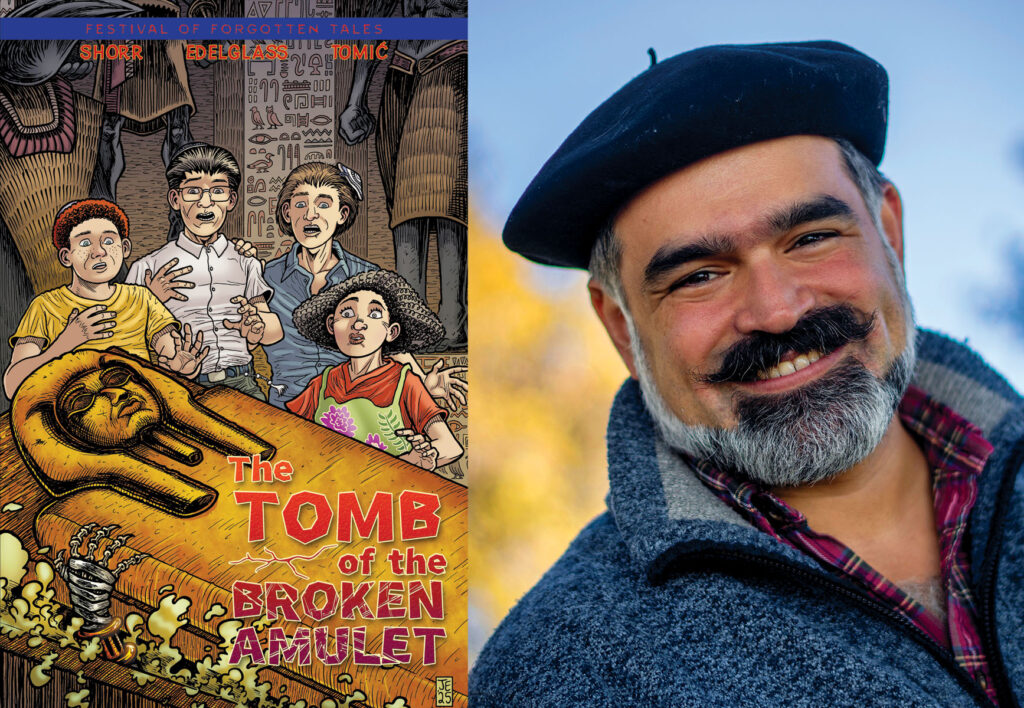
The Jewish tradition overflows with stories — and great storytellers. This month, just before Passover, award-winning storyteller Arnon Z. Shorr and illustrator Joshua M. Edelglass published their latest comic book, “The Tomb of the Broken Amulet.” The story follows the Azaria siblings — Reuven, Sol, Benny and Dinah — whose Passover break turns extraordinary when they stumble upon an ancient tomb hidden in the Judean desert. As curiosity draws them deeper, they inadvertently awaken a mummy that seems determined to pursue them. Facing this unexpected danger, the siblings must uncover the tomb’s secrets, face their fears and find the courage to confront the mummy.

“With ‘The Tomb of the Broken Amulet,’ I wanted to put a classical mummy story in a Passover setting,” said Shorr, who enjoys blending Jewish elements with popular folklore. “The story isn’t just a fun genre mash-up. It’s about a post-Oct. 7 family contending with loss, finding courage and learning that like the Passover seder, our stories don’t truly end until we’ve found what’s missing.”

“The story isn’t just a fun genre mash-up. It’s about a post-Oct. 7 family contending with loss, finding courage and learning that like the Passover seder, our stories don’t truly end until we’ve found what’s missing.” – Arnon Shorr

Shorr, an award-winning filmmaker and author, was born in Haifa, Israel and moved to the United States with his family when he was a year and a half old. Speaking to The Jewish Journal, he mentioned that his children — ages 12, 9 and 5 — are usually his first critics. A few years ago, Shorr moved from Los Angeles to a city south of Boston, making it easier to meet up with Edelglass, with whom he had worked on another comic book, “José and the Pirate Captain Toledano.”

The two had met a few years ago when Edelglass hired Shorr to teach a film class at Camp Ramah Massachusetts, where he works as one of the camp’s directors. Shorr, who is also a filmmaker, had released a short film, “‘The Pirate Captain Toledo,”’ about a Jewish pirate in the 16th century, and wanted to turn it into a children’s book. 

“It was my way to show that I can tell a story that crosses beyond our Jewish bubble. At the time, and even more so today, telling a Jewish story was a heavy lift in Hollywood. Expanding it from a short film to a feature or a TV show seemed out of reach, so, I was looking for other ways to share the story.”

Then he saw a beautiful illustration Edelglass had posted on social media and reached out to him. “I told him I might be interested in telling the story I’m working on as a comic book,” he said. After sharing the idea for his book, the two quickly connected and began working together. They managed to secure a book deal and published the graphic novel in 2022.

The book received critical acclaim and that success sparked the idea to create a series of comic books with Jewish themes. Their next collaboration was “The Beast and the Booth,” a story that weaves Jewish themes of faith and family into a supernatural monster narrative.

When it came time to write his latest book, Shorr knew it should take place either in a museum or Egypt as it was a story about a mummy but quickly decided to set it in Israel. “I asked myself, how can I tell a Pesach story that’s both inherently about Passover and fits within the realm of popular folklore? It quickly became clear that the story needed to take place in Israel, post-Oct. 7,” he said. In the book, the family’s home in northern Israel was destroyed in a rocket attack and they have relocated to the south. 

Much like the four sons in the Haggadah, this story centers around four siblings, each with his own distinct personality. The older two are twins, “one is very meticulous about halacha and the other is a loose cannon. With the younger two, one is fairly simple and the other is very quiet.” 

While the story is rooted in Jewish motifs, Shorr emphasizes that the book isn’t meant exclusively for Jewish children — it’s for anyone who enjoys a good mystery and adventure tale. “I always try to frame stories in a way that even people who aren’t Jewish can find something to connect with,” Shorr said. “This story includes elements that may not be familiar to non-Jews, but in popular culture, we often enjoy stories based in traditions that aren’t our own. When the story is good, it works.”

While working on the book, Shorr made a surprising discovery about the origins of mummy mythology. While the genre is widely believed to have emerged in 19th-century Europe, he found evidence that it dates back much further, possibly to biblical times.

“I came across a story in the Midrash about what happened after Joseph died,” he said. “He made everyone promise to bring his bones back to the Holy Land one day. And when the time came to leave Egypt, Moses, according to the Midrash, went to the tomb. There were many sarcophagi, and he didn’t know which one was Joseph’s. So he called out: ‘If you want us to fulfill our promise and take you with us, rise up.’ And that’s when one of them began to rise.”

Shorr recalled how stunned he was reading the story. Not only did the mummy rise from the dead — it followed the exact structure of a classic gothic horror tale. “A mummy with unfinished business, rising up from the tomb … this is the same concept behind the European idea of the mummy’s curse,” he said. “And yet this version is at least 1,000 years older than the literature usually cited as the beginning of the mummy-monster genre. It was such a fascinating and fun discovery.”

Shorr is currently working on his next book, a Rosh Hashanah unicorn story, which, like the other books in his “Festival of Forgotten Tales” series, blends a Jewish holiday with a monster or folklore theme. “Our goal is to publish three or four stories and then combine them into an anthology,” he said.

“The Tomb of the Broken Amulet” is available on Amazon.

Powerful Jewish Stories — In Comic Book Form Read More »

A Rabbi and Therapist’s Take on ‘Adolescence’

After watching Netflix’s series  “Adolescence,” as a rabbi and therapist, my first question was, “Who’s to blame?” The series focuses on 13-year-old Jamie Miller, a young British boy who is accused of murdering Katie, a female classmate. We learn about Jamie’s engagement with Instagram, his interactions with Katie online and how social media, his self-worth, and relationships with women impact his choices. The four episodes peel back the layers of Jamie’s personality, goading the viewer to wonder how and why a seemingly benign child could commit such a tortuous act. He is charming, sweet, and even after watching the video that implicates Jamie for murder, we are left confused. This couldn’t possibly be the same child who wet his pants when confronted by the police. There is a supportive, loving, compassionate father who stands by his son’s side. A dedicated, down-to-earth family with a devoted mother and sister. They must have the wrong child. But they don’t. Jamie is obviously the murderer. And my only conclusion to the question, “Who’s to blame?” is the following: 

We all are. 

Here are my three takeaways from “Adolescence”:

Jamie’s family is our family. Mine and yours. There is nothing special or different about Jamie’s family. A family of four trying to make ends meet. A mother and father involved enough but also understandably busy with work, keeping a roof over their children’s heads and staying ahead of piling bills. The family is not visibly poor and likewise, not visibly wealthy. The family has enough means to buy their son a coveted pair of Nike trainers but not enough to keep his father home from working late-evening shifts. Their children have phones and are on social media, not surprising for a young boy and girl over the age of 13. According to the Pew Research Study in 2024, six out of 10 teenagers engage with TikTok on a daily basis and on average, half of all teenagers use Instagram and Snapchat every day. Jamie attends a private school, where there is both a policy for wearing uniforms and cell phone usage. Teachers struggle at enforcing both. 

As a mother of a 13-year-old and rabbi who interacts with hundreds of teenagers, there was nothing remarkable about Jamie, his family or school. And because of this lack of distinction, I felt compelled to continue watching the series. Yes, we should add social media alert apps to our children’s devices. Yes, we should work together to strengthen cell phone bans in middle schools and high schools. And yes, there must be a concerted effort to breakdown the ways young men are relating to young women. However, the first takeaway was, this can happen to me. This can happen to any of us. So, I implore you, do not turn off the television. Keep watching. Because Jamie’s family’s story could easily be any one of ours. Encourage your friends and peers to watch the series. We can’t afford to hide, turn the other way or pretend that the consequences displayed in “Adolescence” only happens to certain families. This story is just as much about Jamie Miller as it is about all of us. 

Our children speak a different language. One of the most poignant scenes is when Adam, DI Luke Bascombe’s son pulls his father aside during an investigation at Adam’s school. Bascombe goes classroom by classroom, trying to discover Jamie’s motive. Adam, who is wildly unpopular and clearly bullied himself, explains his father is asking the wrong questions, looking in the incorrect places. To understand Jamie’s motive, one must understand the world of social media, the harrowing underworld of Instagram and TikTok, and the language used by teenagers and young adults. Adam reveals that just one emoji, followed by hundreds of “likes” can cause a teenager to spiral out of control. Following the release of “Adolescence,” articles popped up explaining the multiple meanings behind seemingly innocent emojis. Business Today explains that certain emojis are used to symbolize drugs, sexual acts, acts of bullying and ways to get around helicopter parents. Proverbs 22:6 reads, “Train a child in the way he should go. He will not swerve from it even in old age.” Meaning, parenting is hard. Each child should come with a different set of instructions but we must stay vigilant. Attachment parenting teaches us that we must “study” our child in order to develop a sense of trust between parent and child. We spend years laying a strong foundation so that when our child is in need, they will know we are present to help them navigate this murky world. However, parents are now at a severe disadvantage. Where it may have been a lack of understanding in the newest lingo (i.e. “cringe” or “slay”), when allowing children on social media, it is as if we are sending them into an alternative universe where parents are unaware of the rules, communication, dialects and consequences. Permission to “go online” must now come with training seminars (updated each quarter) so that both parents and young adults are aware of the words, phrases, and messages conveyed through a single heart, kidney bean, eggplant or snowflake. Imagine sending our child into outer space without a GPS or roadmap. How are they supposed to navigate this language when we, their instructors, role models and teachers are not even aware of the language’s existence itself?

The village is dead. When Jamie posted pictures of models on Instagram, was there not one parent or professional (outside of Jamie’s parents) who noticed the story? A major preventative in ACES, adverse childhood experiences include the positive presence of someone outside of the child’s parents. For example, is there a teacher, guidance counselor, camp leader, rabbi, priest or peer’s friend who serves as another mentor or resource to that child? But realistically, who would have seen the social media posts? Ideally, another parent or older sibling or even responsible friend might think to themselves, “This could go very wrong.” 

Perhaps because of the extremes associated with isolation during the COVID years, we have lost accountability for one another. In “Adolescence,” the teachers are overworked, exhausted and, like many professionals, trying to “survive” hour by hour. The storyline moves forward. We don’t witness any past phone calls from worried teachers about Jamie’s behavior or concerned parents who caught Jamie or Katie’s interactions online. And when we think about our own circles, how many of us have fostered environments where we have said to our children’s friends’ or peers’ parents, “Please call me if you see anything troubling about my kid”? In a world in which we ourselves post facades, painting stories of perfect families, vacations and lifestyles, it is difficult to ask our community for help in raising our children. However, we must move beyond our egos and for the sake of our children, create the village once again. When you are unable to be online, who is watching your children? And likewise, are you willing to help guide the children around you, moving past judgment, embracing scrutiny in a way that just might save the lives of those you love?

For years I have preached about the uniqueness of each soul; each one of us has a purpose we are meant to achieve in our lifetimes. But in reality, we are not that different from each other. In efforts to escape the watchful, often painful gaze of others, our children retreated into a different world: a world with a different language, different rules and different norms. Now is the time for a revolution. To take back our kids. Take back our village. The rabbis teach that if you save one life, it is as if you have saved an entire world. 

If we don’t counterculturally embrace each other, there may not be a world left to save. Who’s to blame? Us. Who is responsible? You and me. 

I won’t turn away. I hope you don’t either.


Rabbi Nicole Guzik is Senior Rabbi at Sinai Temple.

A Rabbi and Therapist’s Take on ‘Adolescence’ Read More »

Five for Fighting’s John Ondrasik Releases Musical Tribute to Israeli Hostage

Musician John Ondrasik, who performs as “Five for Fighting,” has continued to show he is one of Israel’s most outspoken allies.

Ondrasik, who isn’t Jewish, recently collaborated with Idit Ohel, the mother of current Israeli hostage Alon Ohel. Alon, 24, was abducted on Oct. 7, and he’s one of 24 hostages still believed to be alive in Gaza. In partnership with the Ohel family, Ondrasik has released a reworked version of his popular song, “Superman (It’s Not Easy),” along with a music video that shines a light on the plight of the hostages. The video, among other images, features a young Alon wearing Superman pajamas.

Currently, 59 hostages remain in Gaza, including 35 confirmed deceased. 

To honor the hostages still being held by Hamas, Ondrasik has changed the original “Superman” lyric, ”Find a way to lie, ‘bout a home I’ll never see,” to “Find a way to fly, to a home I will soon see,” underscoring Ondrasik’s hope that the release of the hostages still being held in Gaza will soon become a reality.

“The boundless spiritual fortitude of the hostages and their families is beyond words,” Ondrasik said in a statement about the reworked song’s release. “It felt right to change the lyric, to honor their strength and to remind the world, they are still there. We cannot forget them.”

“Superman” was originally released in April 2001. In the aftermath of the Sept. 11 attacks in New York City, the song was used to honor victims, survivors, police and firefighters affected by the attack. 

This is not the first time Ondrasik has shown solidarity with Israel. Shortly after the Oct. 7 Hamas-led attack against Israel, the 60-year-old musician released “OK (We Are Not OK)” which condemned the rise of Jew-hatred around the world in the immediate aftermath of the Hamas invasion. The release of the song led to him visiting Israel, where he performed both “Superman” and “OK” in Hostage Square in Tel Aviv, as well as participating in numerous pro-Israel events in Los Angeles.

He likened the experience of performing at Hostage Square to performing at Madison Square Garden in the aftermath of the 9/11 attacks in New York.

He likened the experience of performing at Hostage Square to performing at Madison Square Garden in the aftermath of the 9/11 attacks in New York.

The Jewish community has embraced him, and he has reciprocated the love, he said. 

“In many ways, I’ve become a better person from interacting with so many of my Jewish friends the last 17 months,” Ondrasik said during an April 18 Zoom interview.

As of April 21, the video tribute to Alon, who is a pianist, had accumulated nearly 2,000 views. 

“I’m very happy for Idit and all the hostage families that it’s resonating,” Ondrasik told The Journal.

In a recent interview, Ondrasik spoke about his ongoing support for the State of Israel, being embraced by the Jewish community and why he’s been an advocate for the Jewish people.

“To me it’s not a religious issue — I’m not Jewish — it’s a moral issue,” he said. “The fact that the world is upside down and so many people have a problem saying, ‘Free the hostages,’ shows how broken we are. That’s really what [my song] ‘OK’ is about, that we’re not okay.”

Music, he said, is an ideal medium for expressing one’s point of view. “Music has a way of breaking through,” Ondrasik said. “Music has a way of allowing people to listen when they may not agree with you…that’s why music is so important to fight this culture war.”

Ondrasik, a UCLA alumnus, said he welcomed the way the Trump administration — particularly Secretary of State Marco Rubio and National Security Advisor Mike Waltz — has attempted to crack down on college campuses that have not done enough to protect Jewish students on their campuses.

“From day one, Oct. 8, they have been standing shoulder to shoulder with Israel,” he said. “You may not like Trump, you may not like Netanyahu, but to me this is not a political issue, it’s a moral issue.”

Ondrasik, whose wife, Carla Berkowitz, is Jewish — though nonpracticing — recently had his first seder experience. His wife, he said, “didn’t practice religion growing up. We don’t celebrate holidays, but I went to my first seder last Sunday [April 13]. I love the Jewish traditions; I love the fact they have a 10-day holiday for Passover — I want that.”

While the antisemitism facing Jews the past year and a half has weighed on him, Ondrasik said he’s feeling some hopefulness. He feels, he said, as though the “tide is turning.”

“I do see the tide turning in some spots,” he said. “I’m feeling a little optimistic.”

Five for Fighting’s John Ondrasik Releases Musical Tribute to Israeli Hostage Read More »

Keffiyeh Socialism

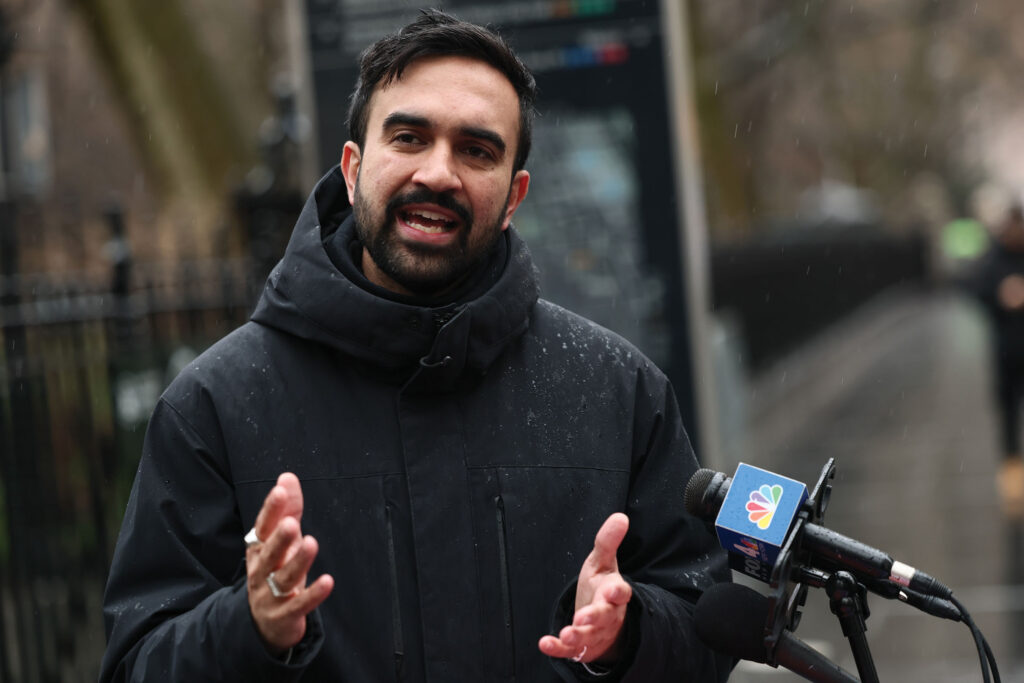
Bernie Sanders is “definitely a style icon.” So says Democratic N.Y. State Assemblyman Zohran Mamdani, 33, who trails former Governor Andrew Cuomo in the Democratic primary for New York City mayor. The scariest part for most New Yorkers: that’s not even close to the most bizarre thing he has said.

Let’s start with those pesky Jews. Early in 2023, Mamdani introduced a bill called the “Not on Our Dime!: Ending New York Funding of Israeli Settler Violence Act,” which would prohibit registered charities from donating to organizations that support Israeli “war crimes” or settlement of Judea and Samaria. In November 2023, Zohran joined Cynthia Nixon in a five-day hunger strike in support of an immediate ceasefire. 

“I’ve been proud to be the first, and to my knowledge, the only mayoral candidate to have said that I would not have sent the police onto Columbia and CUNY’s campus,” said Mamdani. He has accused Israel of committing “genocide,” and says he’ll arrest Prime Minister Netanyahu if he ever sets foot in NYC (Cuomo has already joined the legal team defending Netanyahu).

Mamdani has attended rallies held by Within Our Lifetime, which protested outside the Nova exhibit here chanting: “Kill another Zionist now.” Mamdani also led a five-day “hunger strike for Palestine” outside the White House and blocked the entrance of the New York Stock Exchange in a call for the U.S. to stop arming Israel.

“On Oct. 8, 2023, while Jews were still being butchered, Zohran Mamdani condemned Israel and couldn’t even bring himself to mention Hamas,” Assemblymember Sam Berger, a Democrat who represents a district with a high concentration of Orthodox Jews, said in a statement. “Zohran just spent three hours sipping espresso with an influencer who has used his platform to refer to Jews as bloodthirsty pigdogs, Orthodox Jews as inbred, and has said it doesn’t matter if rape happened on Oct. 7.”

“Zohran Mamdani is running the most deceptive, divisive, and antisemitic campaign in the history of New York City,” added Berger, who says he’s voting for Cuomo in the June 24 primary. The latest polls have Cuomo leading Mamdani 64% to 36%, with 20%  still undecided.

Mamdani’s antisemitism is homegrown. Born to a Muslim family of Indian descent in Kampala, Uganda, his father teaches “colonialism” at Columbia University while his mother, filmmaker Mira Nair, boycotts Israel. 

His father’s new course at Columbia, “Settlers and Natives,” argues for “the necessity of violence in anticolonial struggle.” In November 2023, his dad said: “There’s nothing wrong” with describing Oct. 7 as a “military action.” And last April, his father participated in Columbia’s notorious anti-Israel encampment, leading a teach-in for students on the “historical context from South Africa’s apartheid era.” 

In 2014, during his senior year at Bowdoin College, Mamdani tried to launch a boycott of Israeli academic and cultural institutions. It was necessary, he argued, “to end the oppressive occupation and racist policies within both Israel and occupied Palestine.” At Bowdoin, Mamdani also co-founded the college’s chapter of Students for Justice in Palestine (SJP), whose national arm called Oct. 7 a “historic win for the Palestinian resistance.” 

Socialism über alles

Mamdani began calling himself a socialist in high school, but unlike most of us he didn’t reconsider after discovering that socialism destroys everything it touches, including more than 100 million people. At the Bronx High School of Science, he promised “fresh juice” daily to classmates and free gym credits for just attending sporting events if they elected him vice president. He couldn’t come through on either promise.

The Queens assemblyman is now a member of Democratic Socialists of America’s eight-member “Socialists in Office” bloc. The DSA advocates abolishing the police and prisons, establishing “social ownership of all major industry and infrastructure,” granting voting rights to “noncitizens,” ending “Israeli apartheid,” and establishing “a democratic secular state, from the river to the sea.”  

Mamdani’s wishes for NYC include: 

• Creating a Department of Community Safety to focus on expanding “violence interrupter” programs (an effort to defuse disputes before they escalate) and mental health teams that respond to 911 calls instead of the police. (Budget: $1 billion.)

• Eliminating the NYPD’s overtime budget and its Strategic Response Group that responds to protests. 

• Free buses for all; free childcare for all kids 6 weeks to 5 years.

• Rent freeze.

• City-owned grocery stores. 

• Giving all new families in NYC “baby baskets” containing baby products such as diapers and nursing supplies.

The fact that violent crime is the number one concern for most New Yorkers doesn’t seem to matter to Mamdani, nor does the fact that the NYPD is facing a staffing crisis, largely due to inane “progressive” policies. Cuomo will hire more than 5,000 more police officers to address the crisis.

Mamdani is pitching a 2% tax hike on NYC’s millionaires to help pay for his agenda. “When it comes to taxing the 1% of New York City we will do so by taxing them an additional 2%,” he gleefully states. Mamdani’s plan also calls for a 4.5% increase in corporate taxes, which is sure to go a long way to keep corporations in NYC. Millionaires fled NYC in droves during COVID’s early days, so Albany lawmakers are unlikely to increase taxes, but Mamdani doesn’t seem to care about facts.

His housing plan costs $100 billion, only slightly less than the entire size of this year’s city budget. That’s on top of the $7 billion his other agenda items would cost, including $800 million for free buses, $1.1 billion to build a new Department of Community Safety, and $5 billion for free childcare.

Indeed, the fact that he blatantly misunderstands how basic economics work could be due to the fact that he has led somewhat of a privileged life.

Born in Uganda, Mamdani moved with his family to the U.S. at the age of 7 and became a U.S. citizen in 2018. He grew up in a faculty apartment along Riverside Drive, and attended the hyper-progressive Bank Street School for Children, which currently charges more than $66,000 per year and has taught that white students are born racist. Although Mamdani describes himself as a “graduate of the NYC public school system,” he didn’t attend any public school. In 2014, he graduated from Bowdoin College, an $86,000-a-year private school, with a degree in Africana Studies.

Before entering politics, Mamdani tried to work as a rapper in NYC subway stations. He might want to return to this except this time doing it the socialist way: without asking for donations. #FreeMusic. That’s something New Yorkers can get behind.


Karen Lehrman Bloch is editor in chief of White Rose Magazine.

Keffiyeh Socialism Read More »

The Ethnic Studies to Antisemitism Pipeline: Pajaro Valley Edition

On Wednesday night, often to cheers and applause, school board members of the Pajaro Valley Unified School District (PVUSD), in Santa Cruz County California, berated and accused the Jewish community of using its wealth and privilege to maintain power at the expense of black and Hispanic communities.

The comments were made during a PVUSD meeting centered on whether to renew its contract with Community Responsive Education (CRE), an organization led by Allyson Tintiangco-Cubales, to provide professional development for Ethnic Studies. Tintiangco-Cubales is a member of the Liberated Ethnic Studies Model Curriculum Consortium (LESMCC) and an original author of the California State of Education’s model Ethnic Studies curriculum. The curriculum had to be revised after widespread concerns over antisemitic content. As a result of those changes, Tintiangco-Cubales subsequently removed her name from the finished product.

PVUSD had a previous working relationship with CRE when they developed PVUSD’s Ethnic Studies framework and helped with curriculum development and teacher training. This relationship was severed after Tintiangco-Cubales’ public rejection of California’s model ethnic studies curriculum. Since then, activists have fought for PVUSD to reinstate its contract with CRE.

Thanks to California’s AB 101 legislation, Ethnic Studies will soon become a graduation requirement for California’s high schoolers. As activists were quick to point out in last night’s meeting, Ethnic Studies is not Multicultural Studies; it is not the study of different communities and their contributions to the United States. As it is written and applied, Ethnic Studies is about identifying systems of power and oppression and learning how to dismantle them.

Systems do not materialize out of thin air. They are built. They are designed. If our liberal society is a “system of oppression” then it must have been purposefully designed by oppressors to maintain power.

Ethnic Studies teaches a Manichean worldview of good and bad, oppressor against oppressed, powerful and powerless. That kind of simplistic thinking has always been a happy hunting ground for the antisemite and the conspiracist. It is no surprise, then, that as Ethnic Studies gets adopted in K-12, there is a rise of antisemitism in schools. And this was perfectly displayed by the school board members who voted to approve the CRE contract last night.

Trustee Joy Flynn, for example, assured the Jewish community that there was no hint of antisemitism in CRE’s work while simultaneously claiming that the Jewish community has economic power and white privilege that they are not using to benefit the wider community. Trustee Gabriel Medina went further, addressing Jewish community members in the audience: “You only show up to meetings when it’s beneficial for you, so you can tell brown people who they are…the lies that you spewed here tonight were insane … if you want to continue to be segregationists like you have in the past …”  

A teacher in PVUSD said, in regard to antisemitism in the CRE curriculum, “It would be disrespectful to me, to every teacher who has been in this training, to every student, if you were to say ‘We don’t believe you, we believe this one minority’ and maybe the fact they gave money to certain campaigns helps.” He went on to say “Turns out I’m part Ashkenazi Jew, so if that ups my favoritism, please renew CRE.” This last remark was met with jovial laughter. 

This wasn’t just offensive — it was revealing. Open antisemitism like this may shock, but it shouldn’t surprise. The ideological lens of Ethnic Studies, with its obsession over systems of power and its binary moral structure, aligns all too easily with antisemitic conspiracism. Tragically, it seems that PVUSD has adopted this worldview wholesale.

Let’s hope other districts don’t follow their lead.


Dr Mika Hackner is Senior Research Associate at the North American Values Institute. She has been published in Times of Israel, The Jerusalem Post, the Washington Post, Quillette and the Jewish Journal. 

The Ethnic Studies to Antisemitism Pipeline: Pajaro Valley Edition Read More »

A Warm Hug: New Fund Helps Jewish Families Rebuild After Devastating LA Wildfires

Shortly after her home in Pacific Palisades was destroyed in the fire, Emily Kane Miller, founder and CEO of Ethos Giving, was already thinking about how she could help. While her entire neighborhood was struggling to find housing and come to terms with an uncertain future, Miller was on the phone with the Jewish Federation of Greater Los Angeles (JFEDLA), working on a plan to support the Jewish community.

That plan became the HUG Fund — short for “Helping Uplift Generations” — a multimillion-dollar initiative offering tangible support to local Jewish families trying to rebuild their lives. The fund aims to ease the burden of recovery by covering half the cost of Jewish preschool tuition and summer camp for families affected by the fires.

Miller and JFEDLA identified two key areas they wanted to support: early childhood education and Jewish summer experiences. These are essential to maintaining a sense of stability, connection and continuity during times of crisis, yet they’re often overlooked as families deal with more immediate needs.

Launched in late March with a heartfelt Instagram video from actress and advocate Mayim Bialik, the HUG Fund is already gaining attention and support, offering fire-impacted families a way to begin looking toward the future with cautious optimism.

Miller said she found a tremendous partner in JFEDLA President and CEO Rabbi Noah Farkas to roll out the initiative as part of JFEDLA’s larger Wildfire Crisis Relief Fund. The broader fund provides essential ongoing resources, including mental health support, warm meals, shelter and safe space for displaced individuals, families and institutions.

“When disaster strikes, it can alter life trajectories and weaken communal bonds,” said Farkas. “This strategic fund is designed to address the urgent needs of Jewish families and uphold our collective commitment to Jewish life as a valuable cornerstone that supports our families to rebuild with dignity, resilience and hope.”
According to CalFire, the combined area damaged by the Palisades and Eaton fires exceeded 63 square miles — larger than the total area of Washington, D.C. and three times the size of Manhattan. More than 16,000 buildings were destroyed and nearly 30 lives were lost.

The blazes hit the Jewish community particularly hard. Based on initial survey data collected from synagogues, approximately 1,000 families either lost their homes or had them deemed uninhabitable. Synagogues in both the Palisades and Pasadena were severely affected, temporarily displacing entire congregations.

In a recent open letter published in the LA Times, Farkas reflected on the equalizing force of a natural disaster:

“Fire’s purpose, if it can be said to have one, is to reduce complex matter to the most basic of elements,” he wrote. “The fire has done the same for all of us. Whether we live in Pacific Palisades, Altadena, or anywhere in between, the suffering and subsequent outpouring of love produced by these tragic events broke down our differences and taught us that we are all made of the same grist.”

In a phone interview with The Journal, Miller said she wanted to create maximum benefit for the community. The name HUG, she explained, came simply from wanting to give those families a warm and encouraging hug.

“We wanted to make it easier on families who had lost so much. I wanted to create a fund that would be meaningful for our community, but one that not only benefits them and their children today, but also for the rest of their lives,” said Miller.

“We wanted to make it easier on families who had lost so much. I wanted to create a fund that would be meaningful for our community, but one that not only benefits them and their children today, but also for the rest of their lives” – Emily Kane Miller

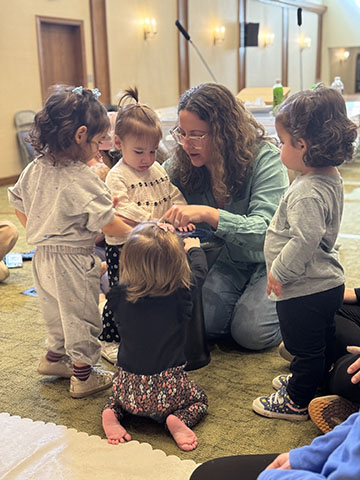
The HUG Fund will provide tuition reductions for Jewish early childhood centers and Jewish overnight summer camps not only to help preserve Jewish life, but also in the hope of welcoming new families into the community — regardless of their prior involvement. This way, families who hadn’t previously enrolled their children in Jewish programs can now offer them this meaningful experience.

“As a kid who grew up going to summer camp myself and as a mom to kids who are going to Jewish summer camps, I just know in my bones that this is the kind of place that will help kids feel joy and warmth,” said Miller. “For families who lost their homes in the fire, this is a home away from home. We know how impactful those are for Jewish life, spirituality and continuity, and we felt that it makes a huge difference today — but also creates stability and real groundwork for those families to truly move forward with strength.”

Rabbi Daniel Sher of Kehillat Israel in the Palisades, whose community was severely impacted by the fires, said he is deeply grateful for the fund, which will benefit many in his congregation. While the synagogue itself wasn’t damaged, many of the families who sent their children to the preschool there were forced to evacuate. The school is now operating out of Beth Shir Shalom in Santa Monica.

“Of the kids in the preschool, 40% don’t live in the area anymore. We have some who are driving all the way from Manhattan Beach, Beverly Hills and the Valley because they want to stay connected to the community, but some just can’t make it work,” said Sher.
The tuition assistance being offered to those families, he said, could be a game-changer in helping them decide where to rent. “If they want to stay close to their children’s Jewish school, that would allow them to do so more easily,” he said.

JFEDLA also offers the One Happy Camper fund and working with the HUG Fund, families affected by the fires will be eligible for a 75% discount on overnight summer camp tuition. “These are exactly what our community needs right now. We don’t want families to have to choose whether or not to send their kids to camp,” Miller said.

“When people talk about something being ‘unprecedented,’ they often mean the dramatic beginning,” said Sher. “But the real unprecedented part is the healing. The ripple effect to the Jewish community and our synagogue is going to be tremendous. They’ve created a way to make the healthiest, best choice for the Jewish community. As a rabbi, I’m profoundly moved that we have this infrastructure in place to help families who have experienced trauma feel compassion and support in this way — and that has an incredibly healing factor.”

A Warm Hug: New Fund Helps Jewish Families Rebuild After Devastating LA Wildfires Read More »

Sarah Nathan: NOOISH, Matzah Ball Soup and Latkes

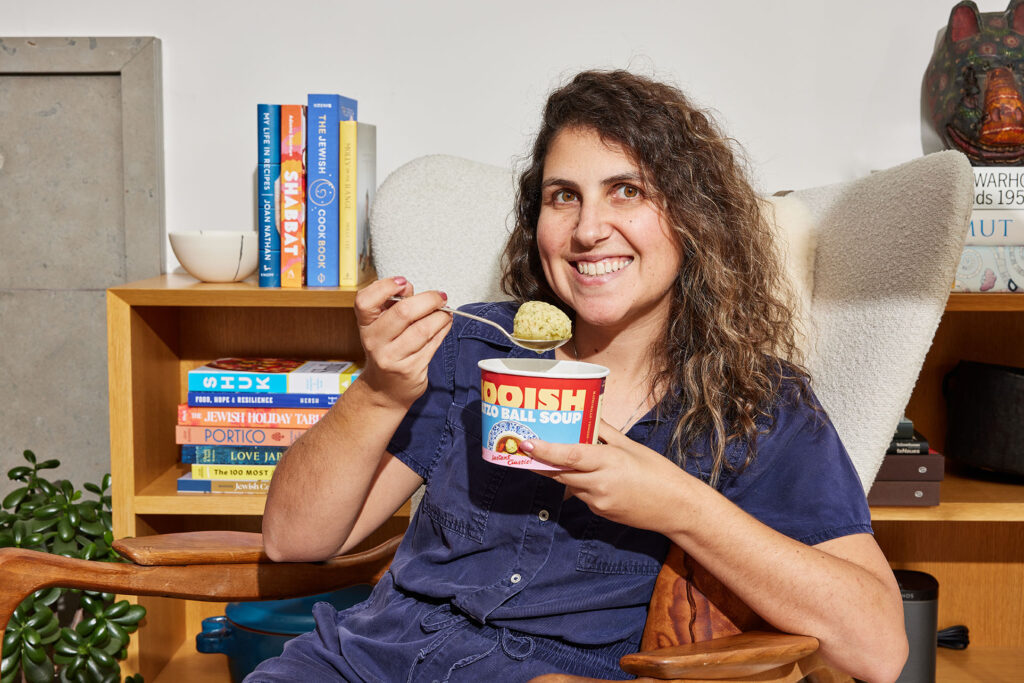
Sarah Nathan has always been a huge fan of soup. It’s no wonder instant matzah ball soup is the first product released under her Jewish comfort food brand, NOOISH.

“Soup blends so many flavors together, and it really can have a depth that you’re not going to get with normal cooking,” Nathan told the Journal. “You get this melding of flavors and that warmth in your heart. … We call it a hug in a cup for a reason.” 

Nathan had been in the culinary space for a while — she ran programming at the Chobani Incubator, was a category manager at National Co+op Grocers and is culinary coordinator for B’teavon, an annual Jewish culinary experience, among other experiences — when she noticed a gap in the market. 

“I was a producer on the Great Big Jewish Food Fest at the beginning of the pandemic, when people were really searching for comfort,” she said. “So many people were interacting with our programming, because it really was telling so many diverse Jewish stories … we really had programming geared towards black Jews, Latinx Jews, Asian Jews, LGBT, different generations.”

People from all over the world were sharing their stories, and feeling connected with each other and the Jewish culture.

“When we came out of all that, [I noticed] everyone else [was still] elevating their own culture’s food [but] nobody really is doing that for Jewish food, outside of the kosher aisle,” she said. 

NOOISH Foods — a new-ish take on Jewish comfort food — started with a mission to elevate and make Jewish food accessible. After all, Jewish food is constantly changing and modernizing.

With her instant matzah ball soup, Nathan developed a product that represents one of the most beloved Jewish staples. One people seem to only put a lot of time and effort into around the Jewish holidays. 

“I kind of equate it to tamales in Mexican culture,” she said. “They really spend the time doing it over Christmas, but people love tamales all year round.”

And while people love matzah balls, and have their own preferences — floater or sinker — actually making them is the hard part.

“It just takes time,” she said. “You got to mix, you got to wait, you got to form, you got to hope that you got it right.”

Now, when you feel under the weather or just need a cup of soup, you don’t need to make the effort. 

“It is very similar in format to Instant Ramen,” she said. “Just add water and microwave for two-and-a-half minutes, and you get a really delicious steaming fresh bowl of matzah ball soup.”

Instant gratification matzah ball soup still counts, Nathan explained.  “I get comments online all the time: ‘My grandmother would be turning over in her grave; if you’re not making it from scratch, it’s not real,’” she said. “Well, I’m making it from scratch, so you don’t have to.”

Nathan said her earliest food memories revolve around the holidays and cooking with her mom. “We definitely made matzah ball soup; her famous dish is mandel bread,” Nathan said. “Spending those times in the kitchen, making it with her and then really seeing that love language of feeding people when you got to go to someone’s house [and] bring that dish.”

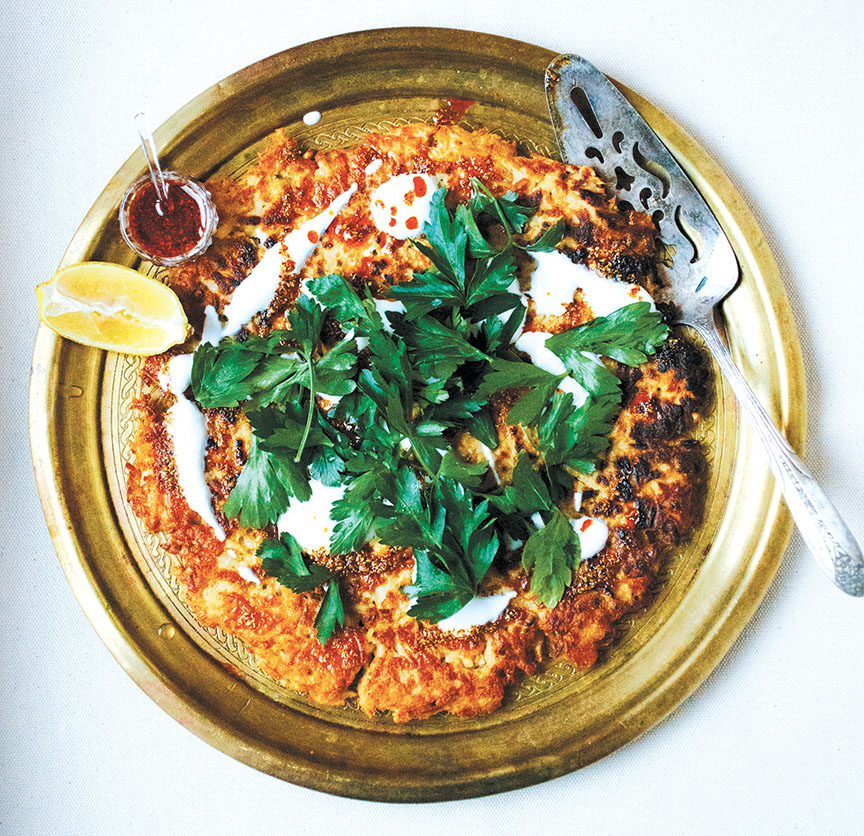
One of Nathan’s favorite recipes is the Jerusalem latke from New York Shuk. That recipe is below. 

“It has Jerusalem artichokes and potatoes; some really interesting things that aren’t just potatoes,” she said. “And they’re another one of my favorite brands … I love to really uplift the community of other Jewish food … brands.” 

Nathan hosts a lot of Shabbat dinners; she does consumer packaged good industry Shabbat dinners at big trade shows and smaller dinners, where she shares modern recipes, like the one from New York Shuk. 

“I like to bring in all of our cultures, and make the table feel unexpected,” she said. “I like bringing together a lot of different traditions, so that anyone can say, ‘I fit at this table and I fit in here.’”

Learn more at NooishFoods.com and follow  @NooishFoods on Instagram and YouTube.

For the full conversation, listen to the podcast:

Giant Jerusalem Artichoke Latke

Makes two 12-inch latkes

Recipe by Ron and Leetal Arazi, co-founders of New York Shuk 

”Jerusalem artichokes are one of our favorite ingredients to cook with. Here, we make an oversize version, which we top with yogurt, herbs and our Shawarma spice. The hot latke paired with the cold yogurt, spices and fresh parsley makes for a winning dish. We serve it cut into wedges.”

3 cups Jerusalem artichokes, peeled and grated

1 cup potatoes, peeled and grated

1 small onion, grated

1 tsp salt

1 tsp Shawarma spice

3 eggs

1/4 cup all-purpose flour

Canola oil, for frying

Plain yogurt and parsley leaves, for serving

Garnish: 2 Tbsp Shawarma Spice + 2 Tbsp olive oil

In a small bowl, mix the Shawarma spice with the oil and let sit until ready to use.

In a medium bowl, cover the grated Jerusalem artichokes and potatoes with cold water to rinse. Drain well and squeeze out as much water as you can. Place in another bowl and add the onion and squeeze again if the mixture doesn’t seem dry. Add the Shawarma spice, salt, eggs and flour and mix well.

Heat oil in a 12-inch frying pan. Add half of the latke mixture and spread it in an even layer. Cook until crisp and golden on the bottom. Flip the latke and cook until crisp and lightly browned on the other side and tender in the center. Transfer to a plate. Repeat with the remaining latke mixture. Drizzle the latkes with yogurt, fresh parsley leaves and a drizzle of the Shawarma spice in oil.


Debra Eckerling is a writer for the Jewish Journal and the host of “Taste Buds with Deb.Subscribe on YouTube or your favorite podcast platform. Email Debra: tastebuds@jewishjournal.com.

Sarah Nathan: NOOISH, Matzah Ball Soup and Latkes Read More »

Second Annual Neurodiversity of Kindness at Vista Del Mar

Kindness is one of the ultimate Jewish values, and so is leaving no one behind. In that spirit, Vista Del Mar’s House of Lovingkindness, Beit Chesed, will host its second annual “Neurodiversity of Kindness” performance and art show on Sunday, April 27 at its West Los Angeles campus. The event, co-produced by Vista’s Director of Spiritual Enrichment Rabbi Jackie Redner and Harri James O’Kelley of The O’Kelley Lab, features storytellers of all abilities in a variety of disciplines.

“Our family has received so much love and support from Rabbi Jackie and Vista’s programs over the years,” O’Kelley, a mother of three special needs young adults and creative community partner, told The Journal. “I’m so grateful for the huge difference that Vista made in our family’s life and grateful for the opportunity to work with Rabbi Jackie again to bring this show back to Vista.

In honor of Autism Awareness Month, neurodivergent performers will share stories about kindness and compassion through music, dance and film, as well as a silent presence woven between the acts. There will also be a companion art show, as well as a table from Autism In Entertainment (AIE), where autistic individuals and families can learn more about opportunities from their community partner organizations.

“Vista Del Mar’s mission has always been to both bear witness to … and nurture the light in each young person who comes into our care — to protect it and affirm its preciousness … until it can shine bright all on its own,” Redner told The Journal. “The ‘Neurodiversity of Kindness’ event is magnificent because of the light being shared and received by all participants: performers, viewers and all who make the show happen behind the scenes.”

Performers and artists from Straight Up Abilities, Spectrum Laboratory, Exceptional Children’s Foundation, Able ARTS Work and LA Goal will be back this year, as well as the Vista Del Mar choir. 

“It has been a pleasure to work with Harri on this project of heart,” Redner said. “And to know we have the full support of Vista’s President and CEO Lena Wilson, who will be singing in our Vista choir during this event and sharing her own beautiful light.” 

New to this year’s “Neurodiversity of Kindness” include Exceptional Minds talent, neurodivergent choreographer Brian Golden, a CalArts student, and neurodivergent composer Isaiah Scanlon, a Bridges Academy high school student. Voice actors Mallory Reese and Tyler Berman, who are Spectrum Laboratory’s real-life “Love on the Spectrum” couple, will emcee, along with Redner, who is the host. “It’s an honor and privilege being part of anything that helps promote anything that’s related to neurodiversity and art in a positive light,” Berman, who is proud that he gets to do it in a Jewish setting, told The Journal. 

Emcees for this year’s “Neurodiversity of Kindness” show will be a neurodivergent couple— voice actors Mallory Reese (L) and Tyler Berman (R). (Photo by Tyler Berman)

“I used to believe that my abilities and gifts had nothing to do with my struggles,” Reese told the Journal. “Over the past year, I’ve come to realize that they are two sides of the autism coin.” She is excited and hopeful that this event will open people’s eyes. “I want everyone to see how our daily battles strengthen each and every one of us,” she said. “That we are gifted because of it.”

O’Kelley, who loves discovering and collaborating with neurodivergent talent, is thrilled to once again create an opportunity for special needs individuals and interns to work with industry volunteer mentors, either on their performances or in learning how to put a theater show together.

“In developing this year’s show, my hope is to highlight the kindness and gratitude that these talented performers and non-profit partners generate in our community,” O’Kelley said. “An event like this could only be made possible by an organization like Vista Del Mar, which has been committed to the mental health and well-being of children and families in our community for over 100 years.”

Added Redner, “Those who enter … the sacred space … for this year’s event, will delight in a celebration of neurodivergent artists and performers, and those who support them; I can’t wait to revel in the joy of this beautiful event!”

Vista House of Lovingkindness, Beit Chesed, is an inclusive and multi-generational community of belonging who gather to share community service experiences, monthly virtual shabbat events and community mind-body medicine healing classes.

The “Neurodiversity of Kindness” takes place on Sunday, April 27, 2025, from 3:30-5:30pm at the Glorya Kaufman Performing Arts Center on the campus of Vista Del Mar Child and Family Services, 3200 Motor Avenue, in West Los Angeles. Learn more at: https://www.vistadelmar.org/events/the-neurodiversity-of-kindness. 

Second Annual Neurodiversity of Kindness at Vista Del Mar Read More »

Spice of Life: A Slice of Za’atar Challah

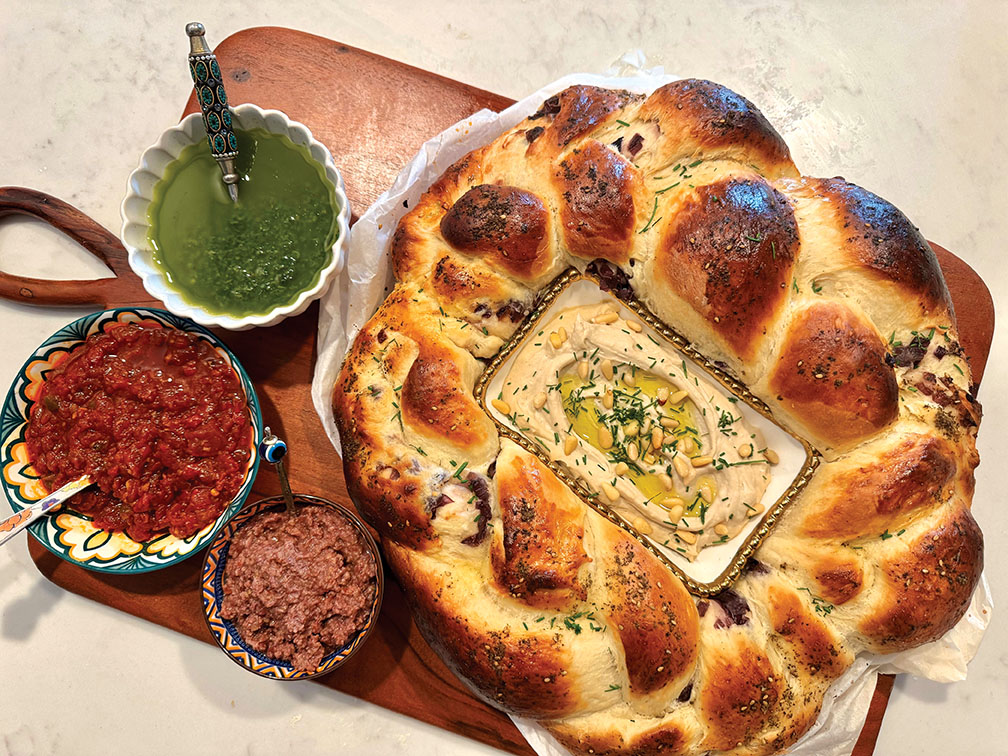
For me, challah baking is a labor of love. The magic of proofing the yeast with sugar and warm water to form a creamy, bubbly foam. The powdery white cloud and soft fluttery feel of the flour as it is sifted into the bowl. Mixing in the oil and eggs and yeast mixture and the tight pull of kneading the ingredients. The satisfaction of a perfect smooth, stretchy dough. Watching the puffy rise of air in the dough. The satisfaction of punching it down, forming strands, then braiding and baking.

This week, dear reader, Sharon and I wanted to inspire you to bake your own challah.

Of course, that meant we had to photograph our challah before Pesach. And we were on a very tight deadline because Sharon was leaving to spend Passover in South Africa.

My challah always comes out perfect, but this time around I was stressed and rushing and I deviated from my recipe. After I put the three eggs in the dough, there was one lonely egg in the carton. I didn’t feel like putting the whole carton back into the fridge for one egg. What harm would it be if I added another egg? First mistake!

Then I left the dough to rise too long. By the time I got to Sharon’s kitchen, it was a bit sticky and I was not pleased with myself at all. Second mistake!

Sticky dough is a challenge. I sprinkled more flour on my working surface. Then, Sharon and I spooned sweet caramelized purple onion into the strands of dough. I did my best to braid the dough into the form that we had envisioned.

Although the dough was not as smooth and beautiful as I had hoped, the za’atar topping covered any imperfections. Challah dough is so forgiving.

We sat and chatted and waited for the bread to bake. When the tops of the challah appeared golden brown, Sharon said, “It looks done. Are you sure you don’t want to take it out?” But challah can be deceptive. The outside might look crisp and golden, but remove it from the oven too soon and it can be slightly raw in the center. Nobody wants that. So, when you bake your challah, make sure that the bottom is darker than the top. Tap the bottom and make sure it sounds hollow.

My mantra for baking challah — Be Patient!

—Rachel

For the past 25 years, I have listened to Alan describe his childhood summers in Capetown. He and his family would travel from Johannesburg to stay with his maternal grandparents at their flat in the Wavecrest Building. His Grandpa Elie would take him for early morning walks on the beach and afternoon rides on the Blue Train and they would share a favorite light night feast — toast topped with orange marmalade, a sliced banana and melted cheese. His favorite memories included warm days lazing on the white sands of Clifton Beach and swimming in the icy blue waters of the Atlantic.

There would be Shabbat meals with Granny Beryl, Auntie Ren, Uncle Theo, his cousins Janine and Jeff, along with his parents and younger sister and brother.

This year, he decided it was time to go back to visit. There were fourteen of us to celebrate Passover together: Alan and I and our three girls (my son Ariel, his wife Rachel and baby Noa were in Paris with her family), Auntie Ren and Uncle Theo, cousin Jeff and Esther and their sweet 19-year-old daughter Layla, who live here in Capetown. Auntie Fiona and Uncle Paul, their daughter Lisa and her husband Ryan flew down from Johannesburg to be with us.

We made our apartment kosher for Passover and I walked up and down Main Road, Sea Point numerous times to gather ingredients for the four meals I would be hosting. I went to Checkers and Spar and Woolworths and back again, lugging readymade food and fresh fruits and veggies.

I certainly wasn’t focused on challah. Alan had brought pita from Los Angeles to make ha’motzi on Friday night. But when we went out on the balcony to have our last taste of chametz, Alan’s aunt was disappointed that there was no challah.

Like a magician, Alan pulled out the large challah that Rachel had forced me to keep from our Jewish Journal photo session. Everyone marveled at the fluffy texture of the bread, the sweet, caramelized onion and the earthy, nutty flavor of the za’atar.

—Sharon

Nothing could make me happier than knowing that my challah had traveled all the way to South Africa and that everyone had enjoyed it.

While challah takes effort and time and patience, it is the ultimate reminder that we reap what we sow.

Gather your friends and family around your table and indulge in the simple luxury of “lechem,” bread.

—Rachel


Za’atar Challah Recipe

Topping:

2 Tbsp extra virgin olive oil 

1 large purple onion, finely diced

1/2 tsp sugar

Pinch of salt

Za’atar

1 egg and 1 Tbsp honey, beaten for egg wash 

Warm the oil in a shallow fry pan over medium high heat. Add the onions and sauté for five minutes, stirring occasionally. Add the sugar and salt, stir well, then lower the heat. When onions are golden brown, remove from heat and set aside. 

Dough:  

4 Tbsp active dry yeast

4 1/2 cups warm water

2 Tbsp sugar

5 lbs high gluten bread flour

1 cup sugar

2 Tbsp salt

3 large eggs

1¼ cup vegetable oil


In a large glass bowl, combine yeast, warm water and sugar, then cover with a towel and allow to proof for 10 minutes.

In an extra large bowl, sift the flour with the sugar and salt. Add the eggs and oil and mix to combine. Add the proofed yeast mixture to the dough and mix until all the ingredients are well incorporated. 

Transfer the dough to a lightly floured surface and knead until the dough is smooth and elastic. If the dough feels too sticky to handle, gradually add a little flour.

Return the dough to the bowl and cover with plastic wrap and a towel. Set aside in a warm spot and allow to rise for 1 hour.

Preheat the oven to 350°F.

Take a piece of challah the size of a golf ball and recite the blessing of Hafrashat Challah. Burn the challah by wrapping it in a piece of silver foil and placing in the oven.

Separate the dough into sections, placing caramelized onion into each strand. and braid into challah. Allow each challah to rise 15 minutes.

Brush with egg wash, sprinkle with za’atar and bake for about 45-55 minutes, until challah is golden brown. Allow challah to cool completely before storing.

Note: It is a mitzvah to make the blessing of Hafrashat Challah when baking a bread dough with 5 pounds of flour. 

Transliteration: Baruch ata Adonai Elo-hainu Melech Ha’olam asher kid’shanu b’mitzvotav v’tziva’anu l’hafrish challah.

Translation: Blessed are You, L-rd our G-d, King of the Universe, who has sanctified us with His commandments and commanded us to separate challah.


Sharon Gomperts and Rachel Emquies Sheff have been friends since high school. The Sephardic Spice Girls project has grown from their collaboration on events for the Sephardic Educational Center in Jerusalem. Follow them
on Instagram @sephardicspicegirls and on Facebook at Sephardic Spice SEC Food. Website sephardicspicegirls.com/full-recipes.

Spice of Life: A Slice of Za’atar Challah Read More »

Table for Five: Shemini

One verse, five voices. Edited by Nina Litvak and Salvador Litvak, the Accidental Talmudist

And Aaron lifted up his hands towards the people and blessed them. He then descended from preparing the sin offering, the burnt offering, and the peace offering.

– Lev. 9:22


Rabbi Rebecca Schatz

Associate Rabbi, Temple Beth Am

Many of us receive a Shabbat blessing by standing under the weight and honor of our parents’ hands. Either on our head or our shoulders, an adult places their hands on us to bring blessing out from their hearts and physically onto us. Some of us have had the experience of being “hooded,” or receiving smikha, where an admired authority, or scholar, bestows upon you, with their hands, the ability to take your next steps into a future life. 

When Aaron lifts his hands toward the people to bless them, we are not surprised that this rather mundane act occurred as choreography for the spiritual moment. However, is it necessary? The Likutei Moaharan teaches that from here we know that the essence of blessing is in our hands. We say a blessing, but unless we act in the world, with our hands, toward others the way we wish our blessings to be actualized, our blessings are useless words. Our words are powerful but our hands make dreams happen. Aaron lifts his hands, not to get their attention, but to show that what he is saying he will also do. 

Our parents and teachers lay their hands on us to bless us with life moving forward. They use their hands to be partners in the next steps. Hands hold us when we need comfort, catch us when we fall, hug us when we need to feel love, and build worlds of wonder and curiosity. Lift up your hands and build a dream for someone who needs to hear a blessing.


Yehudit Garmaise

Therapist-in-training, freelance writer

After seven days of constructing and dismantling the Mishkan and faithfully practicing its service, finally, Moshe clearly and carefully explains to Aaron how to bring three different offerings on behalf of Klal Yisrael. Stepping into his chashuv new role as Kohan Gadol, Aaron regally wears his resplendent, holy garments while stepping forward to scrupulously perform his duties with dignity and aplomb. What the text of this parsha discreetly does not reveal was that Aaron had to descend the Altar in shame: as everyone gathered likely held their breath, they witnessed that Hashem’s fire failed to descend in response.

From Hashem’s circumspect description of what must have felt like crushing failure to Aaron and Moshe, we are reminded to never call attention to anyone’s embarrassment. From Aaron’s regal example, we learn to hold ourselves with quiet dignity amidst humiliation and disappointment. While lesser leaders might have lashed out, Aaron kept silent until he and his brother were alone.

Once in private, Aaron asks Moshe, “Why did you have me perform the service at your bidding only to be embarrassed in public?” In response, Moshe wordlessly initiates prayer to ask for Hashem’s mercy, says Rashi.

After making our best efforts, we feel perplexed when we face negative outcomes. Rashi enlightens us by explaining that unexpected descents and additional prayers are actually two extra required steps of the service that merits Hashem’s presence. Only with sincere humility and saying a few more prayers do we merit seeing Hashem’s fire and glory in return.


Rabbi Michael Barclay 

Temple Ner Simcha, Westlake Village

As the Patriarch of the Kohanim, this verse is the origin of the Priestly Blessing, the words of which are found in Numbers 6:22-27. We all know that God is doing the blessing, and Aaron and his Kohanim descendants are just the vessels, so why must it be Kohanim who raise their hands?

In Numbers 6:27, God directs Aaron to place His Name “on the people,” and this is the blessing that only Kohanim can fully give. The specific placement of the lifted hands resembles the Hebrew letter “shin,” standing for “Shaddai” (the same as the “shin” on mezuzot), and creates pathways for God’s four lettered Name to come through the openings that the Kohen’s fingers create.  The spaces between the fingers focus each letter of God’s Name to individually be placed on the people being blessed.

To many, this all sounds ridiculous: that Aaron and his (only male) descendants have some unique innate ability to channel God’s Name on to people; that in some way Kohanim are “different.” Except it’s true.

Studies in 1997 (Skorecki et al, Nature) and 1998 (Thomas, Ben-Ami, et al) established that modern Kohanim have six genetic markers on the Y chromosome that are not found in other Jews, and date back to a shared ancestor over 3,000 years ago. Called the “Cohen Modal Haplotype,” it demonstrates that there is actually a genetic difference between Kohanim and other Jews. This is why every Kohen must strive to live in a good way: so that they can place the Name of God on the people. It is not just a privilege, but a genetic responsibility.


Rabbi Eva Robbins  

Co-Rabbi, Nvay Shalom and Faculty, AJRCA

This Torah portion, Shemini represents the eighth day. After seven days of Aaron and his sons being consecrated for their holy work in the Sanctuary, it is now the beginning of serving as Kohanim, Priests. Aaron has facilitated the sacrificial service, first for himself, and then for the people. He has used his hands in service of the Holy One, lifted them in sanctity to draw near to the Lord. His work has finally been realized, his purpose fulfilled, in a way he never could have imagined growing up in Egypt.

How many of us journey through life hoping we will eventually find our true purpose, shining a light in the world through our gifts and passion. It’s what brings meaning to our lives and great joy. However, Talmud teaches, “Anyone who derives pleasure from this world without a Bracha (blessing) is stealing from G-d.” At the very moment that Aaron completes his honored task he turns to the people, raises his hands (the word is singular in Hebrew but read as plural), once again, this time for blessing. He is filled with such joy and gratitude that he expresses it by blessing those he serves, the community of which he is a part. 

We are taught something so essential in this sentence, that blessing another is a gift. Our hands are meant to do holy work but also be grateful for the opportunity and to shower others with the Divine flow of goodness, to be a vessel for G-d in this world.


Gilla Nissan

Teacher, Speaker, Author

Aaron, the first Kohen Gadol, lifts the offering up, and we wonder what this constant mention in Torah about lifting things up is all about. Why is this upward movement often mentioned in blessings and rituals? Moses lifts his hands so we can win the battles against evil Amalek (until today). We “wash” our hands often during the day, blessing in Hebrew on what? ”Netilat yadayim,” meaning lifting our hands, not washing them as commonly misinterpreted. The Cohen in the Temple receives offerings and lifts them up in a big movement upwards. One offering called ”olla” is derived from the verb “lehaalot,” meaning to lift. We go up to the bima to perform an aliyah to Torah, meaning “coming up.” When we return to our homeland Israel, we are “Olim,” meaning returners who are going up. We make an aliyah, meaning going up to Israel. So, it is always a movement up both physically and spiritually. The same is here in our parsha, with Aaron, who lifts the offering.

Why is this movement up?

Because the gift of life descends to us by the Creator of the World, and we respond back with gestures of gratitude in order to realign ourselves with our Creator, so that we can feel cared for, protected, safe, and blessed. We keep a reciprocal relationship. It increases our intimate faith in the Giver of Life.

These rituals are all about keeping us under the right influence, elevated, and feeling gratitude.

Table for Five: Shemini Read More »