Why would a Moroccan Jew visit the Chamber of the Holocaust in the Old City of Jerusalem?
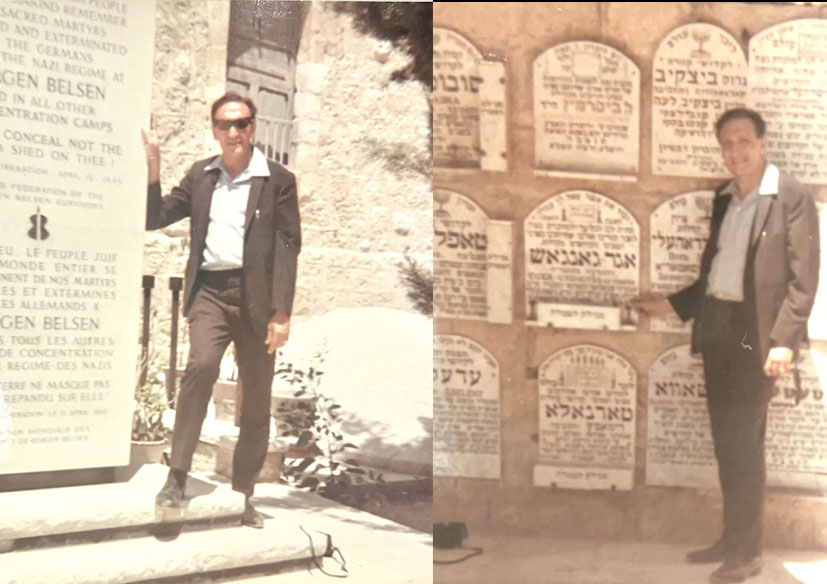
I wondered this when I recently chanced upon the above photographs of my father Nessim z”l, from his second-ever trip to Israel, in 1968.
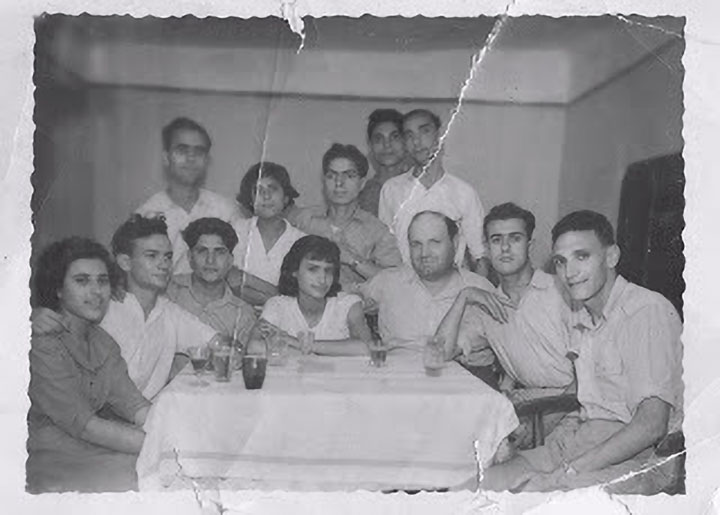
His first time in Israel was 1948. Born and raised in the mellah (Jewish quarter) of Marrakesh, my father left Morocco for Paris in 1946. On May 14, 1948 – the day of Israel’s declaration of independence – my father joined hundreds of volunteers who went to defend Israel (see photo below, my father is seated first from right).
In the War of Independence, my father served in the Palmach. His first time in Jerusalem – 1949 – the Old City was already occupied by the Jordanians. He only saw it from a distance.
Following the liberation of the Old City in 1967, my father returned to Israel and visited the sacred sites. I found pictures of him at the Kotel and various other classic spots.
But why the photographs at the Chamber of the Holocaust on Mount Zion (Israel’s first-ever Holocaust museum)? What was his connection to the tragic story told in that place?
Growing up in LA, my family lived in an apartment building where many of our neighbors were Holocaust survivors. As I noticed the numbers tattooed on their arms and the trauma etched on their faces, I started to ask them questions about their experiences.
“Did you ever experience anything like this in Morocco?” I curiously asked my father.
“Almost” answered my father. “We came very close to the same fate as that of our neighbors here.”
From 1940-1942, Morocco was occupied by the pro-Nazi Vichy French regime, and Jews were subject to anti-Jewish legislation.
“I remember when the Vichy regime demanded to know the number of Jewish children living in the mellah,” my father recounted. “I was a teenager, and I was one of a few boys tasked with going door to door, asking how many children live in each home. At the time, we had no idea why.”
Thanks to Operation Torch, the Allied liberation of North Africa in November 1942, my father and the Jewish children in the Mellah were spared the tragic fate of European Jewry.
I’m sure his visit to the Chamber of the Holocaust was a pilgrimage of gratitude and pain – pain for the six million victims and gratitude that he and his lists of kids were saved.
That “almost” experience is why my father took me to so many Holocaust films and Yom Hashoah ceremonies. To make sure I understood that this tragedy belongs to all of us – our neighbors, my father, me, and the entire Jewish people.
Thank you, Papa.
Rabbi Daniel Bouskila is the international director of the Sephardic Educational Center.
Quark Expeditions: Paddling Through the Wilds of Antarctica
Antarctica is a place of extremes—stunning landscapes, unpredictable weather, and the kind of adventure that pushes you out of your comfort zone in the best possible way. On my Quark Expeditions journey, guests could explore the breathtaking environment on the water in the Sea Kayak Program, or the Stand-Up Paddleboarding or PEP (Paddle Excursion Program), which offer a unique perspective of the White Continent. Thank you toQuark Expeditions for making my dream of not only stepping on my seventh continent but also paddling there come true!
One of the most immersive ways to experience Antarctica is from the water. One afternoon, instead of participating in a Zodiac cruise, I was part of the Stand-Up Paddleboarding (SUP) program—a decision that pushed me beyond my comfort zone but was absolutely worth it. There I was, gliding (or attempting to glide) through icy waters, surrounded by towering glaciers and curious seals. It was incredibly quiet, just the sound of my paddle dipping into the water and the distant calls of seabirds. And yes, I had an unintentional plunge, but with the drysuit, gloves, lifejacket and boots provided by Quark’s expert team, I was well taken care of.
For those looking for a less wobbly adventure, the PEP (Paddle Excursion Program) is a one-time kayaking excursion that allows guests to experience Antarctica without an engine, paddling close to the ice and wildlife. No experience is necessary. The team will give you all the skills and technique you need to enjoy your time on the kayak. It’s an extraordinary way to connect with the landscape, see penguins from their own eye level, and enjoy the peace of the polar environment. For those seeking an even deeper dive into paddling, the Sea Kayak Program offers multiple outings throughout the voyage, replacing Zodiac cruises with a more intimate, immersive experience on the water.
Adventure, Connection, and a Surprise Hula Hoop Moment
One of the things that makes Quark Expeditions so special is the way they create a true sense of adventure while maintaining the highest safety standards. Their guides have decades of experience navigating these waters, assessing conditions moment to moment to ensure the best possible experience for guests. Whether it was the thrill of paddling alongside icebergs, watching penguins from our zodiac landing near their colony, or simply soaking in the untouched beauty of the Antarctic wilderness, every moment felt like a once-in-a-lifetime experience.
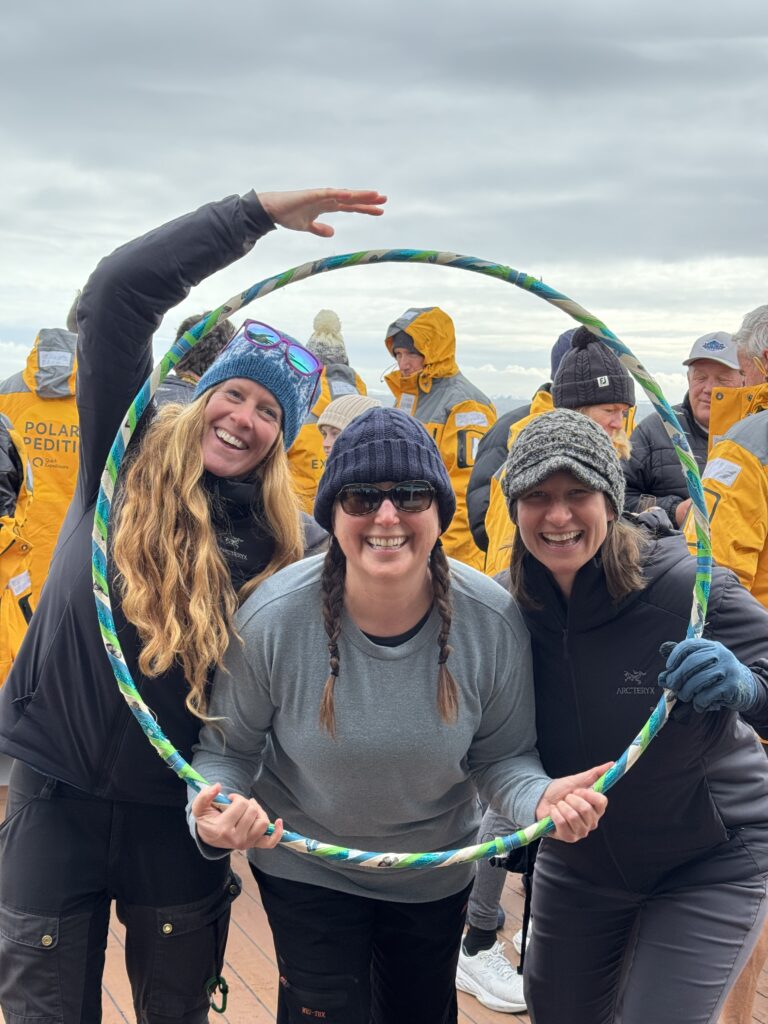
And then, of course, there was hula hooping on the fast ice south of the Antarctic Circle! Kelly and I couldn’t resist bringing a little circus fun to the polar regions, proving that adventure comes in all forms. This entire journey felt like a summer camp for adults, where every day brought new surprises, challenges, and unforgettable memories.
Postcards from the Edge of the World
Quark also brings guests to some of the most fascinating human outposts in Antarctica, including Port Lockroy—the southernmost post office in the world. Once a research base, it’s now a museum surrounded by nesting gentoo penguins. Here, you can send postcards home, stamped and mailed from Antarctica, adding a uniquely personal touch to the journey. These quirky, unexpected moments balanced out the adrenaline-fueled adventures, reminding me that Antarctica isn’t just about the extremes—it’s also about the details, the history, and the connections we make along the way.
A Journey for All Ages
One of the most wonderful things about Quark Expeditions is the diversity of travelers aboard. Whether you’re traveling solo, with a friend, or as part of a family, Quark Expeditions offers something for everyone. They have had guests on board from 9 years old to 93 years young—proof that the adventure is truly for all ages! The ship is incredibly warm and inviting, and although I arrived alone, I was invited to two birthday dinners and an anniversary party! Whether you’re there for the history, the wildlife, or just the sheer thrill of exploring Antarctica, you’re guaranteed to have a truly unforgettable time.
The Quark Expeditions Difference
The expert team of guides, lecturers, and expedition leaders are passionate about sharing their knowledge, ensuring that every guest walks away with a deeper appreciation for this remarkable place. We saw incredible landscapes from our ship, the zodiacs, from the helicopters and so much wildlife including seals, penguins and whales and had the opportunity to connect with others who share a passion for adventure and discovery. Every moment, from watching icebergs drift by to paddling in the water, felt like an exploration not just of the landscape, but of the human spirit.
I’m incredibly grateful to Kelly, the paddle team, and Quark Expeditions for making my Stand-Up Paddleboarding experience so memorable. It was a test of bravery, balance, and adventure, and I wouldn’t trade it for anything. After all, how many people can say they’ve paddled—and taken an accidental plunge—in the waters of Antarctica?
What is it like to travel to Antarctica? 60+ videos to show you my expedition with penguins, seals, whales, SUP and my polar plunge!
Kelly’s passion for adventure, outdoor recreation, and environmental pursuits has allowed her to curate a diverse life as a guide, educator, and instructor. She was born and raised on the west coast of British Columbia, between the mountains and the oceans, and you won’t find her far from either of those ecosystems.
Since 2013, Kelly has been sea kayak guiding and instructing. She strives to provide inclusive and authentic experiences in ocean environments. From culturally significant plants to breaching humpbacks, Kelly’s enthusiasm for the natural world is contagious and unwavering. With her diploma in outdoor recreation management, a degree in environmental studies and a teaching degree in education for sustainability, Kelly’s career and adventures are fed by her zest to connect people to place.
When she isn’t guiding in the polar regions, Kelly can be found paddling, snorkeling, or hiking along BC’s coastline. In the winter you’ll find her snowboarding in the Rocky Mountains. She also teaches outdoor education in schools, organizes a mountain film festival, and loves attending music festivals, spending time with family and friends, and working as an ally to support Indigenous people in the fight to protect wild places. Her advice to first-time adventure travelers is inspired by Sir Ernest Shackleton: “I believe it is in our nature to explore, to reach out into the unknown. The world is a huge place. How will you know where you fit in unless you explore beyond your comfort zone?”
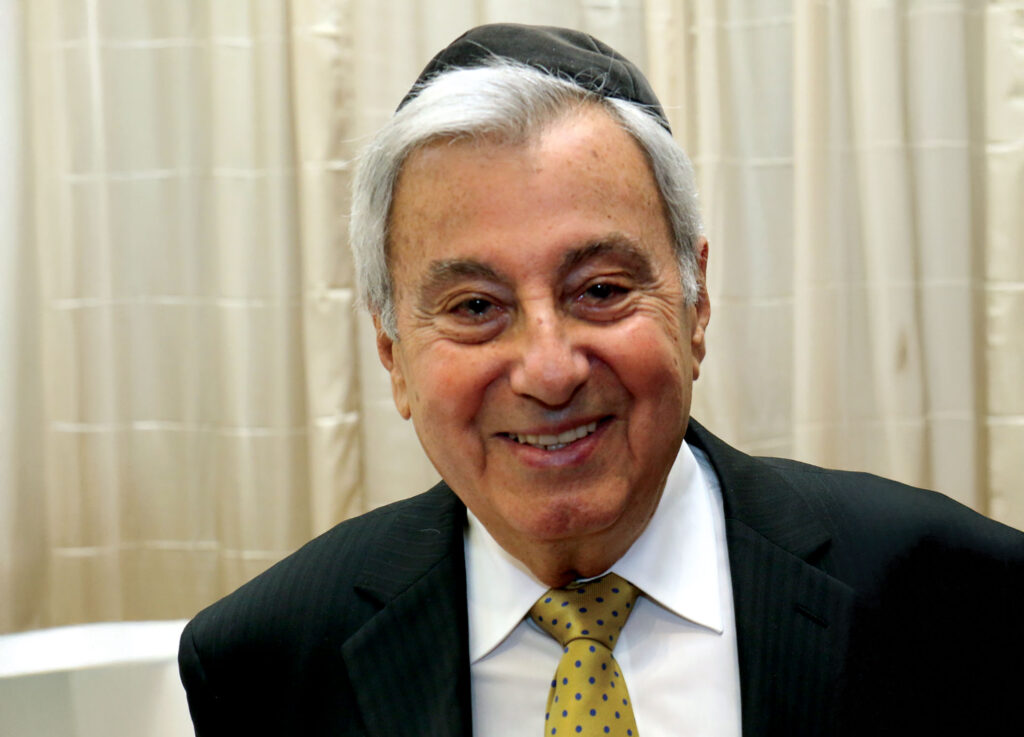
Few are the individuals who are successful in life, make their fortunes and are described first and foremost not in terms of their business acumen or trendsetting but in terms of their humility and kindness to others. This is the legacy of Jack Rimokh, who passed away April 6at the age of 87.
“Despite his great success, he always kept a modest and humble attitude. In truth it is in humility that you find greatness. That was Jack. Greatness and humility,” said Rabbi Joshua Bittan, spiritual leader of Em Habanim Congregation during his eulogy.
Jack Rimokh was born in Fez Morocco, the oldest of six siblings. His father was a leader of the Societé de Bienfaisance Israelite de Fez, an organization dedicated to charitable activities. His personal life’s mission was to make a difference in the lives of the less fortunate and Jack certainly followed in his father’s footsteps.
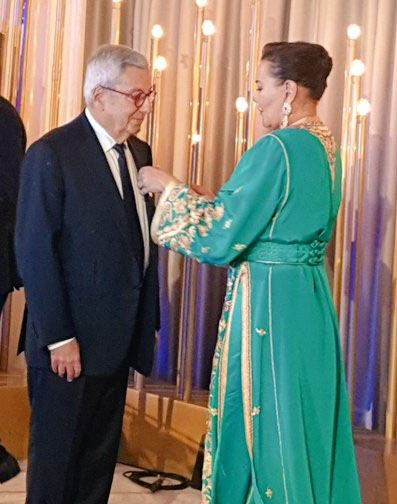
Jack receiving medal on behalf of King of Morocco from Princess of Morocco
Jack left Morocco for Israel in the early 60s and soon joined the IDF where he fought in the Six-Day War as a tank commander. In 1970, he moved to Los Angeles with the wave of Moroccan Jewish immigrants and started a garment company known as Condor. In 1992, Jack founded Signal Products Inc., which held the exclusive global license for Guess Handbags with offices in New York, Hong Kong, Australia and Italy. Together with his eldest son Jason, the company expanded to include other major brand licenses and became one of the largest handbag companies in the world.
As a trailblazer in the LA fashion industry, Jack became one of the most prominent and respected Sephardic Jewish businessmen in the 1970’s and 80’s. Many industry leaders sought his business advice and wisdom which he was happy to share. In business, his word and handshake were his golden contract. Though deeply committed to philanthropy, Jack’s favorite way of helping others was by quietly giving them an opportunity to work. Countless stories have emerged of Jack offering jobs — sometimes to those less qualified— simply to help someone earn a living and maintain their dignity.
People have shared numerous heartfelt stories since his passing: tales of how Jack discreetly helped them in times of need, offered a scholarship to send kids to Jewish schools or to Israel programs, provided funds for the synagogue before the rabbi would even ask, and so many more acts of “hesed,” or true kindness. One friend described how Jack’s wisdom helped resolve a business conflict, saving not only a partnership but also their friendship. The respect Jack earned through such experiences resonated deeply throughout the community, earning him a reputation that transcended mere friendship. His impact was profound and extended far beyond business.
As my family gathered for our seder last week, and the talk got to the passing of Jack and his good deeds, there were more stories shared about how he would help people whose businesses were in trouble and he would never expect anything in return. Their lifetime friendship was repayment enough. What a gentleman!
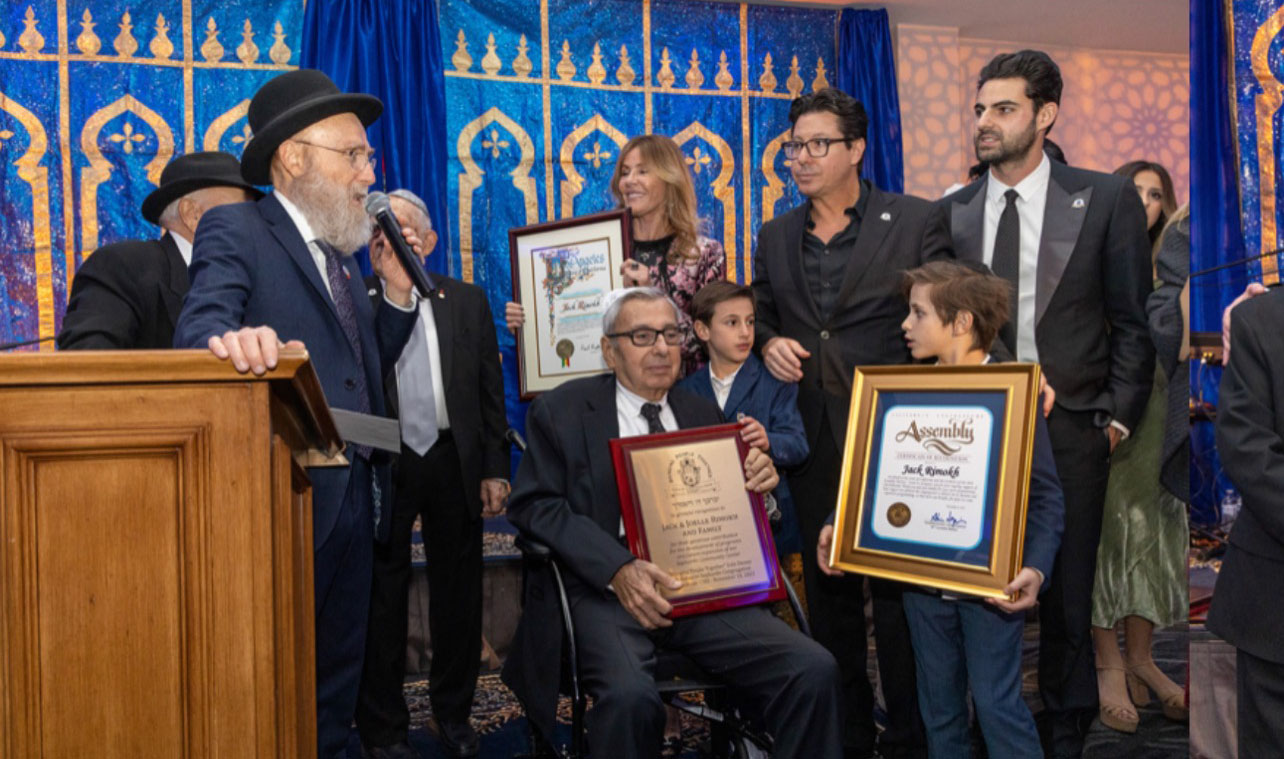
Jack’s philanthropy began with his beloved Sephardic community. He was a pillar of Em Habanim congregation and a benefactor to many other charities, Jewish and non-Jewish alike. He was honored by Em Habanim on numerous occasions, starting with Man of the Year in 1984; in 2014, he was the “Spirit of Life” Award recipient from the City of Hope and that same year, he was honored by the Sephardic Educational Center with the Sephardic Legacy Award. In 2019 he received the Royal Officer of The Throne medal from King Mohammed VI of Morocco. Jack even received the Scientific Engineering Technical Academy Award in 2013 for his company Pixologic, the inventor of ZBrush, a multi-resolution editing system that changed the film industry as we see it today.
Being honored at Em Habanim in 2024
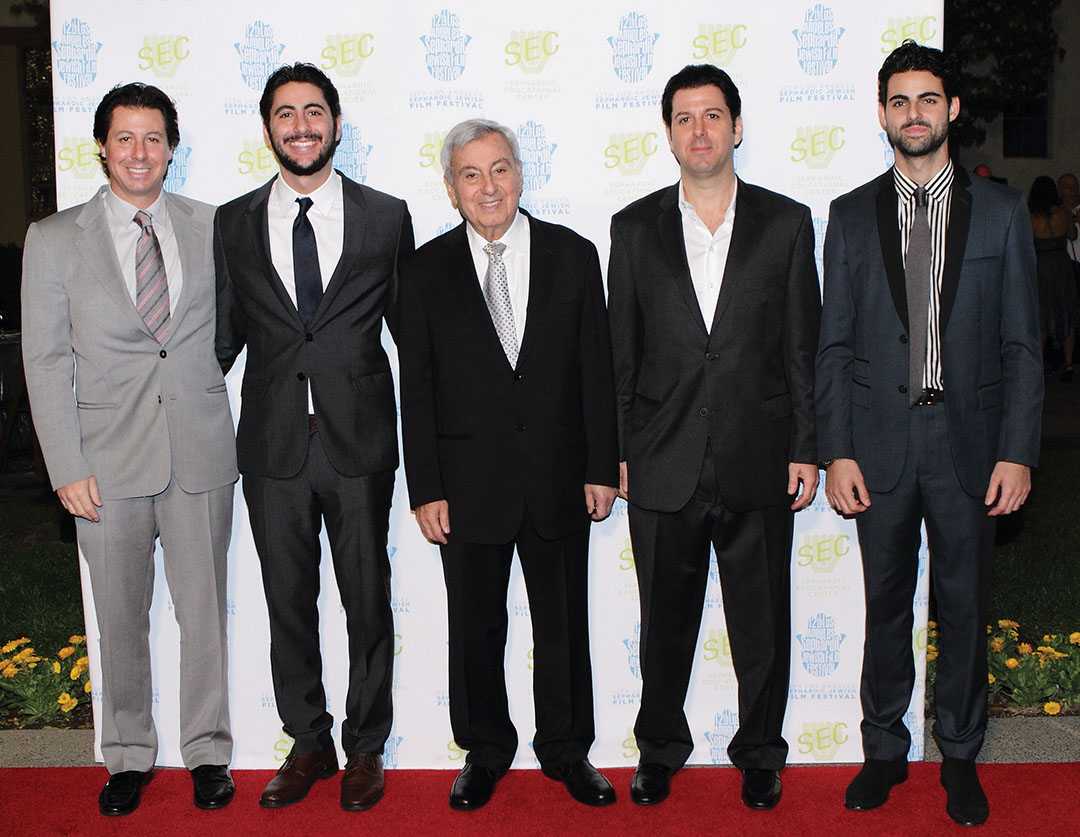
Though I knew Jack for over 40 years since my earliest involvement with the SEC and admired his constant and generous support, it was in 2014 when he agreed to accept our honoring him and Joelle at our Sephardic Film Festival Gala at Paramount Studios that we got to spend a lot of time together and I could see what a consummate “ben-adam” he was. Unlike many honorees, Jack had no special requests, no guest lists, he didn’t even want us to bother people to come to honor him. He just showed up, proud to be surrounded by his family and community, proud of his Sephardic heritage and happy to help support in any way possible. That was Jack.
Despite these and many more accolades, Jack Rimokh’s life was one of complete humility, quiet dignity, and always accented with a warm smile. The highlight of his life was sharing weekly Shabbat with his family, especially his precious six grandchildren, and performing any acts of kindness, large or small.
Jack and his sons at the 2014 SEC Gala: Jason, Michael, Sean and David
How does a soft-spoken, dignified, charitable man leave his mark on a community such as ours? By living a life worth emulating; that would be his greatest legacy.
May he rest in peace.
Neil J. Sheff is President of the Sephardic Educational Center.
Harvard Sues Trump Administration Over Freezing Federal Funding
Harvard University President Alan Garber announced on April 21 that the university is suing the Trump administration over freezing billions of dollars to the university.
The administration initially froze more than $2 billion from the university; the government had at first demanded that the university ban masks and rescinds its Diversity, Equity and Inclusion program and subsequently issued more demands that, among other things, the university revoke recognition of anti-Israel student groups and auditing its academic programs to ensure that they’re adhering to viewpoint diversity. The Trump administration is reportedly planning on freezing an additional billion dollars after the university publicized the administration’s letter despite the administration’s request it be confidential, according to a Wall Street Journal report.
Garber contended that the government’s actions put critical research at risk, including research into cancer, Alzheimer’s disease and Parkinson’s disease. Further, he argued that “the law requires that the federal government engage with us about the ways we are fighting and will continue to fight antisemitism. Instead, the government’s April 11 demands seek to control whom we hire and what we teach. Today, we stand for the values that have made American higher education a beacon for the world.”
Georgetown Student Gov’t Postpones BDS Vote Initially Scheduled During Passover
Georgetown University’s student government postponed a vote on a nonbinding campuswide referendum that was initially scheduled during Passover calling for the university to divest from companies linked to Israel and sever all academic ties with Israeli universities.
The vote was moved from April 14-16 to April 26-28; it requires a majority vote to pass and at least 25% voter turnout by the undergraduate student body. The Georgetown University Student Association (GUSA) said in a statement posted to social media that it “made this decision after hearing concerns about the placement of the election during a religious holiday.” According to The Hoya, a student newspaper at the university, 16 of the 28 student senators voted anonymously to bring the referendum to the student body for a vote, which the paper described as being “a departure from standard GUSA procedure.” Jewish Insider noted that other student government business continued during the Passover holiday. University Director of Jewish Life Rabbi Ilana Zietman told the outlet that this “inadvertently [singled] out Jewish student groups for favoritism or bias as some are claiming, which is not the case. Jewish students would have been happier with postponing all student government matters until after the holiday.” She did say that postponing the vote “was the right move in terms of religious inclusion and a fair process.”
CA Education Dept. Says San Jose Ethnic Studies Curriculum Discriminated Against Jewish Students
The California Department of Education concluded on April 4 that the ethnic studies curriculum at Branham High School in San Jose discriminated against Jewish students, Jewish Telegraphic Agency (JTA) reported.
The Bay Area Jewish Coalition filed a complaint to the department in September alleging that the 12th grade ethnic literature curriculum was biased against Israel; the department concluded that a teacher did not provide a pro-Israel viewpoint during a lesson if Israel is a “settler colonial state.” The department also concluded that a teacher failed to address a group project that featured a slide about the “Genocide of Palestinians.” The teacher’s failure to comment “could have been interpreted by the student audience as approval of the presented thesis.”
“To correct the discrimination found in the San Jose investigation, English language arts and social studies teachers at the school will be required to do a one-hour training before the next school year, and to discuss instruction on “controversial topics” as part of their anti-bias training,” JTA reported.
Columbia President Says University “Would Reject Heavy-Handed Orchestration” from Trump Admin
Columbia University Acting President Claire Shipman said in an April 11 statement that the university “would reject heavy-handed orchestration from the government” in its ongoing dialogue with the Trump administration.
The Trump administration revoked $400 million from the university in March, claiming that the university’s response to antisemitism on campus has been inadequate. Shipman said that their discussions with the administration remain ongoing and that no agreement has been reached yet. She stood by the March 21 “commitments” that the university made with the Trump administration. But Shipman outlined where the university draws the line.
“We would reject any agreement in which the government dictates what we teach, research, or who we hire,” she said. “And yes, to put minds at ease, though we seek to continue constructive dialogue with the government, we would reject any agreement that would require us to relinquish our independence and autonomy as an educational institution.”
Artist Tomer Peretz never planned to be the one holding a camera in a massacre zone. But there he was, on Oct. 8, 2023, volunteering with ZAKA to clean up the carnage.
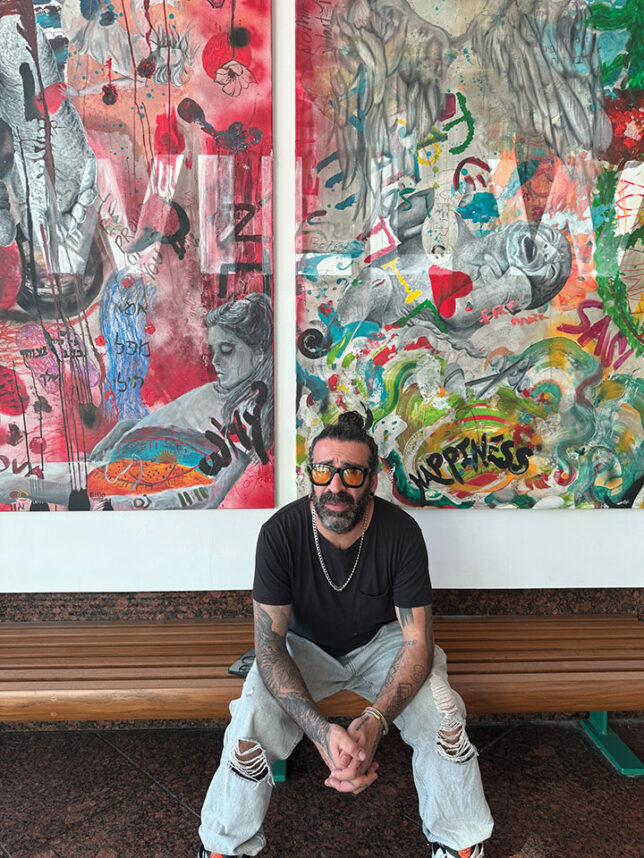
Though he lives in Los Angeles, he and his sons had flown to Israel for a wedding that weekend. Art had been Peretz’s life. But at age 41, he was thrust into the world spotlight for going above the call of duty for his country—with interviews on Fox News, CNN, SkyNews Australia. Today, more than 18 months since that wretched day in the Gaza envelope of Israel, Jews around the world know about Peretz. He’s unmistakable: thick black beard, long but tamed curly Jewfro, sleeve tattoos, and often wearing thick polished athletic shoes.
Photo by Micheal Mike Canon
After the attacks, the ZAKA teams cleaned up bodies and body parts from the multiple crime scenes with haste. They didn’t know the full number at the time, but there were over 1,200 murdered people that needed to be tended to (not to mention the bodies of Hamas terrorists who were neutralized during the attack). Peretz, volunteering to help out in whatever capacity he could in his home country, took out his iPhone and began to document what would soon be cleaned up.
“On the morning of Oct. 8, I was talking to my family, with my friends, with my cousin, they were confused, no one truly knew what’s going on,” Peretz told The Journal. “And when I got into Kibbutz Be’eri and I saw …” Peretz paused for a beat. “Whatever I saw, I knew that people around the world don’t know or understand what I’m seeing. I wanted to make sure the world knows what is going on. That’s the reason I did it.”
“Whatever I saw, I knew that people around the world don’t know or understand what I’m seeing. I wanted to make sure the world knows what is going on. That’s the reason I did it.” – Tomer Peretz
Peretz understood that if ZAKA’s work wasn’t documented, the world would less fully grasp the scale of the havoc wreaked upon Israel. So as he volunteered with ZAKA to pick up the remains, Peretz’s iPhone captured what would have otherwise been cleaned up. He still uses that iPhone. One day, perhaps, it’ll be in a museum. He reassured The Journal that photos and videos of the evidence of that day had been backed up and shared on a multitude of hard drives and across several cloud storage services.
He would eventually return to California later in October as much more than an artist — he still operates out of the mindset he was in as he helped clean up the brutality on Oct. 8, 2023.
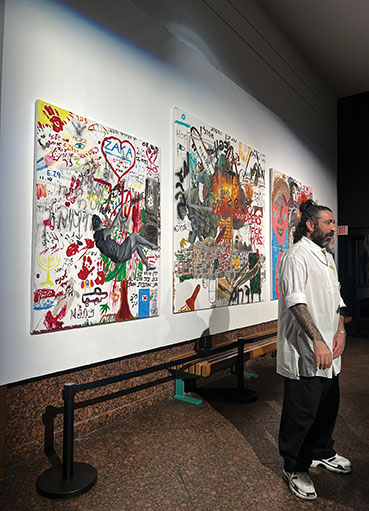
Peretz’s most recent art project, ART WILL S8 YOU FREE, is a culmination of all that he’s poured into his community since the attacks. Over the course of several months, Peretz had survivors of the massacre fly to Los Angeles to do something special at his downtown art studio — heal through art. The collaborative paintings are currently on display at the Museum of Tolerance. And Peretz is now the 32-year-old institution’s first ever artist-in-residence.
Over the course of several months, Peretz had survivors of the massacre fly to Los Angeles to do something special at his downtown art studio — heal through art. The collaborative paintings are currently on display at the Museum of Tolerance. And Peretz is now the institution’s first ever artist-in-residence.
“This is the first art exhibition that speaks about Oct. 7 that targets mainly non-Jews and children” Peretz said. “I think that’s the best way to break the message out of our echo chamber.” It features a series of paintings, photographs (by Mike Canon), and filmed interviews with Nova festival survivors and ZAKA volunteers (by Kalia Gisèle Littman Cohen). It includes a place for visitors to leave their own messages and art on a communal wall. It’s a fitting touch for an exhibition created by a former graffiti artist.
He describes it as an art therapy initiative, a place for communal healing, trauma processing and bearing witness. It’s all part of The 8 Project, Peretz’s long-term art therapy and trauma healing model — built specifically for survivors of mass trauma events. It’s where people come to paint with him, or with each other, in controlled, often emotionally charged sessions. That project extends into every classroom of the thousands of Los Angeles school kids to take field trips to the MOT every month.
The artists are Israeli First responders, IDF units, orphaned children, and even members of ZAKA.
“Some of them never held a paintbrush before,” Peretz said. The “ART WILL S8T YOU FREE” exhibit makes space for the people who can’t unsee what happened—and offers a way to keep going when words or therapy fall short. Still, when these non-artists come to Peretz’ studio to create, they also have access to licensed therapists and trauma experts. ART WILL S8T YOU FREE is only the latest initiative Peretz has led using art to address the Oct. 7 attacks.
“I joined the ZAKA team to clean out dead bodies from Kibbutz Be’eri, and it took me a few days and after a few days I arrived back in LA,” Peretz said in his address to the attendees at the exhibit’s opening on March 19. “Since that moment, I couldn’t hang out, I couldn’t create, I couldn’t do anything that was not related to the war. And that’s how I started to invite people, survivors and different people who got affected by these wars to my studio. And that’s how The 8 Project was born.
Many of the stories he shares originate when he started volunteering with ZAKA. He humbly knows his place in history but isn’t taking it for granted. When he volunteered with ZAKA, he knew he looked out of place with his many tattoos, but the team he was volunteering with trusted him.
“Guys who were not my team, the other guys didn’t even know who the f— I was,” Peretz recalled. “They’re saying, ‘Who’s this guy? This TMZ guy filming everything with a phone?’ But a year-and-a-half later, all of ZAKA knows who I am. The world was exposed to ZAKA because of me in the first 48 hours. The ZAKA spokesperson was the only other one who took photos. That guy actually wanted to kick me out. He saw me taking photos with the phone and he was yelling at me a few times. Obviously, I didn’t give a f— and kept taking photos and videos. Even my team leader on the side said, ‘Just do it, but make sure no one sees.’”
But the raw photos of mangled bodies wouldn’t be enough. The majority of what Peretz photographed and filmed is way too gory to share on social media. He shared a few images, but he saw a much more urgent need.
During the last week of October 2023, word started circulating on Jewish community WhatsApp groups about a live art installation being planned to commemorate those who were killed at the Nova Festival. The promotional materials asked for volunteers to show up at Grand Park early in the morning, dressed in clothes they didn’t mind ruining. Participants would be lying still or standing frozen, covered in fake blood, bruises, and gunshot wounds applied by professional makeup artists. Peretz was the mastermind and the goal was scale — a visceral accounting of what had happened at Nova, staged in the shadow of City Hall.
Hundreds of people — many of them Israelis — came for the event. They stood or lay still, covered in fake blood and detailed makeup recreating wounds. It wouldn’t be appropriate to call it a “reenactment” of the Nova Festival massacre aftermath — it was a solemn portrayal.
Photo by Micheal Mike Canon
One volunteer, Gabriell Kijauskas, told The Journal that she was nervous to go to the live art installation as she didn’t know anyone who would be there, on top of still feeling raw from the previous 28 days. “I was very overwhelmed,” Kijauskas said. “I felt I might just turn around and go back home. But then slowly I felt like I was there to help and just ended up being one of the community. It was empowering and a reminder of how lucky we are to be alive.”
Peretz was just getting started. By the end of November, he was speaking publicly several times per week about what he witnessed as he volunteered with ZAKA. One of those nights was at a packed art gallery on La Brea Avenue the week after Thanksgiving. He described — in full detail — what he saw during his time volunteering with ZAKA. He didn’t show photos. He didn’t need to.
Over the next several months, Peretz kept appearing and sharing what he saw. On the YouTube channel Jubilee, Peretz sat alongside actor Jonah Platt, media personality Shanni Suissa, and Oct. 7 attacks survivor Ariel Ein-Gal to debate pro-Palestinian activists. The video has since been seen over 2 million times.
“It [the Jubilee debate] was actually very tough, I didn’t even want to do it, but I decided that I’m not going to be quiet, I’m not going to sit on the side and let people say bulls— without standing up,” Peretz said. “That’s what happened to us in the Holocaust. People were silent. So I went, and I said what needed to be said.”
“I decided that I’m not going to be quiet, I’m not going to sit on the side and let people say bulls— without standing up. That’s what happened to us in the Holocaust. People were silent. So I went, and I said what needed to be said.”
– Tomer Peretz
Peretz would host small events where the community could mourn and heal together. Some would be last-minute, like the picnic for an IDF soldier getting treatment in Los Angeles for traumatic brain injury. Peretz’ event in Roxbury Park in Beverly Hills had over 100 people come to show the soldier love and check in on each other. Peretz sat protectively beside the soldier’s wheelchair as people came forward to kiss his hands, thank him, and weep.
By the spring of 2024, a campaign emerged across Los Angeles’ Jewish community to name and humanize the American hostages in Gaza for the media and public that didn’t seem to care. Behind the scenes, Peretz was printing black-and-white stickers with the hostages’ names on them. “Hersh,” “Keith,” “Edan,” “Judi” started appearing in bold letters around Los Angeles. His work sparked a ripple effect. Artists, designers and volunteers joined in, not in competition with each other, but in solidarity among artists looking to heal and create awareness. It was a movement of people using art and visibility to combat the antisemitism and indifference towards the Jewish people following the attacks.
Peretz was born in southeast Jerusalem in 1982 to parents who kept a traditional household. The neighborhood was, by his account, quite conservative — to the point that Peretz often felt like the black sheep. His nickname in school was “Asto,” short for “astronaut,” because teachers said he was always daydreaming. He had trouble focusing and often got into fights. He carried a knife in his pocket for protection and got kicked out of one school as a teenager. Despite that, he insists his family was supportive. His older siblings all went on to earn academic degrees. Peretz didn’t. He barely graduated high school. “I grew up in this conflict in one of those places where it’s just part of life,” Perez said. “That’s where I come from.” He would frequently interact with Arab Israelis and Palestinians. His family used to drive across the border to the Qalqilya and Jenin in the West Bank for shopping because “things were just cheaper there.”
As a teenager, Peretz became enthralled with graffiti art. He’d start small and then moved onto painting murals inside the safe room of his apartment building. Though the city painted over a lot of the graffiti he made, he says you can still see some of the late 1990s and early 2000s-era colors he put there showing faintly underneath. That became a metaphor of sorts for how he approached everything: put it all on the surface, and even if it gets erased, something lingers.
In his 20s, he did his Israeli military service in Golani 13 during the Second Intifada — including nearly two years in Gaza. He wouldn’t share any details about his service besides that he came out of it having endured quite a bit of trauma. Looking back, he had no diagnosis and no plan. What he had was painting.
Following his IDF service, Peretz relocated to Los Angeles. His first taste of California was in 1998 to visit an uncle. The city of Los Angeles left enough of an impression on him during that trip to inspire a move less than a decade later.
“I never thought art could be a career until I got here,” Peretz said. “I just started to sell work.” Peretz would launch his art career with underground art parties. “It was not about the painting. It was about the energy, the vibe, the people that I bring together. And I still do it. I just used to create crazy shows and everybody came. And from that moment, it started to grow.”
In Los Angeles in the early 2010s, Peretz was creating a portfolio. Before he was holding space for trauma survivors, Peretz was doing what every transplant artist does in Hollywood — making himself visible. He had his first solo show in 2012 in Culver City, “Unbreakable.”His next solo shows were “Double Exposure” in 2019, “Incomplete” in 2020, “Welcome to America” in 2021 and “Gonna Make Some Bad Choices Tonight” in 2022.
All of them carried his fingerprint — bold, unfiltered, personal. And they were almost always anchored in LA, at Ouro Gallery, where the space matched the artist: raw and unpretentious. He also was exhibited outside of the city. Milan twice. Miami once. Mexico by way of Art Miami.
He didn’t chase approval. He just kept producing. The awards came — like the Arthur Szyk Prize for Zionist Art in 2014 — and the press followed sporadically.
He opened a studio. He got married. He started a family. Then on Oct. 7, 2023, everything changed,including Peretz’s art. “It was not about me anymore, and that’s what changed,” Peretz said. “It became about everybody else. I couldn’t just sit.”
By this point, Peretz had what it takes to build a community for healing and creating awareness. He’d already trained himself to sit with discomfort, to turn it into image, to let paint do what words couldn’t.
He’s been going at a nonstop pace. In June 2024, Peretz hosted an art show at his downtown LA studio featuring Inor Roni Kagno, one of the official photographers from the Nova Festival. At the show, Kagno showcased eighteen photographs captured during the hours leading up to 6:29 a.m. on Oct 7. The first night of Kagno’s shows at Peretz’s studio sold out and a buzz spread around the community quickly. A second night was thrown together at the last minute. Hundreds of people attended — Peretz’ studio became a place for communal healing. The prints sold in droves, and attendees made new friends. “It was a place that people wanted, needed, to come together,” Peretz said. “It was a safe space.”
By July 2024, the Nova Exhibition opened in Culver City and would remain the epicenter for healing and bearing witness for the Los Angeles community through November. All the while, Peretz was working on his next art and healing project.
“When I’m in, I’m all in. I’m 100% in. I cared about doing something that matters. People think I use art to escape. I don’t. I use it to face s—.”
The Museum of Tolerance gave Peretz a platform with the installation of The 8 Project’s “ART WILL S8T YOU FREE.” The paintings capture survivors’ reflections of the moments that make their eyes wide, mouths agape, hands clutched or some form of stress gesturing. Some paintings depicted hopeful messages, others depicted images of horror and shock they continue to process.
“I want people to look at that painting and be uncomfortable,” Peretz said. “I want you to see their pain. I want people to connect to the human side.”
Peretz worked closely with each survivor over multiple art sessions. “It was heavy,” Peretz said. “Some of them couldn’t even talk at first. Some of them were shaking. I had to just sit and breathe with them until they were ready. But they wanted to tell their story. They wanted people to know.
“The difference between me and other people, maybe, is that I feel like I’m obligated to do that. That’s what I say to people,” Peretz said. “I can’t sit in my house. I can’t eat. I couldn’t do anything. I can’t enjoy my life knowing that this thing happened. And it’s on my people. This is the moment that we have to stop everything and do what’s right. And I can’t do what’s right by just sitting and crying. I need to go and do something. So I use the skills that I have.”
Sheri Schlesinger, a Museum of Tolerance board member, noticed that school groups at the MOT have been really impacted. “We’ve had public school students, mostly Latino, mostly not Jewish, and they’re connecting to it in a real way,” Schlesinger told The Journal. “They hear the story, then they see the paintings, and it stays with them. This is a different way of learning. It’s emotional. It’s human.”
She is also the founder of the Genesis Arts Collective, an initiative that connects artists and their messages to students across the country, aiming to foster empathy and personal reflection through art. She helped launch the hART Project, which provides students with branded art kits that are used in conjunction with visits to exhibitions like Peretz’s, where students engage in art therapy and reflect on trauma, healing, and personal experience. She said that the MOT reaches over 100,000 students annually at the MOT, with a majority of them not from the Jewish community.
Littman Cohen, an Israeli artist, who collaborated with Peretz at the MOT on the installation also had an installation. She filmed ZAKA workers at the sites where they cleaned up after the attacks, one year later. The stares of their eyes into the camera tell so much — it’s worth visiting. She would interview them too. “The first ZAKA guy who came in, he looked like he wanted to kill me,” Littman Cohen said. “He was not interested in doing a portrait. He sat there with his arms crossed. I told him, ‘This is not about making you smile.’ I told him, ‘Just sit however you want, and if you want to tell me anything, I’m here to listen.’ And eventually he started talking.”
Littman Cohen said it was one of the most powerful things she’s ever been a part of. “These men went through hell, and they needed to be seen — not as symbols, but as people who did something unbearable,” Littman Cohen said. “I wanted the camera to honor that.”
Peretz is working on bringing those ZAKA volunteers to Los Angeles for a collaborative healing project called “The 8 Retreat.” “It’s not for me. It’s for them,” Peretz said. “They don’t have the opportunity to speak. They didn’t speak for a year. And now, we’re going to give them that opportunity. Not just to speak but to create.” Peretz has also been approached about expanding The 8 Project beyond Los Angeles. He has received requests from major different universities and Hillels and different organizations that want to have it as a pop-up. He’s considering taking it on tour.
But even as his platform grows, Peretz says the core motivation hasn’t changed. “This is for the people who can’t tell the story. For the people who are not here anymore. I don’t care about the likes. I don’t care about the press. I care that someone feels like they were seen.” It still seems like Peretz is everywhere. Peretz continues showing up at nearly every communal event, while managing his studio, his family life, and his role as an artist.
Even as his platform grows, Peretz says the core motivation hasn’t changed. “This is for the people who can’t tell the story. For the people who are not here anymore.”
Right before deadline, The Journal received a random call from Gabriella Karin, a 94-year-old Holocaust survivor and artist who wanted to talk about how she is the only Los Angeles Holocaust survivor going to the March of the Living in Poland in April 2025. Karin wanted to talk about the upcoming journey — her 11th — and her 32 years of sculpting art for her own healing. Without any provocation, she added that after she returns from March of the Living, she and Peretz have plans to collaborate and help others confront history.
Gabriella Karin said “when I walked through [Peretz’s MOT exhibit], I saw that this is the way to speak about trauma,” Karin told the Journal. “Not lectures. Not numbers. Not just books. Art. That’s what people remember.”
Karin said that Peretz is on the right path because “he is not doing this for attention, he is doing it to tell the truth. And people feel that. You can’t fake that. For me, at my age, I am still making art because I want the next generation to feel. I see that in Tomer’s work. He is doing what needs to be done.”
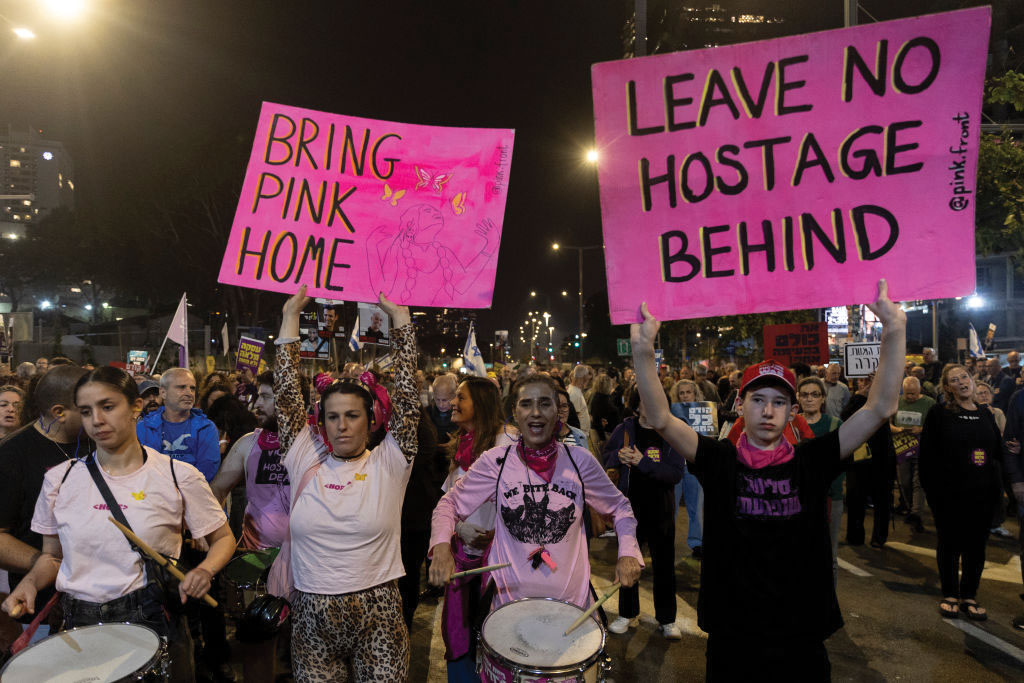
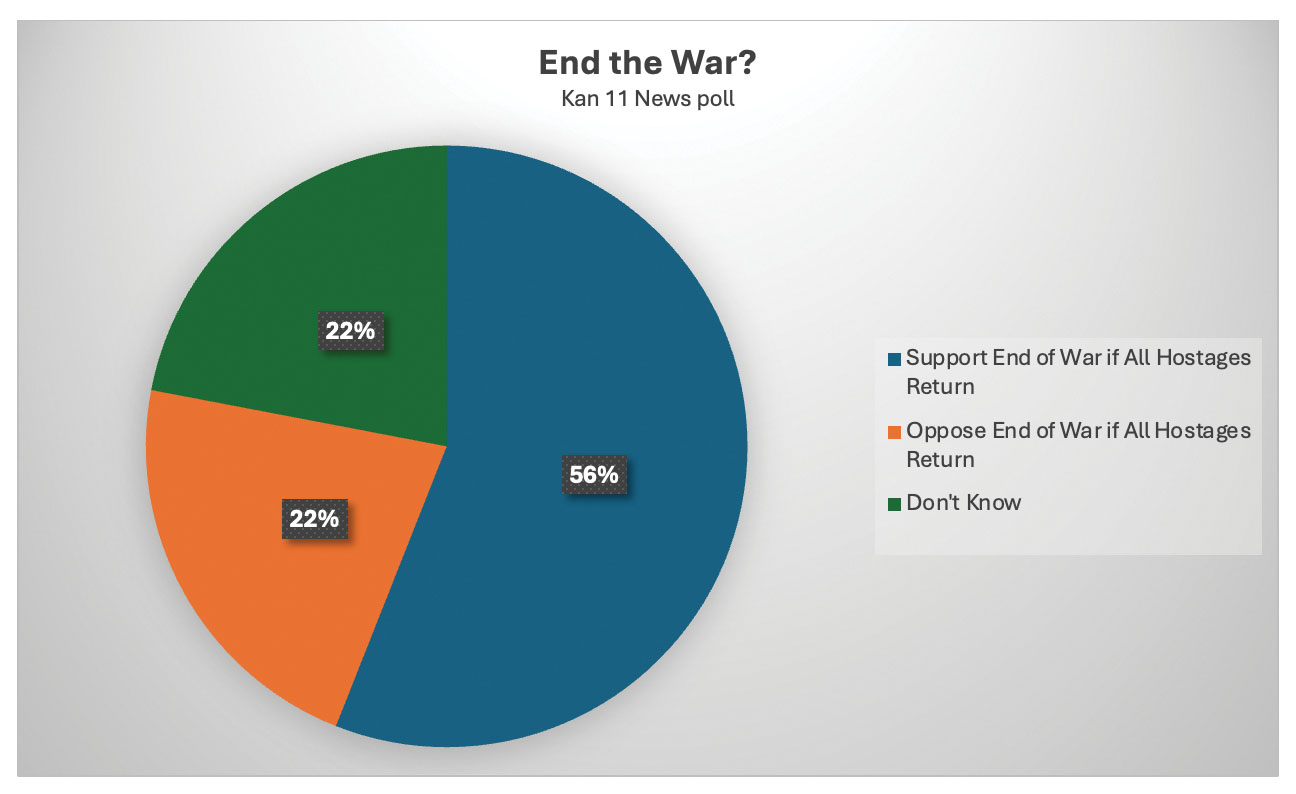
The public sentiment is clear: There is a majority of Israelis in favor of ending the war in Gaza — if the hostages are returned. A new poll confirmed it this week, as many others have before. In late March, a poll showed 69% supported “a deal to return all the hostages in exchange for ending the war.”
The government’s position is also clear: It will not end the war — even if all the hostages are returned. Prime Minister Netanyahu stated this explicitly last Saturday. He declared: “We will not end the war before Hamas is destroyed and before Gaza is no longer a threat.” Finance Minister Bezalel Smotrich reiterated this Monday: “There is one thing we will not do to bring back the hostages — we will not surrender to a terrorist organization.”
The terminology differs, of course. The public is asked about “ending the war” — and supports it. The government talks about “surrendering to Hamas” — and rejects it. But the meaning is essentially the same: Ending the war would mean coming to terms with a reality in which the war’s objectives are not fully met.
Why is the public willing to accept that? For several reasons. First, it wants the hostages back. Second, it is tired — after a year-and-a-half, who wouldn’t be. Third, perhaps it has lost hope that Israel will achieve its full objectives. Netanyahu says, “Victory requires patience and resolve.” That might have sounded convincing in November 2023. Approaching May 2025, it’s harder to swallow.
Harder for two reasons. One: time has passed, the war drags on, and public trust in Netanyahu and his government is low. In fact, it’s been low all along. But early on, there was patience despite the mistrust — a sense that the goals were at least somewhat defined. Over time, that patience eroded. As the war dragged on, the low trust began to manifest in skepticism about government policy, actions and commands. By the one-year mark, most Israelis agreed with the statement that “the war has dragged on because clear and realistic objectives were never defined.” Most also agreed that “the war has dragged on because the coalition has a political interest in prolonging it.” That was six months ago. It’s unlikely the sentiment has softened since.
The second reason is the government’s failure to articulate its strategy and goals. Of course, that’s harder to do when trust is low and attention spans are short. And so the government has not done a good job of clarifying the path ahead. There are plenty of slogans: victory, no surrender, disarm Hamas, eliminate them, bring back the hostages without capitulation, and more. But how, exactly? That remains murky. Where the government sees determination, the public sees foot-dragging. Where the government claims resolve, the public sees hesitation. Where the government points to progress, the public sees repetition. The same slogans appeared in statements made a year ago: back then we were also “on the verge of a breakthrough,” Hamas was “on the verge of collapse,” and we were seeing the “cracks” that would bring down their regime. A year has passed, and every “special address” now sounds like the previous one, which sounded like the one before it.
This failure to clarify the objectives might stem from several reasons. One: the government does have a detailed, coherent, realistic plan — it just can’t share it. Let’s say Israel holds some unique asset, that needs perfect timing to activate. If that’s the case, the government has reason to remain vague.
Two: the government has a plan, and chooses not to reveal it — not for operational reasons, but for political ones. Maybe if the public knew the full picture, it would be even more eager to shut the whole operation down. Angry. Shocked. Who knows?
Three: the government has no plan. It speaks in vague terms because it, too, doesn’t know what comes next. Maybe it’s waiting for the Chief of Staff to come up with something. Maybe for Trump. Maybe for a miracle.
Of these three, the first is the one we should hope for. But it’s also the one that suffers most under the weight of public distrust. If people trusted the government, they might assume there’s a reason for the vagueness. They might grant the PM a bit more “patience.” Under current conditions — low trust — the request for patience is interpreted as a cover for one of the two less appealing alternatives: either the government has a plan the public would firmly oppose, or it has no plan at all and is just stalling.
The result is measurable in polls, in public discourse, in military reservists’ declining turnout. The more the government fails to convince the public that it knows where it’s going, the harder it will be to enlist the public for the mission. And an Israeli government that is waging war without public support is a government that cannot achieve its objectives.
The public is all it has.
Without that — it has nothing.
Something I wrote in Hebrew
When The New York Times reported that President Trump prevented an attack on Iran by Israel, I wrote this:
There is no real surprise in the fact that Trump has, for now, opted against a military strike and turned instead to negotiations. If anything, what’s surprising in The New York Times report is the implied possibility that Trump seriously considered a strike before trying diplomacy. If he really did. If he truly considered it, and not just pretended to consider it. From the outset — and for several months now — it’s been fairly clear that the big question is what Trump will do once he realizes the Iranians are dragging their feet, dodging commitments, lying … of course, there’s always the option that they offer him an agreement – one that suits them, and suits him. Not necessarily one that suits Israel. … An agreement that would make it harder for Israel to act against Iran. An agreement that Netanyahu would struggle to oppose with the same vigor he brought to the 2015 Obama deal.
A week’s numbers
For more on this, read the column on the left-hand side.
A reader’s response
Peter Ellenson writes: “I’m really worried about a 2025 repeat of the 2015 JCPOA [the so called Iran nuclear deal]”. My response: Come join the club of (mostly) Israelis.
Shmuel Rosner is senior political editor. For more analysis of Israeli and international politics, visit Rosner’s Domain at jewishjournal.com/rosnersdomain.