fbpx

April 9, 2025

Why Andrew Cuomo’s Speech on Antisemitism So Moved Me

“I am here to say that I am sorry. I am sorry for the pain and anguish you felt on October 7 and every day since. I’m sorry for any anti-Semitism you have experienced and the repugnant behavior of demonstrators masked as Hamas that you have endured. I’m sorry if you have not felt safe on the streets right here in your own hometown. I’m sorry for the unimaginable pain and hardship the hostages and their families endured and continue to endure.”

“I’m sorry for my mistaken assumption that widespread anti-Semitism could never happen again in modern sophisticated, educated society, and certainly not in New York City.”

When I first found out that Andrew Cuomo is running for mayor on a hard-hitting anti-anti-Semitism platform I was more than a bit wary, as I suspect many New Yorkers were. Cuomo did not exactly make a graceful exit in 2021, wracked by allegations of sexual misconduct and nursing home deaths from Covid.

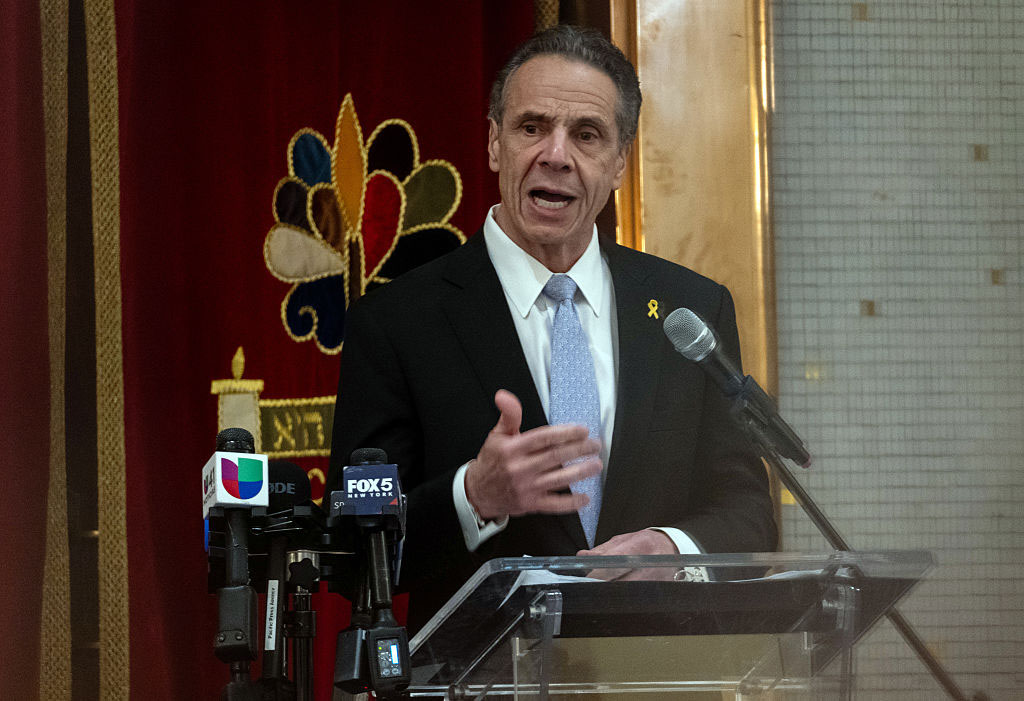
But then I heard the speech he gave on April 1 at the West Side Institutional Synagogue. It was everything we’ve been wanting to hear from every American and European leader since 10/7 but only a few were brave enough to state the obvious—to state the truth. And there’s no question that both Cuomo and his father, Mario, were strong on understanding that Zionism is a subset of liberalism; if you’re not a Zionist, you’re not a liberal.

Under Andrew Cuomo, New York became the first state to oppose BDS, and then the first state to counter BDS by an executive order saying that if a company boycotts Israel, New York will boycott the company.

Cuomo didn’t just list all of the ways he will fight the surge of anti-Semitism in our schools and on our streets. He said the words that every New Yorker has been waiting to hear: With the largest Jewish population outside of Israel, “New York City should set the precedent” in fighting this century’s violent anti-Semitism.

“We must stop the disinformation being spoon fed in many of our educational institutions. We must hold the colleges accountable for their professors and the actions on their campuses. We must stop the flow of funding from countries dictating a biased curriculum. If they want to teach bias and misinformation, then it should be called for what it is… If they want to be an institution of higher education, they must hold themselves to a higher standard or we will.”

In addition, New York must accept the International Holocaust Remembrance Alliance’s definition of anti-Semitism and “be creative and aggressive in making sure the law is enforced by exercising its jurisdiction over human rights violations, which can be prosecuted by New York City without needing a district attorney or a judge to intervene.”

Cuomo said that his administration will show no ambivalence in its full support of both Israel and Jews in the United States. “Any ambivalence by government officials will only fuel the opposition. And the truth is the forces of anti-Semitism and pro-Palestinian policies are organized, well funded, and mobilized, and have significant political strength, even right here in the city of New York.”

Cuomo then detailed the illiberal ideas of the Democratic Socialists of America (DSA); two of his eight opponents are members of the DSA, the others could be called DSA-adjacent. “The DSA advocates that Israel is a racist apartheid state that is engaged in ethnic cleansing. On October 7th, they proclaimed ‘long live the resistance.’”

The DSA charter supports BDS policies against Israel and calls for the end to American military “aid” to Israel. NYC Comptroller Brad Lander divested city pension funds from Israel Bonds for the first time in 50 years. NYC first invested $30 million in Israel Bonds in 1974 via the Teachers Retirement pension system. Today, only the Police Pension Fund owns a small position of $1.17 million in Israeli Yankee bonds.

Meanwhile, DSA Assemblyman Zohran Manami proposed a bill that would revoke the not-for-profit designation of any organization that aided Israel.

“Remember this is happening here,” said Cuomo. “Silence is acceptance. This country made that mistake once and must never make it again.”

Nearly 7,000 Jewish city voters recently registered as Democrats ahead of the June mayoral primary. The number of registered Jewish Democrats in New York is now more than 600,000.

“No one should feel they should take off their yarmulke to walk down the street. No one should think they should put the Star of David inside their shirt. No one should feel the need to look over their shoulder leaving a synagogue. This city must ensure that you feel safe on every street every day, every hour. That must be the mandate. If you discriminate or harass an individual on the basis of their religion, or destroy property, that is illegal, and people must be prosecuted to the fullest extent of the law. No more slaps on the wrist, no more excuses.”

“New York would not be New York without the Jewish community. It has been part of New York City since its first days on the tip of lower Manhattan when the first immigrants stepped off the boats. It’s our legacy at this pivotal moment.

“Let New York City set the international standard of a people, of a government, of a society that has zero tolerance for any anti-Semitic act of any kind…. As Rabbi Sacks said, peace is a duet not a solo. It cannot be made by one side alone; if it could, it would’ve been made long ago.”


Karen Lehrman Bloch is editor in chief of White Rose Magazine.

Why Andrew Cuomo’s Speech on Antisemitism So Moved Me Read More »

Re-Enchanting the World: A Review of Ross Douthat’s ‘Believe: Why Everyone Should Be Religious’

There’s a familiar story our society tells itself about the history of religion. It goes like this:

Since the dawn of time, humans have held superstitious beliefs about a divine creator or a pantheon of gods who created and ruled the universe. These beliefs went mostly unchallenged for millennia, until just a few centuries ago when the scientific revolution revealed them to be myths. 

First, Copernican astronomical discoveries revealed that the earth did not sit at the center of a harmonious and orderly universe, but rather that it was merely one random rock orbiting one random star in a shapeless morass of unfathomable emptiness. 

And then, as if this wasn’t bad enough, Darwin revealed that humans were not “created in God’s image,” but rather that humans are merely a clever primate that had evolved, like everything else, through the blind processes of natural selection. 

And so God was dethroned and the universe was disenchanted. 

In his new book, “Believe: Why Everyone Should Be Religious,” New York Times columnist Ross Douthat argues that this story is in serious need of an update. 

If the discoveries of Copernicus and Darwin dethroned God, Douthat argues, the advances of recent physics have gone a long way to restoring Him. In ways not previously understood, for instance, our universe’s physical laws have been revealed to be “fine-tuned for life’s emergence.” This, according to Douthat, is evidence of a “fashioned” universe. 

There’s also the mysterious “key and lock” relationship of mind and cosmos—the fact that a random primate in a “backwater” (like planet Earth) of a random galaxy in an ever-expanding universe has the cognitive capacities to behold and understand that universe, explicating its laws and cracking its codes with a progress that has yet to encounter any hard limit. For Douthat, this goes some way to restoring mankind to the central position it held in the religious cosmologies of old, making the unceasing advance of science an argument for religious belief, not against it.

“The long arc of science,” Douthat writes, “initially seems to bend away from religion by undermining certain specific scriptural or dogmatic claims, [but] ultimately bends back by confirming humanity’s unique position in a universe strangely suited to both our bodies and our minds.”

The idea that belief in God may actually be rational will certainly be of interest to Jewish readers. Jews are both a highly educated population in America as well as a highly atheist population, with rates of disbelief ten percent higher than that of the general public according to a recent Pew study. 

But even among Jews who do believe, there is a kind of reluctance to go all-in on God—a reticence when it comes to talking about God and a Maimonidean distrust of anything with the whiff of supernaturalism.

Go to a church and you might hear Christians talking about God as if He was a friend they spent the morning catching up with over coffee.  At the church down the street, they’ll be leaping and crying out to the heavens with improvised praises and hallelujahs. 

Not surprisingly, this is not what I see at synagogues, where the discussion is more intellectual, focusing on the interpretation of the Torah portion and matters of law and custom.

This has certainly been my experience in rabbinical school. Over the past five years at Hebrew College, my fellow students and I have discussed and debated halacha, prayer, interpretations of Torah, Israel, Zionism, Palestine, and much else, but we haven’t talked much about God. 

Not everyone is happy with this situation. I know many Jews who long for a closer relationship with God. Even many of those who don’t believe, wish that they did believe, or that they could believe. 

Perhaps this is what it means to live in a disenchanted world. 

Ultimately, as Abraham Joshua Heschel knew, the greatest antidote to this view of things is the experience of awe—what he called “radical amazement.” Nothing will sooner shake one from one’s materialist orthodoxies than turning to the great mysteries that surround us at every moment.

One such mystery is consciousness itself, and Douthat dedicates quite a bit of space to the so-called “hard problem of consciousness,” the question of how, in an allegedly mindless universe, certain clumps of matter suddenly start having felt experiences. 

Another such mystery—perhaps the greatest mystery of all—is the question of why there is something instead of nothing.

There are those who believe that these mysteries will be solved in time and that, once understood, they will no longer seem mysterious. To such individuals, ascribing any theological significance to these mysteries would be to fall prey to the “god of the gaps” fallacy, in which God is used to explain away the rapidly shrinking “gaps” left by an ever-expanding materialist understanding of the universe. 

But there are others (myself included) who believe that these particular mysteries—consciousness and being—are qualitatively different from other scientific unknowns. Unlike the question of why the sky is blue or how to cure a disease, we will never truly be able to understand this most basic nature of our existence and our universe. The physical cannot contain its own explanation. Therefore, something beyond the physical, something utterly transcendent, must be the ground of all that we are and all that we know. According to David Bentley Hart, a theologist whom Douthat quotes and whose wonderful book “The Experience of God” was clearly an inspiration for “Believe,” this transcendent ground of reality is what we mean when we talk about God. 

These mysteries have been dismissed and ignored by what Douthat calls “official knowledge.” Perhaps also they have been dismissed and ignored by official Judaism. But once you begin to really consider them, there is a feeling of thrilling disorientation, like being on a roller coaster. This is radical amazement.

For many of us, this sense of awe is distinctly lacking from our religious lives. Reading Douthat’s book is a suitable first step towards recovering it.


Matthew Schultz is a Jewish Journal columnist and rabbinical student at Hebrew College. He is the author of the essay collection “What Came Before” (Tupelo, 2020) and lives in Boston and Jerusalem.  

Re-Enchanting the World: A Review of Ross Douthat’s ‘Believe: Why Everyone Should Be Religious’ Read More »

From Slavery to Freedom: The Land of Israel and the Passover Seder

The Passover seder is the oldest of Jewish traditions. The core, including the Four Questions, was recited in Israel more than 2000 years ago, with numerous references that go back centuries before. Reclining around the table as free men and women, we recall and reenact the events, including the plagues that forced Pharaoh to release the Israelites, and the triumphal march from slavery to freedom, clenched fists and carrying the unleavened dough. As Ben-Gurion once remarked, the Jewish people know the menu of the original Passover meal in Egypt some 4000 years ago. 

The Haggadah makes clear that the Exodus was not an end in itself, but rather the first step in the return to the Land of Israel, where the Israelites would live as a free people. All journeys require both a departure and an arrival, and the territorial and political end-point was and continues to be essential to the story. Forty years after leaving Egypt, the next generation, led by Joshua, crossed the Jordan River to resettle the land that their ancestors had left. In the decades and centuries that followed, the Hebrews, as they were sometimes called, developed a rich language and the accompanying cultural treasures anchored in the Land and centered in Jerusalem (known as Zion in the Bible) that remain the basis for Jewish identity today. 

In the beginning of the seder, while holding up and pointing to the matzah, we declare: “This is the bread of oppression our fathers ate in the land of Egypt. … Now we are here; next year in the land of Israel. Now we are slaves; next year we shall be free.” This paragraph also references the exile — a form of slavery — following the Roman conquest, and the determination to return to the homeland as free people “next year.” This is the essence of Zionism, and the enormous privilege we have — after 2000 years — of being able to fulfill this pledge as a sovereign nation in directing our own destiny, despite the immense pain that we have endured. 

This theme returns throughout the Haggadah. In the response to the “Four Sons,” the text summarizes the history recorded in the Torah (also known as the Hebrew Bible), based on God’s promise to Abraham that after his descendants are forced to leave the land and into slavery, they will be freed and return. And in “dayenu” (it would have been enough for us), we sing: “Had He given us the Torah without bringing us to the land of Israel, that would have been enough for us.” Shortly after, we recite: “Generation by generation, each person must see himself as if he himself had come out of Egypt. … He took us out of there, to bring us to the land.”

The Haggadah is a retelling of the Book of Exodus. In the first encounter with Moses at the Burning Bush, God declares: “I have come down to rescue them from the Egyptians and to bring them out of that land to a good and spacious land, a land flowing with milk and honey … I will bring you into the land which I swore to give to Abraham, Isaac, and Jacob and I will give it to you for a possession.” As the plot unfolds, step by step, this promise is transformed from words to deeds.  

Four millennia separate today’s Jews from these events, and throughout this time and despite 2000 years of powerless exile, Jews everywhere continued to see the Land of Israel – the “Promised Land” – as our home. At times, a large number of Jews were able to return, although without sovereignty and subject to foreign and often hostile powers. Thus, Zionism has always been an essential component of Jewish identity. Theodor Herzl’s political Zionist movement was not an entirely new invention, but the modern expression of the ancient connection between the Jewish people and Land. Millions of Jews throughout the world agreed, seeing the restoration of national sovereignty as a modern exodus. 

As the seder and the Haggadah make clear, no amount of propaganda, disinformation and brainwashing can change or erase the fundamental connection between the Jewish people and the Land of Israel. The departure from slavery and the arrival in the Land of Israel are inseparable aspects of the same journey. When we conclude our seders by singing “Next year in rebuilt Jerusalem,” we are declaring to all the determination to maintain and nourish this hard-won freedom.


Gerald M. Steinberg is emeritus professor of political studies at Bar Ilan University, founder and president of NGO Monitor and author of “Menachem Begin and the Israel-Egypt Peace Process: Between Ideology and Political Realism.” Translations from the Hebrew text courtesy of Sepharia.org  

From Slavery to Freedom: The Land of Israel and the Passover Seder Read More »

The Seder on Hitler Street 80 Years Ago

On March 26, 1945, the United States’ Major General Harry J. Collins sent a memo congratulating his troops on breaching the Siegfried Line, a German defensive position made up of tunnels, bunkers and tank traps 390 miles long. The Allies had been trying to break through the line since September of the previous year, an effort that had resulted in 8,000 American troops killed. Yet during the final 26-hour push, Collins’ forces suffered only light losses and took 3,500 Germans prisoner.

Collins’ men were the 42nd Infantry Division, a diverse bunch. Their unit had been nicknamed the “Rainbow Division” during World War I by then-Major Douglas MacArthur. Formed by members of 27 National Guard units from across the U.S., its fighters represented a quintessentially American unity-through-diversity that would “stretch over the whole country like a rainbow.”

Two days after their hard-fought victory, a member of that unit, the chaplain, Major Eli Bohnen, led a Passover seder. 

It was conducted at 29 Adolf Hitler Strasse, in Dahn, Germany, in a school that had been used during the war as a Nazi meeting place. The local German mayor was ordered by the American troops to be sure to send a few locals to clean the place up in time for the holiday, and supplies and food were obtained from Northeastern France. As recounted in the biography of Chaplain Bohnen written by his son Michael, 750 American soldiers attended the meal celebrating the Festival of Freedom that evening. 

In a letter composed the next day, the rabbi recounted with wonder how they had somehow, almost miraculously, obtained all the traditional Passover food. “We had a huge crowd and the men couldn’t believe the whole thing possible,” he wrote. “We had roast chicken, boiled potatoes … matzah, wine and tea. Also hard-boiled eggs, which was almost unbelievable since we eat powdered eggs most of the time … We also had horseradish, green onions, charoses and everything.”

The seder was even graced with the presence of a special guest. General Collins himself showed up. He gave, per Bohnen’s recollection, “a very fine talk. He introduced it by saying he thought something would be missing from the colors of the Rainbow if there were not a Jewish chaplain … Naturally, I was blushing all the time, as it was so unexpected … It was the happiest day of the whole war for almost everybody there.”

The second night, a smaller seder was held in a German community center. This time, the guest was a statue. A prominent bust of Hitler stood motionless on a nearby pedestal. The American soldiers had painted his eyes to look cross-eyed. 

To mark the occasion, Bohnen printed a thousand copies of a “Rainbow Haggadah.” While it wasn’t ready in time for the festivities due to a faulty electric generator powering the printer, copies were soon thereafter handed to every Jew in the division. The soldiers had prepped and cleaned the printing press using some Nazi flags that had been left behind. 

The special edition contained a note from Collins, likely ghostwritten by Bohnen himself. It read: 

“To my Jewish soldiers, 

The celebration of Passover should have unusual significance for you at this time, for like your ancestors of old, you too are engaged in a battle against a modern Pharaoh. This Pharaoh has sought, not only to enslave your people, but to make slaves of the whole world. God grant that victory for us will make it possible for you to celebrate the next Passover with your loved ones at home, in a world you helped make free.”

Eighty years after the Rainbow Haggadah’s printing and the seder conducted on Hitler Street, the Passover story remains, for both the Jewish community and freedom-seekers worldwide, a profound inspiration as today’s Pharaohs continue to be fought.


Rabbi Dr. Stuart Halpern is Senior Adviser to the Provost of Yeshiva University and Deputy Director of Y.U.’s Straus Center for Torah and Western Thought. His books include “The Promise of Liberty: A Passover Haggada,” which examines the Exodus story’s impact on the United States, “Esther in America,” “Gleanings: Reflections on Ruth” and “Proclaim Liberty Throughout the Land: The Hebrew Bible in the United States.”

The Seder on Hitler Street 80 Years Ago Read More »

The Bravery of Going Off Script

It’s happening again. People who deviate from the unofficial script written for them by their political side are becoming scapegoats for all that is wrong in America.

It’s nothing new. In 2020 after the death of George Floyd people mobilized against brutality against Black people in a big way. There was solidarity in the fight against something that reasonable people agree is bad: racism. It was exhilarating to witness the way people came together so quickly for what seemed like the greater good.

But many of the people protesting had a fierce need for everyone to recite the same mantras and slogans, to read the same books (“White Fragility,” anyone?), and to commit to the same ideologies—even if they had nothing to do with racism—without question. Once the pandemic started, for example, even an ardent supporter of the BLM movement could not raise the possibility that the COVID virus was developed in a lab without facing complete ostracization and even bullying. If you subscribed to one progressive view, you must faithfully subscribe to all of them or risk being kicked out of the club.

I know how this works because it happened to me. At an implicit bias session for parents at my son’s school, I asked a question about antisemitism that upset some families in the school so much I’m lucky I wasn’t beaten in the schoolyard after dark. But it didn’t deter me. It caused me to dig my heels in deeper and to look for the truth even when it didn’t line up with the liberal and progressive agendas I had previous followed. I no longer accept as truth everything my favorite media outlets tell me. I now believe that viewpoint diversity is just as important as racial and cultural diversity.

It was painful, but it was the wakeup call I needed.

As more people started to reject some of the premises put forward by the left as representative of liberalism, it became more acceptable to question the script we were all supposed to follow. Public intellectuals—many of whom identify as politically liberal—like John McWhorter, Coleman Hughes, and Kmele Foster began to challenge the race narratives hoisted on us by opportunists like Robin DiAngelo and Ibram X. Kendi. Anyone with a shred of honesty had to admit, at the very least, that these guys—all of whom are Black—had a point.

Things started to get easier for those of us who suddenly felt politically homeless. Why? Because we had a community.

But now that Trump’s back, it feels like all bets are off. Many people who are otherwise thoughtful have reverted to extreme rhetoric. “If you voted for Trump or if you support anything Trump is doing then unfriend me now,” wrote one friend on Facebook. And he wasn’t the only one. It’s back to all or nothing. Trump is bad, and therefore everything he does is bad—even if it’s good. One dare not suggest that tariffs may ultimately be good for the American economy or that undocumented immigrants who commit violent crimes should be deported. Doing so makes you the enemy even if you check all of the other “right” boxes.

Look no further than the way media outlets ignored the Abraham Accords during Trump’s first term for an example of how this broken clock will never be correct once let alone twice. Trump is the lightning rod of our time, and it’s hard to imagine anyone overtaking him for that title.

I don’t agree with all of Trump’s policies. But there are also policies I do support. The previous two lines will likely stir up some anger among some of my friends. I’ll probably lose at least a couple of them for suggesting that I don’t disagree with everything Trump does. And this is one of the greatest tragedies of this political moment: If I identify as politically liberal agreeing with Trump is off limits even if his policies are more in line with the liberalism and concern for working Americans than what we see on the left.

The case of Mahmoud Khalil crystalizes this issue. Even those who recognize the exponential increase in antisemitism—especially on university campuses and within the “pro-Palestine” movement—and denounce it have become hysterical over the question of whether Khalil should be deported for actions that may have violated his visa agreement. If you’re not protesting in support of him, then you are a fascist who does not believe in free speech.

It may turn out that the rights of Khalil, who is represented by 19 high-power attorneys, were violated. It also may turn out that Khalil did in fact act in ways that blatantly support terrorism and should be deported. But because the Trump Administration is responsible for his arrest, we are all expected to speak out on behalf of Khalil’s innocence even though none of us know whether he is innocent or guilty. We are expected to scream and protest the ongoing deportations as a new chapter in the fascist turn of our country even though to date there were more quiet deportations under President Obama than any other administration. But few people got worked up about that. Even President Biden’s track record is not clean when it comes to deportations. Where were the outcries?

We are blinded by our political and ideological allegiances. We have trained ourselves to hate anyone who opposes our political beliefs. We can no longer see the forest for the trees.

We are blinded by our political and ideological allegiances. We have trained ourselves to hate anyone who opposes our political beliefs. We can no longer see the forest for the trees.

Even some of the most intelligent people I know have fallen prey to the power of the binary. But the good news is that more and more voices that complicate this imagined binary are emerging—people who don’t allow us to place them staunchly in one category or another. This is where we can find clarity and truth.

Trans activist Brianna Wu, for example, advocates for trans healthcare, but is also highly critical of many trans activists who “are alienating women and feminists.” She’s drawn important distinctions between biological males who present as women (through clothing, makeup, etc.) and trans people who have had gender reassignment surgery when it comes to who should and should not be allowed in bathrooms and locker rooms. She understands nuance and demands that we see it too. She has fought for representation of women in the gaming industry, but she also says that DEI initiatives have “gone way too far.” She is a staunch progressive but is also a fierce supporter of Israel.

Wu makes a lot of people mad because she can’t be forced into one category. She isn’t reading from the script. And for every person that is angered by her refusal to fall into line, there are two more that find her compelling and invigorating.

Similarly, “MAGA leftist” Batya Ungar-Sargon recently caused heads to explode when she articulated that she hasn’t ceased to be a leftist because she supports Trump. In fact, it’s the “pro-worker, anti-war, socially moderate America First agenda” of the Trump Administration that is more in line with what were historically seen as the goals of the Democrats.

And Palestinian activist Ahmed Fouad Alkhatib has emerged as a compelling voice of clarity when it comes to Israel and Gaza. He has been taken to task by the left for his anti-Hamas and pro-peace stance. He lost multiple family members in IDF strikes in Gaza, but still advocates fiercely for the return of Israeli hostages. He refuses to let the complexities of the situation be suppressed by simple, either-or thinking.

If you’re looking for truth rather than propaganda, then I have some advice for you: Follow the ones who are willing to go off-script, who are willing to criticize their own party, and who will tell the truth no matter the cost.


Monica Osborne is Editor at Large at The Jewish Journal of Los Angeles.

The Bravery of Going Off Script Read More »

Infinite Liability

It’s hard to respond to a sigh dressed in sage sorrow at man’s perfidy. The Jews, lamenters say, failed to draw the right lesson from their sufferings in the Holocaust. Having been the victims of one genocide, they hastened to wage their own on another hapless people, the Palestinians. Even more perverse, these observers grieve, the Jews brandish their torments in the Holocaust as a sort of all-purpose get-out-of-jail-free card — a carte blanche for carnage, which the Jews expect the world to observe forever.  

Even more perverse, these observers grieve, the Jews brandish their torments in the Holocaust as a sort of all-purpose get-out-of-jail-free card — a carte blanche for carnage, which the Jews expect the world to observe forever. 

It sounds so virtuous, and especially poignant when it comes from a Jew. These men and women often invoke their Jewish day schools and summer camps and trips to Israel, or even their Israeli citizenship, to give their sadness extra heft. Peter Beinart is probably the most prominent of this sort, but there are many others. I have no reason to think they are deliberately insincere. It’s just curious what an eager reception exists for these Jews’ damning charges against their own people.

The latest in the endless Jews-as-genocidal-maniacs effluvium is found in the New York Review of Books (NYRB), where the bien-pensants go for intellectual cleansing. I remember it fondly as a journal guaranteed to make me feel smarter, rather than where I learn with sinking heart that yet another of my favorite writers hates the Jews. 

I didn’t know of Omer Bartov, the author of the recent NYRB piece “Infinite License,” but he has impeccable credentials for the I-don’t-hate-Jews-I-only-hate-Zionists crowd: He was born in Israel to Jews of Polish background, and is a historian of Holocaust and Genocide Studies at Brown University. When Bartov says Israel is committing a genocide against the Palestinians, it sounds tremendously authoritative. Yet it really should occur to someone, not least a historian, that Israel has been impugned as latter-day Nazis, intent on turning another people into the defenseless Jew, at least since the Six-Day War in 1967. In fact, I suspect that no sooner were the last starved Jews released from Auschwitz than fevered minds already speculated that they’d try to exploit their suffering for their malignant advantage. 

Nothing shakes Bartov’s suggestion that the Palestinians are all innocents, monstrously assailed by a wantonly marauding Israel. He writes that Israel saw the Hamas attack of Oct. 7 “as confirmation that the militant group was utterly savage and barbaric;” that since Oct. 7 “many Jews — not just in Israel but in the Diaspora — feel that they live under genocidal threat;” and that “Hamas militants are seen as modern-day Nazis,” but never wonders whether a person might have good reason, based on gruesome facts, to think and feel these things. There’s scant mention of Palestinian terrorism, and none of Israel’s vulnerability to its vastly more numerous Arab neighbors; the Palestinians’ longstanding refusal to accept a state in return for recognizing Israel; or Gazans’ well-documented support for genocidal antisemitism. In his view of the Israel-Palestine conflict, the only autonomous actors are the Jews, and the things they do to make others hate them.

“The memory of the Holocaust has, perversely, been enlisted to justify both the eradication of Gaza and the extraordinary silence with which that violence has been met,” Bartov writes. At least concerning the latter part of this sentence, he’s quite right. Aside from the huge marches howling for intifada; the flood of denunciations by the U.N., International Criminal Court accusers and powerful NGOs; the condemnatory newspaper editorials and nonstop anti-Israel coverage; the spike in physical attacks on Jews; the swastikas popping up like mushrooms on Jewish establishments; the pious Hollywood speeches and red-hand pins; the campus encampments; the protesters yanking Sabra hummus off supermarket shelves; and a zillion or so indictments on social media, there’s hardly been a peep about Israel’s war in Gaza. 

But it’s Bartov’s central claim that the memory of the Holocaust has been “enlisted” to justify the unjustifiable that is so insidious, particularly coming from a professor of Holocaust and Genocide Studies. Then again, there’s a tipoff to Bartov’s perspective in his academic title. Not so long ago, the Nazis’ attempt to murder all the Jews was considered worthy of its own discipline, and “Holocaust Studies” was born. Soon, however, a squeamishness set in. Why, some asked, should the Jews get so much attention for their particular suffering? What about the world’s many other genocides, the ethnic cleansing of the Native Americans, the enslaved and murdered Africans, the brutal carnage carried out under colonialism? Although it’s hard to imagine, say, an African-American Studies Department being chided that their purview must include the Uighurs, because they too experience slavery today, it wasn’t hard to convince academia that Jewish suffering only merits attention if it sheds light on that of other peoples. “Holocaust and Genocide Studies” was born.

As Alvin H. Rosenfeld writes in his insightful and disturbing book “The End of the Holocaust,” the aim of using the Nazi genocide for “programs that will derive some good from all that bad” may be commendable. But, he suggests, ineluctably “the overwhelmingly destructive history of the Holocaust” is steadily eroded as a focus of concern. This decentering is part of a broader assault on Holocaust memory. Critics either attack the Holocaust outright as a supposed fabrication; or they claim the Jews exaggerate the numbers killed; or they allege that Jews died of disease or the natural consequences of war rather than a deliberate program of extermination; or they charge that the Zionists were the Nazis’ collaborators so the real villains; or they minimize it by saying it wasn’t any worse than other holocausts suffered by other people. The accumulated force of these tendencies, Rosenfeld writes, may bring about “the end of Auschwitz”: the end of any meaningful memory of the Holocaust, and its appropriation and distortion to use against its victims.

This is what Bartov, historian of the Holocaust, is contributing to. Academia is, of course, where the recognition of material reality goes to die. But it should occur to anyone with a passing knowledge of history that the Holocaust established at least two things: first, that it is possible for a modern political movement to envision and pursue the aim of murdering every last Jew; and second, that the continued survival of the Jews mandates they have a state, as other people have a state. Saying this isn’t “exploiting the memory of the Holocaust”; it’s learning from it. Instead we have the steady drip-drip of those intent on drawing other lessons from this horrific chapter in history, silencing its victims and turning the indictment on a new generation.


Kathleen Hayes is the author of ”Antisemitism and the Left: A Memoir.”

Infinite Liability Read More »

The Magic of the Passover Table

As with any transformative historical event, especially ancient religious ones, boundless new interpretations are added, contemporary rituals and insights are developed.  The springtime holiday of Passover illustrates the point.

Passover’s biblical motif celebrates the Jews’ physical liberation from Egyptian slavery. With time and reevaluation, the exodus from Pharoah’s captivity has expanded to include not just the Jews’ emancipation, but emancipation for all humanity. All human beings are entitled to live freely, and unenslaved.

Passover’s concept of universal freedom has broadened further still.  No longer does the holiday speak exclusively of physically-chained servitude.  It now canvases the potential enslavement to one’s work, popularly termed “golden handcuffs.” Or, it might refer to the enslavement of unhealthy relationships, or peer pressure, or social media.

Abstaining from eating, or possessing leavened products during the week-long Passover observance has morphed into the metaphoric removal of anything that might inflate one’s ego. The humble, flattened matzah bread, eaten throughout the holiday, has become a dietary plea to unclog one’s spiritual arteries as well.

But for all the new and varied rituals and interpretations that continue to broaden one’s understanding of Passover, a key element to the holiday is often overlooked: a dining table. Passover, at its core, is an educationally rich, linearly structured, candle-lit dinner, dished out around a dining table.

Patterned after the fourth-century Greek symposium, the unfolding Passover meal, adorned with wine, good food, entertainment and discussion was most likely served on individual dining tables. Each person reclined in front of the modern-day equivalent to a TV dinner, or dining table.

While Passover lasts seven days, for most, the holiday’s chief attraction takes place on the first night. That’s when the Passover story is discussed while seated around a dining table. What’s more, the Passover meal is typically commemorated in one’s home, ideally, not in a synagogue, or church. 

Christians who embrace Passover hold to the synoptic Gospels’ view that the Passover meal was Jesus’ Last Supper. The meal took place while gathered around a dining table. Leonardo da Vinci’s artistic rendering of the Last Supper includes a prominently arranged dining table where Jesus and his 12 apostles gathered to observe Passover.

It’s easy to underestimate the importance of a dining table, as it’s seen by most as simply a functional piece of furniture. The author Bill Bryson in his book, “At Home: A Short History of Private Life,” highlights the development of the dining table. He describes the table’s origins as a rectangular wooden board that hung on the wall when not in use. Bryson claims the word “board” came to mean both the dining surface and the meal. Think of the expression “room and board,” denoting a place to stay, with food included. When used, the board was placed on diners’ knees for meals.

More than a useful piece of furniture, the Passover table also represents a contrarian challenge to the Bible’s Exodus narrative. Reclining around a dining table, as participants are instructed to do, an important message is conveyed: “Sit down, relax. There’s no need to rush through the night.”   

The Passover table also represents a contrarian challenge to the Bible’s Exodus narrative. Reclining around a dining table, as participants are instructed to do, an important message is conveyed: “Sit down, relax. There’s no need to rush through the night.”

The Jews who left Egypt bolted out of their homes, panic-struck.  So much so, the biblical story teaches, their bread didn’t have sufficient time to rise. Hence, the flattened bread called matzah. The Jews of the Bible didn’t have the privilege to sit and luxuriate over the holiday meal comfortably seated at a dining table — of any sort.

The Passover table serves yet another function — a visual reminder of those who are absent, and for what reason. Empty seats tucked under a dining table might signify family members and friends who live out of town. Perhaps, they represent children away at college. Not uncommonly, however, empty seats at the Passover table denote those who are no longer alive, or those who are estranged.

As such, Passover can provide an opportunity to invite individuals with whom one shares sharp disagreements to join in the Passover rite, gathered around a dining table.  Here, a table is transformed into a platform for peace.  Much like the one depicted in Psalm 23:5, “You set a [dining] table before me in the presence of my enemies.”

To the Psalmist, a dining table is a metaphoric bridge that can potentially bring estranged family and friends closer together by seating them across from one another.

Depending on the context, the Hebrew word for a dining table can also mean an altar. Both a dining table and an altar are imbued with spiritual heft. But a dining table, unlike the long defunct historic altar, is a spiritual object frequently unnoticed — taken for granted. 

At night, gathered around a dining table, the holy week of Passover begins.  Passover is moored in thousands of years of tradition and customs.  New insights and rituals are constantly emerging.  None of which could have occurred without one essential element: a dining table.


Michael Gotlieb is rabbi of Kehillat Ma’arav in Santa Monica.

The Magic of the Passover Table Read More »

How We Birth Tyrants

Power, in its most dangerous form, rarely announces itself. It arrives in the guise of protection, clarity, strength. This is a meditation on how such power takes hold — not just in governments, but in homes, in institutions, in the quiet corners of the human psyche. Names change, banners change, but the pattern remains. If this piece stirs thoughts of a particular time or figure, that is the reader’s to carry. My aim is something broader, older and perhaps more urgent: to understand how we yield, why we follow and what it might take to move forward — with grace, with vision, and with an open, unflinching heart.

How does it happen?

How does a single human being — two lungs, two eyes, one fragile and finite body, like the rest of us — rise to such a height that millions come to bend to his will? How does someone who was once a helpless baby in his mother’s arms become a figure whose words alter destinies, whose whims reconfigure nations, whose moods can tilt the world toward war or peace? How does a single soul, enclothed in a body no different from our own — subject to common colds, frightened by loud noises just as we are—find his way to such outsized, unimaginable power?

It’s not a new question.

We’ve asked it of emperors and warlords, of presidents and prime ministers (some great, some terrible), of messianic cult leaders, terrorist leaders and mob bosses. We’ve asked it of men whose names we remember too well — Stalin, Mao, Hitler, Pol Pot, Sinwar — and those we forget.

We ask it again in every era.

This is not just about politics. Or if it is, it is about the politics beneath politics: the primal theater where power is sought, maintained, and often abused. It can also play out in smaller ways — in personal relationships, in the workplace, in religious and academic institutions and in families.

It begins, I think, with a wound.

Somewhere in the life of every tyrant is a moment — or a series of moments — where love was withheld or warped, where fear first took root. The tyrant is, at his core, a frightened person. He may appear strong, composed, even radiant. But look closer and you will see someone perpetually on edge, a self that cannot bear contradiction, that requires constant reinforcement to keep from collapsing. A person whose malevolence was born of love denied.

The need for control becomes absolute. Chaos must be subdued. Rivals eliminated. Truth made flexible. Attention secured.

It’s a fragile architecture, a house of cards — often built on the willingness to do what others would never think of doing.

This is the secret of how power becomes tyranny: the one who rises in this negative sense is simply more willing to use violence than everyone else. Not just physical violence — though that, too; even murder and torture when deemed necessary — but psychological, emotional, legislative, spiritual violence. Where others hesitate, he advances. Where others reflect, he attacks. Where others are bound by decency, he is bound only by desperate, destructive need.

This is the critical edge. The advantage of extremity.

Most people are, in their hearts, unwilling to harm. They do not want to destroy, humiliate, or terrorize. They want to be left alone. They want to get through the day. They want to be good — or at least, not bad. And so when someone appears who is willing to cross every line, to say the unsayable, to threaten what should not be threatened, many instinctively step aside.

And with each step aside, the path widens for the tyrant.

Tyranny — of any sort, in any sphere — is never built in a day. It is a slow construction—brick by brick, fear by fear. It is rarely obvious at first. It comes cloaked in charm, in confidence, in nostalgia, in calls for aggressive order. It appeals to what is wounded in the collective and the personal.

It says: You are in danger. I will protect you. But first, I must be obeyed.

The press is pressured. The courts are questioned. The enemies multiply. The truth becomes malleable. The entire framework is so gaslit it bursts into flames! And eventually, the system itself is reshaped —  subtly, then forcefully — to accommodate the tyrant’s will.

But the tyrant cannot do this alone. He needs accomplices. He needs the enablers, the rationalizers, the ones who say, “Yes, perhaps he’s gone too far — but look how strong he is.” He needs the public voice who praises him, the functionary who fears irrelevance, the citizen who shrugs and says, “What can one person do?”

He thrives in the silence of the decent.

And he needs, above all, people who have grown weary of truth, wary of nuance, of his own hunger for clarity — even if that clarity is a lie. The “decent” person needs slogans, memes, tropes — also soothing words, saccharine suggestions. His brain, suffused with cortisol, no longer has patience for more than that.

It has happened in so many places and arenas. In so many eras. Yet, the dynamic remains: fear, flattery and the careful dismantling of constraint.

It can happen anywhere.

Even in societies with long-standing traditions. Even in nations with well-drafted constitutions. Even in families whose lives behind closed doors look nothing like what is presented to their neighbors. The mistake is to assume that the system itself will hold — that norms will enforce themselves, that laws will not be bent, that those in power will act in good faith — and if not that, at least act in ways believed to benefit what we think is best for our particular set of mercurial values or immediate desires.

But a just society of any kind is not a machine. It is a living agreement. It requires participation. It requires memory. It requires consensus.

More than anything, it demands courage.

John Adams once wrote that the American Constitution was made for “a moral and religious people” and is “wholly inadequate to the government of any other.” What he meant, I think, is that laws alone cannot save us.

They require character.

They require a populace willing to govern not just others, but themselves.

What happens when that self-governance erodes?

What happens when lies are broadcast with the same force as truth — and sometimes more effectively? What happens when people lose the ability to say what is plainly visible? What happens when entire narratives are constructed not to reflect reality but to overwrite it?

We see it in ways that that are both subtle and overt — not just in the overwrought proclamations of public figures, but in the quiet compliance of institutions. In the hesitant, craven way truth is spoken. In the calculated ways reality is denied.

And yet — and this may be the most important turn — if it is true that a single person, through charisma or cruelty, can lead a society (or a family) to the brink of ruin, isn’t it also possible that a single person can pull it back?

If darkness can be multiplied by one will, why not light?

Yes. I’m aware, this is a kind of messianic wish.

Perhaps it is naïve.

Perhaps it is sacred.

Perhaps it is our only hope.

We know that evil can be enacted by a single determined figure. History has proved this many times. But what if goodness — clear-eyed, courageous, uncompromising goodness — can do the same?

What if the same fragile human frame that carried so much destruction — the two lungs, the one heart — could also carry healing?

This is not about waiting for a hero.

It is about rejecting the lie that goodness is inherently weak, or that wanton violence is the only path to change. It is about recognizing that our capacity to imagine better — to hold fast to morality, as Adams suggested, even when it’s inconvenient — might be the truest form of power there is.

The tyrannical person, after all, is not powerful because he is strong.

He is powerful because others allow him to be.

And just as that allowance can be given, it can also be revoked.

This is where we find our agency — not in grand gestures, but in the refusal to look away, in the insistence on clarity, in the daily courage to speak the truth even when it costs something. Indeed for some, it has cost their lives.

Yes, one person can change the course of history for the worse.

But one person — even just one — might also change it for the good.

And maybe that person is not a politician or a prophet.

Maybe it’s you.

Maybe it’s me.

Maybe it’s anyone who, seeing the shadow, decides to light a lamp and hold it up against the encroaching dark.


Peter Himmelman is a Grammy and Emmy nominated rock and roll performer, songwriter, film composer, visual artist and award-winning author. He has been profiled in Time Magazine, Rolling Stone, The Wall Street Journal, Tablet, and NPR. His newest book is: “Suspended By No String: A Songwriter’s Refections On Faith, Aliveness, and Wonder” (Regalo Press/Simon and Schuster)

How We Birth Tyrants Read More »

Two Cases to Watch

With so much frenetic activity emanating from the Trump administration, the U.S. Supreme Court seems to have its hands full at the moment. But there are two upcoming cases that, while not attracting nearly as much attention as government spending cuts and deportations, could have a profound impact on the American Jewish community. 

Both cases deal directly with questions of religious liberty and the separation of church and state, specifically in the area of public education. The first relates to whether and how taxpayer dollars can be spent on behalf of students whose parents wish to enroll them in religious schools. While previous court decisions have allowed parents to use public school vouchers to pay for religious education at private schools, that funding has always been done indirectly by reimbursing parents to spend money as they wish on their children’s schooling. But an Oklahoma case raises the question of whether a publicly-funded charter school that receives financial support directly from the state can provide religious education to its students. 

Because charter schools are publicly funded but independently operated schools that are given a level of autonomy from local school districts and regulations, they have the freedom to provide a wider range of educational services and a greater number of academic options. Their funding comes from state government, so they are considered public schools. But their unique charter status gives them flexibility to provide educational services in nontraditional ways in exchange for meeting specific achievement criteria outlined in their charter agreement.

The question coming to the Court will be whether a state may exclude religious schools from its charter program and whether such an exclusion would represent discrimination against a religious faith or community. Oklahoma’s attorney general has argued that allowing the school to use taxpayer dollars would “open the floodgates and force taxpayers to fund all manner of religious indoctrination, including radical Islam or even the Church of Satan.”

But supporters of the program counter by making the case that Supreme Court precedent has already determined that religious schools cannot be excluded from public funding available to secular schools. The school at the center of the case is a Catholic school, but some Jewish legal groups have joined the fight in their defense, warning that a ruling against the school could also limit educational options for Jewish students whose parents want them to receive a Jewish education.

The other case the Court will be hearing this month is whether public schools must inform parents about instruction that includes gender and sexual content, and whether they should be permitted to withdraw their children from a class whose lessons violates their religious beliefs. Like the charter school dispute, this argument is brought by religious conservative plaintiffs. The coalition, which includes conservative Jewish groups, specifically objects to the teaching of LGBTQ-themed material in the primary grades. But again, there are direct ramifications of the Court’s decision for the broader Jewish community.

The impact would be felt especially strongly in California, where the battle over ethnic studies courses taught in public schools has raged for the last several years. The original ethnic studies legislation that was debated in the State Capitol included numerous alarming examples of blatant antisemitism as well as a pronounced pro-Palestinian bias in its recommended materials. After a long and courageous fight led by the legislative Jewish caucus, the bill that Governor Newsom signed explicitly warned against the use of these discriminatory materials and provided “guardrails” to ensure that ethnic studies classes provided an even-handed overview of the relevant communities that will be part of the curriculum, including Jews.

But many public schools are still ignoring Newsom’s guardrails and using curricula that still include both the antisemitic and anti-Israel material. It appears unlikely that these “liberated ethnic studies” classes will ever be completely eradicated from California schools. So giving Jewish parents the ability to remove their children from such objectionable instruction becomes a necessary last line of defense.

The Jewish community has always maintained a somewhat tenuous relationship with Christian conservatives. But in these cases, the principle of religious freedom should bring us together.


Dan Schnur is the U.S. Politics Editor for the Jewish Journal. He teaches courses in politics, communications, and leadership at UC Berkeley, USC and Pepperdine. He hosts the monthly webinar “The Dan Schnur Political Report” for the Los Angeles World Affairs Council & Town Hall. Follow Dan’s work at www.danschnurpolitics.com.

Two Cases to Watch Read More »

Three Jews to Keep in Mind This Passover

In my experience, we Jews are extraordinarily talented at three endeavors: responding to the world’s never-ending ethical needs; chronicling the human condition through brilliant works of art; and incessantly complaining about the demands of Passover weeks before the holiday starts. 

There is a correlation between religious observance and Passover-related stress: The more you try to honor the laws of Passover, committing yourself to external deeds that mirror the love and respect you hold for Judaism in your heart, the more you inevitably worry over Passover preparation.

But after Oct. 7, 2023, I stopped complaining over the many demands related to Passover and unabashedly celebrated the fact that I, and my loved ones, were still here to experience the holiday. This Passover, I am continuing this liberating mentality, which, like any healthy realization, is based on reality. 

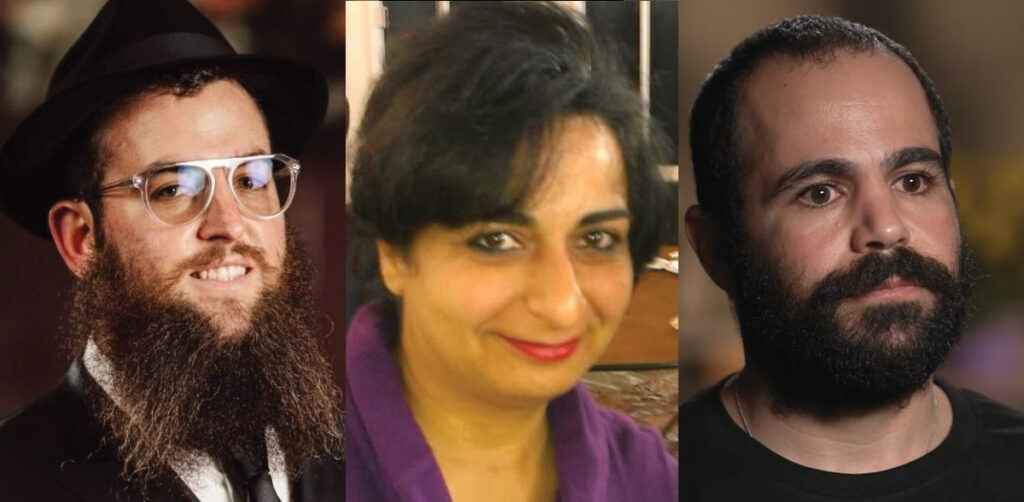
This year, as we sit down for the seder, hear the eternal words of our redemption, and again remember the taste of matzah (was it always this crunchy?), let us keep all Jews, whether our brothers and sisters in Israel, Iran, Argentina, Ukraine, France, or elsewhere in mind. But let us especially keep the following three Jews in mind. Doing so will uplift our humanity and consciousness in immeasurable ways. 

The Young Rabbi and His Wife

As we gather for the Passover seder, let us honor the memory of Rabbi Zvi Kogan, z”l, the Israeli Moldovan Chabad rabbi who was abducted and killed in the United Arab Emirates last November. He was 28. 

Rabbi Kogan disappeared Nov. 21 and his abandoned car was found in the city of Al Ain. He was found dead three days later.

In 2022, just two years before he perished, Rabbi Kogan married Rivky Spielman. Tragically, her uncle, Rabbi Gavriel Noach Holtzberg, and his wife, Rivka, were murdered by Islamists in an attack against Chabad of Mumbai in 2008.

In addition to conducting Jewish outreach on behalf of Chabad, Rabbi Kogan also helped manage Rimon, a kosher supermarket in Dubai (last month, Rimon announced that it was moving). On March 31, the UAE announced it would sentence three Uzbek nationals to death for the crime of abducting and killing him. The men were extradited from Turkey.

Zvi Kogan can no longer search his home, his car, or any other areas for forbidden chametz. He can no longer recite the holy words of the Haggadah or consume four glasses of wine. He and his wife can no longer host Jews in Abu Dhabi for Passover seders. Something tells me he must have loved Passover. 

His wife has been rendered a double victim of Jew-hating terrorism. Last year, she and her husband may have hosted a beautiful seder in Abu Dhabi. I do not know where she will be this year, but I pray that she is surrounded by love, comfort, and unshakeable faith. 

Let us search our homes for chametz, partake in our seders with gratitude, and open our homes with extra zeal — and without complaint —in the memory of Rabbi Kogan.

The Devoted Mother

A woman can be the heart of a home, and since so many Passover rituals focus on the home, much of Passover preparation falls on women. This year, I am thinking of one particular woman, whom I did not know, but who, like most Iranian Jewish women, must have dedicated herself to preparing for the holiday with tremendous time, devotion, and care. 

I am referring to Linda Farzan, z”l, who was allegedly killed by her husband on Feb. 5 in Encino. She was shot outside of a friend’s home after attending a religious meeting; her teenage son witnessed the tragedy. As I wrote in a previous column, her death has shaken our community and caused untold pain.

It is not hard to imagine Linda last Passover, undoubtedly cleaning her home and searching to chametz; preparing shopping lists and visiting multiple kosher supermarkets; checking food items meticulously to ensure they were kosher for Passover; standing on her feet for hours to lovingly prepare Persian delicacies for her family; and, since she was an Iranian Jew, perhaps reveling in the playfulness of the “Dayenu” ritual, in which Jews from Iran swat at one another with pungent scallions. 

None of this is hard to imagine. What is more difficult is the thought of Linda’s beloved children, gathered this year around a seder table, and partaking in Passover without her. 

I am also thinking of her friends who witnessed her death in the early evening hours, in an otherwise quiet residential street in the valley. Her void, on this first Passover without her, must be unbearable. 

Let us have Linda in mind the next time we are tempted to complain about long lines at kosher markets before Passover, or the sheer amount of cleaning and preparation that awaits us. Let us enjoy a sweet treat this Passover and say a blessing over it, in the merit of her memory. 

The Grieving Father

If we stopped this Passover to contemplate the thousands of Israelis who are mourning the loss of their beloved family and friends, whether they were killed on Oct. 7, taken as hostages and later declared dead, or they fell as brave soldiers or first responders, we would undoubtedly fall apart. But we must remember these souls, each precious, and each a universe of life, love and dreams.

We must also remember the 24 hostages who may still be alive in Gaza, continuing to endure Hamas’ barbaric cruelty. Last Passover, as well as this Passover, Jews worldwide truly learned the meaning of freedom, captivity, and tyranny. 

But though I am thinking of the hostages and of those who have perished in the last 18 months, I am also thinking of one man in particular: Yarden Bibas. 

In February, Yarden (and the world) learned that his beloved wife, Shiri, and two precious sons, Kfir and Ariel, were murdered by Hamas, who killed the small boys with their bare hands. 

I imagine this special family during Spring 2023, when they may have celebrated Passover together with relatives. Kfir was born a few months earlier, in January. Did little Ariel, who was three at the time, manage to stay awake for most of the seder? Did he find the afikomen his father may have hidden somewhere in the house?

I then imagine Yarden last Passover, when he was still being held captive by Hamas, and when he still did not know whether his family was alive or dead. 

This year, I do not know if he will participate in any Passover rituals. Hamas also killed his father-in-law and mother-in-law on Oct. 7, wiping out three generations of a Jewish family. I pray that Yarden is with his own family. I can no longer think about finding afikomen without imagining that Ariel Bibas must have delighted in finding the hidden treasure for himself. Perhaps he was dressed in his beloved Batman pajamas. 

Whether our loved ones agitate us before Passover, or during the actual seders, let us bear in mind Yarden Bibas, who no longer had a home nor a wife and children to which he could return upon his release. How small our annoyances seem compared to the universe of pain and grief encompassing this young father. 

In truth, we should have these three Jews in mind the entirety of the year, rather than merely during Passover. And if we really want to honor the memories of Rabbi Kogan, z”l, Linda Farzan, z”l, and Shiri, Ariel and Kfir Bibas, z”l, we can always commit to performing a mitzvah with them in mind. This may include adhering to positive commandments, such as purchasing and consuming a few products with kosher for Passover labels on them, or refraining from forbidden practices, such as choosing to not speak gossip or “lashon hara” (harmful speech) about someone, even if it is true. 

Perhaps the maror, or bitter herbs, and the matzah, or bread of affliction, will taste more bitter this year. Perhaps our mindfulness of their taste is truly for the good.

Chag Kasher v’Sameach.


Tabby Refael is an award-winning writer, speaker and weekly columnist for The Jewish Journal of Greater Los Angeles. Follow her on X and Instagram @TabbyRefael.

Three Jews to Keep in Mind This Passover Read More »