fbpx

April 9, 2025

New ICC Poll Shows Strong Support for Defunding Colleges Over Antisemitism, Deporting Anti-Israel Activists

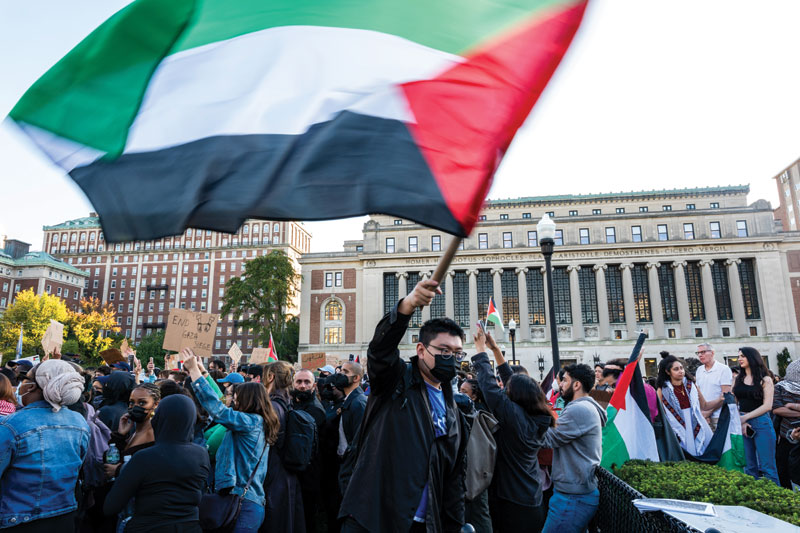
A new survey from Israel on Campus Coalition and Schoen Cooperman Research shows that a majority of U.S. adults and college students support cutting federal funding to universities that have failed to protect Jewish students and address antisemitism head on. According to the survey, 66% of U.S. adults and 56% of college students are in favor of this tactic. Additionally, 54% of U.S. adults and 40% of college students support the deportation of Mahmoud Khalil, the anti-Israel activist at Columbia University.

“The American public has sent a clear message: universities must be held accountable for failing to protect Jewish students from discrimination and harassment” said Jacob Baime, CEO of the ICC, a pro-Israel organization on college campuses that supports Jewish and non-Jewish Zionist students, offers fellowships and sends students to Israel.

“The American public has sent a clear message: universities must be held accountable for failing to protect Jewish students from discrimination and harassment.” Jacob Baime

The survey from ICC and Schoen Cooperman Research included responses from 1,000 U.S. adults and 450 college students and was taken between March 21-24. It also revealed that 83% of Americans affirm Israel’s right to take military action against Hamas to rescue hostages, compel meaningful negotiations and disarm the terrorist group. A strong majority of U.S. adults – 65% – see Israel’s renewed military efforts in Gaza as a justified response to Hamas’ refusal to release the hostages as well as its ongoing aggression.

“The polling demonstrates that Americans continue to be steadfast in their support for Israel in its war against Hamas,” said Carly Cooperman, CEO of Schoen Cooperman Research. “Having polled consistently on this issue for 18 months since Hamas’ October 7th attack on Israel, there is a reliance in the belief that Israel has a right to defend itself, and more recently, that Israel is justified in resuming military action while Hamas refuses to release hostages and continues to attack Israel. This extends to the concern in the US regarding antisemitism and the need for the government to push schools to do more to protect Jewish students.”

Recently, the Trump Administration has supported Israel’s right to defend itself and gone after colleges, threatening to pull their federal funding for not standing up against antisemitism on campus. Ivy League universities in particular have been under harsh scrutiny, as they have been ground zero for anti-Israel, anti-American protests since October 7. The administration has also taken steps to revoke the visas of foreign students who participated in the protests and may have them deported.

Baime said it’s clear that with the new ICC/Schoen survey results, universities need to take immediate action to protect their Jewish students, ensuring that what has transpired since October 7 comes to an end.

“Amid a rising crisis of antisemitism, too many academic institutions have neglected their duty,” he said. “With 66% of U.S. adults and 56% of college students supporting the withdrawal of federal funding from schools that tolerate such failures, these findings signal that administrators must act decisively to ensure a safe, inclusive environment for Jewish students.”

New ICC Poll Shows Strong Support for Defunding Colleges Over Antisemitism, Deporting Anti-Israel Activists Read More »

LA Staples Employee Denies Service to Black Jewish Woman Over Her Zionist Postcards

An employee at a Los Angeles Staples on Wilshire Boulevard refused to print a Black Jewish woman’s postcards with phrases “Black Jewish Zionist Squad” and “Jewish Joy” on April 7, according to video posted to social media that has gone viral.

The video shows an employee, wearing a name badge that says “Ryatt,” saying that “we are not able to print anything that has any racist messages,” specifying that he found the “Zionist” postcard to be racist. The woman, Elisheva Rishon, who recorded and posted video of the April 7 encounter on Instagram in a story titled “staples incident,” countered that Zionism is not racism and that she is Black. Ryatt replied that he too is Black and that he’s also an Arab, “so I do understand the definition of Zionism.” Rishon replied that she has a different definition of Zionism and that the card she wanted printed “clearly stated that it’s for Black Jewish Zionist.”

“Judaism does not equal Zionism,” Ryatt replied. Rishon asked him if he’s Jewish, to which Ryatt replied that his grandfather’s Jewish. Rishon proceeded to ask him what his definition of Zionism is; Ryatt replied that it’s “not really the point.” Rishon countered that it is the point because Ryatt’s definition that Zionism is racism “doesn’t make any sense.” She explained that to her, Zionism “means the yearning to return to a homeland for over 2,000 years.” Ryatt then asks, “Does that mean the extermination of …” prompting Rishon to interject: “Did I say that?” Ryatt replied that Rishon’s definition of Zionism may not fit the definition of “the masses,” prompting Rishon to counter that she doesn’t know “anyone who talks about extermination.” Ryatt then cited the actions of the “current Zionistic regime,” prompting Rishon to ask him if he was talking about a government, to which Ryatt said he was talking about “an ideology.” Rishon told Ryatt, “you have your own interpretation of a religion you don’t belong to that you made up in your head.”

A manager wearing a name badge that says “Cynthia” later came to talk to Rishon; Rishon said that Ryatt is also refusing to print her “Jewish Joy” postcard and accused him of being antisemitic, prompting Ryatt to shake his head and reply that he’s just anti-Zionist. Eventually, Cynthia tells Rishon that “we’re done,” and another customer angrily tells Rishon: “Nobody wants to deal with you. There is way too much going on in the world right now to act like that with employees who are just trying to do their job. You need to get out of here.” Rishon then asked the man if he knew what happened, to which the man replied: “No. I don’t care because I don’t want to hear you yell … Leave them alone and shut the f— up.” The man added: “There are a lot of people here that need service. Fix your wig and get the hell out of here.”

Purported video of Ryatt after the incident shows him saying that he is “shaken up” by what happened and that “my job has a policy against any type of racist messaging, which Zionism holds lots of racist ideologies towards Arab people and Islamophobic ideologies towards anyone who practices Islam.” Ryatt then claimed that Rishon asked him if he’s a Muslim — which Ryatt claimed his response was that it’s none of her business — and also asked him if he’s Jewish, and Ryatt replied that his grandfather was. “I know that my grandfather, rest his soul, would not have stood for this,” Ryatt added. “…no real Jewish people who understands Judaism as what it is would have stood for this … this woman was just here to argue.”

Ryatt then claimed that he didn’t even look at Rishon’s “Jewish Joy” card. “I 1,000% believe that Judaism, true Judaism, should be celebrated, not Zionism,” he said. “I told her a million times, Judaism does not equate to Zionism. It is untrue, it is just folklore, it is a farce, to try and equate the two … she wanted to focus on the fact that I didn’t print out the second cards that I didn’t really care to look at because I was just hit in the face with Zionistic messages and wanted to call me an antisemite.” Ryatt said that he told Rishon that “I am a semite, I’m Arab and I’m Black.”

He alleged that Rishon argued with his manager about a half hour, and that seven people were behind her in line and “rolling their eyes” at the situation. Ryatt lauded the customer who angrily told her to “shut the f— up” since at that point the incident ended. Ryatt further claimed that at that point, he offered to print Rishon’s “Jewish Joy” cards for free, but Rishon refused to take him up on it. “She wanted to just keep arguing, keep filming and calling me an antisemite … it’s just so performative,” Ryatt said. He concluded the video by stating: “Free motherf—ing Palestine forever.”

Rishon claimed in her “staples incident” Instagram story that Ryatt had told her to come into the store to pick up the order, and that he was lying in his video when he claimed she was being aggressive toward him.

We will not tolerate this outrage, and we will not let this clear violation of anti-discrimination law slip by without consequence. Staples is responsible for the reprehensible conduct of its employees, full stop.” – Gerard Filitti

Gerard Filitti, senior counsel at The Lawfare Project, posted on X on April 8 that the video of Rishon being denied service at Staples showed “blatant antisemitic discrimination” and that he would be “meeting with @LawfareProject’s new client. We will not tolerate this outrage, and we will not let this clear violation of anti-discrimination law slip by without consequence. Staples is responsible for the reprehensible conduct of its employees, full stop. At a minimum, their immediate termination is warranted.”

A spokesperson for Staples told The Journal, “Staples is aware of the recent interaction between a customer and associates at one of our stores in Los Angeles, California. Staples is currently investigating the circumstances involving this interaction. Staples remains committed to serving all customers, and we continue to work hard to ensure respectful and professional interactions in all situations.”

LA Staples Employee Denies Service to Black Jewish Woman Over Her Zionist Postcards Read More »

Table for Five: Passover

One verse, five voices. Edited by Nina Litvak and Salvador Litvak, the Accidental Talmudist

You must observe the practices of Passover as a rule for you and your children forever.

– Ex. 12:24


Dini Coopersmith

Educator, Trip Director, www.reconnectiontrips.com

This verse speaks about Pesach being the most foundational and important holiday in the Jewish calendar, “for you and your children forever.”

Leaving Egypt is forever considered our nation’s story. At this moment, Hashem chose the Jewish People to be His ”beloved” chosen Nation. Beforehand, we were a motley group of people. God told Moshe to tell Pharaoh: ”my firstborn son is Israel,” so no matter what they do, my love for them is unconditional. 

All the practices of the seder night reflect this important point: an infinite God exists, Omniscient, omnipotent, Who chose the Jewish People over all other nations, for a special mission and destiny, to be His messengers and light unto the nations.

Talking about the redemption from Egypt and the 10 plagues fuels our Emunah and trust in God for the entire year; we learn about His supervision and power over all aspects of creation, we express our belief in His ability to overcome our enemies and redeem us, we bask in the knowledge that Hashem loves us unconditionally. There is no limit to the storytelling, “the more you tell about the redemption, the more praiseworthy.” Because Hashem is infinite, there is no limit to Emunah.

As Rabbi Jonathan Sacks ob”m said: “the world we build tomorrow is born of the stories we tell our children today … Teach your children the history of freedom if you want them never to lose it.” 

Teach your children the history of Hashem’s unconditional Love for them if you want them never to lose their Emunah.


Rabbi Adam Kligfeld 

Senior Rabbi, Temple Beth Am

I miss the Pesach s’darim of my children’s youth. I worked hard to make them memorable, surprising, inventive. The work invested to whet their spiritual appetites as we approached Pesach — by writing and practicing skits, composing parodic songs, designing elaborate midrashic artwork with which to festoon the room–imbued within them not only enjoyment of the holiday, but also anticipation of it in advance. They could not wait for seder night to arrive. Because we prepared. We set the table, literally and figuratively. 

Those were exhausting years, as father/educator. But immensely rewarding.

Curating anticipation can be read into, and from, our verse. Hebrew roots are pluripotent. “Shamar,” the verb here translated as “observe,” generally means to watch, guard or protect. As in a Jew’s obligation towards mitzvot. But it can also mean to wait expectantly. To anticipate. As when describing Jacob’s reaction to Joseph’s dreams and the burgeoning filial enmity. He waited to see how things would turn out. 

If one imports that sense of the verb to our verse, the Torah is not merely commanding us to observe the rites of Passover. But to anticipate them. To yearn for them. To wait in that way that aches, both delightfully and uncomfortably. Because you want it so deeply. 

Many Jews rue the arrival of Pesach. The burden is immense. We have turned the holiday of liberation into a certain enslavement. Let us not surrender to that heaviness. Let us build towards seder night with great anticipation. For our children. For us all. Let us put in the holy work that has us aching for these rituals. For spiritual liberation itself.


Rabbi Scott N. Bolton

Congregation Or Zarua, New York City, NY

On Passover, we are commanded to tell our children the story of our liberation. This is more than history — it is a transmission of memory, resilience, and responsibility. We teach them that in every generation, enemies rise up against us, seeking our destruction — and yet, through divine grace and human courage, we endure. At the same time, we pour a cup for Eliyahu HaNavi, symbol of hope and promise, who stands for a future redeemed from tyranny, terror, and hate. He reminds us that while the world is broken, it is not beyond repair — and that we are part of its healing.

Children must be engaged through questions, symbols, and song, but the conversation among adults must be real and deep. On this night, we are all banim laMakom — children of the Holy One — equally responsible for remembering and for shaping what comes next.

The Israeli poet Zelda wrote:  

“L’chol ish yesh shem she’natnu lo aviv v’imo, v’natnu lo ma’asav.”

To every person is a name given by their parents — and given by their deeds.”  

We inherit more than memory; we inherit a sacred mission. The burdens of history, and the strength drawn from it, bind one generation to the next.

Jewish tradition teaches that messianism is not distant or abstract — it lives within each of us. In every act of justice, in every refusal to give in to despair, we help bring the redemption closer.


Judy Gruen 

Author, “Bylines and Blessings

Here’s a shocker: biblical Hebrew has no word for history. How can this be? A people whose history is so dramatic, so world-changing religiously, culturally, politically, morally, and universally, has no word for history?

Rabbi Jonathan Sacks explains in essays from his Jonathan Sacks Haggadah that for Jews, the word for memory is more foundational than the word for history. The word zachor — remember — appears at least 169 times in the Bible: “Remember that you were strangers in Egypt”; “Remember the days of old”; “Remember the seventh day to keep it holy.” Not only are we told to remember, but to “not forget” what Amalek did to us due to its particular cruelty. 

Rabbi Sacks writes, “History is his story — an event that happened sometime else to someone else. Memory is my story — something that happened to me and is part of who I am. History is information. Memory … is part of identity.”

Jews have a long memory. These memories — our lived experiences — are essential to preserving our sense of identity. The Pesach seder is a reenactment of our history through our collective memory. It is the longest-running religious observance in the history of the Western world, and one that almost all Jews are drawn to celebrate. Paraphrasing Rabbi Sacks, observing Pesach continues our mission of remembering, joining us to a past and future, a history and destiny, making us characters in the story of our creation as a people. 


David Porush, Ph.D.

Student and Teacher

The verse literally says, “And you will observe this matter as a statute for you and for your children forever.”

The “this” causes a problem. The Hebrew “et” means something very particular. Rabbi Akiva tells us that the word — for which there’s no translation in English — refers to some obscured intention by God. 

Normally “this” must refer to the passage just preceding it, commanding the Hebrews to smear blood on their doorposts so the Angel of Death will pass over them (Ex 12:23). But the Angel of Death was only a miracle in Egypt. The Sages say that “this” must refer back to the commandment to sacrifice the lamb, 18 verses earlier, though it’s a really lost antecedent. No one smears blood on their doorpost now. Obviously, the sacrificed Paschal lamb must be observed for all generations.

However, the word “statute” — “chok” —must also give us pause. It means a mitzvah that transcends understanding. We are on supernal ground and should tread humbly.

Talmud tells us the seder is a performance for children, stagecraft to command their attention so they will transmit it to their children. Unfortunately these past 550+ days also reminded us that the Angel of Death hovers on the threshold of our homes even now, looking for clear signs that we are affirmatively Jewish. In fact, the two are the same: the blood on the doorpost is from the Paschal lamb. Only performing both will preserve us for all time.

Table for Five: Passover Read More »

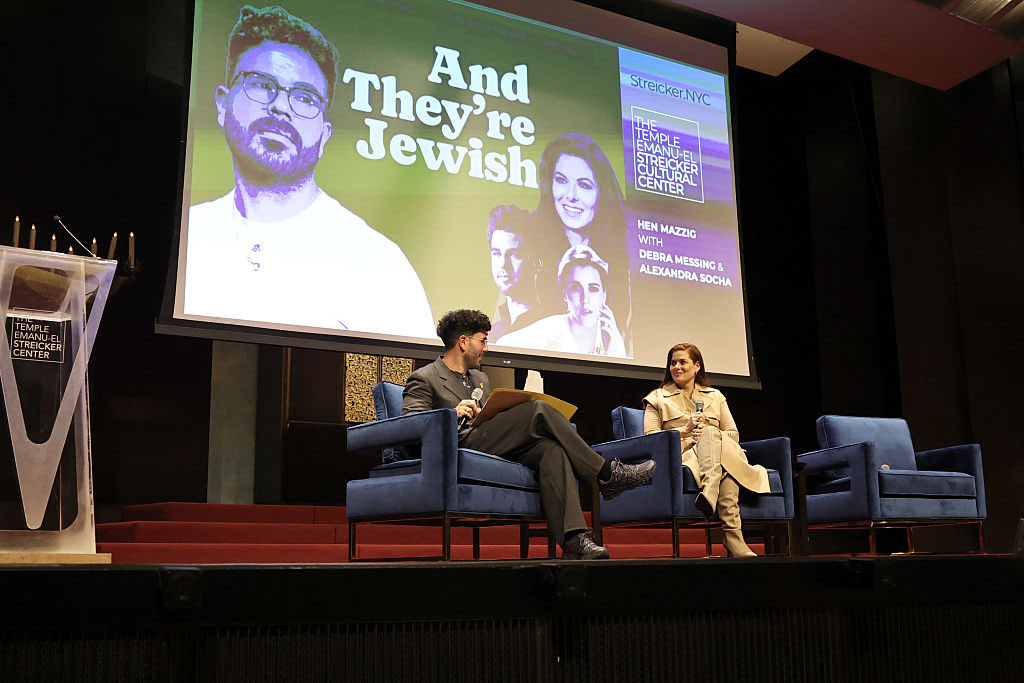
‘And They’re Jewish’

“Jewish representation in mainstream media is shrinking. Jewish identity is being erased and reduced to cliches or only discussed when it’s tied to trauma or conflict,” said Hen Mazzig, author and co-founder of the Tel Aviv Institute, to a packed Streicker Center in New York City. “I’m reclaiming Jewish visibility, not through the lens of victimhood. But through joy, success, and an unapologetic celebration of Jewish identity.”

Mazzig was here to launch his new weekly YouTube series, “And They’re Jewish.” In the new series, Mazzig talks with a diverse group of Jewish personalities such as Debra Messing, Mayim Bialik and Emmanuelle Chriqui, about how they connect with their heritage and Jewish identity. Celebrating our diversity and impact undermines the dehumanization of Jews that has prevailed both on and off campus since Oct. 7.

Each 20-minute episode will showcase “the artists, chefs, actors, and creators whose work you love, but whose Jewish identity you may not have known.” He adds, “This series isn’t just about visibility; it’s about celebrating the depth, diversity and undeniable impact of Jewish voices in every space.”

“This series isn’t just about visibility; it’s about celebrating the depth, diversity and undeniable impact of Jewish voices in every space.” – Hen Mazzig

At the launch event, Mazzig spoke with Messing and Alexandra Socha, who played Glinda in Broadway’s “Wicked.” Messing spoke about growing up in Rhode Island in one of the few Jewish families. She felt hated and “othered” as a child but theater allowed her to escape — “to disappear.” 

But none of this prepared her for our Oct. 8 reality — where Jews have been gaslighted, erased and dehumanized on a daily basis. “Our allies,” Messing said, “they didn’t show up for us.” But Messing believes that this existential threat of extinction has made all of us stronger. “To be a Jewish fighter — it’s in our DNA, part of the global family.” Messing is seeing the fiercest fighters among Jewish students —“Gen Z is the strongest generation of Jews yet.”

“Our ancestors fought and died for us to be here,” said Messing. “We’re not going to let that be for nothing. To all Jewish students: we see you, we stand with you, we will fight with and for you.”

Socha is a proud convert to Judaism. She felt instinctively at home with “Judaism’s ability to hold light and darkness together at the same time,” with the permission Judaism gives “to feel.”

After Oct. 7, Socha also felt “betrayed and abandoned.” She, too, watched with disgust as “perfectly nice” people “parroted jihadist talking points. Idiocy is dangerous,” she said.

But the emphasis of the evening was on the fact that we are “survivors” of antisemitism, not victims. And to continue to see ourselves as such, we must lean in to our ancestral Jewish pride — and to teach the joy and moral clarity of Judaism to our kids. 

“Entourage” star Chriqui says the new series is “a crucial cultural project at a time when Jewish voices need to be heard more than ever,” adding that “Hen has created something truly special — an honest, heartfelt series that showcases the depth, diversity, and humanity of Jewish identity. In a time of rising antisemitism, it’s vital to share real stories that challenge stereotypes and remind the world of the richness of Jewish culture and experience.”

Brett Gelman (“Stranger Things”), singer-songwriter Ari Dayan as well as Socha’s husband, actor Etai Benson. British artist and photographer Zoe Buckman and NBA executive Rachel Simon round out the series’ nine-episode first season. New episodes drop every Wednesday. 

ADL CEO Jonathan Greenblatt applauded the series for “bringing to life the stories of those living with hate.”

“For so long, Jewish stories have been framed through trauma, antisemitism, or political debate,” said Mazzig. “And yes, those are real and important. But we’re more than that. We’re artists, actors, chefs, designers, athletes — we’re creators. We’re joy. We’ve always been joy.”

“This is the start of something bigger. A new era of Jewish storytelling,” said Mazzig. “We’ve spent centuries being asked to justify our existence. This series is about celebrating it.”

“In a world that constantly tries to erase the humanity of our people, we will continue celebrating the miracle of being Jewish and alive.” I have no doubt that the Streicker crowd left the beautiful sanctuary that night fully inspired by Mazzig’s extraordinary light, and feeling a lot less isolated.


Karen Lehrman Bloch is editor in chief of White Rose Magazine.

‘And They’re Jewish’ Read More »

The Worst Two Words in Israel?

These are the two most frightening words in Israeli conversation. 

Civil War.

Or maybe it’s these two?

Deep State.

Frightening, trendy words. Soon, other expressions will replace them, but these are the ones currently in circulation. We talk about them. In fact, the word “talk” doesn’t quite fit this case. We “utter,” “yell,” “hiss” and”scream.” The threat of a civil war, real or imagined, was recently highlighted by former Supreme Court President Aharon Barak. I wrote about it two weeks ago. The threat of the Deep State, real or imagined, is repeatedly raised by Prime Minister Benjamin Netanyahu.

Real or imagined? A survey by JPPI asked what the public thinks about these warnings. One — that there is an imminent and tangible danger of civil war. Another one — that there is a “Deep State” in Israel that makes it difficult for the government to implement policies desired by the public. We asked; the answers of the public tell a story.

Let’s start with the claim that “we are very close to a civil war.” How many Israelis think this is true? 27% say Barak is “right.” That is – “we are very close.” A third (33%) chose an option that implies a degree of agreement, albeit a softer one: “I think he somewhat exaggerated, but the danger is real.” This means they have reservations about Barak’s definitive sharpness – “we are very close” – but their conclusion is not far from his. They chose an option that includes the phrase “the danger is real.” Imminent? Maybe not. Real? Indeed. 

If we combine these two answers, there is a 60% majority in Israel that believes there’s a danger of a civil war. Among Jews, it is 58%. Among Arabs, it is 69%. The other answer options — “He [Barak] greatly exaggerated and we are not close to such a thing,” or “There is no danger of a civil war in Israel,” got a bit more than a third, combined (37%). Only among Jews who identify themselves as “right-wing” is there a majority who do not think a civil war is an imminent danger (68%). The “right” is indeed a large group, but not large enough for its less concerned, less alarmist stance to be the dominant position in Israel.

Now to the “Deep State.” A statement by Netanyahu was presented in the survey. “When a strong leader from the right wins elections, the Deep State, serving the left, uses the legal system in a distorted way to thwart the will of the people.” Thirty-seven percent of Israelis agree with it. And note the similarity: 37% say there is no danger of civil war – 37% say there is a Deep State. Are these the same people? We’ll tell you the answer in a moment.

Just under a fifth chose a middle position: “I think he exaggerates: there is a problem in Israel of balance of power between different authorities, but it is not a ‘Deep State.'” Four out of 10 Israelis believe that Netanyahu is “wrong.” If we combine the first two answers – we find a majority that agrees there is a “problem” (55%). If we combine answers two and three – we find a majority that does not agree with the description “Deep State” (58%).

Now let’s connect the dots carefully by looking at crosstabs: A large majority (77%) of those who think Barak is right (danger of civil war) think Netanyahu is wrong (no Deep State). Conversely, a large majority of those who think there is no danger of a civil war (79%) believe Netanyahu is right. And no – it’s not entirely surprising, but numbers allow us to ratify what we all instinctively understand. Those fearful of civil war are not fearful of a Deep State – those fearful of a Deep State are not fearful of a civil war. The Israeli perspective on reality is a view through political glasses. Which means they do not see the same reality.

Those fearful of civil war are not fearful of a Deep State – those fearful of a Deep State are not fearful of a civil war. The Israeli perspective on reality is a view through political glasses. Which means they do not see the same reality.

Why is this important? Because when not seeing the same reality, there’s really no way to conduct a debate. You can have a debate when you see a similar reality, and the positions on how to respond to it differ. Say: We all understand that Iran is developing nuclear military capability – an agreed-upon reality – but we do not necessarily agree on how to respond to this reality. But in the case of the Deep State and civil war, there’s not so much a way to argue. Had everyone agreed that the danger of a civil war is a real danger, we could debate how to prevent it. But not everyone agrees that the danger is real and therefore, if there is an argument, it’s not about “what to do” but about “what the reality is.” Whether it’s now day or night, whether it’s now winter or summer.

The same rule applies to the “Deep State.” Had everyone agreed there isn’t one – no problem. Had everyone agreed there is one, we could have a discussion about whether it’s good, bad, and, how to manage that reality. But there’s no agreement, which makes the debate almost fullish. Is it a day or night? We’re still looking for the blinds we can raise.

Something I wrote in Hebrew

Pesach is upon us, so here’s something on Israelis at Pesach. How much of the Haggadah do they read? Here’s what I wrote:

I suppose you won’t be surprised to discover that most secular Jews in Israel do not read the Haggadah part that comes after the meal. They stop at the meal (I assume some of them sing “Chad Gadya” or “Echad Mi Yodea” or one of the other hits from the end of the seder, but they don’t read everything between the meal and the sequence of hits). And you won’t be surprised to find out that the ultra-Orthodox and religious continue to read even after the dessert. The majority of Israelis do read the after-meal part, or at least say they read, because we didn’t go to their seders to check that they really are reading, without skipping, and without dozing off while others read.

A week’s numbers

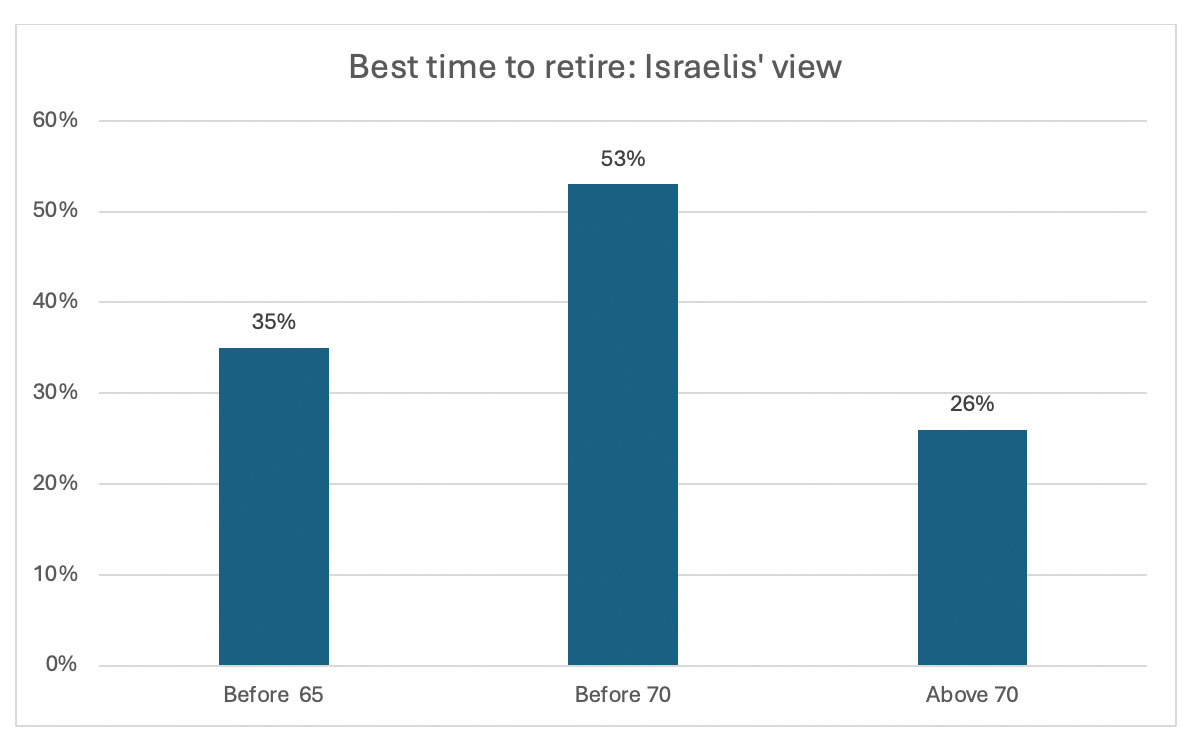
Numbers unrelated to politics: at what age a person ought to retire? A JPPI survey has the answer of Israelis:


A reader’s response

Maya Barr asks: “Do Israelis understand that Trump is ruining the world’s economy?” Answer: If the downward spiral of their savings continues – they will.


Shmuel Rosner is senior political editor. For more analysis of Israeli and international politics, visit Rosner’s Domain at jewishjournal.com/rosnersdomain.

The Worst Two Words in Israel? Read More »

Campus Watch April 9, 2025

Former Columbia President Katrina Armstrong Tells HHS She Doesn’t Remember Specific Antisemitic Incidents on Campus

Former Columbia University President Katrina Armstrong said in April 1 testimony to the Department of Health and Human Services (HHS) that she doesn’t remember any specific antisemitic incidents that occurred on campus in the past year.

The Washington Free Beacon obtained a transcript of Armstrong’s testimony with HHS Acting General Counsel Sean Keveny; the university had announced on March 28 that Armstrong is resigning from her position as interim president and would be leading the Irving Medical Center. Armstrong said in the testimony that she had “no specific memory of hearing” students on campus call for the destruction of Israel. She also acknowledged having no “specific recollections” from what was in an August report by the Columbia Task Force on Antisemitism; when asked about specific incidents from Jewish students, Armstrong could not recall any. Instead, she said, “The most hurtful things I heard were about friends no longer being friends.” At this point, Keveny asked how she has “such a terrible memory of specific incidents of antisemitism when you’re clearly an intelligent doctor?”

When the Free Beacon reached out to the university for comment, a spokeswoman told the outlet: “This testimony does not reflect the hard work undertaken by the University to combat antisemitism, harassment, and discrimination and ensure the safety and wellbeing of our community.” The Free Beacon further noted that after it had reached out for comment on April 6, the university announced that Armstrong “has decided to take a sabbatical and spend time with her family.”

Anti-Israel Protesters Physically Removed from CU Boulder Class After Disrupting It

The University of Colorado Boulder announced on April 2 that it is investigating an incident in which anti-Israel protesters disrupted a class and were then physically thrown out of the class.

The Denver Post, which reviewed video of the incident, reported that two anti-Israel protesters entered the “Designing for Defense” class. One of the protesters was filming while the other, who was wearing a keffiyeh and holding papers, walked to the front of the class. The instructor for the class started shouting at the protesters to leave the class; the Post described a “struggle” that occurred between the instructor, one of the protesters and a class “mentor,” during which the protester wound up on the floor. The mentor is also purportedly seen in the video holding the keffiyeh outside the classroom and saying, “You want some too?” to one of the protesters; the mentor is also purportedly seen “outside the classroom door picking up one of the protesters by the keffiyeh and dragging them, flinging their body around,” per the Post.

“The CU Boulder Police Department is investigating an incident that occurred Wednesday, April 2, where a classroom was disrupted by unidentified individuals, one or more of whom were removed from the classroom after being told to leave repeatedly by the instructor,” the university said in a statement. “A second individual who appears to be removing individuals from the class in a video of the incident was not an employee or a student. CU Boulder condemns acts of violence and does not tolerate classroom disruptions, both of which violate state law and university policies.”

Education Dept. Reviewing Nearly $9 Billion in Federal Funding to Harvard

The Department of Education is reviewing nearly $9 billion in federal funding to Harvard University over the school’s handling of antisemitism.

The department announced in a March 31 press release that the review “includes the more than $8.7 billion in multi-year grant commitments to Harvard University and its affiliates” and “the more than $255.6 million in contracts between Harvard University, its affiliates and the Federal Government.” The Trump administration sent a letter to the university on April 3 highlighting a series of demands that the university must meet to retain the funding, including banning masks and excising its Diversity, Equity and Inclusion program, per CNN.

University President Alan Garber warned losing the federal funding would jeopardize critical research, reported CNN. He also declared that the university is committed to fighting antisemitism and has enhanced their policies to better address the matter.

UCSB Announces Committee to Address Antisemitism

UC Santa Barbara (UCSB) Chancellor Henry Yang and Executive Vice Chancellor David Marshall announced on March 18 that the university is forming a Chancellor’s Advisory Committee on Antisemitism.

“This committee will offer guidance and recommendations about how to ensure that there is a safe and inclusive environment on campus for Jewish- and Israeli-identifying students, faculty, staff, alumni, and visitors, and help us to understand experiences of anti-Jewish and anti-Israeli hostility,” Yang and Marshall said. “It will make recommendations about educational and training efforts to prevent antisemitism, drawing upon best practices and rigorous research and pedagogy.” The committee will also “review and make recommendations about campus codes of conduct and ‘time, place, and manner’ policies, and suggest ways to improve the reporting and transparency of disciplinary processes,” according to Yang and Marshall.

Campus Watch April 9, 2025 Read More »

Let Our Students Go

Since Oct. 7, 2023, countless trips to Israel, from school trips to youth groups to family tours, have been canceled, leaving families and teens disheartened. But the cancellation of a trip doesn’t mean the journey is over. I believe it’s the choice we make afterward that proves truly defining.

This week, Jews around the world will be sitting down for their Passover seders to read the Haggadah, recite the blessings, and celebrate the festivities. I remember years of dressing up in white frilly dresses for my elementary school Passover performances. As a young girl, I would mindlessly and naively sing songs about frogs, hammers banging, and about fleeing slavery. My personal favorite was always the iconic song, “Let my people go!”  All of the parents – including my own – would rush to the front of the hall and raise their phones to record these silly songs of our tradition. While reflecting on these memories, a question dawned on me. Why were the Jews waiting on Pharoah to “let them go”?

Throughout the generations, Jews in the diaspora have consistently demonstrated our determination to reach Israel by confronting and overcoming obstacles along the way. It’s never been about permission. It’s not about a plane ticket. It’s about connection, resilience and an unbreakable bond that no conflict can sever. I am proud of all groups who have pursued trips to Israel.

Over this past winter break, I travelled with my synagogue to Israel on a volunteer trip where we visited army bases, delivered meals, volunteered, and spent time on kibbutzim. One of the kibbutzim we visited in the Negev was Kibbutz Ruchama — a beautiful place surrounded by rolling hills blanketed in yellow flowers and ribbons, full of life and vibrant with families. During our tour, one of the residents showed us an area with over a hundred nearly identical white houses. These temporary tract houses were built after the war broke out, to house the families that had lost their homes from the terror attacks on Kfar Aza. I was so inspired that I returned to Ruchama to volunteer with my best friend, independently from a group, a mere three months later.

For a week, we stayed in Ruchama and volunteered at the elementary school and after-school daycare, Beit Hayeladim. On the first day, we were assigned to work with the third and fourth grade, and immediately fell in love with the children. They were so enthusiastic and pure, despite experiencing terror and living under constant threat of attack. One of the girls in fourth grade originally lived in Kibbutz Kfar Aza, which was destroyed by Hamas on Oct. 7. She was more quiet than the rest of the kids, and always had a teacher’s assistant seated next to her. As I began to speak with her in my broken Hebrew and we drew pictures together, she opened up, showing her true self: sweet and affectionate, with a profound hurt inside. My heart cannot comprehend the trauma she has had to face at such a young age. The connections I built are so meaningful to me that I plan on returning to Kibbutz Ruchama again over the summer to reconnect with the children and spend time in that truly amazing place.

I am so thankful that I didn’t accept defeat when I read that my original trips to our homeland had been canceled. Voyage to Israel has always been our destiny, and no logistical complications, ranging from Pharaoh to insurance plans, are going to stand in our way. I encourage people of any age to make an effort to go to Israel, and build connections so strong that you have no choice but to return. Over the summer there are so many options: family vacation, BBYO teen tours, Birthright, Young Judea, and so many other wonderful offerings. When it comes to Israel, don’t wait for permission, don’t accept cancellations. We show up, we give back, and we keep coming back, because that is our destiny as Jewish people.


Shelby Lebovitz is a 10th grade student at de Toledo High School, who spends her time playing volleyball, guitar, and advocating for Israel.

Let Our Students Go Read More »

Salvador Litvak: Accidental Talmudist, “When Do We Eat?” and Sal-Mon

Filmmaker, Accidental Talmudist and longtime “Jewish Journal” contributor Salvador Litvak’s Passover classic, “When Do We Eat?” took a while to amass a following. However, once his community discovered he was at the helm – maybe 10 years after its 2005 release – it really began to live up to its potential.

“The perennial fifth question of the Passover Seder is, ‘When do we eat?’” Litvak, who is also the author of “Let My People Laugh: Greatest Jewish Jokes of All Time,”  told the Journal. “There’s all these holiday movies… but there was no Passover movie.”

He added, “[Our dream: that] it would become the Jewish, ‘It’s a Wonderful Life,’ the movie that people watch every year.”

The cult classic stars Max Greenfield, Ben Feldman, Shiri Appleby, Lesley Ann Warren, Michael Lerner and Jack Klugman. Litvak directed the film that he co-wrote with his wife and partner, Nina Davidovich Litvak. The latest film “Guns & Moses” is out this summer.

Their second movie was “Saving Lincoln,” but it was meant to be their first. When Steven Spielberg announced he was making “Lincoln,” even though he didn;t make it for a long time, the Litvak’s Lincoln project was put on hold.

They decided to make a move that they could easily shoot: a family dinner movie.

“If you’re an independent filmmaker [and] you want to make a really low budget movie, it should be a horror or a thriller or a comedy, if you’re genuinely funny,” he said. “Do not write a movie where you have 11 people in every scene – it’s extremely challenging.”

When the Litvak’s made “When Do We Eat?” they were connected to Judaism, but not yet Orthodox.

“The movie’s probably a little bit edgier than we would make it today,” he said. “One of the main plot points is that one of the kids doses his dad with a strong hallucinogen at the Passover seder, but also the movie contains wonderful spiritual teachings.

“Max Greenfield plays the boy who’s become religious and his mother [who has] a pretty secular Jewish household is trying to make the home and the seder kosher enough, so the kid will come in his black hat and beard, et cetera.”

When the Atlanta Jewish Film Festival showed “Guns & Moses” last month, they also played, “When Do We Eat?” on its 20th anniversary.

“It was amazing to watch it with an audience 20 years later, and people loved it,” he said. “We’re like cringing – “Are we going to hate this? Are we going to be embarrassed?; – like I said, it’s a little bit edgier than we might’ve made it, but it holds up.”

The Litvak’s dream was for their film to become a perennial holiday favorite. Their “Big Fat Jewish Seder” would be received in the same way as “My Big Fat Jewish Wedding,” one of the most successful independent films of all time.

After being successful on the festival circuit for about a year, “When Do We Eat?” received a theatrical release in April of 2006. Just in time for Passover.

“‘The New York Times’ review dropped first, and if they had said, ‘mediocre, badly directed, not funny,’ that would be on me,” Litvak said. “It’s basically a faith-based movie, but within an irreverent, dysfunctional family comedy, and something, somebody over there got triggered. Same thing at the Washington Post.”

While they had good reviews as well, and Jewish audiences love it, their hopes of it reaching a large audience were dashed.

In 2016, 10 years after the release and four years into growing The Accidental Talmudist audience – listen to the Taste Buds with Deb episode at JewishJournal.com/podcasts for that backstory – , where they share Jewish wisdom, humor and culture, the Litvaks decided to let their community know that they were filmmakers, who made a Passover movie.

They shared the movie’s trailer on The Accidental Talmudist, and hundreds of comments started pouring in: ‘You made that movie, we love that movie, we watch that movie every year.’

“By pure word of mouth and unbeknownst to us, it had become the Jewish ‘It’s a Wonderful Life,” he said. “We just had no idea … I guess we wouldn’t have known if we hadn’t started The Accidental Talmudist.

“Nina likes to say about that story, ‘G-d always knows better than we do what we need,’” Litvak continued. “If we had succeeded, did hundreds of millions of dollars with ‘When Do We Eat?’ and it was ‘My Big Fat Jewish Seder,’ et cetera, [then] we would’ve been pulled into the studio system … and a lot of people [in that world] don’t have time for their kids, so it was such a blessing.”

That being said, since the kids are now out of the house, it would be fine with the Litvaks if “Guns & Moses” becomes a massive hit.

“We could take it,” he said.

When asked about the connection between Judaism and food, Litvak said Shabbos is a great example.

“Every week we make a full stop and have [what] people who are not Jewish would consider a Thanksgiving dinner, so it’s just very much just built in,” he said.

“My mom always used to say there’s two kinds of people: those who get into conversations in the checkout line at the supermarket and those who don’t,” Litvak said. “We are that kind.”

Learn more at SalvadorLitvak.com, AccidentalTalmudist.org, and GunsandMosesMovie.com.Check out Salvador Litvak’s new book, “Let My People Laugh: Greatest Jewish Jokes of All Time.”

For the full conversation, listen to the podcast:

Watch the interview:

Sal-Mon

I learned this one, standing in line at a grocery store to buy some salmon. I got into a conversation with Wolfgang Puck’s sous chef, who shared the best way to make salmon, which I have adapted over the years.

2 tablespoons whole seed mustard
2 tablespoons maple syrup (adjust to taste)
1 teaspoon soy sauce (or less, depending on preference)
1 teaspoon – 1 tablespoon fresh ground ginger
4 salmon fillets (~6 ounces each)

  1. Preheat your oven to 425°F.
  2. In a small bowl, mix together the whole seed mustard, maple syrup, soy sauce and fresh ground ginger. Adjust the soy sauce to your taste for a less salty or more savory flavor.
  1. Place your salmon fillets on a baking sheet, slightly greased or lined with parchment paper.
  2. Generously spoon the mustard-maple mixture over the top of each salmon fillet, ensuring they’re well coated.
  3. Bake in the preheated oven for 15-16 minutes, or until the salmon is cooked through (the exact time may vary depending on the thickness of the fillets).
  4. Turn on the broiler for the last 2 minutes of baking, watching closely to avoid burning. This will create a lovely glaze on the salmon.
  5. Remove from the oven, serve and enjoy!

Debra Eckerling is a writer for the Jewish Journal and the host of “Taste Buds with Deb.Subscribe on YouTube or your favorite podcast platform. Email Debra: tastebuds@jewishjournal.com.

Salvador Litvak: Accidental Talmudist, “When Do We Eat?” and Sal-Mon Read More »

Out of Order: When the World Breaks Script, the Seder Reminds Us Where We’re Going

The word Seder means ‘Order.’ Funny, you wouldn’t think so if you’ve been to one. 

This dinner is so all over the place, you need a manual just to know what to do next. We pretend to invite guests after everyone’s already sitting at the table. We nibble on celery. Then we pick up the bread, break it, cover it, hide it, talk about it—basically everything but eat it. We ask questions highlighting the strangeness of it all, then deliberately avoid straightforward answers. The main course? Two hours after the appetizer. Then, once the meal’s over, we eat some more bread and invite some more imaginary guests. 

None of this is by accident. The Seder is a ritual of induced dissonance. It trains us to sit inside the discomfort of anticipation and contradiction. This is the bread of affliction; this is the bread of redemption. This year we are slaves; tonight we are free. 

In truth, this nature of the Seder reflects one of Passover’s key themes. The Exodus from Egypt was not a predictable event. It was a breakdown of the natural, historical, and political order; a jailbreak from the normal progression of cause and effect. The Hebrew word for “Pass-over,” Pesach—“to skip”—suggests this explicitly. 

Today, we can all feel that same breakdown of predictability just by checking the news. But some, curiously, are not losing faith amidst the disorder of our times. They’re finding it. 

Since October 7, I’ve had nonstop conversations with the grad students on campus I work with who are blindsided by the breakdown of moral logic around the world. They see clarity dissolving around them: How can my classmates view innocent babies as the villains and terrorists as the heroes? 

And yet, the very experience of that dissonance has resulted in a well-documented “surge” of Jewish engagement, bringing countless individuals to explore and grapple with their heritage and faith—often for the first time. 

A renowned tech legend recently told me he was a staunch atheist for 30 years—until the past year. He witnessed numerous events in a row that he felt were, in his words, “of Biblical magnitude,” breaking all the rules of probability, logic, and history. (Why didn’t those missiles hit? How did they pull off those pagers? Why didn’t those buses explode?) He too started to rethink everything, including those old stories he used to dismiss. 

Passover has been reiterating this message to us for millennia. In the shadow of unbearable suffering, God performs a series of miracles that we can’t possibly explain—anchoring the Jewish story in those moments that reason alone could never carry. 

And perhaps that’s precisely why it’s called the Seder. There is an order, particularly when it doesn’t appear so. God doesn’t walk the line, but leaps over it. And so we, too, jump through the Matrix, out of the predictable rhythm of slavery; following God into the desert, the great Unknown. 

What comes next is anyone’s guess. Like the Seder, the Jewish story has never followed a straight path—it leaps, stumbles, endures. Somehow, we follow: through questions, through fire and water, always anticipating redemption. And always ending with the same words: Next year in Jerusalem. 


Matthew Rosenberg is Senior Rabbi and Chief Operating Officer at JGO: The Jewish Grad Organization, which provides Jewish programming at 150 graduate school campuses across North America. He previously practiced corporate law and taught at Georgetown University Law Center. He lives in Los Angeles with his family. 

Out of Order: When the World Breaks Script, the Seder Reminds Us Where We’re Going Read More »

Complaint: Bay Area School District Failed to Handle Antisemitic Incidents

A complaint was filed to the Department of Education’s Office of Civil Rights (OCR) on April 3 alleging that the Santa Clara Unified School District (SCUSD) failed to properly address reported antisemitic incidents on their campuses.

The complaint alleges that “SCUSD applies its policies and procedures regarding freedom of expression, controversial matters and civility in blatantly different ways depending on the impacted student group … SCUSD repeatedly disregards the concerns of Jewish students and suppresses their procedural and substantive rights, all while bolstering the voices of other members of the SCUSD community. This disparate treatment created a hostile environment where SCUSD’s Jewish and Israeli students are continuously being denied equal access to their educational program.”

The complaint points to an instance in February in which the Bay Area Jewish Coalition (BAJC) expressed concern that the Muslim Students Association (MSA) chapter in the district had invited a speaker from the Council on American-Islamic Relations (CAIR) to speak at its “Know Your Rights” event; the MSA had only provided two days’ notice to the school community about the event. The BAJC asked that the district postpone the event given the short notice and contended that CAIR has “social media posts targeting Jews and Israelis” and has “ties to Hamas, a US-recognized terror organization.” The BAJC noted that the MSA chapter did not disclose who the speaker from CAIR would be. The event was also scheduled to take place on the day of Shiri, Ariel and Kfir Bibas’ funeral. “The sensitivity of the day was compounded by the fact that certain leaders of CAIR had previously shared hateful and completely debunked statements blaming Israel for the children’s deaths.”

The district replied that it had thoroughly reviewed the matter; the event went on as planned. The complaint claims the district has the right to stop the event if it “disrupts the educational program or creates a clear danger of unlawful activity” and the event can be canceled if there’s a “credible threat.”

“There is no evidence that the MSA students were aware of, or complied with, these brand new procedural requirements for their event,” the complaint states. “There is also no evidence of SCUSD’s alleged ‘thorough review’ pursuant to these new requirements. Nevertheless, on February 26, 2025, the MSA event moved forward, with Hibah Hammoudeh of CAIR teaching students about Islamophobia, anti-Palestinian bullying, and religious rights in public schools, as well as introducing them to CAIR as an organization. SCUSD did not follow up with the concerned Jewish and Israeli families after this event or make any determination as to the appropriateness of hosting a contentious organization.”

The complaint further alleges that SCUSD failed to respond to the hate speech directed “toward an integral component of mainstream Jewish identity” at a separate MSA event at Wilcox High School toward the end of 2023 and that a teacher “actually gave extra credit to students who attended that event. SCUSD did not take any steps to address the policy violations thereafter.”

The Jewish Culture Club at the high school scheduled their own event for Feb. 2024 to provide a balanced perspective on the ongoing Israel-Hamas war. The club’s flyers promoting the event “were ripped from school bulletin boards,” but no action was allegedly taken after this was reported to school administrators. The district later canceled the event altogether after claiming that “there were significant threats from outside organizations” and refused to provide evidence when Jewish families asked what exactly the threats were. This, the complaint contends, shows a double standard in how the district handled the Jewish Culture Club event compared to the 2023 MSA event.

“SCUSD’s decision to cancel the Jewish Culture Club event resulted in both an infringement on Jewish students’ rights to free speech, and a violation of all students’ rights to an impartial discussion of controversial topics,” the complaint states.

Before the event was canceled, a teacher allegedly targeted a Jewish student over the event during class, urging the student cancel it over a social media post from Bar Yoshafat; the teacher assumed the student was involved because he’s Jewish, per the complaint. The student has not returned to class since then and filed a complaint against the teacher over it. The district concluded that the teacher’s behavior was “unprofessional” and “offensive,” it “did not rise to the level of discrimination as it was not pervasive and did not prevent [the student] from participating in a school activity or event.” The student subsequently appealed the decision to the state’s department of education, which ordered SCUSD to “take further corrective action. … There is no evidence that SCUSD complied with this instruction as of the date of this Complaint.”

The complaint proceeds to focus on a pattern on how teachers and students in the district have allegedly harassed Jewish and Israeli individuals since 2023. The district investigated these incidents, but issued a statement on the matter that did not mention antisemitism or provide any suggested solution for education on antisemitism.

The complaint contends SCUSD’s failure “to address these matters puts them in violation of Title VI of the Civil Rights Acts, The complaint issues a series of suggested remedies, including that the district issues a statement condemning all forms of antisemitism and recognizing that Zionism is a central tenet of Jewish identity, adopt the International Holocaust Remembrance Alliance definition of antisemitism and review all history and social studies curricula to make sure it comports with state standards.

“SCUSD has allowed an egregiously hostile environment to fester for its Jewish and Israeli students in violation of its federal obligations and ethical responsibility to create a safe educational space for all students,” StandWithUs Saidoff Legal Senior Counsel and K-12 Specialist Jenna Harris said in a statement. “We implore the Office for Civil Rights to step in and uphold the right of these students to an inclusive education free from hostility toward their protected identity.”

“SCUSD has allowed an egregiously hostile environment to fester for its Jewish and Israeli students in violation of its federal obligations and ethical responsibility to create a safe educational space for all students.”- Jenna Harris

A spokesperson for the district said in a statement to The Journal, “Santa Clara Unified School District is committed to our values of equity, empathy, and respect. Our schools are beautifully diverse, and we strive for environments where every young person and employee feels a sense of safety, welcome, and belonging,” and pointed to  the variety of resources it provides for addressing controversial issues. There are “established clear procedures for schools to follow when students request guest speakers and other free speech events on campus.”

The complaint was filed by the StandWithUs Saidoff Legal division and the BAJC, represented by David Rosenberg-Wohl of the Hershenson Rosenberg-Wohl, P.C. law firm.

Complaint: Bay Area School District Failed to Handle Antisemitic Incidents Read More »