We don’t know if President Trump’s ultimatum of Saturday noon for Hamas to release all the hostages will hold. We also don’t know what kind of “hell” will break out if Hamas doesn’t release them.
What we do know is that the man who’s made a career out of buying time and keeping his options opened—Prime Minister Benjamin Netanyahu— has been confronted with an unsavory deadline.
So, instead of discussing the next phase of a laborious three-stage ceasefire deal that was already teetering on the edge– and has led to humiliating scenes of Israeli hostages being paraded in front of cheering mobs—Bibi’s security cabinet initially joined Trump’s ultimatum. As JPost reported today, Defense Minister Israel Katz warned that if Hamas does not release the Israeli hostages by Saturday, all hell will break loose, “exactly as US President Donald Trump promised.”
Now, there are rumblings that Bibi and his team are trying to revive the ceasefire deal that will buy Bibi some time, but that’s far from certain.
Even with a tough ultimatum, though, my concern is that it may be 19 months too late.
The time to issue ultimatums about the hostages was immediately after the worst attack in Israel’s history, when Hamas, in addition to murdering 1200 souls, took hundreds more captive. In a region where any sign of weakness can be a death sentence, Israel never looked weaker than on Oct. 7, 2023.
Yes, Bibi’s prompt declaration of war against Hamas was a sign of strength, but separating that war from the release of all the hostages was a sign of weakness. It gave Israel’s enemy all the leverage it needed.
We can see the fallout today, when Hamas is toying with Israel knowing it holds most of the cards, going as far as to declare “victory” even after an extraordinary military effort by Israel to decimate the terror group. Agreeing to a three-phase deal with hostages released in “dribs and drabs” only reinforced Hamas’s leverage.
From Bibi’s standpoint, as long as he kept the focus on “total victory” while giving lip service to the hostages, he could continue to buy time and keep his far-right coalition partners on his side. It helped that the desire to smash Hamas had major public support in Israel.
But so did the desire to see the hostages released.
Bibi tried linking the two by arguing that the more military pressure on Hamas, the more likely they would bend on the hostages. But whether or not that was true, the point is that it didn’t commit Bibi to anything. It was nebulous.
That’s why he didn’t mind caving to White House pressure and finally agreed to a messy ceasefire deal. While some hostages were released, the deal was so full of ambiguities it allowed Bibi to still keep his options opened. He never saw a Trumpian ultimatum train coming.
If Trump holds firm on his Saturday High Noon announcement, he will have blown up all ambiguities. Now it would be all the hostages or nothing. Trump is treating Hamas not as some political pawn on a chess board but as the cruel and evil terrorist force that it is. To street fighters like Trump, the ultimate tough guy move is to issue ultimatums.
But to a political operator like Bibi, the ultimate tough guy move after the Oct. 7 massacre and capture of hostages was an open-ended war. That’s why he’s trying to bring back the ceasefire deal– it would keep his options opened. The alternative of confronting a hard deadline on Saturday that may force him to restart a difficult and complicated war is out of his political comfort zone.
In any case, his good buddy at the White House has shown him an old-school way to fight monsters who murder, torture and humiliate your people: You threaten them with a date.
If the ultimatum holds, we can only hope that for the sake of the hostages, and for the sake of smashing the monsters, it won’t be too little too late.
At a ceremony in Gaza, three emaciated Israelis were forced to publicly thank their captors — the ones who murdered their families and tortured them in tunnels for sixteen months — before being transferred into Israeli custody.
In clean uniforms with bright green headbands, Hamas officials stood before a banner that read “We Are the Flood,” a reference to the Al Aqsa Flood, Hamas’ name for their ongoing war against Israel; and “We Are the Next Day,” a reference to the much-discussed “day after” the war in Gaza.
Two days later, this same terrorist organization announced that it would be halting hostage releases until further notice, citing alleged Israeli violations of the ceasefire.
Is this the behavior of a vanquished force? Is this a movement that has been chastened by over a year of hard losses? Hardly. Amidst ruins, graves, and groans of human agony, Hamas is gleeful, grandiose and cruel.
They have lost this war in almost every way that a war can be lost. Their territory has been reduced to rubble. Their leaders and their allies have been killed. Their infrastructure has been laid waste. And yet, the one way in which they have not lost may prove to be the most significant of all: They have not been forced to surrender.
Israel’s war against Hamas in Gaza has been one of the most divisive events to ever occur on the world stage. Every episode has been fiercely debated in the media, on the streets, on campuses and in the halls of the U.N. But the one issue about which we’re all mysteriously on the same page is that Hamas is not expected to surrender.
Israel’s opponents, obviously, have believed from the start that it is Israel, not Hamas, who ought to surrender. Since Oct. 8, they have demanded that Israel end the war with no conditions — not even the return of the hostages.
Israel’s opponents, obviously, have believed from the start that it is Israel, not Hamas, who ought to surrender. Since Oct. 8, they have demanded that Israel end the war with no conditions — not even the return of the hostages.
But even Israel itself and her allies have failed to take the idea of Hamas surrender seriously. Netanyahu has called for a “total victory,” but has been hesitant to tie this to an explicit Hamas declaration of surrender.
As for Biden, when he dropped his plan for a three-phase hostage/ceasefire deal back in May, he suggested that Hamas was “no longer capable” of carrying out further attacks on Israel and, therefore, the war could safely end.
But “total victory” is not the same thing as surrender. Neither is being “no longer capable” of attack. Surrender is the acknowledgement that one has lost, and that the war is over.
Perhaps a surrender was impossible in this war. If we had waited for a white flag, we may not have been able to secure a deal in time to save any of the hostages. After all, a group like Hamas is uniquely immune to pressure to surrender. In World War II, Germany and Japan’s surrender meant giving up on the war, but it did not mean the end of their existence. Hamas, on the other hand, has no meaningful existence beyond its struggle against Israel, and thus surrender — as a concept — poses a more truly existential threat to Hamas than any weapon in Israel’s arsenal.
That doesn’t mean, however, we should lose sight of Hamas surrender as a goal—even if we realize that it is, for now, far off.
Ceasefire and peace may seem vaguely synonymous to some observers in the West, but for Hamas these are opposites. A ceasefire is a chance to rearm and regroup for continued war. On the far side of every ceasefire in the past twenty years, we have discovered, is another attack.
But what lies on the other side of surrender?
For Israel, peace. For the Palestinians, whatever they want. Look at Germany. Look at Japan. Peace, security, a thriving economy, tourism, and good neighborly relations with their former enemies. This is not a fantasy. It’s history. And it can be Gaza’s history too.
For now, however, with hostages still in Gaza, and having seen the dire state that they’re in and heard the abuses that they’ve endured, a ceasefire will have to do.
Matthew Schultz is a Jewish Journal columnist and rabbinical student at Hebrew College. He is the author of the essay collection “What Came Before” (Tupelo, 2020) and lives in Boston and Jerusalem.
Last week’s Torah portion, parashat B’shalach, celebrates the extraordinary event during our exodus from Egypt wherein we cross through the parted waters of the sea of reeds—a pivotal moment in our journey of liberation. As I reflect upon this part of our people’s story, I cannot help but think of our brave sisters and brothers who, after over a year of captivity, have gone from darkness to light in the past few weeks. We rejoice in their freedom just as we rejoice in that of the Israelites in this week’s parasha, and we will continue to pray and advocate for the safe return of every last one of the hostages.
Before it chronicles the parting of the sea, parashat B’shalach presents us with a surprising and theologically perplexing detail in its opening verse: “Now when Pharaoh let the people go, God did not lead them by way of the land of the Philistines, although it was nearer; for God said, ‘The people might have a change of heart when they see war and return to Egypt.’” (Exodus 13:17)
“Might”? Doesn’t God know the future?
The great medieval commentator, Ibn Ezra, acknowledges this difficulty: “We know for certain that God knows the future. God knew that the people would repent if they were led by the way of the land of the Philistines. The Torah says ‘might’ because it speaks in human language so that we can understand.”
In other words, Ibn Ezra insists that God’s knowledge is absolute; the Torah simply frames concepts in a way that makes them accessible to human beings. And yet, if we read the verse literally, it implies a theology in which not even God knows what the future holds. If this is the case, it follows that we should then be much more cautious when attempting to predict the outcomes of our decisions and actions.
This past decade has made me much more humble when considering what we humans claim to know and far less sure about what will come to pass.
COVID.
Politics.
The precipitous rise of antisemitism.
The degree to which Israel has been demonized around the world, falsely accused of committing the most heinous act imaginable: genocide.
I wouldn’t have predicted any of these things. I wouldn’t have believed some of them if you had told me that they would happen. And so it goes.
Last week, we saw headlines out of Washington, D.C. that none of us could have imagined. The President of the United States, with the Prime Minister of Israel standing beside him, stated: “The U.S. will take over the Gaza Strip, and we will do a job with it too. We’ll own it and be responsible for dismantling all of the dangerous unexploded bombs and other weapons on the site, level the site and get rid of the destroyed buildings, level it out. Create economic development that will supply unlimited numbers of jobs and housing for the people of the area. Do a real job, do something different.”
There is debate around what his comments mean for the Palestinian people living in Gaza today. Would they be forcibly transferred to other countries? Would they be given a choice to leave? Would they ever be allowed to return? Would United States troops be on the ground in Gaza during this time? Who would control the territory more permanently? It’s not clear yet what the President intends to do or what the outcomes will be. Throughout the Middle East and around the world, though, commentators are making their predictions.
As lovers of Israel who call America home, as Jews who care deeply about the eternal values of our tradition, as human beings with empathy for innocents on the other side who have been so terribly served by the Hamas terrorist regime that controls so much of their lives, we wonder:
What does this all mean for Israel? For America? For the people of Gaza?
What does this all mean for Israel? For America? For the people of Gaza?
What does it mean for the hostages—those still alive, those who have been murdered, and those whose fates remain unknown?
What does it mean for ordinary Palestinians who aspire to realize their dreams of sovereignty, just as we have realized ours? What does it mean for the broader region, for our hopes for peace and normalization with countries such as Saudi Arabia and many others?
Here is what I know for certain: We do not yet know what this means. Perhaps only God knows.
Perhaps not even God knows. For now, I am prepared to wait and see what unfolds. Who can say? Just as it was for our Israelite ancestors, deliverance might still be forty years away—or, it could be just around the corner.
Rabbi Yoshi Zweiback is the Senior Rabbi of Stephen Wise Temple in Los Angeles, California.
I walked into the Dan Panorama Hotel in Tel Aviv, a few minutes from the glorious beach, not knowing what to expect, only that I was about to meet 18 young people who had all lost a twin in the current war and, in two cases, a triplet.
OneFamily, an Israeli organization that began during the bloody intifada of 2001, to provide relief and comfort to families who had been devastated by terror or war, through programs, trips, workshops and psychology sessions, has long had special events for siblings.
The small hall filled with women and men, ranging in age from 21-38 (and one 40-year-old I’ll call “Ilan,” whose twin fell in the second Lebanon war), in jeans and backpacks, with kipot and without, women in slacks and skirts, one with a colorful headscarf and another in an auburn wig. In grief, there are no religious, societal or political separations.
The small hall filled with women and men, in jeans and backpacks, with kipot and without, women in slacks and skirts, one with a colorful headscarf and another in an auburn wig. In grief, there are no religious, societal or political separations.
They came from settlements and cities, kibbutzim and development towns, small villages and large metropolitan areas, from homes near the ocean and in the desert. We are a small country. The IDF is the great equalizer in Israel, and, sadly, so is bereavement. Anyone who is in mourning, seeking comfort, feels most comfortable with others who are sharing their experience.
Some of them had met at previous OneFamily events. I saw a lot of handshakes and hugs and backslapping.
And smiles.
Chaya Mushka (Benveniste) Harel, eight months pregnant at the time of the Tel Aviv retreat, has more than one story of bereavement in the family. Born and raised in San Francisco to an Israeli mother and an American father, they eventually became Torah-observant and close to Chabad; they moved to LA, where they lived in Hancock Park and Chaya Mushka and her brothers studied in Chabad schools. Her parents, who divorced, each returned to Israel with the children.
With a degree in medical management, Chaya co-founded a company with her twin, Captain Arnon Moshe Avraham Benveniste Vaspi. They eventually went their separate professional ways and today she has a parlor in Tel Aviv where she removes tattoos, a service she says is greatly in demand since this war began.
Arnon, in an infantry unit, fell in battle on Nov. 20, 2023 in Gaza. Their grandmother, Sarah Vaspi, grieved once again. Her husband, Yoav, fell on the Golan Heights in the Yom Kippur War, fighting off the Syrians. Her second husband’s son, Omri, fell in 1987 from a weapons accident at the base; Ori, the son of her twin brother fell in 1988 in Lebanon in operational activity. Her twin brother was killed in a traffic accident in Australia, and her son Arnon (for whom her grandson Arnon is named) fell in the first Lebanon war.
“There is life after it,” Sarah said in a Channel 13 interview, “and it’s possible to get up, and come out of the depths. To get up in the morning, and see flowers blooming, and the sun shining, and to take pleasure in what exists.” As I was completing the writing of this article, it was announced that Sarah Vaspi passed away.
Chaya, Arnon, mother Vered, brother Yosef (Courtesy of the family)
Chaya Mushka says, “The twins program gives me a place where I feel that I am understood even without words, that we all have a common experience, a common ‘disaster,’ and it gives strength that we face it together and without judgment.”
How and when did the twins project begin?
The answer came from Merav Uziel, the dynamic 42-year-old who led the 25-hour retreat, which included sessions in self-awareness, nutrition, mindfulness and – the evening’s sparkling gem – a cocktail workshop, accompanied by music and lots of laughter. With the exception of the talk on nutrition and the cocktail workshop, all of the sessions were led by Merav, who has her own story of bereavement.
“I first came to OneFamily as a participant. My younger brother, a soldier in the Golani brigade, fell in Jenin in September 2003 in the course of an army operation against terrorists. He was 20 years old. I felt helpless, beside myself; I had just concluded my army service. It was a new world for me, one I wasn’t familiar with.
“OneFamily came to us quickly, and invited my younger siblings and my parents to programs. It was harder to convince me. I acquiesced to go on one three-day hike, and I cried. Then I cried when it ended. I felt that I didn’t need more friends. But it was the need to feel normal within this abnormality, because you are not alone. Eventually I became the coordinator of the 18-40 age group, and a workshop leader.”
Merav is a psychotherapist. She has a B.A. in psychology and trained also in expressive therapies, CBT, trauma and bereavement therapy.
I asked if she still thinks about her brother and misses him. “Every day and every hour,” she answered.
“The twins project grew organically,” Merav said. “Before the war of Swords of Iron, there were three sets of twins, who came to the siblings program. Then, suddenly there were more and more… I called Ilan, and he said, ‘Let’s start a WhatsApp group for twins.’”
Merav and OneFamily, led by Chantal Belzberg, Founder and CEO, realized that there was a unique connection between twins. The twins are also invited to all the programs for bereaved siblings.
“We reached out through social media, or when we read in the paper that someone who was killed in battle had a twin. We arrived at 25 sets of twins who had lost their other half, either fighting in the war or through terror or at the Nova festival. Today we have 38 sets of twins and four sets of triplets in our programs.”
The first people I met that day were a brother and sister, two-thirds of triplets, who also have two older brothers. Ariel Malka is tall with lots of black curls, single, and came after spending half a year traveling around the world, including a month in Thailand. During the war he had fought in the Shuja’iyya area of Gaza. Shira Malka Elgrably, also statuesque, is married with two daughters and lives in the city of Lod. Her degree is in Industrial Engineering and she works in Airport City for the Laline company. Their triplet, Yehonatan (Yoni), was the first soldier to be killed in battle in Khan Yunis, on Dec. 5, 2023. Two of his brothers were officers in paratrooper units and he was a Sergeant Major in the Armored Corp. He had been wounded on Oct. 7 and his officers said he should not return to fight but he insisted on going back.
I asked Shira what the triplets’ birth order was. “I’m the big sister,” she smiles. “And I was closest to Yoni.” They are the children of Ronit and Moshe Malka of Beer Sheva. In an interview with the Israeli news website Ynet, their family revealed that Yoni loved nature, music and song, and that he had a great love for Eretz Yisrael and for Torah. Shira says he loved planting, landscaping, and working with animals. Ronit told Ynet, “We are people of faith, and we pray.” She described how, when they got the dreaded knock on the door, with three sons fighting in the war, she asked, “Which one?” but fainted before hearing the answer.
Others began to arrive at the Tel Aviv twins meeting, and soon everyone sat in a circle and introduced themselves.
One of my first questions was to two young men before the session began. Each of them had a twin brother who had fallen in Gaza. It was the morning after the hostage-ceasefire deal had been announced. “How do you feel about it?” I asked. They both shrugged, and one of them said, “We already lost [someone], so …” His voice trailed off.
The other said, “After my brother was killed, they moved me to a noncombat job on the base.” He explained that, unlike in previous wars when parents who lost a child in battle had to sign that they agree that another child be in a combat unit, the IDF, during this war, had taken the decision out of the parents’ hands and removed the opportunity for them to sign. “It’s hard,” he said, “to train to be a combat soldier and then not do it.” His frustration was palpable.
Another participant told me about the recent trip OneFamily had taken them on to the Secret Forest Wellness Retreat on Cyprus. “We learned how to cope and to enjoy ourselves, and that life goes on.”
One woman said to me, having lost her twin, “It’s as if I’m missing a rib.”
Ziv Halivni, who lives in moshav Misgav Dov, has a camping company called Patina. His brother, Yuval, was a captain in the elite Maglan unit. All three Livni boys were in elite combat units and when the sirens sounded on the morning of Oct. 7, they received WhatsApp alerts telling them to report for duty. Asaf, the younger brother (who is also a twin with sister Michal), is a career officer and company commander in the Armoured Corp who was off for the weekend and was called back to duty. Ziv is a member of the reserve Air Force Commando unit. Their mother, Nirit, told Maariv that every evening she waited to see each son send a heart to her via their family WhatsApp.
On Monday evening, Oct. 9, Nirit Halivni did not receive a heart from Yuval. Yuval was killed that morning while chasing a terrorist cell in Sderot. Ziv said at his funeral, “All my life I’ve been asked what it’s like to be a twin, and I say I don’t have a good answer, because that’s all I know… My dear brother, time has slipped away for us, I miss you and love you.”
Who am I? What is my Dream?
In the opening session Merav had everyone walk around and stop every few minutes to find someone else to share with them answers to questions like: Who am I? What is my dream? What helps me? Later they shared their answers to that last question: keeping to a routine, taking a walk outside, being in nature, work, the quiet of the ocean, being with other people, some (but not all) friends and family, though sometimes, they said, one needs to just be alone.
Merav had studied under, and worked with, Professor Mooli Lahad, a renowned Israeli psychologist and psychotrauma specialist. She said that he asked people with whom he worked during and after the second Lebanon war: What helps you? The answers included: thinking, feeling, a faith system, friends, imagination.
In one of the group sessions, Merav had the participants draw concentric circles, indicating who they felt closer to, and who was farther away for them now. One woman said, “I have no expectations, so I am not disappointed. Some stayed away, and that’s okay. The ones who were not there for me, I feel they are not friends forever.” Other comments were: “There may have been lots of people around me, but I felt alone, like no one really understands my difficulty.” “I feel I have to look after Abba and Ima.” “I feel like my brother who was killed was the closest to me. I know what he would say, what he would do… “
A number of them said that the twins they had lost are in the circle closest to them.
Toward the end of the event, “Nili” (not her real name) told me “I knew my brother was going to be killed. I walked into his room that morning and saw his photo with his commander, and thought, ‘I am so proud of you,’ But what could I do? Go into Gaza and pull him out?”
Merav tells the group. “Sometimes we feel that someone who was close to us before, is now farther away, and sometimes people who just came to visit to be polite, became more meaningful … We try to protect our parents but because we don’t show feelings, rather than them being supportive, they become part of the farthest circle. Some may feel that bereavement changes our personality, so other things interest me now. One’s partner can grow closer or he can become farther away. Sometimes it is difficult for us to ask help from those who surround us.” Regarding one’s spouse or partner, she adds: “We can’t change them.”
“Ilan” said: “It took me 15 years to arrive at the point that I could speak to my parents about it.”
Merav concluded that session: “It is important to understand to identify what is important to you.”
What helped them get through difficult moments? Some answers: “20 minutes of quiet, a hug, to go alone to drink coffee by the sea…”
I asked Shira what she received from the event in Tel Aviv. “It was a special experience, to be with people who can understand more than others how we feel, and to hear how to cope, and what helps them go through it, with their partners, their children… and there were workshops that were liberating and fun!”
About Yoni she says, “The connection to Yoni will never be filled by someone else … he always wanted there to be shalom among everyone, and that everyone should be united; he was always thinking about all of society, and not his personal good, but I try to continue in life and learn from his traits and make it a better world. It’s also been a lesson in life for us, to learn how to strengthen the connection between all of the siblings, to find time to go on trips together, have shared experiences … I feel it’s like a testament he left for us.”
Mindfulness
On Friday morning, Merav led a session in Mindfulness near the seashore. She said to the twins, “They and we owe it to ourselves to remember them, including at meaningful times, like when giving birth.” She explained the idea of grounding, and invited everyone to remove their shoes. “We are steadier when we are close to the ground.”
Another strategy that helps one feel steadier, she said, is counting things – noises, colors, the sounds of birds … anything. “This brings down the overflow of emotions.Learn to listen and then you can hear inside yourself …”
She taught the “butterfly exercise,” which is tapping the palms of one’s hands on the alternate upper arms, signaling to the right and left sides of the brain as a means of calming oneself down.
“One who cannot connect to the pain will not have the ability to feel joy,” Merav said. “Tell yourself, ‘I deserve to remember, to love, to feel joy.” She taught a breathing exercise: four breaths in, hold two, and then six out.
Merav spread out cards with pictures and sayings and invited everyone to choose one that expressed how they would like to summarize how they feel after the last day.
Some of the responses: “Nili” said, “It’s possible to see a bit of light as we are going through this together.” Ziv: “I feel now the freedom to feel …” Others: “Thank you for listening,” “Life forgives …” “To be significant in the world gives us resilience and joy.” “Ilan” chose a cactus, saying, “It reminds us that we are surviving and maybe a hundred years from now we’ll be bigger, like a cactus grows…” The group burst out in laughter. Someone chose a card that for him reflected “Quiet in my soul … I feel that we can hold on to these moments.”
A young man who most of the day before had appeared down, now had a smile on his face.
Aluma, one of the OneFamily staff, chose a card with two birds.
Not far from where we sat, near the ocean waves, there were both doves and ravens alighting, cuddling, seeking food perhaps among the picnickers.
We heard their chirping and cooing, and watched as they took flight.
Toby Klein Greenwaldis an award-winning journalist, theater director, and editor-in-chief of WholeFamily.com.
During the Los Angeles fires, the air quality at my home became unbearable, and I thought, “We’ve got to get out of here!” Throwing a few items in a suitcase, we got in our car and started driving south on the 405. We ended up in Oceanside, 100 miles south of LA, where the air was clear and a learning experience awaited me.
Our second day in Oceanside was Friday. We’d rented an Airbnb and invited our kids who live in LA to escape the smoke and spend Shabbat with us.
Late in the morning, we decided to go for a walk on the beach. From the street, the beachfront looked blissfully inviting (hence the name Oceanside). But when we tried to reach the beach, we discovered that there were berms, or small hillocks, between the beach and the shore. Narrow, steep paths connected the boring beach to the delectable sea.
I looked at the path. Deep down, I knew it was too steep for me. But hope springs eternal, so I took a tentative step down. Plop! I fell and landed hard on my right shoulder on the packed sand. The pain was intense. I could barely move my arm. A woman who was on the beach with her children rushed over and asked if I was okay. I stuttered, “I’m fine,” even though I clearly wasn’t. She asked if there was anyone she could call. I nodded toward my husband and said, “I would tell you to call him, and he’s already here.” She returned to her towel and her children.
I staggered to my feet, and we haltingly set off along the beach, trying to find a place where we could climb back up, get to our car, and head to the emergency room. There was no break; we would have to climb. Forlornly, we kept looking for a path upward. Suddenly, a lifeguard truck pulled up. A burly, tattooed lifeguard asked if we needed help. You bet we did. Gratefully, we got into the truck. He drove us up the hill to the triage station, loaded me into an ambulance and sent me off to Tri-City Hospital, where I was whisked through the emergency room, X-rayed, diagnosed with a broken collarbone (clavicle), and sent home. We arrived at our Airbnb moments before Shabbat.
While in the lifeguard truck, I asked the driver if he had just happened upon us in his regular rounds. “No,” he replied, “A beachgoer came and told us that someone had been injured and sent us to look for you.” That woman who had inquired about me had gone to seek help for me even when I’d told her not to bother. She extended herself to do this act of kindness, and it saved me from a great deal of pain and distress.
I will never know her name. She will never know mine. But her kindness remains with me as my bone heals and I return to daily life.
That’s how it is with kindness: It reverberates. One kind act can generate incalculable results in the life of another person. When we smile and greet someone in an elevator, compliment an older person on the sweater they’re wearing, say hello to a fellow slouching down the street, or bend down and say hello to someone in a wheelchair, we set a cascade of kindness into motion.
As a Buddhist sage said, “Everyone you meet is fighting a war you know nothing about.” Who knows what the people we meet are going through?
As a Buddhist sage said, “Everyone you meet is fighting a war you know nothing about.” Who knows what the people we meet are going through? Maybe everything is hunky-dory, but maybe not. A brief smile or greeting – or a more specific act of kindness like carrying a person’s shopping bags or bringing them a meal — might signal to that the person that the world is not all bad.
The first chapter of Pirkei Avot (The Ethics of the Fathers) tells us that the world stands on three things: Torah, Divine Service, and Acts of Kindness (Torah, Avodah, Gemilut Chasadim). We can’t all be Torah scholars. We do not have the opportunity to serve in the Beit haMikdash. But the one path to the divine that is always open to us is the path of kindness. Today, smile at a stranger. Find a way to lighten another person’s load. You’ll find that your corner of the world becomes stronger because of you.
Elizabeth Danziger is the author of four books, including “Get to the Point,” 2nd edition, which was originally published by Random House. She lives in Venice, California.
On the very day that Jews around the world had to witness three Israeli hostages liberated from the Holocaust of Hamas tunnels emaciated beyond recognition, Kanye West, in an absurdly boastful way, asserts his self-identification as a Nazi and professes his love for Hitler. He then harkens back to when the Jews were slaves in Egypt claiming that one should “make your Jews work for you but watch them as close as you can whip the Jews.”
At what point did the world decide that the worst genocide in Jewish history was fair game to become a spectacle for a global audience? From the hellscape of the Hamas staged hostage humiliation parades to Kanye’s captive 21M followers who gave his antisemitic vitriol proud likes, Jewish suffering has once again become an accepted, if not condoned reality in the year 2025. From the tacit compliance of the Red Cross to the silence of global world leaders as the hostages are liberated in varying degrees of atrophied physical condition, the world has yet again come to accept Jewish suffering as a sign of the times unworthy of protest let alone outrage.
We may never know what series of life’s disappointments have led Kanye to sell T-shirts embossed with swastikas on his website and to flood his social media with the worst of antisemitic tropes.Yet what we do know is that his hate-filled diatribes won’t derail the Black-Jewish alliance that has been forged in this country over decades of solidarity and evidenced in the documentary film “You Will Not Replace Us” by USC filmmakers Josh Greene and Luke Harris. Nor will his rants undercut the vital connection between the Jewish people and their ancestral homeland despite his calls to return us to slavery.
We may never know what led Kanye to sell swastika T-shirts on his website and flood his social media with antisemitic tropes. Yet what we do know is that this won’t derail the Black-Jewish alliance that has been forged in this country over decades of solidarity.
Ironically, the most fervent of Holocaust deniers and antisemites in the academy only serve to strengthen the Jewish identity of the people they seek to marginalize. History has not been kind to empires that have subjected the Jewish people to violence and antisemitism. From the Greeks to the Nazis, no empire predicated on the eradication of the Jewish people has survived no matter how strong their militaries were and how dogmatically their leaders ruled. We are experiencing a very painful collective moment as a people where Holocaust imagery and reference are rendered a mockery. Absent any major consequence, this climate will only get worse.
Unfortunately, antisemitism has been a harsh reality of Jewish life for generations. Yet unlike pre-Holocaust Europe, the existence of the State of Israel today assures us that despite the many challenges we face as a nation, we will always have a home—a haven against the hate that we continue to experience across the world.
Antisemitism is not a winning strategy—Kanye should ask Mel Gibson how well it worked out for him. It is my hope that Kanye will have his come to “Yeezus” moment where he is able to reflect on the pain points in his life for which he is so erroneously scapegoating the Jews. Perhaps he should dust off his photo album from his trip to Jerusalem in 2015 with his then-wife Kim Kardashian and remember that Israel is the only country in the Middle East that guarantees civil liberties to all of its citizens. Or perhaps he will recall that Israel is the only country in the Middle East where members of the LGBTQ+ community can live in freedom without persecution or even death.
Or perhaps at some point he may even muster the intellectual integrity to visit the Holocaust Museum of Los Angeles where he would receive an education on the dangers of hate speech and the direct link between calls for genocide and the death camps.
In either case, one might suggest that his album from his trip to Israel would make for more tasteful conversation than his photos from this year’s Grammy awards.Until then, we are keenly reminded of why Israel has two memorial days—Yom Hazikaron, where we commemorate our fallen soldiers to remind us of the cost of having a Jewish state and Yom Hashoah, or Holocaust Remembrance Day, to remind us of the cost of not having a Jewish state at all.
Lisa Ansell is the Associate Director of the USC Casden Institute and Lecturer of Hebrew Language at Hebrew Union College-Jewish Institute of Religion Los Angeles.
“Don’t just tell me you mean it. If you mean it, then show me you mean it.” – My mother and every other mother
“If you love me, you’ll leave me alone to watch the game.” – My father
In school, we had something called Show and Tell. You brought something into school, showed it to the class, and then told them about it. It wasn’t enough to say you did your homework. You had to show it.
Saying I love you is nice, but showing your love for someone is better.
Calling my parents on Mother’s or Father’s Day was lovely, but writing it on a card, which they would sometimes find months afterward, always brought a smile. When I stumbled on some of the cards I had sent my parents years after they had passed, they filled my heart and reminded me how much I loved them.
Finding a card from my wife telling me how much I mean to her, especially when I think she hates me, goes a long way.
Real love has many lives. Throwing an “I love you” across the room when you’re leaving someone’s home is nice; walking over, looking them in the eyes and hugging them is better.
If you love your family and friends, and they love you, and if you know it, you’re holding a winning lottery ticket. Congratulations, my friend. If I were you, I’d cash in and count your blessings. So many people have an empty bucket of love.
If you love your family and friends, and they love you, and if you know it, you’re holding a winning lottery ticket. Congratulations, my friend. If I were you, I’d cash in and count your blessings. So many people have an empty bucket of love.
You might be wondering where you go to cash in this winning ticket. The truth is, you’re already there. You don’t have to go anywhere. There’s no 7-11 to walk to. There’s no website to check to see if you’ve won. Where you are right now is where you cash in.
Your winning tickets are for your spouse, children, parents, friends, pets and sometimes even relatives. Take them out to dinner. Spend extra time with them. Ask them what you can do without worrying they might have something for you to do.
Few things make me feel better than when I show my love.But like so many of us, I tend to have amnesia regarding how blessed I am. I love my wife, kids and many of my friends. But I can feel the tears welling up as I type this, realizing that, growing up, I wasn’t so lucky. I had no clue how much I loved my parents or how much they loved me.
Recently, while washing my face and looking in the bathroom mirror, I could not believe how much I looked like my mother. I was staring right at her. This realization made me feel a more profound love for her. I realized just how much I embodied her, how much I owed to her, and how much I had always cared about her. I wished I had done more.
Judaism strongly emphasizes “loving your neighbor as yourself” (found in Leviticus 19:18). While verbally expressing “love” to someone isn’t explicitly mandated in Jewish law, the focus is on demonstrating love through actions and kindness. You aren’t required to say, “I love you,” but it can’t hurt.
Rabbi Eliyahu Eliezer Dessler is often quoted as defining love from a Jewish perspective as “giving without expecting to take.” Thinking about what the other person might like and doing it for them goes a long way.
Recently, we had a guest over for dinner who commented on how much he liked my wife’s pastrami. So, before he left, I made him a giant sandwich to take with him. He was amazed and so grateful.
I bring flowers every week for my wife and personally drop off flowers on friends’ birthdays.I toss the garbage without being asked. I try hard not to pile things on the dining room table because my wife doesn’t like it. I treat guests like royalty.
Recently, I had a medical issue, and when my wife said she would come with me to the doctor (without me asking her), it meant the world to me. She showed her true love.
Words mean something, but actions mean even more. Show your love; don’t say it.
Mark Schiff is a comedian, actor and writer, and hosts, along with Danny Lobell, the “We Think It’s Funny” podcast. His new book is “Why Not? Lessons on Comedy, Courage and Chutzpah.”
Gideon Sa’ar said it first and best, but the effect of his words landed harshly on all of us.
“The Israeli hostages look like Holocaust survivors,” he said succinctly. He was right. Like most observers with even an ounce of humanity, Israel’s foreign minister reacted in horror when he saw the gaunt faces, hollow eyes, and the emaciated state of the three hostages released last weekend.
Saar’s assessment was both painfully accurate and unbearably awful. The three men – Eli Sharabi, Or Levy, and Ohad Ben Ami – were in far worse condition than the previous Israelis who have been released since the January ceasefire took effect. Photos of the men taken before their captivity showed three joyful, energetic and enthusiastic individuals rejoicing in three happy and fulfilling lives. The contrast with the footage of their haunted features and anguished expressions is almost too much to bear: news accounts of the torture they endured further deepens our sorrow.
Their haunted features and anguished expressions are almost too much to bear …the photos forced us to confront for the first time the unimaginable cruelty the hostages have endured.
The Israeli people clearly feel the same way. Their delight when the previous hostages were released was overwhelmed by their dismay upon seeing what had become of those men. The scenes of their release were uniquely compelling and visually excruciating, as the photos forced us to confront for the first time the unimaginable cruelty that they have endured.
The other overriding emotions I felt, along with the shock and the disgust, were embarrassment, and shame. Watching the grotesque public relations exercise in which the not-yet-freed captives were forced to participate, I realized how I had been manipulated by Hamas to dramatically underestimate the hostages’ plight over the last 15 months.
Don’t get me wrong: like most of you, I have been furious at Hamas’ barbarism and heartbroken for the ordeal through which the hostages and their families had suffered. But as the days turned into months, I started thinking of those imprisoned in Gaza as part of a broader geopolitical drama. I began calculating the effects of the crisis on the American presidential campaign and the likelihood of Benjamin Netanyahu preserving his governing coalition. I found myself weighing the strategic choices of escalating the war against Hamas or prioritizing the hostages’ release. I raged against campus antisemitism, analyzed the possibilities of a two-state solution and the normalization of U.S.-Saudi relations and found immense satisfaction in the successful Israeli strikes against Hezbollah and Iran.
The hostages themselves suffering in Gaza became just one aspect of the broader conversation, and gradually a less central part of it. The rest of the discussion was predicated on their nightmare, but we spoke less of the men and women being held and more of the surrounding politics and geopolitics. In retrospect, the propaganda sleight-of-hand techniques employed by the terrorists were mercilessly effective: the excruciatingly slow pace of the negotiations made them less newsworthy and less interesting.
The infrequent updates regarding the hostages’ well-being made their distress more abstract and conceptual, so we turned our attentions to more tangible matters such as the war’s impact on Biden, Harris and Trump.
We rejoiced when the first hostages were released last month, forgetting or ignoring that Hamas had orchestrated the timing to free the healthiest of their captives first. We knew in our heads that those who were still being held would be in much worse condition when they finally returned home, but our hearts soared when the first hostages were released with their bodies damaged but their spirits seemingly unbroken. So we buried our dread as to what we knew was likely coming next.
But last weekend’s reminder of Hamas’ savagery was impossible to avoid. Watching those three broken men, and thinking of the damaged and the dead still to follow, have forced us to realize the extent of what Israel and its people have endured.
The catastrophe in Gaza is not another Shoah, but even this shadow of that tragedy still violates our defiant and mournful promise, “Never again.” Mark Twain once said that history doesn’t repeat itself, but it rhymes. In the basements and alleys and tunnels of Gaza, the worst moments of our history continue to echo.
Dan Schnur is the U.S. Politics Editor for the Jewish Journal. He teaches courses in politics, communications, and leadership at UC Berkeley, USC and Pepperdine. He hosts the monthly webinar “The Dan Schnur Political Report” for the Los Angeles World Affairs Council & Town Hall. Follow Dan’s work at www.danschnurpolitics.com.
In December, I invited entrepreneur Caroline D’Amore, also known as the pink-haired “Pizza Girl” who runs a successful business of the same name, to join me on a filmed donut crawl along Pico Boulevard in West Los Angeles. Some people enjoy bar crawls, in which they visit a slew of different bars in one neighborhood in a few hours. I prefer donut crawls, especially when I get to taste incredible pastry during Hanukkah.
Over the course of our visit to delectable kosher cafes and bakeries, many Jews approached D’Amore, who is not Jewish, to thank her for her unwavering love and support of Israel and the Jewish people. Some hugged her. Others cried. One young Israeli man, whom she had never met, recognized her on the street and asked if she had received his Instagram message inviting her to work out at his gym (and to film and post it).
It was a gratifying sight. Local Jews were so viscerally appreciative of D’Amore as a non-Jew who regularly posts in defense of Israel, has visited the Jewish state three times after Oct. 7 (she just returned from her third trip, where she also visited the now-abandoned home of the Bibas family), and who cries in pain over the hostages in a way that’s hard to discern her from any Jewish or Israeli mother.
D’Amore is among a handful of non-Jewish advocates and thought leaders whom I was thrilled to interview for this week’s cover story, recognizing the courage, yes, courage, of non-Jewish friends of Israel and the Jewish community who offer us a respite from the utter abandonment and sometimes, betrayal, we have endured from friends, colleagues, academia, women’s rights groups, progressive circles, the media, and many others after Oct. 7.
In early December, I sat down with D’Amore for our first interview, before she addressed attendees at an event for the wonderful Jewish nonprofit Yesh Tikva, which supports and educates the Jewish community about infertility. I haven’t published that interview until now.
In the past few years, I’ve switched over to celebrating the Jewish Day of Love, Tu B’Av, instead of Valentine’s Day (those delicious candy hearts give me indigestion), but this weekly issue lands right on Feb. 14, and I couldn’t help myself. A non-Jew who risks her friendships, her work and even her mental peace to call out antisemitism, fight for the humanization of Jews and Israelis, and even document stories and spaces where Jews were slain on Oct. 7?
The following has been edited for clarity and length.
Jewish Journal: Before Oct. 7, did you understand the scope of how important allyship is to the Jewish community, or is that a lesson you feel you learned only in the last year?
Caroline D’Amore: I knew absolutely nothing. I was very honest from day one about my very little knowledge, given that antisemitism still exists today. For me, I grew up in LA. I have so many Jewish friends. I never thought twice that anyone would be treated the way that they’ve been treated this past year, just for being Jewish. It blew me away. It shook me to my core. I had never really experienced anything like this. I had only read about it in books and learned about Anne Frank and the Holocaust, and so many stories I remember hearing as a child but thinking that antisemitism was more so an understandable passed-down PTSD [Post-Traumatic Stress Disorder] that was not current.
And then Oct. 7 happened, and several girlfriends called me in tears. Their voices were shaking. They were terrified. It blew my mind. One girlfriend, she was in Israel, she was hiding in bomb shelters, and her [non-Jewish] friends still wouldn’t say anything on her behalf. I thought, Are you kidding me?
I lead with my heart. I wear my heart on my sleeve. I’m Italian. Enough said. So I ran into my backyard. My hair was wet; I looked like crap. I just spoke into my phone, in a quick video, basically saying, “Stop being a–holes to Jewish people. It’s only happening to Jewish people. Wake up. This is awful.”
“I lead with my heart. I wear my heart on my sleeve. I’m Italian. Enough said. So I ran into my backyard. My hair was wet; I looked like crap. I just spoke into my phone, in a quick video, basically saying, ‘Stop being a–holes to Jewish people. It’s only happening to Jewish people. Wake up. This is awful.’”
I didn’t think anything of it. I didn’t think anybody would think any differently than me. I thought they’d all agree. I put my phone away and thought I’d go back to my regular life. I went to a concert that night. And then I glanced at my phone, and I was shocked, to say the least. There were 50,000 views within an hour. The next day, there were over six million views, and I think I was nervous for 48 hours because I didn’t understand it. I just didn’t understand why this video was shared so many times.
And then, over the next week, I was inundated with messages, and obviously, all the hate that comes with that. But then, what I really noticed was mothers DMing [direct messaging] me emotional messages saying, “Thank you. Nobody believes us. Nobody is standing up for us.”
It’s interesting. As I’m saying this, I’m getting emotional because I just realized something: Because my mom passed away when I was five, I think I have a real affinity for women and moms. I always wished I had my mom. I missed her. I begged the universe for her back and never got her back. So truthfully, it’s the moms that would walk up to me in the street and say, “‘Thank you.”
It’s been over a year now and I can’t go anywhere without the love of a beautiful woman coming up and giving me a tearful hug, and there’s nothing I’ve honestly longed for more in my whole life.
JJ: You visited Kibbutz Kfar Aza over a year ago. Does an experience such as that stay with you forever? Was there a Caroline before, and a Caroline after that visit?
CD: I’m light years different. My outlook on life. Cherishing every day with my child. Just looking at the grass differently, the sky differently. Being there at Kfar Aza] was the most emotional experience of my life, other than my mom dying. I remember the chills I got when I was sitting in one of the apartments in that kibbutz. At first, it felt a bit strange. You’re kind of touring this recent disaster, and someone is explaining what’s going on.
But there was a moment when I asked if I could be alone for a minute in one of the apartments. I don’t know why. I just needed a moment. I started to hear the walls. I saw the blue sweater, the chocolate bars. I heard the sounds of the apartment. And then, all of a sudden, I saw the giant bullet holes in the wall.
This was a young couple that was just getting to be together in their own apartment. I was overwhelmed and had chills up my spine and tears pouring out [of] my eyes. I ran out of that room, and I grabbed my phone. There’s a video of me on my Instagram of me asking something like, “How dare you? How dare you talk badly about these people? About their family members … Everybody in Israel knows someone who is going through this right now and how dare you people talk” — I was livid. And that was my first time in Israel.
JJ: Are those images still with you?
CD: Every single day. Even more so, I met with some in the government, saw an Israeli war room. At the Knesset, I was asked to watch the 47-minute video of all the collective footage [from Oct. 7]. I said no for several days.
But I remember this young female soldier pulled me aside. She was emotional, and she said, “Please, will you watch this? Nobody believes us. You have this platform.” I said yes, for her, a woman. And I went in there and watched.
Crying is not even the word. I wailed the most uncomfortable wail that’s ever come out of my body. There were times when I had to look away. I felt like I was in a horror film that the world didn’t get. And I knew, from that moment, there was nothing anyone was ever going to do to change my mind about this.
Tabby Refael is an award-winning writer, speaker and weekly columnist for The Jewish Journal of Greater Los Angeles. Follow her on X and Instagram @TabbyRefael.
After the devastating fires that ravaged Los Angeles County in January, Jewish organizations all around town have stepped up to provide free shopping experiences for fire victims. Having collected thousands of items, they are now trying to get the word out to all fire victims.
The Journal spoke with three organizations and a restaurant that want you to share this with people who need it.
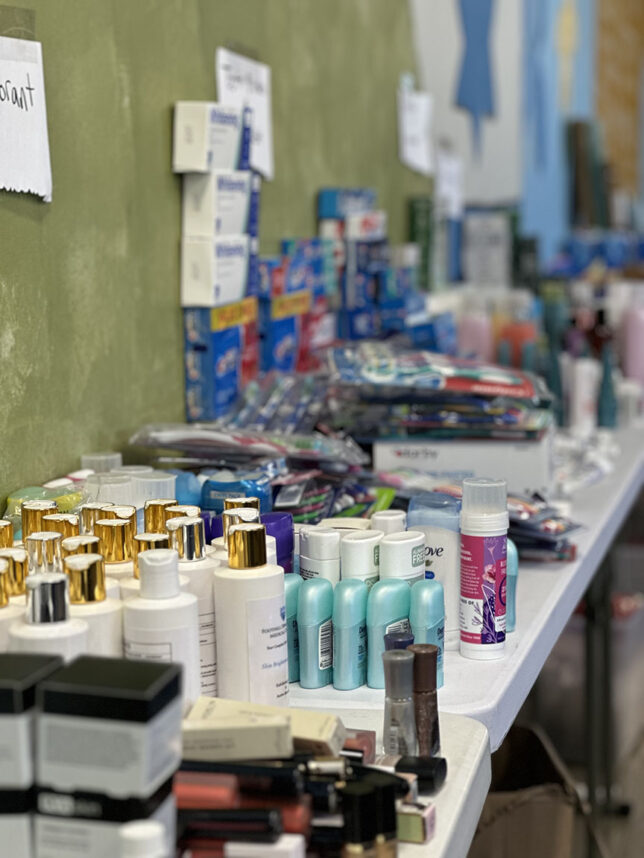
Even a month after the Palisades and Eaton fires began on Jan. 7, tens of thousands of displaced people from Malibu to Altadena are still struggling to find clean underwear, hygiene products, deodorant and supplies for young children. Even the people whose homes are still standing are forbidden to return due to health hazards and mudslide risks.
Maman Nonprofit’s Boutique in Tarzana
One place wildfire victims can go shopping in-person for free is the Maman Nonprofit’s boutique at Eretz Cultural Center (6170 Wilbur Ave., Tarzana). Eretz is near the midpoint between the greatest loss of life and property from the fires. Located just south of Victory Boulevard in Tarzana, Maman’s boutique is about 36 miles from the easternmost extremity of the Eaton Fire, and 20 miles from the western extremity of the Palisades Fire in Malibu.
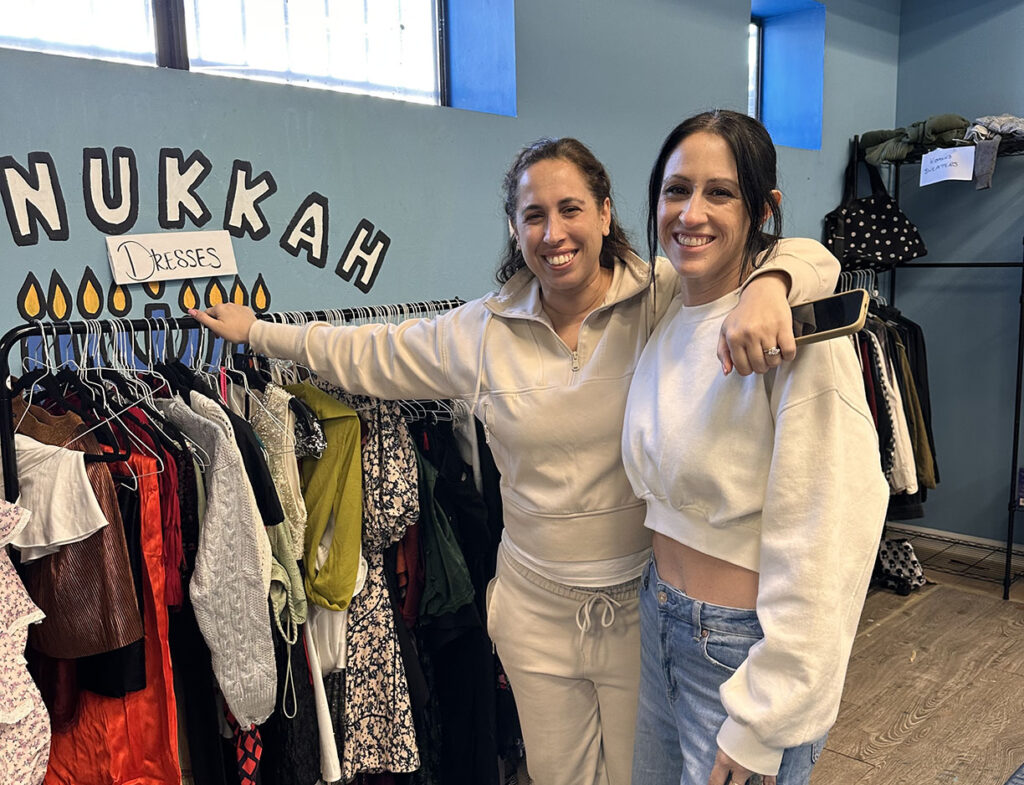
Maman’s boutique is in a children’s multipurpose room at Eretz Synagogue, and their inventory is neatly arranged, folded and displayed like a Kohl’s department store. Almost all of the goods there are brand new, with the exception of a few pre-worn dresses and formalwear dropped off during the Journal’s visit.
Maman Nonprofit founder Sara Raoof Jacobs runs a WhatsApp group of over 400 Jewish community members, mostly women, who have spent the last 15 months stepping up for Israelis in the wake of the Oct. 7 Massacre — shipping necessities for Israeli soldiers, hosting retreats for victims in Los Angeles and creating an outlet for many to put their selfless energy into action.
“It’s so nice for volunteers to have that full circle moment where volunteers see the recipients receive so much in person,” Jacobs told the Journal. “They come in, it looks pretty, they shop, they feel good.”
Jillian Williams, whom Jacobs co-deputized to lead the boutique operation, was in the process of arranging a rack of men’s jackets with her mother-in-law, Sandee Quigley, when she spoke with the Journal.
“As soon as the fires happened, Sara spoke to us right away and we found out that almost an entire congregation [in Palisades] had lost their homes and everything inside,” Williams told the Journal. “We immediately set to work to create what started off as an Amazon wishlist format so that families could specifically order privately what they wanted or what they needed. Our community of donors started mailing in a lot of items.”
Williams said most of the victims that come to shop at the Maman boutique are just looking for things most people take for granted — soaps, diapers, baby formula, basic clothing and bedding. One of the Maman volunteers owns a mattress factory in the Valley, so one of the first logistical challenges that Williams and her co-leader, Liz Zvingler, faced was shipping dozens of customized mattresses. Zvingler started volunteering for Maman after the Franklin Fire broke out in December.
“I love volunteering in my free time and I especially love having my kids join when they can,” Zvingler told the Journal. “It’s important for me to show them that there are people struggling in the world and that we should help whenever we can. Maman is an organization that could help people at the drop of a hat. Everyone is willing to drop everything to organize a delivery.”
Williams said her ten-year-old daughter is quickly learning the value of volunteering and helping in the community by showing up with Maman.
“This makes me feel like I’m raising a really empathetic and caring person,” Williams said.
Williams and Quigley were prepping about a dozen 20-gallon plastic containers filled to the brim with bottles and containers of toiletries. The following day, ETTA, an organization that empowers people with disabilities to be included and live independent lives, would be sending some volunteers to help organize the boutique.
Still, many fire victims are reluctant to come in person for the items they need.
“One thing we’ve seen a lot is a hesitation with these people who have lost everything to come in and take and accept free help or charity,” Williams said. “It’s very important that anyone who wants to should feel very comfortable. We make it very private and very casual so that it’s not an uncomfortable situation. We have a store full of things. We want everyone to come and not feel shy to do that. That’s what it’s here for.”
The distribution process is evolving as more shoppers come by to stock up. Already, there have been many heart wrenching moments.
Williams took a phone call from a mother who had been stuck inside an elevator with her daughters in an office building in Palisades when the power went out on Jan. 7. They called 9-1-1, but rescuers were occupied with fighting the growing fires. They were eventually freed from the elevator, but when they emerged, their lives were forever changed.
“By the time they got out, one of the authorities who arrived to help them also informed them that they had lost their house,” Williams said. That mother showed up to shop at the boutique on Feb. 10.
Zvingler recalled a deaf couple who came to the Maman boutique with a newborn baby.
“Not only were they trying to balance out work with a newborn baby, but now they have lost everything,” Zvingler said.
A UCLA chapter of Maman recently formed by students, Jasmine Golshan and Shannon Broman. Jacobs said Golshan and Broman contacted over 1,000 hygiene product brands throughout January. As of press time, they are prepping them for a distribution spot at or near campus.
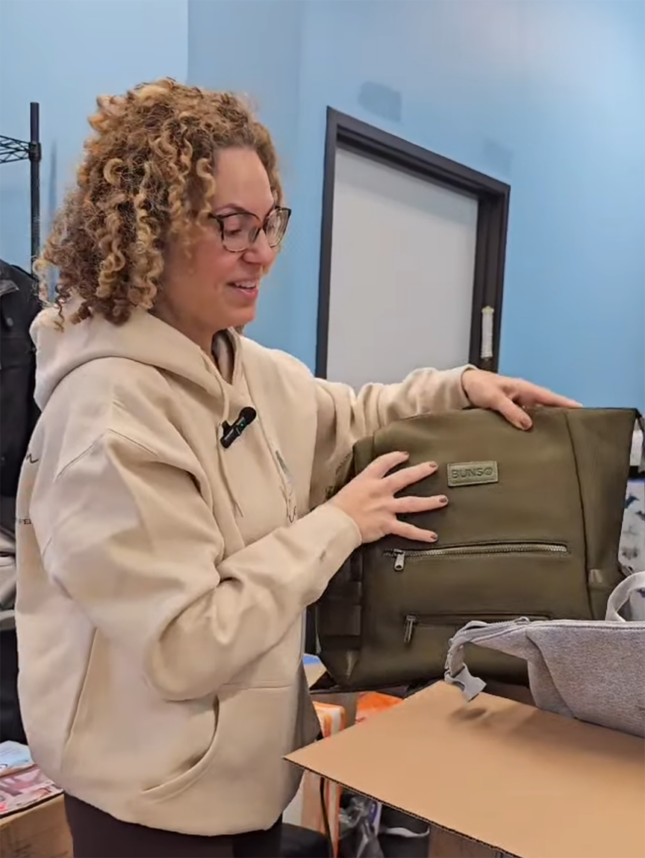
Maman Nonprofit founder Sara Raoof Jacobs opens a box of new diaper bags from Bunso Collection
To get a sense of the fast pace and scale of the Maman operation, I volunteered to fill my vehicle full of heavy bags and courier another donated supply of hundreds of beauty products. The Maman WhatsApp group had trouble finding someone who could move the bags during a narrow time window from West Hollywood to Eretz in Tarzana during the evening rush hour. The woman who handed me the bags didn’t know the people volunteering at Eretz, and she certainly didn’t know me. But there’s a trust and kinship amongst the Maman volunteers where they know that no matter what, someone will step up.
The boutique operates by appointment only, Monday through Thursday from 12 p.m. – 2 p.m.. Fire victims can browse and select the items they need, and for those unable to visit, volunteers are coordinating deliveries.
As the situation is fluid, Jacobs is encouraging any fire victims to contact Maman via direct message on their Instagram www.instagram.com/mamannonprofit or at their website www.mamannonprofit.com to book an appointment to visit the boutique or request care packages.
Chabad Malibu’s Closet of Love
Chabad of Malibu has transformed most of its space into Closet of Love, another donation and distribution center offering free essential items to fire victims. On Jan. 7, as the fires approached Malibu, Rabbi Levi Cunin stayed back to protect the property during the evacuations. On Saturday, Jan. 11, his wife Sara and their children returned. By the morning of Sunday, Jan. 12, volunteers had already begun transforming the synagogue’s foyer into a donation and distribution center.
Chabad received so many donations that they have streamlined their stock to new items only. Their space is still packed with brand-new items ready to go to those in need.
“A big part of our job also is to receive,” Sara Cunin told the Journal. So if somebody shows up here at the door with used items, no matter what, we receive items because of their mitzvah to give. If we feel the items are suited to stay here, we keep them here. If not, we’ve partnered with other charities where the items might be better suited.”
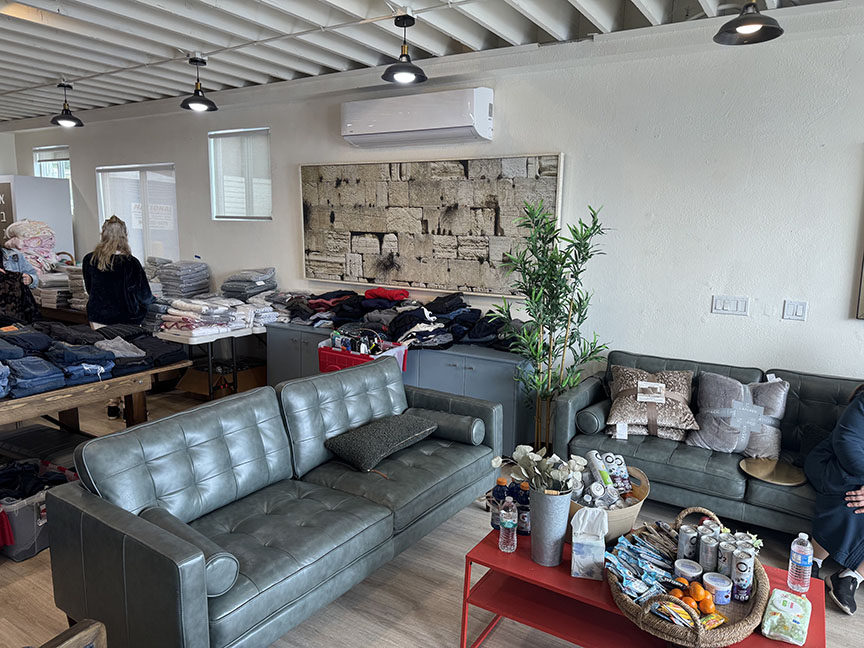
Chabad of Malibu Closet of Love – KotelChabad of Malibu
Since opening, the Chabad showroom has seen a steady stream of families returning as new donations arrive. Closet of Love is located right on the edge of the fire footprint. At the time of the Journal’s visit, the area was still restricted to first responders, utility, residents and media. No surfers jaywalking across the Pacific Coast Highway. The historic Malibu Pier was deserted.
When you walk in, there’s a coffee table filled with oranges, granola, nuts and sparkling water. To the right is a nine footwide photograph of the Kotel on the wall, looming above a cabinet piled high with fleeces. Next to that cabinet is a folding table stacked high with brand-new linens in their plastic packaging.
“People who lost everything — you would think they would come in here and excessively take whatever they can,” Cunin said. “They don’t. People even feel guilty. Many have been in the position to give in the past, so they hesitate to take. We almost have to say, ‘No, you need this right now. When you’re ready to pay it forward, you will, but you need to take this right now.'”
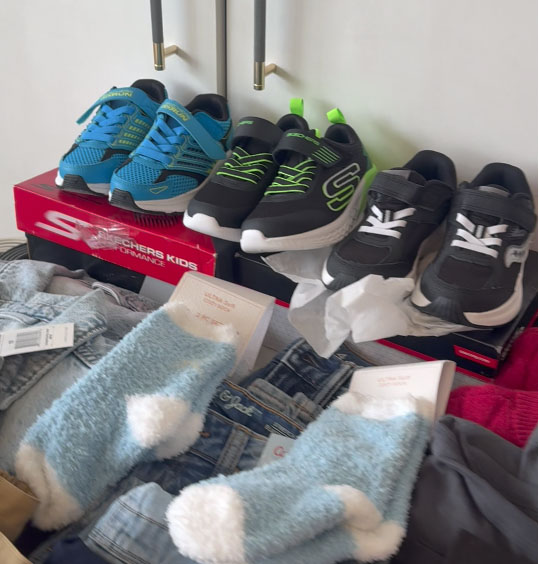
Cunin said that some of the most requested items have been socks, toiletries, water bottles and yoga mats. Earlier in the day, a family took a brand-new Keurig K-Cup coffee maker and some pots and pans.
Beyond distributing supplies, Chabad of Malibu has created a space where people can walk in and get emotional support.
“This isn’t just a place to pick up supplies, people come in just to sit, have a coffee, and be somewhere that feels safe,” Cunin said. “Sometimes, they just need a hug.”
For volunteers like Tilly Feldman, the effort has become part of daily life.
“When I wake up in the morning, I’m like, oh … I just do it,” Feldman said. She has driven 35 miles each way from Granada Hills to Malibu six days a week for the past three weeks to volunteer at Closet of Love. “One or two times, I remember I stayed home and it didn’t feel right to stay home. Those days just didn’t feel right, so come here.”
In front of the front window is the brightest section of the inventory — brand new Barbie dolls, laundry baskets full of plush stuffed animals, shelves of children’s books, and containers filled with colorful wooden blocks.
“So come by here and sit, have coffee, get a nice hug, grab a snack, sit here, maybe get food from Pita ‘Bu (a kosher restaurant next door) and sit with people,” Cunin said. “Some of the Jewish families, they’ve come in, once they’re here, we realize, ‘okay, you need a mezuzah, come, we’ll get some for you.”
Closet of Love is open Sunday through Thursday from 10:00 a.m. through 5:00 p.m. On Fridays they are open from 10:00 a.m. to 2:00 p.m. and on Saturdays they are closed for Shabbat. Fire victims in need of supplies can shop at Chabad of Malibu at 22933 Pacific Coast Highway.
For the latest logistics on Chabad of Malibu’s Closet of Love, visit JewishMalibu.com, follow them on Instagram at www.instagram.com/chabadofmalibu, or call them at 310-456-6588.
Pita ‘Bu’s Free Kosher food
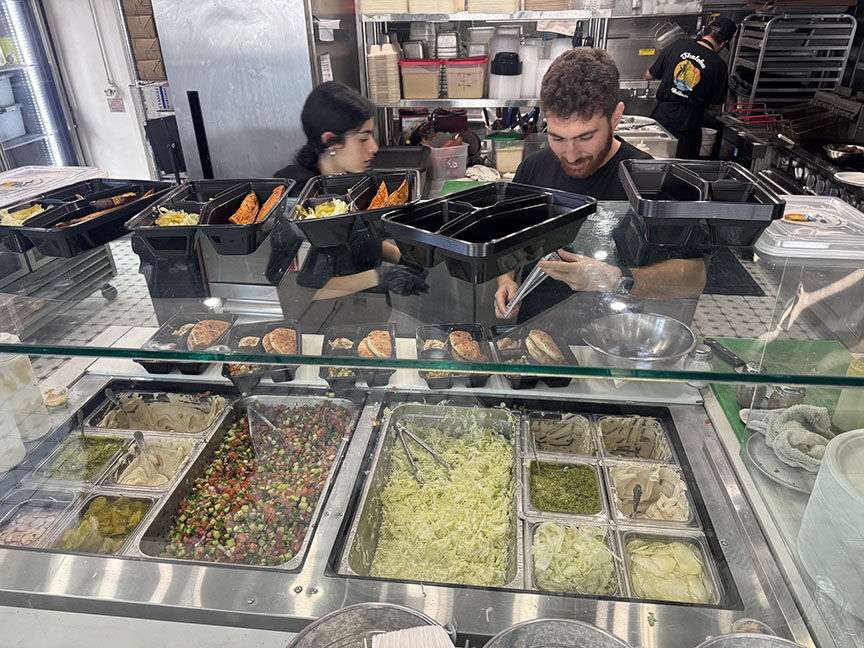
Next door to Chabad of Malibu is Pita ‘Bu, the only kosher restaurant in any direction for 20 miles. Their slogan is “where Tel Aviv meets the ‘Bu.” They have been operating at this location on the PCH for two years. Since Jan. 29, Pita ‘Bu has been providing falafel, hummus, fish tacos and several menu items for free to first responders and fire victims.
“We started this with a generous donation from someone in our community, and soon after, World Central Kitchen reached out to us to partner on a larger scale,” Pita ‘Bu co-owner Ronnie Benarie told the Journal. “We’ve been giving out free, healthy, nutritionally balanced meals to anyone who needs them.”
The generous donors are Kevin and Claudia Bright. Kevin is best known as an executive producer of the NBC show “Friends.” Claudia runs the nonprofit, Dogs of Violence Exposed (DoVE) Project, which aims to end the dog meat trade in South Korea.
Pita ‘Bu has become more than just a place to get food — it has served as a community hub for displaced locals to catch up with each other.
“We’re seeing people from the Palisades through Zuma coming together — many times people who haven’t seen each other in a long time are reconnecting here,” Benarie said. “Some just come by to sit, have a meal, and relax. We’re not a food truck, and we’re not a large-scale operation. We’re just a mom-and-pop shop feeding whoever we can.”
“The best part of this has been the reactions,” Pita ‘Bu worker Tamar Asayag told the Journal. “People are emotional. Some have just come from their homes, realizing everything is destroyed. When they see that we’re here providing them with a meal and a place to gather, it gives them a little comfort.”
Anyone in need can stop by Pita ‘Bu, located next to Chabad of Malibu, for a free meal. There are no restrictions. “Anybody who needs it can come and take a meal,” Asayag said. “It’s not limited to anything. Everyone is welcome.”
As of press time, Pita ‘Bu was still offering a free meal to anyone who comes by. Even after the free meal promotion ends, the Pita ‘Bu food and staff generosity are very much deserving of your business.
Check the Pita ‘Bu Instagram www.instagram.com/thePitaBu (424) 235-2477 for the latest information about what they’re doing to help the community.
Rebuilding Judaica
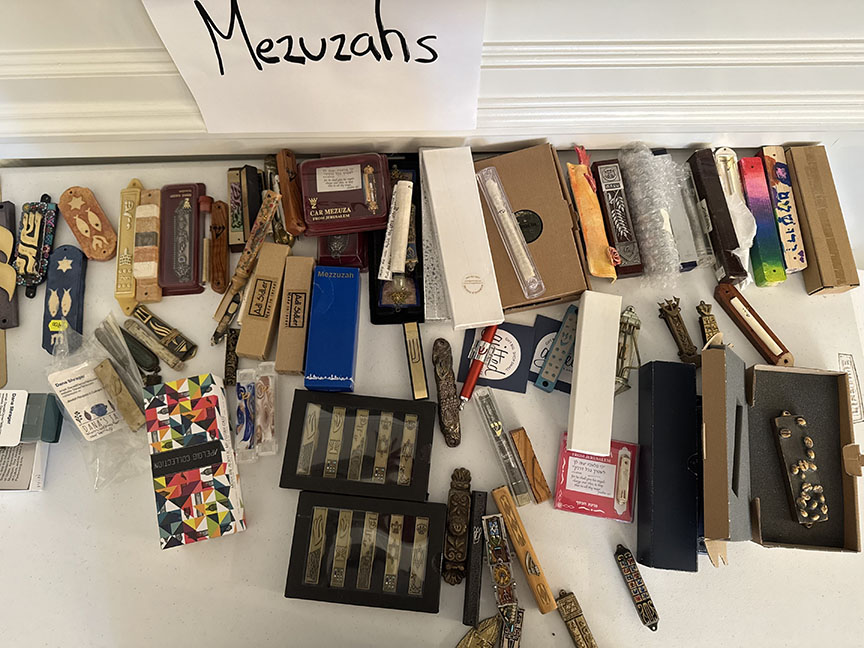
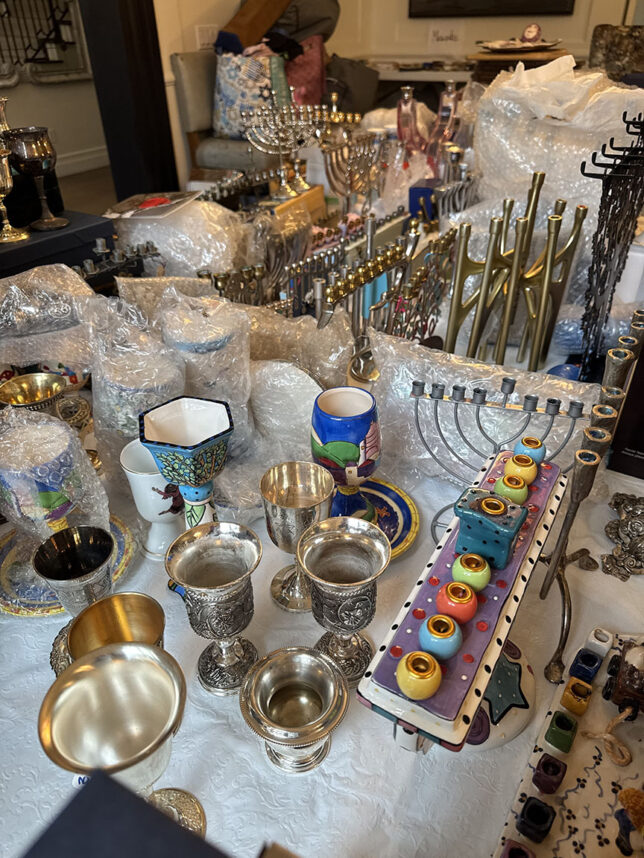
Many families in Los Angeles lost not only their homes in the fires but also their Judaica collections — some dating back over 100 years. To address this, entrepreneur Amy Conroy and her 15-year-old daughter, Chloe, launched Rebuilding Judaica, a grassroots effort to replace Shabbat candles, kiddush cups, mezuzot, menorahs, seder plates and more.
“LA is broken, and everyone is working hard to rebuild,” Amy Conroy told the Journal. “Chloe and I are organizing a way to bring the community together and help families create a sense of ‘home’ through the little things.”
The mother-daughter team started collecting items on Jan. 15. Originally, their project began as an Amazon wishlist of Judaica for displaced people. Since then, as of press time, donations have been mailed to the Conroys from 14 U.S. states, including those with small Jewish populations like Nebraska, Montana and Idaho.
“No one’s looking to run out to the Jewish store,” Chloe told the Journal. “So we’re going to drop [Judaica] off at their doorstep after we get their rental addresses.”
Amy and Chloe made it clear to donors that they don’t want people to just offload their junk. Their directions to donors are to “only send nice items you would proudly display on your Shabbat table or in your home, new and used.”
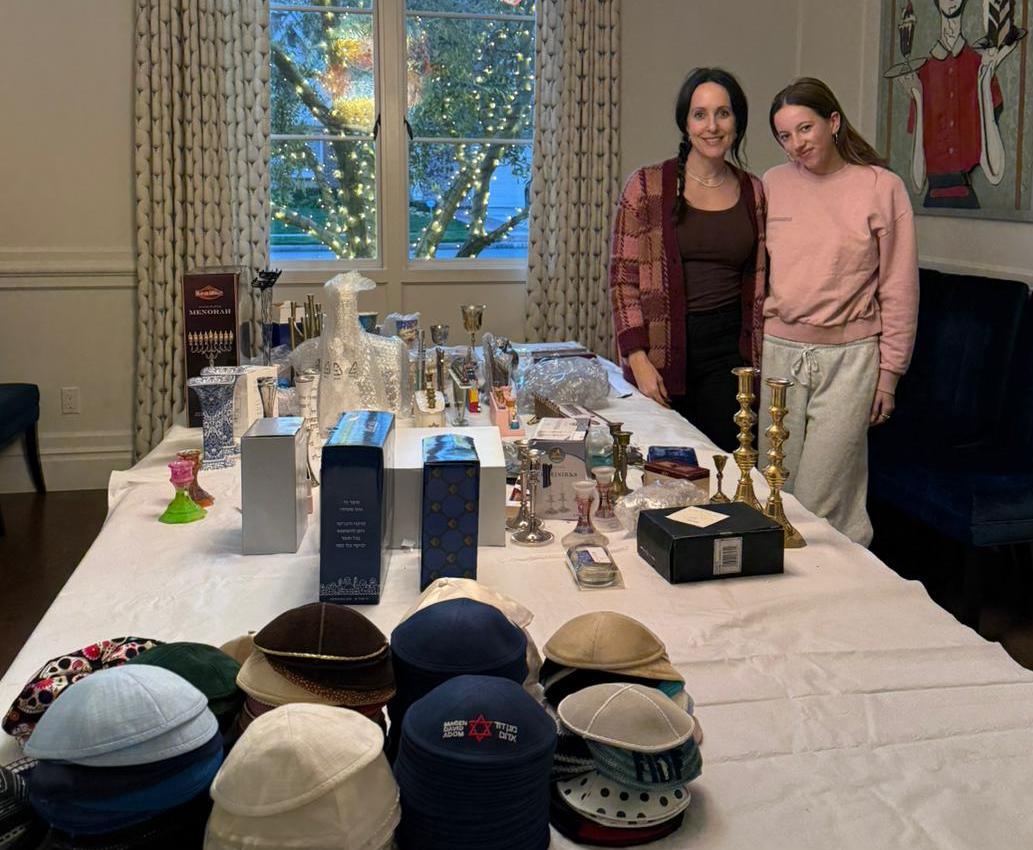
For four consecutive Fridays, from Jan. 17 through Feb. 7, donors could drop off of Judaica at Wilshire Boulevard Temple. The collection has swelled to thousands of items, filling up entire rooms of the Conroy’s home. Amy and Chloe have carefully itemized each donated item and tagged them with the name of the contributor.
“One day down the line, there’s a personal connection, whether a text or a phone call being like, ‘Hey, Joe, I’m using your candlesticks. Thank you so much,'” Amy Conroy said.
They have already compiled a list of 450 Jewish households in Los Angeles in need of replacing their Judaica.
This isn’t the first time that the Conroy’s have sprung into action for the community in crisis. On Oct. 8, 2023, the day after the Hamas’ massacre in Israel, the Conroy’s and their friends raised almost $1 million in relief funds for the victims. Amy remarked that it was a full family effort — her children and her friends’ children were even helping with donors in learning to use QR codes and donation websites. One year later, Amy and her husband Brad were part of a group of donors at Wilshire Boulevard Temple who donated three brand-new Magen David Adom ambulances to Israel on the one year anniversary of the attacks. Each of the custom ambulances costs hundreds of thousands of dollars.
Rebuilding Judaica – Amy and Chloe Conroy will be distributing Judaica to 450 Los Angeles area households of displaced wildfire victims
With Rebuilding Judaica, the Conroy’s are also helping replenish something that many Jew might not realize they have been collecting.
“When we were collecting kippahs, we asked people ‘Are you okay if the kippahs have the Bar and Bat mitzvah dates on them?’” Amy said. “Honestly, every Jewish person has that one kippah drawer with all the different mismatches. And that’s a small thing that no one’s looking to get back, but at some point, is going to be missed.”