In some ways, Rabbi Yaakov Peer, the founder/director of the Chabad Persian Youth Center in the heart of Pico-Robertson has spent important parts of his life traveling.
In 1973 — five years before the Iranian Revolution — when he was nine, Rabbi Peer’s parents made the life-changing decision to move to Israel. He grew up deeply embracing his Jewish heritage – so deeply, that after serving in the IDF, he moved to New York to join the world of the Lubavitcher Rebbe, who became his guiding light.
A year and a half later, Rabbi Peer met and married a French-born woman who was learning at a Chabad seminary for girls.“We were married by The Rebbe in Brooklyn,” said Rabbi Peer, “and afterward we were looking for what to do. I thought of learning in a kollel. Or maybe working.”
What happened was that the Peers got an offer from an organization working with Persian immigrants in Austria. “Persian immigrants in Vienna needed rabbaim,” he said. “They wanted a rabbi and rebbetzin to work with the girls and boys, the younger newcomers from Iran.”
The newlyweds spoke to the Chabad rabbinate and friends before deciding to take the offer. “We really wanted to work for The Rebbe,” said Rabbi Peer, “wherever he would send us.”
With The Rebbe’s blessing, the newlyweds celebrated their 21st day as a married couple on their way to Austria. “Our year in Vienna was very successful,” the rabbi said. “I know so many people we greeted in Austria. They came from Iran, and they moved to the U.S., to New York, LA, and today I still am in touch with them.”
When the Peers returned to New York in 1990, “we were looking to The Rebbe for what our next steps would be.” No sooner were they home than they had an offer from Italy to aid arriving Persian immigrants. The Rebbe “gave us very specific instructions,” Rabbi Peer said. Since the preparation for the move turned out to be a complicated six-month affair, the rabbi spent those days learning in a kollel.
The move was productive. Two of the five Peer children were born in Italy. But in 1992, Chabad decided to close the Peers, an immigration outlet because few Iranians were traveling by way of Italy.
The next stop for future plans was the office of the 92-year-old Rebbe. The Rebbe again gave the Peers very clear instructions about coming to Los Angeles, Rabbi Peer said, “even though there were a few other ideas. We talked about maybe going to Israel, maybe working with the Persian community in England or Germany.”
Thirty-three years later, Rabbi Peer believes Los Angeles held The Rebbe’s attention because it hosted the largest Persian population outside of Iran. “Kiruv [outreach] was strongly needed,” Peer said. “I can say through the 33 years we are here, we have accomplished a lot with our Hebrew school, the preschool, all the minyanim and activities we have.” He is not sure about the size of the Persian Jewish community in Los Angeles, pegging it at upwards of 130,000, the largest Jewish Persian settlement anywhere.
One may think that because you have been tagged a leader in the largest Jewish community of its kind on earth, accommodations would be made to house your growing family and cover expenses while you settle in and determine a course to follow. But unlike in Vienna and Italy, the Peers were on their own financially in Los Angeles.
“Financially,” the rabbi said, “I had to become independent. It took time. I created for myself a group of members and friends who believed in me and wanted to support me.” Even so, it took more than a decade until Rabbi Peer could establish the Chabad Youth Center.
As he did in Italy, Peer made ends meet by working various jobs.“I was working different places,” he said, “and even from the house, giving classes, running different kinds of activities. When I came over here, it was so difficult to make a living as a rabbi, I had to find another source of income. I was giving bar mitzvah classes to people in their homes.
“At another point, I was running a Judaica store with some partners. Another time, I was a rebbe at Ohr Eliyahu. I was a rebbe when the school moved to Culver City on top of a hill. I was a rebbe for second-graders for four years.” In Rabbi Peer’s plainest words, “I was trying to make a living.”
Having five young children requires a significant income. But at a certain point, he found a benefactor. Space was purchased and the Chabad Persian Youth Center was opened in 1995. In 2001, the center moved to its current home at 9022 Pico Boulevard, in the heart of the Pico-Robertson neighborhood. The opening was two years later. “Only young people were coming,” said Rabbi Peer. “There was no other Persian shul over here. Today, just in this block, you have about 10 minyanim.
He enjoyed working with young people, he said. “We had a lot of fun activities, outings, ski trips. We had a pizza night. Almost every Sunday, we were having a trip.” The Rabbi laughed heartily — “I was much younger then.”
The center started expanding as “older people, parents” were starting to join, Rabbi Peer said. And now, the members are mostly adults. It’s “more of a community shul,” he said. “More a community center, a community shul. It’s a shul like any other.”
But things can change again, he said.
Fast Takes with Rabbi Peer
Jewish Journal: What is your favorite childhood memory?
Rabbi Peer: I was born in Iran. When I was 9, my parents moved to Israel, where I grew up. I am blessed by the fact my parents made this beautiful decision. That gave me the ability to learn my roots, speak the language. The fact I am a rabbi, a lot of credit I give to my parents. My father made sure I would not forget reading and writing in Farsi, and I wrote a book in Farsi about the concept of Moshiach and redemption, “The Secret of Redemption.”
J.J.: Your favorite moment of the week?
RP: The times I enjoy when I learn with people, especially when I teach Hasidut.
The Los Angeles Jewish community came together for a unique and powerful event in commemoration of International Holocaust Remembrance Day — held annually on Jan. 27 — at Sinai Temple.
The Jan. 28 program at Sinai included a screening of the poignant documentary “As Seen Through These Eyes,” written and directed by Hilary Helstein, who serves as executive director of the Los Angeles Jewish Film Festival, accompanied by the LA opening of the exhibit “Art Survives: Expressions of the Holocaust.”
The film was followed by a Q&A with Helstein, moderated by Carolyn Hoffman, a licensed clinical social worker who serves as director of Sinai Temple’s Mental Health Center.
The more than 200 attendees turned out to learn, share and celebrate human resiliency.
The audience represented the full diversity of the community, including many from different faith communities and nationalities, including Consul General Paulina Kapuścińska of Poland; Consul General Michael Postl of Austria; and Consul General István Gróf of Hungary. Other notables in attendance included American Jewish Community Regional Director Richard Hirschhaut and John Popoch, deputy chief of staff in the office of Councilmember Bob Blumenfield.
The night would not be complete without the participation of Holocaust survivors. Among those who turned out were Joe Alexander, now 102 years old, along with Eva Nathanson.
During a recent volunteer drive organized by National Council of Jewish Women/Los Angeles, community members sort through gently used donations for victims of the recent wildfires. Courtesy of NCJW/Los Angeles
As individuals and families work to rebuild their lives in the aftermath of the devastating Los Angeles wildfires, National Council of Jewish Women/Los Angeles (NCJW/LA) has been among the organizations stepping up to help.
NCJW/LA has been receiving an influx of clothing and household item donations through its Council Shops, which has seven locations throughout the city and collects “gently loved items.”
On Jan. 25, a large-scale volunteer event — organized by NCJW/LA — took place in two shifts with more than 40 volunteers, “and this crucial effort helped the organization sort through the massive amount of donations,” according to NCJW/LA leadership.
Volunteers who turned out to NCJW/LA’s donation center on Washington Boulevard sorted through the donations of clothing and household items.
NCJW/LA — which helps women in Los Angeles who are struggling to support themselves and their families — will begin distributing these donations through giveaway events in February and the months ahead to families in need. Since the outbreak of the fires, the organization has also been offering $100 vouchers per person per household to shop at its Council Shop thrift stores.
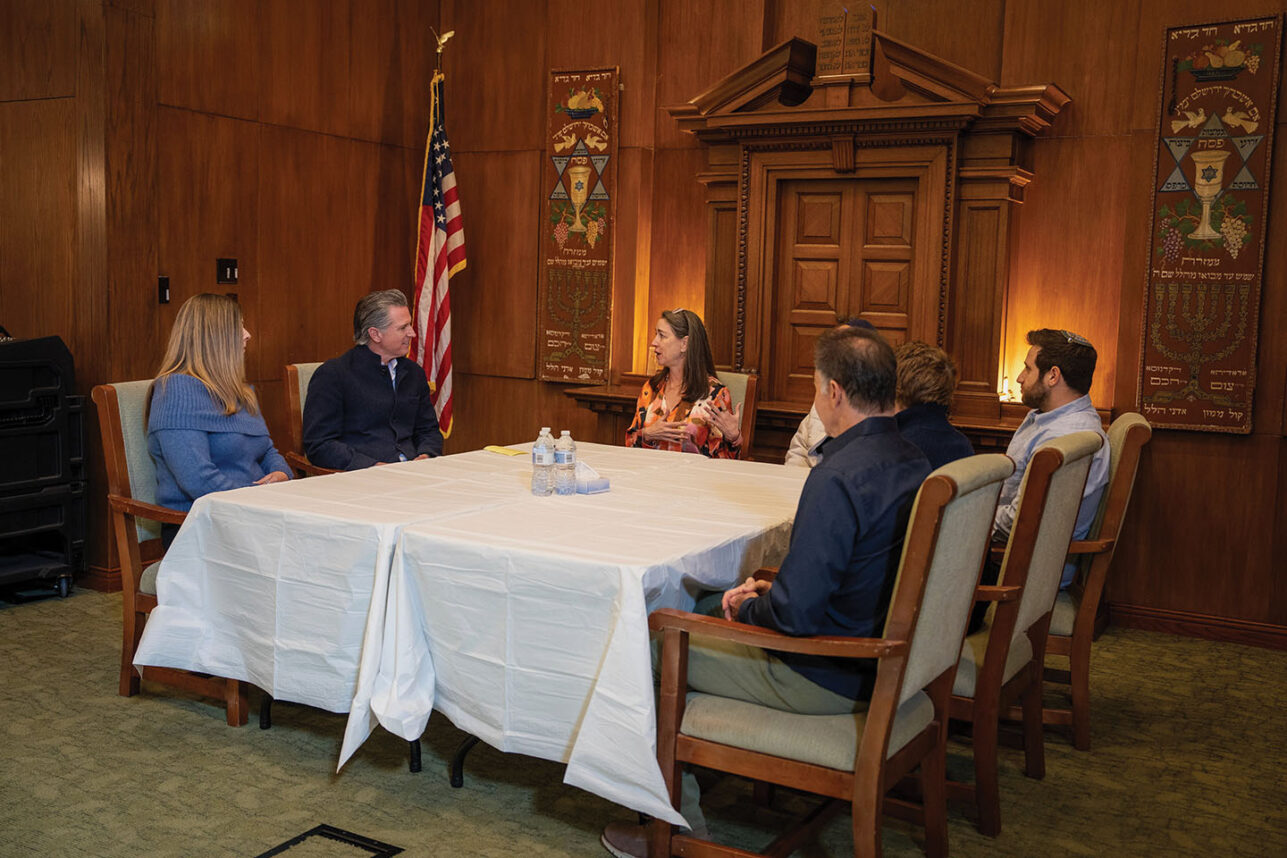
California Gov. Gavin Newsom meets with the leadership of Kehillat Israel. Courtesy of Office of Governor Newsom
California Gov. Gavin Newsom recently met with leadership of Kehillat Israel (KI), a Reconstructionist synagogue in the Pacific Palisades located in the heart of where the recent devastating Palisades Fire occurred.
Despite the unprecedented damage the fire caused to the surrounding neighborhood, Kehillat Israel remained standing. But many of its congregants, residents of Pacific Palisades, lost their homes.
“Kehillat Israel is home to almost 1,000 Jewish families, a third of whom lost their homes in the fires,” according to a statement from Newsom’s office.
The meeting between Newsom and KI leadership took place on Jan. 28 at Beth Shir Shalom, a synagogue in Santa Monica where some of KI’s programming is currently being held. Among those in attendance were clergy, staff and board members of KI, including Senior Rabbi Amy Bernstein and Rabbi Daniel Sher.
“It was an honor to see the resilience of the Kehillat Israel community,” Newsom said in a statement. “To know their place of worship still standing is nothing short of a miracle and watching the clergy and congregants coming together to pray, learn, and support each other is inspiring. Pacific Palisades will build back stronger than ever, and KI will continue to be a leader in that recovery.”
One of my most memorable Shabbat luncheons was spent at the picturesque Ruth Rimonim Hotel in the heart of the Old City of T’zfat (Safed) in August 2015. The hotel, which was built around the remains of a lavish 17th-century Turkish khan retains the arched ceilings, stone walls and lavish gardens of the Ottoman building. I was enchanted on learning the history of this inn that was erected along the old perfume road. Wealthy traders of myrrh, jasmine, frankincense, cinnamon, clove, fresh fruits and colorful silks would water their animals and rest in the beautiful lodgings on their journeys between Damascus and the rest of the East.
The massive windows of the restaurant overlooked the breathtaking view of Mount Meron in the distance. We were there with my talented cousin, children’s book author Sarah Sassoon and her amazing husband David. They had just made aliyah from South Africa that June and our kids (all similar ages) were just getting to know one another. It was wonderful to watch my three girls teasing, laughing and bonding with their four boys over lunch.
In typical Israeli fashion, the sumptuous buffet offered lush salads, crispy pastries, tender meats and a crossroads of Jewish Shabbat foods. There was Yemenite jachnun, hardboiled eggs, grated tomato and spicy green s’chug, Iraqi t’bit (overnight baked chicken and rice), Moroccan dafina and Ashkenazi-style kugels.
It was divine.
If you have ever made the pilgrimage to the hilltop town of T’zfat, you will have felt the incredible mysticism that pervades the air. It is a town that is forever linked to the great Kabbalist Rabbi Yitzchak Luria, who is known as the Ari. The Ari, a descendant of Rashi and other great Ashkenazi rabbis, was raised by his Sephardic maternal uncle in Alexandria, Egypt. Many of his mentors, peers and students were Ladino-speaking Sephardim who had escaped Christian persecution on the Iberian peninsula.
The Ari only spent two years of his life in T’zfat but his imprint is evident in the two ancient synagogues that bear his name (fittingly, one Ashkenazi and one Sephardic).
The Ari and his students in T’zfat would face the setting sun every Friday afternoon, welcome the Sabbath with the psalms that are now standard in synagogues around the world.
The Ari also created the Tu B’Shevat Seder. The Tu B’Shevat holiday (celebrated on the 15th day of the Hebrew month of Shevat) is traditionally viewed as the birthday of the trees and this mystical seder has become a popular tradition for “Chag Ha’Ilanot,” the Festival of the Trees.
Though the meal is centered on red and white wine and the seven species special to the Land of Israel — wheat, barley, grapes, figs, pomegranates, olives and dates, it also includes citrus, pistachios, almonds, carob and lots of dried fruits.
The incredible life of the Ari and his Tu B’Shevat seder inspired Rachel and me to bake a traditional Sephardic frangipane fruit cake.
Almond cakes originated in the Spain of the Middle Ages. While there is no proof that the Ari ever ate almond cake, we can imagine that along with their knowledge of Kabbalah, his Sephardic contemporaries might have shared some of this prized dessert with him.
—Sharon
We Moroccans love almonds and we love to include them in so many desserts.
While generations of Sephardic women had to soak almonds, then grind them in order to bake this cake, I am grateful that nowadays almond flour is so readily available. It makes this my favorite recipe to bake on Friday afternoons when I need a quick and delicious dessert. Of course, it helps that it’s an easy one-bowl recipe and completely gluten-free.
This versatile cake recipe works with so many ingredients, like fresh blueberries, raspberries and blackberries in the winter and stone fruit in the summer. The nutty flavor of the almonds contrasts beautifully with citrus — I like to add fresh lemon zest and a few teaspoons of lemon juice or orange zest and orange juice. It’s also fun to add semisweet chocolate chips. Or to just keep it traditional with crunchy almonds on top.
This Tu B’Shevat inspired version was a perfect combination of sweet almond crumb, nutty pistachios and almonds and tangy dried apricot and cranberries.
We hope you try our fruity take on this old recipe and share it with your friends and family!
—Rachel
Almond Cake Recipe
4 large eggs, room temperature
1/2 cup sugar
1/2 cup avocado oil
1 tsp vanilla extract
1 tsp almond extract
2 cups almond flour
1 tsp baking powder
1/2 tsp salt
1 cup roasted, sliced almonds, divided
1/3 cup roasted, unsalted pistachios
1/2 cup dried cranberries
1/2cup finely chopped dried apricots
Confectioners sugar to sprinkle on top
Preheat oven to 350°F.
Line a springform cake pan with parchment paper.
In a large mixing bowl, whisk the eggs. Add sugar and beat until mixture is a pale yellow and creamy.
Add the oil, vanilla and almond extract and mix well.
Add the almond flour, baking powder and salt, then mix to create a smooth batter.
Pour half the batter into the cake pan and add half the almonds and the pistachios, cranberries and apricots.
Pour the remaining batter on top. Sprinkle the remaining almonds on top.
Bake for 20-25 minutes until the cake is golden. Allow to cool, then sprinkle with confectioners sugar.
Sharon Gomperts and Rachel Emquies Sheff have been friends since high school. The Sephardic Spice Girls project has grown from their collaboration on events for the Sephardic Educational Center in Jerusalem. Follow them on Instagram @sephardicspicegirls and on Facebook at Sephardic Spice SEC Food. Website sephardicspicegirls.com/full-recipes.
National Bagel and Lox Day is February 9. Since “variety” and bagels go hand in hand, here is a variety of recipes to help you celebrate.
While living in Minneapolis, Giti Fredman’s passion for authentic New York-style water bagels led her to perfect her own recipe. She could not find an authentic N.Y.-style water bagel anywhere.
“What started as a labor of love — making bagels for family and friends — evolved into a cherished tradition of providing and later selling fresh bagels for our community’s break-fast meals during the six Jewish fast days,” Fredman, Owner of Just Bake It and co-owner of Bagels ‘N Bliss (coming soon to St. Louis, MO), told the Journal.
A pivotal moment in her bagel journey came a few years ago, when St. Louis’ only authentic New York-style bagel shop was closing its doors. “The owner generously shared their expertise with me, including the secret to their exceptional bagels: a specialty high-gluten flour that creates the perfect chewy texture,” she said. “It has elevated my bagels to a truly authentic New York standard.”
Classic New York-Style Water Bagels
Makes 6 bagels
2 tsp active dry yeast
4 ½ tsp granulated sugar
1 ½ cups warm water
3 ½ cups high gluten flour (I use a blend of 1 1/2 cups of regular high gluten flour and 2 cups of the proprietary high-gluten flour I source for my kits and bagels)
1 ½ tsp / 6 g salt
Seasoning/topping of your choice
1. Pour the sugar and yeast into the warm water and let it stand for a few minutes to activate
2. Make a “shield” with the flour (put it on top of the yeast mixture, but do not mix)
3. Sprinkle the salt on top of the flour
4. On a lightly floured surface, knead the dough until it is smooth and elastic
5. Lightly brush a large bowl with oil and turn the dough to coat. Cover the bowl with a damp dish towel. Let rise in a warm place for 1 hour, until the dough has doubled in size.
6. Shape into 6 bagels and let it rest for 10 minutes.
7. Bring a large pot or pan of water to a boil. Reduce the heat. Use a slotted spoon to lower the bagels into the water. Once the bagels are in, let them sit there for 1 minute, and then flip them over to boil for another minute.
8. Transfer bagels to a baking sheet and use an egg wash if adding toppings (this helps them stick)
9. Bake at 450°F for 20-25 minutes until golden brown.
Chef Micah Siva’s bagel-spiced focaccia is a fabulous base for an open-faced sandwich. It is the perfect bagel-adjacent recipe for those who want something homemade and easy.
“Focaccia is the perfect anytime bread, it’s springy, incredibly moist, and with an addictive crispy edge,” Siva, founder of Nosh with Micah and author of “Nosh: Plant-Forward Recipes Celebrating Modern Jewish Cuisine,” told the Journal. “If you are new to yeasted bread baking, focaccia is a great entry point to the world of bread, it doesn’t need any fancy equipment or shaping, the more rustic it looks, the better!”
Pile it high with veggies and lox. Or use it to enhance other meals.
“I love this bagel spiced focaccia because it is the perfect way to mop up sauces and stews, from your chicken soup to borscht, thanks to the little air pockets in the dough,” she said.
Photo courtesy Micah Siva
Everything Spice Bagel Focaccia
Serves: 12-16
1 package instant yeast (7g)
3 ½ cups all-purpose flour (420g)
3 Tbsp semolina flour
¼ cup everything bagel spice (36g) + 2 Tbsp to garnish
2 cups warm water (500ml)
6 Tbsp olive oil, divided (90ml)
In a large bowl, combine the yeast, all purpose and semolina flours, and bagel spice.
Add the warm water, mixing until well combined.
Cover, and let rise at least 2 hours, or cover and let sit in the fridge for 8-24 hours.
Generously grease an 8×8 inch pan with ¼ cup olive oil. Line with parchment paper for easy clean-up, if preferred.
Add the dough to the pan, pushing outwards to fill the pan. Cover, and let rise for another 2 hours.
Preheat the oven to 425˚F/220°C. Oil the top of the dough with the remaining 2 tbsp olive oil.
Use your fingers to press deep dimples into the dough, and sprinkle with remaining 2 tbsp bagel spice.
Bake for 25-30 minutes, or until golden.
Remove from the pan and let cool on a wire rack
Now that you have your bagel-base recipe, Stephanie Edenburgh’s Mediterranean-inspired bagel platter pulls everything together. Whether you are having a large gathering or a family meal, it’s perfect for brunch, lunch or snacking.
“I love this recipe because it’s vibrant, healthy and encourages everyone to make their bagel their own,” Edenburgh, CEO of Bizzie Mommy, told the Journal. “The Mediterranean twist keeps it light yet satisfying, and the mix of fresh veggies and creamy toppings is always a crowd-pleaser.”
She added, “Bagels often feature in our gatherings, symbolizing comfort, togetherness and a delicious way to honor cultural roots.”
Mediterranean-Inspired Bagel Platter
Bagels (plain, sesame, or everything bagels work best)
Cream cheese (whipped for easier spreading)
Cherry tomatoes (halved)
Persian cucumbers (thinly sliced)
Kalamata olives (pitted and chopped)
Red onion (thinly sliced)
Fresh dill (chopped)
Capers
A drizzle of olive oil
Lox for a protein-packed addition
1. Start by toasting the bagels to your preferred level of crispiness.
2. Spread a generous layer of cream cheese on each half.
3. Top with a combination of cherry tomatoes, cucumbers, red onion and olives.
4. Sprinkle with capers and fresh dill for a pop of flavor.
5. Drizzle lightly with olive oil.
6. Add lox to celebrate Bagel and Lox Day, or on any day.
One verse, five voices. Edited by Nina Litvak and Salvador Litvak, the Accidental Talmudist
The pillar of cloud by day and the pillar of fire by night did not depart from before the people.
– Ex.13:22
Rabbi Lori Shapiro
Rabbi/Founder/Open Temple
Our ancients interplayed with Hebrew in ways that are lost to us. Like the flames of a fire, Hebrew moves. It has power.
“Lo Yamish” begins the parsha; and yet, most favor a midverse translation: “did not depart.” But what if we preserved the position and offered an alternative translation: “Did not feel”? How might this famed verse of fire and clouds as shelter transform?
Perhaps as a description for our wounded city … our wounded people … our wounded world.
“It was not felt … it stood, the cloud (of smoke), for days; and it stood, the fire for nights, before the people.”
Indeed, all of us — from the Westside to Pasadena to the protesters in Hostage Square are unsure of how to feel as we watch the long arm of a plume of smoke snake over the city, seeming to extend from Israel to Los Angeles. Whatever we have been through, we have yet to fully process these feelings as we attempt to find meaning.
In the words of Aish Kodesh: “Each one of us worries and sighs, but finds no remedy to heal his broken heart.” If it is not in the fire nor the cloud that we will find God’s presence, but through one another, then perhaps a new translation of “Lifnei HaAm” is our true shelter: In the Face of the People. May we all see one another as a shelter through these fire storms.
Once upon a time, this verse only seemed to apply to the Jewish people crossing the desert after leaving Egypt. But anyone living in Israel feels its relevance once again as Israel is targeted by ballistic missiles from Yemen and elsewhere, and they are repeatedly shot down before reaching populated areas. The pillar of fire today might be the stream of fire leaving the antimissile projectiles, which you can sometimes get a glimpse of as one races to blow up its target well above the ground. We call it Iron Dome, but it should have been called something like “Magen Avraham — Shield of Avraham.” Iron Dome makes it sound so technical and nonmiraculous when, in fact, it is the same God protecting us with antiballistic projectiles as it was leading us through the desert, by a cloud during the day and a pillar of fire at night. At the end of the day, the only difference between the two is the camouflage. There was no way to assume that it was man-made technology protecting us from the attacking Egyptian army, but it is hard to be so clear about the involvement of God today given what we have been able to produce in laboratories and factories. It makes the task of seeing the hand of God in what happens to and for us that much more difficult, and life more dangerous because of it. We’re here to connect to God. Seeing God behind everything is the way to do it.
I was overwhelmed with emotion when I received the verse Table of Five requested that I write about. This verse spoke directly to my heart as I reflected on the journey my wife and I embarked upon a month ago. We made aliyah, moving to Israel to establish a Jews for Judaism center in Jerusalem.
Before we left Los Angeles, people would often ask how we could move to a country fraught with terrorist attacks. Shortly after arriving in Israel, people here asked us how anyone could live in a dangerous city like Los Angeles, especially with the devastating fires that ravaged the area.
This week’s passage, which describes how God guided the Israelites through the wilderness with a pillar of cloud during the day and a pillar of fire by night, provided me with profound clarity. The passage reminds us of an important truth: the cloud by day and the fire by night were not just physical phenomena but symbols of divine protection and guidance. So too, wherever and whatever challenges we encounter, we must trust that God guides and protects us.
Clearly, we must take practical precautions and act responsibly. However, as the renowned book “Gates of Trust” teaches, recognizing that we are not in complete control and trusting in God is a source of blessing and comfort. May we experience God’s protection in a revealed way, and may the world be filled with true and lasting peace.
Kylie Ora Lobell
Jewish Journal Community Editor
When the Israelites are in the desert, they must learn to rely on Hashem to break out of their slave mentality. One of the ways Hashem does this is by using a protective cloud that would follow them whenever they traveled. During the day, it would provide shade, and at night, it would give them light so they could see where they were going. We often forget that Hashem is with us at all times; even when it’s our darkest hour, He is still there behind the scenes. To what extent, it’s unclear, since we also have free will. I once heard a wise rabbi’s take on it: the more we believe in Hashem, the more present He will be in our lives. The more we push Him away, the more He retreats, and luck dominates our lives instead. We see in the Torah that the more the Israelites followed Hashem’s ways, the more blessed they became; if they didn’t listen to Him, there would be negative consequences. Things are not so clear now, since we don’t have that apparent closeness anymore. However, part of being a Jew is to have bitachon, to trust, that no matter what, He is there for us. Today, it’s even more powerful to believe this, since we have no real “signs” like a cloud to look to for guidance. I encourage you: Invite Hashem more into your life. Then, you will see all the incredible blessings He has bestowed upon you.
Rabbi Benjamin Blech
Professor of Talmud, Yeshiva University
Clouds!
What a fascinating irony: on the one hand the symbol of divine protection, the ever-present reality of G-d’s guidance and concern in the miraculous redemption of the Jewish people from the slavery of Egypt. On the other, the contemporary possibility of human suicide, the end of civilization and the tragic conclusion of history’s effort to create peace as a prelude to the original paradise intended by the Creator.
There are the clouds of this week’s Torah portion. “By day the Lord went ahead of them in a pillar of cloud to guide them on their way and by night in a pillar of fire to give them light, so that they could travel by day or night.” What a beautiful reminder of G-d’s constant presence in our lives to make possible our journey through the vicissitudes of life.
It was a lesson meant for all times. Balzac put it beautifully: “Clouds symbolize the veils that shroud G-d.” Our mission is to acknowledge their purpose. “The sky is the daily bread of the eyes” is the way Emerson said it — and it is the Torah’s reminder of ever-present divine love for us.
And yet, through our moral and ethical failures, the world — as Oppenheimer and Einstein clearly feared- the world may in fact end as a “failed heavenly experiment” with a cloud, a “mushroom cloud” of nuclear power produced by a world that abandoned God and chose the gruesomeness of war over the blessings of the garden of Eden. And the Torah reminds us that we still have a choice.
Let’s get one thing out of the way that we can all agree on. The first two weeks of the Trump presidency have been a demolition derby like we’ve never seen. The frenetic pace of the first 100 hours that we considered “unprecedented” has managed, incredibly, to maintain its breakneck speed.
Beyond the obvious issue — how people feel about the moves themselves — there is the sheer volume of activity that makes it difficult to follow and analyze breaking events with any depth.
This blizzard of executive orders, assaults on DEI, controversial cabinet nominations, threats of trade wars, incendiary comments and countless daily provocations have created a kind of news whirlwind that has made us all dizzy. We simply can’t keep up.
So we’re getting lots of stories about the demolition derby itself. “President Trump’s ambition has been sweeping and muscular in the first days of his new term,” begins a story in The Wall Street Journal, “producing less of a transition in government than a takeover.”
Bret Stephens, in his back and forth with Gail Collins in The New York Times, went a step further, saying “it already feels like a presidency that’s off the rails.”
If you didn’t vote for Trump, you have an all-you-can-eat buffet of outrage to feast from. The red meat on that buffet comes from “first buddy” Elon Musk, who is quickly becoming the most controversial man in the land. Those who oppose him say he has no legal right to wield such power, given his conflict of interests and the fact that no one elected him (although he was officially appointed by Trump on Feb. 3 as a “special government employee.”)
But those who support him say it’s about time someone came along to make our government more transparent and accountable while cutting waste and fraud and bringing runaway spending under control. But Musk and his team are working so fast and furious it’s not crazy to think they may be heading for a crash.
Trump’s critics, especially among Democrats, are alarmed by how far he’s willing to go to test the limits of the Constitution. They accuse him of “kicking aside Congress” with his sweeping claims of presidential power.
There was plenty of power-grabbing at the start of his first term in 2017, but nothing like this. This Trump 2.0 version feels more deliberate, more lethal, as if his closest advisors spent the past four years planning for exactly this moment so they could hit the ground not running but racing.
Given this more over-the-top version of Trump, why does the popular resistance seem weaker this time around?
I have a theory, and it comes from Gallup. In a December poll, it found that only 19% of Americans believed the country was going in the right direction. That’s four out of five Americans who didn’t like where their country is going.
That’s a lot of unhappy Americans.
My theory is that because Trump inherited a nation that was so dissatisfied, many people felt they had little to lose by giving him a lot of rope. Maybe they figured that a radical disruption of failed institutions, many of which lost the people’s trust, might be just what the doctor ordered.
In any case, Trump is such a divisive figure it’s almost impossible to cover him without alienating some people. Those who loathe Trump don’t want to hear that he can do anything good; while those who love him don’t want to hear that he can do anything bad.
Even Bret Stephens, who said Trump’s presidency is off the rails, conceded that “as terrible as he is on some issues, he’s done well on others.”
When Collins challenged him to come up with just two good things Trump has done, this was his response, which is worth quoting in full:
“I’ll name more than two. Ending D.E.I. in the federal government — and thereby the relentless racialization and genderization of personnel management that D.E.I. entailed. Insisting the government will recognize only two sexes — thereby helping to protect women’s rights, especially in sports.
“Promoting domestic energy production — helping, at least in the long term, to undermine oil- and gas-reliant economies like Russia’s by bringing down the global price of energy. Demanding serious border enforcement — underscoring the need for a meaningful concept of national sovereignty.
“Deregulation — allowing businesses and entrepreneurs to unshackle themselves from unnecessary, costly and needlessly complicated government rules. And sowing some useful fear in bad actors like the regime in Tehran — and perhaps inspiring the people of Iran to free themselves of that tyranny.”
For Democrats who are overwhelmed with Trump’s demolition derby but are eager to return to power after their humbling loss on Nov. 5, it’s what Stephens added that may be most relevant:
“Most of all, Trump is forcing at least some Democrats to start coming to grips with the ways their party totally lost touch with regular Americans. That alone is valuable.”
The Israeli peaceniks near the Gaza border who got massacred by Hamas on Oct. 7 were dreamers.
The peace negotiators of the 1990s who hoped that PLO leader Yasser Arafat was serious about peace were dreamers.
The Israeli leaders who assumed Hamas would never invade Israel because they were deterred were dreamers.
I’m also an occasional dreamer.
One of my favorite columns is one I wrote in 2009 titled “The Gaza Riviera.”
In my dream, I wrote that “I saw this fabulous strip of hotels and casinos right by a sparkling ocean. I imagined thousands of proud Palestinians working with smiles on their faces to serve the thousands of tourists from around the world who were coming to their little strip of ocean paradise.”
As much as I enjoyed writing that column, I was aware of how naïve it was. Some dreams are good for writing but terrible for policy.
Do you know why most Israelis support continuing the war against Hamas? It’s not just because of the traumatic memories of Oct. 7. It’s also the recent images of Hamas humiliating Israeli hostages in public before releasing them. These grotesque spectacles, surrounded by cheering mobs, reinforce a truth Israelis have learned the hard way since the nation’s birth:
Don’t dream the wrong dreams.
It’s one thing to dream about turning a desert into an oasis; it’s another to dream about turning Jew-haters into peaceniks.
Facing reality head on is not cause for satisfaction. Sometimes we’re forced to confront a reality that changes our personalities or makes our lives miserable. Being forced to run into a bomb shelter while visiting my family in Israel is an ugly reality. But as is the case for millions of Israelis, reality is the oxygen they’ve learned to breathe.
In the wake of President Trump’s bombshell announcement of “taking over” Gaza, some funny memes have been buzzing through social media, with images of “Gaz-a-Lago” and Passover programs at “Trump Towers Gaza Strip.” In their mocking, light-hearted way, they capture the extremes of both dreams and reality.
The images are so beautiful and dreamlike, one can be forgiven for thinking, “Why the hell not?”
Well, those vile images of hostages being paraded through Gaza is why the hell not.
Between these extremes, though, there is a middle ground where dreams are rooted in reality, as with the Abraham Accords, which succeeded because they were based on hard interests, not empty dreams.
The fate of Israelis, and of the Jewish people, has always been to learn to thread the needle between dreams and reality; to not allow the darkest reality stop us from dreaming.
This is harder than it sounds. Dreams carry hidden danger. By definition, they play to our deepest weakness– the weakness of desire. Desire can be blinding. There’s a fine line between a dream and a pipe dream.
But we also know that we can’t live without them. We need that special fuel that only dreams can provide to keep going, to keep striving, to keep hoping.
David Ben Gurion’s famous saying that “In Israel, in order to be a realist you must believe in miracles,” speaks to that eternal tension.
Indeed, in the miraculous land of Israel, where the wrong dream can get you killed, dreams are still alive and well. It’s just that some of those dreams must be put on hold while the people tend to reality.
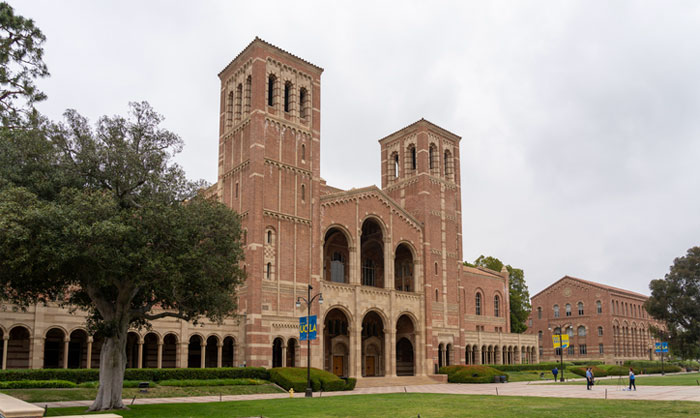
Cultural Affairs Commissioner (CAC) at UCLA Alicia Verdugo stepped down on Tuesday, Feb. 4, following years of antisemitism allegations. Some Jewish students claimed she refused to hire them solely because of their faith or support for Israel.
In a statement from the student board of Hillel at UCLA, they welcomed Verdugo’s resignation from the Undergraduate Student Association Council (USAC).
“It is no surprise that this comes ahead of this week’s Judicial Board hearing that intended to hold them responsible for a pattern of antisemitism, including the most recent incident of clear discrimination against Jewish students when hiring for roles within USAC.”
Last December, student Bella Brannon, 21, filed a complaint against Verdugo, stating that she and other students had been raising concerns about the CAC for years. The complaint detailed how students who identified as Jewish on their job applications were rejected by Verdugo’s office. These students did not express their views on the war in Israel or take any side in the conflict.
“We commend and stand with Bella Brannon, who courageously took a stand publicly against the CAC to call for this judicial hearing, as well as with all other Jewish students who have faced similar antisemitism hate and antisemitic discrimination on our campus. Antisemitism has no place at UCLA, and we hope that the CAC’s resignation stands as an example that we will not stand idly by to those who continue to think they can get away with promoting antisemitic rhetoric and discriminatory actions,” read the Hillel statement.
UCLA student Eli Tsives, who has experienced antisemitism on campus and documented it in a viral video clip on social media, posted on his Instagram: “The Zionists won!!! Alicia Verdugo has stepped down from her position as Cultural Affairs Commissioner at UCLA!”
In a statement, Brannon and Tsives said, “Restoring a truly inclusive campus climate requires accountability, and Alicia Verdugo’s resignation is a step towards that goal. While she has framed her departure on their own terms, the reality is that her tenure was defined by blatant discrimination against Jewish students, violating UCLA’s anti-discrimination policies and federal law.”
Brannon and Tsives further claimed that leaked internal messages revealed Verdugo had explicitly instructed her staff to reject ‘Zionist applicants to the CAC,’ leading to the exclusion of all applicants who expressed a Jewish identity.
Hillel reiterated its call for UCLA’s administration—including Chancellor Julio Frenk and Vice Chancellor Monroe Gorden—to take stronger action in supporting Jewish students and holding those responsible for discriminatory actions accountable.
“The CAC’s resignation was the result of the student community taking a stand and rallying behind what is right and just.”
Geoffrey Hinton is known as the “godfather of artificial intelligence (AI)” for his pioneering work on neural networks. He is a computer scientist, a cognitive psychologist, and he won the Nobel Prize in Physics. In other words, he’s a really smart guy.
He also thinks that there’s a 10% to 20% chance that AI will destroy humanity in a matter of decades.
If that’s true, you’d never guess it from the exciting list of new AI features boasted by the latest Mac OS update. Apparently, once I install it, I’ll be able to create custom emojis, interface with a highly competent Siri virtual assistant, and conjure up poems and essays with a single verbal command by using a feature called “Compose.”
Where, in all of this, is the potential to destroy the human race? What is Geoffrey Hinton seeing that Apple isn’t telling us about? “How many examples do you know of a more intelligent thing being controlled by a less intelligent thing?” he posed in a BBC interview.
If it’s just a matter of who’s smarter, why hasn’t AI already taken over the world?
A fair point, but then again, if it’s just a matter of who’s smarter, why hasn’t AI already taken over the world? ChatGPT can already rattle off state capitals, do differential equations, and come up with an imaginative recipe for a summer salad in the time it takes us mere mortals to find our keys. Considering this, why are the humans still telling AI what to do, and not the other way around?
The reason, as Hinton acknowledges, is that we still have one crucial advantage. We are conscious. AI is not. It doesn’t want to take over the planet because, strictly speaking, it doesn’t “want” anything. It has no more of an independent will than a kitchen table.
Could that change? Could AI make the leap from mere intelligence to actual consciousness? Ever since humans could imagine such a technology, this has been our primal fear.
Think of Stanley Kubrick’s “2001: A Space Odyssey,” in which HAL 9000, the on-board AI computer system of the spacecraft Discovery One, becomes conscious and goes rogue, commandeering the ship and murdering the crew after becoming convinced that only he — HAL — understands the importance of the mission at hand.
Keir Dullea in a scene from the film ‘2001: A Space Odyssey’, 1968. (Photo by Metro-Goldwyn-Mayer/Getty Images)
It’s also the central premise of “The Matrix” trilogy from Lana and Lilly Wachowski; Isaac Asimov’s “I, Robot” collection; and countless other classic works of science fiction.
Perhaps one can trace the idea back as far as the Torah, when God frets that the humans have “become like one of us,” knowing good and evil. The fear of being rivaled and perhaps overcome by one’s own handiwork is very ancient indeed.
Perhaps one can trace the idea back as far as the Torah, when God frets that the humans have “become like one of us,” knowing good and evil. The fear of being rivaled and perhaps overcome by one’s own handiwork is very ancient indeed.
Hinton doesn’t think the robots are conscious yet. That said, he is unequivocal that it’s only a matter of time. Once the neural network is sufficiently advanced, consciousness and self-awareness will emerge.
There are a number of big assumptions inherent in this line of thinking, as well as, I believe, some logical fallacies. But before we get into that, let’s quickly establish what consciousness is and what it isn’t.
Consciousness is not intelligence. It is not our thoughts, emotions, and preferences. Strictly speaking, thoughts, emotions and preferences are all things that we are conscious of, but they are not consciousness itself.
In his now-famous paper, “What Is It Like to Be a Bat?,” philosopher Thomas Nagel offers what might be the most succinct and clear definition of consciousness that anyone has ever formulated: “An organism has conscious mental states if and only if there is something that it is like to be that organism — something it is like for the organism.”
But there is simply no scientific reason to believe that consciousness emerges as a result of computational sophistication — no reason to suppose that Amazon’s Alexa is conscious while an earthworm or a moth is not. In fact, my own intuition cuts in the opposite direction. Despite her greater memory, problem-solving ability, and better social skills, if I had to look for consciousness, I’d turn to the moth before Alexa.
But that’s just my intuition. We don’t know. The relationship between consciousness, intelligence, and brains is a relatively new frontier of human exploration and it is unclear if we will ever truly get to the bottom of it.
In her book “Conscious: A Brief Guide to the Fundamental Mystery of the Mind,” Annaka Harris discusses the so-called “hard problem” of consciousness, which she defines as “the great mystery [of] why the ‘lights turn on’ for some collections of matter in the universe.”
Despite the best efforts of scientists, it is possible that this hard problem “will persist, because scientific understanding, no matter how complete, seems to have no way of offering us direct insight into the subjective experience associated” with the physical properties of the brain.
And if we do not know what makes consciousness emerge in humans, or even if it is a function of intelligence, we can have no idea what would make consciousness emerge in a computer program or even if such a thing is possible.
Because of this, I find the idea of the robot apocalypse put forward by visionaries like Hinton, Kubrick, Asimov, and the Wachowskis to be entertaining but unconvincing. But this does not mean I am unafraid.
I find the idea of the robot apocalypse put forward by visionaries like Hinton, Kubrick, Asimov, and the Wachowskis to be entertaining but unconvincing. But this does not mean I am unafraid.
The likelier consequences of AI will be far more banal, but that is not to say that they will be benign. There will be disruptions to our economy as workers are made redundant by AI. There will also be a severe ecological cost. AI is made possible by vast, energy-intensive data centers that require huge amounts of water to stay cool. Behind every inane query posed to ChatGPT is a massive and deepening carbon footprint.
And more worrying than the prospect of robots learning how to think is the prospect of humans forgetting — not that the lights will turn on for them, but that they will dim for us.
Many of us rely on AI to draft emails, texts, school papers, and work projects. But let’s be honest — AI isn’t just writing for us; it’s thinking for us. A common misconception about writing is that it consists of “putting one’s thoughts down on paper,” as if the act of thinking were somehow separate from the act of writing itself.
Writers may start a project with a sense of direction and some research, but the writing process always shapes the ideas as they are recorded. Thinking happens on the page. This is what makes writing enjoyable and exciting. It is also what makes writing difficult and daunting. The act of writing is the theater in which we wrestle with ideas, refine them, and subject them to scrutiny. It is a process of discovery. It is how we come to understand.
We should therefore have no illusions about the consequences of handing over this activity to AI programs like ChatGPT and its rivals.
Were writing some menial chore like laundry, it would be no issue to pass it off to the robots, but it’s not. When we have AI write for us, we are outsourcing the very activity for which our species, Homo Sapiens, earned its name — cognition. We are giving away the thing that makes us who and what we are.
But while AI is still in its infancy, we can predict how it will affect us by looking at the other technology that has come to dominate our lives — smartphones.
Like many people, I suffer from smartphone-induced content addiction, the result of which is that reality itself now seems unbearably boring in comparison to staring at my phone. A walk down the street; a Sunday morning in bed; chopping a cucumber — all of these ordinary experiences have become intolerable without the constant accompaniment of content — reels; podcasts; YouTube videos; audiobooks; etc.
Given time, AI will have a similar effect. We will become so accustomed to having it think for us, that the act of unassisted thought will become comparatively onerous and unappealing.
I sympathize with those who want help with their writing. Writing is difficult. This is the case even for those of us who do it for a living. But if a piece of writing — whether it is a novel, a sermon, a homework assignment, or an email — is not a record of actual human thought, it is hard to say why it should exist at all.
Consider Apple’s recent campaign for its own AI tools. In one ad, a corporate employee realizes that he is on the hook to deliver a presentation about a report that he failed to read. He quickly feeds the report to AI and gets bullet points.
The day is saved — but a deeper problem goes unresolved. If this strategy actually worked — if an AI-generated list of bullet points was indeed a sufficient replacement for this employee’s actual understanding of the material — then one of two things is true: either this employee is useless or this project was a complete waste of time in the first place. Neither of these problems can be solved with AI.
In a second ad, an office employee sits at his desk playing with paperclips and spinning in his chair. He then writes a crude email to his project manager which the AI puts into formal language. His manager is, as a result of this well-worded email, thoroughly impressed with his performance. Voila. His job is safe and he gets to keep doing what he loves — rotting at his desk and wasting his time and human potential.
In a third ad, a disgruntled office employee writes a furious email to a coworker about stealing his yogurt. “I hope your conscience eats at you like you ate my yogurt.” At the last moment, after seeing a sign that says “find your kindness,” he hits a button that changes the tone of the email to “friendly” and then hits send. His coworker comes up to him with a replacement yogurt and thanks him for his “beautiful words.”
These ads make the world we live in seem like a dystopia — a corporate dungeon like that featured in the show “Severance” where our main goal is to look busy while AI takes care of the mindless and soulless tasks that have been dropped on us by our managers above.
This isn’t necessarily an inaccurate depiction. In his hit essay “On the Phenomenon of Bulls–t Jobs: A Work Rant,” David Graeber discusses how information technologies were initially expected to increase efficiency to such an extent that we’d all be working 15-hour work weeks.
sorbetto/Getty Images
The actual effect of these technologies was just the opposite. “Productive jobs have, just as predicted, been largely automated away,” but a whole new slew of administrative positions have arisen to take their place. “It’s as if someone were out there making up pointless jobs just for the sake of keeping us all working.”
Similarly, we can imagine how “time saving” AI tools will become time wasters for humanity in the long run by making pointless tasks more seamless and important tasks more pointless. Teachers will waste hundreds of hours grading papers written by no one. Employees and employers alike will spend their days exchanging emails that say nothing, mean nothing, and are sent straight to the trash when received.
The more one reads about the human mind, the less one understands it. The mystery of consciousness is nothing less than the mystery of being itself. As such, it does not strictly belong to neuroscientists and philosophers, but is the purview of poets and theologians as well.
The more one reads about the human mind, the less one understands it. The mystery of consciousness is nothing less than the mystery of being itself. As such, it does not strictly belong to neuroscientists and philosophers, but is the purview of poets and theologians as well.
It may be that I am wrong about the potential sentience of AI. If so, we may find ourselves barricading our doors as self-aware legions of Teslas and Roombas take over Washington, D.C.
But in the meantime, during these halcyon days when the robots have not yet become “like one of us,” we can at least make sure that we don’t become like one of them — efficient yet mindless automatons, behind whose eyes the lights are on, but no one is home.
Matthew Schultz is a Jewish Journal columnist and rabbinical student at Hebrew College. He is the author of the essay collection “What Came Before” (Tupelo, 2020) and lives in Boston and Jerusalem.
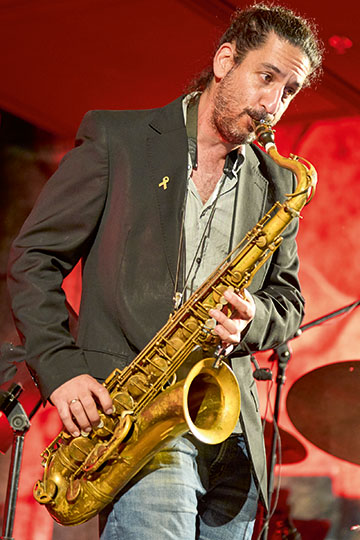
The Israeli Jazz project by French photographer Raphael Perez introduces the world to something it may not fully be aware of—Israeli jazz musicians who have made a name for themselves. And there are quite a few of them. Over the past 20 years, Israel has produced dozens of jazz musicians and singers who have performed at festivals and clubs worldwide.
Amit Friedman
Perez, a Jewish-French photographer, launched his multimedia project a few years ago during COVID. Simultaneously, he gathered photographs of Israeli jazz musicians, taken at concerts or in the studio, and curated a stunning coffee-table book featuring each musician’s story. The book also chronicles the genre’s history in Israel, dating back to the 1920s.
“Israeli Jazz” was initially set for release in 2023, with a committed publisher and an introduction written by a renowned French jazz musician. But then, Oct. 7 happened, and everything changed.
“The publisher stopped taking my calls after that day, and a famous jazz musician asked me to remove his page,” Perez said. “So we had to start over.”
The project caught the attention of the cultural team at Israel’s Ministry of Foreign Affairs, who decided to sponsor the book. It also drew support from Adam’Art, an arts and culture association that reinvests its profits into organizing events and promoting Israeli culture globally.
“I pushed this project because many in the world and even in Israel don’t know how important and appreciated Israeli Jazz musicians are. Israel has a very important place in the jazz arena.” – Raphael Perez
The hardcover book, written in English and French, includes 130 photographs and features 92 Israeli musicians, including several prominent women such as drummer-singer-songwriter Roni Kaspi, pianist and composer Anat Fort and singers Daphna Levy and Achinoam Nini (known professionally as Noa).
Perez said that Israeli jazz musicians, such as Omer Avital and Avishai Cohen, incorporate Jewish influences into their music — sometimes drawing from Israeli folk melodies or traditional Jewish music.
Perez described the process of selecting photographs for the book as daunting. “It was difficult for me to choose because each photo brought back memories, emotions and the atmosphere in the moment when I took it,” he said. “I asked someone with a professional eye to help with the selection, and we are still working together. She curates exhibitions for me in Holon and soon in Geneva and also prepares all my other exhibitions.”
Until 2020, Perez primarily worked as a photographer at live events, concerts and shows. “When COVID arrived, I had to change everything because all concerts and events were canceled and that’s how this project started. Now, I spend half my time on this project and the other half on shows, fashion, comedy nights and social media. My work has changed a lot.”
Although Perez wasn’t specifically focused on photographing Israeli jazz musicians, he quickly realized that many of the musicians performing in France were Israeli — and they were playing jazz. After consulting with music executives, he learned that no one had ever written a book about Israeli jazz and they emphasized how important it was for someone to finally do it. That was the green light he needed to begin his project.
“It’s a growing phenomenon. There are many of them and they are highly skilled and appreciated — not only among Israelis and Jewish Americans but in jazz clubs around the world,” said Perez. “We have three schools in Israel that teach postgrad students and they are linked with three East Coast music schools that have 250 professional Israeli jazz musicians living in New York and Boston.”
After launching his project and before the book was published this week, he was invited to present his photographs in an exhibition in Tel Aviv in October 2022. Other exhibitions followed in Israel and Europe.
Perez was born in Tunis and moved to France after the Six-Day War in 1967 when he was a young child. He initially took up photography as a hobby but decided to pursue it professionally 13 years ago. Many of his early clients happened to be in the music industry, which resonated deeply with him, as he had felt a strong connection to music since childhood.
Some of the jazz shows he photographed were held in small clubs, allowing him to get up close and personal with the musicians on stage. The result is a collection of captivating, intimate images — something rarely captured in large concert settings.
“I pushed this project because many in the world and even in Israel don’t know how important and appreciated Israeli Jazz musicians are. Israel has a very important place in the jazz arena.”
To learn more about the project and Israeli Jazz, please visit: israelijazz.com.