fbpx

January 1, 2025

Engaging with Jimmy Carter’s Legacy

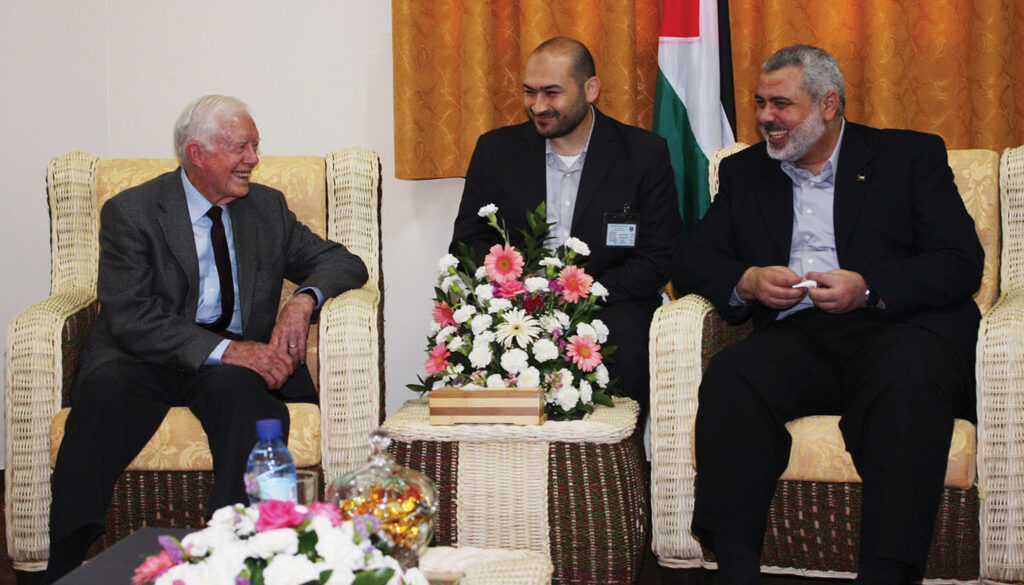
For many years, Israeli leaders avoided Jimmy Carter. They were not the first  — nor the only — ones to sidestep a meeting with the former president. Various members of the Clinton administration, including both the president and his wife, Hillary, preferred to avoid him. Most senior officials in the George H.W. Bush administration — up to and including the president — avoided him; almost all members of the George W. Bush White House did the same. Carter had a peculiar quality: he seemed to find it easier to bond with dictators. If the people one engages with are a reflection of their character, Carter’s list of preferred interlocutors speaks volumes. It includes the likes of Saddam Hussein, Yasser Arafat and Kim Il-Sung.

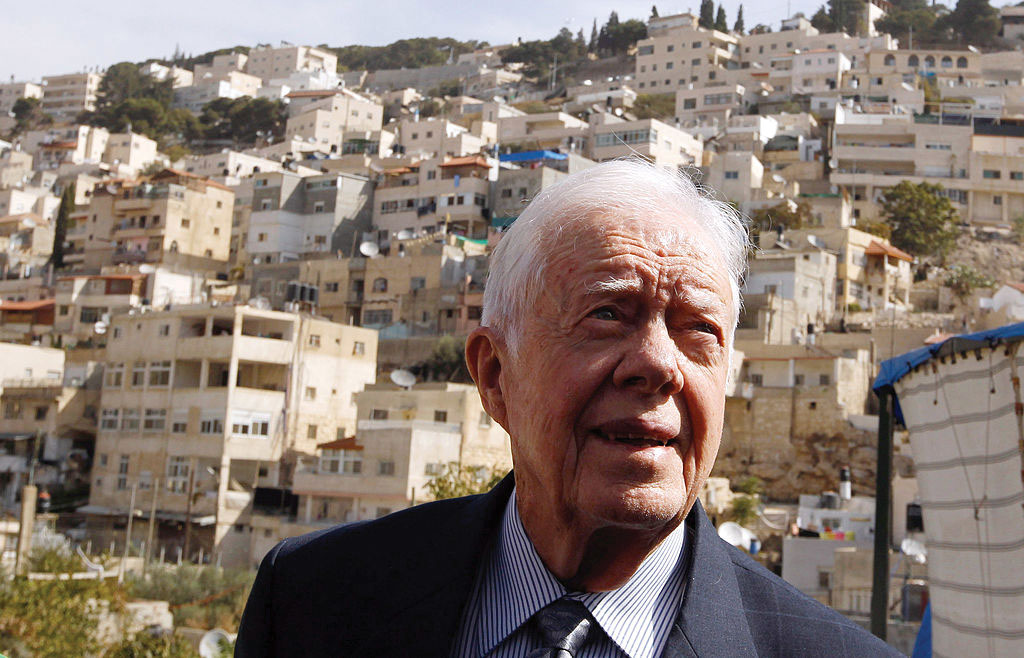
Carter died at 100, of which only four years were spent at the top echelon of U.S. policy making. But an Israeli must attempt to remember him with certain appreciation, because of his role as peace-maker. He deserves at least some of the credit for he 1978 Israel-Egypt peace accords. And it is still the most important contribution of any American president to Israel’s national security. 

With such an achievement, you’d expect Carter to easily win a popularity contest in Israel. He never did. In a 2015 poll, Carter was ranked by Israelis lowest on relations with Israel of all previous presidents. Barak Obama, the sitting president at that time, ranked even lower, but, as I explained at the time, that’s “due to Israelis’ short memories, many of which don’t remember his term, or just vaguely remember it.” Among older Israelis, who might still remember him with certain clarity, Carter’s numbers tanked.  

Peace with Egypt was a unique achievement. But Carter was also unique in the type of criticism he hurled at Israel. He undoubtedly contributed to humanitarian efforts, as Brent Scowcroft, national security advisor to George H.W. Bush, once noted. But Scowcroft would also mention that Carter’s political judgment was “simply abysmal.” In the early 1990s, after Iraq invaded Kuwait, the former president opposed military action to expel Saddam’s forces. He even proposed a “creative” solution to the crisis: “This is the perfect time for Israel to launch an honest peace initiative,” he thought, suggesting a trade — Israel’s withdrawal from the occupied territories in exchange for Iraq’s withdrawal from Kuwait. 

Carter’s creativity produced many such ideas, few of them useful, some of them harmful and many of them downright bizarre. And yes, quite often they involved Israel. In 1977, at a formal dinner at the White House in honor of Saudi Prince Fahd, Carter expressed his view of the Israeli-Arab conflict in troubling terms: “Peace in the region,” he said, referring to Israel and its neighbors, “largely means a chance for world peace.” This was perhaps the most extreme articulation of the all-encompassing “linkage” theory. Resolving the festering scar of the Israeli-Arab conflict, Carter implied, was not merely essential to calming a violent Middle East. It also held the key to solving the world’s problems. Not for the last time, this early statement was dangerously close to antisemitic tropes that tie global crises and challenges to the acts of the world’s few Jews. 

For decades, from Reagan to Obama, U.S. administrations have had to endure Carter’s relentless activism and, perhaps more galling for succeeding politicians, his remarkable talent for self-promotion. When the Clinton administration reached an agreement with North Korea — a deal Carter had played a role in brokering — its officials were stunned to see the former president claim credit in a nationally broadcast interview. He used the same skill to sell his books, including one that labeled Israel “an apartheid state.”

His claim to fame was an aggressive push for engagement with all vile enemies. Whether it’s Hamas, Assad’s Syria, or the Maoist guerrillas of Nepal – all three used by him as positive examples of his approach – the formula was always the same: Recruit Carter, let him engage, problem solved. But as I wrote in one such occasion, There’s no moral virtue in talking to one’s enemies. Engagement is a tool, but so are disengagement and even isolation. Both are effective, if used wisely; both can be damaging if used in haste. Talking to one’s enemies is a tool. Hamas and Syria – assisted by Carter – used it as they were trying to counter the isolation being applied to them. 

The American people corrected the mistake of electing Carter in 1976. But Carter was never a quitter. And from an Israeli perspective, his presence gradually grew from the level of nuisance to the level of headache. Since the country never bought into his religion of engagement, when Carter insisted on visiting Israel, he found little to engage with. In 2008, the former President was relegated to a courtesy meeting with Israel’s president, a person who holds little sway over Israeli policies. In 2015, not even Israel’s president would see him.

Something I wrote in Hebrew

I recently analyzed the last 50 political polls and came up with the following conclusions:

So what did we learn? That the glue of the coalition is strong. That is, unless its leaders have polls that show that almost all the polls we — the public — see are inaccurate. As far as I know, they don’t have such polls … It is true that there is some show of confidence (on the right) and anxiety (on the center-left) that “Bibi will win again” in the next election. And maybe he really will win. But right now, if there’s an election, this would be an unexpected result. Right now, the coalition probably doesn’t have enough votes to win. What it does have in an abundance is time. It can pass the next two years hoping that the picture will change. That’s the coalition’s political strategy.

A week’s numbers

Israel is still at war, with Israelis killed and maimed on a daily basis, and yet, this is what Israeli Jews still think…

A reader’s response

Andy C. asks: Did many Israelis see The Bibi Files? Answer: Define “many.” Truth is, there’s no data about this but I assume the answer is no. Not many Israelis did.


Shmuel Rosner is senior political editor. For more analysis of Israeli and international politics, visit Rosner’s Domain at jewishjournal.com/rosnersdomain.

Engaging with Jimmy Carter’s Legacy Read More »

Pulling the Plug on the NGO Propaganda Industry

In the ongoing plague of Jew-hatred and Israel derangement, the propaganda war led by powerful nongovernmental organizations (NGOs) plays a central role. Since the Oct. 7 Hamas atrocities, the multi-billion-dollar NGO industry has pumped out a continuous stream of false accusations (lies) accusing Israel of apartheid, starvation, ethnic cleansing, war crimes, etc. 

In the past month, the superpowers — Amnesty International, Human Rights Watch (HRW), and Médecins Sans Frontièrs  (MSF, or Doctors Without Borders) issued hundreds of pages of bogus “reports” in the cynical campaign that weaponizes human rights to demonize Israel with the stamp of “genocide.” Oxfam joined with a scurrilous attack falsely claiming that Israel’s actions to prevent Hezbollah’s murderous strikes from Lebanon were also “war crimes.”

Following the standard pattern for over 25 years, the NGOs’ allies among mainstream journalists gave the propaganda major coverage – copied directly from the press releases, since almost no one reads the repetitive word salads and jargon in the actual reports. For example, a New York Times headline read: “Amnesty International Accuses Israel of Genocide in Gaza” and the CNN version (written by Nada Bashir) is “Amnesty International says there is ‘sufficient evidence’ to accuse Israel of genocide in Gaza.” The same is true for social media platforms and the anonymous editors of Wikipedia, who dictate the anti-Zionist narrative. The genocide inversion that labels the Jewish state as the equivalent of Nazi Germany ostensibly proven by these “highly respected” and “unbiased” organizations is then parroted by UN officials, politicians, and academics in frameworks claiming to focus on human rights and international law.  

The central role of the NGOs in promoting this agenda has been documented in detail but that has not stopped or significantly slowed the disinformation juggernaut. The leaders of these organizations have been named and shamed, and their obsessive hostility to Israel and research facades have been repeatedly exposed, but they are undaunted.  

The main reason for the poisonous impact is the power of the NGO industry, which is the direct result of their massive funding and protected legal status as nonprofits and charities. In 2022, MSF’s budget was $2.4 billion; in 2023, HRW spent $116 million, and for Amnesty, total 2022 income was $400 million. These huge amounts give the NGO superpowers the resources to produce slick publications and graphics, and to employ armies of press manipulators who market their pseudo-legal “research reports” to mainstream journalists and social media influencers, as well as directly to politicians, UN and government officials, and university professors.  

Another factor that exacerbates the power of the heads of the NGO industry is the fact that, in contrast to legitimate business frameworks, there are no independent checks and balances. The boards of directors that have legal and moral responsibility for NGO oversight are usually rubber stamps. When HRW’s Ken Roth received a large check from a Saudi billionaire, highlighting the deeply ingrained hypocrisy of an organization that claims to promote moral values, the board was apparently left in the dark. When the details were leaked eight years later, HRW’s board took no action. 

Although the NGOs are registered as charitable organizations by the Internal Revenue Service, the U.K. Charity Commission and similar agencies and receive the benefits that derive from this status — particularly the ability to receive funds as tax-exempt donations — these groups are far from the small, altruistic volunteer organizations this status is designed to assist. Their massive budgets and staffs, and divisive political agendas are fundamentally inconsistent with the generally accepted characteristics of nonprofits that are entrusted with providing important benefits to society at large. 

Furthermore, as charities, Amnesty, HRW and MSF (registered in the U.S. as Doctors Without Borders) are able to hide their key funders, including foreign governments, which is also inconsistent with the principles of civil society organizations. Amnesty created a very complex legal framework based in the U.K. which enables them to avoid revealing major sources of funding. And in 2009, HRW stopped publishing its list of funders, coinciding with the withdrawal of many of the original donors following founder Robert Bernstein’s denunciation in the New York Times of the organization’s central role in “turning Israel into a pariah state.” Sarah Leah Whitson, then HRW’s Middle East director, traveled to Saudi Arabia, Libya and probably other Arab countries to raise funds. For many years, HRW and Whitson denied receiving donations from the region, but subsequent leaks exposed major “gifts” including from Qatar, and there is a high probability that more are still hidden. When foreign governments control the NGO purse strings, they can also dictate political agendas and personnel decisions. 

As these details demonstrate, a major and externally imposed reform of the politicized NGO industry is long overdue. As a first step, removing the reporting exemptions for nonprofits and charities that allow the superpowers to hide their donors, including foreign governments such as Qatar that use these organizations to manipulate policies, should be an urgent priority for the U.S. Congress and the IRS. Other countries — particularly Canada and the U.K. — should also be urged to adopt similar transparency measures that are considered essential dimensions of democratic societies.  

Removing the reporting exemptions for nonprofits and charities that allow the superpowers to hide their donors, including foreign governments such as Qatar that use these organizations to manipulate policies, should be an urgent priority for the U.S. Congress and the IRS.

In addition, there is no justification for allowing governments to secretly or openly provide funds to “nongovernmental organizations,” particularly those that engage in blatant political lobbying. The leaders of the NGO political superpowers hide their foreign state funders because they realize that, although legal, being seen to be acting on behalf of tyrannical regimes, such as Qatar, is inconsistent with the “human rights” and “humanitarian aid” image that the NGOs project. The massive loophole needs to be shut.  

In parallel to revising the nonprofit regulations, including requiring transparency in reporting all funders, the boards of the NGO superpowers should no longer be limited to rubber-stamping the agendas and decisions of the organizations’ leaders. Instead, board members must be held responsible for oversight, and could be the subject of lawsuits if they fail to uphold their fiduciary and other duties. 

The fundamental reform of the NGO industry, and particularly the superpowers like Amnesty, HRW, MSF and Oxfam, will not end the obsessive focus on Israel, disinformation and lawfare campaigns. But these steps will pry open the very powerful sources of demonization and hate to public scrutiny, and reduce their unchecked and illegitimate influence.


Gerald M. Steinberg is emeritus professor of politics at Bar Ilan University in Israel, and founder of the NGO Monitor research institute in Jerusalem. 

Pulling the Plug on the NGO Propaganda Industry Read More »

Jimmy Carter: Good Intentions Weren’t Enough

H.L. Mencken, the 20th-Century American journalist, satirist, and cultural critic, noted that “for every complex problem, there is an answer that is clear, simple, and wrong.” His pithy observation prophetically described President Jimmy Carter, who died Dec. 29 at the age of 100. 

Although he lived for more than a century, Carter’s legacy is unlikely to last nearly as long — because time and again, when faced with complex problems, he reached for clear and simple solutions that turned out to be disastrously wrong.

History’s verdict on Carter is hardly mixed — it leans heavily toward disaster, particularly when it comes to foreign policy. While he may have meant well, his penchant for moralizing in a way that bordered on patronizing, and his insistence on prioritizing ideals over reality, made him a pioneer of the kind of weakness that Barack Obama later perfected with his “leading from behind” doctrine. Carter’s America didn’t lead from behind — it just didn’t lead at all.

The fallout? A Middle East that’s been on fire ever since.

Carter’s most consequential failure was Iran. By abandoning the Shah and allowing Ayatollah Khomeini to step through the front door with his fanatical Islamic revolution, Carter handed the world over to radical Islamists. Khomeini didn’t just take over Iran—he ignited a revolutionary flame that still burns today. 

Oct. 7, the deliberate and eagerly executed Hamas massacre of 1,200 innocent Israelis in Southern Israel, an evil atrocity that sent shockwaves through Israel and across the world, is just one link in the chain of chaos that Jimmy Carter helped to forge. Iran’s terror tentacles — Hamas, Hezbollah, the Houthis — all trace their origins to the regime Carter allowed to flourish. 

The vile Assad regime in Syria, now deposed, with as yet unknown chaos following in its wake, also owed its longevity to support from the regime that came into being as a result of Carter’s inadequate response when he could have cut it off before it took root.

In a 2014 interview on CNBC, Carter admitted, “I could have been reelected if I had taken military action against Iran. It would have shown that I was strong and resolute and manly … I could have wiped Iran off the map with the weapons that we had. But in the process, a lot of innocent people would have been killed, probably including the hostages.” 

What an admission! Look how many innocent people have died and been repressed as a result of his ivory tower moral stance. As Churchill said, “An appeaser is one who feeds a crocodile — hoping it will eat him last.”

Many commentators have pointed to the fact that Carter presided over the historic Camp David Accords, but let’s be clear: while he played a significant role as a facilitator, the deal ultimately succeeded because Sadat and Begin were pragmatic men who understood their people needed peace more than platitudes. 

Carter’s vision leaned heavily toward Palestinian autonomy, and had he gotten his way, Israel might have faced greater pressure to concede to PLO demands. Instead, the actual treaty focused on Israel-Egypt relations, and Carter, despite his moralizing, was fortunate to share credit for a deal rooted in the leaders’ pragmatism rather than his ideology. 

And, as former Israeli ambassador to the U.S. Michael Oren put it in his article about Carter’s legacy, “No sooner were the Camp David Accords signed in 1979 than Carter embarked on a 40-year smear campaign against Israel.”

And in his post-presidency, things only got worse. Instead of acting as a neutral go-between and peace facilitator for Israel and the Palestinians, Carter transformed himself into the elder statesman of global finger-wagging. He seemed determined to lecture Israel at every opportunity, portraying it as the primary obstacle to peace, while cozying up to arch-terrorist Yasser Arafat — a man whose organization, the PLO, had the blood of countless Israelis on its hands. 

Carter didn’t stop there. In 2008, he went out of his way to meet in Syria with leaders of Hamas, a group designated as a terrorist organization by both the U.S. and Israel. Carter defended the visit as an attempt at peace-building, but in reality, it gave Hamas a veneer of legitimacy it neither earned nor deserved. 

Carter compounded his betrayal of Israel by introducing the word “apartheid” to describe Israel’s treatment of Arabs — an obscene accusation with no basis in reality, and one he surely knew was both false and inflammatory. 

Rather than contributing to peace, Carter’s self-proclaimed moral high ground quickly eroded into a moral swamp, enabling some of the world’s most dangerous actors while undermining America’s closest ally in the Middle East. Instead of securing his place in history as a peacemaker, Carter’s post-presidency cast him as a sanctimonious meddler whose actions deepened divides rather than bridging them.

There was undoubtedly a good side to Carter — his Habitat for Humanity project, which built thousands of affordable homes for Americans who couldn’t afford expensive property, showed that he genuinely cared about people. He was willing to roll up his sleeves — literally! — and get to work for those in need. It was a touching example of his personal decency and desire to make a tangible difference in people’s lives.

Carter wasn’t a bad man—he was just a bad president. Idealism, while admirable, often walks hand-in-hand with naivety. And naivety, especially in leadership, allows evil to flourish — even when the intentions are noble. Carter believed deeply in human rights, but he had no idea how to protect them. He believed in peace — which all good people do — but he mistook appeasement for diplomacy. Worst of all, he failed to grasp a harsh truth: Giving bad people slack doesn’t make them better — it just gives them room to harm the innocent.

And that’s the crux of the problem. The world Carter left us is more dangerous, not less, because he gave evil a foothold — and then had the audacity to call it progress.

In the end, Carter’s legacy is a cautionary tale. Good intentions aren’t enough. Leadership means knowing when to stand firm, when to draw red lines, and when to stop pretending that the world’s villains can be reasoned with. Carter never learned that lesson. And the world is still paying the price. 


Rabbi Pini Dunner is the senior spiritual leader at Beverly Hills Synagogue, a member of the Young Israel family of synagogues.

Jimmy Carter: Good Intentions Weren’t Enough Read More »

Wrapped in Light: Choosing to Be Fully Seen

For as long as I can remember, my Jewish identity was something I have mainly kept private — to protect myself from judgment, rejection, and even concerns for my safety.

 While in college, as I prepared for a research trip to Poland, I tried to reassure my Bubbie, Ann Shalmoni — a Holocaust survivor — by saying, “Don’t worry, no one will know I’m Jewish. I’ll bleach my hair blonde.” She sighed with relief.

I didn’t expect to feel a profound sense of connection—and cowardice —  walking alongside an ultra-Orthodox rabbi and his family in Warsaw. Their visible tzitzit seemed illuminated, symbols of extraordinary courage, a stark contrast to my carefully orchestrated anonymity. 

I imagined my ancestors walking those same streets, adorned in traditional garments, until a world consumed by hatred tried to erase them — not just their bodies, but their spirit and legacy. Yet, in the flowing tzitzit of the rabbi’s family, I saw defiance stronger than fear, a testament to survival that declared: We are proud, and we are still here. Could I ever find the courage to walk through the world unhidden and unapologetically visible as a Jew?

Since childhood, I’d been curious about the tallis. I had heard it could heighten one’s spirituality. Reb Zalman Schachter-Shalomi, in an interview, shared his meditation on the Midrash: “How did G-d create the world? He wrapped Himself in a robe of light, and it began to shine.” This rabbinic image inspired his famous B’nai Or (Children of Light) tallis.

Traditionally, the tallis is worn by men, but according to the Mishneh Torah (Fringes 3:9), women who choose to wear them should not be discouraged. I began privately wrapping myself in a tallis, terrified of being judged. But over time, this sacred garment of tradition and light — began to teach me something profound.

I wept as I wrapped myself in its threads for the first time. I cried for the parts of me that were revealed, for the ways I held back my spirituality, and for the times I feared being recognized as a Jew. The tallis became a symbol of healing, a reminder of the divine light within my Jewish soul, and of G-d’s presence in my life. 

A teacher once told me of a rabbi who said, “We cannot understand the mysteries of the tallis until we’ve cried more tears than there are threads in it.” I felt those words deeply.

One day, searching for solace, I discovered Rabbi Dr. Abraham Twerski’s book “I’d Like to Call for Help, But I Don’t Know the Number.” It encouraged me to light Shabbos candles. That simple act changed everything. As Rabbi Shneur Zalman of Liadi taught, “A little light dispels much darkness.” Slowly, I felt spiritually nourished as my soul’s light grew stronger.

The tallis helped me discover the courage to be myself. It reminded me of my Zayde, Jay Shalmoni, a Holocaust survivor, who gave me a rainbow eyeshadow palette etched with the words True Colors the night before he passed away. The moment we got the call that he had a heart attack, I happened to be holding the rainbow sparkly palette, while suddenly, as if on cue, Cyndi Lauper’s “True Colors” started playing on the radio. It felt like a message from him: “Don’t be afraid to let your true colors show.” And so, I began to discover ways to let myself sparkle. 

Inspired, I envisioned a tallis of actual light — sewn of glowing fiber optic threads weaving our heritage with our legacy, from the material to the spiritual. 

I created this tallis of light as a reminder that the tallis is more than a garment, it’s a bridge — a lens to reconnect with the divine sparks within and around us. When we wrap ourselves in its threads, we are safe and held, cradled in a radiant and protective embrace.

Yet embracing that light has not been easy. The intergenerational trauma of the Holocaust instilled in me the fear that standing out could be dangerous. Even today, amid rising antisemitism and the division within the Jewish world, I wrestle with conflicting emotions — moments of wanting to hide, and moments of wishing I could live more openly. For so long, I felt like I couldn’t even tell the closest people in my life that I was becoming a rabbi. In a world of so much turmoil and condescension, it felt safer to hide. This felt too personal. I was terrified of judgment, afraid of being disconnected from or rejected by my community. 

But I remembered the tzitzit shimmering in those streets of Warsaw, and I decided to choose freedom, resilience and courage over fear. I chose to wear my tefillin like a crown and wrap myself in the light of the tallis, fully embracing my role as a new rabbi.

There isn’t just one way to be a Jew, or one way to connect with G-d. At creation, divine light was poured into vessels, but they shattered, scattering sparks everywhere. It’s our job to gather those sparks and bring more light into the world. As Rabbi Dr. Belinda Silbert said, “We are Jewish stardust scattered across the earth. Let us shine wherever it is darkest.”

Here I am, wrapped in shimmering light and divine connection, stepping fully into my purpose. For so long, fear silenced me. That fear still lingers, but I’ve chosen not to let it hold me back any more.

Following my heart and the whispers of my soul have brought profound spiritual nourishment, while discomfort has become a catalyst for meaningful growth. By embracing who we are, we can add more light to a world that desperately needs it. If sharing my journey helps even one person feel seen or empowered to embrace their own light, I am tremendously grateful.


Evey Rothstein is a rabbi, light-up fashion designer, author, spiritual care provider, light worker, and host of the podcast “Let Yourself Sparkle,” where she explores creative ways to light up the body, mind, heart and soul. 

Wrapped in Light: Choosing to Be Fully Seen Read More »

Reflecting on Maoz Tzur’s Rock of Salvation

Why a rock? 

“Maoz Tzur,” that most beloved of Hanukkah songs, begins with a curious metaphor for the Almighty. Sometimes mistranslated as “Rock of Ages,” the opening line actually translates to “Refuge, Rock of my salvation.” It goes on to recount God’s rescuing of the Jewish people throughout history.

Taking a peek at the medieval scholar Maimonides’ philosophical masterwork might offer an insight into the stanza’s meaning. In the 16th chapter of his “Guide for the Perplexed,” the sage offers a brief review of what the word “tzur” connotes when it appears throughout the Bible.

“It may mean mountain,” Lenn E. Goodman and Phillip I. Lieberman’s new translation of the “Guide” has Maimonides suggesting. As in “smite the rock” (Exodus 17:6), a reference to when Moses drew water for the Israelites during their post-Exodus wanderings, sustaining them during the dry days in the desert. “Or a hard type of stone, like flint,” as in ‘knives of flint, tzurim’” (Joshua 5:2) – a description of the utensils used to circumcise the male Israelites who had entered the Promised Land.

Then again, continues Maimonides, it can also mean a quarry, from which one cuts stones (like in Isaiah 51:1’s “look to the rock from which you were hewn”). In this sense, it signals toward the source or origin of something. The verse there, fascinatingly, isn’t referring to God. Rather, the ancient prophet explains who the rock is: the first Jewish marriage – “Look to Abraham, your father, and to Sarah, who gave you birth.” It’s to the First Couple of our faith that we turn in gratitude for gifting us life and the formation of our values.

Of course, ultimately God is the ultimate origin of all things, as the “Guide” elaborates. “He is the Ground and active Cause of all else,” setting the world in motion after He created it. “The Rock whose work is perfect” in Deuteronomy 32:4’s apt appellation. So too Isaiah 26:4 urges, “Trust in God for ever and ever, For in God you have an everlasting Rock.”

Maimonides then ends his brief survey of biblical references by citing Moses’ revelation in the rocky corner of the mountain as God’s Presence passed him by. Quoting the episode in which the Lord teaches Moses the Thirteen Attributes of Mercy as a means of granting Israel forgiveness after the sin of the Golden Calf, God instructs Moses “Stand by the rock.” This, Maimonides says, was meant to teach all of us, not just Moses, throughout the rest of Jewish history, “lean on Him. Hold fast to the thought that he is the Source.”

As Goodman and Lieberman add in a note accompanying Maimonides’ text, “Abraham aids one in reaching God, the higher Rock,” as his near-sacrifice of Isaac on Mt. Moriah embodied the Jewish values of both fear and love of God. Moses’ own later moment on the mountain articulates “God’s grace and justice in nature’s governance.”

As the last candle of Hanukkah melts and the menorah is put back on the shelf then, we can still reflect on the plethora of meanings of the poetic reference to the Rock in Maoz Tzur. A symbol of sustenance, a sign of the covenant, and metaphor for the sources of our sustaining existence – God and our ancestors – our Rock remains an eternal emblem of salvation.


Rabbi Dr. Stuart Halpern is Senior Adviser to the Provost of Yeshiva University and Deputy Director of Y.U.’s Straus Center for Torah and Western Thought. His books include “The Promise of Liberty: A Passover Haggada,” which examines the Exodus story’s impact on the United States, “Esther in America,” “Gleanings: Reflections on Ruth” and “Proclaim Liberty Throughout the Land: The Hebrew Bible in the United States.”

Reflecting on Maoz Tzur’s Rock of Salvation Read More »

Praying Alone

Twenty-five years ago, Harvard University political scientist Robert Putnam published his monumental contribution to our understanding of American identity and culture.  Professors seem to take a perverse pride in selecting obscure names for their publications that only their academic peers have a chance of deciphering, but not Putnam.  His book’s title, “Bowling Alone,” says it all.  

Putnam argued that the demise of once ubiquitous bowling leagues was indicative of a wholesale reduction in the sort of in-person social interchange that used to characterize American life.  Putnam posited that such a trend seriously imperils democracy, which depends on a common sense of purpose.  Some commentators have subsequently credited the alienation associated with the decline in social and civic groups as one factor in the election of Donald Trump in 2016.  I suspect that they will say the same about his 2024 reelection.

Houses of worship, formerly a focal point for interpersonal exchange, have met a fate similar to bowling leagues.  In 2020, 47% of Americans said they were members of a church, synagogue or mosque.  By contrast, between 1940 and 1985, roughly 75% of survey respondents said they belonged to a house of worship. Lest you blame generational change for this steep decline, it isn’t just those who are under 30 who have become disconnected from organized religion, it is also the case for older Americans.  And this was before COVID shutdowns.

Focusing on Jews, I have heard a number of rabbis lament that substantial numbers of synagogue members who used to attend services in person – especially during the High Holy Days – now stream them from the comfort of their homes.  For the Zooming Jews, it is nice not to worry about parking (and, for some, paying dues), but praying alone or with just your immediate family, is further evidence supporting Putnam’s point of declining social engagement.

There is little reason to expect that a resurgence in religious commitment will serve as an antidote to the isolation Putnam so memorably documented.  While 41% of U.S. adults in 2020 said that their religion was very important to them, only 27% reported that they attended religious services on a regular basis.  For Jews, the numbers were substantially less – with 21% saying that religion was very important to them, and 12% regularly attending services.  It will be interesting to see if post-Oct. 7 survey results will show an increase in those figures.

In light of all of this, it isn’t surprising that in 2023 the U.S. Surgeon General put out a widely discussed advisory about the impact of the lack of personal engagement on individual and societal health.

Technological change is undoubtedly a contributing factor in explaining the decline in social connections.  Siri and Alexa make our lives easier, but it is hard to see how they are a remedy for ever-growing isolation.  With electronic banking replacing bank tellers and account executives who actually remembered our names, receptionists morphing into digital interfaces that “welcome” us, online learning substituting for real live teachers, and telemedicine reducing our contact with doctors, nurses and physician assistants, human relationships outside our inner circles are in peril.  

Of course, technology also has its benefits.  Despite all the worries about how AI, robotics, and outsourcing are affecting the U.S. workforce, history suggests that technological innovations lead to an upgrading of job skills, increased labor productivity, and higher wages.  

And I, for one, don’t miss long lines at banks, or sticky floors at movie theaters. But at least I have religious services each Shabbat.  True, I stream Friday night services from Am Shalom, in Glencoe, Illinois, while sitting in my home in Sherman Oaks, but on Saturday morning I am physically present at Adat Ari El in nearby Valley Village.

Some might say that, regardless of the venue, prayer is a private experience – that it is between an individual and a higher power.  Still, I find it reassuring to look around the sanctuary and realize I am part of a larger community.

So, if you are lonely, take the initiative and join an in-person organization.  If you need a recommendation, ask your buddy Siri.  As always, she’s there to help.


Morton Schapiro is the former president of Williams College and Northwestern University.  His most recent book (with Gary Saul Morson) is “Minds Wide Shut:  How the New Fundamentalisms Divide Us.”

Praying Alone Read More »

Saved by a Mitzvah

Last July I was interviewed on an author-focused podcast in Canada about my new book, “Bylines and Blessings.” This was a non-Jewish podcaster with a sizable audience, making it an especially valuable opportunity. Since Oct. 7, many Jewish writers had been suddenly shut out in many corners of the literary world: agents, publishers, indie bookstore owners, literary magazines, reviewers, and conference organizers. It didn’t matter if a writer had never even written a single word about Israel, ghosting was the new craze, and I had learned to take nothing for granted.

Dave was a friendly, engaging, skilled interviewer, and I was pleased with our conversation about my experiences and insights as a longtime Jewish journalist. As is typical, he told me it would be a few weeks before he would edit and upload the episode. Six weeks later, it hadn’t posted. After two months, I emailed him to inquire, but the email went unanswered.  

After a follow-up inquiry, Dave replied, saying he’d gotten busy with a remodeling project and would post the interview soon. Three months later, it still hadn’t posted, though he was uploading two new author interviews each week, remodeling project notwithstanding. 

What had happened? I found it implausible that someone so friendly and who had asked meaningful questions about Judaism had joined the antisemitic bandwagon, but my paranoia was growing because of the steady drumbeat of examples of this kind of thing happening to other Jewish authors.  

In Pirkei Avot, we are taught to give others the benefit of the doubt and judge others favorably. This is true even when circumstances are ambiguous and could be read with an eye toward guilt or innocence. This situation was definitely ambiguous, and my better instincts told me to continue judging favorably, though I was growing impatient.   

In Pirkei Avot, we are taught to give others the benefit of the doubt and judge others favorably. This is true even when circumstances are ambiguous and could be read with an eye toward guilt or innocence. 

Last week, feeling thoroughly frustrated and aggrieved, I was ready to email him, daring him to admit that he had decided not to run the interview because I was Jewish. Don’t, a small voice of conscious and common sense whispered. Check his website one more time. In fact, I hadn’t checked it in a month, and when I checked again, there it was: My episode had posted in early November — four full months after we recorded it.  

Thank God I hadn’t embarrassed myself — and hurt the Jewish cause — by falsely accusing him of antisemitism. Instead, I had the pleasure of sending him a thank-you note, with greetings of the holiday season. I wasn’t even tempted to say, “Hey! What took so long?”  

Today, it’s too easy to suspect good people of bad intentions, while defaulting to judging ourselves with heaping loads of favoritism. Looking back on this situation, I know that my own impatience, his lack of communication (he was probably overloaded with emails and missed mine), and being oversaturated in stories about antisemitism toward Jewish authors, all contributed to this perfect storm, making it a major test to continue giving Dave the benefit of the doubt. Without proof positive that he had gone to the dark side and chosen to ghost me for political reasons, I had no right to assume the worst. Finally, I needed to have faith, emuna, that if God had closed this particular door for me, another one would open.  

It can be a real struggle to judge others favorably, especially when our limited knowledge of the facts seems to lean toward a guilty verdict. I nearly lost the battle this time and am grateful that I didn’t make a fool of myself. A Mishna in Pirkei Avot says, “Anyone who judges others favorably will be judged favorably in Heaven.” This sounds like a good deal to me, and I’ll probably have many more opportunities to practice this mitzvah here on Earth.


Judy Gruen is the author of “Bylines and Blessings,” “The Skeptic and the Rabbi,” and other books. She is also a book editor and writing coach.  

Saved by a Mitzvah Read More »

My New Year Resolution

I must admit that ten days over the High Holy Days has never been enough time for me to accomplish a full year’s worth of repentance. So I regard the secular new year as a logical and annual bookend to Rosh Hashanah and Yom Kippur. At the beginning of Tishrei, I try to identify and atone for my sins. At the beginning of January, I compile a list of resolutions that I hope can help me avoid and overcome at least some of those sins in the months ahead. 

Addressing the potential violation of all 613 mitzvot listed in the Talmud is not possible in this space. But our friends in the Roman Catholic Church have helpfully highlighted seven types of sinful behavior as most worthy of our attention. Pride is usually listed as the first of the seven deadly sins, as it is considered to be the root from which more spiritual transgressions like envy and wrath and then physical indulgences like gluttony and lust emanate.

So let’s talk about pride.

At the conclusion of a presidential election marked by anger, vitriol and alienation, we find ourselves divided almost precisely in half by bitter political dispute and utterly baffled as to how roughly 50% of our fellow citizens could possibly have voted for another candidate than our own. We are convinced of our own certitude and righteousness and even more convinced of the danger posed by the person who we voted against. So we assume that those who disagree with our selection must be stupid or evil or otherwise beneath our contempt.

Which means that almost all of us now despise almost half of us. Which means that the near-unanimous sentiment in our society is that each of us is completely, totally, and entirely right about the future of the country and the world, and that those who disagree are just as utterly and indefensibly wrong. Which sounds a lot like the type of untrammeled pride that is the root of the other deadly sins.

Our nation’s founders warned of such intolerance and conceit. When they proposed measures to protect against what they referred to as “the tyranny of the majority” their purpose was not just to protect the rights of the minority, but to remind those in power of the need for humility. Just because one side has more votes than the other does not mean that those in the majority are unfailingly correct and that those without sufficient support are unremittingly wrong. Perhaps we might benefit in looking back at the last two presidential elections through this lens.

Since its inception, I have attempted to write this column as an independent analyst rather than a partisan advocate. (At least when it comes to American politics. I make no effort to hide my support for Israel or our Jewish community in this space.) I have not belonged to a political party for many years, and I take it as a compliment when a reader tells me that they do not know which side I support in the political debates about which I write.  Jewish Journal readers are sufficiently intelligent and well-informed that they have no need for me to tell them what to think or how to vote. Rather, I try to provide some context so each of you can make your own educated decisions. Whether I would agree with those decisions is immaterial.

Since its inception, I have attempted to write this column as an independent analyst rather than a partisan advocate… My resolution this year is to be a better listener, especially of those with whom I disagree.

I frequently receive correspondence from those who are convinced that I am actually an unabashed partisan (almost always on the opposite side from them). Most of those critics – both liberal and conservative – seem knowledgeable and well-read, but they are unable or unwilling to understand how or why someone could conceivably disagree with them on any matter of import.

This is not the way a healthy society is supposed to function. As the Torah tells us, “Pride goeth before destruction, and a haughty spirit before a fall.”  My resolution this year is to be a better listener, especially of those with whom I disagree. I hope some of you will make a similar commitment.


Dan Schnur is the U.S. Politics Editor for the Jewish Journal. He teaches courses in politics, communications, and leadership at UC Berkeley, USC and Pepperdine. He hosts the monthly webinar “The Dan Schnur Political Report” for the Los Angeles World Affairs Council & Town Hall. Follow Dan’s work at www.danschnurpolitics.com.

My New Year Resolution Read More »

Mazel Tov! ‘The Simpsons’ Celebrates 35 Years on TV

It is among the greatest moments in television history. Thirty-six glorious seconds, to be exact. And each of those seconds consists of a disgruntled man being hit in the face with a rake. 

Fans of “The Simpsons,” which celebrated its 35th anniversary on Dec. 17, hold varied opinions on the animated show’s best moments. But as much as I have loved (and memorized) nearly every delicious quip that renders the spoken words on “The Simpsons” among the best on TV, including “You don’t win friends with salad” and “Me fail English? That’s unpossible,” I inevitably return to that wondrous moment in a 1993 episode, “Cape Feare” (season 5, episode 2).

The sinister Sideshow Bob is eager to kill Bart Simpson but is derailed in his murderous pursuit by a series of rakes that hit him squarely in the face. Where did the rakes come from? No one knows. Who left them there? It doesn’t matter. The scene, complete with a repeated “Whack!” sound effect and Bob’s corresponding snarls (voiced perfectly by Kelsey Grammer) is so breathtakingly gratuitous and unexpected that it has remained a gift to viewers for over three decades. 

I began watching “The Simpsons” in 1990, shortly after arriving in America, when the show still aired on Thursday nights. Back then, Fox was pushing the envelope with irreverent sitcoms such as “The Simpsons,” “In Living Color” and the bane of my traditional Iranian mother’s existence, “Married with Children.” 

My father knew we were no longer in Iran the first time that he heard a rabbi’s voice on American radio. The 1991 “Simpsons” episode “Like Father, Like Clown” marked the first time I saw a rabbi on television, and though I was a little girl and not a rabbi, I felt strangely seen. 

Depictions of rabbis and other Jews, such as those in “Yentl” or “Fiddler on the Roof,” didn’t exactly make the cut in TV program lineups or movie theaters in Iran after the Islamic Revolution. I knew I was in America the moment I saw Rabbi Hyman Krustofsky embrace his long-lost son, Herschel, otherwise known as Krusty the Clown, in that episode.

That same year, Lisa Simpson became enamored with a handsome and dedicated substitute teacher named Mr. Bergstrom, and I realized that for the most part, Springfield was a safe town in which to watch positive depictions of Jews. Having escaped the rabid antisemitism of post-revolutionary Iran, it was a good feeling. 

Perhaps those positive depictions explain why, in 2014, the host of a popular show on the Egyptian TV station Al-Tahrir alleged that “The Simpsons” was a front for the Jewish lobby in America, accusing it of exerting nefarious influence by sowing the seeds of the Syrian opposition movement in an episode dating back to 2001. 

As a little girl in Iran, I had innately understood that Iranian Jews had made significant contributions to fields such as music, medicine, and building/infrastructure. But in America, I proudly discovered that Jews had the capacity to deeply influence pop culture by infusing it with the kind of rapid-fire humor I had known among my own Jewish family members. 

Not yet fluent in English and still struggling to understand the fair-skinned, light-haired community of Jews called Ashkenazim I had been introduced to, I nevertheless sat on our faux Persian rug in our small Los Angeles apartment, stared up at our bulky television set, and happily managed to identify every Jewish name on the list of credits at the beginning and end of each episode of “The Simpsons.” 

Mike Reiss? Sounded Jewish. Sam Simon? Had to be a Jew. Josh Weinstein? Please. Conan O’Brien? Not so much. But his name already sounded like he would be funny. 

In a recent podcast, David Sacks, an Emmy award-winning former “Simpsons” writer who also happens to be an Orthodox Jew, discussed how he and O’Brien had written together for The Harvard Lampoon as students (O’Brien was staying in Sacks’ apartment when he was first hired to write for “The Simpsons”). Sacks also shared the time he attended a writers’ meeting on Tisha b’Av and was the only one to sit on the floor, per the holiday’s somber restrictions. The head writer, who normally directed his hilariously sharp, acerbic tongue toward any target, simply looked at Sacks on the meeting room floor and asked, “A Jewish thing?”

For those who still do not believe that earlier episodes of “The Simpsons” featured some of the best writing on TV, Sacks recently told me that during seasons five and six the group of writers “would spend approximately 20 minutes on each line of the episode, and that includes writing billboards in the background that would only be readable if you freeze-framed the show.”

Twenty minutes per line. That is amazing: Season five was the best season in the history of “The Simpsons.” It featured such classic episodes as “Cape Feare” (mentioned earlier) and “Deep Space Homer.” 

In the late 1990s, on my first day of journalism class at Beverly Hills High School with the legendary Gil Chesterton, who taught a generation of student journalists who wrote for the school’s award-winning newspaper, Highlights, and produced the award-winning student television station, KBEV, he pointed to the back of the classroom and nonchalantly announced, “Nicolas Coppola sat way in the back, right over there.” 

At that moment, 15 freshmen, whom Mr. Chesterton called “cub reporters,” squealed simultaneously because we understood that Nic Cage had sat (and mostly slept) in the last chair by the wall. But when Mr. Chesterton shared that Sam Simon “sat over here and drew comic strips for Highlights,” half of the room swooned. That half was us “Simpsons” devotees.

Years later, I learned that past Beverly High students had lined up for their free copy of the weekly “Highlights” newspaper if it featured a comic strip by Sam. In 1989, Simon worked with Matt Groening and James L. Brooks to develop “The Simpsons,” infusing the nascent show with a unique sensibility that won the heart of millions of viewers, including nearly all of the newly-arrived Iranian Jewish child refugees who entered the rigorous (and most importantly, free) Beverly Hills Unified School District in the late 1980s. Sadly, Simon – one of TV’s greatest and more generous minds — passed away in 2015. 

For me, “The Simpsons” is the best show in television history … that should have stopped producing new episodes 20 years ago. Somewhere in the mid-2000s, the magic seemed to end. In 2007, “The Simpsons Movie” mostly didn’t disappoint, though I admit I watched it while waiting for the other proverbial shoe to drop, like a bowling ball on Homer’s head.

I have always spoken openly about the fact that I have not watched my beloved animated series in many years because newer seasons never managed to capture the multi-layered humor and utter perfection of older ones, and I would humbly share this view with the show’s creators and writers (after offering to kiss their hands, of course). There came a time when, as an undergraduate, my peers and I no longer shared the brilliant one-liners that once filled “The Simpsons” from beginning to end, mostly because they no longer existed in newer episodes. A line like “Just because I don’t care doesn’t mean I don’t understand” only comes along once in a generation. 

Perhaps I’ll be accused of jumping ship, but I remain undeterred in the belief that if you are a true “Simpsons” fan, the kind who has only one association with monorails or still remembers “The Cletus Song,” you stopped watching a long time ago. If you truly love something, you will let it go, until the earlier seasons are rerun in syndication.

I have been known to thank God for the gift of this inimitable show, and for having created Matt Groening, Sam Simon, and James L. Brooks. Even without its deliciously satisfying Jewish moments, “The Simpsons” would have constituted, in the words of the Passover Haggadah, a level of “Dayenu” that would have still been enough for us.  

Even without its deliciously satisfying Jewish moments, “The Simpsons” would have constituted, in the words of the Passover Haggadah, a level of “Dayenu” that would have still been enough for us. 

As Mark I. Pinsky, author of “The Gospel According to The Simpsons: The Spiritual Life of the World’s Most Animated Family,” wrote in a 2014 essay in The Forward marking the show’s 25th anniversary, “If the only thing viewers knew about the Jews was what they saw on ‘The Simpsons,’ they — and we — would be well served.”

In a town where even the local news anchor, Kent Brockman, was previously known as Kenny Brockelstein, such innovation and brilliant blooms of comedy always managed to put the “spring” in “Springfield.”


Tabby Refael is an award-winning writer, speaker and weekly columnist for The Jewish Journal of Greater Los Angeles. Follow her on X and Instagram @TabbyRefael.

Mazel Tov! ‘The Simpsons’ Celebrates 35 Years on TV Read More »