

For as long as I can remember, my Jewish identity was something I have mainly kept private — to protect myself from judgment, rejection, and even concerns for my safety.
While in college, as I prepared for a research trip to Poland, I tried to reassure my Bubbie, Ann Shalmoni — a Holocaust survivor — by saying, “Don’t worry, no one will know I’m Jewish. I’ll bleach my hair blonde.” She sighed with relief.
I didn’t expect to feel a profound sense of connection—and cowardice — walking alongside an ultra-Orthodox rabbi and his family in Warsaw. Their visible tzitzit seemed illuminated, symbols of extraordinary courage, a stark contrast to my carefully orchestrated anonymity.
I imagined my ancestors walking those same streets, adorned in traditional garments, until a world consumed by hatred tried to erase them — not just their bodies, but their spirit and legacy. Yet, in the flowing tzitzit of the rabbi’s family, I saw defiance stronger than fear, a testament to survival that declared: We are proud, and we are still here. Could I ever find the courage to walk through the world unhidden and unapologetically visible as a Jew?
Since childhood, I’d been curious about the tallis. I had heard it could heighten one’s spirituality. Reb Zalman Schachter-Shalomi, in an interview, shared his meditation on the Midrash: “How did G-d create the world? He wrapped Himself in a robe of light, and it began to shine.” This rabbinic image inspired his famous B’nai Or (Children of Light) tallis.
Traditionally, the tallis is worn by men, but according to the Mishneh Torah (Fringes 3:9), women who choose to wear them should not be discouraged. I began privately wrapping myself in a tallis, terrified of being judged. But over time, this sacred garment of tradition and light — began to teach me something profound.
I wept as I wrapped myself in its threads for the first time. I cried for the parts of me that were revealed, for the ways I held back my spirituality, and for the times I feared being recognized as a Jew. The tallis became a symbol of healing, a reminder of the divine light within my Jewish soul, and of G-d’s presence in my life.
A teacher once told me of a rabbi who said, “We cannot understand the mysteries of the tallis until we’ve cried more tears than there are threads in it.” I felt those words deeply.
One day, searching for solace, I discovered Rabbi Dr. Abraham Twerski’s book “I’d Like to Call for Help, But I Don’t Know the Number.” It encouraged me to light Shabbos candles. That simple act changed everything. As Rabbi Shneur Zalman of Liadi taught, “A little light dispels much darkness.” Slowly, I felt spiritually nourished as my soul’s light grew stronger.
The tallis helped me discover the courage to be myself. It reminded me of my Zayde, Jay Shalmoni, a Holocaust survivor, who gave me a rainbow eyeshadow palette etched with the words True Colors the night before he passed away. The moment we got the call that he had a heart attack, I happened to be holding the rainbow sparkly palette, while suddenly, as if on cue, Cyndi Lauper’s “True Colors” started playing on the radio. It felt like a message from him: “Don’t be afraid to let your true colors show.” And so, I began to discover ways to let myself sparkle.
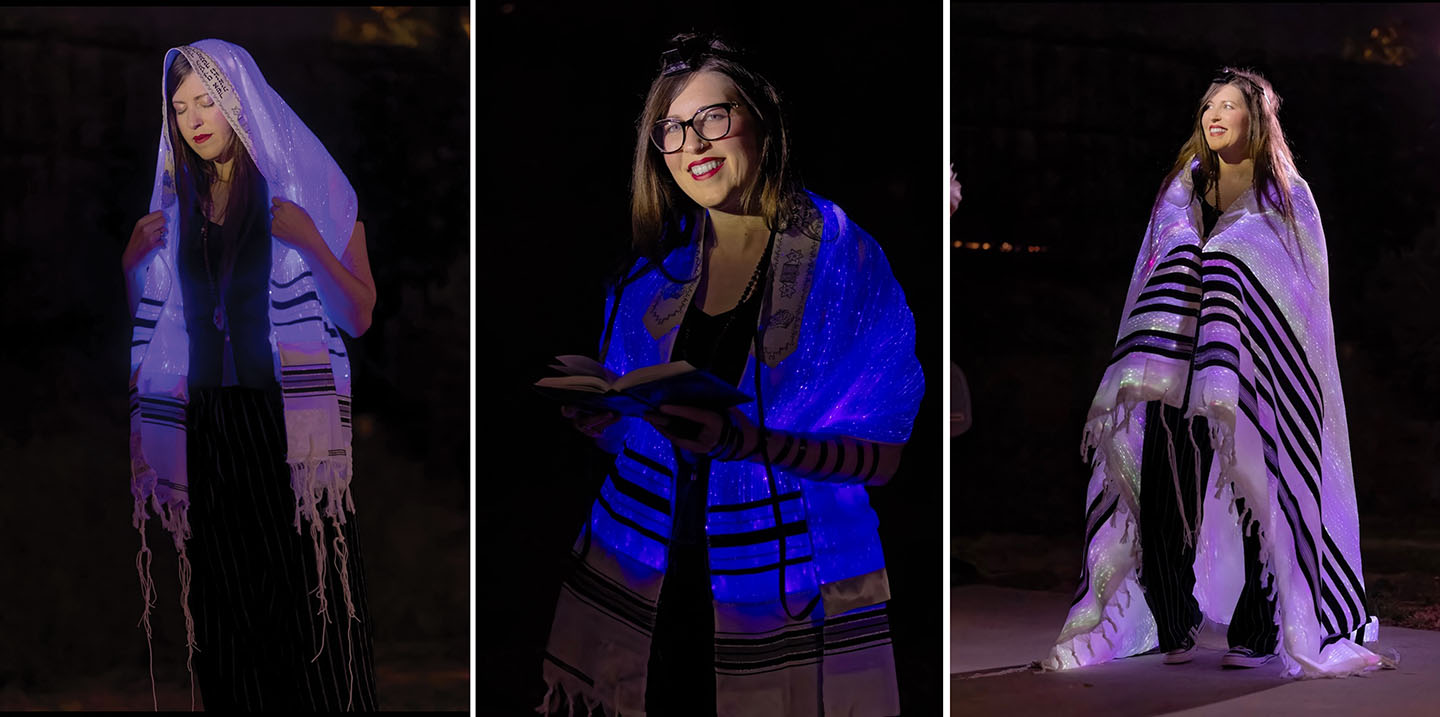
Inspired, I envisioned a tallis of actual light — sewn of glowing fiber optic threads weaving our heritage with our legacy, from the material to the spiritual.
I created this tallis of light as a reminder that the tallis is more than a garment, it’s a bridge — a lens to reconnect with the divine sparks within and around us. When we wrap ourselves in its threads, we are safe and held, cradled in a radiant and protective embrace.
Yet embracing that light has not been easy. The intergenerational trauma of the Holocaust instilled in me the fear that standing out could be dangerous. Even today, amid rising antisemitism and the division within the Jewish world, I wrestle with conflicting emotions — moments of wanting to hide, and moments of wishing I could live more openly. For so long, I felt like I couldn’t even tell the closest people in my life that I was becoming a rabbi. In a world of so much turmoil and condescension, it felt safer to hide. This felt too personal. I was terrified of judgment, afraid of being disconnected from or rejected by my community.
But I remembered the tzitzit shimmering in those streets of Warsaw, and I decided to choose freedom, resilience and courage over fear. I chose to wear my tefillin like a crown and wrap myself in the light of the tallis, fully embracing my role as a new rabbi.
There isn’t just one way to be a Jew, or one way to connect with G-d. At creation, divine light was poured into vessels, but they shattered, scattering sparks everywhere. It’s our job to gather those sparks and bring more light into the world. As Rabbi Dr. Belinda Silbert said, “We are Jewish stardust scattered across the earth. Let us shine wherever it is darkest.”
Here I am, wrapped in shimmering light and divine connection, stepping fully into my purpose. For so long, fear silenced me. That fear still lingers, but I’ve chosen not to let it hold me back any more.
Following my heart and the whispers of my soul have brought profound spiritual nourishment, while discomfort has become a catalyst for meaningful growth. By embracing who we are, we can add more light to a world that desperately needs it. If sharing my journey helps even one person feel seen or empowered to embrace their own light, I am tremendously grateful.
Evey Rothstein is a rabbi, light-up fashion designer, author, spiritual care provider, light worker, and host of the podcast “Let Yourself Sparkle,” where she explores creative ways to light up the body, mind, heart and soul.

































