fbpx

September 18, 2024

The Case Against Divestment

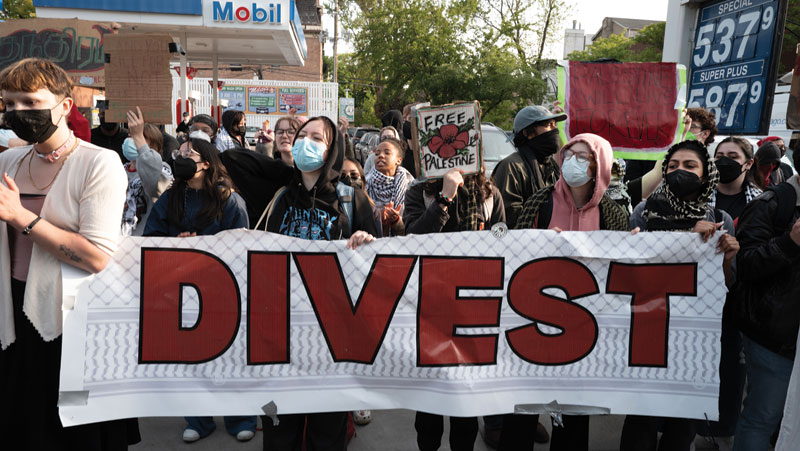
Editor’s note: Earlier this year, the Brown Divestment Coalition (BDC) submitted a recommendation to the Brown University Corporation to “divest from companies that profit from and facilitate gross human rights abuses committed by Israel throughout occupied Palestine.” Next month, the Corporation of Brown University Management will vote on the resolution. 

We publish below a summary of a counterproposal submitted by four Brown alumni, working with the Committee for Accuracy in Middle East Reporting and Analysis (CAMERA), which may be useful for pro-Israel activists at other campuses across the country. 


INTRODUCTION

An expanded version of this report was formally submitted to the Advisory Committee on University Resource Management (ACURM) earlier this month. The report aims to debunk “45 false claims” made by the Brown Divestment Coalition (BDC), which, according to the report, “involve demonstrably false statements, misleading omissions, intellectually dishonest arguments and highly emotive language designed to distract readers from the fundamental truth that the BDC cause is based on bigotry and lies, not justice.”

FALSE CLAIM #1

Claim: “On Nov. 8 2023, 20 members of BrownU Jews for Ceasefire Now engaged in a peaceful sit-in at University Hall The university had them arrested once the building closed for the day … These students’ crimes? Asking that [the administration] respect the voices of the Brown community and formally consider a report …” 

Facts: The students were not arrested for asking that their voices be respected. They were arrested for trespassing within school buildings. BDC omits the dangerous rhetoric that has characterized these protests.

FALSE CLAIM #2

Claim: “These activists staged another sit-in with the same demand, this time in honor of and in solidarity with Hisham Awartani.”

Facts: While the shooting of Mr. Awartani was tragic, it does not appear to have been motivated by animus based on his Palestinian background. The shooter, Jason Eaton, who has a long history of mental illness, appears to have been pro-Palestinian and anti-Israel. 

Mr. Awartani was a victim of gun violence, not of hate.

FALSE CLAIM #3

Claim: “We acknowledge there is a vocal minority of students who do not support divestment…” 

Facts: The assertion that opposition to divestment is from only a “vocal minority” is unsupported. It appears there’s only a vocal minority in favor of divestment, an issue which most of the student body is uninterested in addressing.

FALSE CLAIM #4

Claim: “Referendum Results: 69% of those undergraduate students who voted for the referendum voted yes to the question, ‘Should the Brown University administration divest all stocks, funds, endowment, and other monetary instruments from companies complicit in human rights abuses in Palestine?’” 

Facts: As noted above, the figure of 69% is of the minority of students who voted, who represented only 27.5% of the student body.

FALSE CLAIM #5

Claim: “The occupation of Palestinian land by the Israeli government violates article 49 of the Fourth Geneva Convention … Israel has consistently transferred parts of its own civilian population into occupied Palestinian territories.” 

Facts: Occupation does not violate the Fourth Geneva Convention, which, far from outlawing occupation, recognizes its frequency in armed conflict and codifies the rules by which an occupation is to be carried out. Nowhere in the Convention is the word “settlement” or “settler” mentioned. 

As Robbie Sabel, Professor of International Law at the Hebrew University of Jerusalem, explained, “It is not a logical interpretation of international law that would allow citizens of all States to live in the West Bank but for it to be a war crime to allow Israeli citizens to do so.” That this does not violate the Geneva Conventions is further evidenced by state practice.

FALSE CLAIM #6

Claim: “The total area of Palestinian land on the Israeli side of the wall amounts to 9.5% of the West Bank…”

Facts: The land in question is not “Palestinian land.” There is not now, nor has there ever been, a state called “Palestine” with sovereignty over any land. Nor is any plot of land designated for a future Palestinian state. The BDC misleadingly suggests that the borders of a future Palestinian state are set in stone according to the armistice lines set between Israel, Jordan and Egypt in 1949.

Instead, they are to be negotiated between the two parties. That is why all the major peace proposals, which the Palestinian leadership has consistently rejected, have involved land swaps which would provide the proposed Palestinian state with plots of land on the Israeli side of the 1949 armistice lines.

FALSE CLAIM #7

Claim: “The placement of this wall has therefore allowed for additional land annexation by Israel …” 

Facts: Israel has not “annexed” land on either side of the security barrier. 

Moreover, the placement of the wall, and the route it follows, was guided by a balance of security considerations and the rights of local inhabitants and was heavily litigated in Israeli courts. 

FALSE CLAIM #8

Claim: “Under Israeli military law, the Palestinian people are subjected to a system of separate and unequal laws and services.” 

Facts: Under the laws of occupation, found in the Geneva Conventions and Hague Regulations –which Israel voluntarily applies – the application of a separate set of laws, namely military law, is, in fact, required. For Israel to apply its civil law to Palestinians would, ironically, require it to annex the West Bank. 

It is notable that the Palestinian Authority has since implemented an actual system of unequal and discriminatory laws, including forbidding the sale of land to Jews, a “crime” punishable by death.

FALSE CLAIM #9

Claim: “Article 33 of the Fourth Geneva Convention states: ‘No general penalty, pecuniary or otherwise, shall be inflicted upon the population on account of the acts of individuals for which they cannot be regarded as jointly and severally responsible.’

“According to Amnesty International, Palestinian civilians are collectively punished in the form of home demolitions by the Israeli government … Nearly 50,000 Palestinian structures were razed by the IDF from 1967-2019.” 

Facts: This claim is one of the most egregiously misleading. The authors cite no source for the claim that “nearly 50,000 Palestinian structures were razed by the IDF from 1967-2019.” The likely reason is that it would quickly expose the dishonesty of the claim. 

The 50,000 figure appears to come from the activist organization, The Israeli Committee Against House Demolitions (ICAHD). But as ICAHD explains, its figures include multiple types of house demolitions and, according to ICAHD itself, in fact punitive demolitions account for only 1% of all defined demolitions. Far from 50,000 homes being “punitively” demolished, the real figure is around 500. 

FALSE CLAIM #10

Claim: “Brown University has made commitments to promoting good-will solutions to the conflict on campus, through discussion, outreach, and education. The University hosts speakers, seminars, and events on the conflict, which has for the past several years included a regular Israel-Palestine Lecture Series.” 

Facts: As documented in a 2023 report by the Committee for Accuracy in Middle East Reporting and Analysis (CAMERA), numerous events hosted by Brown University on the subject have involved speakers promoting blatant antisemitism and extremism.

The university has done little to nothing to promote “good will solutions” to the issues dividing Israel and the Palestinians. The university has exacerbated the problem of Brown students and faculty being unable or unwilling to discuss the Israel-Palestinian situation in an honest way.

FALSE CLAIM #11

Claim: “The Boycott, Divest, and Sanctions (BDS) movement was founded in 2005 as a grassroots, nonviolent Palestinian civil society movement inspired by protests against South African apartheid.” 

Facts: While the BDS Movement (capital “M”), the organization, was founded in 2005, the movement (lower case “m”) is an outgrowth of an organized boycott that began years before the State of Israel was even formed. In 1945, the newly formed Arab League instituted a boycott of Jewish goods and services in the British Mandate of Palestine in 1945. The Arab League pledged to “combat Zionist industry,” three years before Israel declared independence.

The attempt to depict the anti-Jewish boycott movement as having begun in 2005 is an effort to erase its controversial and antisemitic origins. This current iteration began with the infamous 2001 Durban “Anti-Racism” Conference, which the late Rep. Tom Lantos (D-San Mateo), a Holocaust survivor, described as “the most sickening and unabashed display of hate for Jews I had seen since the Nazi period.” 

It had nothing whatsoever to do with a “grassroots” movement “inspired by protests against South African apartheid.” That argument is pure fiction.

FALSE CLAIM #12

Claim: “Ending Illegal Occupation: ‘Ending [Israeli] occupation and colonization of all Arab lands and dismantling the Wall.’” 

Facts: There is no such thing as an “illegal occupation.” As explained by the late Yoram Dinstein, former Dean of the Faculty of Law at Tel Aviv University: “In truth, international law – far from stigmatizing belligerent occupation with illegality – recognizes its frequency and regulates its application in great detail.” The International Committee of the Red Cross, hardly a friend of Israel, is of a similar view, “Regarded from a purely [international humanitarian law] perspective, occupation law applies equally to all occupations, whether or not they are the result of force used lawfully.”

FALSE CLAIM #13

Claim: “Equal Rights for all Israeli Citizens: ‘Recognizing the fundamental rights of the Arab-Palestinian citizens of Israel to full equality’” 

Facts: Israeli law already guarantees the equal rights of all of Israel’s citizens, regardless of race or religion. In fact, the Israeli Supreme Court has gone so far as to apply positive discrimination in favor of Israel’s Arab minority, ruling that while Arabs may not be excluded from majority Jewish communities, Jews may be barred from residing in Bedouin Arab towns.

FALSE CLAIM #14

Claim: “Respecting the Right of Return: ‘Respecting, protecting and promoting the rights of Palestinian refugees to return to their homes and properties as stipulated in U.N. resolution 194’” 

Facts: The “right of return” is a myth created to sustain the Arab world’s hope and desire that Israel be wiped off the face of the earth. Resolution 194 was rejected by the Arab parties, who refused to negotiate with Israel as called for in the resolution. It is also made conditional on the willingness of Palestinians to “live at peace with their neighbors.” The widespread support of Palestinians for Hamas’ attack on Oct. 7 shows that condition clearly has not been met. 

FALSE CLAIM #15

Claim: “While Palestinian citizens of Israel are permitted to vote and hold office, they may be forbidden by the Supreme Court of Israel if they engage in ‘negation of the existence of the State of Israel as a Jewish and democratic state.’”

Facts: This language misleadingly suggests this rule applies only to Arab Israelis, when, in fact, it applies to all Israeli citizens, regardless of ethnic or religious identity.

This practice is the equivalent of oaths of office across the world.

FALSE CLAIM #16

Claim: “In 2018, the Knesset passed ‘The Basic Law: Israel — The Nation-State of the Jewish People.’ It states that the ‘exercise of the right to national self-determination in the state of Israel is unique to the Jewish people.’ In other words, Palestinian citizens of Israel are not entitled to the self-determination that Israel claims for its Jewish citizens.” 

Facts: As an initial matter, BDC ignores that the law it references has been interpreted by the Israeli Supreme Court as having no effect on any of the rights of any Israeli citizen. As then-Chief Justice Hayut ruled: “The Nation-State Basic Law does not violate the State of Israel’s nature as a democratic state. It does not give preferential status to the Jewish identity of the state over its democratic identity. It does not detract from the principle of equality’s status in our legal system.”

The right to self-determination does not equal a right to carve out a new state from an existing one. For example, while the Quebecois have a right to self-determination, that does not entitle them to secede from Canada and form their own state.

So while the Jewish people were able to exercise their self-determination in the form of a nation state (an option given to, but rejected by, Palestinian Arabs), that does not negate the existence of self-determination for the non-Jewish population in Israel, whose self-determination is exercised in the form of political, social, cultural, and other rights. 

FALSE CLAIM #17

Claim: “Furthermore, housing discrimination prevents Palestinian citizens of Israel from residing within major Israeli cities at the same rates as Jewish citizens, isolating them into sparse enclaves.”  

Facts: This is a complete fabrication.

There is no law preventing Arab Israelis from residing anywhere that a Jewish Israeli can. In fact,, the only housing discrimination legally allowed is against Jews, who may be prohibited from residing in Bedouin Arab communities.. The argument put forward by the authors is that if you discount all the Arab Israelis living elsewhere in Israel, Arab Israelis only live in a small part of the land.

That is an obvious absurdity.

FALSE CLAIM #18

Claim: “While Palestinian citizens of Israel have the privileges of voting and running for office denied to Palestinians of other location categories, they still do not exist on equal status with Israel’s Jewish citizens.” 

Facts: This sentence lists several ways in which Arab Israelis are fully equal to Jewish Israelis, before claiming – without providing any evidence, examples, or sources – that Arab Israelis are not fully equal to Jewish Israelis. The accusation requires actual evidence.

FALSE CLAIM #19

Claim: “In terms of the right of return, U.N. General Assembly Resolution 194 states clearly in regards to the Palestinians displaced in 1948 …” 

Facts: As noted earlier, the supposed “right of return” is a myth.

FALSE CLAIM #20

Claim: “According to the UNRWA, 5.9 million Palestinians are refugees today.”

Facts: This figure is deeply misleading. It applies the definition of “refugee” used by UNRWA, applicable only to Palestinians. Under the 1954 Refugee Convention, one must individually meet a set of requirements to be considered a refugee. Under the UNRWA definition, these requirements are waived for Palestinians. All patrilineal descendants of the original refugees are automatically given refugee status regardless of whether they would individually meet the Refugee Convention definition. The true figure, under the universal 1954 Convention definition, was estimated to be less than 200,000 in 2021.

FALSE CLAIM #21

Claim: “To accomplish these goals, BDS is at its core a nonviolent struggle.”

Facts: To call BDS a “nonviolent” struggle is akin to depicting the Nazi boycott of Jewish stores as a “nonviolent.”  It divorces the boycott from the larger, virulently antisemitic movement of which it is but one element. 

The BDS Movement itself is directly tied to terrorist organizations. The very first member organization listed by the BDS Movement is the Council of National and Islamic Forces in Palestine (PNIF), a coalition of terrorist organizations, including Palestinian Islamic Jihad. Obviously, these organizations are not interested in a solely “nonviolent struggle.” 

FALSE CLAIM #22

Claim: “As founding member of the BDS movement Omar Barghouti articulated, ‘BDS targets complicity, not identity.’” 

Facts: This is also a demonstrably false claim about BDS, using a carefully curated quote. Consider other remarks of Barghouti, such as: “No Palestinian – rational Palestinian, not a sell-out Palestinian—will ever accept a Jewish state in Palestine.” Thus, it is absolutely about identity for the “founder” of the BDS movement.

BDS activists have regularly targeted Jewish community organizations with no real connection to Israel or any involvement in any alleged “crimes,” such as the so-called “Boston Mapping Project,” which targeted dozens of Jewish institutions Even organizations sharply critical of Israel were included for being Jewish.

FALSE CLAIM #23

Claim: “BDS does not promote a one-state over a two-state solution, or vice-versa; participating in a divestment campaign would not require Brown to back one political solution over another, but rather side with bare-minimum human rights law.”

Facts: This is another blatant lie. BDS promotes positions that they openly acknowledge are steps toward the destruction of the Jewish state, such as the imaginary “right of return,” which Barghouti claims: “You cannot reconcile the right of return for refugees with a two-state solution … a return for refugees would end Israel’s existence as a Jewish state. A two-state solution was never moral and it’s no longer working.”

FALSE CLAIM #24

Claim: “In Palestine, the current members of the BDS National Committee include the General Union of Palestinian Workers, Global Palestine Right of Return Coalition, Palestinian Bar Association, Palestinian Medical Association, [and others].” 

Facts: This passage underscores, as much as or better than, any other of BDC’s many deceits. The authors clearly researched who is a part of the BDS National Committee but chose to conceal the one member that contradicts everything BDC claims about BDS.

That member is the PNIF.  BDC intentionally curated the membership list to omit the terrorist-designated groups whose causes they proudly and shamelessly champion. 

FALSE CLAIM #25

Claim: “As the examples below demonstrate, divestment campaigns, especially when embraced by prestigious institutions with large endowments, national, and international influence, are an important starting point for placing systemic pressure on states, corporations, and institutions to cease human rights abuses, violations of international law, and other social harms.” 

Facts: Similarity in tactics does not equate to a similarity in justness of the cause. Boycotts  of Jewish academics by “prestigious institutions” was an early feature of life in Nazi Germany too.

FALSE CLAIM #26

Claim: “The campaigns helped increase the political power and legitimacy that anti-apartheid leaders held within South Africa …” 

Facts: There are no individuals among Palestinian leadership who even arguably can be compared with “anti-apartheid leaders” in South Africa. Unlike Israel, the PA actually has on paper laws akin to the racist apartheid laws of South Africa, such as barring the sale of land to Jews and prohibiting Jews from worshipping at their holy sites. 

FALSE CLAIM #27

Claim: “Leading human rights organizations have charged Israel with the crime of apartheid since 2019. They include prominent Israeli human rights organizations Yesh Din and B’Tselem as well as international organizations Human Rights Watch and Amnesty International.” 

Facts: While a full rebuttal of the “apartheid” charge is beyond the scope of this document, it is necessary to point out that the allegations made by these organizations have been debunked time and time again. Tellingly, these organizations have refused to correct the record even when directly informed about some of the hundreds of objectively false claims underpinning their allegations.

FALSE CLAIM #28

 Claim: “This is the consensus of all reputable human rights organizations that have endeavored to investigate the topic.” 

Facts: BDC engages in the fallacy of an appeal to a supposed higher authority. Rather than tangle with the hundreds of factual and legal errors, omissions, and misleading claims noted above, BDC hopes to distract readers by waving around the phrase “reputable human rights organizations.” But when an allegation of a violation of international law is made, what matters is not who made the charge but rather the arguments and the supporting evidence. 

Moreover, the implication that there is a “consensus” is deeply misleading. 

FALSE CLAIM #29

Claim: “In response [to] the claims made by South Africa, the court assented [sic] that ‘at least some of the acts and omissions alleged by South Africa to have been committed by Israel in Gaza appear to be capable of falling within the provisions of the (Genocide) Convention,’ legitimizing the severity of the situation, as well as the court’s jurisdiction over it.” 

Fact: BDC wants you to believe that the charge of “genocide” against Israel has been given credibility by a judicial order at the International Court of Justice (ICJ). Joan Donoghue, who was the president of the court at the time, made it clear that the ICJ did no such thing: “I’m correcting what’s often said in the media – it didn’t decide that the claim of genocide was plausible.”

All the order did was declare that if everything South Africa claimed was true, then the allegations might properly fall under the Genocide Convention. The actual substance of the allegations, if any, has yet to be litigated.

FALSE CLAIM #30

Claim: “Since early October, at least 26,000 Palestinian people have been killed, including more than 10,000 children.”

Facts: BDC omits the source of these figures: Hamas.  Even the United Nations has downplayed these figures in ways that cast serious doubt on the highly charged claims about the proportion of women and children among the fatalities.

Moreover, “people” is inclusive of Palestinian terrorists. While Hamas avoids distinguishing between civilians and combatants when peddling its statistics, the Israel Defense Forces have estimated they’ve eliminated approximately 14,000 terrorists, and that approximately 16,000 Gazan civilians have also been killed in the fighting. While each civilian death is a tragedy, a nearly 1-to-1 ratio of civilians to combatants would be unprecedented in modern military operations in urban areas. 

Hamas’s entire strategy is designed to exacerbate civilian harm. 

FALSE CLAIM #31

Claim: “Only ‘16 out of 36 hospitals in Gaza are ‘minimally or partially functioning,’’ with “healthcare workers increasingly unable to adequately address disease or other life-threatening conditions that arise from overcrowding, flooding, and hunger.”

Facts: The authors depict a dire situation without addressing the causes. Hamas has exploited hospitals in Gaza, using them as command-and-control centers, arms caches, and detention centers for hostages.

Hamas having done so both constitutes a war crime and renders the hospitals legitimate targets under international law. Israel has facilitated enormous amounts of medical aid into the Gaza Strip.

FALSE CLAIM #32

Claim: “Shrinking sources of clean water endanger ever larger numbers of Palestinian civilians, and Israeli refusal to admit fuel for desalination plants has forced vulnerable populations to depend on water that is ‘highly salinated or polluted.’” 

Facts: Gazans are not being forced to depend on “highly salinated or polluted water.” Israel has repaired and opened the three water pipelines into Gaza. Two additional pipelines were constructed from Egypt. These pipelines alone are capable of providing enough clean water to a large majority of Gazans.

Notably, the authors once again omit any real analysis of the causes of the dire situation they present to blame Israel. The Palestinian Authority was given control of most of Gaza’s water infrastructure in 1995, and then total control in 2005. Hamas has mismanaged the infrastructure and has openly boasted about how it digs up water pipelines for the purpose of turning them into rockets meant to kill Jews.

FALSE CLAIM #33

Claim: “Ninety-three percent of Gazans are currently facing ‘crisis levels of hunger’ as a result of Israeli policies that seek to induce extreme deprivation onto the captive population.”

Facts: This claim is simply baseless. Israel has continuously scaled up its efforts to facilitate humanitarian aid into the Gaza Strip. 

FALSE CLAIM #34

Claim: “More than 100 journalists have been murdered…” 

Facts: The description of many of these individuals as “journalists” is misleading. Many of these individuals have turned out to be members of terrorist organizations. Some, such as Al-Jazeera’s Ismail al-Ghoul, even participated in the Oct. 7 massacre. 

Many held Israeli civilians hostage in their own homes and worked for “media” outlets directly connected to these terrorist organizations. These people were not actual journalists; they were propagandists in the employ of a terrorist organization. 

FALSE CLAIM #35

Claim: “Lifesaving resources are being slowed or outright blocked by Israeli government and military forces.” 

Facts: Israeli forces are not responsible for the slow pace of aid delivery. In fact, enormous amounts of aid (over 920,000 tons) have entered Gaza faster than aid agencies like the United Nations can deliver it within the territory.

What BDC appears to be complaining about are the inspections carried out by Israel of aid shipments being sent into Gaza. Beyond not actually being responsible for the slow delivery of aid, there is nothing illegal or untoward about such inspections. 

FALSE CLAIM #36

Claim: “More than 100 aid workers affiliated with the U.N. were murdered in the first month of bombardment alone.”

Facts: Once again, the authors allege criminal intent without supporting evidence. Without that evidence, these accusations cannot be taken seriously, as they simply seek to mask the lack of substance behind the charge.

FALSE CLAIM #37

Claim: “Attacks on aid convoys, limits on hours in which humanitarian vehicles can move through checkpoints, and lengthy inspections of shipments of food and medical supplies have bottlenecked access to vital resources that growing numbers of refugees are ‘wholly reliant on… to survive.’” 

Facts: This is, once again, a flat-out lie. The bottleneck is not Israeli inspections or restrictions, but rather the inability of the United Nations to scale up its aid delivery within the territory. It has been Egypt which has declined to coordinate with Israel to reopen the humanitarian aid crossing.

FALSE CLAIM #38

Claim: “Israeli military control of checkpoints connecting Gaza to Israel and Egypt not only deny displaced Palestinians the ability to escape to safety but gives military forces the ability to deny them aid through border closures and blockades.” 

Facts: Here, BDC misleads by omission. The full story is a case study in how “international law” seems to be applied differently against only the Jewish state. The reason Gazans were not able to escape to safety into Egypt had nothing to do with Israel. Gazans were prohibited from finding refuge in Egypt by Egypt.

To this day, no Arab country has agreed to take in displaced Palestinians, with the exception of a limited number of temporary entries to receive medical care.

FALSE CLAIM #39

Claim: “Eighty-five percent of people living in Gaza have been forcibly displaced by Israeli attacks—nearly two million people are now refugees.” 

Facts: Once again, BDC misleads by omitting the party responsible for the situation – Hamas. There is a reason for the prohibitions in the law of armed conflict on locating military targets in civilian areas: It puts civilians in harm’s way. 

Israel’s evacuation orders have been designed, in compliance with international law, to remove civilians from those areas in which it must operate to eliminate Palestinian terrorist targets that have been unlawfully embedded in those areas.

In other words, the legal wrong that led to this displacement is not that of Israel, but that of Hamas, who built their terror infrastructure underneath their homes.

FALSE CLAIM #40

Claim: “The scale of destruction to civilians’ homes is staggering — nearly 80% of Palestinians in Gaza have no home to return to.” 

Facts: This claim is unsupported even by the cited source. The U.N. News story cited by the authors derives a faulty conclusion from its own data, presumably to advance its own political narrative. Many – if not most – of those Gazans are displaced because of evacuation orders, not necessarily because their homes no longer exist.

According to a recent UNOSTAT damage assessment, the total number of structures destroyed, severely damaged, moderately damaged, and possibly damaged is about 55% of the total structures in Gaza. If one removes the “possibly” damaged structures, the figure drops to below 40%.

FALSE CLAIM #41

Claim: “Since Israel launched its war on Gaza in October 2023 …” 

Facts: This claim, standing alone, warrants the dismissal in its entirety of the BDC proposal. It could not be clearer that Israel did not launch a war on Gaza. Precisely the opposite is true; Palestinian terrorists launched the war on Israel on Oct. 7, 2023. If the BDC is willing to lie about something so basic and obvious, none of its other claims can be taken seriously.

This claim, standing alone, warrants the dismissal in its entirety of the BDC proposal. It could not be clearer that Israel did not launch a war on Gaza. Precisely the opposite is true; Palestinian terrorists launched the war on Israel on Oct. 7, 2023. If the BDC is willing to lie about something so basic and obvious, none of its other claims can be taken seriously.

FALSE CLAIM #42

Claim: “On Dec. 7, prominent Palestinian poet and professor Rafaat Alareer, who was known as the ‘voice of Gaza,’ was killed by an Israeli airstrike in northern Gaza.” 

Facts: Refaat Alareer was not simply a “poet and professor.” Alareer was a notorious antisemite. Prior to his death, Alareer spent his time online celebrating and cruelly mocking the death of Israeli civilians, including children, murdered on Oct. 7.

FALSE CLAIM #43

Claim: “Recently, the Israeli Occupation Forces arrested 25 student activists at An-Najah University in Nablus, in the West Bank, during a sit-in where students were protesting internal university policies on tuition payment. Birzeit University students, staff, and faculty have faced similar and constant raids targeting Palestinian students who have been abducted, detained, and brutalized by the Israeli military for decades, which goes well beyond the obstruction of their rights to education.” 

Facts: Students were not arrested for protesting internal university policies. To the contrary, they were arrested for their affiliations with Hamas.

The student factions of Hamas and other terrorist organizations regularly held rallies and parades glorifying terrorism. Students from these universities have carried out terror attacks targeting Israelis or have been otherwise involved in terrorist activity.

FALSE CLAIM #44

Claim: “These blatant obstructions of education should be of utmost concern to Brown University. Such obstructions are a clear contravention of the right to education enshrined in Article 26 of the 1948 Universal Declaration of Human Rights and Article 13 of the 1966 International Covenant on Economic, Social, and Cultural Rights.”

Facts: The actions of Israel are not, in fact, a “clear contravention of the right to education.” In the law of armed conflict Steven Haines explained, “A school is ordinarily a civilian object, of course, and not subject to lawful targeting. If, however, military forces use it, the school loses its protected status and becomes a military objective.”

The war began with the savagery of Palestinian terrorists on Oct. 7, 2023, has severely affected the ability of Israeli students to access education, particularly for the children of the thousands displaced in southern and northern Israel by the indiscriminate attacks of Palestinian and Hezbollah terrorists.

FALSE CLAIM #45

Claim: The use of “Palestinian citizens of Israel” throughout the document.

Facts: The authors refer to Arab citizens of Israel as “Palestinian citizens of Israel,” in spite of the fact that very few actually identify as “Palestinian.” Surveys consistently show that only a small minority define themselves primarily as “Palestinian.” Instead, these surveys show most prefer to be referred to as “Arab-Israeli.”

Propagandists, like the BDC, treat facts as devices to be manipulated, hidden, and disguised in service of partisan ends. Peacemakers work with the facts as they are, not as they wish them to be.

CONCLUSION

“Brown University, as one of the leading institutions of higher education in the world, has a moral and professional obligation to embrace and embody intellectual honesty. Instead of being led astray by the BDC, Brown must tangle with the facts. Propagandists, like the BDC, treat facts as devices to be manipulated, hidden, and disguised in service of partisan ends. Peacemakers work with the facts as they are, not as they wish them to be. Solutions based on lies will only perpetuate conflict and the accompanying harms. The BDC is not willing to engage honestly with the facts. It seeks to exploit Brown for purely partisan ends. If Brown University is to maintain its image and uphold its mission, it must reject BDC’s bad faith ploy.”

The Case Against Divestment Read More »

‘Let It Out’ Stand-Up for Neurodivergent Adult Comedy Fans and Friends at The Laugh Factory

On Sept. 11, Rob Kutner and Mike Rotman co-produced a neurodivergent-friendly stand-up comedy night at The Laugh Factory in Hollywood. “The cool thing was also that, when they turned the lights down, you forgot that anybody was neuro anything,” comedy writer and author Kutner told The Journal. “It was just a room full of people just having a good time laughing at comedians.”

More than 80 neurodivergent and neurotypical comedy fans came together in an accessible environment. The show featured comics Willie Hunter, Kruger Dunn, Josh Meyrowitz, Laurie Kilmartin, Jeremiah Watkins and Erik Griffin.

“The stereotype is that autistic folks are loners or distant and remote, but they like to connect just as much as anyone, if not more,” Tom Fields-Meyer, coauthor of “Uniquely Human,” one of the best-selling books on autism, told The Journal. “They also have unique ways of perceiving the world, which is exactly what makes for good comedy.”

“The stereotype is that autistic folks are loners or distant and remote, but they like to connect just as much as anyone, if not more. They also have unique ways of perceiving the world, which is exactly what makes for good comedy.” –Tom Fields-Meyer

Fields-Meyer’s adult son is on the autism spectrum. ”My son Ezra loves to laugh and loves to make people laugh, but I had never been to a comedy club with him,” he said. “Seeing the smile on his face, and looking around the room and seeing the joy of folks listening and laughing was a treat.”

The show’s title, “Let It Out” is a reference to an atmosphere that “accepts outbursts, physical motions and other behaviors that neurodivergent people sometimes engage in, but can be sources of embarrassment in intolerant settings,” Kutner said. “More generally, it signals the overall vibe of ‘just let your hair down, don’t worry and have a good time.’”

Rotman has a neurodivergent relative and also knows others who love going to comedy shows, but never quite feel comfortable in a large crowd or with loud sounds  “I thought, “‘Why isn’t there a comedy show for a neurodivergent audience?’” Rotman, a comedy writer and director of special events at Big Bear Theater Project, told The Journal. “I started asking around and nobody knew of any, so I thought, ‘Let’s put one together.’” 

Rotman, who is a big animal rights advocate, said in that community they talk about speaking for those who have no voice. “I always believe in living my life by that philosophy: doing right for others, treating those as I would want to be treated,” he said. “All of that seems to be in line with the moral teachings of Judaism.”

Done in partnership with The Miracle Project and Autism in Entertainment, “Let It Out” was a follow-up to Kutner and Rotman’s “A Comedy Hug for Healing,” at The Laugh Factory in February, a stand-up show to benefit the Koby Mandell Foundation and Sheba Medical Center in Israel.

“[Owner of The Laugh Factory] Jamie Masada had been super welcoming, lovely to work with, and his staff is really great,” Kutner said. “So, when we had this idea, we thought, ‘Let’s go back to them,’ because they are like the menschiest comedy club.”

Kutner and Rotman call their neurodivergent comedy night an easy-to-replicate model that they not only hope to continue doing, but want to encourage others to do, as well. “We were just trying to slightly retrofit a regular comedy show with standard mainline comics, giving them a bit of mindfulness about how to deal with the audience,” Kutner said. Their other guidance: “Don’t have crazy changes in lights and music, which some comedy clubs don’t necessarily do anyway,” he said. These are all very easy things to adjust.

The producers prepared the comics, letting them know that an audience member may yell something or get up and walk away, which is typical for a normal comedy show anyway. “We simply asked the comedian not to target or mock anyone who might be doing that,” Rotman said. 

The results were even better. 

“It felt like any night at a comedy club: waiters taking drink orders, comics delivering some of their best material, and a good share of groaners, an emcee holding it all together,” Fields-Meyer said. “Only this time, one of the audience members called out, ‘When are you going to talk about trains?’” 

Instead of turning on him, the comedian paused, smiled and said, ‘Okay. Let’s talk about trains!’ 

“He did,” Fields-Meyer said. “And it was very funny.”

Another addition to the show was a chill-out space, Kutner explained. “We cordoned off the lobby of The Laugh Factory, so that if someone’s getting overstimulated, they could just retreat back there and just cool their jets, which a few people did,” he said. 

When asked what he wanted people to get from the experience, Rotman said “I hope everyone who attended felt like they were included and did not feel nervous or worried about going to the show,” he said. “The goal is to treat this like any other show … and enjoy an evening out.”

Added Fields-Meyers, ”I’ve heard lots of comedy, but rarely in a comedy club do you feel a sense of love and caring and connection the way I did that night.”

‘Let It Out’ Stand-Up for Neurodivergent Adult Comedy Fans and Friends at The Laugh Factory Read More »

Rosner’s Domain | And a Second Year Begins

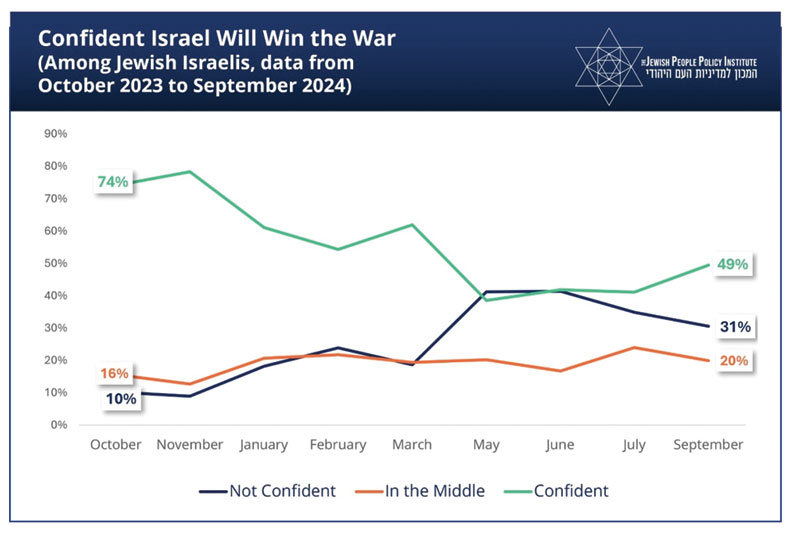
In just slightly more than two weeks, it will be a year. A full year of war. And as the anniversary of the attack gets closer, a sense of closure is still a distant dream. Only a fifth of the Israeli public feels that an official state ceremony is needed “to mark Oct. 7.” A much larger group, 40%, believe that it’s too early to have such a ceremony. They choose the option “the war isn’t over yet.” And their conclusion is clear: One does not commemorate an ongoing event. 

Everything these days is a controversy and hence we shouldn’t be surprised that there’s an unresolved controversy over how to mark the one-year anniversary of attack. The result would be funny had it not been so sad. There will be both an official state event, filmed and broadcasted, and a privately organized, crowd-funded civilian ceremony that is expected to attract hundreds of thousands of participants. When the real event – the one with an actual crowd – ends, the staged government event will be broadcast. 

Based on the JPPI survey of Israeli society for September, most Jewish and Arab Israelis do not plan to watch the state ceremony. They will not exactly shun the event, because no one is invited to attend – and all one has to do to ignore it is switch to another TV channel. And yet, the statement “We aren’t going to watch” has meaning. Of all the ideological subgroups, only among self-identified “right” is there a majority who say that they intend to watch the ceremony, making the political nature of it vivid and impossible to ignore. Israelis pulled together to fight the war, but find it hard to pull together to remember it. 

The ”alternative” civil ceremony has its own bag of problems. A country is supposed to mourn together, and celebrate together, its national holidays and calamities. Thus, while a third of Jewish respondents feel that the civil way, detached from the official, state-organized event, is “the right ceremony at this time” (35%), a similar share of Israelis say that such a private ceremony “undermines the national character” of a memorial day and “shouldn’t be held” (32%). Responses to this question also show disagreement along clear ideological lines. Self-defined right-wing Israelis largely oppose the civil ceremony. Centrist and left-wing Israelis largely favor it.

A house divided – that we already know – cannot stand. Can a house divided keep fighting? Can a house divided bear the burden of yet another year of war? Carmit Rapaport, a Haifa University expert on dealing with crises and calamities, gives the Israeli public high marks for being relatively calm under the pressure of war. On the other hand, she says, what other choice do people have? When we met for a recording, last Sunday, it was merely a few hours after sirens disrupted the morning routine in Israel because of the unexpected and unwelcome arrival of a Houthi missile. It was 6:30 a.m. and kids were readying themselves to go to school. Should they go? Should they not go? 

Two hours later, schools were as packed as usual. A missile, a siren, a short halt to understand the magnitude of the event, a return to routine. Most likely, Oct. 7 will be somewhat similar. A pause, a reflection, a tear, a sigh, and back to the routine of war. Counting of the first year ended, counting of the second year begins. 

That’s the insight that dawned on Israelis, gradually, then suddenly. The loose talk about a long war, that could take years, becomes their reality. Gaza is still an open wound to which no remedy is offered. Lebanon is looming as the next crisis. In recent weeks, the roles of leaders have seemed to be reversed. While at the outset of the war Defense Secretary Yoav Gallant pushed, without success, for launching a surprise attack in the north rather than focus on the south – he is now an objector to PM Netanyahu’s tendency to declare the south almost done and move the main military effort northward.

Whatever they end up deciding, the result will be more war. Could it have been any different? The honest answer is that we don’t know. Testing the outcome of alternative paths is impossible. And while many Israelis – a clear majority – are quite unhappy with their leadership, they still must remember that Israel’s enemies also have a role in ensuring that the war will be prolonged. And they should also remember that the international community was also unable to present a path forward that could bring about both calm and an acceptable political arrangement for Gaza and Lebanon.   

And so, we will soon enter our second year of war. Can we handle this pressure? It is almost a silly question, as we don’t have much choice.

Something I wrote in Hebrew

This is the question: Where will Israel have doctors from when the ultra-Orthodox society will continue to grow… when there will be 20% ultra-Orthodox, and then – if the forecast comes true – 30% – the question will become more acute… Ask: Why shouldn’t the ultra-Orthodox become doctors? We will answer … The proportion of ultra-Orthodox among all degree recipients in universities (not in colleges of education) is 2.3%. Very little relative to the size of the group. Those of them who go to university, turn to the humanities. It is good that there are students who study the humanities, but doctors come from other fields as well as engineers, entrepreneurs, hi-tech people. What is the share of ultra-Orthodox among graduates of medical schools? There is an answer to that. One finger is enough to give it – 1%. 

A week’s numbers

Would you open a second front in Lebanon when the numbers look like this?

A reader’s response

A Question from Barbara B: “Are Israelis concerned about climate change? I don’t see many reports on this issue coming out of Israel. For me and most American Jews this is a top priority.” Answer: Israelis are currently more interested in regime change (in Gaza, Lebanon, Iran and other countries) than in climate change.

Rosner’s Domain | And a Second Year Begins Read More »

The World Peace Foundation’s Propaganda War

Throughout recorded history, nations and peoples have waged war against each other. In response, prophets and idealists have decried the destruction and prayed for peace, generally with meager results. After the devastation of two World Wars in the 20th century, a number of academic programs were established with the proclaimed mission of reversing this dismal history. 

Unfortunately, as is clear from the state of the world today, they have made little progress. And in some cases, groups operating under the banner of promoting peace have become partisans to conflicts and joined in amplifying hatreds between peoples.

The World Peace Foundation at the Fletcher School of Law and Diplomacy at Tufts University is a depressing illustration of Orwellian hypocrisy and doublethink. Established by Edwin Ginn, a Boston-based publisher of educational texts and an advocate for international peace, the WPF’s stated objectives are to educate “a global audience” on “the waste and destructiveness of war and of preparation for war,” and, based on “justice-informed research,” to promote “international justice and the brotherhood of man … peace and goodwill among all mankind.” But like other well-intentioned frameworks, the declared objectives must be measured against the results, and here, the chasm is massive. 

This is clearly illustrated in the roles of the WPF and its head, Alex de Waal, in joining the intense propaganda war accompanying the Gaza conflict that began on Oct. 7 with the Hamas mass attacks, atrocities and hostage-taking. In a series of publications and interviews, de Waal amplified the accusations that Israel was deliberately using starvation as a weapon against Palestinians in Gaza. Following an orchestrated campaign, International Criminal Court prosecutor Karim Khan announced that he had requested arrest warrants for Prime Minister Netanyahu and Defense Minister Gallant for “war crimes and crimes against humanity,” the first of which was “starvation of civilians as a method of warfare.” Violent campus activists repeated the accusations as they attacked and intimidated Jewish students.   

However, as the evidence was carefully examined, it became clear that there was and is no famine or food shortage in Gaza. Despite the ongoing attacks by Hamas and the devastating torture and point-blank murder of hostages, Israel has maintained a steady flow of vital supplies. Nevertheless, and predictably given the deeply ingrained bias, the accusations continue to be pressed in the ICC, by NGOs and in other venues. 

De Waal’s contributions included two articles with this theme in the Guardian (UK). The first, in January 2024, declared, “Unless Israel changes course, it could be legally culpable for mass starvation.” The second, in March 2024, proclaimed, “We are about to witness in Gaza the most intense famine since the Second World War.”  In a July 2024 interview for the Iranian regime’s propaganda television platform Press TV, he declared that “The starvation of Gaza is man-made. It is a crime — certainly a war crime, possibly the crime of extermination, possibly the crime of genocide.” De Waal also participated in an event headlined “Starvation as a Weapon: Predicted Health Outcomes for Mothers and Children in Gaza,” held by Jewish Voice for Peace, a notorious agit-prop NGO.

In a highly inflammatory opinion piece under the heading “Famine in Gaza: an example of the global humanitarian crisis” in the American Journal of Clinical Nutrition (AJCN) (June 2024), de Waal repeated the accusations, sourced to the Hamas-controlled Gaza “Health Ministry,” U.N. agencies that automatically recycle these claims, and reports of the Famine Review Committee. Although often described as neutral experts, the FRC also had no independent evidence and cited the same sources, as well as NGOs linked to the Popular Front for the Liberation of Palestine terror organization. 

De Waal’s diatribe also erased the responsibility of Hamas and its supporters: the 17-year reign of terror and the horrifying Oct. 7 mass slaughter, brutality, and rape are reduced to a brief reference to the “Hamas attack on Israel and massacre.” After the AJCN published a detailed rebuttal documenting these failures (written by an academic colleague and myself), de Waal doubled down with more blatantly false or unverifiable accusations.  He dismissed details showing that Israeli facilitation of aid was more than adequate, and included a tendentious tag-line: “Many Israelis are upset that the Government of Israel is being accused of creating famine in Gaza. But the facts speak for themselves.” (I flagged this, and the AJCN editors removed it.) 

The use of the academic and “peace” banners at the WPF to promote the opposite is also reflected in the activities and backgrounds of other staff members. Prior to the latest and most deadly Gaza war, at least three (in addition to de Waal) joined in the campaign calling for discriminatory boycotts and arms embargoes against Israel. Vice Chair Anat Biletzki has a long record of providing an Israeli fig-leaf for anti-Israel propaganda, including serving as chair of the B’Tselem NGO that, among other “achievements,” legitimized applying the apartheid label to Israel. In March 2024, Biletzki signed a petition headlined “Genocide is plausible; stop arms to Israel,” and another that called on the US to “stop its unconditional support of Israel’s assault.”  Yael Krifcher, Researcher on Famine and Starvation Crimes, previously worked at Bimkom (another Israeli ideological advocacy NGO) and has actively supported the BDS movement, and B. Arneson’s social media posts demonstrate his political bias, including the declaration that Israel “has separated, contained, imprisoned, tortured, and killed #Palestinians for 75 years.”

As this record demonstrates, WPF is a very visible example of exploiting the façade of peace to fuel conflict and promote false accusations that contribute to hatred and violence. Tufts University and the Fletcher School of Law Diplomacy would be well advised to undertake an immediate, detailed and fully transparent review of WPF’s activities, and to address the question of whether these are consistent with academic norms and standards.


Gerald M. Steinberg is emeritus professor of political science at Bar Ilan University, founder and president of NGO Monitor, and author of “Menachem Begin and the Israel-Egypt Peace Process: Between Ideology and Political Realism”

The World Peace Foundation’s Propaganda War Read More »

An Executive Order that Targets Jews

Should U.S. Presidents be able to freeze your bank account if they disagree with your views on foreign policy, or if anti-Israel groups ask them to? The Biden administration apparently thinks so, at least if you’re Jewish and have opinions on what’s going on in Israel that they don’t like.

In February of 2024, the Biden administration issued Executive Order 14115, which authorized the State and Treasury Departments to impose financial sanctions, including the freezing of bank accounts, on people or entities that do a wide variety of things in, or relating to, the territories Israel captured from Jordan during the Six-Day War in 1967. The language of the Order suggests that sanctions are allowed against anyone—although the administration has applied it mostly to Jews—who is violent. But it also explicitly allows sanctioning anyone who commits any “actions—including directing, enacting, implementing, enforcing, or failing to enforce policies—that threaten the peace, security, or stability of the West Bank.” 

The current administration, like the Obama administration, believes that any Jewish presence in any area over the Green Line is a threat to the peace, security and stability of the West Bank. So what this Executive Order does is empower the administration to sanction anyone who commits any action that it determines to be a bad idea.

The kind of sanctions the administration imposes prevent anyone from dealing with the sanctioned person: their internet and email are canceled,  they have no access to their credit cards and thus can’t pay for basics like insurance and daily life activities. Their life is essentially unraveled. And once they’re sanctioned, they can’t hire a lawyer to defend them and to seek removal of the sanctions without going through a special administrative process—because after all, rendering services to a sanctioned person is illegal, and that includes legal services.

Typically, such sanctions are used against terror states and rogue regimes, drug traffickers and international arms dealers. Such entities and people probably have the means to live with such sanctions. But no other sanctions program applies to a democratic U.S. ally. And this Order is being used to sanction individual Israelis who run small businesses or farms—suddenly turning their lives into a Kafkaesque nightmare. But it doesn’t apply only to Israelis. This Executive Order applies also to U.S. citizens doing nothing other than speaking or financing speech.  

As a result, some Americans deeply committed to helping Jews live freely in the land of Israel are in danger of having their financial lives frozen without notice. Among these people are Christian Zionists, who believe that Judea and Samaria are parts of Israel given by God to the Jews, and that it is important for Jews to be able to live there as Jews.  

Many American Jews are suspicious of Christian Zionists, imagining that they work with Jews only out of a secret desire to convert them to Christianity. But this is false. By and large, these people just want to help the Jewish State. During the current Gaza war some even came to Israel to step in for soldiers who’d been called up.  

In the U.S., Christian Zionists donate to help Jewish towns buy security equipment like fences and cameras, and they bring Jewish residents from Judea and Samaria to the U.S. to speak and to meet with U.S. government officials.  

On behalf of Texans for Israel—a Christian Zionist organization that deeply believes in the right of the Jewish people to live in Judea and Samaria—as well as other plaintiffs, a group of lawyers including this writer has filed a constitutional challenge to the Executive Order in federal court in Texas. The case is based on the fact that the Order chills activity that is fully protected by the First Amendment. As U.S. citizens, our Christian Zionist clients have full protection for all of their Constitutional rights. The Executive Order tramples on these rights, because any one of the Israelis with whom these Americans are working could, at any moment, be sanctioned. And then, because the Americans were supporting them, the Americans would be sanctioned next.  

On behalf of Texans for Israel—a Christian Zionist organization that deeply believes in the right of the Jewish people to live in Judea and Samaria—as well as other plaintiffs, a group of lawyers including this writer has filed a constitutional challenge to the Executive Order in federal court in Texas.

Because there’s no notice provided under this Executive Order, you find you’ve done something impermissible only when the sanctions have already been imposed. Then, while your bank account is frozen, you can initiate an administrative proceeding, which could take months to resolve, to ask for removal and try to prove you’ve done nothing wrong. In the meantime, even if you’re an American, you’ll have to borrow cash to buy groceries.

Because there’s no notice provided under this Executive Order, you find you’ve done something impermissible only when the sanctions have already been imposed.

The sanctions are being imposed on people who are neither settlers nor violent. The list of sanctioned entities includes Tsav 9, an organization that engages in nonviolent protest to prevent humanitarian aid from being captured by Hamas. You’d think that this administration, or any U.S. government, would have exactly the same goal: It can’t be a good idea to let Hamas capture humanitarian aid, because we know—as reported by Israeli TV again recently—that Hamas sells the aid, at exorbitant prices, to the Gazans to whom it’s directed, and then uses that money to fund Hamas terror operations.  

The Israelis who are trying to right this obvious wrong are engaging in exactly the kind of protests we see all the time. When such tactics were used to protest judicial reforms, President Biden praised the riots as an “enduring protest movement that is demonstrating the vibrancy of Israel’s democracy.”    

But the same tactics deployed by Israeli Jews against Hamas get a different response, and this administration is committed to stopping them even if they take place entirely in Israel, entirely among Israelis and are entirely nonviolent. What does this mean in practice? It means that the organization Tsav 9 and one of its organizers, a mother of eight living in a development town in Southern Israel, have been debanked. 

As shocking as it is, this Executive Order didn’t come out of nowhere: Within weeks of President Obama’s first inauguration, IRS and State Department officials began considering whether they could deny or revoke tax-exempt status for organizations that provide material support to Jews living across the Green Line—the nonborder that delineates pre-1967 Israel from the territories Israel acquired in the Six-Day War. The theory was that a Jewish presence in those areas is inconsistent with U.S. policy. The IRS drew up lists of such organizations based on information from anti-Israel websites such as Electronic Intifada and Mondoweiss. A case successfully challenged that policy, with a federal appellate court opinion holding that the IRS couldn’t discriminate on the basis of viewpoint when processing applications for charitable status.

One of the most troubling things about this Executive Order is how it’s targeting Jews. There are plenty of Islamist terrorists operating in Judea and Samaria, and in fact the Palestinian Authority itself officially pays monthly stipends to the families of terrorists who have been convicted of killing Jews. (Those payments are an explicit violation of the U.S. law known as the Taylor Force Act, but the Biden administration doesn’t care and allows such payments.) Not one Arab individual has been sanctioned under this Executive Order. 

The only sanctions “imposed” on any non-Jewish person or entity was the Lion’s Den terrorist cell in Nablus. But the terrorist cell is just that—a cell. It has no bank accounts or credit cards in its own name, and nobody else was sanctioned along with it—no individual people or leaders, no banks that service those people. And aside from this “sanction,” the Biden administration has done nothing under this Executive Order to sanction any non-Jew for any action, including the actual or attempted murder of Jews, which you can read about every few days in the newspaper.  

As a matter of Constitutional law, the president has the authority to treat allies and enemies largely as he wishes, and it’s not illegal for the President to discriminate among different groups of people when none of them is a U.S. citizen.  But it’s disappointing that Israel, which for the Biden administration is formally categorized as an ally, has its citizens subject to financial sanction while the people who are trying to kill them not only get virtual immunity, but also get paid with money provided as U.S. aid.


Jerome Marcus is a lawyer in private practice, and the president of The Deborah Project, a public interest law firm that represents people affected by antisemitism and anti-Zionism on American university campuses. He is also a Fellow at the Jerusalem-based Kohelet Policy Forum.  

An Executive Order that Targets Jews Read More »

9/11 and 10/7: The Same Story

Like many of you, I’m sure, I remember exactly where I was early in the morning on September 11, 2001. My brother phoned me first thing in the morning and told me to turn on the television, America was under attack.

Jacqueline and I had been asleep. We rubbed our eyes, turned on the TV, and watched in disbelief at the image of the second plane crashing into the Twin Towers. Jacqueline was eight months pregnant with our second child. She had family living in New York City, including her mother, father and older brother. My first cousin was living on the Lower East Side, about two miles from Ground Zero.

I remember so many moments from that day: the horrifying images of the planes hitting the towers playing again and again on the news; video of people covered in ash fleeing lower Manhattan; the heartbreaking photos of people jumping to their deaths.

It took a while for us to understand what had happened, but within a few hours we knew with certainty that our country had been attacked by terrorists; and not just in lower Manhattan but at the Pentagon and in a field in Somerset County, Pennsylvania as well.

The days and months that followed included an outpouring of international support and concern, along with story after story of heartbreak and loss.

Twenty-three years have passed.

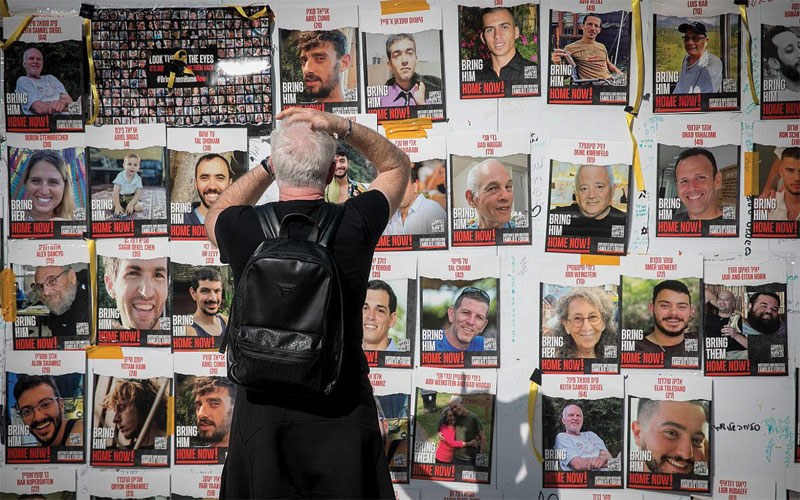
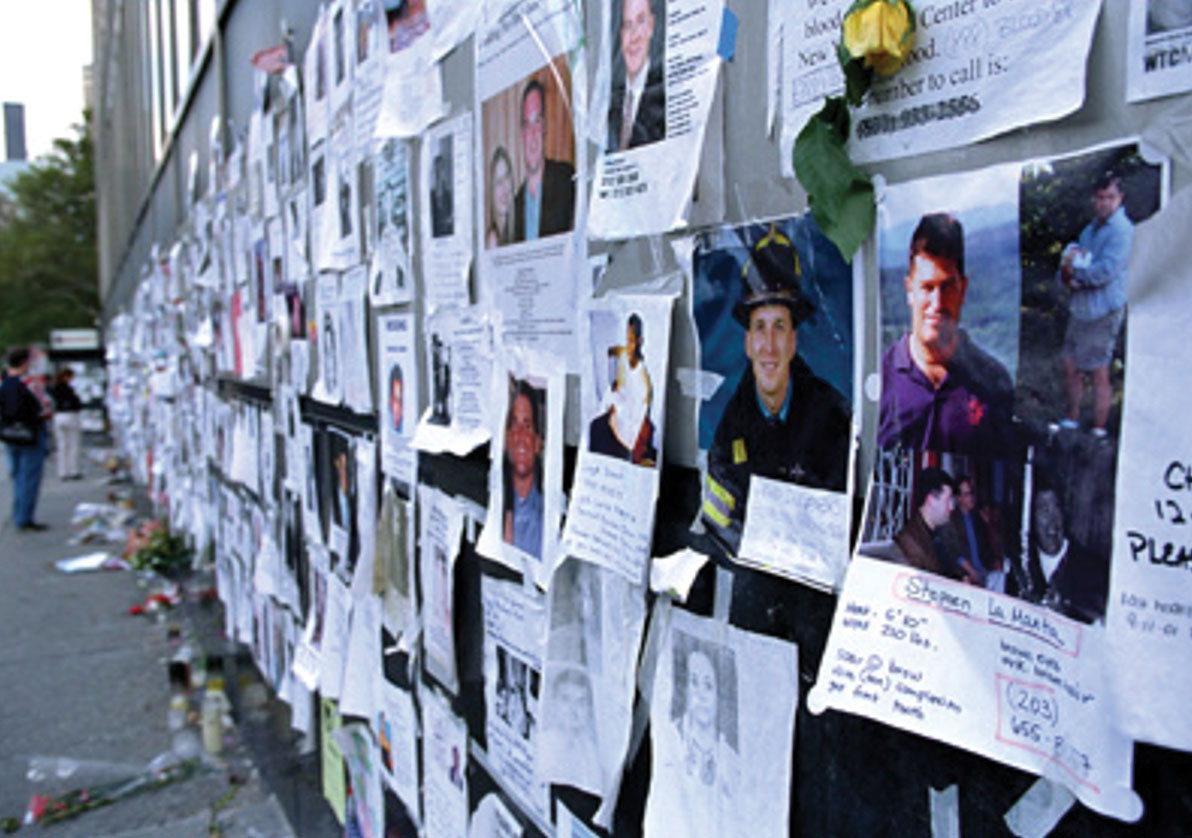
The sorrow that I have felt over the past 11 months makes this year’s remembrance of that day even more painful. As I reflect upon the stories of those killed in Israel on Oct. 7, I see in my mind’s eye the posters of the missing from that fateful day and I cannot help but connect those images to the posters of our hostages in Gaza.

But make no mistake — it’s the same story, a story of religious extremism and hatred strong enough to inspire a person to do the unthinkable: to murder hundreds and thousands of innocent strangers.

Make no mistake – it’s the same story, a story of religious extremism and hatred strong enough to inspire a person to do the unthinkable: to murder hundreds and thousands of innocent strangers. 

Of course, we could and — for another time should — compare and contrast the different ways in which the world responded to these two terrorist attacks. We could and — for another time, should — compare and contrast the brutality, violence, and horror of the attacks: one committed in a much more sterile fashion using sleek jetliners as weapons of war, the other much more personal, direct and bloody, including acts of torture and sexual violence. Also this: The 9/11 terrorists didn’t take anyone hostage so that they could continue the torture of those individuals, their families, and an entire nation.

But it’s the same story, to be sure. And as Americans, let’s not fool ourselves: In the eyes of both sets of terrorists, it’s the same target. These terrorists make no distinction between the “Little Satan” and the “Great Satan”: Israel and America.

The memories of the victims of 9/11 should forever be for a blessing. They were murdered by a cruel, demonic ideology of which the ultimate aim is the destruction of the values both nations share: open societies, rule of law, religious freedom, and equal rights for all people.

In our pain and even in our anger at the injustice of it all, let us find purpose and meaning in a tradition that urges us to respond to moments like these with compassion and love for the victims and their families.

In our pain and even in our anger at the injustice of it all, let us find purpose and meaning in a tradition that urges us to respond to moments like these with compassion and love for the victims and their families, along with an unending commitment, in the words of last week’s Torah portion, to pursue justice, only justice, so that we and our descendants might live.


Rabbi Yoshi Zweiback is the Senior Rabbi of Stephen Wise Temple in Los Angeles, California.

9/11 and 10/7: The Same Story Read More »

Good and Evil Today

In today’s polarized world, the terms good and evil are presented as opposites that are always and permanently opposed. We are overwhelmed by the evil we see around us and feel helpless and fearful. 

From a Torah perspective, however, the question is more nuanced. It is a Jewish belief that people have been given a choice between good and evil — the evil inclination (yetzer hora) and the inclination toward good (yetzer tov) — and that change is possible. 

Given the Torah’s acknowledgement of the presence of evil and the need to resist it on a personal level and oppose it on a national level, the Torah also makes a quite different statement. In Genesis, God creates the world and “God saw all that he had made and found it very good” (1:31), meaning that creation itself is inherently good, both as a divine creation and a model for humans, who are made in God’s image.

Joseph and his brothers, who are fiercely jealous of him, sell him into slavery in Egypt. Miraculously, he rises to become the next in power to the Pharoh himself. They are reunited when they come to Egypt to purchase food during a drought in Israel. They repent and he forgives them: “Don’t be afraid. Am I in place of God?”  (Genesis 50:19-20). Joseph’s generosity of spirit ends the period of rivalry between brothers that had dominated society from the days of Cain and Abel and is illustrative of a life choice that set an example for humankind. 

The Torah’s description of the Flood (Genesis 6:13) conveys the idea that a whole society can choose evil, but the consequences are dire. They will drown, physically or metaphorically, in the world that they have desecrated. As we see in the story of the Flood, when too many choose evil, entire societies bring destruction upon themselves. In the words of Aldous Huxley: “So long as men worship the Caesars and Napoleons, Caesars and Napoleons will duly rise and make them miserable.” Bad choices lead to disaster for all. 

Writing in Psychology Today, Dr. Steve Taylor said “good means a lack of self-centredness, while evil means an inability to empathise with others … one way to view goodness is that it expresses something fundamental about human nature, while evil represents an aberration from it.” Good is benevolence, altruism and selflessness; evil is selfish, self-absorbed and narcissistic. However, as indicated in the Torah’s idea of good and evil cohabiting in every person, good and evil are fluid and complex rather than irreconcilable opposites. Psychology suggests that much evil behavior is not intrinsic but learned, as in an abusive childhood, bad models at home or religious or political indoctrination. 

Other than confirmed cases of mental illness, what we call evil is a learned condition. Jewish teaching and modern psychology concur that evil is a range of behaviors that can be renounced, given proper conditions — a choice that can be changed. The despair that one experiences in witnessing the horrors visited on the world by evil is understandable but should be balanced by the knowledge that fate does not dictate our future.

Jewish teaching and modern psychology concur that evil is a range of behaviors that can be renounced, given proper conditions — a choice that can be changed.

Amid the worst atrocities, there were what Yad Vashem calls “the Righteous Among the Nations,” those who resisted hatred and saved the lives of the persecuted at the risk of their own lives. Today, for example, the “son of Hamas,” Mosab Hassan Yousef, rebelled against the death cult of his father and chose instead to embrace both life and Jews. 

Nelson Mandela said that “no one is born hating another person … People must learn to hate, and if they can learn to hate, they can be taught to love, for love comes more naturally to the human heart than its opposite.” Instead of anger and grievance, Mandela chose love and led a peaceful revolution in South Africa. 

The American writer Toni Morrison portrays good and evil in an imaginative fashion: “Good is just more interesting, more complex, more demanding; evil is silly. It may be horrible but it’s not a compelling idea: It’s predictable, it needs blood … in order to get anyone’s attention, but the opposite, which is survival, blossoming, endurance, those things are just more compelling intellectually if not spiritually.”

Mandela and Morrison see good and evil as choices for which every person must ultimately take responsibility, regardless of what they are taught in their youth. People are accountable for their decisions.  

Religious tradition that teaches the power of the individual to choose good, and democracy, which gives responsibility to people to choose their leaders, stand as bulwarks against evil on a personal and a national scale if we are wise enough to profit from those opportunities. Religious ideals and good governance are necessary to resist the rise of extremism and hatred. Evil will always be with us, but the aim should be to minimize it and contain it. It is like an insurgency that will never be completely defeated but can be controlled. 

As with the Son of Hamas and the Righteous Among the Nations, even indoctrinated people have human agency and can choose peace. Free choice comes with great responsibility. The exercise of that choice determines the fate of individuals and nations.


Dr. Paul Socken is Distinguished Professor Emeritus and founder of the Jewish Studies Program.

Good and Evil Today Read More »

Honesty in the Time of Elul

As we are in the month of Elul, there’s an undeniable feeling in the air — a sense of anticipation, urgency, and, let’s be honest, maybe a little panic. The Yamim Norayim are around the corner, and suddenly, everyone’s sprinting to repent like it’s a spiritual Black Friday. But before we get caught up in the checklist of apologizing to every acquaintance, let’s talk about what real repentance and growth actually look like. Spoiler alert: It’s not about saying the right things for one month and hoping Hashem doesn’t notice our year-long habits of procrastination.

Repentance isn’t meant to be a fleeting season; it’s a call to personal growth that should stretch far beyond Elul. It’s like joining a gym on Jan. 1 — if you go all-out for two weeks and then disappear, that gym membership isn’t doing much for your fitness, is it? In the same way, Elul is a jump-start, not a one-time detox for the soul. We’re here to change the way we live, not just buy spiritual credit until next year.

Repentance isn’t meant to be a fleeting season; it’s a call to personal growth that should stretch far beyond Elul. It’s like joining a gym on Jan 1 — if you go all-out for two weeks and then disappear, that gym membership isn’t doing much for your fitness, is it?

As Ernest Hemingway wisely put it, “There is nothing noble in being superior to your fellow man; true nobility is being superior to your former self.” Elul is not a competition of who can fast the longest or cry the hardest during Selichot. It’s about being able to look at yourself a year from now and say, “I’m a little better. I handled that situation differently. I didn’t yell at my kids as much.” Because that’s growth! Real nobility is inching forward — even when it’s hard, messy and slow.

Growth, though, isn’t automatic. Abraham Maslow said, “One can choose to go back toward safety or forward toward growth. Growth must be chosen again and again; fear must be overcome again and again.” Notice how Maslow didn’t say “choose growth once, and you’re good to go!” We are faced with this choice over and over again. Growth is less about some massive overhaul and more about the daily choices. It’s when you’re tempted to lash out but take a deep breath instead, or when you feel like avoiding a difficult conversation but dive in anyway. Those are the little victories that add up to a bigger transformation.

Let’s be honest — some of us treat Elul like an annual subscription service to repentance. We sign up, say the right things, and figure we’ve got a solid year of spiritual subscription ahead. But repentance is supposed to be a lifestyle, not a 30-day free trial. If we only crack open the book of self-improvement once a year, we’ll keep getting the same tired results. 

So this year, let’s take Elul seriously — but not too seriously. Be honest with yourself. Make small, achievable resolutions. Laugh when you mess up (because you will), and get back to work. The point isn’t to be perfect by Yom Kippur; the goal is to be authentically a bit better by Yom Kippur. And if you can carry that momentum forward, then you’ve unlocked the real code of repentance — sustained growth, all year long.


Elan Javanfard, M.A., L.M.F.T. is a Consulting Psychotherapist focused on behavioral health redesign and a Professor of Psychology at Pepperdine University and Touro University. He is the author of “Psycho-Spiritual Insights: Exploring Parasha & Psychology” weekly blog.  He lives in the Los Angeles Pico Robertson community with his wife and three children and can be reached at Elan.Javanfard@gmail.com. 

Honesty in the Time of Elul Read More »

Dreamstime.com

Fighting for the Jewish Vote

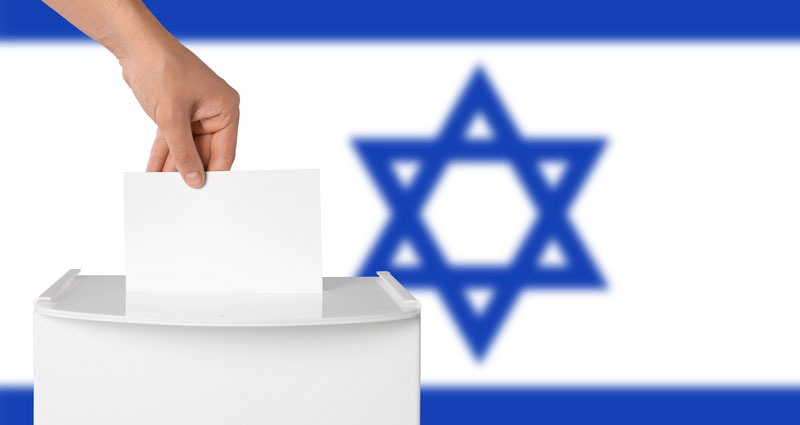
News coverage of the recent presidential debate tended to focus on the size of the candidates’ rallies and the potential survival threats to Ohio household pets, but there were also fleeting moments of foreign policy discussion. Kamala Harris and Donald Trump exchanged barbs over the Russia-Ukraine war and very briefly traded blows over the Middle East. Although the candidates didn’t spend much time on Israel, their short back-and-forth may have revealed how the two campaigns are thinking about their fight for the support of Jewish Americans.

Trump repeated his previous charge that Israel will not exist two years from now if Harris is elected. Harris reiterated her support for Israel’s right to defend itself, as she had in her convention speech last month, but interestingly did not repeat her language from that speech about the suffering of the Palestinian people. We can assume that the vice president is not any less committed to humanitarian relief in Gaza than she had been this summer, but the omission was notable nonetheless. 

While it’s possible that her debate message was aimed at winning Jewish voters in key swing states, as discussed in last week’s column, it’s much more likely that this emphasis was part of a broader effort to win over undecided voters who are not yet sold on her candidacy. Since she entered the race in late July, Harris has done a masterful job of consolidating the Democratic base — motivating young people, non-white voters and single women — in a way that Biden had not. This success has pulled her even with Trump in most national and battleground state polls, but now she must reach out to the political center.

So Harris talked in the debate about the Biden Administration’s expansion of domestic oil production, making it clear that she no longer opposes fracking. Her campaign is running ads highlighting her record as a border-state prosecutor and her efforts to crack down on fentanyl and human trafficking. And she went out of her way to tell the audience that she owned a gun.

It is entirely possible that Harris’ omission of the Palestinian people was simply an oversight, or possibly an on-the-spot decision to fit her answer into the prescribed time limit. But it’s equally likely that her decision to emphasize Israel’s self-defense and not mention humanitarian aid was intended for voters who are wary about the marked pro-Palestinian turn of the Democratic left.

It’s equally likely that her decision to emphasize Israel’s self-defense and not mention humanitarian aid was intended for voters who are wary about the marked pro-Palestinian turn of the Democratic left. 

Harris’ brain trust may also be looking at new polling from the respected Pew Research Center that showed their candidate winning the Jewish vote by a margin of 65-35 percent, which would reflect the largest percentage a Republican candidate has won since George H.W. Bush in 1988 and would give Trump a potentially significant benefit in states like Pennsylvania, Arizona and Nevada, whose Jewish populations could be determinative in November. 

Just as Harris’ level of support among other traditionally Democratic constituencies such as Black and Latino voters are still below traditional partisan norms, she is much more likely to win these highly contested states if she can increase her numbers among Jewish voters between now and Election Day. She is in no realistic danger of losing the Jewish vote, but if the current results in the Pew survey do not change by November, her path to victory becomes much more difficult. 

Harris’ left-leaning record and agenda on domestic policy is a natural fit with the majority of American Jews, who have always trended heavily Democratic. But while issues relating to Israel and the Middle East have historically been less important to Jewish voters, there’s no question that the Gaza conflict has significantly increased their saliency this year. 

Most of the voters she’s trying to reach also support increasing humanitarian assistance to Gaza, so Harris does not lose votes by talking about that objective along with her otherwise decidedly pro-Israel message. But every vote matters in a close election, so Harris may be looking for ways to reassure that slice of the electorate by talking about the war much more selectively than she has in the past.


Dan Schnur is the U.S. Politics Editor for the Jewish Journal. He teaches courses in politics, communications, and leadership at UC Berkeley, USC and Pepperdine. He hosts the monthly webinar “The Dan Schnur Political Report” for the Los Angeles World Affairs Council & Town Hall. Follow Dan’s work at www.danschnurpolitics.com.

Fighting for the Jewish Vote Read More »

Why Aren’t We Exposing More Palestinian Hate Against America?

I don’t know why National Students for Justice in Palestine (NSJP) chose Sept. 12 as its “Day of Action” and indirectly encouraged thousands of students in the United States to continue to destroy campus property and express solidarity with terrorist groups. Perhaps the organization thought it would be vulgar and insensitive to promote more hate and violence on the 23rd anniversary of the worst terror attacks against a country it calls “the American empire” (never mind that these SJP members live in the U.S. and enjoy the kind of freedom and human rights they would never know in most Middle Eastern countries). “Let’s not call America a disgusting, imperialist, genocide-enabler for one day,” they must have figured, while refusing to condemn the fanaticized Islamists who have unleashed untold cruelty against innocents worldwide. 

NSJP had been promoting its “Day of Action” for weeks and recently tweeted a flier featuring a young man whose face, except for his eyes, was entirely covered in a red Palestinian keffiyeh. A slogan, “We will not stop. We will not rest,” appeared under the man’s image as part of NSJP’s extremely well-coordinated and, let’s face it, well-funded campaign to continue what it calls a full-scale “student intifada.”

I was thinking about Palestinians a lot lately as I contemplated the anniversary of 9/11 last week. As a college freshman in September 2001, I was old enough that I can remember the horrifying videos of Palestinians celebrating the news that thousands of Americans had been slaughtered. Hijab-clad women ululated; families passed out sweets and candy. The most disturbing videos weren’t from the West Bank, but of many Palestinians cheering and hugging one another at the Damascus Gate in East Jerusalem. I’ll also never forget how Palestinian (and Arab) media refused to identify the 9/11 perpetrators as either Arab or Muslim until days after the attack, and how official Palestinian Authority media outlets published one cartoon after another cruelly mocking America and portraying all Arabs as victims. 

I have also been thinking a lot lately about the primary messages that American Jews and Jewish organizations have been conveying the past 11 months. These messages have mainly focused on how Hamas has brutalized Jews and Israelis. This was understandable, the right course of action.

But soft-hearted as we are, we have also spent all year assuming that most Americans would be horrified, or at least rattled, by the barbarism of Hamas, and hopefully moved to act in solidarity with Jewish Americans. 

I now realize the limits of our approach: Whether through viral videos, survivor testimonials or even touring exhibitions dedicated to Oct. 7, we thought it would somehow be enough to remind Americans how much most Palestinians hate Jews and Israel. Instead, we should have taken every chance to remind Americans how virulently many Palestinians hate America. 

Perhaps that sounds harsh. But as we continue to let Palestinian antisemitism speak for itself, why haven’t we made more space for Palestinian anti-Americanism to speak for itself?

In some cases, we didn’t need to do much work; images this year of people climbing flagpoles to replace an American flag with a Palestinian one easily speak for themselves. But how many Americans have even seen such videos of American flags being replaced on campuses and in cities all over this country?

To be fair, we have repeatedly warned Americans all year that Israel is the first target of brainwashed, violent fanatics, but not the last. Our warnings that “America is next” have gained more traction than ever. Again, rallies in the U.S. at which cries of “Death to America” are heard, as we saw this year in Michigan, make it a little easier to see the bigger, looming picture, but I doubt most Americans have seen such videos. 

I have watched several excellent videos this year by pro-Israel social media activists that show interviews with Palestinians in the West Bank who are asked to share their views on everything from whether they support Hamas to whether they believe Hamas raped Israeli women on Oct. 7. Not surprisingly, the responses are revolting. But these questions often only highlight the hatred of many Palestinians against Jews and Israelis. 

Where are the videos that ask average Palestinians what they think about gay marriage, rights for trans people, mixed-sex beaches where women may sunbathe in bikinis, or even the simple question of what most Palestinians think about America? I surmise that America has never been more unpopular with Palestinians than it is today, due to its support for Israel in this year-long war. But 22 years before this war erupted, why were Palestinians jubilantly celebrating 9/11?

And I’m still searching in vain for videos in which Palestinian residents of East Jerusalem (or that bastion of secular reformism known as Ramallah) are asked what they think of the 9/11 attacks today. Did Americans deserve 9/11? Do they wish there would be another 9/11, or that Oct. 7 would be replicated in the U.S.? And, out of curiosity, where’s the leftover stash of celebratory candy from Oct. 7?

Twenty-three years later, chances are that most young Americans have never seen those unbelievable images of Palestinians rejoicing over 9/11. And over two decades later, chances are that some young Americans, for whom America is the bastion of all capitalist and imperialist sin, won’t bat an eye if they’re exposed to those videos. They will simply rationalize celebrating terror as a justified response to their favorite buzzwords, “occupation,” “imperialism” and “genocide.”

But a minority of irreparably-brainwashed college students are not the target audience I had in mind to learn more about Palestinian anti-Americanism (please visit Palestinian Media Watch for shocking documentation of the messages emanating from Palestinian newsrooms and classrooms). These deeply short-sighted individuals already hate America, even as they enjoy the freedoms of this country to their full extent. Though, while we’re at it, we should film videos in which we ask some of these students in the U.S. if there should be another 9/11. I think we can all imagine the shocking responses. 

This year, let’s work doubly hard to expose those who truly revile America, but are indescribably blessed to live in this extraordinary country, where they use their freedom of speech to kill our freedom of speech.

This year, let’s work doubly hard to expose those who truly revile America, but are indescribably blessed to live in this extraordinary country, where they use their freedom of speech to kill our freedom of speech.

The most important audience I had in mind is comprised of average, hard-working Americans who still like this country, and whose desire to live in peace and safety would enable them to better understand that Israel, and the Jewish people themselves, represent Western values, the kind of values that make it safe to enjoy life in this country.

According to MEMRI.org, a Washington, D.C.-based nonprofit that works around-the-clock to translate Arabic, Persian, Dari, Turkish, Urdu-Pashto, Russian and Chinese media, Al-Qaeda has threatened a “third 9/11” (counting Oct. 7) and is actively encouraging pro-Palestinian protesters in America to carry out violent attacks. An Oct. 13 Al-Qaeda statement celebrated Hamas’ massacre as a “blessed battle” that had changed jihad and “the rules of combat,” adding that Israel’s “encroachment” on Al-Aqsa will ensure that “the coming flood of Islamic heroes will make the Zionists and the Crusaders forget the horrors” of 9/11.

No, we will never forget. 

In the statement, Al-Qaeda exhorted Muslims worldwide to attack America and other countries: “Now that the mujahideen of Palestine have mobilized the entire nation to participate in their blessed jihad, there is no excuse for anyone to claim that the battle is only within Palestine itself …” 

There is a reason why the only memorial outside of the U.S. that lists all the names of the 2,996 victims of 9/11 exists in Israel — at the 9/11 Living Memorial Plaza in Jerusalem, to be exact. During last week’s annual 9/11 remembrance event in Jerusalem, IDF soldiers with developmental disabilities, who comprise The Special in Uniform Band, sang “Wind Beneath My Wings.” Please look up the video and remember that in other parts of the Middle East, there are vastly different tunes being dedicated to America.

There is also a reason why there is a plaque at Yad Vashem, Israel’s national Holocaust museum, that reads, “Unto every person there is a name.”

Pro-Palestinian protesters in the U.S. who assault Jews and march with Hamas and Hezbollah flags don’t want you to know their names, nor recognize their faces. Perhaps we can’t change that. But 30 seconds of film exposing how many of those yelling “Long Live Palestine” also scream “Death to America,” whether in Jenin or Berkeley, would be a good reminder to the average American that many of those who relentlessly hate Jews and Israel reserve their biggest hatred for this wondrous country. And the sooner the average American realizes there isn’t a single American flag at pro-Palestinian rallies, the better.


Tabby Refael is an award-winning writer, speaker and weekly columnist for The Jewish Journal of Greater Los Angeles. Follow her on X and Instagram @TabbyRefael.

Why Aren’t We Exposing More Palestinian Hate Against America? Read More »