fbpx

September 18, 2024

Jewish Winners, Nominees and Tributes at the 76th Primetime Emmys

The 76th Primetime Emmy Awards at the Peacock Theatre in Downtown Los Angeles on Sept. 16 featured several Jewish moments and winners.

For the first time, the Emmys were hosted by a father-son duo: Jewish actors Eugene Levy and Dan Levy. During their opening remarks, one of the first big laughs from the audience was about the frequent mispronunciation of their last name. “If it goes well tonight, my name is pronounced ‘Levy,’ not ‘Leevy,’” Dan Levy said. “And if things go south, my name’s pronounced ‘Martin Short,’” Eugene quipped. Later, the elder Levy said to his son, “Without question, my most rewarding dad role ever has been being your dad — in ‘Schitt’s Creek’ … because it got me my first acting Emmy.”

Hosts Eugene Levy and Dan Levy speak onstage during the 76th Primetime Emmy Awards at Peacock Theater on September 15, 2024 in Los Angeles, California. (Photo by Kevin Winter/Getty Images)

Jon Stewart won his 23rd Emmy as host of “The Daily Show” (Comedy Central) which won for Outstanding Talk Series. Following the departure of host Trevor Noah in 2022, Stewart returned as a once-a-week host of the show on February 12 after stepping away from hosting eight-and-a-half years ago.

Comedian Alex Edelman won the Emmy for Outstanding Writing for a Comedy Special for his one-person stage show, “Alex Edelman: Just For Us” (Max). After a massively successful national tour of the show about his experience attending a white nationalist meeting in New York, a special was broadcast on Max in April.

Ebon Moss-Bachrach (Photo by Frazer Harrison/Getty Images)

Ebon Moss-Bachrach won Outstanding Supporting Actor in a Comedy Series for the second year in a row for his role as Richie Jerimovich in “The Bear” (Hulu).

Hannah Einbinder was nominated for Outstanding Supporting Actress in a Comedy Series for her role as Ava Daniels in “Hacks” (Max). The show won three Emmys on Sunday, including Outstanding Comedy Series. Paul Rudd was nominated for Outstanding Supporting Actor in a Comedy Series for his role as Ben Glenroy in “Only Murders in the Building” (Hulu). Larry David was nominated for Outstanding Lead Actor in a Comedy Series for the final season of “Curb Your Enthusiasm” (Max). Over the course of 12 seasons, “Curb” was nominated for 55 Primetime Emmys. It only won two: in 2003 for Outstanding Directing for a Comedy Series (Robert B. Weide for the episode, “Krazee-Eyez Killa”), and in 2012 for Outstanding Single-Camera Picture Editing for a Comedy Series (Steve Rasch, for the episode, “Palestinian Chicken”).

Henry Winkler, who won his only Emmy for his supporting role in “Barry” in 2018, participated in a tribute to the 50th Anniversary of “Happy Days” alongside Ron Howard. Six-time Emmy winner Billy Crystal presented the award for Outstanding Talk Series. Actor Zach Braff (“Scrubs”) co-presented a “Tribute to Doctors” segment along with Mindy Kaling (“The Mindy Project”) and Mekhi Phifer (“ER”), before co-presenting the award for Outstanding Writing for a Drama Series. Actor Richard Schiff appeared on stage with several former cast members of “The West Wing,” celebrating the show’s premiere 25 years ago. They also presented the award for Outstanding Drama Series.

The “In Memoriam” segment featured tributes to sex therapist Dr. Ruth Westheimer and comedian/actor Richard Lewis.

During the pre-show red carpet arrivals, there were about thirty pro-Palestinian protesters who attempted to block traffic at the corner of South Figueroa and West 18th Street. Although this was about half a mile southwest of the Peacock Theatre, Deadline reported that these protests caused some arrival delays.

There also were several people on the red carpet spotted wearing pins distributed by Artists4Ceasefire. The organization says their mission is to “represent support for a permanent ceasefire, the release of all hostages, and the urgent delivery of humanitarian aid to Gaza amidst the ongoing Israel-Hamas conflict.” The pins feature an orange hand with a black heart in the palm, on a circular red background. The imagery on the pin, however, has been alleged to be a reference to an infamous photo from 2000 of a Palestinian raising his blood-soaked hands after lynching and murdering two IDF soldiers in Ramallah. Among those spotted wearing the pins at the Emmys were actress Nicola Coughlan (“Bridgerton”), writer Brittani Nichols (“Abbott Elementary”), and “Reservation Dogs” actor Dallas Goldtooth and actress Devery Jacobs.

Ido Samuel (Photo by Frazer Harrison/Getty Images)

Israeli actor Ido Samuel was spotted at the Emmys wearing a yellow ribbon on his black tuxedo to bring attention to the Israeli hostages being held in captivity in Gaza by Hamas since Oct. 7, 2023.

“I am honored to wear the yellow ribbon and bring attention to the 101 hostages still in captivity. “It’s a way to show their families they are not forgotten — that we stand with them, think of them constantly, and pray for their safe return every single day.” – Ido Samuel

“I am honored to wear the yellow ribbon and bring attention to the 101 hostages still in captivity,” Samuel told The Journal. “It’s a way to show their families they are not forgotten — that we stand with them, think of them constantly, and pray for their safe return every single day.” This past spring, Samuel starred as Isaac in the “We Were The Lucky Ones” — a historical drama on Hulu about a Polish family’s fight to survive the Holocaust.

Maya Rudolph (Photo by Amy Sussman/Getty Images)

In addition to the Primetime Emmys, on September 7 and 8, there were several notable Jewish winners at the Creative Arts Emmys. Maya Rudolph won Outstanding Character Voice-Over Performance for her roles on “Big Mouth” (Netflix). Jon Bernthal won Outstanding Guest Actor in a Comedy Series for his role as Michael Berzatto on “The Bear.” Jamie Lee Curtis won Outstanding Guest Actress in a Comedy Series for her role as Donna Berzatto on “The Bear.” Eric André won Outstanding Performer in a Short Form Comedy or Drama Series for “The Eric André Show. ”Composer and lyricist Benj Pasek (along with Justin Paul) won Outstanding Original Music and Lyrics for “Only Murders in the Building.” With that Emmy, they both became the 20th and 21st EGOTs—winners of an Emmy, Grammy, Oscar and Tony Awards.

Jewish Winners, Nominees and Tributes at the 76th Primetime Emmys Read More »

“Kissufim,” Israeli Film About Young IDF Soldiers, Makes Netflix Debut

In August, Netflix began streaming the award-winning Israeli film, “Kissufim” — and it could be a sign of things getting better for Jewish and Israeli film and television content in the U.S.

The film, in Hebrew with some dialogue in English, was directed by Keren Nechmad (“Ani” and stars actress Swell Ariel Or (“The Beauty Queen of Jerusalem”) and takes place at Kibbutz Kissufim near the Gaza border in 1977. Four years removed from the Yom Kippur War, the story follows young IDF soldiers nearing the end of their military service. It’s a peek into the ordinary lives of male and female soldiers as they contemplate friendship, romance, security threats, kibbutz life and political tensions between their homeland and its neighbors. When it was made in 2021, the film was a coming-of-age story with the main character, Eli (played by Or) based on a 21-year-old IDF soldier Elian Gazit. The contrasting mood of the era can be felt when the soldiers erupt in cheers when they watch Egyptian President Anwar Sadat visits Jerusalem on television, followed by a scene of Eli laying barbed wire along the perimeter of a mine field.

But less than a month before “Kissufim” premiered at the Cyprus International Film Festival on Nov. 4, 2023, the film took on new importance. On Oct. 7, 2023, when Hamas terrorists murdered nearly 1,200 people across southern Israel and abducted 251. Twenty-two people at Kibbutz Kissufim were murdered that day, and four were abducted by Hamas and held captive in Gaza.

“It tells a story about a group of friends who in any other situation, in any other place, would just be a coming of age story,” Nechmad told The Journal. “In the face of reality in Israel, it just shows the loop that we live in. The loop just hit us in a moment in time that I never knew how close it would get to the film and how much it relates to what we’re going through today … it just touches in a very close hurting place.”

“It tells a story about a group of friends who in any other situation, in any other place, would just be a coming of age story. In the face of reality in Israel, it just shows the loop that we live in.” – Keren Nechmad

Just one year ago, Or really wanted people to see this film and relate to one of the characters, to see that character as a reflection of themselves. Now, she wants people to see the film and learn about Israelis.

“I really want people to see what it’s like to navigate adulthood, not just adulthood, but becoming an adult within this setup and background of the country,” Or said.

In many ways, “Kissufim” feels like the 1995 film, “Now and Then,” another coming-of-age film set in the 1970s, about the lives of four teenage girls and their summer hijinks. “Kissufim,” though, adds military service and boys to the mix. Nechmad and Or both said that the camaraderie among the cast members is what really brought the story to life. During the summer of 2021, they went out together every day between shoots. Or described filming on location at the kibbutz was a meditative experience for the entire cast and crew.

“There’s something that happens there after 48 hours; you feel like you’re in one of the highest forms of meditation,” Or said.

Nechmad described the location as both beautiful and constantly under threat. Even with the border wall with Gaza less than half a mile away, their biggest worries on set were about preventing an outbreak of COVID-19 within the cast and crew. She said it was an “unexpectedly peaceful summer” following the May 2021 outbreak of violence between Israel and Hamas.

“God protected us and it gave us a full summer of just quiet and freedom to really work on this film,” she said.

One of the film’s most  arresting scenes is when Eli does a dance for her fellow soldiers in a minefield. In the midst of her dance, a landmine detonates, but Eli is unharmed. Seeing her joy juxtaposed with sudden terror and the looks on her comrades’ faces is what makes the scene so poignant.

“If someone would want to see the whole film in one scene, I would give them that sequence — the kind of childish, dreamy way of having fun and just not caring versus reality and instant changes and life threats,” Or said.

“We really wanted to make sure we get the emotions from the high to the low lows you can feel from one moment to another,” Nechmad said.

On Oct. 7, one of the security officers from the kibbutz was murdered. He had briefed the cast and crew on what to do in case of a terrorist attack during filming. Nechmad and Or revisited the kibbutz after the attack.

“There are just a couple of people trying to build back the kibbutz,” Nechmad said. “The kibbutz itself, it’s residential. They moved somewhere else for now, and they don’t see themselves coming back anytime soon.” Nechmad shared a heartbreaking story about one of the kibbutz members returned to check on the livestock after the attacks.

“Most of [the livestock] got abandoned, and then one of the farmers came back after three days to feed the cows,” Or said. “They’re were hungry, and he got killed by a terrorist who was still hiding there.”

“Kissufim” has received strong emotional reactions from audiences around the festival circuit. At the Orlando Film Festival, Or recalled a non-Jewish viewer who approached her, uncontrollably crying following a screening. The film made the man think about his daughter who was volunteering with vulnerable populations in India.

“Kissufim” is the rare Israeli film that have shown up on the major streaming services. It shows a part of Israel that existed before the attacks of Oct. 7, compounded with the complexity of love, friendship and young adult angst. It’s a much-needed depiction of life in Israel near the Gaza border and the daily deluge of threats and ordinary life.

“If it’s a way for you to connect to it and a way for you to just find a different way to search deeper into what it means to live in the Middle East, then go watch it,” Nechmad said.

“Kissufim,” Israeli Film About Young IDF Soldiers, Makes Netflix Debut Read More »

When the Primal Meets the Cerebral

As I was hearing French philosopher and author Bernard-Henri Lévy discuss his new book, “Israel Alone,” the other night, it struck me that it must be daunting for a man of intellect to confront the very antithesis of intellect: the gruesome savagery of Oct. 7.

How does one bring intellect to the mutilation, rape and gleeful murder of 1200 human bodies?

What can a philosopher say about murderers whose philosophy revolves around the very idea of murder?

It feels like a disconnect: the most primal and brutal dimension of humanity clashing with our most refined and sophisticated dimension.

And yet, God knows Jews have plenty of experience with that disconnect.

The clash of the primal and the cerebral has plagued us throughout our history. Violence against Jews is never just violence against Jews. It’s also violence that interrupts a prayer service, a Talmud class, a family meal, a communal gathering, an artist at work or simply the peaceful rhythms of a kibbutz.

For much of our journey, the assault on Jewish bodies has forced Jewish scholars and spiritual leaders to interrupt their contemplation of big ideas to deal with the reality of brutality. Oct. 7 was a staggering reminder of that brutality.

In her new book, “Ghosts of a Holy War: The 1929 Massacre in Palestine that Ignited the Arab-Israeli Conflict,” Yardena Schwartz does a deep dive on another story of Jewish carnage. She quotes a British High Commissioner Chancellor, who wrote in his diary on Oct. 8, 1929:

“Fifteen days after the massacre, the floors, the walls, the bedding were still stained with blood…I do not think history records many worse horrors in the last few hundred years.”

Indeed, the idea of “recording” is the philosopher’s weapon in “Israel Alone.” Lévy confronts that day’s atrocities through clear, on-the-ground reporting, something he’s done in many of his books, however unusual that may be for a public intellectual.
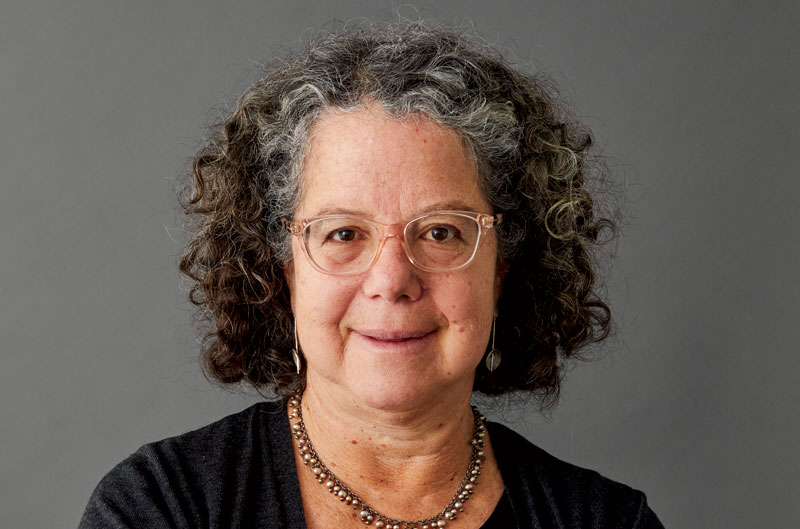
“I will never forget my first impressions,” he wrote about the carnage the day after Oct. 7. “The smell of sour milk that filled the bullet-pocked, blasted, half-burned houses; the contents of their kitchen cabinets scattered in the rooms, as if blown away by a hurricane. The neatly laid out streets lined with pretty houses with their shrubs intact but empty of birdsong and human voices; or the consistent accounts of survivors and rescuers who recounted how the dead were collected, some of them decapitated and dismembered, others burned, others riddled with bullets and their hands torn to shreds as if they had fought until they dropped.”

Perhaps it’s the deepest expression of philosophy to understand that the straight reporting of evil, as Holocaust writer Primo Levi showed us, is the most forceful way to convey truth. And if the search for truth is not a mission of philosophy, then what is?

Lévy’s deep knowledge of philosophy, history and geopolitics are brought to bear throughout the book, as he helps us make sense of the madness of our post-Oct. 7 world and Israel’s unique predicament– not least the enduring madness of antisemitism.

But there is also an aesthetic quality to his prose that moves the reader. When Lévy writes, for example, about “neatly laid out streets lined with pretty houses with their shrubs intact but empty of birdsong and human voices,” one detects a subtle, defiant tone, a voice that insists on injecting humanity and elegance even when describing the indescribable.

In many ways, we’re all facing similar questions in the wake of Oct. 7.

Can we wallow in ugliness without becoming ugly ourselves? Can we peer at darkness without losing the light of hope? Can we internalize interminable sadness without losing our capacity for joy? Can we delve into the repulsive without losing our thoughtfulness? Can we grieve the pain of our brethren without forgetting the pain of the other?

Can we confront hate without eroding our love?

When poets and artists and writers and musicians bring their talents to an “Event” as bewildering as Oct. 7, can they do justice to monstrosity without losing beauty?

The unspeakable horror of that fateful day has tested our humanity like nothing else. Whether we’re philosophers or not, that may well be the challenge of our time: dealing with inhuman acts while staying human.

When the Primal Meets the Cerebral Read More »

Jeffrey Eisner: Pastabilities, Pressure Luck Cooking and Kasha Varnishkes

Jeffrey Eisner ‘s love of cooking took his career in a direction he never could have imagined.

The founder of Pressure Luck Cooking, Eisner is the bestselling author of the “Step-by-Step Instant Pot” series of cookbooks. “Pastabilities, released on September 17, is his fifth and first non-Instant Pot-centric cookbook. Filled with his signature user-friendly style of instruction–and chapters that include farm and garden, soups, salads, stir frys, one-pot dishes and more– “Pastabilities” is a comfort-food palooza.

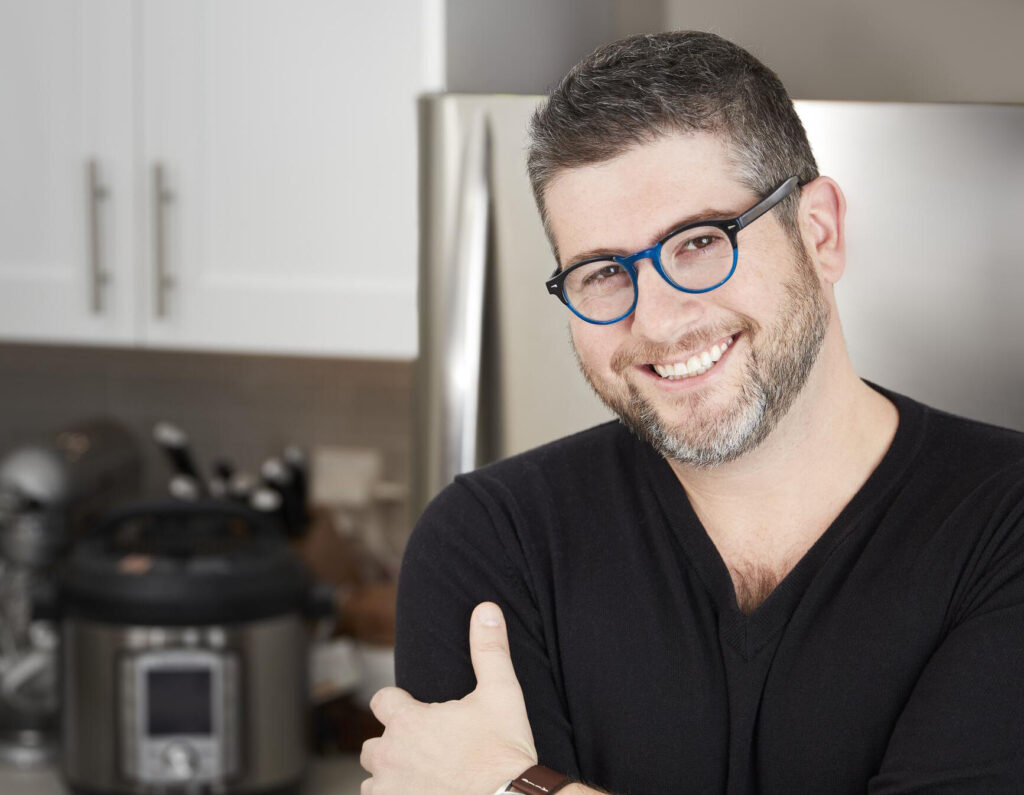
“I always loved to cook,” Eisner, whose previous career as a video producer kept him behind the camera, told the Journal. “At the end of the day, when I was super stressed out from work and living in {New York] City, I would take trips to the supermarket late at night … walk up and down the aisles listening to really bad covers of muzak on the system and seeing what … comfort I could bring myself that evening.”

When the Instant Pot started becoming popular in the mid-2010s, Eisner took it as an opportunity to try something new.

“You think of a pressure cooker [as] something from the old school days that looks like a torture device that goes on the stove and it has these clamps,” he said. “[When] this thing comes out and it’s completely electronic, nothing to do with the stove … I figured a lot of people had it, but were afraid to use it.”

Eisner filmed himself making mac and cheese in the Instant Pot and put it on YouTube just for fun. He had no expectations; he just wanted to see if people would find it when they did a search.

“Everyone started seeing my video and then I very quickly got a following,” he said. “The next thing I knew it was just building, like a pressure cooker, and I started getting television appearances, then I got a cookbook deal and it became my career.”

Eisner, who has been doing this now for eight years, said his love of cooking came from his Grandma Lil. She was a free-spirited cook, known for making her stuffed cabbage during Jewish holidays.

“It was always fascinating to watch her cook,” he said. “She would take a little bit of this, a little bit of that; there was never a measurement, it was just how she did it.”

Eisner takes the opposite approach.

“I feel [using measurements] is the easiest way to have something totally foolproof,” he said.

“Pastabilities” is loaded with visuals; every step in each recipe has accompanying photos, as well as a final shot of what the recipe looks like. He also notes which ones are vegan, vegetarian and dairy-free, as well as modifications, such as how to make a recipe gluten-free. Note: this is not a kosher cookbook, but many of Eisner’s recipes can be adapted.

“A big bowl of pasta on the couch [is] one of my favorite things,” he said. “[The book] really is a warm hug with every single recipe.”

“Pastabilities” spans all different types of cuisine. It ranges from classics, like marinara, pesto and Alfredo to unique dishes like lemon poppy mascarpone.

Eisner’s pride in being Jewish also shows in the book.

“My Judaism is about the food and the traditions,” he said. “I touch on some Jewish dishes that incorporate pasta.”

This includes noodle kugel (“The kugel actually is very deserty in this book; it’s practically like a Jewish cheesecake,” he said.) and also kasha varnishkes (that recipe is below).

“[It’s] essentially bow ties with buckwheat groats and caramelized onion that you typically saute and schmaltz, which is rendered chicken fat, [or] you could use vegetable oil,” Eisner said. “Kasha varnishkes brings [memories] of growing up, and I feel like a lot of other Jewish people can relate to that if they’ve had this dish before.”

Eisner believes cooking should make you feel accomplished. And anybody can do it!

“All it takes is to follow a recipe and prep your ingredients ahead of time,” he said. If you read [the recipe] properly and do everything [it says], you’re going to have an unbelievable meal in your hands.”

Learn more at PressureLuckCooking.com and follow @PressureLuck on YouTube, and @PresuureLuckCooking on Facebook and Instagram.

For the full conversation, listen to the podcast:

Watch the interview:

Photo by Aleksey Zozulya

Kasha Varnishkes

Dairy Free: (if using schmaltz, vegetable oil, or margarine)

Vegetarian: (if using vegetable or garlic broth and not using schmaltz)

THE PASTA

1 tablespoon salt

1 pound farfalle (bow ties) or mini farfalle

THE VEGGIES

6 tablespoons schmaltz (rendered chicken or duck fat, see Jeff’s Tip), vegetable oil, margarine or salted butter, plus more to taste

4 yellow onions, roughly chopped

8 ounces baby bella or white mushrooms, sliced (optional)

THE KASHA

1 cup medium-size granulated kasha (buckwheat groats; I use Wolff’s brand)

1 large egg, lightly beaten

6 cloves garlic, minced or pressed

2½ cups chicken, vegetable, or garlic broth (e.g., made from Better Than Bouillon Roasted Garlic Base)

2 teaspoons seasoned salt, plus more to taste

½ teaspoon white pepper, plus more to taste

Prep Time: 10 min

Pasta Cook Time (farfalle/bow ties or mini farfalle): 7-11 min

Caramelizing Time: 20-30 min

Kasha Cook Time: 15 min

Total Time: 45 min-1 hour

Serves: 4-6

  1. Boil the Water: Fill an 8-quart pot halfway with tap water and bring to a rolling boil over high heat.
  1. Caramelize the Onions: Heat the schmaltz (or other fat) in a nonstick 4.5 to 5-quart sauté pan over medium-high heat. Once melted or shimmering, add the onions and sauté for 20-30 minutes, stirring occasionally, until they caramelize (which means they become syrupy and golden in color).
  1. If using, add the mushrooms and sauté for another 5 minutes, until they are browned and their juices have released.
  1. Transfer the cooked veggies to a bowl to rest and place the pan back on the stove.
  1. Start the Kasha: In a mixing bowl, mix the kasha, egg, and garlic until combined.
  1. Transfer the coated kasha to the now-empty sauté pan and cook, stirring, over medium-high heat until it begins to break up, toast, and separate, 3-5 minutes.
  1. Add the broth, seasoned salt, and white pepper to the kasha and bring to a boil. Return the onion mixture to the pan and stir well. 
  1. Cook the Pasta: Add the salt to the pot of boiling water and reduce the heat to medium. Add the pasta and stir. Set a timer to cook until al dente (per the package instructions), or to the shortest amount of time given. When done, drain the pasta in a colander in the sink without rinsing it.
  1. As the pasta cooks, cover the sauté pan, reduce the heat to medium-low, and let simmer for 10-12 minutes. After 10 minutes, remove the cover and see if the broth has been absorbed by the kasha. If not, cover again for a few minutes until it has. If the kasha is done before the pasta, just remove from the heat and keep the pan covered.
  1. Marry It All: Add the cooked and drained pasta to the sauté pan of cooked kasha, onions, and (maybe) mushrooms and toss until combined. Feel free to add more schmaltz (or vegetable oil or butter), seasoned salt, or white pepper to taste before serving.

Excerpted from PASTABILITIES by Jeffrey Eisner. Copyright © 2024 by Jeffrey Eisner. Photographs by Aleksey Zozulya. Used with permission of Voracious, an imprint of Little, Brown and Company. New York, NY. All rights reserved.


Debra Eckerling is a writer for the Jewish Journal and the host of “Taste Buds with Deb.Subscribe on YouTube or your favorite podcast platform. Email Debra: tastebuds@jewishjournal.com.

Jeffrey Eisner: Pastabilities, Pressure Luck Cooking and Kasha Varnishkes Read More »

Rosh Hashanah and the Love of Life

Rosh Hashanah takes on added power this year. The terrorism of last October, the ongoing captivity of Israeli hostages, the eruption of antisemitism that preceded any Israeli response, the devastation of Palestinian lives, and the normalization of demonizing Israel and Jews makes it all the more imperative that we come together. All the more crucial that we stand with each other to mourn, to rage, to introspect, and to reaffirm our core values for the year ahead. We’ve never needed Rosh Hashanah more than we do now.

On July 16, 2006, a bearded Hezbollah guard was quoted in The Los Angeles Times.  “People are begging Hassan Nazrallah to fight.  They want to be human bombs.” Then he added the following comment: “This is the difference between us and them – the Jews. They fear death and love life; we are believers in another life, and we welcome death.” Jews fear death and love life, he says. I am not prepared to concede that this guard speaks for other Muslims – I suspect they love life very much. But I will admit that when it comes to the Jews and their love of life, I think he is right.

Is it terrible to love life?  Hezbollah thinks it is.  They think this will make Jews look bad.  Those Jews – they are afraid of dying because they love life so much.  Is that a sin?  Does it reflect a lack of faith to love life?  

Rosh Hashanah celebrates the birthday of the world. It is the quintessential affirmation of life itself. 

“Who is it who desires life and loves many days to see good, keep your tongue from evil and your lips from speaking guile. Depart from evil and do good. Seek peace and pursue it (Psalm 34).”  Jewish tradition understands that loving life is not a self-indulgence. To love life is a mandate to do good and to flee from evil. To love life is to pursue peace and to spread it among our brothers and sisters.  To love life is to see life arrayed before us as a feast, a bounteous party to which we are invited guests. The Talmud commends to us: “Grab and eat. Grab and drink. Because this world from which we will one day depart, is like a wedding celebration, a wedding feast (Eruvin).”  We were all of us born into a world that was created for us.  

In the creation story at the beginning of the Book of Genesis, we are told that humanity was made, not at the beginning of creation, but at its end, to which the rabbis comment: Just as when one celebrates a party, one sets up the party first, and then tells the guests to come  so it is that God arrayed this glorious pageant of beauty — water and land; sky and sea; animals and plants; bedecked the world and festooned like it a glorious banquet —and only then beckoned us to join.  How can one not love life if we understand that the world is a wedding feast? 

Each day that God creates the world, God says, “Ki-tov” – “It’s good!”  And then stepping back at the end of Creation and looking at it all – even that exclamation is not enough.  God says, “Ki-tov me’od:  It’s very good!” 

Rav Saadia Gaon teaches, “The first of God’s acts of kindness to God’s creatures was the gift of life.”  Judaism affirms that life is a gift. To spurn the gift is to spurn the one who gives it.  How dare a religious person not love life?  How dare a person who claims to be God’s servant throw the gift back at God?  As the Holy Day Machzor reminds us, “You who remember life, remember us in the Book of Life.”  Jewish law, Halacha as well, emphasizes again and again that loving life is a supreme religious value. The Talmud tells us that nothing stands in the way of saving a life other than three prohibitions.  Because living itself is a mandate.  Again the Talmud tells us, “When there is two legitimate ways to interpret Jewish Law, one of which makes possible living, then you are obligated to rule leniently.”  The Torah tells us, “You should live by them.”  The Gemara goes on to explain, “You are not commanded to die by mitzvot.”  The laws of the Torah are meant to enhance life, to add to the beauty of the world we are born into. 

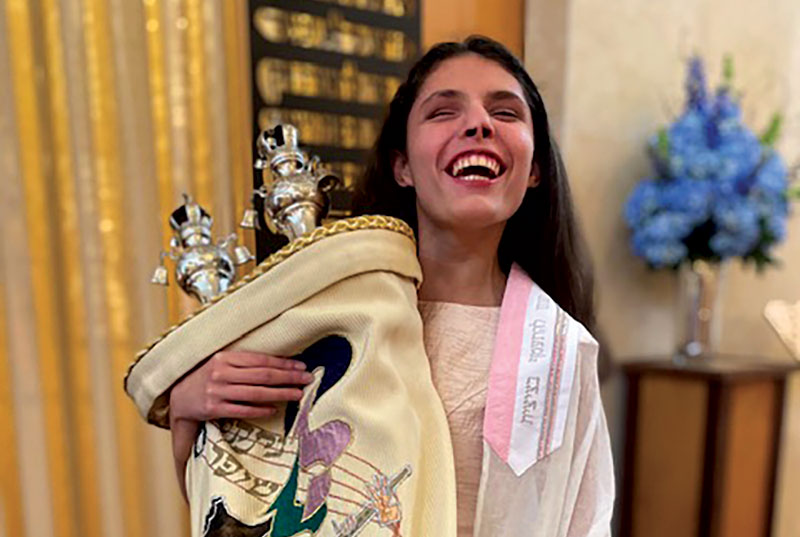
My guide in the love of life is my son.  At the time the Hezbollah article appeared in The Times, Jacob was a 14-year-old boy enrolled in the local public middle school. As he has grappled with the world’s responses to autism his whole life, Jacob has taught me what it means to love life.  Here is what Jacob wrote as a response:  

“For most of my life my existence was controlled by autism. Autism was at the root of every experience I had or didn’t have. I lived with constant anger at my disability and fear that it would isolate me forever. One day last year, my wonderful physician and mentor asked me, what is the opposite of anger?  And I realized that it’s not the absence of anger, but rather acceptance, laughter, and joy.  I also realized that fear and anger just produces more fear and anger, while acceptance brings connection to God and humanity. For many years I have been praying for God to cure my autism, and wondering why God didn’t answer my prayer. I realize now it is because I have been praying for the wrong reason.  I started to pray for the strength to accept autism and to live with joy, laughter and connection. My prayers have been answered more richly than I could have ever imagined. I still passionately hate autism, but now I love life more than I hate autism.”

Is not that the life-task of every human being?  To move from fear and anger to acceptance and joy? Anger is a trap. Anger ensnares us in its reach and then won’t let us ever leave. Small wonder that the Talmud says: “One who tears garments in anger, who breaks utensils in anger, or scatters money in anger, that person should appear to you as though performing idolatry,” for anger is the craft of the yetzer hara, of the evil inclination.  A letter written by the Baal Shem Tov, the founder of Hasidut, says that when tempted by anger, which is an expression of sinful fear and derives from the attribute of judgment, overpower your inclination and transform that trait into a chariot of God.  Make your fear and your anger, which are expressions of weakness, into a chariot for God, a vessel for the sacred.

An ethic which takes creation seriously bids us to tell the Hezbollah guard that his anger and his fear have warped him, have robbed him of his humanity, and are a betrayal of the very religious convictions that his own religion teaches.  I have read the Koran.  I have seen the life-affirming teachings that can be found there for those who look.  But first, we must leave aside fear, step beyond hatred.  And I say this to myself, to all of us, because we too become trapped in our fear and our hatred and our anger, and it is paralyzing. To move beyond anger into joy is the work of a lifetime and it begins each day.

An 18th-century poet, William Ellery Channing, tells us:

To live content with small means,
to seek elegance rather than luxury,
and refinement rather than fashion;
to be worthy, not respectable,
and wealthy, not rich;
to study hard, think quietly, talk gently, act frankly;
to listen to stars and birds, babes and sages with open heart;
to bear all cheerfully, to do all bravely;
await occasions and hurry never.
In a word, to let the spiritual,
unbidden and unconscious grow up through the common,
This is to be my symphony.  

The Torah mandates: “You shall rejoice before God.”  And it is precisely that command to rejoice that sets us free, at this time of year most of all.  In Jewish mystical thought we are told that what we do in this world below has an impact in the world above.  And when we release the bonds of rage, the bonds of depression, the bonds of fear, the trap that it must always be like this, we liberate supernal joy as well.

The Torah mandates: “You shall rejoice before God.”  And it is precisely that command to rejoice that sets us free, at this time of year most of all.  

Rosh Hashanah reminds us to celebrate life, and to fight for it when we need to.


Rabbi Dr. Bradley Shavit Artson, a Contributing Writer for The Jewish Journal, holds the Abner and Roslyn Goldstine Dean’s Chair of the Ziegler School of Rabbinic Studies and is Vice President of American Jewish University in Los Angeles. He is also  rabbinic leader of the Abraham Heschel Seminary in Potsdam, Germany ordaining Conservative/Masorti Rabbis for Europe.  

Rosh Hashanah and the Love of Life Read More »

TikTok Banned My New Book Even Before It Was Published

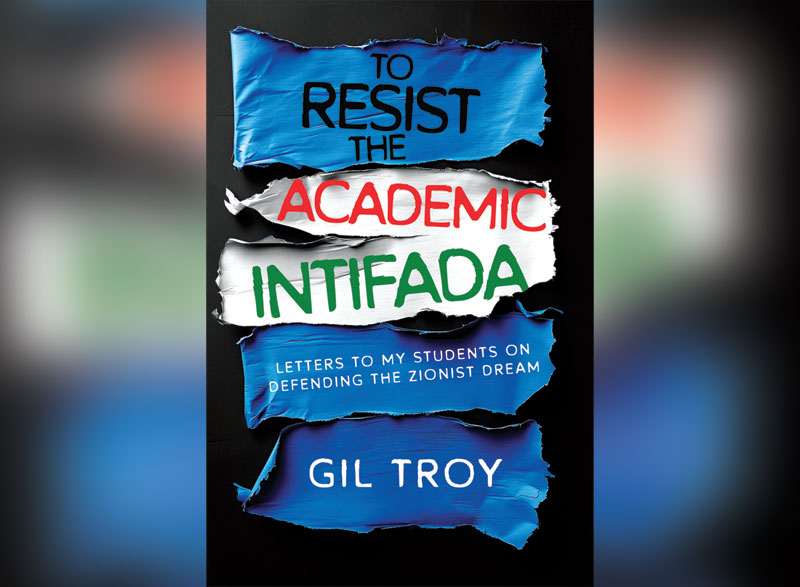
Last month, I interviewed my brother Tevi Troy during the Jerusalem book launch of his latest, “The Power and the Money: The Epic Clashes Between Commanders in Chief and Titans of Industry.” Eventually, he turned the tables, asking me about my book, “To Resist the Academic Intifada: Letters to My Students on Defending the Zionist Dream,” published September 17. I summarized the argument: that the spread of aggressive, doctrinaire anti-Zionism in academia “isn’t just a Jewish crisis” and “isn’t just a Zionist crisis,” but is “a crisis of liberalism” and higher education. Somehow, TikTok decided to remove my two minute, eight second riff, declaring: “This video violates our Community Guidelines” by passing on “misinformation.” Apparently, TikTok and its Chinese owners are more bullish about America’s universities than most of us are.

I tried understanding what triggered the ban. It mocked TikTok executives’ repeated denials that TikTok has an antisemitism problem. The managers were reacting to assessments that in one year, the Jew-hating comments on the popular app rose 912 percent, that Jew-haters use code-words like “juice” for Jews and “H!tl3r” and that the all-powerful algorithm, which pushes videos through TikTok’s FYP For You Page tends to send viewers down conspiracy-oriented “rabbit holes,” spewing Jew-hatred. 

TikTok’s Jew-hating problem predates October 7. Back in 2020, NBC News interviewed half a dozen teenagers who reported that “they experience antisemitism nearly every time they post content to the platform… whether or not the content is about their Judaism.” Julia Massey told reporters that “Before, I guess, I ‘came out’ as Jewish on my TikTok … I was getting almost all positive response.” But since one Jewish-oriented video, “I’ve received antisemitic comments, regardless of the content.”

American Jews face double-trouble these days. Jew-hatred has gone from the margins to the Big Tent. America’s Silenced Majority remains pro-Jewish and overwhelmingly pro-Israel. But dynamics on social media, and a polarized political culture that broadcasts extremists too loudly, has given the haters an outsized profile. And since Oct. 7, the intensity of pro-Palestinian, anti-Zionist Jew-haters has shaped public discourse, eclipsing the quiet but less passionate support Jews and the Jewish State enjoy.

America’s Silenced Majority remains pro-Jewish and overwhelmingly pro-Israel. But dynamics on social media, and a polarized political culture that broadcasts extremists too loudly, has given the haters an outsized profile.

At the same time, Jew-hatred, the longest and most plastic hatred, has also become the invisible hatred, the overlooked hatred, the excused hatred. Especially in universities, the zero-tolerance for other prejudices disappears when it comes to Jews. So Jews find them targeted by more American bullies than ever – as many American institutions downplay this growing scourge.

The TikTok problem reflects this double bind – while transcending the Jewish question too. TikTok’s Chinese ownership worries Americans so much that Congress passed the “Protecting Americans from Foreign Adversary Controlled Applications Act,” which President Joe Biden signed. It demands that TikTok be sold, to avoid this nefarious Chinese influence. While the Chinese enjoy access to 170 million users’ private information, they also orchestrate the conversation. Somehow TikTok suppresses videos sympathetic to Tibetans and Uighurs oppressed by China, while boosting support for the Palestinians, among others.

In the absence of any clarifying information from TikTok, it seems my video fell victim to these broader dynamics. The Jewish People Policy Institute, the Global ThinkTank of the Jewish People, posted the video. And yes, I confess: My analysis, like my book, is pro-Israel and pro-Zionist, as well as pro-liberal and pro-American. Alas, those positions are unpopular among too many influencers.

Clearly, these platforms enjoy outsized power in our democracy. Ironically, the surge in canceled posts reflects an attempt to limit the mainstreaming of hate online.

It’s confusing. Hate breeds hate. In an age when too many people lack moral fiber and common sense, we farm out decency to monitors, because expressions of bile grow exponentially. Each hater posting validates many others. Yet, beware: Censors breed censoriousness. They wield their power arbitrarily, and, in this case and so frequently, heavy-handedly.

TikTok’s “Community Principles” of April, 2024 claim that “To strike the right balance with free expression, we restrict content only when necessary and in a way that seeks to minimize the impact on speech.”  Obviously, once again, when it comes to Jewish content, let alone Zionist content, the impulse to restrict is far greater – as is the chilling “impact on speech,” ultimately depriving us of the robust debate we need.


Professor Gil Troy, a Senior Fellow in Zionist Thought at the JPPI, the Jewish People Policy Institute, the Global ThinkTank of the Jewish People, is an American presidential historian. His next book, “To Resist the Academic Intifada: Letters to My Students on Defending the Zionist Dream” will be published this fall.  

TikTok Banned My New Book Even Before It Was Published Read More »

JBI Expands Programs to Combat Isolation and Enhance Jewish Life for the Visually Impaired

During her recent visit to Los Angeles, Livia Thompson, executive director of Jewish Braille Institute (JBI), met with a middle-aged woman facing a devastating challenge: She was rapidly losing her eyesight due to cancer. 

Livia Thompson

“She is a professional woman who had a full career, but as her vision deteriorated, she expressed how her world was becoming smaller and smaller,” Thompson recounted. “Living alone, she felt incredibly isolated and was in desperate need of companionship, [like] someone to join her for walks and talks.”

JBI, known primarily for providing reading materials in Braille, large print and audio formats to the visually impaired, has been a lifeline for many since its founding in 1931 by Leopold Dubov, the blind son of a rabbi, with the assistance of Rabbi Michael Aaronson, a World War I veteran who lost his sight in combat. While this remains a core mission, JBI has evolved to offer much more than just books; it also provides a sense of community and belonging.

As technology advances, JBI is adapting to better serve its patrons. “We used to send materials by cartridge, which could only be used on a special device,” said Thompson. “Nowadays, more and more people can receive Braille files or audio files electronically and download them to their own devices. It’s much quicker and we’re happy to accommodate this shift. We hope to eventually make our entire collection available electronically.”

JBI’s reach is extensive, with materials sent to all 50 states, Puerto Rico and internationally. Its circulating library currently holds 13,000 books, with materials ranging from liturgical texts to novels and children’s literature. “We’re excited to announce that we’ve been accepted into an international library network through the United Nations,” Thompson said. “This international server will give people from 70 different countries access to our books and we’ll have access to theirs, significantly increasing the number of people we can serve.”

Despite being a nonprofit largely funded by individual donations and foundations — 99.7% of which come from Americans — JBI continues to strive to expand its capacity and the number of individuals it supports. The organization also benefits from free mailing services, which helps them reach their widespread audience.

Many of JBI’s patrons are older adults, but the organization is broadening its services to include children’s books, recognizing the importance of reaching younger audiences. “We’re using technology to provide children’s books, which is crucial because there are many people who are dyslexic and find it difficult to read, even though they may not be blind,” Thompson said. The institute has partnered with PJ Library and various producers of children’s books, who provide materials at no cost.

JBI’s efforts are supported by a diverse group of volunteers, ranging from retired cantors and actors to young people from sororities at NYU. “We even have volunteers from Russia who want to give back and do recordings in Russian,” Thompson noted. 

To accommodate those who cannot travel to the studio, JBI uses a special device that allows volunteers to contribute remotely. “We’re always looking for more volunteers, not only to read but also to explore other ways they can support our mission,” she said. 

Thompson will travel to Los Angeles in November and said she’d be happy to meet potential volunteers and supporters.

JBI patron reading large print machzor

As the Jewish High Holy Days approach, JBI remains dedicated to its mission of ensuring that no one feels isolated when the community comes together. “Our work is centered around making sure our materials are available so that everyone can participate in the holidays and feel connected,” Thompson said. “All the work we’re doing is really for that purpose — ensuring that no one is outside the circle of community.”

As they do each year, JBI distributes Braille calendars, with over 2,000 already sent across the country. These calendars, along with prayer books in multiple formats, including Braille and large print, are intended for long-term use, so recipients are encouraged to keep them. Additionally, JBI offers a range of books for the holiday, including works by Israeli author S.Y. Agnon and children’s books such as “Apples, Apples All Year Round.”

To further enrich the community’s experience, JBI’s programming aims to bring people together. For Rosh Hashanah, Rabbi Andrew Goodman led an online study session on Sept. 10, and on Sept. 25 at 4:30 p.m. JBI will host an event, “The Tastes and Sounds of Rosh Hashanah” at their headquarters in New York City.

“JBI is so much more than a place to find accessible materials,” Goodman said. “It’s a community of people actively engaged in Jewish life and learning. Our new Judaism 101 programming reflects this inclusive and, frankly, fun aspect of what we do. We also have a poetry series, book clubs, and a Jewish Voices on Democracy initiative — we’re exploring Jewish ideas, history and culture, and everyone is invited.”

JBI’s circulating library, liturgical offerings, events and programs are all completely free of charge for its patrons. JBI encourages anyone who is blind, visually impaired, or has a print disability to reach out and take advantage of its complimentary offerings, resources and inclusive community.

For poetry lovers, JBI launches the November Poetry Program, beginning on November 9 at 5:30 p.m. ET at Central Synagogue. People don’t need to live in New York to participate, as the program will be available also on Zoom.

For further information, visit https://jbilibrary.org/

JBI Expands Programs to Combat Isolation and Enhance Jewish Life for the Visually Impaired Read More »

In Century City, a Gathering Honors Civic Heroism and Israeli Independence

Members of the community were invited to an event honoring civic heroism and the 76th anniversary of Israeli independence. Held at the Fairmont Century Plaza on Sept. 8, the afternoon kicked off with comments by Israel Bachar, consul general of Israel in the Pacific Southwest. He emphasized that, “nobody is free until all of the remaining 101 hostages currently held captive by Hamas in Gaza are brought home.”

Among the well-known participants who spoke during the evening were Tal Ramon, son of Israel’s first astronaut, Ilan Ramon; Congressman Mike Garcia (R-Palmdale); actress Patricia Heaton; and Eli Wininger, an American who served in the Israeli Defense Forces (IDF).

Ramon shared memories of his father and the tragic day in February 2003 when he and his family were expecting his return aboard the tragic Columbia space shuttle. The family returned to Israel, where they endured two more tragedies: In 2009, Tal’s brother Assaf, 21, was killed in a crash of an F-16 fighter bomber during a training exercise, and nine years later, his mother, Rona Ramon, passed away at 54 after a battle with cancer.

“I’ve had to try all my life to find a way to continue living fully, as my parents would have hoped for me,” said Ramon. “My story involves great loss, but I can honestly say it’s not the biggest part. I insist that my family’s name will never become a symbol of tragedy or grief. The bigger part of my family’s story is about overcoming, growing, fulfilling dreams, exploring and making memories, knowing that we live once and should make the most of this journey.” Ramon, a singer-songwriter, performed John Lennon’s “Imagine” in honor of his parents, a song they both loved.

Eli Wininger Photo by Yarin Darshan

Garcia, a former U.S. Navy pilot who served in the Middle East during Operation Iraqi Freedom, delivered a speech stressing the importance of the U.S.-Israel alliance. His remarks were met with enthusiastic applause and cheers.

“Israel has the right to defend itself,” Garcia said. “Few people appreciate the value of the shared interests between our two nations as much as I do, and no one is more aware of the consequences of failing to ensure mutual support.”

In today’s environment, he said “it is absolutely critical that all elected officials, at every level of government — and in fact, all governments, including the U.N., which should be ashamed of its behavior as of late — be 100% clear in their stance toward Israel. They must be either hot or cold, not tepid. And if elected officials are not supportive of the nation of Israel, you deserve to know that.”

Patricia Heaton, who starred in “Everybody Loves Raymond,” spoke about how she immersed herself in the Jewish community. Although she is Irish Catholic, she explained that Oct. 7 truly shook her. Troubled by the lack of outrage in her hometown of Nashville, Tennessee, and after questioning local pastors, Heaton and a close friend founded O7C, the October 7th Coalition, to encourage Christians to be more supportive of the Jewish people.

Eli Wininger, born in Los Angeles to Israeli and American parents, shared his experiences as a lone soldier in the Israeli Defense Forces. After graduating from USC in 2015, he moved to Israel, serving in the IDF from 2016 to 2019 in an Elite combat unit. 

“It was never a question in my home — Israel must exist, because we knew what happened when it didn’t,” Wininger, the grandson of a Holocaust survivor, said. “I wanted to make sure that what happened to my family and millions of others would never happen again.”

When the war broke out, he immediately called his commander, who informed him that, as an American, he wasn’t obligated to return to his unit, Sayeret Egoz.

“It took me two seconds [to decide],” he said. “I knew with my body and soul that I had to go. I couldn’t conceive that my brothers were fighting while I was living comfortably in L.A. As a Jew in the Diaspora, Israel may not be our physical home, but it feels very much like home. It’s our spiritual home, our safe haven in case history repeats itself.” As he was packing his bags on Oct. 7, “scared and wondering if I would return home, I couldn’t help but think of Menachem Begin’s quote: ‘I’m not a Jew with trembling knees; I’m a proud Jew with 3,700 years of civilized history.’”

“I knew with my body and soul that I had to go. I couldn’t conceive that my brothers were fighting while I was living comfortably in L.A.” – Eli Wininger

This quote from former Israeli Prime Minister was delivered in 1982 during a closed-door meeting with the U.S. Senate Foreign Relations Committee. Joe Biden, then a senator, had threatened to cut military aid over Israel’s campaign in Lebanon. In response, Begin said: “Don’t threaten us with cutting off aid to make us give up our principles,” continuing with the words that left a lasting impact on Wininger, who never forgot them.

He continued quoting Begin. “Nobody came to our aid when we were dying in the gas chambers and ovens. Nobody came to our aid when we were striving to create our country. We paid for it. We fought for it. We died for it. We will stand by our principles. We will defend them. And, when necessary, we will die for them again, with or without your aid.”

The event concluded with over 500 audience members joining Ameet Kanon and her band in singing “Am Yisrael Chai,” as they proudly waved Israeli flags.

In Century City, a Gathering Honors Civic Heroism and Israeli Independence Read More »

‘To Be a Jew in the Twentieth Century’ (after Muriel Rukeyser)

Keep going. No one taught me that better
than you did. There is only one world
and we are here. Bright, blustering, you
pretended to be cheerful until you were,
your face purple and blue from many falls
but no broken bones – a miracle each time
you fell down then just stood up. Survival
was one of your many gifts: Inherited.

Your grandfather came back from exile.
Your mother left Warsaw just in time and
then Paris before the Nazis arrived.
What were your struggles compared to theirs?
To know history was to know gratitude —
to prize the latitude you’d been granted.


Hilene Flanzbaum is Professor Emerita at Butler University.

‘To Be a Jew in the Twentieth Century’ (after Muriel Rukeyser) Read More »

Kaylin + Kaylin Pickles: Serving Up the Classic Sour Treat at the Original Farmers Market

Growing up in Oceanside, New York, on Long Island, Scott Kaylin would go to the local Jewish deli with his father every weekend. While he loved the sandwiches, there was something else he also looked forward to: the pickles.

“We’d go to the deli and get appetizers, and while I was waiting for the main course, I’d eat a hot dog with a full sour pickle,” he said. “That memory was burnt into my head.”

Fast forward several decades later, and Kaylin is now a pickle king. He owns Kaylin + Kaylin, a popular pickle bar inside of the Original Farmers Market. There, customers can try the brand’s signature products like the classic dill, jalapeno, honey mustard, spicy garlic spears, sweet heat chips, and bread and butter pickles. The pickles are kosher certified, gluten-free and 100% vegan, and the company ships pickles all around the country.

“We have the classics like kosher dill, but we also have our interesting flavors,” Kaylin said. “A big part of it is the texture and crunch.”

Before establishing Kaylin + Kaylin, he worked in the fashion industry for 30 years, and then he started Champion System, where he made apparel for cyclists.

“I got very embedded in the cycling community for a long time,” Kaylin said. “I drank pickle juice when I was cramping, before it was a fad.”

He started Kaylin + Kaylin in Canada – his wife’s home country – but he couldn’t locate a good pickle in Vancouver, where they were living at the time.

“Sometimes you don’t realize what you’re missing until you don’t have it anymore,” Kaylin said. “For me, that was pickles. I would have four to five jars of pickles in my refrigerator. I’d bring pickles from New York back to Vancouver.”

Kaylin soon decided to attend Picklefest on the Lower East Side of New York, where he talked to different pickle makers. He decided to team up with a third generation pickler and start making his own products.

“I found a place in Vancouver like the Farmers Market,” he said. “I told the owners I wanted to build a pickle bar, and they laughed at me. I told them, ‘If the first Starbucks opened here, you’d be very happy. Think of us as the Starbucks of pickles.’ They said I could do a pop-up table.”

They opened and sold out within six days.

“I knew I had a business,” Kaylin said.

The pickles were in grocery stores and restaurants within just two years, and he started a second location.

Eventually, Kaylin and his wife moved to Los Angeles, which wasn’t known for its pickles, either. In February of 2020, he opened up the pickle bar there.

“We had one of the best openings in the history of the Farmers Market,” he said. “When COVID hit and the shutdowns happened, I was determined to stay open. I went to the health department and told them I ran an essential business, since vegetables are essentials. They said we could stay open, but we couldn’t sample anything.”

Kaylin + Kaylin, with its tagline, “Happiness in every crunch,” stayed open thanks to their loyal customers.

“People would call me up and ask me how many pickles they had to buy that week to make sure we didn’t close,” Kaylin said. “It was really amazing.”

During the pandemic and beyond, the business grew its social media presence, racking up 65,000 followers on Instagram and 167,000 on TikTok. They create videos with influencers and show the various toppings customers can put on their pickles, like smoked salmon with cream cheese and pretzels with chocolate.

“We are the most viral pickle company on these platforms,” Kaylin said. “There are over 50 million views for our brand.”

The entrepreneur credits his success not only to his delicious pickles and his fervent fans, but the fact that he’s also dealing with a food that’s sure to never go out of style.

“There are certain foods that come and go, but the pickle will never go away.”

“There are certain foods that come and go, but the pickle will never go away,” he said. “It’s been around for thousands of years, and it just keeps evolving. Every single ethnic background has pickling in it. It doesn’t matter if you make minimum wage or $100 million per year. Pickles cross every barrier.”

Kaylin + Kaylin Pickles: Serving Up the Classic Sour Treat at the Original Farmers Market Read More »