fbpx

June 26, 2024

My Year at Harvard

The first day of the holiday of Sukkot was a week before the Oct. 7 attack. Each year the Divinity School at Harvard, to its credit, erects a Sukkah. Remarkably, the only ceremony marking the holiday was run by a group that called itself “Jews for Liberation.” As a Visiting Scholar I was new to campus and decided to attend my first Divinity School event. There was no lulav or etrog, traditional symbols of the holiday. Hebrew prayers were omitted in favor of English songs.  But before even this exiguous ceremony began, we were told by the student coordinator for whom the ceremony was intended:

“This is a safe space for anti-Zionists, non-Zionists and those who are struggling with Zionism.”  Wow, I thought. My first Divinity School event is a Jewish one in which there is no safe space for people like me. 

Like many people, I had a somewhat idealized image both of Harvard and of the position of Jews in the United States. I stood in the Divinity School chapel and marveled that this was the spot where Emerson had delivered his famous address, “The American Scholar.” Here was a plaque to the great American Preacher Theodore Parker whose sermons Emerson called “a streak of rockets all night long.”   I passed by storied halls and pictures of illustrious alumni.  But as the days passed, in the pit of my stomach was a gnawing sadness mixed with dismay. I began to understand, as I visited these places with my kippah on my head, that I might be the kind of Jew that this place was not eager to see.   

Like many people, I had a somewhat idealized image both of Harvard and of the position of Jews in the United States … I expected a year of family, quiet study, teaching and writing. Nothing turned out to be quite what I thought it would be.

Then came Oct. 7. As the world knows, campuses exploded into protests and became a focus of worldwide attention.  The Divinity school was swept up in the maelstrom. The “apartheid wall” — an art installation claiming Israel is an apartheid state and calling for divestment from any business or institution associated with the State — was removed from Harvard Yard, where it had stood in previous years, and found a congenial home on the grounds of the Divinity School. The explosion and its implications, of course, went far beyond that corner of the university. 

When I packed my bags in September and moved across the country, the air was still warm and I felt a little like a student again. After 26 years as the Senior Rabbi of Sinai Temple in Los Angeles, I retired and was serving for one year as a visiting scholar at Harvard’s Divinity School. The move promised a reunion across the generations. My parents grew up in Boston and we used to come here when I was a child to visit my grandparents. Although I had not returned here as an adult, and never attended Harvard, it was a kind of homecoming. Cousins appeared whom I had never met nor knew existed. I expected a year of family, quiet study, teaching and writing. Nothing turned out to be quite what I thought it would be.

The Divinity School has a very strong Protestant tradition, but is nonsectarian. Today you will find self-identified pagans, Buddhists, Sikhs, syncretic faiths, as well as Judaism, Islam Christianity, and many others. The notice boards are a pastiche of workshops in psychedelics, gender studies, ancient languages and slam poetry.

I was aware that the Divinity School had a reputation for being politically left even among the leftist bent of higher education.  The usual explanation was that graduates, unlike those in other departments of the university, did not have to enter corporations or businesses that moderate any ideological excesses. Additionally, the Divinity School was both geographically and ideologically the most distant from the business school. These were the avatars of Harvard idealism. Or, as one professor wryly put it, “The Woodstock of Cambridge.”

During orientation we all stood before the students and presented our classes for the coming year. The dean who ran the session with skill and wit, told us all where her office was located. Later that day I happened to wander by her office. Her front door was dominated by a poster reading “Democracy is not Occupation” in Hebrew, English and Arabic. For the curious, no, I don’t recall during my time seeing a poster or protest concerning the Chinese treatment of the Uyghurs, the Syrian treatment of the Yazidis, the oppression of the Rohingya in Myanmar, or even a forlorn hope that Tibet might be restored. With hundreds of millions of literal slaves in the world from North Korea to Mauritania to Eritrea, America’s racial problems, gender questions and the plight of the Palestinians seemed to be the only issues that gripped the conscience of students and faculty.

With hundreds of millions of literal slaves in the world from North Korea to Mauritania to Eritrea, America’s racial problems, gender questions and the plight of the Palestinians seemed to be the only issues that gripped the conscience of students and faculty.

The day after Hamas’ brutal massacre of some 1,200 Israelis, 33 campus organizations issued a statement blaming Israel for its citizens having been raped, brutalized and burned alive. The following day I received a call from the Harvard President, Claudine Gay. She was clearly shaken by the events. Only two months into her term, the University was suddenly facing what one old hand told me was “undoubtedly its greatest crisis.” Gay was contemplating possible responses.  We spoke for a while and it was a good conversation:  I suggested some resources to acquaint her with the history of the conflict and the story of antisemitism. She asked if I would serve on an antisemitism committee. I said yes without thinking — why wouldn’t I? I felt proud to have stepped onto campus two weeks before and suddenly have a way to contribute something meaningful.  

The day after Hamas’ brutal massacre of some 1,200 Israelis, 33 campus organizations issued a statement blaming Israel for its citizens having been raped, brutalized and burned alive.

To her credit, and the credit of the advisor to the committee, Provost (now interim President) Alan Garber, those appointed to the antisemitism committee were both committed to Israel and to free speech on campus.  We took the meetings — almost all on Zoom — seriously. I think it is fair to say we began under the impression that our advice would be heeded.  

The conversations of the committee were confidential, since it was advisory. Each of us was glued to the news day and night and much of the communication concerned the latest developments in the unfolding war and the world’s reaction to it. Our task was clear: To encourage Harvard to enforce university policies already in place, institute transparent punishments for those who broke the rules, set up a decent and responsive reporting system for infractions, and take antisemitic speech as seriously as racist or homophobic speech. We offered longer term suggestions in terms of hiring and administrative and policy changes. It took skill and will, but the solutions to the immediate problem were not that complex. Effecting deeper ideological changes would take longer. 

Yet day after day we received reports on the ubiquitous faculty and student WhatsApp groups of hostage posters defaced or torn down, students subjected to cruel and sometimes blatant antisemitic statements on internal channels of communication, protests that violated the school’s own policies, and in the favored inversion, defining Israelis as that which has most cruelly afflicted Jews, widespread Nazi imagery. 

More than one student showed me the vile images on Sidechat, the internal Harvard communication channel. When a Jewish student pushed back they were overwhelmed by a torrent of shame, abuse and accusation. Eventually many of the Jewish students went silent. 

In a place where discourse and argument should prevail, certain suggestive silences took their place. In silence and stealth, hostage posters were ripped down and defaced. Complaints from Jewish students to the administration were met with silence. On my way to class I saw a student published newspaper: “Harvard Daily: The Genocide Edition.” On internal Harvard messaging and on X, tutors in a student house were writing about “Judeonazis.”  

In a place where discourse and argument should prevail, certain suggestive silences took their place. In silence and stealth hostage posters were ripped down and defaced. Complaints from Jewish students to the administration were met with silence.

Some of us pushed back against the silence of course. We recognized what observers of hatred of Jews have long known. Repeatedly we witnessed the phenomenon of disparaging Jews with whatever crime the world particularly despises at the moment.  As I wrote on X: “Today colonial-settlerism is the evil of choice, so Jews are colonial settlers. Nazism is a perennial hatred, so Jews are Nazis. If you hate communism, Jews are communists, if you hate capitalism, Jews are capitalists. You can hate Jews because they are weak and stateless or because they are strong and ethno-nationalists. Because they wear ‘regular clothes’ and blend in or because they wear long black coats and side curls and refuse to assimilate. Because they are subhuman (the Nazis called them ‘vermin’) and because they are superhumans who control the world. Because they are resolutely secular or stubbornly religious. Because they went like lambs to the slaughter or because they fight too vigorously. The image of the Jew shapeshifts as a dark psychic threat in the hater’s mind. The one thing the antisemite is sure of, however, whether marching at a Klan rally or just hanging out on campus: There is a good reason. They would NEVER hate Jews just because they are Jews.”

Internally we kept pushing for a vocal and decisive response, and kept receiving assurances. Harvard, being Harvard, having existed before the founding of the country and standing with its laurels and crowns, assumed this would blow over. I had enough experience running a large institution to recognize that two factions in a dispute do not calm one another, they aggravate one another’s sensitivities. Also, taking a student leadership position as an agitator at Harvard is good for one’s resume in many parts of the world. All the incentives were for escalation. This was going to get worse. More times than I can count I went to administrators and insisted that what they were treating as a slow burn was, in fact, a five-alarm fire. I was reminded again of that sickening feeling in the pit of my stomach: What I saw so clearly seemed shaded from the sight of those charged with fixing it.  

More times than I can count I went to administrators and insisted that what they were treating as a slow burn was, in fact, a five-alarm fire. I was reminded again of that sickening feeling in the pit of my stomach: What I saw so clearly seemed shaded from the sight of those charged with fixing it. 

On Oct. 27, President Gay appeared at a Hillel dinner on the Sabbath and promised action to the students and their parents. Sitting near me was a student who had been in the IDF and nonetheless told me right after the attack that she was scared in her dorm room. I asked her if the President’s remarks had reassured her. “Nir’eh” she said in Hebrew — we’ll see.

As the days passed in fact, little changed and frustrations mounted. Masked protests appeared on campus and Jewish students were accused of supporting genocide and inventing the assaults on Israelis.  

Frustrated, five of us on the advisory committee wrote a letter saying we intended to resign. For the only time in the months I was on the committee, the chair of Harvard’s corporation (the governing body of Harvard, none of whom ever wrote to us or even greeted us), Penny Pritzker, showed up at the meeting. She assured us plans were in place for things to change, that to resign now would exacerbate tensions and help no one. Offering provisional assent, we shelved the letter and watched. We didn’t have to wait long.

We heard congressional hearings were being planned and offered to help. Privately I proposed sending some Jewish sayings or concepts to use to explain Harvard’s approach, believing that sprinkling in some Jewish knowledge or quotations would bolster the university’s genuine concern about Jewish heritage.  This is about antisemitism — you have a Rabbi willing to help you! All overtures were politely rebuffed, and the committee, all of whom had a vested interest in Harvard climbing out of the morass, wished the delegation well and held our collective breath. On Dec. 5 I watched as President Gay, along with the presidents of MIT and Penn, appeared before Congress. 

Five hours. Five long hours. After the first 10 minutes I turned to my colleague with whom I was watching and said, “This is a disaster.” As the world tuned in, the presidents of three of the most lauded educational institutions on the planet sat before a congressional committee and delivered lawyerly, timid responses to pointed ethical questions. I felt like a frustrated coach willing the player to take a swing, even if they miss — just try to hit the damn thing. I realized lawsuits were flying right and left and the university presidents were in a precarious position, because anything they said in front of the committee would be used against them. But in the immortal words of Harry Truman, sometimes you have to put your principles aside and do the right thing. 

The parade of evasions and circumlocutions started early and did not abate. There were painstaking, truth-adjacent answers about donations, the atmosphere on campus, the prevalence of antisemitism — it reminded me of diplomats saying we had a “full and frank” exchange, meaning nothing of substance was permitted to escape one’s lips. From all of the respondents, answers were on tiptoe, as if treading on coals, offering an image of pusillanimity instead of power. Many contended — justly — that the hearings were a setup to trap the presidents. Doubtless many in congress were out to get them. But the presence of hunters doesn’t mean you turn yourself into prey.  Not to recognize and plan for a predictable barrage was unforgivable naivete.  Or hubris. 

Almost immediately, the roof fell in. 

Headlines and outcry followed before the day was out. I felt enormous internal pressure between my public role and my private convictions. My loyalty was clear in my own mind — it was not to Harvard, but to the Jewish people. Parts of the university epitomized an ideology that I believe is injurious to higher education and devastating for Jews. The designation of Jews and Israelis into the facile stereotypes of the day, white oppressors who colonize the land of people of color, tying into old tropes about Jews who control (pick your arena: Hollywood, the banks, the media, the government …) was rife. Less than a century ago a third of the world’s Jews were murdered. Millions fled from Arab lands, the Soviet Union, Northern Africa. Yet now historical ignorance, hate and indifference combined to make Jews, in protests on campus across the country, the satanic forces in a profoundly warped scenario. It was impossible to believe that by staying on the committee I was not giving cover to a pernicious ideology.

I felt enormous internal pressure between my public role and my private convictions. My loyalty was clear in my own mind — it was not to Harvard, but to the Jewish people. Parts of the university epitomized an ideology that I believe is injurious to higher education and devastating for Jews. 

I assumed that leaving the committee would cause something of a stir. I could not foresee how much, but it didn’t matter: I knew that without immediate, drastic changes I couldn’t stay.

First I spoke to President Gay. I outlined what would have to happen, immediately, for me to be able to stay on. Then I spoke to the other members of the committee. I’ll only say that nothing in either conversation persuaded me I was making a mistake. 

As the former Dean of the law school, Martha Minow, who served on the committee with me, explained, her father once told her never to take a position that has accountability and no authority. I had done just that, and it was time to leave.

The post I wrote to explain my departure went viral, and many millions of people saw it on various platforms. The volume was a tribute to the enormous, pent-up frustrations people were feeling, and the sense of lethargy and indifference they experienced in the institutions they once trusted. Suddenly I was sought out by anguished students and media eager to explain Harvard’s paroxysms to the world.

As I wrote in my resignation post: “The ideology that works only along axes of oppression and oppressed places Jews as oppressors and therefore intrinsically evil, is itself evil. Ignoring Jewish suffering is evil. Belittling or denying the Jewish experience, including unspeakable atrocities, is a vast and continuing catastrophe. Denying Israel the self-determination as a Jewish nation accorded unthinkingly to others is endemic, and evil.”

And I acknowledged that Harvard, along with other institutions, was in need of a “vast unlearning.”

By now the silences had distinct shapes. The silence of many Jewish students and faculty was that of grief. We were in mourning and like Aaron in the bible, silence seemed to fit the shocked and pained mood. But silences of other kinds prevailed as well: After the hearing not a single professor at HDS reached out to me or, so far as I know, to any of my Jewish colleagues. The fear of being seen as supportive of Jews seemed to cripple the eloquence of noted academics. There was a void where encouragement or even acknowledgment should have been. One student listened to her teacher devote an entire class, purportedly on ‘public health’ elaborating on the suffering of children in Gaza. Afterward, the student asked the Professor (who was Jewish) about the children of Israel. Why didn’t you ask during the class, I wondered? Because, the student explained, ‘I didn’t want to put a target on my back.’ I heard many stories of hiding, knowing all the while that there is more hiding than we know. Hiding and silence are not unfamiliar in Jewish history, but in 21st century America, at Harvard? 

There are faculty and administrators who simply do not believe Jewish students could be victims, or victimized. It didn’t matter that in the lifetime of people still walking this earth more than a third of all the Jews in the world were murdered. It is irrelevant that antisemitism is a hatred older than the Greeks and the Romans they study in ancient history classes and archives. No one seemed to take into account that this particular hatred was supercharged by the classical Christianity that founded Harvard or even that the brutality of the slaughter on Oct. 7 represented a desire to harm and violate Jews shared by far too much of the world. The Jewish kids at Hillel and Chabad appear white and privileged, rather than the children and grandchildren of refugees, heirs to a tradition that both created the West and was decimated by it. So apparently they could not be victims, human beings entitled to sympathy, support, understanding and protection.

Then there are Jewish students who know the safest silence is to join the chorus. How often could one spot wearers of multicolored kippot chanting “from the river to the sea” in the surreal parade of students advocating for their own destruction? Throughout Jewish history there have been Jews eager to embrace people who detest them; when Moses finally did lead the people out of Egypt, they clamored to return. 

After the hearings and again after the winter break, Harvard’s campus devolved into a mosaic of legitimate concern and hysteria. I took calls all the time from students and parents who were afraid. They wondered, in anguished voices, what the college they chose and the country they love had become.  

Hatred hid in plain sight and accusations of prejudice flew in all directions. Antisemitism, like racism, is the nuclear accusation, and I spent a good deal of time trying to help people direct it to those who deserved it, so as not to cheapen its importance, or to let genuine antisemites off the hook. In a resolute attempt to reach across the boundary I sat with Arab students and at the end of a conversation gave several of them my contact information and suggested we should initiate a dialogue. They never called. Apparently for some, even to engage with the other side is a betrayal. 

Media attention to Harvard’s campus began to wane, then came the encampments. They were as celebratory as they were indignant. On Passover I walked by the encampment and saw the “Jewish tent” filled with bread and crackers and cereal. The students posed in their kaffiyehs in front of the John Harvard statue and draped it in a kaffiyeh.  All the while we heard about terrible Islamophobia, but although I know Jewish students who removed their kippot, kaffiyehs were the “in” fashion statement, whether you were from Riyad or Greenwich. 

Throughout Spring semester, as the war continued to rage, the rot spread across the world of higher ed. A highly regarded professor at UCLA could write, in a prestigious publication, “American universities are perceived as supporting Israel’s objective, which appears to be the wholesale extermination of the Palestinian people,” recycling a blood libel with roots in the Middle Ages. Nazi images are still rife; one would think Harvard students would have the requisite historical knowledge to invoke other villains. But no, Torquemada and King Leopold II and Vlad the Impaler lie dusty on the shelf (not to mention Stalin or Mao). The only image for one you don’t like is Nazi and the only paradigm of evil is Hitler. We are stuck reliving WW2 night on the History Channel at each demonstration. As some have noted, there is a special, sick frisson in comparing the Nazis’ greatest victims, the Jews, to Nazis themselves. After all the purpose of a scapegoat is to clear one’s own conscience.

 Now that the school year is over and I look back with a bit of distance, a few things seem clear to me that are worth recording as a first draft of history:

Antisemitism on campus is not a new phenomenon. When the crisis first erupted President Gay in her speech to Harvard Hillel spoke about “Harvard’s long history of antisemitism.” That is entirely correct. Way back in 1922 the governing board of Harvard unanimously voted that there was a “Jewish problem” — referring to the necessity to limit the number of Jews admitted to Harvard.  https://www.thecrimson.com/article/2023/11/9/legacy-admissions-scrut/ Even before Oct. 7, there was widespread feeling among the Jewish students and faculty that current policies of Diversity, Equity and Inclusion were weighted against Jewish students, and ideological antisemitism that embraced a rejection of Israel had been growing on campus for decades. As several students said to me when I expressed dismay, “Welcome to my world.” They explained that the slights and subtle disparagements of their Jewish identity had been a long-time complaint and usually ignored. 

At the same time, many of the leaders and administrators with whom I met and spoke were people of both good will and genuine perplexity about how to address the problem. But as is often the case, they were the voices that remained quiet, or “worked behind the scenes” which here is a synonym for avoiding the whiplash of public positions. They were afraid of, or in thrall to, the very students whom they were supposed to teach.

Of course, some of the faculty had very little good will. I know of an eminently qualified student, festooned with the type of extra curriculars and record any university would prize, but also a self-declared Zionist, who upon applying was told by an Assoc. Dean renowned for her hostility to Israel, “We think of Israel as an occupier in this school.” (Again, HDS).  The statement was apropos of nothing. They weren’t discussing Israel. But it was said in the same smug, certain tone as one would say “we oppose serial killing here at Harvard.” 

The Jewish students went through channels, and channels can be as oblique and ineffectual as protests are direct and unignorable. One Dean said to me, privately in background deeper than a Hamas tunnel, “I can’t stand the protests, I think they are in bad faith, but I also can’t suspend an entire cohort of people, can I?” This was a few weeks before Vanderbilt did just that, in response to a protest that violated its rules.

What did not make the press was that the majority of students just want to get a degree and get a job. Repeatedly I would ask undergraduate students about their take on what was happening on campus only to get, if not blank stares, at least dismissals. Many were sad to see President Gay resign, since they held hope for an African American woman as President. Some might agree or disagree with the prevailing progressive views, but they were not the focus of their life as they were for the activists.  

For the zealots, hostility to the West was an animating force. In an unconscious echo of the leaders of Iran, some of the protesters would shout “down with America” with the same Che Gueveran gusto that they shouted “down with Israel.” The Mephistophelian pairing — little Satan and big Satan — is back, not from the Supreme Leader of a rogue nation in the Middle East, but from students, some of whom had grown up in the Middle East, and others of whom, it pains me inexpressibly to say, grew up in synagogues in Scarsdale.

The New England Protestant roots of Harvard shaped a picture of the Jew that is now bolstered by students from the Middle East where antisemitic tropes are imbibed with one’s mother’s milk. Even in countries ostensibly at peace with Israel like Jordan the most venal and familiar of antisemitic stereotypes are regularly shown. In countries where there has been no moderating influence at all, including Syria, Pakistan and others, the education about Jews is almost inconceivable to Americans, but it touches our campuses. The students who stood up to cheer for Hamas may not have been the majority, but they were not outliers either.

This matters because both in this country and abroad Harvard has an outsized influence. Many Harvard students, having waded in the murk of anti-Israel and antisemitic rhetoric throughout their college (and sometimes high school) years, will now go on to positions of leadership within multinational corporations, global politics and media as well as academia. They will shape society worldwide. Ideological deformities and malignancies are preparing to infiltrate positions of power in the U.S. and abroad. 

 “I can’t wait to get out of this place,” one HDS student said to me about the university she once dreamed of attending. She loved some of the professors and many of the students. Harvard is a place of stupendous resource and fascinating people. But it had repeatedly given her the message that her passions were not just unshared, they were in some deep sense evil. Standing alone at a demonstration, praying for the hostages, she was accosted and chased away. To be a good Jew on campus was to disavow Israel which was genocidal, to disdain America, which was racist, and to be ashamed of whiteness which was her inexorable identity, Jew or not. 

Before the last term ended, my class wrote an appeal to the Dean of HDS to bring me back next year, desperate for a class that wasn’t tainted by ideological special pleading. Two alumni approached Harvard offering to fund my return. The resulting lack of response was unsurprising, although three other universities reached out to ask me to teach.  Some of the students will miss me, but HDS won’t. 

In his autobiography, Sartre comments that “like all dreamers, I confused disillusion with truth.” These students, along with their entire generation, have discovered the world is not frictionless, that authority figures are flawed, that politicians, the media, the clergy and the professorial class — none of them are the idealized specimens that we all once pretended to be. Alongside this is the first generation of young people who have essential life skills that their parents, digital primitives all, do not possess. There is a great deal of disillusion, which, mixed with an uninformed idealism, is a powerfully toxic combination. 

The vast unlearning has to start now. As a rabbinic sage said long ago, we do not have to finish the work, but we dare not desist from it.  

The vast unlearning has to start now. As a rabbinic sage said long ago, we do not have to finish the work, but we dare not desist from it. 

In my class we studied the Esh Kodesh, the remarkable Rebbe of Warsaw. In the midst of tremendous suffering, he wrote that pain can be a channel to God.  One beautiful result of this heartbreaking year is a reawakening in many Jews.  They have found through pain, as the Rebbe would have predicted, a path back to our tradition and our people.

And part of that renewal is the awareness that our children deserve a loud, sustained and serious response from the Jewish communities and our allies. For all the duplicitous distinctions between Jews and Zionists, we must be clear about the deep nature of this movement.

As a student in my class put it, after having walked through Harvard Yard and being screamed at by some of the protesters: “They don’t just hate what I believe. They hate me.” 

I wanted to contradict him. But I felt, as he said it, that sick feeling again in my stomach and this time I took it for what it was — the harbinger of truth.


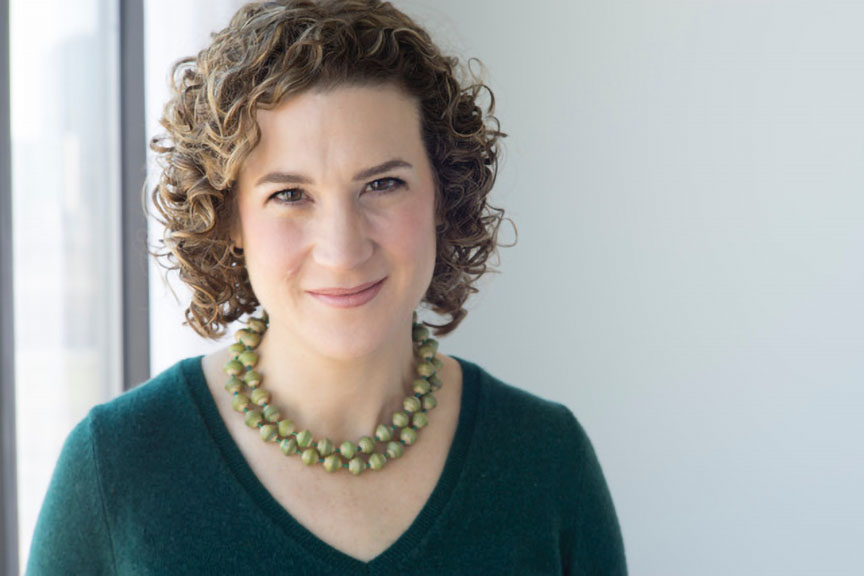
Rabbi David J. Wolpe served on Harvard’s antisemitism advisory group before stepping down in early December.

My Year at Harvard Read More »
Rosner’s Domain | Bibi’s Video: An Assessment

It should be obvious but we Israelis sometimes tend to forget: America does not owe us anything. Not ammo, or a quick supply of it. We also forget that relations between countries are based on interests. Of course, there is also affection and shared values but first of all interests. And one more thing: In every give and take transaction there is a “take” (ammunition) and there is also a “give” (whatever it is that America wants). The assumption that the U.S. will supply Israel and will not use such supply as leverage to steer Israel towards something is the assumption of the naive (or stupid, but there are no stupid readers of this column).

Now we can turn to a specific discussion about our specific situation. What do we know? That Israel claims the pace of ammo transfer from the U.S. to Israel is not fast enough. What else? That PM Netanyahu decided to make this a public dispute with the U.S. administration. What don’t we know? If Israel is right, and the pace has slowed. And we don’t know if it has slowed because of slow bureaucracy, or maybe it is a deliberate slowdown for political reasons. And we don’t know if Netanyahu’s decision will turn out to be beneficial.

Now let’s try some assumptions. One —Netanyahu is looking for a quarrel with the U.S. in order to gain politically in Israel. Many of Netanyahu’s opponents think this is the case, but that does not mean this really is the case. This means they have no confidence in Netanyahu. It is unfortunate to see that the PM of Israel has degraded his status to such an extent. Unfortunate — but this is reality.

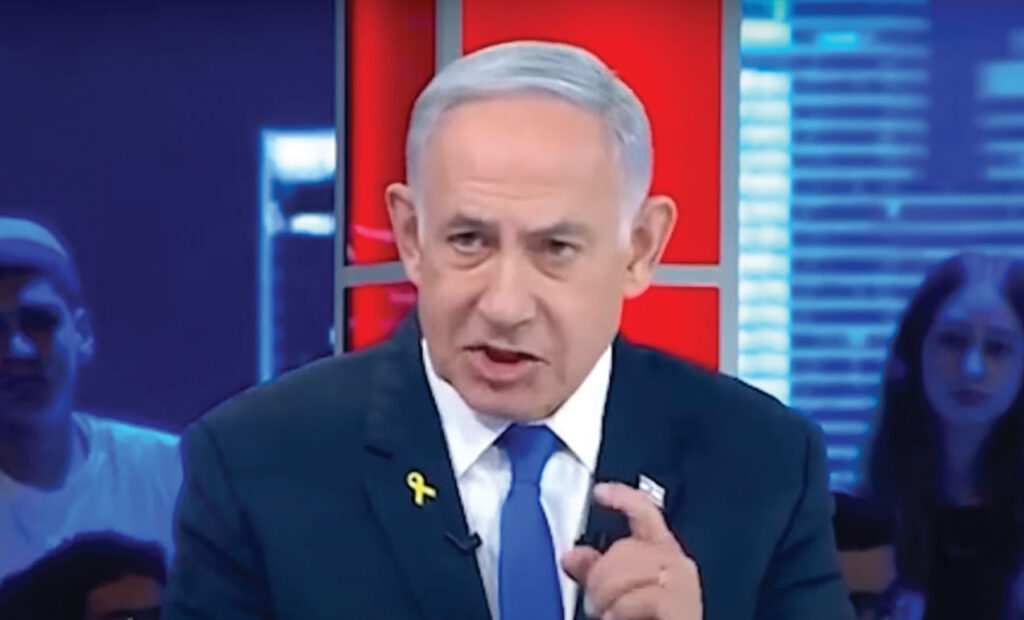
Let’s give Netanyahu credit for what he did. Reminder: He released a video in English in which he directly and harshly criticizes the Biden administration. “It is unimaginable that in recent months the administration has been withholding weapons and ammunition from Israel,” Netanyahu said. Suppose Netanyahu is right (and I assume he is), and suppose the Americans slowed down. The question about Netanyahu’s video is a simple one: Is this the most effective means of getting the ammunition, and what is the risk involved?

The question about Netanyahu’s video is a simple one: is this the most effective means of getting the ammunition, and what is the risk involved?

Netanyahu says he tried to get things moving discreetly, to no avail. He concluded that a public confrontation is the only option left. Here’s another reminder: Netanyahu is a leader at war and time is of the essence. Because of this, he can make the following calculation: Israeli might indeed lose points in its future relations with the administration because of the video. But right now, Netanyahu will say, Israel needs ammunition, and will have to deal with the administration’s wrath later.

This is what can be said in Netanyahu’s defense if we accept Netanyahu’s version, which includes three components: First —there is an American delay and a lack of ammunition that is critical; second — an attempt was made to get the ammunition in other ways and it was not successful; third — public criticism is the best available path to remove the obstacles. 

As mentioned, it is very difficult to know whether these three conditions are met, because only a few Israelis still have faith in Netanyahu. And because trust in his administration is not sky high. And also because rumors about the shortage of ammunition have been circulating in Israel for quite some time. And, because there are things that cannot be known in advance, only estimated: Netanyahu estimates that his video will do the trick. But one can also make the opposite assumption: The Biden administration does not want to appear weak and therefore will decide to delay the shipment even more. 

Which of the two outcomes will come true? Here is one prediction: Netanyahu will tell you that his assessment was correct, and that, thanks to him, the ammunition arrived. The Americans will tell you that his video was unnecessary, and if anything, because of it, the ammunition was delayed. 

And you? You will not know, because this type of information is very difficult to gather, and most of those who report on it will be fed by an Israeli source or American source. And since all of us — that’s how we are built — have a prior position regarding the PM’s move, and a prior position of trust or distrust in the PM and the Biden administration, any information that arrives will be filtered by us accordingly. We will believe what is convenient, we will not believe what is inconvenient. We will believe the truth that fits our other beliefs.

Something I wrote in Hebrew

Based on the surprising results of a new poll, I wrote this:

It’s a fascinating difference. The division between “camps” in Israel is seen by one camp (the right wing) mainly as an expression of a political position, and in the eyes of another camp (the left wing) mainly as an expression of cultural characteristics. On the right, people say “we choose right because of our beliefs concerning the Israeli-Palestinian conflict.” In the center-left, many have changed their tune: “We choose center-left because this is the camp whose cultural vision is more in line with ours.”

A week’s numbers

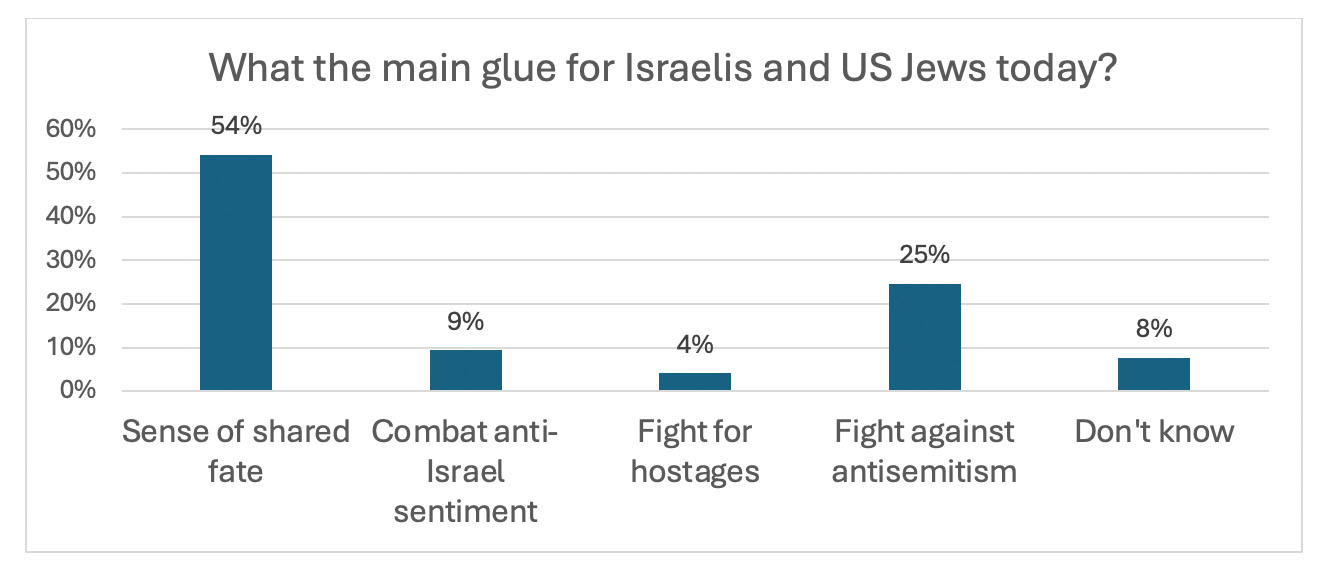
In both Israel and the U.S. Jews feel more connected to one another today. But what’s their bond based on? Here’s what Israelis say:

A reader’s response

Alice Frank wrote: “You recently seem to be more pessimistic about the future of Israel than before.” My response: Yes, I need to find a way to resurrect my optimist. 


Shmuel Rosner is senior political editor. For more analysis of Israeli and international politics, visit Rosner’s Domain at jewishjournal.com/rosnersdomain.

Rosner’s Domain | Bibi’s Video: An Assessment Read More »

Why Did a Massacre of Jews Lead to an Explosion of Antisemitism?

On the surface, it makes no sense.

How can the biggest massacre of Jews since the Holocaust lead to the biggest rise in antisemitism in modern times?

Wasn’t it supposed to be the other way around— the more Jews die, the more they like us? Like that famous book said, “People Love Dead Jews”?

How does one explain that on Oct. 8, right after 1200 Jews were massacred, mutilated, butchered and raped by Hamas terrorists, 33 Harvard student organizations co-signed a statement holding Israel “entirely responsible” for the violence?

How does one explain that on Oct. 8, as the ADL reported, “anti-Israel activists flocked to rallies across the United States at which speakers and attendees openly celebrated the brutal attacks?”

How does one explain that even as families were being burned alive, a group like If Not Now couldn’t find an ounce of sympathy for the victims, releasing a statement that “we cannot and will not say today’s actions by Palestinian militants are unprovoked”?

Remember, this was BEFORE any military action started in Gaza. This was before Jewish blood had dried. This was instant, reflexive.

How does one explain such callousness?

My theory is that the Israel haters panicked.

The tragedy of Oct. 7 was so enormous, the violence of Hamas so blatant, the images of Jews being massacred so graphic, this posed a stunning threat to the cemented narrative of Israel as the oppressors and Palestinians as the oppressed.

Thus, it would require an immediate and massive response to shift the focus back to Israel. The world must know that big, bad Israel had it coming. That is the narrative that must never be disturbed.

The problem was that no one had seen such savage, monumental Palestinian violence as they saw on Oct. 7, so the usual explanations like the “occupation” were too small, too quaint. Occupation was too 1967. Occupation was two-states.

To match the epic nature of Oct. 7, the haters had to go back to 1948. They had to undermine the very birth of the Jewish state.

That’s why we’ve been hearing cries of “we don’t want two states” and “from the river to the sea”. This is no longer about ending an occupation for future co-existence. This is about ending Israel’s very existence.

The war in Gaza has fueled the rioters in two ways. One, it has given them a pretext to use the deaths of Palestinians as a moral cover. But again, notice the use of extreme language—not occupation but apartheid and genocide.

The second way the war has fueled the rioters is by reminding them how difficult it will be to get rid of Israel. This has exacerbated their rage. They see that these are not the powerless Jews who went to their slaughter in Holocaust death camps. These are badass Zionists who know how to fight.

Nevertheless, Oct. 7 introduced the tantalizing possibility that even these badass Zionists can be defeated. After 75 years of military victories, the dreaded Jewish state finally got the spanking it deserved. The haters smelled blood, even victory.

So while the war has put Israel back in the oppressor camp, this is no longer enough of a victory. Oct. 7 made the haters taste the ultimate victory of eliminating Israel, and they like the taste. That’s why they’re going hysterical. Their mission is to put Israel squarely in the defeated camp.

The Jews have tasted that camp before, however, and no matter how the world may feel about dead Jews, they will fight like hell to never taste it again.

Why Did a Massacre of Jews Lead to an Explosion of Antisemitism? Read More »

Jewish Author Explains the Power of an Authentic Apology

The country is already polarized and this year’s presidential election will only increase the tension between family and friends on opposite sides of the political spectrum. And it’s possible that in the heat of an argument, lines could be crossed and things said you regret. Sometimes what’s needed to repair a fractured relationship is an apology.

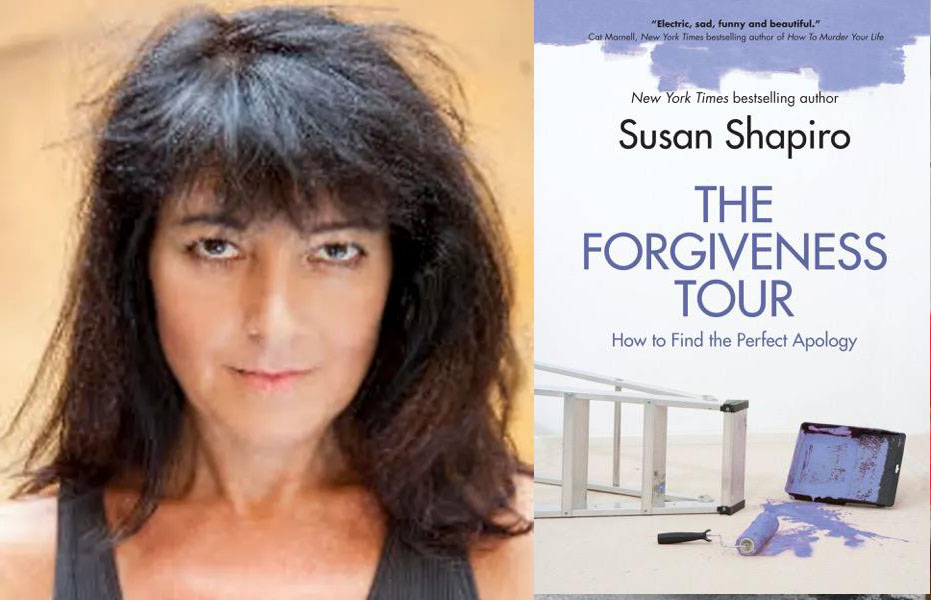
“I think it’s complicated,” Susan Shapiro, author of “The Forgiveness Tour: How To Find The Perfect Apology” told the Journal. “Because you have a moral code and there are people that feel that a vote for one is in violation of it. I think some families are able to have rational discussions and have different opinions. But there is pressure because there is a lot at stake right now. It’s hard when you feel a spouse or someone you care about seems to have the opposite set of values.”

On “Curb Your Enthusiasm,” Larry David would insist people who wronged him had to give him a heartfelt apology, even for such mundane things as arriving late. Shapiro said while it is better to apologize in person, some may do it via text or email, but the key is to make sure four things are included:

There should be a clear apology, an explanation of what happened, a demonstration that it will not happen again, and a reparation.

Many were stunned when Will Smith slapped Oscar host Chris Rock in public at an event televised around the world. But he’s seemingly been forgiven as he is currently starring in “Bad Boys: Ride or Die.” “

Public apologues have an important place whether it’s celebrities or politicians,” Shapiro said. “I don’t have skin in the game, but Will Smith did apologize, he did try to explain that his wife had alopecia, and I did feel on some level he worked on himself. He did take a hit. I don’t think Will Smith will ever hit someone in public again. He almost lost his entire career.”

Shapiro, who has taught writing at the New School, Columbia University, NYU and online, is a best-selling author of 18 books. She has helped scores of students publish articles in major outlets and get book deals with top publishing houses. But when a family friend wrote a 700-page memoir on surviving breast cancer and asked her to read it and make some edits, Shapiro admitted she was a bit too flippant in responding that she didn’t have time to do it. The person then blew her off.

Shapiro said she apologized, explained the situation but did not make it an excuse, and offered to give her notes on the book in an upcoming class. She was forgiven.

The key is to make sure four things are included: There should be a clear apology, an explanation of what happened, a demonstration that it will not happen again, and a reparation.

“The Forgiveness Tour” is a fascinating exploration in how people deal with trauma and how they navigate their emotional needs, in examining whether to forgive someone for small things or big things.

In one of the book’s more fascinating chapters, she talked to Emanuel Mandel, a therapist and Holocaust survivor who was in Bergen-Belsen. He told her that “feeling stuck without a choice is demeaning and devastating,” but that he used the one-time reparations payment of $500 for his honeymoon at the Concord Hotel in upstate New York.

“There are times when it’s healthier not to forgive for your own sake of well-being and there’s also times when the crime is so extreme it makes perfect sense not to,” Shapiro said. “Some can use terrible things as motivation to succeed in life through spite, but the key is to feel like one has choices. Manny did not push forgiveness on people who were victims of trauma.”

It is never too late to apologize, she said, nor is it too late to rescind an apology if it was given without agency or under duress.

What about those who cheat on their spouses? In those cases, Shapiro said, one needs to look at the specifics.

“If somebody has a slew of secret affairs, doesn’t come clean, gets caught and says, ‘oh I’m sorry let’s get back together, that’s a different story than someone who has one affair, comes clean, admits they did wrong and makes a reparation to never see the person again and offers to go to couples therapy.”

Has writing the book made Shapiro more forgiving?

“No, but I learned the nuances of an apology,” she said. “In the past I had been passive aggressive and would say to people that I was sorry if they felt offended. The key is you must be sincere and show the person that what you are saying is more than just words.”

Jewish Author Explains the Power of an Authentic Apology Read More »

The Case for Independents

Growing up in the home of a staunch Republican and an equally staunch Democrat, I became an Independent; it seemed like the sensible choice. The more I began to understand our political system — how partisan it can become, how parties change through the years — the more I remained steadfast in my choice.

When I worked at The New Republic in the early ‘90s, most of my friends were Democrats because the party still represented classical liberalism: Liberty, justice, equality, pluralism, civil society. With Republicans at the time, you never knew if a sexist or racist comment was on its way. Nevertheless, I chose candidates based on who they were, not which party they represented.

When I moved to New York City and 9/11 happened, the first thing I said to my father was: “I’m glad there’s a Republican in the White House.” It was beginning to become obvious that Democrats were on a dramatic decline into what we now call leftism: Illiberalism on every front. As any self-reflective Democrat would have to admit, John F. Kennedy and Martin Luther King Jr. would not call themselves Democrats today. 

I had also become less convinced about the Democrats’ ability to run things (my father’s favorite expression: Democrats can’t run a lemonade stand); fighting terrorism was not something I could see them doing effectively.

Terrorism is again at the forefront, as well as antisemitism and Israel. Leaving aside President Biden’s flip-flops on Israel, just in the last week in NYC: District Attorney Alvin Bragg incomprehensibly dropped all charges against the mini-jihadists who stormed and occupied Columbia University, and a Jewish mom, her husband, and 16-year-old son were beaten at a Brooklyn elementary school graduation by a Muslim family, who first taunted them with shouts of “Death to Israel!” 

At the mostly unpeaceful protests throughout the city, pro-jihadists waved “flags” from Hamas and Hezbollah and celebrated Oct. 7. A Jewish woman passing by one at Hunter College was told to hang herself. 

While Mayor Eric Adams has voiced numerous condemnations, the New York City Council, run by self-proclaimed socialists, has cheered all of this on. In the past decade, the council has granted nearly $3 million to five nonprofits that helped organize or support these radical anti-Israel student protests.

We can no longer ignore the obvious: Most of the Democratic Party today actively or passively opposes the existence of Israel and has helped to enable a global pogrom against Jews.

American Jews who don’t want to make Aliyah yet have two options: Become a Republican or an Independent. Third parties have never worked in the U.S., and I don’t see that changing.

For many, former President Donald Trump is a barrier to even thinking about becoming a Republican. That’s understandable, but one also has to admit that Trump wouldn’t have happened if the Democrats hadn’t gone off the deep end. Also understandable is a worry about the growing neo-isolationist wing of the GOP, a wing that is peppered with vocal antisemites. Though I think most of us would love to be able to use our space lasers to control the weather right now.

Becoming an Independent provides a safe alternative for Jews in 2024, which continues to fully blossom into 1938. But despite the antisemitic ideology of leftism — and the blatant antisemitism of many elected Democrats — most Jews are still registered Democrats.

Becoming an Independent doesn’t mean you still can’t vote for Rep. Ritchie Torres or Rep. John Fetterman — the two strongest voices of reason in the Democratic Party today — or for any of the suspiciously silent Jewish Democrats. 

The one thing you can’t do is vote in the primaries. Right now, I do believe the trade-off is well worth it. 

Becoming an Independent is also in sync with Judaism’s nonconformist roots. The cult-like partisanship of both parties should have been enough for Jews to leave.

Becoming an Independent is also in sync with Judaism’s nonconformist roots. The cult-like partisanship of both parties should have been enough for Jews to leave.

A historic exit from the Democratic Party today will send a message. Anyone who cares about a future for Jews in the U.S. needs to understand this. The argument for staying and “fighting from within” is no longer viable; it’s clear the party will never return to classical liberalism. It needs to die, receive a proper burial in Iran, and then a new classical liberal party can emerge.

Jews need to stop identifying with people who blatantly hate us. And at the moment, most of them definitely couldn’t run a lemonade stand.


Karen Lehrman Bloch is editor in chief of White Rose Magazine. 

The Case for Independents Read More »

Israel Lives

I’m on my first visit to Israel, and there’s something almost biblical about the Israeli people. Ever-emerging stories about October 7 continue to awe and humble me. From one of Israel’s most celebrated writers I hear about a man on a kibbutz who heard the terrorists were coming and armed himself: one pistol, 30 bullets. The man knew the army was not coming, no one would save him, but he’d been trained as a sharpshooter so he had a plan. He would kill 29 terrorists, then himself. Before he could proceed, however, three tanks rolled in. They were driven by three girls, the writer said, from a neighboring army base, who hadn’t waited for permission but had simply each got in a tank and driven to the kibbutz. The man, the girls and the kibbutz survived, which is why no one hears this story. Presumably it seems small compared to the stories of tragedy and heroism reported at the other kibbutzim: once-idyllic places whose names have taken on a doomed quality, like those of Nazi concentration camps. But lost in the swirl of heroic and tragic stories is this one, of a man who planned his final moments and three young women who changed the outcome.

Yet Israelis are not stuck in the past, in the horror of October 7. They are getting on with living, and fighting the terrorists behind those massacres. My first Friday evening in Jerusalem, we were invited to dinner with Rabbi Nolan Lebovitz of Valley Beth Shalom and his congregation. A few of the dozen or so seats remain empty, and we’re told they’re being saved for IDF soldiers who otherwise have nowhere to spend Shabbat. When the soldiers arrive, they’re so young it hurts. One, from New Jersey, with thick glasses and a tumble of light brown hair, is so delicate and awkward I can’t imagine him shooting a gun. He is fighting alongside his peers however, and seems stoic about it. He has every reason to be afraid, of course; soldiers here are dying all the time. But he gets on with defending his people, a blend of fragility and courage. 

Meanwhile they live like no one I’ve ever seen. At moments of rest on the hottest of days, they break out in singing “Am Yisrael Chai,” clapping their hands and dancing with wild abandon. Jerusalem’s restaurants and shops are bustling; at ten o’clock at night the shopping mall is full of families, Jewish and Arab alike, going into shoe stores and eating ice cream. At a café one afternoon there’s an announcement from the large group at the next table—a couple has decided to get married—and cries of “Mazel tov!” ring out. Israel lives. Everyone knows the war in the south is going badly, that Hezbollah rockets are making the north perilous and largely uninhabitable, and in private conversation they express fear about what’s going to happen. There is no point in dwelling on these thoughts however; the best way of defying the death cult is by living. 

They live like no one I’ve ever seen. At moments of rest on the hottest of days, they break out in singing “Am Yisrael Chai,” clapping their hands and dancing with wild abandon.  

And war is an intrinsic part of this life: unwanted, unavoidable, but now so clearly just. At first I’m startled to see so many people—soldiers and civilians, male and female—toting weapons, but accept it immediately. This is what it means to preserve, against all odds, a state for the Jewish people. Soldiers with machine guns at their hips coo over babies in strollers, walk through the streets of the Old City. Yishai Fleisher, our guide to Hebron, emerges from his apartment that morning wearing tefillin; when he reappears a half hour later, the tefillin has been replaced by a machine gun. It sounds incongruous, but isn’t. I might wish it weren’t so, but one complements the other.  

One day we visit the Gaza envelope with Rabbi Pini Dunner’s congregation, Young Israel of North Beverly Hills. After an emotionally harrowing visit to Kibbutz Be’eri and the Nova festival site, we go to Sderot City Hall to meet the mayor, where we are told we must wait. It’s hot; everyone is tired. We’re milling around upstairs, fighting boredom and irritability with varying degrees of success, when we hear singing and a flute playing downstairs. The music proceeds up the stairs, and I see the flutist is the tall dark Israeli who acts as the group’s security guard. He has a machine gun at his hip and a flute at his lips, and he leads a sweet melody which others immediately join in singing. No one seems to find anything odd about holding a concert in a dreary vestibule in Sderot’s City Hall. In America, security guards would bustle the disruption away immediately. Here the music comes from security, and no one bats an eye—in fact it seems entirely fitting.

That morning we’ve woken to the news that back at home, an antisemitic horde attacked our neighborhood, Pico-Robertson. The videos we watched in disbelief over our cellphones have graphically reminded us why Israel was founded as a haven for the Jewish people, why it matters. But Israel is so much more than that. Its people show us how to fight, how to live, and how to fight by living.


Kathleen Hayes is the author of ”Antisemitism and the Left: A Memoir.”

Israel Lives Read More »

We’re Wasting Our Lives Staring at Our Phones

As an observant Jew, I am privy to an experience that nearly no one else in the Western world will ever have. 

Once a week, I close my phone and laptop away in a drawer and don’t open it again for an entire day. 

It is, without a doubt, the most radical, countercultural thing that I do.

During this day of disconnect, I find myself marveling at myself for things that would have been utterly banal just a couple of decades ago — things like walking to synagogue without a phone call or a podcast; chopping a cucumber without an episode of Real Housewives blaring in the background; and even just staring into space for a bit when I wake up, letting my mind take whatever course it chooses. 

To my nonobservant and non-Jewish friends, this is an amazing feat, indicative of an inner wellspring of self-control and discipline. The truth is, however, that it’s easy to turn off the tech for a day. What’s hard is moderation. 

The instant that Shabbat ends, I am pulled back in. After Havdalah comes Hadlakah — the turning on of the devices. 

Often, I have two screens going at once. A TV show in the background while I scroll in the foreground. 

Sometimes I lose time. I pick up my phone to check my calendar and suddenly come to, realizing that 40 minutes have passed. 

Occasionally, as I lie in bed at night or early in the morning, I yield completely to the phone’s forceful seductions — lifting my neck to the sweet oblivion of the vampire’s bite. 

The youth call this “bed rotting.” Some of them have the audacity to call it a “self care” practice. It is not. Spending an afternoon in bed, as I often do on Shabbat, can indeed be refreshing and joyful. “Rotting” in bed in front of a screen feels as awful as it sounds. 

I’ve considered ditching my smartphone for a flip phone, what the ultra-Orthodox call a “kosher phone,” but as someone who uses social media for work, this isn’t a good option. Tech companies like Apple and Meta have us right where they want us. The tech, which is designed to be as addictive as possible, has been so thoroughly integrated into our lives that any possibility of going cold turkey is effectively blocked. 

What can be done? There are apps that promise to help us limit screen time. Online gurus offer helpful tips, telling readers to “use a timer!” or “set a daily limit!” or “ban devices from the dinner table!”

Recently, Surgeon General Vivek Murthy suggested slapping social media services with warning labels like those found on a pack of cigarettes.

All of this falls short. The focus on hacks and tips makes it seem like this is a small problem, and not a massive spiritual crisis. The focus on mental health outcomes, while important, can obscure the bigger picture, which is that it’s entirely possible to waste one’s entire life this way.

Consider this. Some studies show that the average American is in front of a screen for seven hours a day. We sleep for around eight. We work for eight. That leaves us with one hour a day for everything that matters.  

Some studies show that the average American is in front of a screen for seven hours a day. We sleep for around eight. We work for eight. That leaves us with one hour a day for everything that matters. 

The late poet Mary Oliver famously asked, “Tell me, what is it you plan to do with your one wild and precious life?”

Certainly not this. 

Not “bed rotting.”

Not throwing away time as if it were worthless.

Not having reality mediated and filtered for us by Silicon Valley billionaires. 

The only suggestion I can offer right now is this—if you don’t turn off your phone for Shabbat already, start doing it. This won’t cure you of your screen addiction. Once three stars appear in the sky you’ll be right back to your old ways. 

But at the very least you will have one day a week to remember what this wild and precious life is really for. 


Matthew Schultz is a Jewish Journal columnist and rabbinical student at Hebrew College. He is the author of the essay collection “What Came Before” (Tupelo, 2020) and lives in Boston and Jerusalem.  

We’re Wasting Our Lives Staring at Our Phones Read More »

Emily Paster: Air Fryer Cooking, Food Culture and Lamb and Bulgur Kofta

Cookbook author Emily Paster, author of “Epic Air Fryer Cookbook” and “Instantly Mediterranean,” came from a food loving family.

“We always celebrated the Jewish holidays with my grandparents, aunts, uncles and cousins,” Paster, founder of the West of the Loop blog, told the Journal. “My grandmother and my Aunt Ann were outstanding Jewish cooks who made everything – gefilte fish, matzo balls, kreplach – from scratch; we connected with our culture and heritage through food above all.”

While food was always a big part of her life, and even though she had an aunt in the food business, it initially didn’t occur to Paster, a former lawyer, that food was a possible career path,

“If you … cast your mind back to the 1980s and 1990s, food did not have the place in our culture that it does today,” she said. “Even when I was practicing [law], I was at my desk, researching the next restaurant I wanted to go to, planning the next dinner party I was going to host [or] dreaming about what was going to be at the farmer’s market that week,” she said.

After having kids and staying home with them – “My husband’s also a lawyer and two lawyers and two kids was a lot,” she said – Paster started a food and parenting blog that then transitioned to a food blog.

She also started a recurring popular event, called the Chicago food swap.

“At the time, a lot of people were doing a lot of DIY stuff: people were canning or fermenting or they were raising backyard produce or raising backyard chickens,” she said. “So the people who were doing the various sorts of culinary DIY tasks [had an abundance of their specialty] wanted to get together and swap.”

“This was a big trend around 2010, 2011 … and I thought there should be a food swap cookbook, so I wrote a proposal, got an agent and, sheer luck, we sold the book,” she said.

Fast forward to 2018 or early 2019. Paster was approached by an editor who had an idea for an air fryer cookbook.

“He basically said, ‘I know you’re a good author, a good recipe developer; how are you with the air fryer?’” she said. “I just lied and said, ‘Oh yeah, totally familiar with the air fryer.’”

At the time, she didn’t even own one and had never used one.

“I took the gig and I’m so glad I did,” she said. “It was an international bestseller, it’s been translated into multiple languages but also it basically exposed me to the air fryer, which I now love.”

While most of the air fryer cookbooks at that time were very much about using processed ingredients, Paster’s book exemplifies how she cooks.

“It is from scratch, whole ingredients, healthy, global cuisine,” she said. “And because they’re in the air fryer, they’re quick, they’re accessible, they’re a little healthier than stove top versions that use a lot of oil.”

One of Paster’s favorite, easy air fryer recipes is for lamb and bulgur kofta.

“It’s ground lamb with some soaked bulgur wheat; you can use a little bit less meat [and it’s] a little bit healthier,” she said. “You form a little patty or a kebab.”

If you are not yet an air fryer person, there are other cooking options

“I live in Chicago, so during our short, nice weather, I have my husband throw them on the grill,” she said. “But for the rest of the year, it’s absolutely [made] in the air fryer; it’s quick, super juicy and the cleanup is not bad at all.”

Paster’s recipe for lamb and bulgur kofta from “Instantly Mediterranean: Vibrant Satisfying Recipes for Your Instant Pot, Electric Pressure Cooker & Air Fryer” is below.

While Pasted believes some people have this mistaken notion that all you can do is fry in an air fryer, it is perfect for reheating leftovers and is good for cooking so many other things.

“If you like to roast brussels sprouts or broccoli in your oven, try it in the air fryer; it is amazing and quick,” she said. “Maybe the most unique thing is fruit.”

To caramelize pineapple or peaches in the air fryer, just brush on a little melted butter and some cinnamon. Cook softer fruits, such as peaches, at 375 for 8 to 10 minutes; cook tougher fruits, like pineapple, at 400 for around 15 minutes. Then, enjoy it with a dollop of creme fraiche, yogurt or even ice cream.

“If you’re going to be indulgent, that’s a beautiful dessert,” she said.

Learn more and get additional recipes at WestoftheLoop.com.

For the full conversation, listen to the podcast:

Watch the interview:

Lamb and Bulgar Kofta

Serves 4

1/4 cup finely ground bulgur wheat

1 pound ground lamb

1/2 an onion, grated

1/4 cup packed chopped fresh herbs, such as flat-leaf parsley, cilantro, mint or a combination

1 teaspoon kosher salt

1 teaspoon ground cumin

1/2 teaspoon paprika

1/4 teaspoon allspice

1/4 teaspoon cinnamon

Oil for spraying

Tahini Sauce for serving (optional)

Mix the bulgur with 1/4 cup of boiling water in a heat-proof bowl. Let stand for 7 minutes.

To form the kofta, combine 1/2 cup of the cooked bulgur with the lamb, onion, herbs, salt and spices in a medium bowl and mix thoroughly with your hands .

With damp hands, form the lamb mixture into 8 equal, tightly packed oval patties. Place the patties on a plate, cover and refrigerate for at least 30 minutes and up to overnight.

When you are ready to cook the kofta, preheat the air fryer to 400ºF for 3 minutes. Spray the basket with oil to prevent the patties from sticking. Working in two batches, so as not to overcrowd the air fryer basket, arrange half of the patties in a single layer in the basket. Cook until the kofta are browned and the internal temperature reaches 145ºF degrees, about 10 minutes, turning once halfway through cooking. Repeat with the second batch of patties.

Place the cooked kofta on a paper towel-lined plate to absorb any excess oil. Serve warm with tahini sauce.

Tahini Sauce

Makes approximately 1 1/2 cups

3/4 cup tahini

1/3 cup lemon juice

2 to 3 cloves garlic, roughly chopped

1/2 teaspoon kosher salt

1/2 to 3/4 cup cold water

Place all of the ingredients except the water in a blender or food processor and pulse a few times until the mixture forms a paste. With the motor running, slowly pour in 1/2 cup water and blend until the sauce is lighter in color and fluffy, 1 to 2 minutes. If the mixture is still quite thick, which will depend on the consistency of your tahini, add the remaining water in the same manner and process until the mixture is completely smooth and thin enough to drizzle. Tahini sauce will keep in the refrigerator for up to 2 weeks.


Debra Eckerling is a writer for the Jewish Journal and the host of “Taste Buds with Deb.Subscribe on YouTube or your favorite podcast platform. Email Debra: tastebuds@jewishjournal.com.

Emily Paster: Air Fryer Cooking, Food Culture and Lamb and Bulgur Kofta Read More »

Former French Ambassador to Israel: Unknown How Jews Will Vote in Upcoming French Elections

Éric Danon, the former French ambassador to Israel, told The Journal in a June 24 phone interview that it is currently unknown how the Jewish community will vote in the upcoming French elections; he also discussed the current political climate in France as well as the ongoing Israel-Hamas war.

France is facing snap elections after President Emmanuel Macron dissolved parliament following the staunchly right-wing National Front’s landslide victory in the European Union parliament elections earlier in June. Danon told The Journal that “many individuals from the Jewish community are considering voting for the extreme right” over the extreme left, which was unfathomable years ago. “Clearly the extreme left in France has become antisemitic, and that is the main change in French politics … 30 years ago, the extreme right was antisemitic, not the extreme left,” he said. “Today, the extreme left, because they need the votes of the Muslim community in France, so they shifted to antisemitism.”

According to Danon, the extreme right in France now claims to support Israel and the country’s Jewish community. “No one knows if this is a lie or not. Everything is a mess today.”

Previously, Danon told The Journal on April 5 that, regarding what was at the time the upcoming 2027 elections “the Jewish community’s against the day-to-day aggressions generally coming from the third or fourth generation of Muslim immigrants, because at the same time, the extreme left are very supportive of the Palestinians. They even say that Oct. 7 is not an act of terrorism but an act of resistance.” Danon clarified that those that say this are on the “extreme extreme” left.

Danon has been a diplomat since 1986, and served as the French ambassador to Israel from 2019-2023; he was the first-ever French Jewish citizen to serve as the country’s ambassador to the Jewish state. “I did not ask to go to Israel because I really thought it was impossible,” Danon said. He posited that the reason why it took so long for France to appoint a Jewish ambassador to Israel was over concerns of “dual allegiance.” When he was offered the position of ambassador, he “accepted immediately.”

Danon and his family received a warm welcome when they arrived in Israel in August 2019. While Danon’s appointment did not change French policy regarding Israel, it did change the “personal relations” with the people of Israel, the former ambassador said. “You just can’t imagine the reaction of the French Jewish community in Israel,” Danon claimed, as the French Jewish population in Israel is 200,000 people. “They expected a lot.” Danon made it clear that his only role was to implement his government’s policy, “but at the same time I had a different comprehension of what was going on in the country.”

A lot happened in Israel and in the world during Danon’s ambassadorship tenure, including the COVID-19 pandemic, several Israeli elections in which Benjamin Netanyahu was ousted from ––and then returned  to — the prime minister position, and the 2021 conflict with Hamas. Danon said it was particularly “interesting to be in Israel” during the pandemic “because of the vaccination system.”

Danon’s tenure ended in August 2023, so he was not in the country when the Oct. 7 massacre occurred. But he did visit Israel back in March. “What is unbearable is to see the pleasure of terrorists filming themselves killing Jews, and killing Jews in this very barbaric way,” Danon said, adding that “the concept of justice is at the center of Judaism” and that he heard three different kinds of answers from Israelis on the matter. One was “we know what is happening in Gaza” but they don’t have any compassion because Hamas and supporters of Hamas in Gaza “hurt us so much,” Danonclaimed. The second answer, which is “political,” is that everything that’s happening to the Palestinians in Gaza is Hamas’ fault and that Hamas wanted many Palestinian civilians killed in the war so the world would blame Israel. “And that’s what we see with the boom of antisemitism in the world,” Danon said.

The third answer: a “shift from the moral aspect to the ethic aspect” in geopolitics. Danon cited Winston Churchill’s justification of the Hiroshima and Nagasaki bombings in World War II; according to Danon, Churchill argued that it was immoral that 200,000 people were killed in both bombings, but it was ethical in order to prevent a million more lives from being lost. Some in Israel have a similar perspective when it comes to ongoing war in Gaza.

The Israelis’ end goal of the war is to dismantle Hamas’s military capacity so they cannot attack in Israel again and to make Gaza “safe,” said Danon, as well as to establish a “new deterrence” against Hezbollah to prevent them from launching their own Oct. 7 attack against Israel.

However, Danon claimed that that there is a feeling among some in Israel that Netanyahu has a “personal agenda” to keep the war going in order to prevent U.S. President Joe Biden from claiming that he achieved peace. “The idea of the Likud today is to go to Nov. 5, and there is a perverse effect in this of course,” he said. “What if Hamas leaders are killed in a week or two, and the hostages are released? Will the war continue or not? And the debate in Israel is, if this is the case, we will go to Lebanon because we have the threat of Hezbollah. That’s why everybody thinks that the war will continue at least until November, and probably after November.” Danon stressed that it would not be an “artificial reason” for Netanyahu to turn the war to the north once Hamas is eliminated, as Hezbollah is a legitimate threat, but Netanyahu also does not want to give Biden a “pretext” to say he ended the war, and that is “part of the equation.”

This has created a “paradox” among the people of Israel in that they understand Netanyahu is probably the only political leader to dismiss international pressure, but the Israeli populace may not like the way he is going about it, Danon claimed, prompting “mixed feelings” in Israel.

Danon also praised Israel as being “extraordinary” in how its populace has responded to Oct. 7. The government was “lost” at first, “but the population did the job. The young Israelis came back immediately from abroad … the result is that Israel is back on track.” But the population is still “really traumatized” by Oct. 7, Danon said. Additionally, there have been some economic issues in Israel because the “young people” who make up the “startup nation” in Israel are currently fighting in Gaza as well as the tens of thousands of refugees from the north as a result of Hezbollah’s attacks.

Danon has visited the various communities in southern Israel that were attacked on Oct. 7, recalling how people in a couple of kibbutzim close to Gaza believe that “they cannot live anymore with Hamas being so close to us.”

The French government has called for a ceasefire in the ongoing Israel-Hamas war and supports Biden’s ceasefire proposal in order to release the hostages and “reorganize the humanitarian aid and support in Gaza.” Danon said foreign policy ultimately stems from domestic policy and while France has the largest Jewish population in Europe (400,000) it also has the largest Muslim population on the continent. Danon believes France has around nine million Muslims, but “no one knows exactly.” And given that France is about to head into elections, “you have to be very cautious if you want to win the elections.”

Another domestic issue is the war of “public communications,” which Danon says Israel hasn’t been very good at, dating back to the Jewish state’s inception. “Oct. 7 is a one-day or one-week event. But TVs today need to have new images every day, so they get images only from Gaza … and you have the public opinion, so you have to deal with this,” Danon said. Israel doesn’t show the horrific images from Oct. 7 to “large audiences” and instead shows it to political leaders. “So everybody from France … is under the pressure of the Gaza images of today,” Danon said.

Danon also pointed out that Hamas controls the information coming out of Gaza. “We don’t know the number of casualties. They say 30,000; maybe it’s half that. Nobody knows.” He added that regarding the reports of people dying from hunger in Gaza and that 60% of the buildings in the enclave are down, “nobody can verify that.”

But Danon clarified that the ceasefire proposal that France supports does not mean the end of the war. “We know that neither nor Hamas nor the Israeli government is going to accept that.”

Danon argued that the various Arab countries on the Mediterranean border are not interested in the seeing the conflict end. “They are very happy that Israel is doing the dirty job, which is killing the Muslim [Brotherhood] and Hamas ideology … and more than that, they forbid any demonstration that is in favor of the Palestinians,” claimed Danon. “You can’t have any demonstration in Nigeria, in Morocco, in Tunisia, in Libya. Why? Because they are afraid of the consequences of such demonstrations.” He also contended that these countries’ governments don’t like each other very much, but “the only thing which gathers them is their hate of Israel. They need Israel as an enemy, but to have an enemy, you must have a pretext, and the pretext is the conflict with the Palestinians. So you keep Israel as an enemy if you keep the conflict alive.”

“The only thing which gathers [the Arab nations] is their hate of Israel. They need Israel as an enemy, but to have an enemy, you must have a pretext, and the pretext is the conflict with the Palestinians. So you keep Israel as an enemy if you keep the conflict alive.”

These Arab countries fear that if the conflict ends, Israel will become a true superpower; as it is, Israel’s GDP is already higher than all of those Arab countries combined and Israel’s GDP per capita is higher than France’s and equal to the United Arab Emirates, Danon said. Further, these Arab countries cannot fathom “dhimmi,” or non-Muslims, thriving “in a Muslim world.” The only ones who are confident enough to say nothing about the conflict “are the Gulf countries… because they understand that to live in a peaceful, quiet environment, extremist jihadists radical Islamism has to be tackled and destroyed.”

Danon thinks that Saudi Arabian Prince Mohammed bin Salman believes he can do something to fix the conflict, and that Israeli-Saudi normalization will happen when the current war is over. But what would separate Israeli-Saudi normalization from the countries in the Abraham Accords is that with the Abraham Accords, the normalization was purely on a “political” basis. Normalization with the Saudis would result in “de-facto … religious normalization between Mecca and Jerusalem, and if you have that kind of normalization, you live in another world,” Danon said, calling it a “game changer.”

France has certainly not been immune to the surge in antisemitism since Oct. 7; Danon said that while antisemitic incidents in France have mostly been “verbal insults in the streets,” there has been “physical violence and for the moment, nobody died from that… but it could happen. What is important is the response of the government facing this.” The Interior Minister, for instance, has not provided authorization for pro-Palestinian rallies in the streets, per Danon, and imams that have been promulgating hatred “have been sent back to Arab countries.”

It can be tough for French politicians to support Israel because anyone that expresses support for the Jewish state is “immediately insulted on the social networks, so the vast majority says we don’t know really about this issue.” But he lauded the European Leadership Network, or ELNET, for their role in bringing more French MPs to Israel and changing their minds about Israel. Macron himself is pro-Israel “but does not like the way the war is going on,” which Danon analogized to how Democrat politicians view the matter. Again, it comes down to “public pressure” and the images coming from Gaza, opined Danon. But “many people know” that the “enemy today may be the ideology of the radical Islamist jihadists” and understand the importance for Israel to succeed because the ongoing war is a battle for civilization, “and that is more and more the case in France,” Danon said. And “at the governmental level … they are frankly in favor of Israel” and ultimately that makes Danon “more optimistic than pessimistic. There’s a clear conscience that we have common enemies with Israel, that’s why we have to fight together.”

Former French Ambassador to Israel: Unknown How Jews Will Vote in Upcoming French Elections Read More »

A Letter on Liberty

John Adams was right, but he was off by two. 

In a July 3 letter to his beloved wife Abigail, John was giddy with excitement. “Yesterday,” he began, “the greatest question was decided, which ever was debated in America, and a greater, perhaps, never was nor will be decided among men. A resolution was passed without one dissenting colony, ‘that these United Colonies are, and of right ought to be, free and independent States.’” In just a few days, he assured her, she would read of the Declaration of Independence, which would detail “the causes which have impelled us to this mighty revolution, and the reasons which will justify it in the sight of God and man.” Expressing wonder “at the suddenness as well as greatness of this revolution,” Adams swiftly turned spiritual:

“It may be the will of Heaven that America shall suffer calamities still more wasting, and distresses yet more dreadful. If this is to be the case, it will have the good effect at least. It will inspire us with many virtues which we have not, and correct many errors, follies, and vices which threaten to disturb, dishonor and destroy us. The furnace of affliction produces refinement, in states as well as individuals. And the new governments we are assuming in every part will require a purification from our vices, and an augmentation of our virtues, or they will be no blessings.”

Anticipating the bloody battles ahead, Adams saw in the struggle to come a means of national introspection and moral improvement, an opportunity for repentance for individuals and the polity as a collective. 

He was not naive. Democracy is a difficult art, America’s future first vice-president and second president no doubt understood. “The people will have unbounded power, and the people are extremely addicted to corruption and venality,” Adams lamented. But hope lay in the heavens. “I must submit all my hopes and fears to an overruling Providence,” he confessed, “in which, unfashionable as the faith may be, I firmly believe.”

In the meantime, it would be up to America’s citizens to manifest their covenantal destiny. “Time has been given for the whole people maturely to consider the great question of independence,” his letter continued, “and to ripen their judgment, dissipate their fears, and allure their hopes, by discussing it in newspapers and pamphlets, by debating it in assemblies, conventions, committees of safety and inspection, in town and county meetings, as well as in private conversations, so that the whole people, in every colony of the thirteen, have now adopted it as their own act.”  

As long as Americans stand firm in their faith in God and each other, sharing a commitment to community and virtue, good-faith debates and most of all the light of hope, there will still and always be reason to celebrate, on July 4th and every day.

If Americans were, as Abraham Lincoln would later call them, “God’s almost chosen people,” built in the model of biblical Israel, they would, like their ancient forebears, debate and dissent, kvetch and quarrel constantly. But, it was hoped, the United States would eventually become its own Promised Land.

John and Abigail were deeply devoted readers of the Bible, quoting it constantly in their correspondence. “The Psalms of David,” John would later write to Thomas Jefferson, “in sublimity, beauty, pathos, and originality, or in any word, in poetry, are superior to all the odes, hymns, and songs in any language.” No wonder, then, that in bringing his short missive to a close, Adams envisioned, in a tone tinged with prophetic allusions, a holiday that would last, like Israel’s own, for centuries.

“The second day of July, 1776, will be the most memorable epoch in the history of America,” he said, still floating high from the colonies having declared their freedom from England that day. “I am apt to believe that it will be celebrated by succeeding generations as the great anniversary festival.” 

Of course, it would be not the second but the fourth of July that would forever be celebrated as Independence Day, commemorating the day the Second Continental Congress officially approved the Declaration, which would actually not be signed until August 2. The barbecues and ballgames would be there, Adams predicted, but also, he hoped, expressions of gratitude to God for the gift that is the United States.

“It ought to be commemorated, as the day of deliverance, by solemn acts of devotion to God Almighty. It ought to be solemnized with pomp and parade, with shows, games, sports, guns, bells, bonfires, and illuminations, from one end of this continent to the other, from this time forward, forevermore.”

Like Israel’s Festival of Freedom, a holiday celebrated for generations in anticipation of an even greater future redemption, America’s Independence Day would point the way toward a brighter future. “Through all the gloom,” Adams concluded, “I can see the rays of ravishing light and glory.” Adams here was lifting a phrase taken from the 58th chapter of Isaiah’s description of God’s shining appearance as he removed the yoke of Israel’s enemies, a reward for the righteousness of a people who had fed the hungry and supported the poor. “I can see that the end is more than worth all the means, and that posterity will triumph in that day’s transaction, even although we should rue it, which I trust in God we shall not.”

Though the Fourth of July would come to overshadow the second of the month, Adam’s meditation is fitting for the ongoing American experiment. Errors, follies, and vices still threaten to disturb, dishonor and destroy us, seemingly daily. Enemies foreign and domestic often darken our days. But as long as Americans stand firm in their faith in God and each other, sharing a commitment to community and virtue, good-faith debates and most of all the light of hope, there will still and always be reason to celebrate, on July 4th and every day.


Rabbi Dr. Stuart Halpern is Senior Adviser to the Provost of Yeshiva University and Deputy Director of Y.U.’s Straus Center for Torah and Western Thought. His books include “The Promise of Liberty: A Passover Haggada,” which examines the Exodus story’s impact on the United States, “Esther in America,” “Gleanings: Reflections on Ruth” and “Proclaim Liberty Throughout the Land: The Hebrew Bible in the United States.”

A Letter on Liberty Read More »