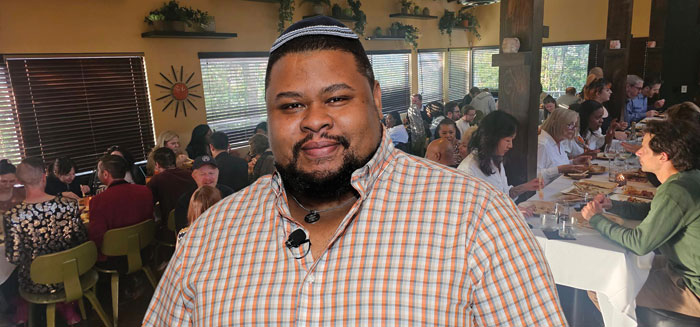
In mid-May we had the good fortune to enjoy an amazing culinary, cultural, and yes, religious experience helmed by Michael Twitty, the James Beard Award-winning writer and chef. Twitty created a pop-up at Post and Beam, one of Los Angeles’ most prominent Black restaurants in the heart of Baldwin Hills. Twitty, who is African American, Jewish and gay, and his team kashered the kitchen and prepared a fully kosher meal for two sold-out seatings, with a different menu for each. We chose the second seating, styled as his “Koshersoul” menu, named for his most recent book.
Twitty has one of those larger-than-life personalities; he fills the room, welcoming all the patrons as if to his own home, and throughout the evening, he moved through the restaurant, to all the tables to make sure the food got to everyone and that they were satisfied. This was a unique event, as the diners comprised Jews (white and black), non-Jewish blacks (including Los Angeles County Second District Supervisor Holly Mitchell), gay and straight, religious and secular. And it was a celebration of a coming together of people from different cultures to share some extraordinary food and fascinating conversation, at a time of polarization, when too much of our focus is on our differences, contrasts and disagreements. It was a time of joy — good food does that — at a time of struggle and turmoil in a world that seems broken.
It was a celebration of a coming together of people from different cultures to share some extraordinary food and fascinating conversation, at a time of polarization, when too much of our focus is on our differences, contrasts and disagreements.
Twitty believes that food brings out what we have in common.His journey to Judaism started at an early age, when he declared himself, at seven years old, to be Jewish, attributable in part, at least, to his mother’s (a Christian) delicious and beautifully braided challah.He made his official conversion in his 20s. He sees common experiences in Jewish and Black history, of slavery and persecution.
The multi-course meal, which began with his recitation of Hamotzi, featured collard green-wrapped lox, barbecued brisket, chicken skewers, barbecued beans with lamb bacon, Texas slaw with black-eyed peas, potato salad and more. Each dish was more surprising than the previous and more delicious. The only controversy was which tasted best and why.
Twitty’s first book, “The Cooking Gene” (2017), traces his African American roots, along with a culinary and cultural journey through the American South. He called his exploration “the Southern Discomfort Tour.” In the book he intertwines genealogical research with stories of food, recipes and cultural traditions passed down through generations.It reflects on the parallels and differences between African American and Jewish culinary traditions, emphasizing food as a means of preserving heritage and culture.
During the meal, he told the diners of his struggle to get his memoir published, and the countless obstacles he had to overcome.Ultimately, his tenacity and perseverance paid off; the book won two James Beard Awards, for writing and book of the year.When he shared that story, he also told us he recited the “she-he-che-anu,” prayer when he received the awards.More recently, he has published “Koshersoul” (2022), about Jewish and African American traditions and how they inform one another.He finds Jews and Blacks share a Venn diagram of turmoil and pain, migration and diaspora life. Food, including the recipes, and the traditions of family gatherings over well-prepared meals, are a bridge to common experiences and understanding.
We sat next to one of Michael’s former students at American Jewish University.He described how AJU was the right place for him, a Black Jewish man, to pursue his studies and his continuing commitment to Judaism; part of his professional work is aimed at ensuring Jews of color are made to feel at home within Jewish institutions and that Jewish institutions are accepting of Jews of color. This was a special night for Jews of color who felt themselves quite at home in both communities and who could serve as a bridge between Jews and Blacks
On the way into the restaurant, we met an African American family curious about Jews and Judaism; their daughter who accompanied them sings in her choir at the First AME Church, which has performed with the choir at Temple Isaiah. A love of good food brought us together — black and white, Jewish and non-Jewish Angelenos; good food sparked good conversation and a feeling of community. For the first time in too long a time, politics and loss were not at the center of our discussions and when the divisive topics were raised, we found an uncommon unity and a mutuality of concern.
Melissa Berenbaum is an attorney living in Los Angeles. Michael Berenbaum is director of the Sigi Ziering Institute and a professor of Jewish Studies at American Jewish University.
For most people, the mention of any food or meal will spark a memory, whether loving, nostalgic, bittersweet or all of the above. Whether you are enjoying a family favorite or trying a new recipe this Father’s Day, here’s hoping it’s a wonderful experience.
After chef Alon Shaya graduated from culinary school, his first real cooking job was at Antonio’s Italian Ristorante at the Rio Casino in Las Vegas.
“I wanted to show my grandfather my talent; I wanted to impress him,” Shaya, co-founder of Pomegranate Hospitality, told the Journal. “I cooked a steak well done for him, as he’d asked, even though I knew it would ruin the meat.”
While Shaya’s grandfather told him how much he loved the food, and how proud he was, Shaya said the recognition now feels melancholy.
“That steak dinner was our final meal together,” Shaya said. “That final meal I cooked for my saba — steak and potatoes — inspired many of the recipes in my cookbook.”
He added, “It’s the meal I would make for him if I could get a do-over.”
“It’s the meal I would make for him if I could get a do-over.” – Alon Shaya
Cast-Iron Ribeye
Before you begin, make sure to have at least one dozen bamboo or metal skewers for the chicken and any vegetable kebabs you plan on grilling.
Use a paper towel or dish towel to pat the steaks dry on both sides. Sprinkle ¼ teaspoon salt on each side of each steak and give it a pat to make sure it sticks. Refrigerate the steaks on an uncovered plate for at least 1 hour and up to a day.
Before you cook, let the steak sit at room temperature for 20 minutes or so to take off the chill.
Set a large cast-iron skillet over high heat until it’s blazing hot, then add the canola oil. If the steaks won’t fit in the skillet without crowding, add only 1 tablespoon of oil now and save the other for the second steak. Heat your oven to 175°F so that the first steak stays warm while you cook the second. Allow the oil to get smoking hot.
Lay the steak or steaks in the skillet side by side, and immediately decrease the heat to medium. Leave them alone for 5 to 8 minutes, depending on how thick they are. You should see a deep-brown crust climbing about ¼ inch from the bottom for medium-rare or a little higher if you prefer a more well-done steak. Flip and cook the other side for another 3 to 5 minutes, until the other side is deeply browned as well. Again, cook for an extra minute or two if you like.
Let the steaks rest for at least 5 minutes on a plate, so the juices can settle in. (If you’re worried about the steaks getting cold, keep them in a warm oven.) Slice the steak thinly and on a bias to serve, preferably with chimichurri on the side.
Za’atar Chimichurri Photo: Rush Jagoe
Za’atar Chimichurri
1 cup lightly packed fresh parsley leaves
¾ cup lightly packed fresh cilantro leaves
½ clove garlic, grated or minced
2 tsp za’atar
¼ tsp Morton kosher salt
¼ tsp red-pepper flakes
½ cup extra-virgin olive oil
2 Tbsp lemon juice
Chop the parsley and cilantro together. Add them to a bowl with the garlic, za’atar, salt and red pepper, then stir in the olive oil. Shortly before it’s time to eat, stir in the lemon juice. This is best eaten when it’s very fresh.
Dawn Lerman’s fad-dieting, 400-pound ad-man dad was never a morning person. Every Father’s Day, she knew the only way to wake him up early was to make him a scrumptious breakfast in bed. Figuring out what to prepare depended on the diet du jour, so she always had to be creative.
“On Father’s Day, right after I turned nine, I came up with a recipe that fulfilled my dad’s diet requirements while also creating one of his favorite dishes from his childhood: ‘little packages of love,’ a.k.a. cheese blintzes,” Lerman, a board-certified nutrition expert and the author of “My Fat Dad: A Memoir of Food, Love, and Family, With Recipes,” told the Journal.
Lerman had seen her grandmother prepare the recipe so many times, she was confident she could replicate them with her healthy twist.
“Watching my dad enjoy the gluten-free blintzes with no mention of the ingredient swaps, I realized I could help my dad with his weight loss, while still serving up a hefty dose of ‘nostalgia,’ an essential ingredient in any family recipe,” Lerman said.
Gluten-free Cheese Blintzes
6 servings
Crepe Batter:
3 mashed bananas
3 Tbsp milk or choice
6 scoops protein powder of your choice
1½ cup egg whites, beaten until stiff
A splash of water after, before ladling
in pan
Cooking spray
Cheese Filling:
12 ounces farmer’s cheese
4 ounces cream cheese, softened
1/3 cup sugar of choice (I like monk fruit)
1 tsp lemon juice
1 tsp vanilla extract
1 egg yolk
Pinch of salt
Toppings:
2 cups berries, sliced thin
Dollop of yogurt.
To make the batter:
Mash the bananas and add the milk. Then stir in the protein powder and egg whites. Make sure you beat the egg whites separately until stiff, and then fold in.
To make the crepes:
Grease a 6- or 7-inch skillet until it is hot but not smoking.
Put a ladle full of batter into the skillet. Tilt the pan to swirl the batter so it covers the bottom of the skillet.
Fry on one side until bubbles form and the top is set. The bottom should be golden brown. Carefully loosen the edges of the crepe and slip it out of the skillet onto a plate.
Repeat the above procedure until all the batter is used. Grease the skillet each time before pouring the batter.
After all the crepes are made, begin filling them. The brown side should be facing up. Place 3 tablespoons of filling on one edge.
Roll once to cover the filling. Fold the sides into the center and continue rolling until completely closed.
After all the blintzes are assembled, heat 2 tablespoons of butter in the skillet and place each crepe, seam side down, in the skillet. Fry for 2 minutes on each side, turning once.
Serve with a dollop of yogurt, garnish with fresh berries.
This year the 14th of Sivan, which marks the one-year anniversary of my father’s passing, begins on the eve of June 16. It feels so right that the eve of Father’s Day just happens to be my father’s hazkara (yahrzeit, for you Yiddish speakers).
My father was a quiet man who managed to cast a giant shadow. Years of working as a bricklayer endowed him with a muscular physique, but his restraint and quiet stoicism were even more impressive. He was strong in every meaning of the word.
His strength lay in his quiet discipline. His commitment to Torah, mitzvot, Jewish values and Zionism. His love for my mother, who he adored and admired. His devotion to me and my brothers. His sheer joy and enjoyment of his grandchildren.
His superpower was his ability to listen. Then depending on the situation, to offer moral perspective, business advice or encouragement. What my brothers and I loved the most were the unexpected brilliant, insightful, humorous quips.
My father was a private man who never sought acclaim. I have spent this year of mourning contemplating his many qualities and achievements. The good memories really are a source of comfort.
Fittingly for a Sephardic Spice Girl, much of the way that I have commemorated my father has been through serving food to others.
For his shloshim (30 days after passing), with help from my friends, we hosted 300 people for a home-cooked meal of his favorite foods—Kubbah Bamia (okra stew), Kubbah Shwandar (beet stew), grilled kebabs, rice and dates, served every which way.
For Yom Kippur (his birthday), I hosted my extended family for the pre-fast meal. And because this year is a leap year, we marked the end of the 12-month mourning period on the 14th of Iyar. I cooked a huge meal of fish and chicken, an okra stew, rice and salads. My cousin Daniella Clifford Wolf (@eventsbyella2) is a sought-after party planner extraordinaire and she rescued me after a long day of solo cooking. She transformed the table into a beautiful, luscious tableau of fruits, vegetables, flowers and greenery.
My father always stressed how important it is to look after oneself, because we don’t live for ourselves, we live for the ones who love us. This Father’s Day and every day, I will do my best to honor his legacy in every way that I can.
—Sharon
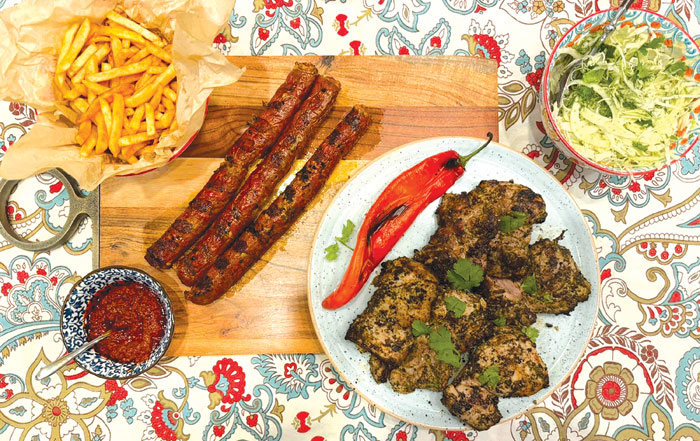
A Sephardic barbecue is different from the all-American version with hot dogs and hamburgers. Whenever my husband Neil wants to have a barbecue, the menu always includes some combination of chicken, steak, spiced ground beef kabobs and merguez (spicy Moroccan sausage).
For many years, I did not approach the grill because that was a “man’s job.” Every Father’s Day, my boys would take Neil for a round of golf and inevitably, dinner would be delayed. I got tired of waiting and figured out how to work the grill. Now, I no longer fear the grill and happily get the job done. Very efficiently, I might add.
I love to grill a whole fish and lots of veggies for a quick, healthy weeknight dinner. But pargiyot, boneless chicken thighs, have become one of my favorite things to grill. So easy and flavorful, thighs adapt well to any spice rub or marinade. I just toss them into a ziploc bag, add my seasoning and allow them to marinate awhile. Za’atar and lemon juice is probably our most go-to flavor profile. But we also enjoy great options like shwarma seasoning, Jerusalem Grill spice blend, a teriyaki sauce marinade or just a simple sweet, mesquite barbecue sauce. I grill the pargiyot at a medium heat, until the chicken has a nice golden crust.
Festive family barbecues at our house are not complete without grilled merguez, a lamb or beef sausage that is spiced with harissa or cumin and chili pepper. This spicy staple of the Maghreb kitchen is a perfect foil for fresh baguette or pita.
While meats and chicken anchor the feast, we love to pile on the sides and condiments. A lemony coleslaw, Israeli salad and potato salad. Fries or rice. Lots of pickles, harissa and tehina.
Nowadays Father’s Day is a bit different because our kids are all grown up. There are no more handmade cards and school art projects. But one thing is golden — there will for sure be a (Sephardic style) barbecue!
—Rachel
Nowadays Father’s Day is a bit different because our kids are all grown up. But one thing is golden —there will for sure be a (Sephardic style) barbecue!
Spicy Grilled Chicken
4-6 chicken thighs, deboned and skinless
1 Tbsp extra virgin olive oil
1 large lemon, juiced 1/4 cup za’atar
Kosher salt, to taste (omit if spice mix has added salt)
Place the chicken thighs in a Ziploc bag with the olive oil, lemon juice and spices. Rub the bag until thighs are completely coated.
Allow to marinate for 10 minutes.
Grill for about 6-8 minutes per side, until chicken is completely cooked.
Oven method
Broil the chicken under high heat for about 5 or more minutes per side, until completely cooked.
Lemony Slaw Dressing
1/2 cup extra virgin olive oil 1/4 cup apple cider vinegar 1 large lemon, juiced
1/2 tsp honey Salt and fresh ground black pepper
In a small bowl, whisk all the dressing ingredients together.
Place vegetables in a serving bowl.
Just before serving, pour dressing over the salad.
Sharon Gomperts and Rachel Emquies Sheff have been friends since high school. The Sephardic Spice Girls project has grown from their collaboration on events for the Sephardic Educational Center in Jerusalem. Follow them
on Instagram @sephardicspicegirls and on Facebook at Sephardic Spice SEC Food. Website sephardicspicegirls.com/full-recipes.
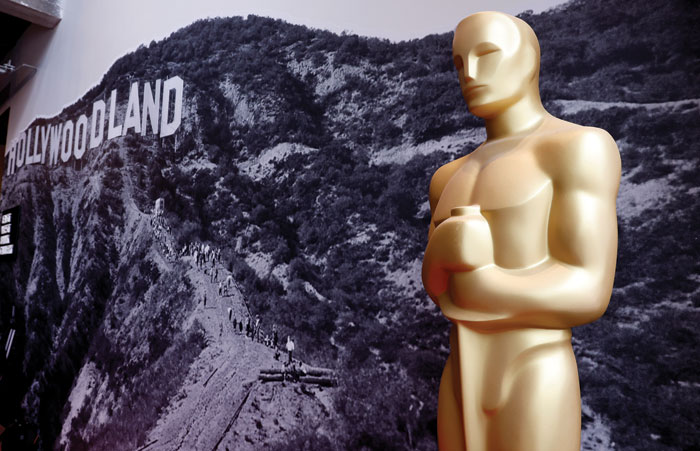
Two-and-a-half years after the opening of The Academy Museum, an exhibit dedicated to the Jews who invented Hollywood finally opened. And “Hollywoodland: Jewish Founders and the Making of a Movie Capital” is a colossal flop. There was plenty of time to come up with an exhibit on Hollywood’s origins and the Jews who fled persecution and created the scene.
A quick overview of the exhibit:
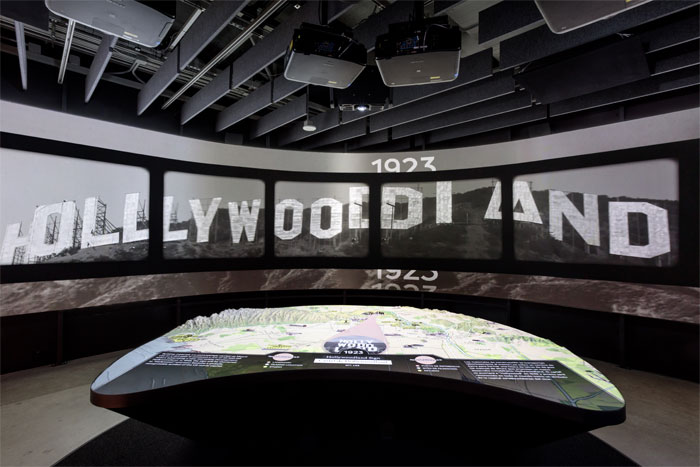
You enter the exhibit through a glass door to a room in the middle of the museum’s third floor. To the right is a relief map of Los Angeles with some geographic history of where these studios were located, plus a few other landmarks. It’s big, bright and incredibly unengaging.
It’s made clear on the displays that several of the Jewish studio heads who shaped Hollywood were like so many other captains of industry during their time — successful but not exactly decent humans.
Front and center of “Hollywoodland” is a wall of eight displays about the major film studios from the early 20th century. The wall is broken up into eight parts: Paramount, Columbia, RKO, United Artists, Warner Bros., Universal, Metro Goldwyn Mayer, and Fox. The big bold names you see at the new Hollywoodland exhibit are well … boring. It’s made clear on the displays that several of the Jewish studio heads who shaped Hollywood were like so many other captains of industry during their time — successful but not exactly decent humans. Their successes and shortcomings are succinctly written, and seem to be intended as a lament of unfair and harmful labor practices — again, not unique to the Jewish community’s business leaders of the era.
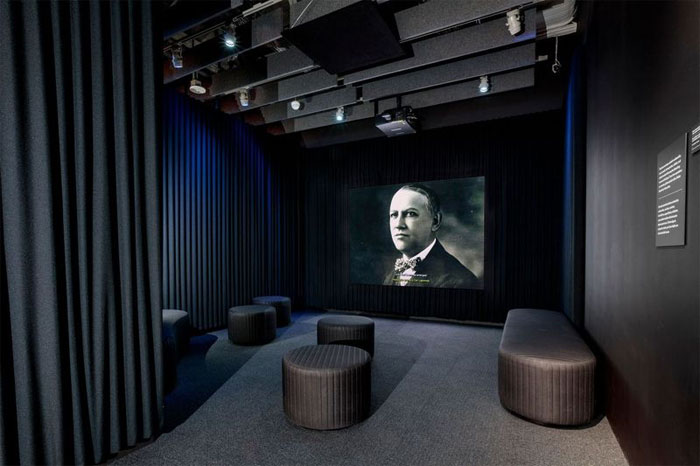
To the left is a small, dark screening room showing a 30 minute video term paper about the complicated history that the exhibit intends to show. It’s titled “From the Shtetl to the Studio: The Jewish Story of Hollywood” and is narrated by Turner Classic Movies’ Ben Mankiewicz (the grandson of screenwriter Herman Mankiewicz). The space is fit for about 10 people to watch comfortably.
The “Hollywoodland” exhibit has not been well-received. It was scorned by critics and several petitions against it have circulated. One petition, “Letter Concerning Double Standards in the Academy Museum Jewish Founders Exhibit” summarized the grievances quite aptly:
“We wish to express our extreme disappointment in, and frustration with, The Academy Museum’s Jewish Founders exhibit. Using the words ‘tyrant,’ ‘oppressive,’ ‘womanizer,’ ‘predator,’ ‘offensive,’ ‘racial oppression,’ ‘nepotism,’ and ‘prejudices’” it is the only section of the museum that vilifies those it purports to celebrate. While we acknowledge the value in confronting Hollywood’s problematic past, the despicable double standard of the Jewish Founders exhibit, blaming only the Jews for that problematic past, is unacceptable and, whether intentional or not, antisemitic. We call on the Academy Museum to thoroughly redo this exhibit so that it celebrates the Jewish founders of Hollywood with the same respect and enthusiasm granted to those celebrated throughout the rest of the museum.”
LA Magazine published several points of contention from Jewish advocates and film industry folk. Among them: the location of the exhibit within the museum, there’s little mention of the technological innovations by Jewish folks behind the camera, it’s small, there’s too much focus on the Jewish studio heads’ business savvy and unlikable temperaments.
It’s true, Columbia Pictures Corporation founder Harry Cohn was not a great guy. Yes, he openly lauded Italian Dictator Benito Mussolini. Metro-Goldwyn-Mayer co-founder Louie B. Mayer wasn’t a decent person either (look up his name and actress Judy Garland on Google). But the story of the Jews who invented Hollywood doesn’t begin and end with the c-suite dudes at the biggest studios.
Still, two-and-a-half weeks after “Hollywoodland” opened to the public, the Academy Museum issued a statement responding to the brooding criticism: “We are proud of all our exhibitions at the Academy Museum of Motion Pictures, including Hollywoodland: Jewish Founders and the Making of a Movie Capital. Our goal with the exhibition is to celebrate the founding of the U.S. film industry and understand what motivated and drove these individuals to create it. We are listening, as some members of the Jewish community have come forward to express some concerns, and are looking at how to address those concerns best while continuing to share an authentic understanding of these complex individuals and the time they lived in. As part of this process, we are continuing to engage with the community members who have come forward with constructive feedback and welcome these conversations. We hope to move quickly and thoughtfully in this process.”
A week later on June 10, the Academy Museum issued another statement acknowledging the criticism of the Hollywoodland exhibit: “We have heard the concerns from members of the Jewish community regarding some components of our exhibition Hollywoodland: Jewish Founders and the Making of a Movie Capital. We take these concerns seriously and are committed to making changes to the exhibition to address them. We will be implementing the first set of changes immediately — they will allow us to tell these important stories without using phrasing that may unintentionally reinforce stereotypes. This will also help to eliminate any ambiguities. In addition to these updates, we are convening an advisory group of experts from leading museums focused on the Jewish community, civil rights, and the history of other marginalized groups to advise us on complex questions about context and any necessary additions to the exhibition’s narrative. We are deeply committed to telling these important stories in an honest, respectful, and impactful way.”
As they say in the film and television industry development Hell, I have notes. Author Neal Gabler’s book “An Empire of Their Own: How the Jews Invented Hollywood” was clearly the primary citation for the Hollywoodland exhibit, and that’s not a bad thing.I don’t claim to know exactly where to put each of the early Hollywood Jewish influencers on a decency scale. And I’m not saying that this exhibit should be the “Early Hollywood Jewish Hall of Fame” either. But as a Jewish, life-long museum-lover and a film geek that writes for a Jewish newspaper in Los Angeles, I have a few suggestions for a much-needed reboot of the Hollywoodland exhibit.
Five Ways To Improve the Hollywoodland Exhibit
1:More focus on the Jewish actors and actresses of early Hollywood.
Were the actors and actresses the founders of Hollywood? No, but when people think of Hollywood from this era, they picture Hollywood’s original superstars, and they’re much more interesting than the studio heads.
Between 1929 and 1949, the first 20 years of the Academy Awards, ten Jewish actors and three Jewish actresses were nominated for best leading role. Fourteen times during that time span, a Jewish Actor was nominated, eight times for a Jewish actress. After supporting actor and supporting actress awards were introduced at the Ninth Academy Awards in 1937, five Jewish actors and three Jewish actresses were nominated for the award before 1950. Several of them fled Europe with nothing, yet absolutely crushed it on screen. Let’s hear about them.
2:Make a long, visual timeline.
You don’t have to ignore the cultural and societal strife, but put the changes in the context of the films that were being released at the time. Every ten years, tell us how many people lived in Los Angeles. For each year starting in 1929, tell us which film won Best Picture and was the highest grossing at the box office. And regardless of the layout of the space, and how the timeline is designed, please make the timeline begin on the left and have it end around 1950 on the far right of the space.
As for the content of the timeline, I’ll outline it for you with a couple of questions:
Late 1800s: What caused the massive Jewish immigration to the United States? Why were the Jews relegated to working only in certain types of arts? Tell us about what antisemitism is.
1900-1910: What did the founders of the big eight studios do when they first arrived? What technology is emerging? What kinds of “low-class” film and theater did the Jewish actors and actresses start doing? What is vaudeville anyways?
1910s:Major studios form. World War I breaks out. Spanish Flu pandemic. Prohibition. Women’s suffrage. That’s a busy decade. What’s happening in Hollywood?
1920s: “The Golden Age of Hollywood.” Who are the big stars? Who was seeing films? Who were the American antisemites who stood in the way? Tell us about milestone firsts in film.
1930s: Rise of fascism in Europe. World War II breaks out. Studio system solidifies. Somehow, “The Wizard of Oz” happens at the end of the decade.
1940s: How does the film industry survive during World War II? Let’s hear about the House Un-American Activities Committee investigations and blacklisting of many Jewish artists. Somewhere halfway in between, mention “It’s a Wonderful Life.”
3:Captivate us with the technological innovations made by Jews.
According to the museum’s press release, there are 145,000 production and costume design drawings, and 8,000 props, process and production items in the Academy’s collection. Let’s see a few of the filmmaking tools that were invented by crafty Jewish innovators. What filmmaking problems did the early technology solve? What were the inventors doing for their day jobs? Everything in that primitive process we 21st century folk can do with our smartphones.
4:Make a map of Europe, showing where Jewish filmmakers, studio heads, and actors lived and worked pre-exodus to Hollywood.
Give us a big map (or several regional maps) of all the places where so many of the early Jewish Hollywood movers and shakers came from. Compliment it with explanations of what was going on in Europe to help visitors understand why so many Jews fled to the U.S. — whether for Hollywood or elsewhere. Stand in the lobby of the Academy Museum for a few minutes and you’ll hear languages from all over the world. Teach them something about their own backyard. Tell us about what life was like over there during that time if you were Jewish.
Also, put the existing giant relief map somewhere else. I am a huge nerd for maps. But even I think the giant relief map takes up too much space that can be better used to tell the Jewish stories from early Hollywood.
5:Keep in mind, this isn’t just for entertainment.
If you’re on the committee that is tasked with rebooting the Hollywoodland exhibit, go be a tourist in a museum or Hall of Fame. Think of your favorite museums you’ve ever been to — the fascinating, the entertaining, and the morbid — think of what you remember from the first time you went. Go back and visit them if you can.
You can stick with the facts while still creating a balance between the inspiring and the downright shameful when creating a museum. For every nasty Harry Cohn, there were many many more kind generous Jack Benny’s. Like any marginalized group trying to make it in a new place, some of our people made history while also leaving a shameful legacy. But there’s always going to be many more of us who left a positive dent in the world. A museum is a place where you can learn about both.
When the Academy Museum opened in 2021, it felt like a celebration of film in Los Angeles at an affordable price (unlike the studio tours) and in a clean environment (unlike the Hollywood Walk of Fame). I wrote two articles in the Journal about how much I learned and how much I was excited to tour it with my family members living outside of California. I saw what was missing at the Academy Museum and I excused it. With a new museum, similar to a new restaurant, the first few weeks (and sometimes months) can be ripe with missteps, poor taste and just plain old things that you can’t prepare for prior to the unwashed masses visiting. At the Academy Museum, the Jewish origins of the film industry in Los Angeles were an omission that, sad to say, was not obvious to everyone.
If you have an idea, put it out in the world. Crowd-sourcing the design might be the way to go for the reboot. After all, it was a public design competition that led to the Vietnam Veterans Memorial in Washington, D.C. The winning design was created by a 21-year-old college student, Maya Lin. The design was selected from a pool of 1,432 submissions. The Academy Museum might need that many to get the Jewish history of early Hollywood right.
I’m rooting for this exhibit to be better, because I know it can be better.
One verse, five voices. Edited by Nina Litvak and Salvador Litvak, the Accidental Talmudist
Thus Naomi returned from the country of Moab; she returned with her daughter-in-law Ruth the Moabite. They arrived in Bethlehem at the beginning of the barley harvest..
– Ruth 1:22
Aliza Lipkin Writer and educator, Maaleh Adumim, Israel
The symbolism of Ruth arriving in Beit Lechem at the beginning of the barley harvest is robust. The barley harvest begins on the second night of Pesach, the first day of a newly redeemed Israel. A nation transformed from slaves of a foreign country into a nation free to dedicate their lives to G-d, their people, and their mission to be a light unto the nations.
We begin counting the Omer at the onset of the barley harvest and finish counting by Shavuot. These interim days serve as an opportunity to perfect our character. In doing so we strengthen our bond with G-d as we renew our dedication to Him and His Torah on Shavuot.
Ruth’s resolve to commit to a Jewish life was rewarded with Divine Providence guiding her to glean from Boaz’s field. She arrives at the start of the barley harvest corresponding to the beginning of the Omer count, which is no coincidence. After she declares her full allegiance to Naomi, G-d, and the Jewish people she is ready for the transformation these days offer. Her valuable time spent with Naomi was bolstered during these fortuitous days gleaning with Boaz’s maidens, no doubt learning the essentials she will need to mother Boaz’s child and to instill those values into her descendants who will ultimately yield Moshiach.
This parsha teaches us that anyone, even a foreigner from a despicable nation such as Moav, can uplift themselves to the highest level given the will and determination to do good.
There are different types of miracles. There are miracles that WOW, like the 10 plagues in Egypt, the splitting of the sea, and even something as recent as the Six-Day War. Then there are the “quiet” miracles, the ones that seem more coincidence than anything else, of being in the right place at the right time. But make no mistake about it: “Quiet” miracles are every bit as miraculous as the “loud” ones. The story of Rus and the building of the foundation of Moshiach is the story of a quiet miracle. Ostensibly, it seems like just another story that starts off negative but has a happy ending. It is not. Below the surface is a story of the Divine manipulation of history to bring about fantastic results that have impacted all of history with the best yet to come, likely in our time. Who knows where the story really began, but it certainly was advanced when Lot left Avraham to live in Sodom, from where he was later forced to flee with his wife and two daughters. He lost his wife along the way, and eventually had sons through his daughters. The one named Moav became the people from whom Rus eventually descended, and later left behind when she converted to Judaism. Eventually, Rus gave birth to the Davidian line of kings and Moshiach, and the soul that was hidden in Sodom was redeemed by Lot, passed on to Rus, and born into her son, the soul of Moshiach.
On the first day I attended a reserve police academy, I was given law books for the State of California and Los Angeles County. Together, they contained more than 10,000 statutes, codes, and laws. Considering this, the 613 biblical commands no longer appear overwhelming, as some critics of the Torah argue.
When Ruth decided to return to Bethlehem with Naomi, she was not frightened by the “burden” of the Torah. To the contrary, she was prepared to join the Jewish people by accepting the God of Israel and the responsibility of observing the commandments. This commitment is alluded to in Hebrew letters of Ruth’s name which have a numerical value of 606. Since Ruth was already following the seven Noahide commandments, by accepting the additional 606 she brought the total to 613.
This lesson is particularly appropriate for the Shavuot holiday, which commemorates the giving of the Torah to the Jewish people more than 3,300 years ago. The Torah contains spiritual, moral, and ethical lessons, and the Jewish people have proudly carried the torch of the commandments and served as a “light to the nations.”
In these troubling times compounded by confusion and lack of moral direction, the Ruth narrative reminds us of our collective responsibility to transform the world into a world filled with the knowledge of God, which will be ushered in by Ruth’s descendant, the heir to the Davidic throne, who will bring our messianic hopes of peace to fruition.
Rabbi Benjamin Blech Professor of Talmud, Yeshiva University
Are Jews members of a race or a religion?
The answer is so important that it is the reason behind the special reading for Jews on the holiday of Shavuot, the day commemorating the giving of the Torah on Mount Sinai.
It is the Book of Ruth – the story of a Moabite who voluntarily chose to identify with the children of Israel. Ruth was not a Jew by birth but a Jew by choice. And that makes her the heroine of a historic decision that was divinely blessed by God with the birth not too many years later of two major biblical figures: King David as well as, ultimately, according to tradition, the Messiah!
It was Maimonides who was famously asked whether a convert to Judaism may pray with the words “Our God and the God of our fathers, the God of Abraham, the God of Isaac and the God of Jacob.” The ruling universally accepted is positive. More decisive than biology in defining our ancestry is belief. Judaism is the fulfillment of Martin Luther King’s dream that his children “will one day live in a nation where they will not be judged by the color of their skin but by the content of their character.”
Ruth is the paradigm of the Jew not defined by race — race is not a personal choice — but by our values. It is rooted in one fundamental truth: God created every one of us in His image, representatives of the universal divine image. Understand that and you grasp the link between Shavuot, Ruth — and the Messiah.
Rabbi Lori Shapiro Artistic Director/Open Temple
Ruth has a cache like none other; a young widow who travels outside her family’s homeland, she says little, but when speaking, the words transform. Captivating in her vulnerability, Ruth, a young bride and now widow, uses language sparingly. So why is verse 22 a repetition of verse 19, which already establishes that Ruth and Naomi have reached Bethlehem? Why the repetition of the return?
I’ve always been drawn into the idea that the text translates “Kalatah” as “daughter in law” when it literally writes “her bride” (complete with a possessive “mapik” in the hey, a sign that this bride belonged to Naomi). This word is a keyhole into the repetitive meaning. It is here that the text transforms, an act of t’shuvah. “Naomi returned, “or “did t’shuvah.” In the wake of her mourning, she is turning and returning, “and Ruth the Moabite, her bride, with her.” A new life has begun for the women in the fields, as they return from the fields of Moav. Ruth makes Naomi feel young again. Their friendship restores Naomi, and her t’shuvah through mourning is nursed through this sacred bond. And there they came, to Bet Lechem at the beginning of the barley harvest, a harvest representing all people, as barley was the most modest of grains. It is in Bet Lechem that Naomi is restored and the reaping of the harvest a symbol of the completion of this cycle of mourning to life. May we all rediscover this restoration through love.
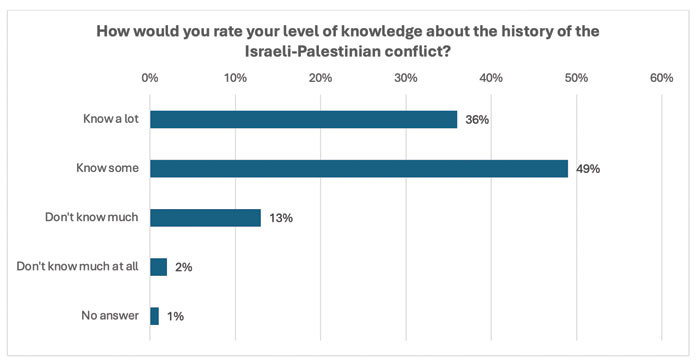
“Now then, if you will obey Me faithfully and keep My covenant, you shall be My treasured possession among all the peoples.” So says the verse from the Book of Exodus that was read on Shavuot. “Treasured possession” is a translation of a term whose meaning is less than clearly defined – “Am Segula.”What does the term mean? It could mean a special people, or a people especially loved by God, or a people owned by God (a common interpretation), or a people that is especially important. Some commentators suggest that “Segula” distinguishes the Jews from the rest of humanity. Others suggest that “Segula” requires the Jews to get highly involved with the world to try to fix it. Is the nation of Israel special? The Torah seems to say that it is. Most Jews in the State of Israel agree. Nearly half of them believe that Segula means “that the people of Israel have a special role in the world.” A minority (16%) think it means that the people of Israel “have obligations that other nations do not have.” A very small minority (2%) believes that “the people of Israel have rights that other nations do not have.”
The data is from a survey of JPPI in which about a third of Israeli Jews said that they do not believe that Israel is a special nation — Am Segula. Does this mean that they disagree with the Torah? Not necessarily. In the verse we quoted it is said that if the people of Israel behave as God demands — then they will be Am Segula. So those who do not believe that Israel is Am Segula assume one of two things. Either the people of Israel do not obey God and therefore are not Am Segula, or what the Torah states in the name of God is not true. Clearly, these are two very different assumptions.
One can guess which of the two assumptions is more common. First, because of the one-third of Jewish Israelis who do not agree that the people of Israel are Am Segula, the majority (19% of the total) say that Am Segula is an “arrogant/racist” idea. The concept of specialness is foreign to their world and outlook. And this is consistent with the sector to which they belong: of the seculars in Israel, 58% do not agree that Israel is Am Segula. Most of those (36% of the seculars) believe that the concept is arrogant or racist. In contrast, all religious Israelis agree that Israel is Am Segula. Overall, there is also a broad consensus among religious and ultra-Orthodox on the meaning of the term: the Jews have a special role in the world. This is what makes them Am Segula.
In a previous survey, when Israelis were allowed to mark more than one answer to the question, a majority of religious Israelis marked two — they said that Am Segula means both that the Jews “have a special role” and that they have “obligations that other nations do not have.” About a third of them also marked “rights that other nations do not have.” So religious Israelis believe that the Jews have a special role, special duties, and to some extent (but this is not the majority view) also have special rights.
Religious Israelis are used to the word “Segula,” and the meaning they attribute to it does not make them uncomfortable in any way. Seculars have difficulty with Segula as it is a word they identify with a tribal, separatist mindset.
Is this social difference between religious and secular Israelis important? That’s not an easy question to answer. It may be a difference that mainly reflects differences in the way people use language. Religious Israelis are used to the word “Segula,” and the meaning they attribute to it does not make them uncomfortable in any way. Seculars have difficulty with Segula as it is a word they identify with a tribal, separatist mindset. That term isn’t a part of their Western, egalitarian, liberal terminology. By the way, that wasn’t always the case. David Ben-Gurion discussed the question of Segula unapologetically. Segula, according to him, is equivalent to prophets’ demand “to establish one’s life on the foundations of kindness and truth, justice and peace.”
And yet, the difficulty of seculars with the term “Am Segula” is understandable. If all people are equal, then the claim of “specialness” could seem awkward.
We asked if the difference is important: it may be. It may be that on certain issues — say, the treatment of non-Jewish Israelis — acceptance of the term “Segula” leads to one practical conclusion, and its rejection leads to another practical conclusion. What will this conclusion be? Theoretically, it could be that those who think that the Jews are a special people will conclude that they should be less considerate of others. Theoretically, the opposite can also be the case: Those who think that the Jews are a people who have special obligations, will conclude that they are obliged to be more considerate of other peoples. Theoretically — both conclusions are possible. But practically … look at the data and understand for yourself what happens in practice.
Something I wrote in Hebrew
I was asked to write about Israel “hasbara” (PR). Here’s what I wrote:
It is easy to explain a good government, it is easy to explain a reasonable policy, it is easy to explain a balanced, considered leadership. It is impossible to explain Ministers Amichai Eliyahu, or Bezalel Smotrich, or MK Nissim Vaturi. It is impossible to explain Minister Itamar Ben-Gvir. And no speaker, no magician, no pyrotechnics, no special office for special affairs, no investment in budgets, no appointment of polished English speakers – none of these is going to help. Therefore, Israel does not have a hasbara problem … because such a government cannot be explained, and it is not certain that there is any point in making an effort.
A week’s numbers
This nugget from the AJC annual survey of US Jews reminded me of the fact that most people believe they a better than average drivers.
A reader’s response:
Nathan Erlich commented: “Your negativity towards the current Israeli government is becoming tiring.” My response: Thinking about the government, I feel exactly the same.
Shmuel Rosner is senior political editor. For more analysis of Israeli and international politics, visit Rosner’s Domain at jewishjournal.com/rosnersdomain.
On a recent Sunday morning, an energized group of 25 teenagers gather at Sinai Temple in Westwood. Their enthusiasm is justified. They have a busy day ahead of them.
When everyone’s ready, the teens hop on a bus, their excited chatter filling the air as each makes their way down the aisle to find a seat. Boys sit with boys. Girls with girls. The destination is the Skirball Cultural Center.
Inside a theater at the Skirball, they strap on cutting-edge virtual reality headsets. Suddenly, they find themselves inside an immersive environment while interacting with Albert Einstein. The state-of-the-art technology provides insight into innovations developed by Technion-Israel Institute of Technology.
As the day continues, the group of teens are treated to an aerial presentation of drones, led by specialists from Ben-Gurion University. Afterwards, they participate in a discussion about Israeli water technology.
Jeff Polak, AKLA Founder
This flurry of stimulation is a typical Sunday for the participants of AKLA, a bold new initiative that facilitates experiential mitzvah projects and activities for Jewish kids ages 12-14, around the time of their bar or bat mitzvahs. The timing is intentional; it’s a transitional moment when teens begin to carve out independent paths for themselves, the organization’s founder, Jeff Polak, told The Journal in a phone interview.
“We showcase the awesome achievements and accomplishments of the Jewish people, whatever they may be,” Polak said. “Our goal is to excite kids who are 12 to 14 years old, b’nai mitzvah age, to get them on a track to be enthusiastic about this amazing community and understand the breadth of the Jewish people’s accomplishments.”
What’s AKLA?
Pronounced “ACH-la,” AKLA’s name derives from the slang Hebrew word for “awesome,” “excellent,” or “great.”
Each day’s program is designed to emphasize the unique achievements of the Jewish and Israeli people, particularly those who’ve had a lasting impact on society.
Over the course of five consecutive Sundays, AKLA students travel by bus to sites around the city — their stops include the Skirball Center, the Jewish Federation Los Angeles headquarters and the Academy Museum of Motion Pictures — where they participate in sessions led by experts in entertainment, medicine, technology and self-defense, among other fields. Each Sunday is a jam-packed, half-day program designed to emphasize the unique achievements of the Jewish and Israeli people, particularly those who’ve had a lasting impact on society. “We’re not religious or political,” Tonia Barber, AKLA’s executive director, told The Journal. “We’re just celebrating the awesome accomplishments and contributions of the Jewish community to society.”
Five Weeks in AKLA
On a recent Sunday, a cohort of AKLA teens visited the Mid City headquarters of the L.A. Jewish Federation. There they participated in activities revolving around security and defense. The group heard from a panel of Israel Defense Forces soldiers and Jewish Federation security experts in discussions that were framed to be informative without frightening the teens, Barber said.
AKLA students participate in the Krav Maga session. Photo by Kyle Ellis
Cole Saltzman, one of the students in the 2023 fall cohort said the Krav Maga session was worthwhile considering the constant attacks targeting Jews today. “A lot of people now are thinking of Jews as less than normal, and it really sucks, so you need to be able to defend yourself and your rights,” he said.
“When we go to a hospital like Cedars-Sinai and see how far it’s come, from a hospital with five beds, to what it is today, and we learn about how it’s a hospital with Jewish roots, the kids can’t help but feel proud of that.” – Jeff Polak
On the following Sunday, they traveled to Cedars-Sinai Medical Center, where they practiced cardiopulmonary resuscitation (CPR) maneuvers on mannequins, toured the hospital’s simulation center and met with Rabbi Jason Weiner, director of the medical center’s spiritual care department. “When we go to a hospital like Cedars-Sinai and see how far it’s come, and we learn about how it’s a hospital with Jewish roots, the kids can’t help but feel proud of that,” Polak said.
Case in point: As the group of teens first approached the hospital, they saw a Star of David prominently placed on the top exterior façade of the medical center, which was founded at a time when other hospitals refused to offer Jews equitable care or allow Jewish physicians onto medical staffs. Of course, the teens had been unaware of this history, and had a tough time fathoming there could be a time when antisemitism was so openly part of society.
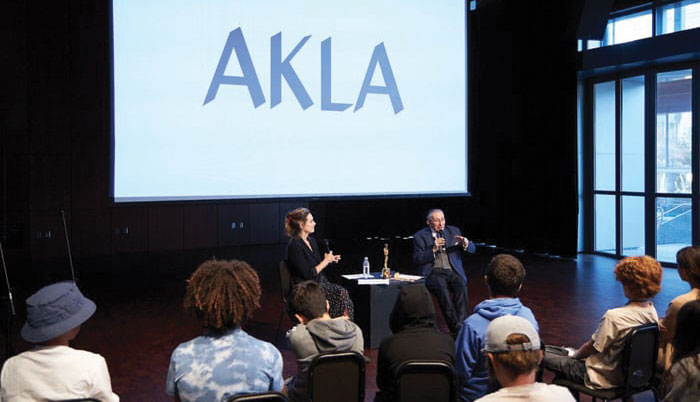
AKLA students meet with Simon Wiesenthal Center’s Rabbi Marvin Hier during an arts and media day. “The kids loved hearing his stories and being able to touch the Oscar,” AKLA Executive Director Tonia Barber says. Photo by Kyle Ellis
As they looked up at the Jewish star, they felt a keen sense of pride. “I think they feel validated, and they feel seen, and they feel excited,” Rabbi Lori Shapiro, the program’s rabbinic educator, told The Journal in an interview while discussing “AKLA moments.”
Shapiro is the founder of an innovative Venice Beach-based Jewish community, Open Temple, and she previously served as the director of Jewish life at USC Hillel. She has years of experience working with young Jews and knows what makes them excited about Judaism. She compared AKLA’s structure and goals to Birthright Israel, which is widely acknowledged as successful in fostering a strong connection among its participants to Israel.
“With Birthright, someone noticed you can have as much impact with a 10-day experience as you do with five years of Hebrew school. People love that. I think AKLA borrows from that wisdom,” she told The Journal. “It gives people a very dense, well-programmed, thoughtful and respectful invitation to experience their Judaism.”
During their AKLA trips, the teens visited two museums: the Museum of Tolerance, where they participated in a tour of the facility, met with a Holocaust survivor and learned about a Holocaust remembrance project, and the Academy Museum of Motion Pictures, where the day’s topic was “Arts and Media.”
They learned about Jewish movie studio moguls who helped develop the film business into the multibillion-dollar industry it is today, from Carl Laemmle to Louis Mayer to Steven Spielberg.
At the latter, they learned about Jewish movie moguls who helped develop the film business into the multibillion-dollar industry it is today, from Carl Laemmle to Louis Mayer to Steven Spielberg.
Deli food is part of the Jewish experience, so they swung by Canter’s Deli for lunch, where they were given a tour of the deli’s pickle room by one of the restaurant’s owners. “They were just taken with all of it,” Barber said.
AKLA students complete writing exercises as part of their five-week experience. Here they craft letters to IDF soldiers after Oct. 7, including a thank-you note to a VR creator who was called back to Israel for service and whose tech was premiered during AKLA. Photo by Kyle Ellis
Why AKLA?
Ultimately, AKLA’s leadership want Jewish teens to feel good — awesome, even — about being Jewish. Working with Polak is an advisory board that includes Shapiro; Jewish Journal Editor-in-Chief and Publisher David Suissa; Jewish educator Samara Hutman and Jewish Community Foundation of Los Angeles Board Chair Evan Schlessinger.
By exposing them to the many areas where Jews have succeeded and excelled and by introducing the teens to Jewish and Israeli contributions to local and global society, AKLA is instilling in them a sense of Jewish pride. Between Israeli-engineered VR-experiences and engaging, relatable discussions about how the mythology of “Superman” is rooted in Judaism, AKLA exposes the teens to the persistent spirit of Jews who’ve overcome antisemitism and taken control of their own destinies.
Of course, AKLA didn’t anticipate Oct. 7. In the aftermath of the worst single-day attack on Jews since the Holocaust, the teens’ program has taken on new significance. (AKLA’s previous cohort met for the first time on Oct. 12, just five days after the attack.) While AKLA’s youth were raised during a time where attacks against Jews existed only in distant stories told to them by their grandparents or great-grandparents, recent surges in antisemitism have demonstrated Jewish safety is never a guarantee.
“Right now, people are scared to be Jewish. People don’t know if they want to be out as Jews and AKLA offers people, like, absolute permission to be Jewish. It’s not political, it’s not identity politics. It’s like pure, good, clean Jewish innovation. That’s we what we do. From Torah to today, we’re innovators.” – Rabbi Lori Shapiro
“Right now, people are scared to be Jewish,” Shapiro said. “People don’t know if they want to be out as Jews and AKLA offers people, like, absolute permission to be Jewish. It’s not political, it’s not identity politics. It’s like pure, good, clean Jewish innovation. That’s we what we do. From Torah to today, we’re innovators.”
For Polak, the mission of spreading a pro-Jewish message to young Jews is vital. Among his own two children, he observed their adoption of a universalist, tikkun olam-centric idea of Judaism that emphasizes repairing the world through environmentalism, social justice and ending homelessness. While no doubt important, those issues fail to expose young Jewish souls to the richness, beauty and complexity of Judaism, expand their knowledge of their faith or deepen their Zionism, he said.
The David and Janet Polak Foundation, founded by Polak’s parents, completely subsidizes the AKLA program, allowing it to be free for each student. Polak, a certified investment management analyst, serves as the foundation’s president and executive director.
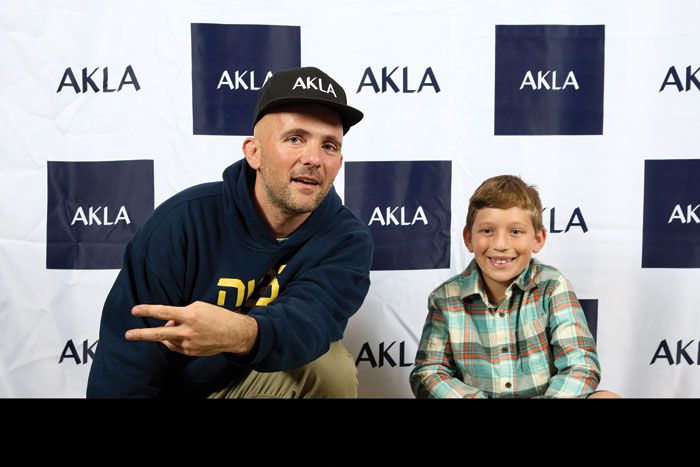
Jewish rapper Kosha Dillz joins an AKLA student during a luncheon held at Hillcrest Country Club. Photo by Kyle Ellis
Since its inception in 2012, the foundation has supported Israel, the American Jewish community and other causes. It has donated funds to more than 50 organizations, including Cedars-Sinai Medical Center, Los Angeles Jewish Health, formerly known as L.A. Jewish Home, and the Technion-Israel Institute of Technology.
AKLA is the latest venture that’s close to the philanthropic family’s heart.“The Polaks have attended a number of the [AKLA] sessions,” Barber said. “They feel great the kids are learning this vital information.”
How to Get Involved
Sinai Temple and Temple Judea in Tarzana have been recruiting teens for the AKLA program, with Temple Judea’s Rabbi Cantor Alison Wissot playing an active role. Milken Community School and Pressman Academy have informed their students’ families about the program.
Currently, the organization is conducting outreach for its next cohort, which is scheduled to begin in October after the High Holy Days. AKLA accepts applicants on a rolling basis, and the website — aklausa.org — offers details on how teens can apply.To date, the organization has served nearly 80 teens, with approximately 25 in each of the three cohorts that have thus far been held.
The teens’ religious backgrounds span the spectrum — some are secular, others religious — and bringing teens from such a diverse range of Jewish households together is part of what makes AKLA unique, Polak said.
“It’s nice to bring that broad community together. We have kids who are very secular and are not participants in any meaningful way in Judaism, and we’ve had kids who are religious. And a lot in-between.”– Jeff Polak
“It’s nice to bring that broad community together,” he said. “We have kids who are very secular and are not participants in any meaningful way in Judaism, and we’ve had kids who are religious. And a lot in-between.”
What’s Next?
The organization has enjoyed sufficient success here in Los Angeles that its leadership believes it can scale, expand and serve additional Jewish communities. That means AKLA could soon be reaching Jewish teens in Chicago, New York, Miami, Boston and San Diego.
“We’re looking to have a big expansion of our program this coming fall,” Polak said. “We’d like to increase our numbers and have this operating in other cities.”
For those in Los Angeles, an AKLA event is tentatively scheduled for June 23 at Warner Bros. Studios,celebrating the Jewish origins and founders of Hollywood.
“I’ve always thought of Judaism as sort of, like, you’re-sitting-in-a-temple-praying-kind-of-thing. And I think that really opened my eyes to how it can be enthusiastic, it can be different.”– AKLA student Jack Berkett
The enthusiastic response to the program has led Polak to believe he’s onto something. He’s even seen AKLA alumni wearing their AKLA sweatshirts while out in Palisades Village.“I’ve always thought of Judaism as sort of, like, you’re-sitting-in-a-temple-praying-kind-of-thing,” Jack Berkett, 13, a member of the 2022 fall cohort said. “And I think that really opened my eyes to how it can be enthusiastic, it can be different.’”
For Polak, it all crystallized for him during a recent lunch with an AKLA teen’s dad who told him his son now wants to wear a kippah in public because of his positive experience with AKLA. “AKLA is the one thing that everyone can agree on,” Polak said. “It’s awesome, if you will.”
Ryan Torok is a contributing writer to the Jewish Journal.
“What Does Hollywood Owe Its Jewish Founders?” wondered a recent headline in the New York Times as the controversy continued regarding the Academy Museum of Motion Pictures having neglected to include Jews in its portrayal of the emergence of Hollywood when the museum opened in 2021. Despite the founding forces of Warner Brothers, Universal, Columbia, Paramount, 20th Century Fox, and Metro-Goldwyn-Mayer being Jewish, most of them immigrants, this was somehow not part of the history the museum set out to tell. Its former director Bill Kramer denied to the Times that this had been in error, admitting only “it was clear that this was something that certain stakeholders were expecting.” This after a Hollywood historian told Rolling Stone that leaving the Jews out of the story of the film industry was “sort of like building a museum dedicated to Renaissance painting and ignoring the Italians.” Thankfully, a new permanent exhibit, “Hollywoodland: Jewish Founders and the Making of a Movie Capital,” was added and opened last month.
As Jews continue to navigate antisemitism from Hollywood to the Holy Land, we can draw inspiration from a very different Jewish founder, the biblical figure of Ruth, whose story we just read on the holiday of Shavuot. A remarkable figure, Ruth was a Moabite married to one of the sons of Naomi, an Israelite from Bethlehem who lived during the period of Judges, which followed the death of Joshua, Moses’ successor. After the passing of their respective husbands, Ruth accompanied Naomi back home in an act of selfless loyalty, proclaiming “Wherever you go, I will go… Your people shall be my people and your God my God.” Back in Bethlehem, Ruth met and eventually married Boaz. They produced a child, reviving the family line and the psychological spirit of both Ruth and Naomi.
Ruth acts, in her starring role, as a foreign refounder of the Children of Israel. Though our patriarch Abraham is credited rightfully with being history’s first Jew, Ruth’s actions both mirror and perhaps even supersede those of the patriarchal predecessor’s initial journey to the Promised Land. As literary scholars have pointed out, Ruth’s actions bear a striking similarity to Abraham’s:
Both head to the land of Israel despite an uncertain future — Abraham by God’s command and Ruth simply out of generosity of spirit.
Abraham is promised that upon arriving there he will be a great nation, blessed and of strong societal standing. Ruth is offered no such reward, and Naomi even attempts to dissuade her from coming at all.
Abraham sets out with both wife and wealth in tow. Ruth is a destitute widow.
As the Bible professor Yair Zakovitch has put it, “This inverted comparison between Ruth and Abraham testifies that this Moabite woman, who knows no selfishness, who leaves her country out of commitment to her mother-in-law with no hope to become a mother herself, is a more noble figure than the nation’s father, Abraham.”
As a coda to Ruth’s commitment to Naomi, the Book of Ruth ends with a genealogy. It reveals that Ruth’s son Oved’s descendant was none other than King David, the paradigmatic poet-prophet monarch, for whose kingdom’s restoration in the form of the Messiah Jews pray three times a day. “The foreignness of Ruth is what enables her to supply the Israelites with a refurbishment they periodically need,” observed the political philosopher Bonnie Honig, “she chooses them in a way that only a foreigner can … and thereby remakes them as the Chosen People,” setting in motion the redemption of the world. Her act of kindness helped Israel emerge from its period of disarray and divisiveness and head towards a kingdom blessed by the divine.
Though they were hardly of the spiritual status of Abraham or Ruth, Hollywood’s founders saw in their creation an ability to write new stories, both for their new country and themselves. As the Times notes, citing Neal Gabler’s 1988 book, “An Empire of Their Own: How the Jews Invented Hollywood,” Louis B. Mayer, a co-founder of MGM, claimed that his birth papers had been lost during his emigration from Russia and declared his birthday would now be the Fourth of July. To these founders, Judaism was incidental, perhaps even a hindrance to the new tales they wanted to tell. The Academy Museum’s initial effacement of Jews, then, continued its industry’s preference for rewriting its roots.
Standing thankfully in contrast is Ruth. Arriving as a foreigner, she proudly proclaimed loyalty to the Jewish faith and Jewish people. Deeply dedicated to her Judaism even in the most fraught of times, her commitment to God’s covenant with the Jewish people authored a story that continues to shape history more than any Hollywood blockbuster, or museum, ever will.
Rabbi Dr. Stuart Halpern is Senior Adviser to the Provost of Yeshiva University and Deputy Director of Y.U.’s Straus Center for Torah and Western Thought. His books include “The Promise of Liberty: A Passover Haggada,” which examines the Exodus story’s impact on the United States, “Esther in America,” “Gleanings: Reflections on Ruth” and “Proclaim Liberty Throughout the Land: The Hebrew Bible in the United States.”
American Jewish University (AJU) Chairman of the Board Harold Masor and his wife, Amy, announced their $4.5 million donation to AJU at the gala event held on Sunday, June 2. In recognition of this generous donation, the School for Jewish Education and Leadership will be renamed the Masor School for Jewish Education and Leadership.
“I am passionate about supporting Jewish education and ensuring the continuity of the Jewish people,” Masor said. “Amy and I believe that providing an endowment to AJU’s School for Jewish Education and Leadership is crucial to the success of the school and, subsequently, the Jewish community at large.”
In a further display of dedication, the Masors are extending their philanthropic support with an additional $550,000 donation earmarked for enhancing Camp Alonim, AJU’s Jewish summer camp in Simi Valley. This generous gift will directly support the thousands of children who attend Camp Alonim, allowing them to foster a deep connection to their Jewish heritage.
“Masor and Amy’s involvement with major Jewish organizations exemplifies their dedication to making a lasting and positive impact on the broader Jewish community,” said AJU in a statement.
During the event, AJU President Jeffrey Herbst stated that the name change is most appropriate given the Masors’ dedication to Jewish education and continuity.
“This is especially important because we know that the decision to belong to a synagogue is often directly related to early childhood Jewish education.“
– AJU President Jeffrey Herbst
“We express our deepest gratitude to Amy and Harold Masor for their transformative contributions,” said Herbst. “This generous donation will enable us to strengthen our contribution, expand our reach, improve educational programs and drive positive change for generations to come. Now generations of teachers will be able to benefit from Harold and Amy’s generosity to serve and inspire Jewish children and their families. This is especially important because we know that the decision to belong to a synagogue is often directly related to early childhood Jewish education.”
Guests enjoyed a festive brunch that included an omelet stand, bagels, lox and cream cheese, waffles, salads and drinks. Stand-up comedian Elon Gold hosted the event, garnering laughs primarily through his Israeli imitations, explaining the differences between Israelis and American Jews and joking about those who refer to Israelis as colonialists: “Jewish settlers? The only place where Jews ever settled was the Catskill Mountains.” He quipped about Gen Z: “They don’t know what Intifada is; they think it’s something you order at Taco Bell.
Comedian Elon Gold
“I’ve been to Israel twice over the past few months and was happy to perform for the soldiers and offer some comic relief,” Gold said. “At one of the performances, I thanked the soldiers for protecting our people and the commander said, ‘Sorry, wait, wait, wait, wait.’ In Hebrew, every word is repeated several times, not just once: No, no, no, come, come, come.”
Violinist Niv Ashkenazi and bassoonist Leah Kohn also performed at the event.
Violinist Niv Ashkenazi and bassoonist Leah Kohn
Earlier this year, on February 20, AJU finalized the sale of its Familian Campus to Milken Community School, the private Jewish high school and middle school in Bel Air. The sale enabled AJU to pay off all of its debt and achieve greater financial strength.
AJU still maintains the 2,700-acre Brandeis Campus in Simi Valley where Camp Alonim is run as well as additional programs. Rabbinical school classes will continue at a building in the Pico-Robertson area. Since the purchase was completed, AJU relocated a significant portion of its library (120,000 volumes) to the Brandeis-Bardin Campus.
During the gala, the university honored two veteran scholars: Michael Berenbaum, professor of Jewish studies and a well-known Holocaust scholar and Rabbi Elliot Dorff, rector and professor of philosophy and expert on Jewish law.
Berenbaum, former president and CEO of the Foundation for the Visual History of Holocaust Survivors and Rabbi Dorff, who has taught at AJU since 1971, are longtime colleagues and friends. They introduced each other, showing their deep appreciation and admiration for one another. They then presented each other with the university’s certificates of appreciation.
“Not only will this certificate hang in our house, but it will also each hang in each other’s home,” said Berenbaum. “Because it’s a friendship. It’s brotherhood. It is an ongoing dialogue between researchers, friends, rabbis and teachers. We continue this dialogue every Shabbat. Elliot comes to the synagogue to talk to God. I come to the synagogue to talk to Elliot.”
For millions of families in the United States, spring turning into summer means baseball season shifting into full gear — from Major League stadiums to the small-town Little League sandlot fields.
For media personality Teresa Strasser, baseball season is more than just a sport her young son plays during the summer. Strasser’s new memoir, “Making It Home: Life Lessons from a Season of Little League,” stands as a warm exploration of family, grief, and the redemptive power of baseball. Through the lens of her son’s Little League season, Strasser’s memoir will bring any former Little Leaguer back to the days of summer on the baseball diamond.
She won a Daytime Emmy for writing on “Win Ben Stein’s Money” on Comedy Central, and is well-known for her work on “The Adam Carolla Show.” And it’s quite evident in her dark-humored scenes that balance between wit and tense family drama. The critics have taken note too. USA Today named “Making It Home” one of the best books of 2023.
“Making it Home” begins with the heart-wrenching state of Strasser’s life: Her brother Morgan’s battle with cancer and subsequent death. Just four months later, her mother passed away. Baseball serves as a metaphor throughout the book, representing life’s unpredictability and the stages/innings of grief.
“Redemption is baked into the game. You’re not promised a happy ending, but there’s always room for one.“– Teresa Strasser
“I think that’s why baseball was such a good backdrop for this story,” Strasser told The Journal. “Cause there’s always hope in baseball. There’s no clock. As Yogi Berra said, ‘It ain’t over ’til it’s over.’ There’s always the possibility for something great to happen. Redemption is baked into the game. You’re not promised a happy ending, but there’s always room for one.”
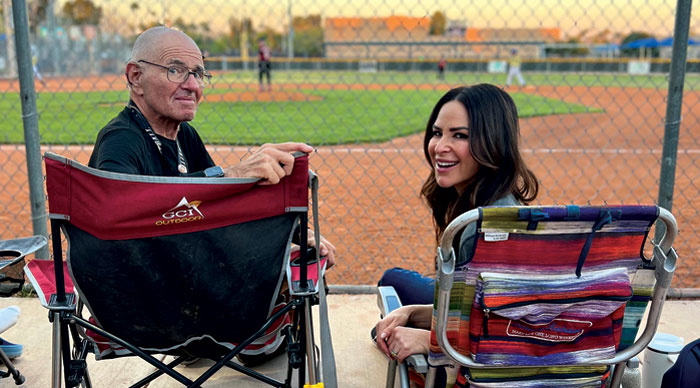
Strasser’s father, Nelson, has quirks that will resonate with anyone who has a father who’s a bit boorish and rough around the edges. Underneath the surface, Nelson is a loving and dedicated grandfather. He would often be one of the earliest arrivals in the stands at his grandson’s Little League games. Throughout the book, Nelson’s presence at these games becomes a therapeutic healing space for both him and Strasser, helping them both process their grief in a shared space.
“My dad would roll up [to Little League games] on his bike, throw a green sheet over it,”Strasser said. “He has half his teeth, none of his hair. He’s not like the country club grandpas that I saw all around. But by the end of the season, I was so proud because no other grandpa had been to every game and every practice.”
Strasser said that watching baseball with her father resurrected a healthy version of her brother.
“We could see him out there,” Strasser said. “When we watched my son, I remember my son was playing first base, and my dad said, ‘Morgan never missed a grounder. He knew how to play the bounce. He played the ball. He never let the ball play him.’”
She discusses the trauma of her childhood, including the custody situation where her mother lost custody of both her and Morgan when Teresa was just three years old. This separation shaped her relationship with her father and, ultimately, tested her resilience.
“There are two fight scenes with my dad [in the book] that were so ugly and brutal that they were very difficult to write,” Strasser said. “And I just thought, ‘if I said the unsayable, and if I write it down, people are going to hate me and they aren’t going to root for me.’ But then I realized if you’re writing a book about redemption in a family and you don’t include the bad part, then what are you being redeemed from?”
The book also delves into Strasser’s personal insights and philosophical reflections on grief and existence. Reflecting on the role Judaism played in this book, Strasser sees a connection between mourning and America’s pastime. “Jewish mourning rituals are about community, and so is baseball,” Strasser said. “You’re in a group, even if it’s not Little League, even if it’s the majors, you’re part of a community of fans for that team. And there’s something magical about that. You belong. But it’s not going to be that there’s a magical stage and you wake up one day and all that heavy sadness or survivor guilt is gone. It’s more like your state is going to change. You might not feel better, but you’re going to feel different, and different becomes better.”
Scenes of Nelson’s grief are especially powerful. Strasser describes her father riding his bike, screaming Morgan’s name into the night. Despite his flaws and quirks, Nelson emerges as a hero in “Making it Home,” a figure of resilience and dedication who finds redemption in his role as a grandfather. Strasser said that if she could have any actor play her father on screen, it would be Henry Winkler.
The memoir also highlights the emotion of watching her son Nathaniel play sports. Strasser’s memories of her brother playing baseball shape her experiences and coping mechanisms. The Little League season, with its emotional highs and lows, mirrors life’s unpredictability and the process of grieving.
Even for non-baseball fans, the emotional depth and humor in “Making It Home: Life Lessons from a Season of Little League” make it a compelling and therapeutic read. Readers may even be inspired to find their own unconventional ways to relate to loved ones. “That’s what I love about [baseball], I can have a deeply satisfying exchange of emotion and ideas with my dad, and it’s just about baseball,” Strasser said. “But it feels like a deep conversation that’s satisfying because we’re talking about losing on the diamond, but we’re also talking about all kinds of loss or all kinds of hope or all kinds of triumph.”
Teresa Strasser shared more about her book “Making It Home” with the Journal. The conversation has been edited for length and clarity.
JEWISH JOURNAL: What was going through your mind as you revisited some of these really difficult situations?
TERESA STRASSER:I think with grief, there’s this concept of adaptive oscillation. My grief therapist taught me that. And it seems like, but if you can go back to work, maybe you should, because grief is so intense that you need breaks from it. And if you can go to work or do something else, then that’s healthy for you. And it allows you to work through your grief. That’s what baseball was for my dad and me.
JJ: How do you handle rejection and criticism?
TS: When I experience rejection, I take it really hard. I’m wired to have an extreme emotional reaction to things. So it’s not like it’s water off a duck’s back. That water is soaking me to the bone, but I just keep going because I don’t have another choice. I also think some people might be born just with a resilient gene. I have always picked myself up. But it’s with the caveat that I feel it, and I take it hard every time. I take every rejection hard, every loss hard.
JJ: What has surprised you most about people’s reactions to your book?
TS: One surprise is that non-baseball people love the book. People who have never watched any baseball get it and relate to it. I think that’s the magic of baseball. Somehow, it lends itself to story and metaphor. And I think any parent can relate to the feeling of worrying about your kid and wanting your kid to succeed. And all of us are going to experience grief if we haven’t already and lost.










 For media personality Teresa Strasser, baseball season is more than just a sport her young son plays during the summer. Strasser’s new memoir, “Making It Home: Life Lessons from a Season of Little League,” stands as a warm exploration of family, grief, and the redemptive power of baseball. Through the lens of her son’s Little League season, Strasser’s memoir will bring any former Little Leaguer back to the days of summer on the baseball diamond.