fbpx

June 12, 2024

LA’s Academy Museum to Revise Exhibit on Jewish Founders After Criticism from Jewish Hollywood Figures

An exhibit about Jews in Hollywood that launched at the Academy Museum of Motion Pictures in Los Angeles following an outcry from Jewish critics is now getting a revision — following another outcry from Jewish critics.

The museum opened its first-ever permanent exhibit, a deep dive on the Jewish pioneers who laid the groundwork for Hollywood, on May 19. “Hollywoodland: Jewish Founders and the Making of a Movie Capital” launched two and a half years after the museum opened without the history of the industry’s Jewish beginnings.

Designed as a response to critics who complained about Jewish exclusion from the museum, the exhibit highlights the Warner brothers, Louis B. Mayer, Adolph Zukor and other Jewish film giants. And now, it has drawn fire for portraying some of those figures in a negative light.

“We wish to express our extreme disappointment in, and frustration with, The Academy Museum’s Jewish Founders exhibit,” said an open letter signed by more than 300 industry professionals. “Using the words ‘tyrant,’ ‘oppressive,’ ‘womanizer,’ ‘predator,’ ‘offensive,’ ‘racial oppression,’ ‘nepotism,’ and ‘prejudices,’ it is the only section of the museum that vilifies those it purports to celebrate.”

The statement acknowledges “the value in confronting Hollywood’s problematic past,” but goes on to accuse the museum of creating a “despicable double standard.”

“Blaming only the Jews for that problematic past, is unacceptable and, whether intentional or not, antisemitic,’ the letter says, before calling on the museum to “thoroughly redo this exhibit.”

The letter was organized by United Jewish Writers, a coalition that formed shortly after Hamas’ Oct. 7 attack on Israel as the Hollywood unions were divided over whether and how to issue statements condemning the attack and supporting Israel. The group previously organized an open letter rebutting “The Zone of Interest” director Jonathan Glazer’s Oscars speech that harshly criticized Israel.

The new letter asked signatories not to post publicly on social media and does not display who signed. But according to The New York Times, signatories include executive Casey Wasserman, actor David Schwimmer and writer Amy Sherman-Palladino.

“This is not unconscious bias, this is conscious bias,” producer Lawrence Bender, who signed the letter, told the Times. “It feels like a hatchet job on the Jews.”

The letter followed mounting criticism — covered by local outlets TheWrap and Los Angeles Magazine — since the exhibit’s launch, including from Israeli-American director Alma Ha’rel, who resigned from the museum’s inclusivity committee after touring.

On Monday, the museum announced that it was making changes in response to the feedback.

“We have heard the concerns from members of the Jewish community regarding some components of our exhibition,” said the statement, released before the United Jewish Writers letter arrived. “We take these concerns seriously and are committed to making changes to the exhibition to address them.”

A first set of unspecified changes would be made “immediately,” the statement said, adding that the changes “will allow us to tell these important stories without using phrasing that may unintentionally reinforce stereotypes.”

The museum also said it would convene an advisory group composed of “experts from leading museums focused on the Jewish community, civil rights, and the history of other marginalized groups to advise us on complex questions about context and any necessary additions to the exhibition’s narrative.”

Ahead of the opening of the “Hollywoodland” exhibit, Jacqueline Stewart who until last month served as the museum’s director and president, had told the Jewish Telegraphic Agency that community feedback played a role in the construction of the exhibit. (Her departure was planned prior to the exhibit’s opening.)

“I really feel that we’re able to present this exhibition now in a way that’s better than it would have been if we had tried to tell the story when we first opened,” Stewart said during a press preview. “Because we understand our audiences better.”

The new exhibit initially drew plaudits, including from some who had previously criticized it for excluding Jewish stories. But the new critiques, made at a time of extreme anxiety about Jewish inclusion, started soon after.

“The exhibit is a lazy and insidious condemnation of Hollywood’s founders,” writer Patrick Moss told LA Magazine. “The focus is not on the founders’ achievements — but on their sins.”

“The exhibit is a lazy and insidious condemnation of Hollywood’s founders,” writer Patrick Moss told LA Magazine. “The focus is not on the founders’ achievements — but on their sins.”

LA’s Academy Museum to Revise Exhibit on Jewish Founders After Criticism from Jewish Hollywood Figures Read More »

How Filming ‘Guns & Moses’ Brought Two Sisters Closer to Judaism

In Salvador Litvak’s new movie, “Guns & Moses, Mila Brener, 19, and Juju Brener, 12, play the daughters of Rabbi Mo Zaltzman (Mark Feuerstein). The Zaltzmans live in a small, quiet town where a neo-Nazi teen is accused of murder. The rabbi steps in to prove the boy’s innocence and confronts a far more sinister villain. The film also stars Christopher Lloyd, Dermot Mulroney, Neal McDonough, and Alona Tal.

The film will premiere on June 19th at the Los Angeles Jewish Film Festival and will be followed by a Q&A with the director, Feuerstein, actor Michael B. Silver, and the Brener sisters.

“This is the first time we are playing sisters and also Jewish characters,” Mila said. “And not only are that, but they are Orthodox. We didn’t know much about this world, so we watched a couple of documentaries and read a lot online to understand what it’s like. Why do girls cover their bodies? Why our mom in the film, portrayed by Alona Tal, wears a wig? It removed a lot of stereotypes for us.”

The Brener sisters were born in Los Angeles to actress/producer Shirly Brener and artist Bruce Rubenstein. They started acting and modeling at a young age. Previously, Juju played the young character of Sarah Jessica Parker in “Hocus Pocus 2,” and Mila had guest roles in the TV series “Mom and “Ray Donovan.”

“We grew up in a non-Orthodox household. Although our parents are both Jewish and celebrate the high holidays, we didn’t know much about the Orthodox lifestyle. We are so grateful to be cast in these roles because it has taught us so much about Judaism and brought us closer to being Jewish,” Mila said.

Filming took place in Santa Clarita and coincided with Hanukkah 2022. One of the sisters’ favorite memories was celebrating the holiday on set. “Sal, the director, is religious and lit the candles with us and everyone on set, including the non-Jewish crew members. He told us tales about Hanukkah,” Juju said. “He was not only a director but a teacher. He explained why each tradition is practiced. It was very educational.”

Mila plays Esti, the eldest daughter. Talking about their character, she said Esti “is very strong and brave, acting like the brain of the family. She handles all the technical aspects, is very intelligent and tech-savvy. I related to her a lot.”

“I played the younger sister who basically always follows her older sister and likes to do what she’s doing, just like in real life,” Juju added.

Director Litvak, known as “The Accidental Talmudist” and is co-editor of The Journal’s “Table for Five,” grew up with two Holocaust survivors, including his grandmother Magda who was pregnant with his mother during the war, said he couldn’t imagine that the film he made before the war in Israel would be so relevant just a few months after production. “We conceived ‘Guns & Moses in the wake of the synagogue shooting in Poway, California. We knew antisemitic attacks would always be relevant, but we never imagined that the most deadly attacks since the Holocaust would occur on Oct. 7, during the post-production of our film.”

We conceived ‘Guns & Moses’ in the wake of the synagogue shooting in Poway, California. We knew antisemitic attacks would always be relevant, but we never imagined that the most deadly attacks since the Holocaust would occur on Oct. 7, during the post-production of our film.” – Salvador Litvak

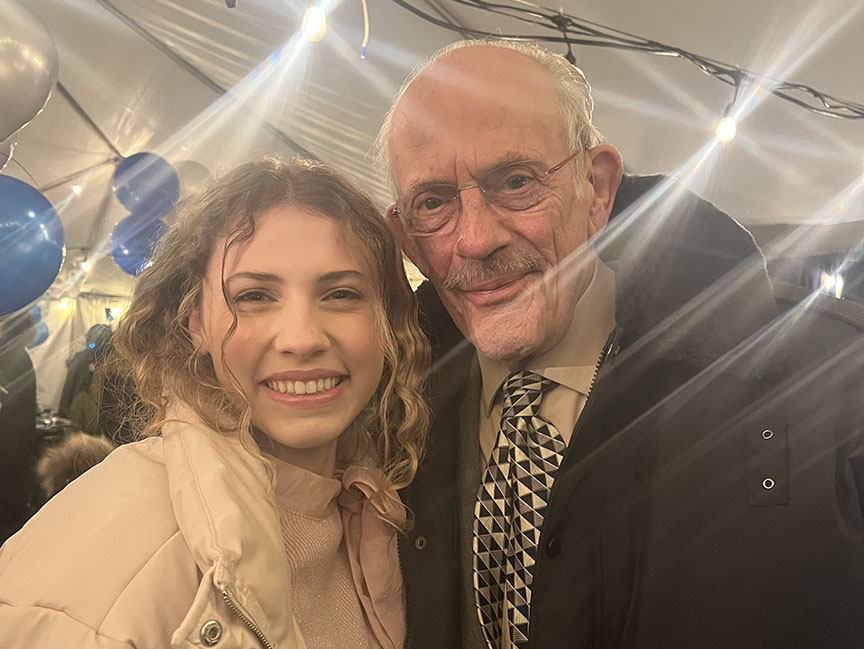
One of Mila’s favorite memories of shooting “Guns & Moses was meeting actor Christopher Lloyd (“Back to the Future”). “It was an honor meeting him. He is such an iconic person. We had a scene together, and while we were waiting for them to set the shot, it was super cold. We were freezing. I was with my mom, and I told her, ‘It’s cold AF.’ Christopher looked puzzled and asked me, ‘What does ‘AF’ mean?’ I whispered in his ear, and his face brightened. He smiled and said, ‘I like that. I’m going to use it.’ So now I can say I taught Lloyd a bit of Gen Z slang.”

Mila with Christopher Lloyd

Mila, who was accepted to Loyola Marymount University, said she never experienced or witnessed antisemitism until Oct. 7. “Unfortunately, I know of many friends at U.S. campuses who were segregated just because they are Jewish. They were told they couldn’t be in certain parts of the campus or couldn’t walk freely, and these are universities they were accepted to and paid for. It’s unimaginable.”

Although it’s the first time the two have played sisters, they have collaborated before on different projects. Previously, Mila directed a six-minute short starring Juju, “Not My Circus,” and recently, they worked on a music video for Juju’s single ‘Buzzin,’ which was released on all music platforms and became popular on TikTok. The music video was shot around Los Angeles and features a hybrid reality versus fantasy narrative and was done in collaboration with YMI Jeans.

“It was really fun to film, although a bit challenging,” Juju said. “There were times when people walked into the frame, and we needed to reshoot the scene.”

“People kept asking, ‘Who is that?’” Mila, who directed the video along with Antonio Chavez Trejo, said. “The vibe of the video was ‘follow your dreams and live your best life’. We shot in the most iconic locations in L.A. such as Santa Monica Pier, Hollywood Boulevard and the view of downtown. We were surrounded by people and tourists who tried to touch a piece of the glamour of the city and it was a great opportunity to showcase all the places our city is famous for.”

The sisters hope to collaborate more in the future, both in film, TV and music videos.

“Guns & Moses” will have its North American premiere at the Saban Theater on June 19 at 7pm, followed by a Q&A with Sal Litvak, Mila & Juju Brener and other guests.

How Filming ‘Guns & Moses’ Brought Two Sisters Closer to Judaism Read More »

UCLA Announces New Chancellor

UCLA announced on June 12 that their new chancellor is going to be Dr. Julio Frenk, the outgoing president of the University of Miami who also happens to be a Latino Jew.

The university noted in their announcement that the 70-year-old Frenk had been serving as the University of Miami’s president since Aug. 2015, where “he achieved a dramatic turnaround of the university’s academic health system, drawing on the strengths of its Miller School of Medicine, and made strategic investments in educational innovation and interdisciplinary research” and promoted “culture of belonging,” in his words. Born in Mexico, Frenk has also previously served as that country’s secretary of health, a World Health Organization executive director and dean of Harvard University’s T.H. Chan School of Public Health.

“At this crucial moment for higher education, returning to the public sector to lead one of the top research universities in the world — including one of the 10 largest academic health systems — is an exciting opportunity and a great honor for me,” Frenk said in the university’s announcement. “I look forward to adding my lifelong commitment to public service in education and health care to the vibrant, diverse and cosmopolitan community that is Los Angeles.”

At a press conference announcing Frenk’s appointment, the chancellor-to-be vowed “inclusive excellence” at the university and will be focused on building “bridges among disciplines, among geographies,” The Daily Bruin reported. Additionally, the Bruin paraphrased Frenk as pledging “to balance protecting free expression with ensuring that the university can provide a learning environment free from harassment and discrimination.”

“Dr. Frenk has demonstrated a powerful commitment to the health and well-being of people, institutions and systems around the world,” UC President Michael Drake said in a statement. “His leadership will build on the growth and strength the campus has achieved under Chancellor Block and accelerate UCLA’s brilliant trajectory in service to Los Angeles, the nation and the world.”

Outgoing Chancellor Gene Block released a statement calling Frenk “an excellent choice” who is “widely respected across academia.” “UCLA is in great hands,” he said. “I am certain that UCLA’s star will rise even higher under Julio.”

U.S. Rep. Ted Lieu (D-West Los Angeles) said in a statement, “ Dr. Frenk is a renown global health expert who admirably led the University of Miami. He is the son of a German Jewish father who fled Nazi Germany, and will make history as UCLA’s first Latino Chancellor. He will bring meaningful perspective to his work at UCLA. I look forward to working with Dr. Frenk and have no doubt he will build on outgoing Chancellor Block’s incredible work in making UCLA the outstanding university it is today.”

Frenk will officially begin his tenure as UCLA chancellor in January 2025; Block is stepping down at the end of July 2024. UCLA Executive Vice Chancellor and Provost Darnell Hunt will serve as the interim chancellor.

Following the Oct. 7 Hamas attack, Frenk issued a statement that read in part: “We stand in solidarity with the people of Israel, with all those impacted by the violence, and with all who seek peace. The images emerging from the war are harrowing. Our hearts break for Israelis and for the Jewish state, as well as for the innocent Palestinians, Druze, Bedouins, and others who live within its borders and the region. The most recent reports indicate more than 1,200 lives have been lost so far. We condemn any form of aggression targeting civilians, including the taking of hostages.” He also noted the University of Miami’s “deep ties to Israel.”

In November, Frenk was part of a panel on the University of Miami’s campus last November with Hillel International CEO Adam Lehman and Jewish student Abi Schcolnik; Frenk said that “Freedom of expression has clear rules and clear limits. Number one: no hate speech, no incitement to violence, and no public display of support to organizations that have been officially declared by our government as terrorist organizations.”

UCLA Announces New Chancellor Read More »

Rabbi Jill Turns Mid-Life Career Change Into a Success

They say when one door closes, another one opens. For newly-minted Rabbi Jill Gold Wright, that was very much the case. When she was ordained to the rabbinate last month, she was ending a 27-year career teaching at Mt. San Antonio College. What caused that sharp turn? “A few years before my 50th birthday,” Rabbi Jill explained, “I was starting to feel a little utzy at my job. It took a year of thinking about what to do next.” She passionately loves teaching, but saw how some longtime colleagues were just waiting to retire. “I was not unhappy, but unhappy at being at my job another 15 years. Almost on the edge of unfulfillment. Like I wasn’t there yet. I still am not there. But I knew it was coming. I saw a lot of my  colleagues who were drag-g-g-g-g-g-ging to retirement at 65. One colleague had a red sharpie literally slashing away the days he had left.” Her father had died at 54, and she was ”not going to slash my days away. Not me.”

Helping her make the decision was Cantor Ruth Berman Harris at the Pasadena Jewish Temple & Center (PJTC). Rabbi Jill, a Burbank native, and her family have been davening there for nearly 15 years, and she had become “extremely close friends” with Cantor Ruth. “As I was thinking about what I wanted to do the second half of my life,” Gold Wright said, “I was talking to Ruth about various options. She said, ‘Why don’t you go to rabbinical school?’”

Her first instinct was to dismiss the idea. “Why would I want to go to rabbinical school?”  But even before she finished that sentence, Gold Wright was thinking, “rabbinical school … A lot about that was very exciting to me.”

There were many reasons why: “One, I love school. I have always been a student. I am a lifelong learner. I love being in classes. I like learning things. About 15 years after I completed my PhD, I was feeling pretty intellectually staid.” A tireless worker and steely self-driver from childhood, Gold Wright felt she was coasting not pushing. “I wasn’t reading much besides 120 student essays a week,” she said. For professional stimulation, she would rework the syllabus for her Mt. Sac classes. “Bringing in new texts for my own sanity. But I was not really pushing myself intellectually.”

If she was going to pursue the rabbinate, Gold Wright promptly eliminated two of the three Los Angeles rabbinical schools: Hebrew Union College and the Ziegler School at American Jewish University. Both require full-time participation plus a year in Israel. 

“I have a job, a spouse, two children in school, a mortgage, a cat and two guinea pigs,” all of which added up to her saying “no, thank you.” 

The Academy of Jewish Religion | California offered something different. “The special contribution of AJR is for second-career people who can’t drop everything for five years,” Gold Wright said.

Dipping her toe in without making a stone-cold commitment, Gold Wright told herself “I am not going to make a decision.” Her friend Cantor Ruth advised her to “take one class and see. If it’s the right thing, you will know.” The cantor was correct.  “On Day 4 [at AJR], I said ‘Let’s go! Sign me up! I want to matriculate.’”

It was still a rigorous program. “I was taking four classes and teaching four classes – which is what I have been doing for the past five years. Full-time at Mt. Sac, full-time at the Academy. It’s been a lot.”

There were three crucial keys to her success: “I am ridiculously organized, a hard worker and I also have an ability to focus intensely on one task for a period of time.” She learned to break her days into two-hour periods. She would teach for two hours, grade for two hours, or be in an AJR class for two hours. “I was always double dipping,” she said. “If I was taking my kid to gymnastics, I would have papers with me to grade. Or if I was taking my kid to piano, I would sit outside with a Tanach and do my homework.” Once she entered rabbinical school at the Academy, Gold Wright would make homework dates with her son, now 19, and her daughter, now 14. 

“After picking them up at school and getting them a snack,” she explained, “everyone would take a seat at the table. For 45 minutes, we would focus on what we were doing. Then we would take a break and run around the backyard before returning to the table.”

This teacher/rabbi is intensely disciplined. “When things are due and you don’t have a choice, you just do it,” she explained. “Never felt like a chore. I hold myself to maybe an unhealthily high standard. But it is a standard I am proud of.  I just do the work. I am not a super-genius.”

In Gold Wright’s third year of rabbinical school, the country was coming out of COVID, and she landed her first internship with Beit T’Shuvah — one year as a spiritual counseling intern at their addiction treatment center. “It was a little difficult to triangulate among Mt. Sac, Culver City and my house,” she said.

In spring 2022, Gold Wright interviewed with Rabbi Brian Schuldenfrei at Adat Ari El, Valley Village. He asked what she needed to learn. A lot, she said, because she had not grown up in the Conservative movement. “All of that summer I was doing power walks while listening to davening in my ears,” she said. “I worked really hard. Brian Schuldenfrei taught me an enormous amount.”

Jill Gold Wright is launching her rabbinic career at the Pasadena Jewish Temple & Center, her spiritual home since 2010, while doubling — how fitting — as Director of Education.

Fast Takes with Rabbi Jill

Jewish Journal: What figure in Jewish history would you like to have a meal with?

Rabbi Jill: Twenty names are swimming in my head. I would say Rav Kook. I once wrote an essay comparing Rav Kook and Walt Whitman. They were very much the same kind of democratic, spiritual lover of humanity and nature and the world.

J.J.: What is your favorite Jewish food? 

R.J.: Two: A really good bialy with fresh cream cheese and a lot of lox. Also, my husband’s latkes, crispy on the outside, quite pillowy on the inside with sour cream and applesauce.

J.J.:  What is your favorite family activity?

R.J.: Throwing on a daypack and tromping through cities with my family. Last summer we took a seven-week odyssey, two weeks in Israel, five weeks in Europe. The rule was everyone does everybody else’s favorite. We travel hard – museums, concerts, events, tours, busses, trains, underground. Every place must be seen.

Rabbi Jill Turns Mid-Life Career Change Into a Success Read More »

Lessons Learned and Not Learned From the al-Nuseirat Raid

Amidst the pain of war, the Israel Defense Forces conducted a brilliant, beautiful raid. The IDF rescued four Israeli Jewish hostages alive. The al Nuseirat raid in Central Gaza was conducted with the precision of the raid on Entebbe that launched a young Benjamin Netanyahu to political stardom. Noa Argamani, Almog Meir Jan, Shlomi Ziv and Andrey Kozlov are now safe and sound to spend Shavuos with their loving families thanks to the IDF’s skilled determination. 

Yet even the sunniest of moments brings out those seeking to find rain and darkness, much of it imagined. The al-Nuseirat raid offered valuable lessons that will be ignored while bringing new anti-raid rationales that deserve to never be learned.

For starters, the raid’s success had zero percent to do with diplomacy. Those worshipping at diplomacy’s altar may not always be completely useless, but they were in this instance. Exactly zero percent credit for this raid belongs to diplomats sipping tea with dictators. This raid was hard military power at its most efficient and effective.

Those worshipping at diplomacy’s altar may not always be completely useless, but they were in this instance. Exactly zero percent credit for this raid belongs to diplomats sipping tea with dictators. This raid was hard military power at its most efficient and effective.

One leftist reporter from the anti-Israel British Broadcasting Company asked why the Central Gaza Arabs were not given advance warning of the raid. IDF International Spokesman Lt. Col. (Ret.) Jonathan Conricus had to explain to Helena Humphrey what a raid actually is. Conricus added that “in the upside-down universe of activist journalism, this question makes total sense.”

Another lesson never learned comes from those offering useless and often fictional Arab death statistics and those blindly believing those fake and meaningless numbers. 

The numbers are fake because Hamas, who behead, rape and torture people, falls short in other ethical ways. They are lying weasels who lie because other anti-Israel lying weasels eagerly and reflexively believe anti-Israel lies. Grossly inflated death statistics since the start of the war have already been debunked as impossible by Wharton statistician Abraham Wyner. 

More importantly, even if the false Hamas casualty numbers were to be true, they would still be irrelevant. Nothing in the history of war ever mandated proportionate war deaths. The very argument is nonsensical. Proportionality means perpetual stalemate and endless war. Decisive disproportionate force and deaths cause victories and defeats, which end wars. 

Additionally, nothing in the history of war prohibits collateral damage in severity or amount. Collateral damage has always been unfortunate and completely legal. 

Anti-Jewish zealots and other apologists are screaming that 274 dead “Palestinians” is too high a price to pay for only four Jewish hostages. Vice President Kamala Harris lamented the Gaza Arab deaths, ignoring that some of them were hostage takers. Israel is defensively insisting that the number of dead Gaza Arabs is under 100, as if that matters. 

The argument itself is dubious.  Collateral damage by definition is accidental, and the number of genuinely unfortunate allowable accidents can’t be fixed. The precedent for this came when President Harry Truman dropped atomic bombs on Hiroshima and Nagasaki. Hirohito quickly surrendered to end World War II, saving millions more lives. Military power, not diplomacy, saved the world. 

Finally, the raid’s success strengthened Prime Minister Netanyahu and his right-wing coalition. Benny Gantz quit the unity government, which should cause pro-Israel people everywhere to shrug. Gantz claimed that he quit because Netanyahu refused to implement the Biden-Blinken ceasefire plan. If this is true, Israel is better off. Netanyahu wisely rejected an Israeli surrender plan and insisted that a total military victory was still the objective. His right-wing government partners cheered the return of hard military power after a brief flirtation with diplomatically assisted national suicide. 

Before the raid, it looked like the Biden administration would help Hamas wait out Netanyahu until he was ousted in favor of a more pliant Israeli government. After the raid, the tables have turned. Netanyahu hopes to wait out the Biden administration in the realistic hope that it is replaced with a more Israel-friendly Trump administration. 

The al-Nuseirat raid will not make State Department diplomats or anti-Israel college professors more useful. Yet this spectacularly successful raid has changed the game back in favor of Israel militarily, politically, morally, and from a morale standpoint. It was a good day at the office for the IDF and everyone who bleeds blue and white. These colors don’t run. They fight and win.


Eric Golub is a retired stockbrokerage and oil professional living in Los Angeles.

Lessons Learned and Not Learned From the al-Nuseirat Raid Read More »

A Bisl Torah – Renewing our Vows

When I stood under the chuppah with my husband, I chose the following verses to share with him:

“I will betroth you forever;

I will betroth you with righteousness, justice, goodness and mercy;

I will betroth you with faithfulness.”

These verses from Hosea are the same one recites when daily donning tefillin. We daily recommit ourselves to God and the ideals of Torah. Our dedication to living lives immersed in compassion, empathy, goodness and truth must be strengthened through ritual for we know how easily one succumbs to anger, selfishness, jealousy and hatred.

While each morning we offer this mantra to God, Shavuot is considered our annual renewal of vows. An anniversary. The Torah is our ketubbah. In the same spirit of recommitting to a beloved, may we evaluate our own behaviors within the relationship we have with God. Reminiscing over memories, grieving through losses and making space for the shared journey yet to come.

The reenactment of receiving the Torah on Mount Sinai is a reenactment of our own stepping into an eternal partnership with our Creator. May this year’s Shavuot, this year’s renewal of vows be filled with gratitude and thanks for the life we have been given and each subsequent day we are blessed to live in this beautiful world.

Chag Sameach and Shabbat Shalom


Rabbi Nicole Guzik is senior rabbi at Sinai Temple. She can be reached at her Facebook page at Rabbi Nicole Guzik or on Instagram @rabbiguzik. For more writings, visit Rabbi Guzik’s blog section from Sinai Temple’s website.

A Bisl Torah – Renewing our Vows Read More »

Kafkaesque Evolution of Antisemitism

Memory of persecution used to be a major factor that united

all Jews, but was replaced in many members of the nation

by the illusion that they were all cordially invited

to join the gentiles in the gentle process of assimilation.


Unfortunately its policy did not succeed. Though not politically correct,

their persecution would evolve pseudo-PC peacefully into discrimination,

just as “antisemitism” would, becoming anti-Zionism, an insect

like Kafka’s Gregor Samsa when transformed into a pest without an explanation.


Discrimination though illegal has persisted; Jews who

don’t disavow their alien Jewishness are liable

to be accused of Zionism, a Jewish point of view

which I’m afraid will make survival of too Jewish Jews less viable.


Translation can be very difficult as

demonstrated by the case of Dreyfus,

for whom translation from Alsatian Jew

to Frenchman evolved problematically,

like the translation of a kosher

word into one that, sounding trayf, is

as dissonant as antisemitism

translating Zionism traumatically.


This poem was inspired by two reviews in the May 31 issue of the TLS.

In “A Jewish life: The heroic survival of Alfred Dreyfus, victim of French antisemitism,” Natasha Lehrer, reviewing Alfred Dreyfus: The Man at the Center of the Affair by Maurice Samuels, writes:

Samuels argues that France at the time was such a hotbed of antisemitism that, “if you asked observers in 1899, at the height of the Dreyfus Affair, to predict which country was mostly likely to unleash a genocide against Jews, they would very likely have guessed France”. While Dreyfus was neither a religious nor a spiritual man, he never sought to disavow his Jewishness, and it is possible that this refusal may have “attracted the negative attention of his superiors” that led to his arrest.

In “An unsettling vision: Franz Kafka reconsidered, 100 years after his death,” Karen Leeder, reviewing Der Process, by Franz Kafka, edited by Reiner Stach, Kafkas Werkstatt: Der Schriftsteller bei der Arbeit, by Andreas Kilcher and Selected Stores, by Franz Kafka, translated by Mark Harman, writes:

All translation is difficult, but rendering Kafka especially so. The difficulty resides in the fact that, as the Kafka translator Michael Hofmann observes, his language is “as approachable as it is strange”. If Kafka’s Prague German is austere, it also rests on ambiguity and self-consciously plays games. But multiple layers of meaning that are held in tandem in one language rarely offer themselves in the same way in another language. Faced with a term, a translator must choose.

A case in point is the famous first sentence of the story known as “The Metamorphosis”, which Harman retitles “The Transformation”: “Als Gregor Samsa eines Morgens aus unruhigen Träumen erwachte, fand er sich in seinem Bett zu einem ungeheueren Ungeziefer verwandelt”.

Harman has: “One morning when Gregor Samsa awoke in his bed from restless dreams he found himself transformed into a monstrous insect”.

The word Ungeziefer is famously non-specific, indicating something like vermin or a pest. Equally ungeheuer – the opposite of geheuer, or familiar – ranges in meaning from egregious to monstrous. A translator must decide whether to maintain the impression of deliberate ambiguity, for example with “some kind of monstrous vermin” (Joyce Crick’s solution for Oxford World’s Classics); or focus the inner eye with the splendidly specific “cockroach” (Hofmann for Penguin Classics). Kafka had a horror of an actual insect being depicted on the cover of his work; although the writer and entomologist Vladimir Nabokov claimed to have identified the precise species of beetle, in fact the creature Gregor becomes is a deliberate shapeshifter in terms of form and scale.


Gershon Hepner is a poet who has written over 25,000 poems on subjects ranging from music to literature, politics to Torah. He grew up in England and moved to Los Angeles in 1976. Using his varied interests and experiences, he has authored dozens of papers in medical and academic journals, and authored “Legal Friction: Law, Narrative, and Identity Politics in Biblical Israel.” He can be reached at gershonhepner@gmail.com.

Kafkaesque Evolution of Antisemitism Read More »

How My Wife’s Conversion Brought Me Back to Judaism

After I graduated from high school and went on a year course in Israel, I made a decision: I wasn’t going to be religious anymore.

I’d gotten kicked out of my yeshiva for bad grades in secular studies and ended up in public school. A Jewish organization I was involved with snubbed me for no good reason, and then I lived in a community where nobody invited me for Shabbat meals. I felt out of a place and rejected, so I decided it’d be easier to just disconnect. Aside from that, I was getting into stand-up comedy, and that required performing on Friday nights. I enjoyed it, I made friends easily and it was fulfilling. I felt good.

So, for years, I didn’t keep Shabbat, I didn’t eat kosher and I only half-heartedly celebrated the Jewish holidays with my family. I didn’t date any Jewish girls because I didn’t want to get pulled back in. 

It worked for a while. I thought I had found a great non-Jewish girl named Kylie. We started dating and fell in love. One Friday night, I took her to Chabad, a place I’d gone to a few times because the rabbi stopped me on the street and encouraged me to come. I could go there for a nice free meal and that was it. I thought that the Friday I took Kylie, she’d enjoy it, and that’d be it.

But it wasn’t. She loved it so much that she asked me to go back every week. And then one day, she told me she was thinking about converting. She told me that although she was an atheist, she believed in G-d again, and she felt like she had a Jewish soul. 

I was worried. I tried to discourage it. This was the last thing I wanted to happen.

She said she wanted to go to conversion classes, but I wouldn’t have anything to do with it. I didn’t want to become religious again, because then I’d have to give up doing shows on Friday nights and everything else in my career that I’d worked so hard to build. I’d have to face the very people who rejected me. I secretly hoped that she’d learn something she didn’t like and get the idea of converting out of her head. 

Kylie kept pressuring me to go with her to the class. I decided one night to go and sabotage it. When the class was over, I let loose on the rabbi. I told him everything I was upset about with Judaism and everything I’d been through. 

I thought he would kick us both out of the class and that would be the end of it. Instead, he listened carefully and replied that he understood why I was so hurt. If I didn’t want to come to Kylie’s conversion classes, that was fine. He wouldn’t hold it against me. But if I did want to come to the classes and to shul, the door was always open to me. 

The rabbi was so kind and thoughtful, and I eventually ended up going to his classes. I felt like I was seeing Judaism with fresh eyes. I loved his shul and started going to services. Everyone in the community – the rabbi and his congregants – were so nice to Kylie and me. 

Slowly, I took on more and more. Kylie and I learned and took on new mitzvot together. Coming back to Judaism felt comforting, like I was coming home.

Today, I’m so grateful that Hashem sent Kylie to me. I’m still doing comedy, and I’m a proudly observant Jew with a beautiful family and community. 

My life may not have gone the way I planned it. But I can tell you this: It turned out much, much better than I ever could have expected.

And here’s one of life’s great ironies: After giving up performing standup on Friday nights, I started getting phone calls from Chabad rabbis who wanted me to do their events. And guess what? They’re almost always on Friday nights.  

And here’s one of life’s great ironies: After giving up performing stand-up on Friday nights, I started getting phone calls from Chabad rabbis who wanted me to do their events. And guess what? They’re almost always on Friday nights.


Daniel Lobell is the co-host of the “We Think It’s Funny” podcast with Mark Schiff. Follow him on Instagram @daniellobell. 

How My Wife’s Conversion Brought Me Back to Judaism Read More »

This Israeli Musician Had Nine Family Members Taken Hostage on October 7

The American Friends of the Israel Philharmonic Orchestra (AFIPO) hosted an event on May 13 announcing the Israel Philharmonic’s upcoming season, which includes performances for evacuees and IDF soldiers. The gala, held at the Fairmont Century Plaza, featured some memorable moments: five-time Grammy-nominated singer and pianist Michael Feinstein performing standards from “The Great Jewish American Songbook” with members of the Israel Philharmonic, and a moving speech by this year’s honoree, The Recording Academy CEO Harvey Mason, Jr.  

But it was Israeli singer/songwriter Or Sella performing “Hatikvah” that made the strongest impression. Sella has endured unspeakable pain and loss over the past half year. Three family members were murdered on Oct. 7. Nine family members were taken hostage by Hamas. Eight of them were released; one still remains in Gaza. 

Sella (born Orion Stone) channeled his grief into music to amplify the voices of hostage families. But it took about six weeks and two trips halfway across the planet to get there. It may have been the longest span of time Sella had gone without playing any music.

“Before one event in Chicago, there was a beautiful soul of a person that hosted us in his home for a little getaway from all the intense schedule that we had been in, and there was a piano there,” Sella told the Journal. “It was a group of family members — three representatives from each family. And we connected so deeply. So I played two songs there, and it opened a river of emotions that we held back. This is the power of music. And then after that, when we were in the U.S. for the second time, we were in the Bay Area, and there was an event with music and I asked, ‘Maybe I can do one song?’ And I did. After a few months with every day learning how to better explain ourselves. It was very intense every day, we’d have three meetings a day. So in between each, we spoke about the last meeting and what we said and what we can do to really emphasize what matters and how to convince the leaders to take action and also understand what is happening. So it was this very, very intense studying that no one in our family has had to do in their lives — how to be interviewed, how to speak with a crowd — and then I got excused for that event. My sister and cousin got the speaking part, and I just got the playing part.”

“Before one event in Chicago, there was a beautiful soul of a person that hosted us in his home for a little getaway from all the intense schedule that we had been in, and there was a piano there. It was a group of family members—three representatives from each family. And we connected so deeply. So I played two songs there, and it opened a river of emotions that we held back. This is the power of music.“ – Or Sella

At that event in the Bay Area, Sella performed a new original song in Hebrew that he calls “a pure emotional love song. … It resonated so much and responses were for something that I didn’t see before at so many events,” Sella said. “And then I understood that the music has to continue and that the power of not just words, but the power of music and the fact that no one can put defenses through that. It goes straight into your heart. I understood at that moment that I needed to do advocacy with my music.”

Sella comes from a musical family. His father, David “Dudu” Sella, was a renowned cellist and music professor in Israel. Sella picked up piano at age six and began playing bass guitar at age 12. After playing in several bands during his high school years, Sella played in the Israeli Defense Forces band during his compulsory service. He was working as a music producer when his life was upended last year. 

The Israel Philharmonic is mighty important to Sella. Michael Haran (who played first cello for the Israel Philharmonic) was his father’s best friend. When Sella shared his experiences at the Hostage Family Forum in Tel Aviv in January, he met Ross Buckley, co-chair of the AFIPO Young Patrons Circle. Sella and Buckley connected immediately. Buckley was so moved by Sella’s story and music that he and fellow co-chair Jared Sleisenger knew they had to bring him to Los Angeles.

“He’s a music artist who’s been using his craft to amplify the voices of the hostage families — all their hope and heartbreak — ever since Oct. 7,” Buckley told The Journal. “I have two great passions in life: the arts and Israel, and the Philharmonic dovetails the two. More than just chords on a scale, music inspires accord at scale, and the Philharmonic — through its role as cultural ambassador — embodies this principle.”

Sleisenger, a classical oboe player and film and television production professional, shared a similar sentiment. “I fundamentally feel like music demonstrates our humanity, our resilience, our freedom,” Schlesinger told the Journal. “The Israeli Philharmonic is representative of the soul of the Jewish people.” 

Sella’s performance at the gala was a testament to his resilience and commitment to using music as a force for good. “Performing ‘Hatikva’ was incredibly personal for me,” Sella said. “The lyrics speak of hope and freedom, which are more important now than ever. I wanted to convey that even in the darkest times, there is hope. Going to an event of the Philharmonic on the other side of the planet and getting on stage to speak, it’s about what makes us human — and it’s what music is about.”

This Israeli Musician Had Nine Family Members Taken Hostage on October 7 Read More »

Campus Watch June 12, 2024

UCLA Chabad Rabbi Assaulted by Pro-Palestinian Protesters

UCLA Chabad Rabbi Dovid Gurevich was assaulted by pro-Palestinian protesters on UCLA’s campus on the evening of June 10.

Gurevich told The Journal in a phone interview that he came to “support our students” after hearing that pro-Palestinian protesters were attempting to establish another encampment on campus and “wrapped tefillin with a couple of guys.” He later started filming “to capture the atmosphere” and that an agitator “approached me from the side and violently slapped the phone out of my hand, and was just very aggressive and vulgar, verbally assaulting and getting in my face.” The situation then “escalated with some death threats [from the protester] at the end,” Gurevich said.

The pro-Palestinian protest on campus started in the afternoon, as more than 100 protesters attempted to reestablish an encampment on campus for a third time, according to The Daily Bruin. The protesters marched on campus while holding faux bloody body parts and “a coffin-shaped object” to honor their “martyrs,” per the Bruin. 

The Times of Israel (TOI) reported that, according to university police, 25 protesters were arrested “for willful disruption of university operations and one for interfering with an officer” and that the arrested individuals have been ordered to stay away from campus for 14 days. “The demonstrators repeatedly tried to set up tents, canopies and barriers as they moved to various locations, disrupting nearby final exams,” reported TOI. “The group also damaged a fountain, spray-painted brick walkways, tampered with fire safety equipment, damaged patio furniture, stripped wire from electrical fixtures and vandalized vehicles, the statement says.”

USC Chabad Vandalized

The USC Chabad Jewish Student Center was vandalized on the evening of June 4.

Chabad Rabbi Dov Wagner told The Journal in a June 6 phone interview that at the time of vandalism, he was with a bride and groom preparing for their wedding. “Suddenly we heard a smash from the front … I didn’t know at first what exactly had happened, ran towards the door, was scared that maybe somebody had shot at the house, you don’t know what’s on the other side,” he said. “Looked out and saw there wasn’t anybody there, and then we looked at the Ring video and saw that it had actually been kicked in.” Wagner added that “this is a place that’s served as a home away from home for thousands of people and judging simply by the number of them I’ve heard from in the last 36 hours now, it’s something that very much feels like a violation and attack to many of them.”

13 Arrested After Pro-Palestinian Protesters Occupy Stanford President’s Office

Thirteen people were arrested after pro-Palestinian protesters occupied the Stanford University president’s office on June 5 and are being charged with felony burglary.

According to The Stanford Daily, the protesters barricaded themselves inside and declared they wouldn’t leave until the university divests from companies that do business with Israel. NBC News reported that university officials said in a statement that there was “extensive graffiti vandalism on the sandstone buildings and columns of the Main Quad” promulgating “vile and hateful sentiments that we condemn in the strongest terms.” Additionally, a police officer was injured while removing the protesters from the office. 

One of the people arrested is a reporter for the Daily; the student newspaper’s editor-in-chief, Kaushikee Nayudu, said in a June 7 statement that the reporter had clearly identified himself as a journalist multiple times and that he was not involved with anything the protesters were doing, per KQED. The university said in a statement on June 10 that they removed the suspension for the reporter because he doesn’t “pose an immediate threat,” but noted that he did not have a legal right to be in the building. The university added that it was “concerning” that one of the Daily’s managing news editors was involved in the protest and that two reporters “knowingly came along for the planned criminal activity.”

Anti-Israel Protesters Target Baruch College Hillel

Anti-Israel students at Baruch College, which is part of the City University of New York (CUNY) system, held a protest in front of the school’s Hillel on June 5, accusing it of being complicit in “genocide.”

Jewish Telegraphic Agency (JTA) reported that “a recent trip to an Israeli army base that Hillel organized for students” is what prompted the protest, based on social media posts promoting the protest. Among the chants the protesters shouted included, “From CUNY to Gaza, globalize the intifada,” and “Hillel, Hillel, what do you say? How many kids did you kill today?” The protesters also held a banner with an inverted red triangle on it that was also adorned on the hands of many of the protesters; the red triangle “has come to signify support for Hamas on social media because the terror group uses the symbol in videos of its attacks,” according to JTA. Additionally, two protesters wore Hamas headbands and one of the protest’s leaders wore a Popular Front for the Liberation of Palestine (PFLP) headband, per JTA. JTA also reported that there were “scuffles” between protesters and counterprotesters.

Campus Watch June 12, 2024 Read More »