fbpx

May 16, 2024

Alleged Paul Kessler Killer Will Stand Trial

A judge ruled on May 15 that Moorpark resident Loay Alnaji, who faces charges of involuntary manslaughter and battery with serious bodily injury in the death of Jewish man Paul Kessler, will stand trial on the matter.

Alnaji, 51, was present at a pro-Palestinian rally in Thousand Oaks on Nov. 5 in which an altercation occurred, resulting in the 69-year-old Kessler, a pro-Israel counterprotester and Thousand Oaks resident, fell and hit the back of his head; Kessler later succumbed to his injuries. Alnaji, who was arrested nearly two weeks later, is accused of hitting Kessler in the head with a megaphone, which allegedly caused Kessler to fall. Special allegations of greater bodily injuries were added onto the manslaughter and battery charges. Alnaji has plead not guilty to all the charges and is currently out on $50,000 bail.

According to reports from the Thousand Oaks Acorn and Ventura County Star, the ruling came after preliminary hearings were held on May 14 and 15. Ventura County Sheriff’s Office Forensic Scientist Jeannine Aguirre testified that she found Kessler’s blood on the rim of the megaphone in question. Ventura County Assistant Chief Medical Examiner Othon Mena testified on May 15 that, in his opinion, abrasions on Kessler’s face were consistent with being struck with the megaphone’s rim and he believes that is ultimately what caused Kessler to fall. Mena is quoted in both the Acorn and the Star as saying that “being struck on the face caused him to fall” and that “there’s an event that occurs where he is struck in the head, and shortly after he falls. I cannot disconnect that event from having at minimum contributed to his falling.”

“There’s an event that occurs where he is struck in the head, and shortly after he falls. I cannot disconnect that event from having at minimum contributed to his falling.”- Ventura Co. Ass’t Chief Medical Examiner Othon Mena

Alnaji’s attorney, Ron Bamieh, argued in court that Alnaji swung the megaphone at Kessler in self-defense, claiming that Kessler shoved a phone in Alnaji’s face and was recording him, and that Alnaji swung the megaphone in an attempt to keep the phone away from him; a sheriff’s deputy testified that Alnaji had also told her that he swung the megaphone toward Kessler’s phone and that it’s possible he hit Kessler’s hand. Bamieh further claimed that Kessler fell as a result of a medical condition; Mena did acknowledge that Kessler did have a benign brain tumor that might have affected his balance, but was steadfast in his belief that it was being hit in the face with a megaphone that caused Kessler to fall. Police officers testified that they spoke with a couple of witnesses who claimed they saw Alnaji swing at Kessler before Kessler fell. By contrast, Bamieh contended that video evidence shows that Alnaji was far enough away from Kessler at the time of his fall to show that he did not cause the fall and it was more likely a medical condition did. He also claimed that most witnesses were “confused” as to what they saw take place, per the Star.

According to The Acorn and The Star, the prosecution presented video evidence from Kessler’s phone showing Kessler and nearby pro-Palestinian protesters yelling at each other and at the end, Alnaji can be seen with his megaphone facing toward Kessler.

Preliminary hearings have a lower burden of proof than the “beyond a reasonable doubt” standard for conviction. Prosecutors issued a statement on May 15 saying that they are not yet pursuing hate crime charges against Alnaji because they haven’t found evidence that Alnaji espoused antisemitic hate speech at the rally.

Alnaji will be arraigned on June 10 and faces up to four years in prison if convicted.

Alleged Paul Kessler Killer Will Stand Trial Read More »

So Many Holidays, So Little Time – A poem for Parsha Emor

These are God’s appointed [holy days] that you shall designate them as holy occasions, [on which] to offer up a fire offering to the Lord ~ Leviticus 23:37

Will you be at work today?
No. It’s the Jewish holiday of
[insert Hebrew-sounding word
that for sure has a ch sound in it
which is not pronounced like
the beginning of the word chair.]

We Jews have so many holidays –
so many opportunities to offer our
fire to the One. It’s a miracle we
get anything done amidst the
prohibitions of our holy days.

Will you be paying the rent today?
No. It’s one of our holidays where
we’re not allowed to commingle
with currency or electricity or
combustion engines. All we can do
is take our pre-lit fire and bring it
to the One.

Check with me on Wednesday.
Though that may be the festival of
[insert another vaguely Hebrew
sounding phrase that, odds are,
is another seven-day period
where we have to live in a hut,
or at least light a candle every day.
And, by the way, come for dinner.
The meal is going to be fantastic.
Probably something fried, or
an entire platter of cheese,
wrapped in anything we could find.]

Will you be bringing your fire
to the Lord today?
No, not today. It’s a work day.


Rick Lupert, a poet, songleader and graphic designer, is the author of 27 books including “God Wrestler: A Poem for Every Torah Portion.” Find him online at www.JewishPoetry.net

So Many Holidays, So Little Time – A poem for Parsha Emor Read More »

Israel War Room Discovers How-to-Riot Guide and Pro-Terror Propaganda for College Students

Israel War Room, a social media account that tracks news about Israel on X and Instagram, exposed a Google Drive that included pro-terror propaganda and a how-to-riot guide for students at anti-Israel encampments across the U.S.

According to IWR, National Students for Justice in Palestine (SJP) “appears to be behind the Drive” because the files list Carrie Zaremba as the owner. “Zaremba has been identified by several sources as a spokesperson for National SJP… SJP is likely behind the campus riots and encampments as well,” IWR stated on X.

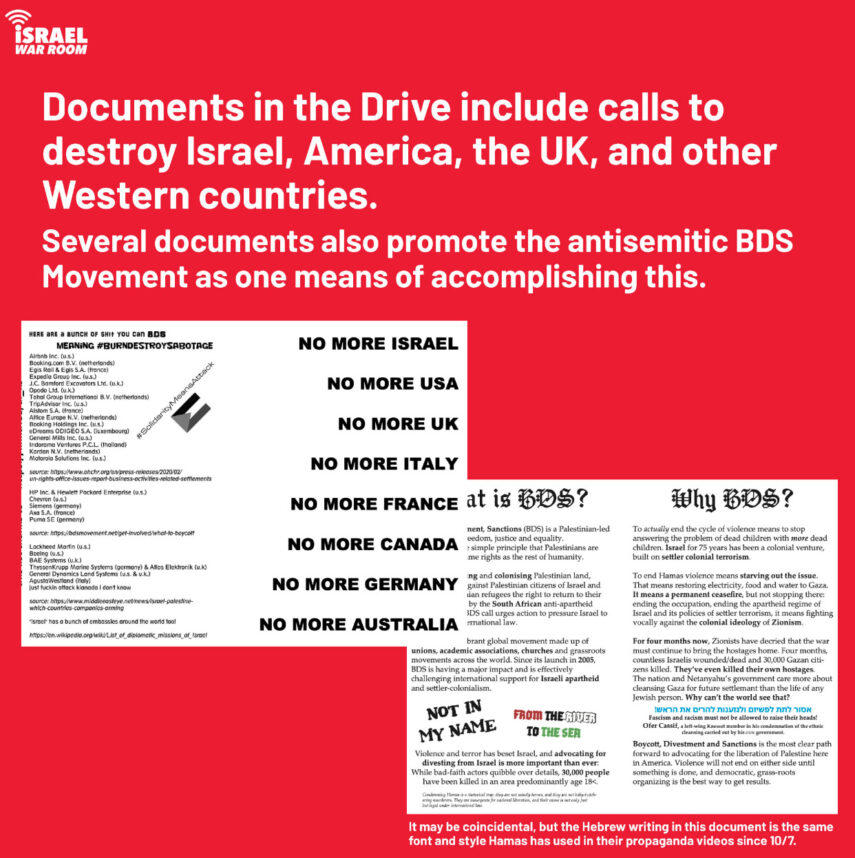
The drive contains more than 200 documents that include anti-Israel propaganda dating back to 1948; publications from terror groups Hamas and the PFLP; how-tos on creating print propaganda, establishing an autonomous zone, crowd and riot control and blockading; information on avoiding the police and staying anonymous; and documents that encourage readers to “globalize the intifada.”

Screenshot

Eve Barlow, a pro-Israel influencer who gained access to the drive, posted on her Substack, “To trawl through the trove of documents is to take a dive into the minds of wannabe insurgents, not future hopeful university graduates… All of this is damning evidence, suggesting that the activities taking place on Ivy League and UC campuses in America in the last few weeks are not examples of innocent grassroots movements, but well-planned, well-funded, well-organized attempts to infiltrate elite institutions and undermine American values and American democracy.”

“To trawl through the trove of documents is to take a dive into the minds of wannabe insurgents, not future hopeful university graduates.” Eve Barlow


Graphics from the drive show readers “Why We Break Windows,” “In Defense of Smashing Cameras” and a man throwing a Molotov cocktail and wearing a shirt with an anarchy symbol on it. One document says BDS has a double meaning: not only does it stand for Boycott, Divestment, Sanctions (BDS) – it also means “#BurnDestroySabotage. Readers are told to #BDS companies like Airbnb, Chevron, General Mills and Expedia. It says, “NO MORE ISRAEL. NO MORE USA. NO MORE UK. NO MORE ITALY,” along with other Western countries.

One document called, “A Radical Voice for Palestine,” is from the PFLP terror group, while another, “Our Narrative… Operation Al-Aqsa Flood” is from the Hamas Media Office. An excerpt from “International Intifada” appears on the drive and says, “The day that the colonizer is sent to his grave will be the birthday of a free humanity. You’re invited to participate in his assassination.”

Screenshot

Dr. Sheila Nazarian, a Beverly Hills plastic surgeon and pro-Israel activist, said that as a resident of LA and Columbia alumnus she is, “deeply troubled but not surprised by the recent revelations from the Israel War Room. The discovery of over 200 documents, including guides on orchestrating campus ‘occupations’ and promoting violence, clearly indicates that these are not spontaneous grassroots movements. This is a highly sophisticated and organized effort, designed to incite and perpetuate violence against Jewish students under the guise of protest.”

She continued, “The antisemitic violence from the mob that we’ve seen on campuses, including at my own alma mater, is now undeniably linked to these orchestrated efforts. These are not isolated incidents. The toolkits being shared among encampment organizers prove a disturbing level of premeditation and malice that is happening across the country.”

Israel War Room Discovers How-to-Riot Guide and Pro-Terror Propaganda for College Students Read More »

Orthodox Jewish Families Fight for Equal Treatment in California Schools

As Orthodox Jews, it was important for Chaya and Yoni Loffman to be able to send their son to a Jewish school. It was there that he would learn about his heritage while following Jewish law and engaging in secular studies as well.

However, because the Loffmans’ child is disabled – and because they live in California – he and his family have faced difficulties ever since he entered the schooling system.

“We send him to a Jewish school, but we are left to pay completely out of pocket for the services that his disability requires,” the Loffmans told the Journal. “We were even forced to discontinue his speech therapy because we could not financially handle paying for all of his services. But this is the sacrifice we feel we need to make to remain faithful to our duties as Jewish parents to teach our son the faith.”

“We send him to a Jewish school, but we are left to pay completely out of pocket for the services that his disability requires.” – Chaya and Yoni Loffman

In California, students with disabilities can go to public schools or non-religious private schools and receive the services they need. However, when it comes to religious schools, funding for services for students with disabilities is blocked – even though it should be permitted under the federal Individuals with Disabilities Education Act (IDEA).

IDEA funds special education programs in public schools in states including California, but public schools cannot always meet the needs of all students with disabilities. Federal and state law allow IDEA funding to be used in private schools, but in California, religious private schools cannot access that funding. This means that religious parents of all faiths must decide whether to place their children with disabilities in public school or pay for services out of pocket.

Now, the Loffmans and other religious Jewish parents of students with disabilities, including Fedora Nick and Morris Taxon, and Sarah and Ariel Perets, are plaintiffs in a lawsuit, Loffman v. California Department of Education. They are fighting for the opportunity to place their children in the school of their choice and receive the services they need.

“We aren’t looking for special treatment, just equal treatment,” the Loffmans said. “California already allows parents to receive IDEA funding to send their children to hundreds of other private schools. The state should allow the same for Jewish schools.”

The Becket Fund, a non-profit public interest law firm that defends religious freedom, is representing all the parents involved in the case. On May 7, oral arguments were heard at the U.S. Court of Appeals for the Ninth Circuit in Pasadena, and a decision is expected in the coming months.

Teach Coalition, a nonprofit that advocates for government funding and resources for nonpublic schools, is supporting the lawsuit.

“Since 2013, Teach has advocated for equitable funding and resources for our yeshivas and Jewish day schools, ensuring our families have access to safe, affordable, quality Jewish education,” said Teach Coalition CEO Maury Litwack. “This issue of ‘access’ is precisely what’s at the core of this lawsuit. When California denies children with special needs the right to a Jewish education with the tools needed to thrive, they are denying our children access to an education that best suits their needs.”

Litwack hopes that the lawsuit will end up opening doors for California, as well as other states, to “reassess their programs and statutes and provide equitable funding and resources for all students, regardless of religion or educational needs,” he said.

For Chaya and Yoni Loffman, they simply strive to provide their son with the right resources so he can thrive.

“As parents of a child with disabilities, we want him to have an education that helps him learn alongside his peers,” they said. “As a Jewish family, we also must raise him in our religious tradition. We believe that parents in California should have access to schools that can do both.”

Orthodox Jewish Families Fight for Equal Treatment in California Schools Read More »

The Multitasking Chef: Benny’s Grill L.A. is a Solo Restaurant Operation

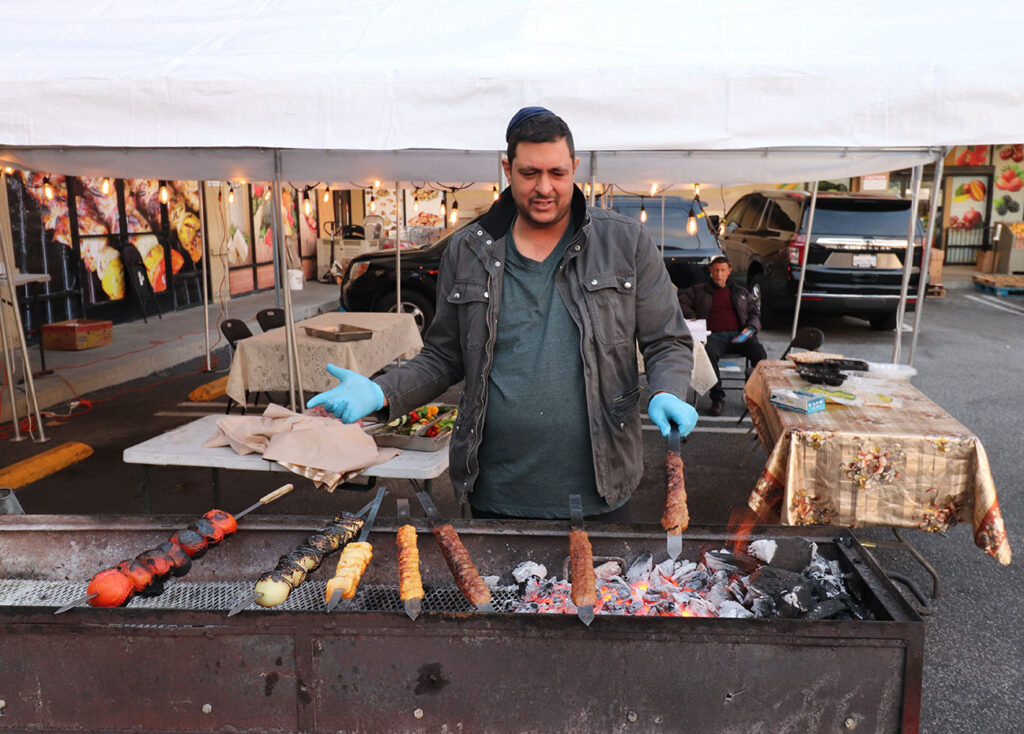
A few days after Benny Azizi opened his under-the-sky restaurant, Benny’s Grill L.A., he found himself engrossed in the bustle of grilling chicken kabobs and vegetable skewers, taking orders and packaging rice and ground beef kabobs into to-go Styrofoam containers. In this bustling scene, Benny is a one-man show, seamlessly transitioning between roles as chef, waiter, cashier and busboy.

Even his kashrut supervisor (OU) pitches in, assisting with the setup of the pop-up canopy tent and folding tables draped with plastic coverings. The setting? The Santa Monica Glatt Kosher Market parking lot, a longstanding establishment owned by Benny’s father, Joseph Azizi and his brother Bob Azizi, for approximately 20 years.

Up until 6:30 p.m., the location buzzes with activity as cars are parked at every spot in the lot, filled with eager buyers, many of whom are Iranians drawn to the market’s diverse array of Persian food and ingredients. However, as evening descends, Benny begins the remarkable transformation of one section of the parking lot into an authentic Persian restaurant—or, to be more precise, a vibrant street food market.

Benny’s roots in this market run deep, tracing back to its original location a mile down the street before it relocated to its current spot at 11540 Santa Monica Blvd, nestled in an area renowned for its vibrant Persian community. The burgeoning clientele prompted the owner to seek out a larger space, leading them to this bustling location.

Azizi, reminiscing as he tends to the sizzling kabobs, recounts his childhood spent in the market: “I started working here as a child, maybe around 8 or 9 years old, helping my dad.” His passion for cooking ignited early, fueled by the tantalizing scents of spices and meats wafting through the air.

After spending three years in Yeshiva Lev Aharon in Jerusalem, Azizi returned to Los Angeles 12 years ago, dedicating himself to the art of kabob preparation and cooking on Sundays. The market had been serving Persian-style kabobs for the past 15 years, inspiring Benny to expand operations to a five-day schedule, offering an extensive menu to cater to both loyal patrons and passersby.

“My food is my love and passion.” – Benny Azizi

“My food is my love and passion,” Azizi said, emphasizing his commitment to using only the finest ingredients. “From fresh garlic to premium saffron, I spare no effort in delivering authentic ancient Iranian flavors at a reasonable price. It’s my mission to offer the community the highest quality possible.”

I opt for the Beef Soltani—a combination of steak shish kebab and ground beef kebab served with white rice, grilled tomato, pickled vegetables, Lavash bread and a petite garden salad. The total comes to $30 before tax. Other items on the menu are less pricey and range between $12.99 for a ground beef kabob and up to $38.99 for a boneless rib eye steak.

Though tables and plastic chairs are available, most customers prefer to grab their meals to go.

It’s 7:30 p.m., and some customers have already ordered kabobs to go, with one phone order placed. While most customers are Iranians, there are also locals and office workers nearby. “They can smell it from a mile away,” said Azizi. “They simply can’t resist the aroma.”

The restaurant owner, married and father of three, takes charge of cooking at home and thoroughly enjoys it. “I love cooking, and my family enjoys my food,” he said.

Running a restaurant single-handedly, with occasional assistance from his father nearby, is no small feat. He deftly navigates between the grill, a large pot of rice, darting into the market to fetch pre-cut vegetables he prepared earlier, then back outside to tend to the kabobs on the grill. Just watching him running back and forth like that is exhausting.

It’s a tad chilly outside, but with spring around the corner, Azizi anticipates customers will enjoy their meals outdoors once the temperatures warm up.

The outdoor restaurant is open between Sunday-Thursday from 6:30 p.m.-11:30 p.m.

Benny’s Grill L.A

11540 Santa Monica Blvd.

(310) 256-5873

The Multitasking Chef: Benny’s Grill L.A. is a Solo Restaurant Operation Read More »

Showing Decent Respect to the Opinions of Mankind

In the Declaration of Independence by the representatives of the United States you’ll find,

in its first paragraph, the reason why the Founders wrote it.

While they assumed the station to which laws of nature and its God entitled them,

they felt they had an obligation, proclaimed in words that are a precious gem,

explaining why to independence of their land they were devoted.

Like them Jews are required — out of decency! — to show respect for the opinions of mankind,

except for those who don’t respect the views of others.

When God told Abraham, as we are told in Genesis, to found

a state for his descendants, He told him He would bless all nations who blessed them, but curse

all nations who cursed them, towards their country’s independence indecently adverse.

The reason for this language is still, very sadly, sound.


Gen, 12:1-3 states, according to the King James Version:

Now the Lord had said unto Abram, Get thee out of thy country, and from thy kindred, and from thy father’s house, unto a land that I will shew thee:

And I will make of thee a great nation, and I will bless thee, and make thy name great; and thou shalt be a blessing: And I will bless them that bless thee, and curse him that curseth thee: and in thee shall all families of the earth be blessed.

In “Israel’s Declaration of Independence: A Biography,” Jewish Review of Books, Spring 2023, Neil Rogachevsky and Dov Zigler write:

The second aspect of Israel’s Declaration that maintains strong popular currency is its statement of political ideals together with a kind of informal bill of rights. It reads:

The State of Israel . . . will be based on freedom, justice and peace as envisaged by the prophets of Israel; it will ensure complete equality of social and political rights to all its inhabitants irrespective of religion, race or sex; it will guarantee freedom of religion, conscience, language, education and culture; it will safeguard the Holy Places of all religions; and it will be faithful to the principles of the Charter of the United Nations.

This admirable statement of ideals is what most Israelis think of when they say, “These are our values.” Amid war and turmoil, Israel’s founders thought to proclaim the inherent rights and freedoms of citizens and to emphasize the rights of minorities—even minorities with whom they were then at war.


Gershon Hepner is a poet who has written over 25,000 poems on subjects ranging from music to literature, politics to Torah. He grew up in England and moved to Los Angeles in 1976. Using his varied interests and experiences, he has authored dozens of papers in medical and academic journals, and authored “Legal Friction: Law, Narrative, and Identity Politics in Biblical Israel.” He can be reached at gershonhepner@gmail.com.

Showing Decent Respect to the Opinions of Mankind Read More »

A Bisl Torah – A Soulful Journey

The omer is not the most widely celebrated mitzvah. However, with patience, grace, and intention, the omer holds potential to be a soul-stirring experience.

From the second night of Passover until Shavuot, we “count” each evening to mark the ritual of Jews bringing sheaf offerings to the Temple in gratitude for the harvest. Today, when no sheaf offering is given, we look at the evening counting as a spiritual link between Passover and Shavuot.

Rabbi Melissa Buyer-Witman explains, “On Passover, we celebrate leaving Egypt, which represents a narrow place of constriction and limitation of choice. We journey out into the open space, which is liberating but also uncharted terrain, where we may encounter doubt, uncertainty and fear. As we learn to be in the unknown, we also internalize a vision of faith and discover ourselves feeling a new sense of belonging, more connected and at home.” In other words, Passover is the beginning of our journey into the wilderness. We have the opportunity to leave the narrowness of what constrains us and explore that which might open our hearts anew. An expansiveness that has not yet been realized.

49 days later, we reach Shavuot, the celebration of receiving the Torah. What kind of spiritual journey must we walk through to break open our hearts? To receive what the Torah is saying specifically to each one of us?

These weeks of counting remind us to look inward, introspectively asking: what will enable me to leave my person Egypt and walk confidently towards a Promised Land?

May your evenings be filled with reflection and wonder, gratitude and blessings. As you wander through your spiritual journey, let God be your guide and Torah be your destination.

Shabbat shalom


Rabbi Nicole Guzik is senior rabbi at Sinai Temple. She can be reached at her Facebook page at Rabbi Nicole Guzik or on Instagram @rabbiguzik. For more writings, visit Rabbi Guzik’s blog section from Sinai Temple’s website.

A Bisl Torah – A Soulful Journey Read More »

A Moment in Time: “We Have Two Ears and One Mouth for a Reason”

Dear all,

Maya and Eli simultaneously whispered into each ear the other day. I tried really hard to listen to both at the same time.

No, it wasn’t possible.

But it did remind me of an old saying: “We have two ears and one mouth for a reason.”

And the meaning?

We are supposed to listen twice as much as we talk!

Sometimes (ok – many times) I have to remind myself to keep my mouth shut and take in what is going on around me. I have to listen to what others are sharing, gain perspective from their wisdom, and strive to understand even when it might seem impossible.

The most important prayer in Judaism is the שמע/ shema, teaching us to “listen.” While it takes a second to blurt something out, it takes a moment in time to ensure that we are listening. Let’s give it that moment before we open our mouths!

With love and Shalom,

Rabbi Zach Shapiro

A Moment in Time: “We Have Two Ears and One Mouth for a Reason” Read More »

Print Issue: Breaking Barriers | May 17, 2024

CLICK HERE FOR FULLSCREEN VERSION

Print Issue: Breaking Barriers | May 17, 2024 Read More »

Eitan Bernath: Exploring the Jewish Kitchens of Mexico, Food on Social Media and Egg Salad

Eitan Bernath is a chef, entertainer and cookbook author.

The 22 year old started cooking at the age of eight, and has been working in food entertainment for about 10 years.

“I didn’t really fit in, when I was younger, with the little league or sports, but I really loved food,” Bernath told the Journal. “My mom encouraged me [to] try cooking … and I really just fell in love with being in the kitchen.”

When he was 11, Bernath randomly auditioned for an episode of the Food Network’s “Chopped;” the episode aired when he was 12.

“From there started my social media, and everything that came after,” he said.

Until about 2018, food in social media was all about photos. Then, around 2019, video took over.

Bernath embraced it. “It really did lead me to where I am today … with the explosive growth that I had in 2020 with video, primarily on TikTok and Facebook and Instagram.”

If a picture is worth a thousand words, then a video provides infinite words.

For instance, he recently posted an egg salad video, to share his love of this underrated food.

“Egg salad does not get the love that it deserves,” he said. “There’s a lot of boring, bland egg salad in the world, and I think people would appreciate [my] super flavorful egg salad.”

Bernath’s secret ingredient is chili crisp. His recipe is below.

“Breakfast, lunch, dinner, late night snack,” he said. “Anytime of day [this recipe is] a winner.”

Bernath said the fascinating part of creating short-form food video content is the feedback he gets from the audience: He makes it look so easy.

“That’s the goal,” he said. “It should look easy and effortless, but the amount of ‘non-easiness’ is what makes it look so easy.”

He added, “There’s a lot of effort into the food, the prep, the lighting, how it’s shot, how I speak, what I’m wearing, like every little detail is thought out to make it look effortless.”

One of the things that makes food meaningful for Bernath is that it’s the great connector. Teaneck, New Jersey, where he was raised, is was very diverse. There were Jewish areas; one of the families next door was Indian, the other was Dominican.

“We all grew up, playing with each other … celebrating each other’s holidays, enjoying each other’s food,” Bernath said. “My upbringing was just with so many people who weren’t like me.”

In his new digital series, “Eitan Explores: Mexico City,” Bernath dives into the culinary joys, along with the history from the Jewish kitchens, of Mexico City. The seven two-minute episodes, which premiered this month, explore a melting pot of culture and people deeply connected to the spirit of their country as well as their ancestral roots.

“I’ve done a lot of travel over the last bunch of years and whenever I travel, whether it’s been to India, to different parts of Europe or other parts of Asia, I’m always fascinated about connecting with Jews in that part of the world,” he said.

While these Jews all have very different backgrounds, one thing everyone connects on is the food. Going into this series, Bernath didn’t know that much about the Jews of Mexico City.

“I like Mexican food [and] I know that Mexico has such a rich food culture and culture in itself,” he said. “So the goal with the series was to meet Mexican Jews, hear their stories and learn about their food, their culture [and] their history; it was such a transformative experience.”

Usually Bernath is also filming his experiences. Having a crew for this series, which he did with Tastemade, allowed him to be fully immersed in the food.

One of his favorite experiences was having a Shabbat meal with Estrella Jafif, a Mexican Jewish chef with roots in Lebanon and Cuba.

“We were eating this kibbeh, which are these very ground up meat and rice,” he said, likening them to a combination of a dumpling and a kebab in a really tangy stew.

“Instead of tamarind, they use limes, because that’s what they have in Mexico, and some people [add] avocado,” he said. “This Middle Eastern dish infused with the ingredients of Mexico was just so beautiful.”

To learn more about Eitan Bernath and to check out “Eitan Explores: Mexico City,” go to EitanBernath.com and follow @Eitan on Instagram.

For the full conversation, listen to the podcast:

Egg Salad

It’s time I admit I have been eating copious amounts of egg salad for the past few weeks. I think I’ve perfected my recipe and I NEED to share it with you to see what you think. The secret ingredient is some chili crisp which helps cut the fattiness along with the acidity from the lemon juice.

8 hard-boiled eggs

½ cup mayo

2 Tbsp Dijon mustard

2 Tbsp whole grain mustard

Juice from ½ lemon

Kosher salt, to taste

Freshly cracked black pepper, to taste

1 tablespoon chili crisp, plus more for garnish

1 stalk celery, diced

2 Tbsp chopped dill

2 Tbsp chopped chives

2 Tbsp chopped capers

2 Tbsp chopped gherkins

To Serve:

1 loaf challah or white bread, sliced

1 head Little Gem lettuce, or a few pieces of romaine

Roughly chop the hard boiled eggs. Mix ingredients together. Enjoy on challah with your favorite lettuce.


View this post on Instagram


A post shared by Eitan Bernath (@eitan)


Debra Eckerling is a writer for the Jewish Journal and the host of “Taste Buds with Deb.Subscribe on YouTube or your favorite podcast platform. Email Debra: tastebuds@jewishjournal.com.

Eitan Bernath: Exploring the Jewish Kitchens of Mexico, Food on Social Media and Egg Salad Read More »