Harvard Student’s Thesis Alleges That Israelis Face Discrimination on Campus
Harvard University student Sabrina Goldfischer, who previously served as the president of the university’s Hillel, has published a thesis paper alleging that Israelis have faced discrimination on campus.
Goldfischer explained in an April 22 Times of Israel blog that the course of her investigation for her 110-page thesis — which examined the state of antisemitism on campus — revealed “the most acute examples of discrimination involved Harvard’s Israeli students.” “One student faced backlash for his involvement with Israel Trek, an Israeli student-led trip to Israel for Harvard students who do not identify as Jewish,” Goldfischer wrote.
Goldfischer told the Journal that it was “shocking” for her to learn “the amount of the brunt of antisemitism and anti-Israeli discrimination that the Israeli community on campus has to bear … The stuff that Israeli students go through at Harvard … it’s outright discrimination.”
More Than 80 Jewish Orgs Call on Anthropology Association to Reject BDS Resolution
More than 80 Jewish organizations have signed onto a statement calling on the American Anthropology Association (AAA) to reject a resolution supporting the Boycott, Divestment and Sanctions (BDS) movement.
The resolution would call for a boycott of Israeli academic institutions and will be voted upon digitally from June 15-30. It is the second time the AAA has considered such a resolution, with the previous time occurring in 2016. “While the Resolution asserts that Israeli academic institutions are ‘complicit’ in the oppression of Palestinians, the reality is that Israeli university leaders and faculty work hard to foster Arab-Jewish coexistence and ensure a diversity of opinion on their campuses, including support for Palestinian voices,” the statement read, adding that “an academic boycott would undercut the important work for peace and social justice being undertaken by many Israeli academics.”
Among the signatories of the statement include the Anti-Defamation League, J Street, the Simon Wiesenthal Center and Americans for Peace Now.
UC Santa Cruz Students Celebrate Hitler’s Birthday
A group of UC Santa Cruz students reportedly celebrated Adolf Hitler’s April 20 birthday on campus, according to a statement from the university.
Dr. Akirah Bradley-Armstrong, the university’s vice chancellor for student affairs and success, wrote in the April 30 statement that the students “sang happy birthday and ate cakes adorned with hateful and horrific symbols.” She also noted that on April 28, a student found a flyer on their car in downtown Santa Cruz containing “despicable and degrading claims about Jewish people and LGBTQIA+ people.”
“We unequivocally condemn these – and all – antisemitic and anti-LGBTQIA+ actions,” Bradley-Armstrong said. “They are at odds with our Principles of Community and, as such, will be addressed accordingly.he concerning flyers reported downtown.”
CUNY Denies Report That It’s the “Most Systematically Antisemitic” University in America
A spokesperson for the City University of New York (CUNY) rebuffed a report claiming that the university is the “most systemically antisemitic” in the United States.
As previously reported in the Journal on March 29, the report by Students and Faculty for Equality at CUNY (SAFE CUNY) included criticism of Chancellor Felix Matos Rodriguez for skipping two New York City Council hearings on antisemitism and hiring former CAIR [Council on American-Islamic Relations] Diversity Officer Saly Abd Alla as CUNY’s Chief Diversity Officer. A CUNY spokesperson told Campus Reform on May 2 that the report is “littered with factual inaccuracies and inflammatory accusations, is designed to malign our system, and ignores CUNY’s consistent and ongoing efforts to counter the violence, hate, antisemitism and racism that can creep into our campuses, our country and the world.”
SAFE CUNY Co-Founder Jeffrey Lax told Campus Reform that the spokesperson’s statement amounted to “a horrifying admission that they cannot refute even one fact in our report.”
Report: BDS Threatens “Political Neutrality of the University”
An April 22 report from the National Association of Scholars found that BDS threatens the “political neutrality of the university.”
The report, authored by Ian Oxnevad, studied the movement’s effect at Columbia University, Ohio State University and UC Riverside; Oxnevad found that “anti-Israel professors are instrumental in animating and organizing the BDS movement” and that the movement foments “an environment of intimidation against Jewish students and supporters of Israel.” Additionally, various BDS groups have ties to Palestinian terror organizations like Hamas and the Popular Front for the Liberation of Palestine, per the report.
“Far from a movement centered exclusively on the Israeli–Palestinian conflict, BDS operates as part of a larger progressive, left-wing movement that is well-funded and connected beyond the university,” Oxnevad said in a statement.
I was sitting at shul one Saturday morning five years ago and looked all around me. I was surrounded by mothers with little children. They were tending to their children when they cried and laughed when they did something silly. They talked amongst each other about diapers and dolls and daycare. They discussed the rigors of mom life and how they were coping.
I was the only one there without a child, which was usually the case. It was an Orthodox shul; Orthodox Jewish families are notoriously large, and mothers often have four or more children.
At that point, my husband Daniel and I had been together for eight years and married for three, but we weren’t yet ready to have children. We didn’t feel prepared practically or emotionally. We had planned to start trying, but that time came and went and we never did. We got in our own way because we were worried about becoming parents.
We wanted to be in a good spot with our careers and know that we could provide for our child’s needs. Spiritually, we knew there wasn’t ever a perfect time to have kids and that the saying “babies are born with a loaf of bread under their arms” was true – we’d seen it firsthand from other couples. We knew that children would make our joyful life that much better. But still, we wanted to wait.
That didn’t mean it wasn’t difficult. At shul, I often felt left out of the conversation; mothers didn’t want to seem to want to talk about anything other than parenthood. When I’d talk with them, everything came back to being a mom. I understood why, but I couldn’t relate. And even though we had plenty of other things in common, at that moment, they couldn’t relate to me.
I’d long for a child when I’d see toddlers jump on their mothers’ laps at shul and hug them. They’d say things like, “I love you so much” or “I want you, mommy.” I wondered when the day would come when I’d get to experience that same amazing feeling.
I knew that when I had a child, I’d be a great mother. I didn’t have the best childhood because I was lonely much of the time. My parents got divorced when I was five, I became a latchkey kid and my mom and dad were constantly working to support us. When given the opportunity, I was certain I would love my children unconditionally and do whatever I could to make them happy.
Daniel and I waited for a sign for something to tell us to have children already, but it didn’t come. So, four years into our marriage, we decided it was finally time to start trying. Thankfully, I got pregnant right away, and we had our first daughter in October of 2019.
Now that I’m a mother to two wonderful girls, I can say it’s the most gratifying and meaningful experience of my life. As soon as I had my first daughter, I thought, “This is incredible. Why didn’t I do this sooner?” But I also knew that God had a plan. Everything happens exactly at the right time.
Since we waited so long, I had plenty of chances to babysit my friends’ kids; I learned how to change a diaper, how to soothe a child and how to put them to bed. I knew what children of all ages liked to do for fun and how to effectively communicate with them. I read numerous articles on parenting and got advice from the women in my community who had children before me. All of it helped once I became a mother myself.
Watching my children grow and learn is one of the best parts of motherhood. It’s absolutely fascinating to witness them discovering how to turn over, crawl and then walk. It’s exciting to see how they learn how to talk and process the world. There are times when it gets tough, like when they wake me up in the middle of the night or they’re sick, but I know it comes with the territory. All of the challenges are opportunities for growth, for refining my character.
Just like those other moms from shul, all I want to do is talk about parenting with my fellow mommies.
Just like those other moms from shul, all I want to do is talk about parenting with my fellow mommies.
And, just like those other moms, I now have a child who comes up to me at shul. She busts out of the kids’ program, sits on my lap and whispers into my ear, “I want you, mommy.”
We have been hearing — and telling — jokes about Jewish mothers and Jewish cooking for most of our lives. But what if it turns out that our moms were on to something, and it turns out that matzah brei and brisket and latkes were actually the foundation to our future as a people? New research suggests that more than our religious beliefs and practices, more than our participation in community events and Jewish organizations, or even our children’s education and upbringing, the most unifying aspect of Semitic life in America is our affection for Jewish food.
The Keren Keshet Foundation recently released a study in which they asked American Jews about what their Jewish identity means to them and how they participate in Jewish life. The results show an increasingly bifurcated community, in which we are becoming more and more divided in our religious, cultural, political and child-rearing beliefs and practices.
The number of Jewish Americans has remained fairly constant in recent years, and the percentages of those who say that being Jewish is important to them has continued to remain at very high levels. But the ways that we demonstrate that commitment are shrinking at a noticeable rate.
For many of us, our Jewishness has become more a matter of convenience than of commitment.
The frequency we attend religious services or observe the Sabbath has fallen dramatically. 56% of us rarely or never go to synagogue for services (only one -third of us even have a family member who belongs to one) and roughly three-quarters of American Jews do not recognize Shabbat in any religious way. Disturbingly, 41% of Jewish Americans believe that religious organizations in America “do more harm than good”.
These disagreements tend be most noticeable between those who affiliate with different branches of Judaism. The percentage of Orthodox Jews among the American Jewish population has remained steady for many years. But the number of self-identified Conservative and Reform Jews has dropped precipitously in the last decade, while those who claim no affiliation to any of the branches has risen by more than 10 percent since 2013. Today, almost half of all American Jews do not see themselves as belonging to any of the three major sects.
But if we no longer see the sanctuary as a cultural touchpoint, we seem to have replaced in with the kitchen. Almost two-thirds of American Jews cite cooking and eating Jewish food as a way of connecting with their heritage and culture. This far outpaced any religious or community-based activity in terms of relevance to Jewish identity, suggesting that for many of us, our Jewishness has become more a matter of convenience than of commitment.
This division becomes even more disconcerting when we look to the future. Just as American Jews have come to dramatically different conclusions on religious practices and community engagement, these same splits are growing when it comes to our children’s education.Enrollment in “supplemental” Hebrew schools (those that meet late afternoons or on weekends to complement a secular education) has dropped by an astounding 45% since 2006, according to a new report released by The Jewish Education Project. During that same time, more than one-quarter of these schools have closed.
While attendance at these Hebrew schools has dropped by almost one-xhalf in recent years, there has been almost as large an increase in enrollment in Jewish day schools, where children study Jewish topics for at least part of the day. Most of the students switching to these day schools come from either Orthodox or other more religiously devout families, which means that the divide between religious and secular Jews will only grow wider in the future.
In addition to book learning, children also benefit from their schooling to develop social skills and to develop tolerance and respect for those who are different from them. But isolating our children from each other at such young ages does not bode well for their ability to cooperate in the face of future challenges and threats to our community. As much as we all love Jewish cooking, it might not be enough to hold us together as a people forever.
Dan Schnur is a Professor at the University of California – Berkeley, USC and Pepperdine. Join Dan for his weekly webinar “Politics in the Time of Coronavirus” (www.lawac.org) on Tuesdays at 5 PM.
On an afternoon last week, in between waving away at a few newly arrived mosquitos and listening to my 10-year-old son play the piano in the next room, I stood in my kitchen thinking about all the ways in which I had failed to plan a proper dinner. We would no doubt be relegated to a basic risotto or a quick pesto pasta if I could find some basil that was only half spoiled. I know, of course, that a homemade risotto is in no way tantamount to opening a bag of Doritos and pouring them into a bowl and calling it dinner, but there are rules we set out for ourselves, and I was dangerously close to breaking one of mine. No fresh vegetables, no protein, no forethought: a broken rule. Things must always be done the right way.
The piano notes drifting in from the other room provided the perfect melancholy soundtrack for my self-indulgent reflections on my poor mothering. My son was working on mastering a new song: “Experience” by Ludovico Einaudi, an Italian pianist and composer whose father, a publisher, worked with literary greats such as Primo Levi and Italo Calvino. Let’s be honest: It’s hard to feel like I’m a parenting failure when I hear those haunting notes blending perfectly together, when I see the back of his head, with his big mop of hair, swaying slightly with the music, his bare foot keeping time on the sustain pedal. I did something right, I tell myself. I’m a good mother.
How erratic are the emotions of those who create small beings. One moment we have convinced ourselves that we are ultimate failures, and the next we bask in our own glory.
But then I heard it.
“Something wasn’t right about that,” I called out softly. He paused, and I continued. “It’s wrong.” Before you judge me for being too harsh or overly critical of my child, you should know that just the day before he had asked for my help with the song because he wanted to get it right before his next piano lesson, and he, too, worried that something was off. I watched as the fingers of the hand I could see became still, hovering over the keys. He took an exasperated breath and said, “Mama, I know. I chose to play that part in a different octave because it sounds better to me. I decided I don’t care if it’s right.”
My face became instantly warm as my own idiosyncrasies and predilections surfaced in an attempt to control everything around me. But it’s not right, I said to myself, that’s not how it’s written. That the way he played it actually sounded good was beside the point. It was maddening, in that moment, to imagine him playing such a beautiful song over and over without the perfection that he so desires. But I realized just as quickly that maybe I’m the one who was searching for that perfection, guiding him to it as if somehow a piece played precisely as it’s written is a testament to my own abilities and excellence, or to his.
“Okay,” I said to him. “I really like it.” And he kept playing, with more heart than he had before receiving permission to be creative and to think for himself.
I was stunned. Maybe I even felt a bit of awe. Especially at that age, it never would have occurred to me that playing it differently from how it was written, hearing the music and making an executive decision regarding how it should be played, was allowed. How sad, I thought. How many beautiful sounds do we miss out on because we are afraid of playing the wrong notes or, worse, being wrong?
There’s a lesson for all of us in the audacity of his choice, in his willingness to step beyond his own need to get it right or to follow the script or music written for him. Parenting books abound, and while parenting certainly isn’t the brain science many of the experts lead us to believe it is, it’s also true that the little things add up. If I tell my son over and over that certain behaviors or decisions aren’t correct—whether it’s the way he chooses to play a song, how he holds a fork and knife, or how he interprets a story—that’s going to be the dominant concern for him in everything he does. He’s going to worry more about making sure the people around him will affirm his choices rather than think carefully about the meaning behind what he does. What is “right” or correct is not always clear; sometimes it’s subjective, and more often it’s complicated.
It’s not that there aren’t objective truths. We know there are. We know that a red stop light means only one thing. It’s not really open to interpretation. We also know that it isn’t okay to hurt people. But the irony is that many of the things we formerly believed to be objective truths are now up for debate in some circles. Some say violence against innocent people is admissible if they are part of a certain class or race. Others say it’s acceptable, even admirable, to steal from stores or smash up buildings because the people who do so are making a point about systemic discrimination and inequalities.
In a culture that is increasingly divided when it comes to what is right and wrong, I want my son to be able to think for himself when people around him tell him what is fashionably “right.”
In a culture that is increasingly divided when it comes to what is right and wrong, I want my son to be able to think for himself when people around him tell him what is fashionably “right.” I want him to know that the most important thing is not to be right when what is right has become subjective. I want him to know when being “wrong” or doing something differently is right. I want him to be free to be creative and innovative, to read between lines and see all of the meaning that glimmers there. And most of all, I want him to know that it’s okay to go against the grain, and that it’s okay to see things differently than his peers do. Playing a few notes of a well-known song in a different octave may not seem like a big deal—it’s not so wrong, after all—but as a mother, the way I respond to it makes all the difference.
The freedom to question and to pursue alternate answers and possibilities is inherently Jewish. And while both parents play a crucial role in developing a child’s understanding of this, the mother carries an especially important burden in this regard. Proverbs 1:8 reads: “Hear, my son the instruction of your father and do not forsake the Torah [or the law] of your mother, for they are a chaplet of grace to your head and a necklace to your throat.” There are different ways to read this verse—Rashi, for example, interprets “mother” as the nation of Israel—but let’s read literally for a moment. For Jews, the law (the Torah) is about understanding the ethical responsibility to which we are called. Responsibility is at the heart of Judaism, and we find here that it is the mother who communicates this to the child.
The freedom to question and to pursue alternate answers and possibilities is inherently Jewish.
But what is responsibility? Among other things, it’s our obligation to think carefully about the issues around us and to respond with grace, insight, and dignity. It’s about making sure we don’t simply fall into step with the most popular opinions and viewpoints without examining them. And it’s about being a light and having a voice.
Every Mother’s Day, I think about what I want for my son, and then I think about what that means for me. This year, I know that what is required of me is to loosen the grip that some of my own rules have on me. I want to give space for difference and doubt, to allow for the brazenness of choosing the wrong choice because, sometimes, it’s okay to go a little rogue and to do something the “wrong” way in order to get it right in the end.
Monica Osborne is a former professor of literature, critical theory, and Jewish studies. She is Editor at Large at The Jewish Journal and is author of “The Midrashic Impulse.” Twitter @DrMonicaOsborne
In the six years since I first began writing for the Jewish Journal (four of them as a weekly columnist), I’ve interviewed many dynamic people, including authors, activists, dignitaries, journalists, my mother and most recently, Israeli grandmothers (in honor of Israel’s 75th birthday).
But I have yet to interview the one person who truly means the world to me, in all her brilliant, lovely and humble glory: myself.
If this experiment is successful, I look forward to conducting more interviews, one with my younger self (past), one with my older self (future) and one with the artificial intelligence-version of myself (ChatGPTabby).
Since May is my birthday month, I decided to do just that. I don’t take it for granted that the Jewish Journal might be the only Jewish newspaper in the world, whether in print or online, to publish an interview a writer has had with herself. If this experiment is successful, I look forward to conducting more interviews, one with my younger self (past), one with my older self (future) and one with the artificial intelligence-version of myself (ChatGPTabby).
The following has been edited for clarity, length and above all, to prevent any chance of embarrassing myself irrevocably.
Jewish Journal: Hello, Tabby.
TR: Hi, Tabby.
JJ: Thank you for agreeing to speak with me for this column. Do you always show up for interviews in bare feet and sweatpants?
TR: I work from home. You’re interviewing me from home.
JJ: In that case, we should get something to eat out of the fridge.
Ten minutes later.
JJ: Let’s start with some thought-provoking questions. For one thing, it’s pretty self-serving to interview yourself, isn’t it?
TR: I thought it would be clever and refreshing. And writing too much about Iran, Jewish life and my mother can be monotonous (though very important).
JJ: So you thought you would devote an entire column to yourself?
TR: Can I get another interviewer?
JJ: No. Believe it or not, you’re the only person who actually wanted to interview you. And I’ll be nice, I promise. I researched you quite well. You could even say I know everything about you.
TR: Then you must know where I put my favorite spatula that I packed away with the other chametz cookware before Passover. For weeks, I’ve been flipping pancakes with a knife.
JJ: We really don’t have time to discuss such frivolous matters. My first question focuses on food. Do you have a favorite snack?
TR: You’re interviewing me so you can ask about my favorite snacks? I love blueberries, croissants, curly fries and cheese puffs. One of the best days of my life was when Whole Foods and Trader Joe’s added a hechsher (kosher certification) to their cheese puffs.
JJ: For someone who’s no longer 15, I didn’t expect you to consume such a copious amount of junk food.
TR: I know my priorities. In the words of Erma Bombeck, “Seize the moment. Remember all those women on the ‘Titanic’ who waved off the dessert cart.”
JJ: She was great. If only you were funny and talented enough to be called “a Persian Erma Bombeck.”
TR: Can I please get another interviewer?
JJ: I said no. I canceled an entire afternoon of phone-scrolling to conduct this interview. Let’s move on. What do you wish more people knew or appreciated about the Iranian Jewish experience?
TR: Finally, a deep question. Thank you. Iranian Jews are like delicious watermelons.
JJ: Green on the outside and full of seeds, even when they’re advertised as seedless?
TR: I mean that watermelons, like all fruits, grow in a certain environment. For 2,700 years, we metaphorically grew in one land: Persia. We were Israelites who arrived in Persia, straight from Samaria, and stayed there from the eighth century BCE until 1979. Can you imagine how much being Persian and Jewish is ingrained in us?
We’re eternal watermelons (for the record, I love watermelon). You simply can’t transplant a watermelon from the only soil it’s known for nearly three millennia, replant it in countries such as Israel, Canada or the United States, and expect the same results. In 1979, Iran’s soil became metaphorically contaminated, and we were saved by other magnanimous states. In Israel, we threw the watermelons in with the cantaloupes, honeydews and other melons and told them all to never look backward.
In America, we tried to metaphorically grow watermelons by hanging them from trees. “Be individualistic!” we urged. “Just hang from this branch, cut off from former emotional and communal support systems. You’ll be isolated and lonely, but professionally successful.” So we began floundering. Many of us are still floundering. But we’re still amazing. I don’t if any of this makes sense.
JJ: Not really, but now, I’m in the mood for watermelon.
TR: It’s best served with salty feta cheese and sweet cardamom tea. Everyone knows that.
JJ: What led you to become a writer?
TR: Another meaningful question! If you love something, the passion (and, hopefully, the skills to do it) are transferable from profession to profession. As a child, I loved creative writing. As a young adult, I infused writing into my work tasks at every opportunity. Soon, I became a public speaker, discussing issues related to Iran, Israel, Jewry, women and much more. Speaking is like writing, without the delete button. Today, I’m so grateful to my readers (and editors).
JJ: How interesting. And do you prefer burgers or hot dogs?
TR: You were on such a roll. And that wasn’t a pun. I see we’ve downgraded to the simpler questions again. I guess a broken clock can still be right twice a day. I love burgers. As far as hot dogs are concerned, I’ve always wondered how they fit all those meat trimmings, tennis shoes and shredded newspaper into such a tight casing.
JJ: Do you have a favorite Jewish celebrity?
TR: What an L.A. question. My favorite Jewish celebrity is Jess Oppenheimer, who passed away in 1988.
JJ: You love the father of the atom bomb?
TR: That’s J. Robert Oppenheimer. Jess Oppenheimer was the creator and head writer of “I Love Lucy.” Everything I needed to learn about life, love, wit and timing, I learned from that show. It also taught me English.
JJ: Describe one of the proudest moments of your life.
TR: When I finally learned enough English to help program our family VCR back in the mid-1990s.
JJ: Do you have a few favorite columns that you’ve written for the Jewish Journal?
TR: I have a special place in my heart for “Next Year in Tehran” (January 2023). In the humor category, my favorite column, which I wrote in November 2022, is titled, “If The Pilgrims Had Been Jewish.” I had a great time writing that one.
JJ: Let’s do some “fast takes.” Favorite aspect of being Jewish:
TR: The fact that being Jewish is the only part of me that’s stamped on my soul. I am it and it is me.
JJ: Favorite Jewish food?
TR: My mother’s slow-cooked tongue and black-eyed peas, a Persian-Jewish Rosh Hashanah staple. I should clarify that the tongue belongs to a cow, not to my mother.
JJ: Favorite city in the world?
TR: Los Angeles. The LA I once knew is still there somewhere, buried beneath all that crime, tragic homelessness and maddeningly overpriced gas. And Jerusalem. There’s a little hill on Ramat Eshkol, with an olive tree, that’s my happy place. I like to sit beneath that tree, speak to G-d and enjoy some sweet, seedless watermelon.
Tabby Refael is an award-winning weekly columnist for The Jewish Journal, and an LA-based speaker and civic action activist. Follow her on Twitter and Instagram @TabbyRefael.
Contrary to a popular belief, sometimes you can go home again. Rabbi Leslie Alexander found this out when she returned to Adat Ari El 26 years after she left the Valley Village congregation.
For the rabbi, it was a true homecoming. When she started at Adat Ari El in 1986, “thanks to the openness of Adat Ari El,” she became the first woman rabbi to be hired by a major Conservative synagogue. “Adat Ari El was very welcoming,” she said. “My husband made scrapbooks of the stories about my appointment from newspapers all over the world. I owe a lot to Adat Ari El, a lot.”
But a decade after joining Adat Ari El, Rabbi Alexander’s husband, Ken, a chemist, was offered the job of a lifetime in Silicon Valley.“Now,” the rabbi said, “it was his turn to do something he really wanted to do.”
“When I needed to tell the board I was leaving Adat Ari El, I cried my eyes out at that meeting. I loved being here so much.”
While both the rabbi and her husband were natives of Northern California, it was hard for her to leave Los Angeles. “I was not happy when I had to move back to Northern California. I fell in love with Los Angeles. But it was his turn.” That didn’t make the move any easier. “When I needed to tell the board I was leaving Adat Ari El,” Alexander said, “I cried my eyes out at that meeting. I loved being here so much.”
There were some positive aspects to the move: “When we moved back up north, my parents lived about an hour from us,” Alexander said. “My two daughters got to know their grandparents and see them all the time.” But there was a yearning for the rabbi’s adopted home. Was it difficult to return to Southern California?“No-o-o-o-o-o,” the rabbi answered with a laugh. “I have always loved L.A. This was my thought process: I really loved being Jewish, and I wanted to live where there was a significant Jewish population. When I went to college at Berkeley, I really wanted to transfer to UCLA.”
Returning to Adat Ari El was not part of the rabbi’s plan when she returned to Los Angeles. “We moved back here to be closer to our daughter Shira, our son-in-law Justin and our granddaughter Romi, who live in Pico-Robertson.” And after spending 17 years working with a Jewish Federation in Silicon Valley and several years as a rabbi at a Saratoga synagogue, she was ready to retire.
Then, last July, Adat Ari El’s senior rabbi, Brian Schuldenfrei, gave her a call. “I hear you’re back in town … You want to come in and talk?” She thought it was going to be a social call, a chance to catch up and schmooze. But when they sat down to talk, Rabbi Schuldenfrei told her “we have talked to a few people in the last year about being an assistant rabbi … but none worked out.” He then asked, “How would you like to be an interim rabbi at Adat Ari El?”
Her first response was skeptical. “I want to take care of my granddaughter and pick her up from preschool two days a week,” she told the rabbi. That wouldn’t be a problem, he said; she could work part-time. “But what if I want to go on vacation?” she asked. “He told me we’d work it out.” And just like that, she was unretired.
Becoming a rabbi was something Alexander was almost fated to do. The daughter of a Conservative rabbi, she decided she wanted to be a rabbi when she was 17. Her parents vigorously supported her choice. The Conservative movement at the time was more hesitant. Women were not yet accepted for ordination as rabbis by Conservative temples, so Alexander attended the Reform-affiliated Hebrew Union College in Los Angeles.
Which isn’t to say it was easy. It was a tough time to be a deeply committed Jewish woman. She recalled a party before her ordination ceremony. Gag gifts were distributed; Alexander’s was a raw chicken wing and a small plastic chicken for holding up the right-wing of the Reform movement. “This was because I kept kosher, I wouldn’t turn on lights on Shabbat, I wouldn’t spend money or tear toilet paper.”
Was she ever upset that the Conservative movement didn’t begin to ordain women rabbis until 1985?No, because I believe in Halacha,” she said. “I am glad the Conservative movement came to the conclusion of approving women rabbis based on Halacha. That’s the way things go if you are serious about Jewish life.”
Fast Takes with Rabbi Leslie Alexander
Jewish Journal: What is your favorite Jewish food?
Rabbi Alexander: A pastrami sandwich at the 2nd Avenue Deli in New York. Also, maybe, matzah balls.
JJ: What do you do on your days off?
Rabbi Alexander: I have a lot of hobbies. I pick up my granddaughter from Beth Am’s preschool every Monday and Thursday, take her for ice cream and play with her until my daughter is done with work.
JJ: What superpower would you like to have?
Rabbi Alexander: The power to make people listen to one another and understand the value of others.
On a chilly spring evening, an excited group of nearly 50 people congregated in the backyard of a Beverly Hills home. They ordered margaritas, wine and cold beer at an open bar, loaded their plates with pita, hummus, Israeli salad and fresh kosher shawarma. Israeli music played. It could’ve been cocktail hour at a cousin’s wedding, or an open house on Bravo’s “Million Dollar Listing.”
But the ritzy affair was serving a decidedly more inspiring purpose, one having to do with the group of guys dressed more casually than the other guests and chatting in Hebrew by the bar.
These scruffy young guests were Israeli Defense Forces (IDF) veterans, visiting Los Angeles on a weeklong tour of entertainment, decompression and, most of all, healing. Their experience included overnight stays with host families, an afternoon at Universal Studios, a Lakers playoff game, shopping and fine dining in Beverly Hills and even friendly games of pickleball.
The intimate crowd of pro-Israel community members, organizational leaders and philanthropists gathered in the host’s living room, and several of the solders shared their stories. They offered vivid, descriptive and frightening first-person accounts from the front lines of combat in Israel.
As the soldiers described encountering gunfire from Hamas terrorists attempting to cross into Israel through underground tunnels; riding in an armed SUV in the West Bank that suddenly exploded because of a roadside bomb; outmaneuvering incoming artillery shells, their experiences may have felt lightyears away from daily life in Los Angeles, let alone a mansion in Beverly Hills, yet the bond between the speakers was undeniable.
All 10 of the IDF combat soldiers who appeared that evening were injured in combat and attempting to move on with their lives despite the severe physical and mental traumas they endured protecting the Jewish homeland and people.
They were there because of the Israel-based nonprofit, Brothers for Life, which brought the delegation of IDF veterans to Los Angeles, from April 17-24.
The origin of Brothers for Life dates to 2006, when Rabbi Chaim Levine, a longtime leader in the Seattle Jewish community, met Gil Ganonyan, an officer from Duvdevan, an elite commando brigade in the IDF. The two men immediately bonded. When the Second Lebanon War broke out soon after, Levine knew he couldn’t just stand by. He took four other American Jewish leaders to Israel and joined Ganonyan in delivering aid to Israelis whose lives were being devastated by the brutal fighting.
They distributed funds to families in bomb shelters and visited the bedsides of soldiers at Haifa’s Rambam Hospital. Ganonyan, who had been shot through the neck only two years earlier by a Hamas terrorist in Bethlehem, saw young soldiers fighting desperately for their lives and knew exactly what they were going through.
Meanwhile, Levine observed soldiers lifted by their interactions with Ganonyan, saw the easy trust that developed between the newly wounded soldiers and the veteran who’d overcome his injuries and was hit with inspiration. He’d create an organization where the model was IDF veterans helping other IDF wounded soldiers.
“As a Jewish person, when I saw the suffering they were going through and how they could uniquely help each other, I first felt I had a debt to pay to them,” Levine said in a recent interview.
In 2008, Brothers for Life — also known as Achim L’Chaim—was officially registered as a nonprofit organization in Israel. Levine, who continues to be based in Seattle, is the co-founder and president. Ganonyan, based in Tel Aviv, is the co-founder and executive chairman.
The organization is run and created by injured Israeli combat soldiers.
“From the moment a soldier is injured, we’re at their bedside in the hospital,” Levine said. “We have a huge brigade of IDF injured soldiers healing each other.”
For approximately 15 years, the organization has paired recently wounded soldiers with other injured soldiers, creating a tight-knit community of young men who lean on one another during the recovery process.
For approximately 15 years, the organization has paired recently wounded soldiers with other injured soldiers, creating a tight-knit community of young men who lean on one another during the recovery process.
BFL, as it’s also known, is based on four principles: Financial assistance not otherwise available to wounded soldiers through other agencies; projects and mentoring; job placement; educating and inspiring love of Israel.
Additional services include critical medical support, PTSD counseling, educational scholarships, vocational training and comprehensive emotional guidance.
Once a soldier can confidently rejoin daily life and feels himself again, he, in turn, becomes a mentor to a newly injured soldier.
The idea is simple, yet powerful. Once a soldier can confidently rejoin daily life and feels himself again, he, in turn, becomes a mentor to a newly injured soldier. The newly injured individual eventually gets unstuck, reclaims his life and becomes a support system to someone else.
“Meeting a soldier who himself lived through injury and is now thriving is the most powerful help we could give,” Yaniv, an IDF soldier with Brothers for Life, said.
The host family with the soldiers (Photo courtesy BFL)
Currently, the organization works with more 1,300 IDF soldiers and their families across Israel. Because it costs $6,000 to provide for a soldier’s rehabilitative needs for one year, the organization relies on donations from supporters across the world to fund their programs.
At the recent evening in Beverly Hills, the group raised more than $200,000. Pro-Israel philanthropist and real estate investor Naty Saidoff, chairman of the Israeli American Council, expertly took pledges from attendees eager to demonstrate support.
Sending soldiers to cities across the world is one of Brothers for Life’s most impactful programs, said Rafael Kellen, BFL’s soldier delegation coordinator.
“It’s a very magical thing,” Kellen, 31, said in an interview from Israel.
Kellen served as a commander in the IDF’s K-9 unit and was injured by a bomb designed to release shrapnel upon exploding, during a 2013 mission. The then-21-year-old was hospitalized for over a year and a half and underwent multiple surgeries. There’s still metal in his leg, he told the Journal, yet he’s joined BFL on a variety of recreational activities, including running in the Tel Aviv Marathon and climbing Mount Kilimanjaro.
From the moment he awoke in the hospital, Kellen had BFL leaders at his bedside. Today he is an instrumental part of coordinating the overseas delegations, including the recent one in Los Angeles.
Local community leader Amy Conroy headed the recent Los Angeles delegation and hosted two IDF soldiers, including Kellen, in her family’s West L.A. home. Her four children, three of whom attend Jewish day school, developed a quick bond with the soldiers, illustrated by her 13-year-old daughter, Chloe, a student at Brentwood Day School. Chloe did a project for her class that included a painting of an El Al plane and an explanation of what living with heroes for the week was like.
Photo courtesy BFL
Perhaps it’s not surprising that while the Diaspora community views the IDF soldiers as heroes — protectors, even — the soldiers don’t see themselves that way.
In fact, Ofer Hai Meyer, a combat medic in a paratrooper unit who was injured in 2006, said the perseverance of Brothers for Life’s members in the aftermath of their wartime experiences, their decision to continue fighting and choose life — if anything, that made them heroic.
“I don’t think going to war is heroic … I think what’s heroic is when I see people that choose to live after what they’ve gone through.”
– Ofer Hai Meyer
“I don’t think going to war is heroic,” Mayer said. “I think what’s heroic is when I see people that choose to live after what they’ve gone through.”
As the organizing volunteer of the delegation, Conroy was tasked with finding four other families who’d be willing to open their homes to soldiers — 10 visiting soldiers required five host families—during their week here.
Ultimately, several of her friends took part and found their relationship with Israel fundamentally changed by the intimate and unique experience of having soldiers in their home and around their kids and breakfast tables.
The soldiers were caught off-guard by the unconditional kindness of their hosts.
“They couldn’t understand why we’d want to host them and care about them,” Conroy said. “For them, in Israel, everyone has stories like theirs.”
Many of those in her social circle had never been to Israel. But because of their experience hosting the soldiers, they now plan on going. This outcome is a bonus of the delegation, one that isn’t all that surprising to Levine.
“When people meet the soldiers,” he said, “Israel becomes personal.”
Having facilitated more than 120 delegations of IDF soldiers to major cities across the world, including Seattle, Toronto, New York, Mexico City and London, BFL leaders have observed the transformational affect soldiers have on their host families. The soldiers, too, form relationships that last a lifetime.
The experience of meeting Jews abroad who express so much love and appreciation for Israel also has the effect of strengthening the IDF soldiers’ Zionism, Kellen said.
“I think to be out in the States made me more Zionist than I was before,” he said. “Before I said, ‘I was in the army, I did this and that.’ It’s very natural to go to the army here — rockets fall, there’s a terrorist attack. When we’re kids, we say, ‘Who is going to be in the better unit?’
“I never knew what we have outside of Israel. But I finally understood, it’s not only me. There are people out of Israel who are very Zionist. It gave me a lot of strength to understand how much bigger we are than I thought.”
“When the soldiers come to a community like Los Angeles, they have no idea how much these Jews living in the Diaspora love and appreciate them,” Levine said. “They become families for life.”
The overseas delegations are designed to be intense and cathartic, purposeful and mission-oriented. The trips have even provided opportunities for IDF soldiers to connect with wounded American soldiers who’ve been injured in Afghanistan and Iraq. As a result, a sister organization to Brothers for Life, serving injured U.S. soldiers, was started in Seattle.
“We call them healing delegations for a reason,” Levine said.
The soldiers’ time in Los Angeles coincided with Yom HaShoah (Holocaust Remembrance Day). On April 17, the 10 soldiers took part in a candle-lighting memorial organized by pro-Israel education organization StandWithUs at the Saban Theatre in Beverly Hills.
Additionally, they spoke with students about their experiences serving in the IDF. They also underwent group therapy and participated in physical challenges that were designed to help them overcome their fears.
While Brothers for Life has not been able to connect with every single soldier who is wounded while fighting, the organization is nonetheless committed to reaching that goal.
Not every IDF soldier is fortunate enough to experience a free visit to L.A., though. There are about 170,000 active-duty soldiers in the IDF, including 30,000 in combat positions. While Brothers for Life has not been able to connect with every single soldier who is wounded while fighting, the organization is nonetheless committed to reaching that goal.
BFL leaders realize the urgency: Every 48 hours, according to the group’s website, an Israeli soldier is wounded while protecting the Jewish people. The severity of the injury and the uncertainty about the future can be devastating for a young person. As such, more than 20 members from different regions of Israel participate in Brothers for Life’s hospital visitation program.
Shai, an IDF soldier, has benefited from BFL’s financial aid and counseling program, which involves mentors with financial backgrounds helping injured veterans and their families stay out of debt and better manage their finances. It’s not something people think about when reflecting on the challenges a wounded IDF soldier faces, but it’s all-too real for those spending their time recuperating in the hospital.
For Levine, whose connection to Israel began as a student there, the benefit of becoming involved on a personal level has been immeasurable.
Working with Brothers for Life, he said, has “changed the trajectory of my life” — less a profession than a calling. Indeed, when he speaks about the work of his scrappy nonprofit, his passion for the Jewish homeland and the young people defending it comes through.
All these years since leading the organization has reaffirmed Levine’s belief that wounded soldiers are uniquely equipped to support other injured soldiers.
“It’s such a privilege to help with,” he said. “It’s my responsibility. They’ve done so much for us.”
(This online version has been corrected from the print version to reflect that Amy Conroy has four children, not three. Three of the four attend Jewish day school. And her 13-year-old daughter is named Chloe, not Amy.)
An article recently came out regarding the research of “hope molecules.” Myokines are chemicals secreted when muscles contract. Myokines are known for their positive effects: anti-aging qualities, improvement of negative mood and overall increased mental and physical health. The research shows that exercise is a great source for these molecules of hope.
And I wonder, where else can hope be found? The data points to the treadmill and pilates as best known practices. No disagreement from me. However, I challenge us to both run the mile and run towards faith.
Hope can be sourced in the pews of the synagogue and within the embraces of community. It is in our being together in which we realize that even with our struggles, we are not meant to be alone. Rabbi Jonathan Sacks teaches, “Optimism is the belief that things will get better. Hope is the belief that, together, we can make things better.”
Science reminds us that hope potentially heals physical ailments. And when anchored in faith, it is hope that heals the soul.
May you find hope. May hope find you.
Shabbat Shalom
Rabbi Nicole Guzik is a rabbi at Sinai Temple. She can be reached at her Facebook page at Rabbi Nicole Guzik or on Instagram @rabbiguzik. For more writings, visit Rabbi Guzik’s blog section from Sinai Temple’s website.
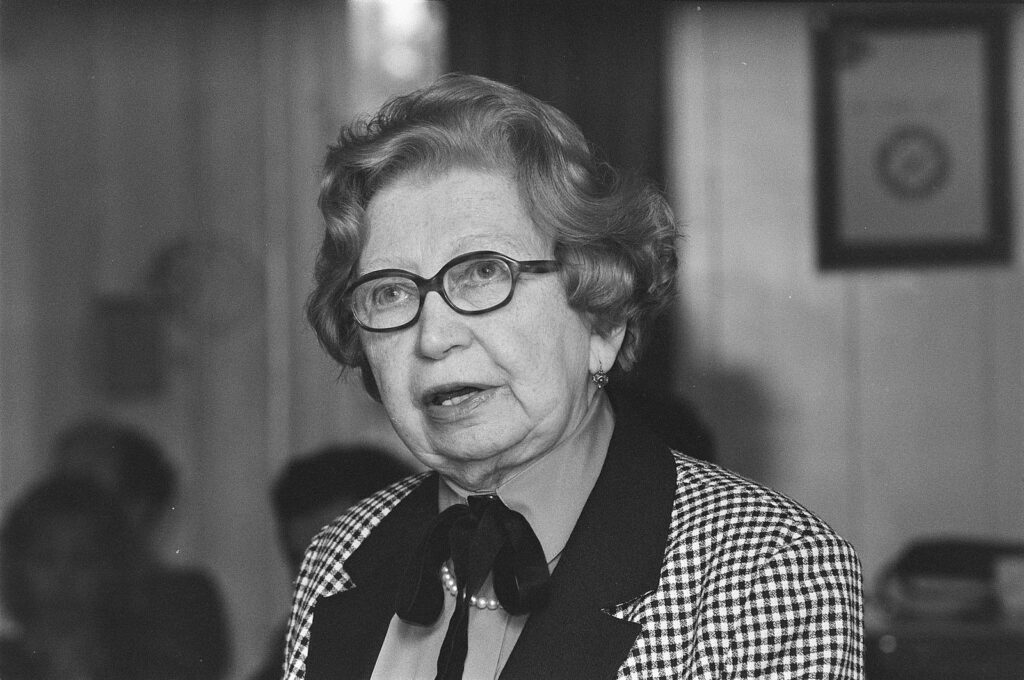
In an obituary of Miep Gies, Richard Goldstein wrote in the NYT, January 12, 2010:
Miep Gies, the last survivor among Anne Frank’s protectors and the woman who preserved the diary that endures as a testament to the human spirit in the face of unfathomable evil, died Monday night, the Anne Frank Museum in Amsterdam said. She was 100. The British Broadcasting Corporation said Mrs. Gies suffered a fall late last month and died at a nursing home. “I am not a hero,” Mrs. Gies wrote in her memoir, “Anne Frank Remembered,” published in 1987. “I stand at the end of the long, long line of good Dutch people who did what I did and more — much more — during those dark and terrible times years ago, but always like yesterday in the heart of those of us who bear witness.”…..
….. Mrs. Gies remained largely anonymous until an American writer, Alison Leslie Gold, persuaded her to tell her story and worked with her on “Anne Frank Remembered.”
In her diary entry on May 8, 1944, Anne Frank wrote how “we are never far from Miep’s thoughts.” In her memoir, Mrs. Gies told of her emotions when she finally read the diary. She wrote: “The emptiness in my heart was eased. So much had been lost, but now Anne’s voice would never be lost. My young friend had left a remarkable legacy to the world. But always, every day of my life, I’ve wished that things had been different. That even had Anne’s diary been lost to the world, Anne and the others might somehow have been saved. Not a day goes by that I do not grieve for them.”
Gershon Hepner is a poet who has written over 25,000 poems on subjects ranging from music to literature, politics to Torah. He grew up in England and moved to Los Angeles in 1976. Using his varied interests and experiences, he has authored dozens of papers in medical and academic journals, and authored “Legal Friction: Law, Narrative, and Identity Politics in Biblical Israel.” He can be reached at gershonhepner@gmail.com.