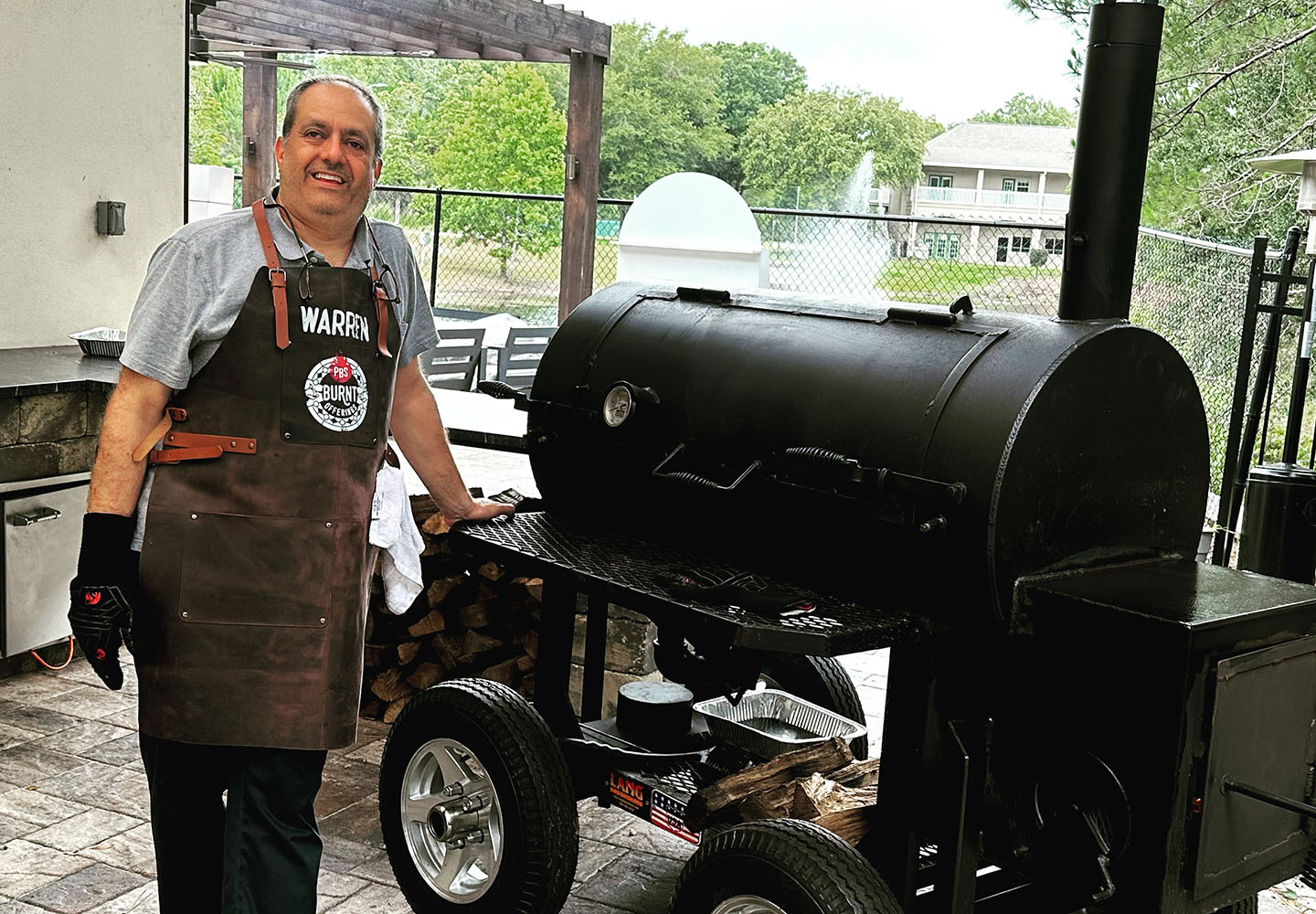
There’s an art and craft to making barbecue. And many reasons to love it!
“[The art] is taking something uniquely American … and being able to make it your own,” Warren Rockmacher, aka the godfather of kosher barbecue, told the Journal, “[This applies to] something as simple as just grilling hamburgers and hot dogs or elevating that chicken [or] brisket.”
He added, “Chicken doesn’t need to be boring; you can spice the chicken up with various different types of rubs. … Even adding a little salt and pepper and putting that on a hamburger before you throw it on the grill is going to enhance that hamburger so much.”
Two of his favorite recipes – crack hot dogs and brisket – are below.
Barbecue started from cooking the cuts of meat that nobody really wanted; brisket was one of those cuts of meat.
“It’s very tough, you can’t turn it into steaks, so [people] would take it home, put it in a slow cooker … by cooking that low and slow and, and giving it smoke, it made it very tender and soft,” he said.
“A good brisket is going to take you anywhere from 9 to 13, 14 hours, depending on how you do it,” he continued. “We start at night and they’re done the next morning, and then you let them rest for a period of time and then go ahead and eat them.”
Rockmacher, who competes around the country with his BBQ team from the Palm Beach Synagogue and does backyard grilling, got into kosher barbecue by accident.
In 2013, back when he still lived on the East Coast. Rockmacher was up late watching a TV show on barbecuing and decided to Google, “”kosher barbecue.”
“I found a competition in Long Island … and I said to some friends, ‘This is kind of neat; let’s go do this,” he said. “They provided the pits, the meats, everything; all we had to do was show up.”
That’s all it took to get bitten by the barbecue bug.
After competing in Long Island for a second year, Rochmacher’s synagogue in Fairfield, Connecticut, suggested hosting their own event.
“We created the Southern New England Kosher Barbecue Championship,“ he said. For two years in a row, they had more than 7,000 attendees.
Rockmacher and his wife moved their family down to Florida and, after things settled down from COVID, he started the Great American Kosher Barbecue Championship and Jewish Festival in Lake Worth, Florida. Their third annual event will be February 15, 2026.
“People love coming out for the food [but we also have] crafters, vendors,” he said. “We’re celebrating being Jewish and that’s really what [the event] is all about.”
While not just one thing makes great barbecue, but the grill is a huge component.
In his yard, Rockmacher has three: a small Weber kettle grill – while his is used solely for fish, anyone can cook pretty much anything on a small grill like that. He also has a huge smoker for big items like brisket, turkey or prime rib, and a combo pellet grill that’s also a smoker; that is for everyday use.
“If we’re making hamburgers, hot dogs, steaks, whatever, I can take that up to 600 degrees and I can sear on it,” he said. “It burns those wood pellets … instead of charcoal or propane, [and] you’re getting a nice wood flavor, which is really, really nice.”
The craft of barbecue is the fire management. You use the different woods to create flavor; the smoke gets into the meat.
“It creates a nice, smoky protein,” he said.
More than anything, Rockmacher explained, barbecue is also about food and family; having people over to laugh, sing, tell stories and enjoy the experience together.
“It goes back to my grandparents’ table in Long Branch, New Jersey,” he said. “Everybody gathered around the kitchen table – that was the center point of the house – while my grandmother or my aunts were [cooking]… having barbecue, it’s the same thing.”
To learn more about the Great American Kosher Barbecue Competition, visit gakbbq.org.
For the full conversation, listen to the podcast:
Honey Bourbon Crack Dogs
Ingredients
2 cups honey
1 6 ounce/180 mL can tomato paste
1/2 cup/120 mL dark brown sugar
1 cup bourbon (I used Evan William Honey Bourbon)
1 tablespoon/15 mL Dijon mustard
1 tablespoon/15 mL garlic powder
1/4 teaspoon/1.25 mL Tabasco
Instructions
Slice hot dogs almost all the way through and coat with the honey bourbon glaze. Cook on indirect heat, 300º for 45 minutes. Half way through the dogs will have opened up and started to curl. Glaze again with honey bourbon sauce, making sure you get in the openings. Finish and eat.
***
Classic Kosher Smoked Brisket
Equipment
Trimming knife and large cutting board
Spritz bottle (for apple juice + cider vinegar mix)
Butcher paper
Heavy-duty aluminum foil and clean towels
Cooler (for resting)
Ingredients and Equipment
1 full packer brisket (USDA Prime or Choice)
For the All-Purpose BBQ Rub
2 parts butcher block coarse black pepper (essential for bark formation)
1 part coarse Kosher salt (Recommended: Morton’s or Badia for granule size)
Preparation
- Trim the Brisket:
– Remove all silver skin and excess fat.
– On the fat cap, trim to ¼ inch thickness for even rendering.
– Save all trimmings in a bowl – you’ll render these later for beef tallow.
Tip: For trimming technique, search “Mad Scientist BBQ Brisket Trim” on YouTube. Jeremy Yoder breaks it down perfectly.
- Season Generously
– Apply the 2:1 pepper/salt rub liberally to both sides of the brisket.
– Let it sit at room temp while your smoker comes to temp.
Smoking Instructions:
- Set Up Your Smoker
– Prepare for indirect heat cooking.
– Target start temp: 235°F
– Recommended wood: oak, hickory, or pecan
– Place brisket fat side down on the smoker grates.
- Spritz During the Cook
– Mix equal parts apple juice + apple cider vinegar in a spray bottle.
– Lightly spritz the brisket every 45-60 minutes after the bark begins forming (around the 2-hour mark).
– Optional: Some pitmasters swear by Dr Pepper or other creative blends for spritzing.
Understanding the Stall
At around 160°F internal temperature, brisket hits what’s called the stall; when evaporation on the surface cools the meat, temporarily stopping the temp from rising. This can last 1.5 to 3 hours depending on humidity, airflow, and brisket size.
To Power Through:
– You can ride it out, or…
– Wrap the brisket tightly in butcher paper to push through the stall faster while still allowing some airflow for bark development.
Finish and Rest
– Brisket is done when the internal temp hits ~200°F or when it becomes probe tender (a skewer slides in like warm butter).
– Remove from the smoker and let it rest, still wrapped, on your counter for 20-30 minutes.
The Cooler Rest (VERY IMPORTANT)
– Re-wrap brisket in foil, then wrap in towels.
– Place it in an empty cooler and let it rest for at least 2 hours (up to 6 hours is fine). This step allows juices to redistribute and improves slicing texture.
Slice and Serve
– Unwrap and place on a cutting board.
– Slice against the grain. Note: Grain direction changes between the flat and point.
– Serve hot, preferably with pickles, slaw, or your favorite sides.
Questions? Email wmrrock@icloud.com.
Debra Eckerling is a writer for the Jewish Journal and the host of “Taste Buds with Deb.” Subscribe on YouTube or your favorite podcast platform. Email Debra: tastebuds@jewishjournal.com.