fbpx

July 10, 2025

Why Do Some Jews Support Those Who Hate Them?

In one of the more astonishing developments in recent political history, Zohran Mamdani — a New York City assemblyman with a well-documented record of anti-Israel and arguably antisemitic positions — has just won a Democratic primary in a district with a significant Jewish population. More surprising still: among his vocal supporters were Jewish voters, and even a number of rabbis.

This is not merely paradoxical. It is perilous — and painfully familiar.

Mamdani, a member of the Democratic Socialists of America, has openly aligned himself with the BDS movement, refused to condemn Hamas terrorism during the October 7 massacre, and reportedly mocked Hanukkah by lighting “intifada candles.” He voted against Holocaust education funding and described Israel’s existence as a colonial enterprise. And yet, Jews helped him win.

The question begs to be asked: How can members of a community support a man who aligns with movements and ideologies hostile to their very existence?

This is not the first time in Jewish history that such self-defeating alliances have emerged. We saw it in the 1930s — in Germany. We saw it again in the 20th century — in Soviet Russia. And we are seeing it now.

In the early days of Adolf Hitler’s political ascent, certain German Jews tried to downplay or deny the danger. Some even collaborated with the Nazi party, believing that if they distanced themselves from Judaism — or at least from Zionism and Orthodoxy — they would be spared.

Dr. Max Naumann, leader of the Verband nationaldeutscher Juden (“Association of German National Jews”), advocated for complete assimilation and actively opposed Jewish nationalism. He believed that German Jews could demonstrate their patriotism and loyalty to the Reich, and thereby earn Hitler’s trust. He was tragically mistaken. In 1935, his organization was banned by the Nazis and he was briefly imprisoned. He died shortly thereafter — a victim of the very system he had sought to appease.

Other prominent Jewish voices sought accommodation. Werner Cahnman, a noted sociologist, documented how some German Jewish intellectuals, fearing Bolshevism more than fascism, saw Hitler as a lesser evil. The Allgemeine Zeitung des Judentums, a major German Jewish newspaper, initially counseled calm and restraint, warning against “hysteria” even as Nazi rhetoric grew more violent.

This historical blindness wasn’t limited to fear or delusion. It stemmed from a deeper pathology that still afflicts segments of the Jewish community today.

Philosopher Jean-Paul Sartre, in “Anti-Semite and Jew,” argued that some Jews internalize the hostility directed at them, rejecting their own identity in hopes of gaining acceptance. “The anti-Semite creates the Jew,” Sartre wrote, “and the Jew, in turn, may become the mirror of that fantasy.”

Theodor Adorno, co-author of “The Authoritarian Personality,” explored how minority groups, including Jews, sometimes adopt the values of dominant cultures — even when those values are hostile — in an attempt to survive through mimicry or moral superiority.

Sigmund Freud, in “Moses and Monotheism,” described the ambivalence within Jewish identity as a struggle between chosenness and alienation — a tension that, when unresolved, can lead to rejection of one’s own heritage.

In today’s context, that same psychology may help explain why progressive Jews — often alienated from tradition, memory, and peoplehood — align with figures like Mamdani who cloak antisemitism in the language of “social justice.”

The pattern repeated itself tragically under Soviet Communism. Although the USSR officially espoused anti-racism, it also declared war on religion and national identity — two pillars of Jewish continuity. And yet, many Jews joined the revolution.

Leon Trotsky (Lev Bronstein), a key architect of the Red Army, rejected his Jewishness and actively supported the suppression of religious life. The Yevsektsiya, the Jewish section of the Communist Party, was created to dismantle Jewish schools, synagogues, and cultural institutions. Jews — in the name of “progress” — led campaigns to destroy their own spiritual infrastructure.

Even in the United States, Jewish intellectuals like the anarchist Emma Goldman critically supported communist ideology, despite its clear hostility to religion and national identity. They believed that by embracing universalism, they would transcend antisemitism. Instead, they found themselves stripped of both tradition and protection.

What links these eras — from Hitler’s Germany to Stalin’s Russia to Mamdani’s New York — is a tragic pattern: Jews, often in pursuit of assimilation or moral superiority, support movements that endanger their survival.

History reveals a tragic pattern: Jews, often in pursuit of assimilation or moral superiority, support movements that endanger their survival.

Today, radical anti-Zionism, particularly within elite academic and progressive circles, serves as a respectable cloak for ancient hatreds. And yet, young Jews, especially those disconnected from tradition and history, are joining those very movements. They march in rallies where “From the river to the sea” is chanted, failing to realize that the slogan calls not for peace but for their erasure.

This is not political disagreement. It is historical amnesia.

The Jewish tradition teaches that memory is redemptive. “Zachor” — remember — is not just a commandment; it is a survival strategy. When Jews forget who they are, they become vulnerable not only to their enemies, but to themselves.

“Zachor” — remember — is not just a commandment; it is a survival strategy. When Jews forget who they are, they become vulnerable not only to their enemies, but to themselves.

The lesson of Mamdani’s victory is not just that dangerous ideologies can win elections — but that they can win them with Jewish help. That makes them even more dangerous.

It is time for Jews to remember: who we are, what we have survived, and what history has taught us about those who promise utopia while threatening our existence.


Rabbi Benjamin Blech is Professor of Talmud at Yeshiva University.

Why Do Some Jews Support Those Who Hate Them? Read More »

Balaam’s B-Sides – A poem for Parsha Balak

How firm is your dwelling place, and your nest is set in a cliff! ~ Numbers 24:21

If you’re a good Jew, and who am I to assume otherwise,
every morning, you quote your favorite diviner, Balaam’s
greatest hit How lovely are your tents, O Jacob;
your dwelling places, O Israel –

his famous blessing, which he meant to be a curse
but then just couldn’t, thanks to some divining
from the even Greater Diviner. Every morning!
It’s the hey, what’s up, is everything good with you

of its day. His parable continued with the
lesser-known ditty How firm is your dwelling place,
and your nest is set in a cliff! He spoke this to
a Keinite, which wasn’t very nice as the Keinites

were our pals, and how would you feel if your
good friend told you you lived in a cliff nest?
Not good, I bet. I mean, with all the Midianites
and Moabites, and some king named Og

attacking as at every turn towards the river,
let’s not make the Keinites unhappy too, you know?
We don’t hear much from Balaam after this.
He kind of shot his shot with the lovely tent thing

(I mean, we all say it every morning, right?
That’s the kind of good Jews we all are, right?)
And I guess it wasn’t so great for the Keinites
having their nests up in cliffs because

they don’t seem to be around anymore
and we are with our feet on every side of the river
and our memory longer than our own lives
and our lovely, lovely tents.


Rick Lupert, a poet, songleader and graphic designer, is the author of 29 books including “God Wrestler: A Poem for Every Torah Portion.” Visit him at www.JewishPoetry.net

Balaam’s B-Sides – A poem for Parsha Balak Read More »

When Jew-Hatred Meets Partisan Hatred, Things Can Get Complicated

One of the mind-numbing cliches of the Jewish world is that “antisemitism is unacceptable, whether it comes from the left or right.”

Well, yeah. All antisemitism is bad. That’s an obvious moral truth.

The more interesting questions for me are: How are they different and why? Are some Jews more hated than others depending on their political affiliations? And why would that matter?

Let’s start with antisemitism from the left. In brief, the left is against anything that smacks of Western, white patriarchy, colonialist, capitalist, Republican, and so on. Think AOC meets Bernie meets Mamdani.

So, if you’re a right-wing Jew who checks all those boxes, you can be sure these leftists will hate you more than they hate other Jews, because they despise everything from the right.

The Gaza War was a Jewish hate accelerator for this group, as we saw with the loud anti-Israel protests on college campuses. This made the antisemitism from the left more prominent.

In recent months, however, antisemitism from the right has moved up the awareness ladder. Here again, the right has its own set of leftist hate boxes. If you’re woke, anti-West, anti-America, anti-cop, anti-white and Jewish, you can be sure this group will hate you more than Jews who share their right-wing views.

One factor has complicated the picture from the right—an America-first, isolationist wing (led by Tucker Carlson) that abhors all U.S. involvement in foreign conflicts. Since they can’t stand foreign entanglements of any kind, this wing is not too fond of military support for Israel.

Their real venom, however, is reserved for Jews who fit the Trump-hating, anti-America, Democrat woke crowd that would never be caught dead hoisting a U.S. flag on July 4th.

The point is this: Jew-hatred is terrible regardless of where it comes from. But depending on where you sit politically, some Jews can be more hated than others.

We’re conditioned to believe that Jew-haters hate all Jews equally; that Jew-haters hate Jews so much they don’t care what kind of Jew it is.

Of course there’s some truth to that, but extreme political partisanship has complicated things, what epidemiologists call a “confounding factor.”

In other words, the left has so much hatred for the right it’s natural they would have a special hate for right-wing Jews. Same with the right—they hate the left so much that when they think of hating Jews, it’s leftist Jews who are top of mind.

This doesn’t mean both sides of the political aisle don’t share some classic and ancient resentment of Jews, such as the stereotype of the powerful and conspiratorial Jew. But partisan animosity has become so intense in our day, and so entangled with every aspect of our culture, it’s inevitable that it would get entangled with other hatreds, such as Jew-hatred.

In short, there’s another serious hatred in town, and this one, rooted in our political parties, also means business.

What does this mean for Jews? At the very least, we need to pay attention to these political distinctions, because they may require different strategies. Yes, we must fight all Jew-hatred, but not all Jew-hatred is created equal.

This may complicate an already complicated picture, but at least it’s not a mind-numbing cliché.

When Jew-Hatred Meets Partisan Hatred, Things Can Get Complicated Read More »

Israel Discount Bank’s Soiree, LA Jewish Film Fest Closing Night, AJU Board Chair

Israel Discount Bank (IDB), a New York-based private and commercial bank and the largest Israeli-owned bank in the United States, held its annual client appreciation event at the Beverly Hilton on June 12, bringing together valued clients, bank executives, and community members for an elegant evening under the stars.

Guests enjoyed a wide-ranging culinary experience featuring Persian, Israeli, American, Mexican, and Japanese cuisine, alongside live entertainment and a vibrant atmosphere.

This year’s event also marked a leadership transition: attendees had the opportunity to bid farewell to outgoing CEO and President Ziv Biron and meet Avner Mendelson, the bank’s new CEO and president. Mendelson, former CEO of Bank Leumi USA, brings extensive experience in international banking and a deep connection to both the local and Israeli communities. The leadership transition took place on May 1.

The event was coordinated by Moti Levi-Tzedek, IDB’s Head of Business Development, who oversaw the planning and production of the celebration took place on May 1.

By Ayala Or-El, Contributing Writer


Director Anja Marquardt, actor Mike Burstyn, LAJFF Director Hilary Helstein and the Jewish Journal’s David Suissa attend the closing night program of this year’s Los Angeles Jewish Film Festival, which screened films celebrating the diversity of the Jewish experience. Photo by Todd Felderstein, courtesy of L.A. Jewish Film Festival

The closing night for the 20th annual Los Angeles Jewish Film Festival was held at the Museum of Tolerance on July 1. Mike Burstyn, star of the closing night show, “The Zweiflers,” was honored and celebrated for his 80th birthday.

The festival screened two episodes of the award-winning German series he stars in, “The Zwieflers,” with a Q-and-A panel including the series’ director, Anja Marquardt; L.A. Jewish Film Festival Director Hilary Helstein; Burstyn; and Journal Publisher and Editor-in-Chief David Suissa.

“The Zweiflers” is a six-part series about a Jewish family in contemporary Germany pondering the inheritance of the family delicatessen. Something like a German-Jewish “Succession” story, the series took home the prize for Best Series at the Canneseries Awards in 2024.

The Los Angeles Jewish Film Festival builds community awareness and appreciation for the diversity of the Jewish people through cinema. This year’s festival took place from June 26-July 1.


Larry Platt

American Jewish University (AJU) has announced the appointment of Larry Platt as chair of its board of directors. As a seasoned leader and strategic thinker, Platt brings decades of executive and philanthropic leadership to AJU during a pivotal time in its evolution, according to AJU.

Platt joined the AJU board in 2016, where he has served in several key leadership roles, including chair of the development committee. He currently chairs the executive compensation committee. Platt previously held leadership positions at some of Los Angeles’ most respected institutions, including Cedars-Sinai Medical Center, where he helped steward a healthcare system with deep Jewish roots and broad civic impact. His lifelong commitment to Jewish continuity, community-building and innovation makes him uniquely equipped to help guide AJU’s mission into the future, AJU leadership said.

“Larry steps into this role at a transformative moment,” AJU President Jay Sanderson said. “His passion for Jewish life and his deep understanding of our community’s needs will be instrumental as we expand AJU’s impact, invest in new models of education and engagement, and ensure a thriving Jewish future.”

In his new role, Platt will work closely with Sanderson and the AJU board to help shape and support AJU’s vision for long-term Jewish leadership development. Together, they aim to prepare the next generation of Jewish leaders, including rabbis, educators, activists and community builders, to carry Jewish life forward with purpose and pride.

“I believe that the future of the Jewish people in the United States depends on how we educate and inspire the next generation,” Platt said. “AJU is uniquely positioned to meet people where they are—through camp, online learning, and formal education—and to build a vibrant, inclusive Jewish future grounded in both tradition and innovation.”

Platt succeeds Harold Masor, who recently completed his tenure as board chair.

Israel Discount Bank’s Soiree, LA Jewish Film Fest Closing Night, AJU Board Chair Read More »

Bombing Auschwitz—in Iran

A major front-page article in the New York Times this week strongly criticized Israel’s bombing of an Iranian torture center, even going so far as to suggest that the Israeli strike may have been a war crime. One wonders how the Times would have responded if the United States had done to Auschwitz what Israel did to the barbaric Evin prison in Tehran.

While Evin was not a death camp, and the brutalization of prisoners there was not another Holocaust, the bombing and its aftermath raise some of the same questions with which we grapple in ongoing discussions about the Allies’ failure to attack Auschwitz.

Even as it disparaged the Israeli bombing raid, the New York Times acknowledged that Evin was a singular symbol of oppression,” where Irans rulers punish dissent with detention, interrogation, torture and execution.”

The lengthy Times article mentioned that the bombs hit “the infamous 209 ward controlled by intelligence forces,” but it failed to explain why that ward is infamous. For that, one must look elsewhere, such as Hengameh Haj Hassan’s gripping 2013 memoir, Face to Face with the Beast: Iranian Women in Mullah’s Prisons.

Hassan and five other women were confined in a Ward 209 cell so small “that there wasn’t room enough to stretch out” to sleep. Some were political dissidents. One was a 16 year-old girl jailed for possessing a romance novel. The prisoners’ clothes were filthy “because of torture and bleeding wounds.” They shared a single decrepit toothbrush. The food consisted of one barely-edible meal daily.

All the women in Hassan’s cell were beaten and tortured regularly. The officers who questioned Hassan boasted that they were “better at torturing and interrogating” than their colleagues. She endured unimaginable suffering, and also witnessed numerous “scenes of sexual humiliation,” including officers “raping girls before they executed them.”

The centerpiece of the New York Times story was the accusation that Israel’s bombing of Evin harmed some innocent bystanders. How many of them were killed or injured is impossible to know, because the Times relied partly on information from the Iranian government. The total number appears to be in the dozens, including some prisoners and relatives who were visiting them.

Kanal 13, an independent news outlet based in neighboring Azerbaijan, has broadcast video on YouTube that it said shows prisoners escaping from Evin as a result of the bombing. How many escaped may never be known.

When the Israeli government decided to strike at Iran’s nuclear facilities, it had no military reason to come to the aid of imprisoned Iranian dissidents. Attacking Evin was strictly a humanitarian gesture.

Unfortunately, Israel has not yet invented bombs that only blow the locks off prison cells or kill only the guards. Meaning that hitting the prison could endanger the lives of some innocent bystanders. But it also could mean freedom, and life, for many others.

The Allies faced similar dilemmas during World War II, yet that never stopped them from bombing necessary targets.

In February 1944, British fighter-bombers attacked the Amiens prison in German-occupied France, where the Nazis were holding French resistance fighters. The planes struck such narrow targets as a guardhouse and specific walls. As a result, 258 prisoners escaped. But 102 were killed.

The New York Times article about the Amiens raid did not contain even a hint of criticism. Nor did other media coverage of the bombing. An official of the World Jewish Congress clipped out the Times article and sent it to U.S. Assistant Secretary of War John McCloy, with a note describing the raid as “exactly the kind of assault which we have been asking for in order to free the doomed inmates of the German slaughter camps.” Roosevelt administration officials rejected such requests from dozens of officials of Jewish organizations.

Assaults such as the one on Amiens were known as “precision bombing,” but of course there was a limit to how precise they could be. As in all wars, bystanders sometimes were harmed.

In April 1944, for example, the British targeted an archive in The Hague where the Germans stored documents that were potentially harmful to the Dutch resistance. The bombers destroyed the building and an adjacent SS barracks, but 64 archivists and passersby were killed. That August, American planes bombed a rocket factory inside the notorious Buchenwald concentration camp. They demolished the factory and killed about 100 SS officers and their family members, but an estimated 388 slave laborers in the factory were killed and more than 1,000 were wounded.

Two months later, the British bombed Gestapo headquarters in northeastern Denmark. They destroyed crucial files and killed dozens of Germans. Two prisoners from the Danish resistance escaped; but a third was killed in the bombing. Stray bombs hit an adjacent building, killing ten civilians. Five months after that, the British bombed Gestapo headquarters in Copenhagen, leveling the building and enabling eighteen Danish prisoners to flee, but some bombs accidentally hit a nearby school, killing about 125 civilians.

American planes repeatedly bombed the synthetic oil factories in the industrial zone of Auschwitz, even though the Allies knew that about 600 British POWs were being held there. Thirty-eight of them were killed when the U.S. bombed those factories on August 20, 1944.

The choice for Israel was to do what the international community has always done about Iranian oppression—nothing—or to take action to interrupt the mass torture, even at the risk of harming some bystanders. The Israelis made the morally right choice, even though Amnesty International says it was a “war crime.” The Israelis accomplished in minutes more than all of Amnesty’s crocodile tears press releases about Evin ever did.


Dr. Medoff is founding director of The David S. Wyman Institute for Holocaust Studies and author of more than 20 books about Jewish history and the Holocaust. His book The Road to October 7: Hamas, the Holocaust, and the Eternal War Against the Jews will be published on October 1, 2025, by The Jewish Publication Society / University of Nebraska Press.

Bombing Auschwitz—in Iran Read More »

Joshua Stopped the Sun

Joshua became the ally of Adoni-Zedek, king
of what originally was called Shalem
and would  become Jerusalem, defended in a military sting
like Abraham’s in Genesis fourteen almost the same,

when the priestly king Melchizedek was by Honest Abe defended,
before God aided Moses in the plague of hail,
which miraculously both on heavenly fire and ice depended,
not stones, God’s weapons, in the Joshua tale,

before God stopped the sun for him, as He had done
for Moses in the plague of darkness, helping Israelites
to identify Egyptian treasures before their freedom had been won,
not plagued by darkness when the plague transformed dark days to blinding nights,

foreshadowing how God caused the foes of Joshua to fail by losing light,
which he extinguished as if he had stopped the sun, reiterating
how during the ninth plague all foes of Moses lost their sight,
Joshua’s miracle Moses’ dark plague reliterating.

Dom!” he told the sun, which means “Be silent!” In both tales no dogs whetted
their tongues when miracles to Israel occurred,
not barking like fake news about failures silently regretted
by Israel’s foes, no words like “We’re defeated” heard.

The iniquity that was foreshadowed by the sin of Amorites
to which Torah makes a strange allusion
when in the covenant God made with Abraham it writes
God promised him its covenantal conclusion

would lead to the success of the colonial settler movement it defended,
depended on completion of a sin defined  as “Amorite,”
with this word, I believe, predicting antisemitism by shalom would be shalem,  amended,
as Joshua hoped it would be, switching off sunlight.

Settler colonialism, nasty label, is not necessarily,
despite progressive doctrine, always immoral.
In the covenant God validated with Abraham, we’re told that verily
it would be moral once Amorites are no more amoral.

Stopping sunlight in the sky Joshua reminded us that godlight, which C. S. Lewis
appreciated more than what astronomy is able to explain,
can be appreciated fully down on earth only if of it our view is
not overshadowed by a solar, soulless  light which makes it wane.


Joshua 10 describes how God enabled the Joshua to protect five Amorite kings, including the king of Jerusalem, Adoni-Zedek, in a battle against four Canaanite kings. During he course of the battle  described in this  narrative we are informed that he stopped (literally “silenced”) the sun. The story echoes a narrative in Genesis 14, describing  Abraham’s ability to help five kings of the Jordan valley defeat four Mesopotamian kings, a victory that led to a blessing by Melchi-Zedek, king of Shalem, Salem. This blessing was followed  In Genesis 15 by a covenant with God, who assures Abraham that though his descendants would be a great nation they would only be allowed to settle in the land of Canaan after the sin of the Amorites was shalem, meaning completed.

The story of Joshua in Joshua 10 also echoes the story of the defeat of Pharaoh caused by the ten plagues with which God ensures Moses’ victory in the Israelites’ battle for freedom while they are enslaved in Egypt.

On 7/8/25 Rabbi Meir Soloveichik in Episode 189, 10-Minute Mitzvah, “Gratitude vs. Forgetfulness,” inspired by the thirteenth century tosafist and codifier Moses of Coucy, suggested that Deut. 11:8 implies that we should be grateful for what C. S. Lewis called “Godlight.” In Patches of Godlight, C. S. Lewis writes:

Any patch of sunlight in a wood will show you something about the sun which you could never get from reading books on astronomy. These pure and spontaneous pleasures are “patches of Godlight” in the woods of our experience.”


Gershon Hepner is a poet who has written over 25,000 poems on subjects ranging from music to literature, politics to Torah. He grew up in England and moved to Los Angeles in 1976. Using his varied interests and experiences, he has authored dozens of papers in medical and academic journals, and authored “Legal Friction: Law, Narrative, and Identity Politics in Biblical Israel.” He can be reached at gershonhepner@gmail.com.

Joshua Stopped the Sun Read More »

A Bisl Torah — A Prayer for the People of Texas

Ribono shel Olam, Master of the Universe, our hearts are broken as we continue to learn about the devastation in Texas. Water offers the power of rebirth and, destruction. We remember the story of Noah in which, “All the fountains of the great deep burst apart, and the floodgates of the sky broke open…all the highest mountains everywhere under the sky were covered.” As we learn about each stolen life, the floodgates of the sky broke open once more. We pray with urgency and angst that the waters recede, and semblances of peace find ways into the hearts of the bereaved.

Master of comfort, we know what it means to send a child to overnight summer camp. The weeks of planning and packing, hoping that you tucked in the right stuffed animal and favorite blanket. The parents telling their children not to worry because everything will be ok; the parents holding back fears knowing that summer camp provides space to stretch, learn, laugh, and grow. The children anxiously awaiting to reunite with best friends and the children nervously wondering if they will be accepted. Summers filled with songs, relationships, traditions, and play. Holy One of Blessing, we know what it means to send a child to overnight summer camp. To the parents, brothers, sisters, grandparents, aunts, uncles, cousins, and friends that lost beloveds at Camp Mystic, we share our hearts with you. Your children’s names, ages, and memories are forever stored within the facets of our souls.

God, remind us of the power of prayer. No matter the religion or culture, let the words of our mouths enter the hearts of the bereaved.

In their grief, let them know they are not alone.

In their sorrow, let them know we pray for their souls.

In their horror, let them know we hope that one day, they will again know peace.

Together, we cry. Together, we mourn.

May the memories of the departed inspire us to always, in their name, be a blessing.

Amen.

Shabbat Shalom


Rabbi Nicole Guzik is senior rabbi at Sinai Temple. She can be reached at her Facebook page at Rabbi Nicole Guzik or on Instagram @rabbiguzik. For more writings, visit Rabbi Guzik’s blog section from Sinai Temple’s website.

A Bisl Torah — A Prayer for the People of Texas Read More »

A Moment in Time: “The Awe of In-Between”

Dear all,

As Maya and Eli gazed into the pond, two turtles popped their heads out and gazed right back at them. It was a precious moment in time, and I thought deeply about the two worlds coming together – words that generally live above and beneath a surface.

Judaism so often seems to emphasize similar opposites:

Kosher/ Traif (not-kosher).

Male/ Female

Holy/ Ordinary

Shabbat/ Rest of the Week

But in truth, the emphasis isn’t really about the separation. It’s about the points of contact.

When does Shabbat begin? On Friday evening when the sun hasn’t quite set. It’s not dark. It’s not light. It’s in-between. And the magic of in-between is incredible.

The same goes for all these other examples above.

We have a lot to learn about the awe of in-between. If we can work to create connections rather than divisions, if we can strive to cross the surfaces that separate us, if we can reach out to find unity in our very complicated time …. Then we will allow heaven and earth to kiss.

Maya and Eli waived good-bye as the turtles swam beneath the surface. My kids can’t wait to see them again, crossing the boundary beneath these two worlds.

With love and shalom,

Rabbi Zach Shapiro

A Moment in Time: “The Awe of In-Between” Read More »

Print Issue: Hate VS. Love | July 11, 2025

CLICK HERE FOR FULLSCREEN VERSION

Print Issue: Hate VS. Love | July 11, 2025 Read More »

Prophetic Illumination, or, The Comedy Club of Canaan


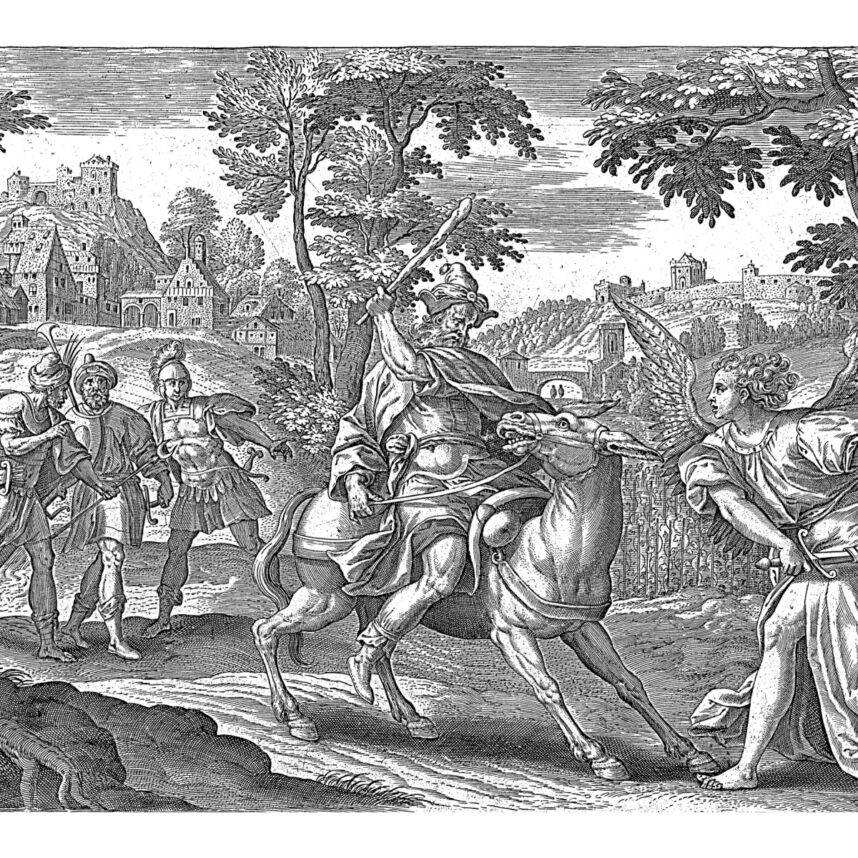
The story of Balaam and his talking donkey is a major problem for serious theologians and scholars of the Bible. If you are not familiar with this gem in this week’s Torah portion, take a look at Numbers 22:20-25, the story that contains the chattering mule. Some people poke fun at literalists who believe that the donkey actually spoke. These literalist might point to a fish called “sarcastic fringehead” (neoclinus blanchardi) and say that if this denizen of the shallow exists, why not the talking donkey starring in this tale saturated with irony (if not sarcasm).


In case you are not caught up on your Bible stories, here is a quick summary. The King of Moab is terrified of the Israelites. They began their march across the Sinai desert to Canaan and seemed undefeatable, the Mike Tyson of their times. The scared King engages a certified prophet of God, Bilaam, to curse the Israelites, and offers a substantial reward. Bilaam, takes the challenge, but says he must ask God. After some initial resistance, Bilaam finally got God to “yes,” with the caveat:  ‘Only say what I tell you to say.”


The prophet alights upon his donkey. Somewhat inexplicably, God becomes angry. Suddenly a fierce sword wielding angel appeared on the road, but only to the donkey, not to the prophet.  The donkey veered off the path to avoid the sword and the angel.  Bilaam beat the donkey to get her back on the road, but the angel cornered the donkey and her rider. The donkey, offended at having been beaten, speaks up and says something like, “I’ve worked for you a long time; have I ever done anything this before?” I imagine the donkey urgently gesturing with her ears trying to say, “There’s something on the road you need to know about!”  The angel finally reveals himself, also angry that Bilaam had beaten the donkey. The angel tells Bilaam that he came down to kill him, but the donkey saved him. Bilaam apologizes and offers to go back; the angel tells him to go on, but remember: “Say only what God tells you to say.”


We, the readers, can only infer that Bilaam was daydreaming about the curses he wanted to cast upon the unsuspecting Israelites, camping on the other side of the hill yonder, to please his patron the king, but God caught him.  “How did He know what I was thinking?” Bilaam probably asked himself, but then quickly answered his own question. “Right. God.”  The remainder of the story is an exquisitely written farce.


Full disclosure:  I see the Bible as literature, not journalism. Great literature contains jokes. This passage is burlesque satire, meant, in my mind, to make us laugh, think and admire. If you’ve never read the Bible before, you absolutely for sure did not see this story coming.


Serious theologians avoid the embarrassment of this passage by taking it utterly seriously. Theologians, such as the greatest Jewish theologian, Maimonides, file this passage under “prophecy,” not “the best jokes in the Bible.”


Prophecy is almost certainly the most important idea in medieval Jewish theology. Medieval philosophers, under the powerful sway of Plato and Aristotle, saw the Bible as we might see a dream – fantastic metaphors for the uninitiated, metaphors aimed at communicating truths, almost too unbearable for us to know.


For example, you might upon awakening say, “There I was, walking in the mud of the low tide, and suddenly I was surrounded by sarcastic fringeheads nipping at my feet!” You weren’t actually surrounded by sarcastic fringeheads; your dream factory took some object of your unconscious, your insufferable teenager, for example, and created a metaphor to communicate a thought.


Powerful truths are communicated to simple people through metaphors, according to the medieval theologians. ‘God spoke to the people’ and ‘God descended on Sinai in fire and smoke,” are obviously impossible for a God of pure being that does not have vocal cords, nor a corporeal body at all that can move from place to place.


Those initiated into divine secrets look past the metaphors and ask a fundamental question: how can a God of pure being communicate with human beings? Who can know the secrets of the Divine realm, and how? Why some people and not others? Closer to our Torah portion, how can we explain that a person such a Bilaam, who appears to be an archetype of inauthenticity and lack of integrity, is called a prophet?


The theories of mystical experience and accessing knowledge of the Divine devised by the medieval theologians are truly stunning and piercing works of brilliance. I’d like to talk about some of these theories Friday night, after a I deal with a question I can’t let go of.


The scene of this story is on the other side of a hill far away from the Israelites. Who leaked this story of Bilaam’s crushing reckoning with God? The only ones who knew were Bilaam, God, the Angel –  and the donkey. Was there a Donkey Night at the Comedy Club of Canaan? And even then, how did this story get into the Bible?


If this is a Divine secret, I want to know it.


Prophetic Illumination, or, The Comedy Club of Canaan Read More »