After being alive for 16 years, I would think it would be easy to classify myself into a certain category, and that by now I would know what, who and why I am what I am. But as I grow older, it has become more complicated for me to label myself — secular, religious, Jewish American Mexican, Mexican American Jew.
This is probably a result of the fact that the older I get, the more in-depth I learn about my religion and the more I begin to formulate my own thoughts and opinions about it and about myself. While for a long time I have been able to articulate thoughts on certain religious matters, I have to admit that those opinions were, for the most part, strongly or loosely based on those of my parents and teachers. For example, I was a secular Jew because my mother told me that she was a secular Jew. I considered myself to be a Mexican American teenage girl, who happened to be Jewish, as well, because that was the way I was raised. We would celebrate Shabbat when it was convenient to, and would observe only the “famous” Jewish holidays — Chanukah, Pesach, Yom Kippur, and Sukkot.
I considered a Jew to be a person who knew about the Torah, kept kosher, celebrated Shabbat and who went to temple every Friday night — and anyone who did not, was, in my eyes, not a “real” Jew. This consequently meant that I was not a “real” Jew. The thought of this not only made me hate the religion’s standards — which I myself had set — but it caused me to feel very confused about myself. I wasn’t sure which temple I liked, how to celebrate each holiday, and even how to eat. Everyone I met seemed to have different views than I did, and no one was able to help me understand where I fit in best.
When I started Milken Community High School’s middle school after finishing the sixth grade at Abraham Joshua Heschel Day School, I further realized how unacquainted I was with my own feelings toward my religion. Although we had Judaic studies every year, I felt unable to drift away from my parents’ beliefs and create my own.
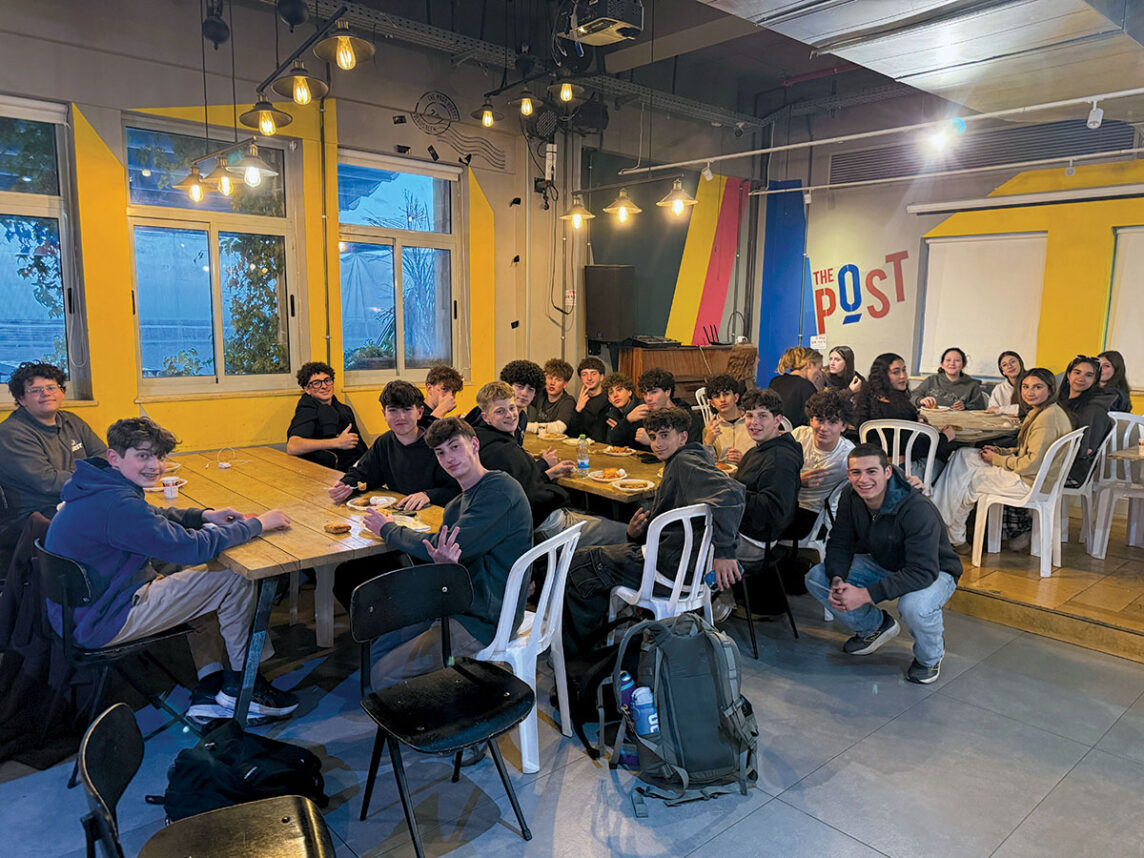
Then, in 10th grade this past year, I was accepted into the Tiferet Israel Program, for which I left the comfort of my parents’ home and lived in Israel on my own for four months, along with 38 other Milken 10th- graders.
I was relieved to find that one of my friends, Tali, happened to be in Israel at the same time, on a separate school program. Tali, a girl I met at tennis camp, was one of the only people I knew who shared my beliefs — we both agreed that it was not necessary to follow all of the rituals of the Jewish religion. It was not until we reconnected in Israel that I found out her father is an Orthodox rabbi who works at Chabad. This immediately made me wonder how a rabbi, an Orthodox rabbi, a “real” Jew, could raise a “fake” one. I asked Tali what she considered herself to be, and whether or not she felt comfortable with her decision of moving away from her family’s opinions and creating her own. She answered that she respected her parents’ beliefs but did not completely agree with what they stood for. When I asked her if she felt as Jewish as her father, she responded without any hesitation, “I am just as Jewish as my father and mother and you are just as Jewish as them as well.” Hearing those words finally come out of someone’s mouth besides my own was like lifting the world off my shoulders. From that point on I no longer felt uncomfortable with my beliefs, and I no longer felt out of place.
Every day it became clearer to me that there was not one specific way to define a “real” Jew. By observing the amount of pride and devotion that all the Jewish Israelis felt toward their religion, I began to understand that simply believing in God and being proud of the fact that you are Jewish automatically makes you as Jewish as you can get. I was able to see on many different occasions the variety of Jews, and how I did not have to fit into any one of them in order to be Jewish. When our group went to the Kotel, for example, I was able to see ultra-Orthodox Jews, Conservative Jews, Modern Orthodox Jews, and Jews that don’t fit into any of the categories praying toward the Wall, and every one of them accepts the other as a member of the Jewish faith.
All of my experiences in Israel made me able to officially classify myself under a category that I fit into. I now consider myself to be a Jewish Mexican American teenage girl, and I am proud to have it be in that order. I no longer feel disconnected from the rest of the Jewish people, and for the first time in my life, I feel as Jewish as any rabbi who works at Chabad — or any Jew in the world.
Rebecca Suchov just completed the 10th grade at Milken Community High School.<BR>