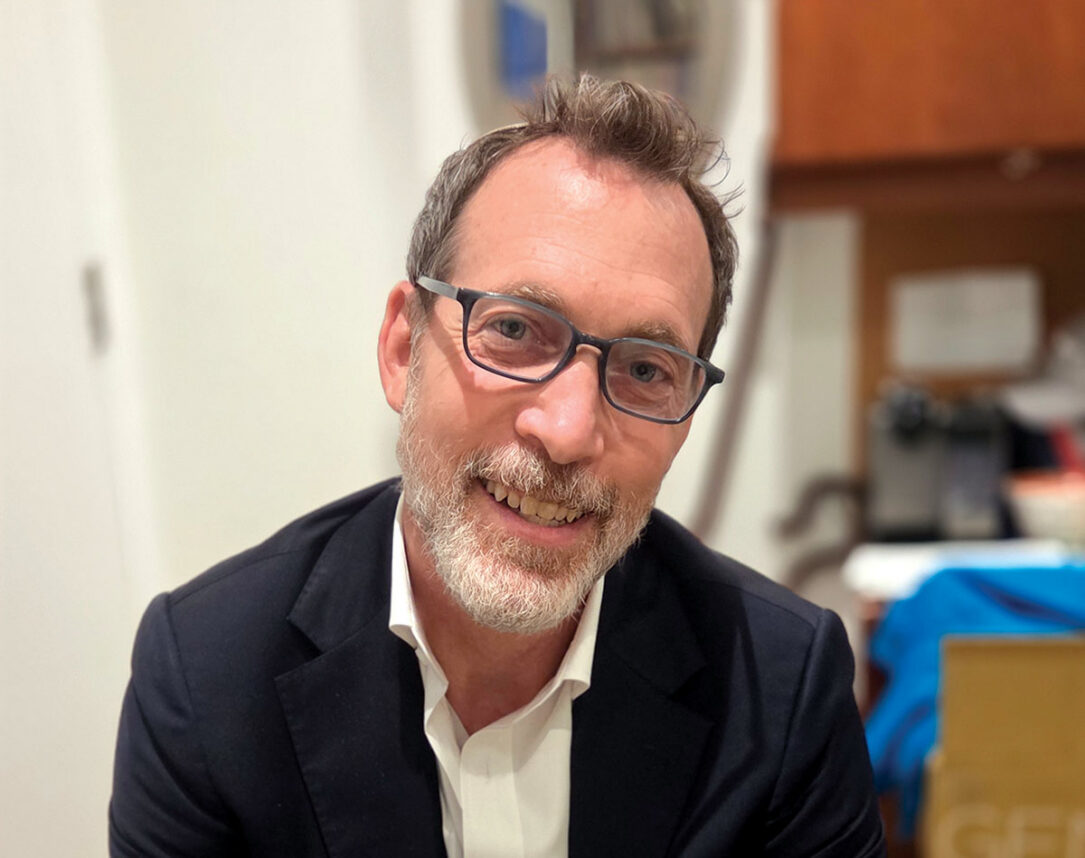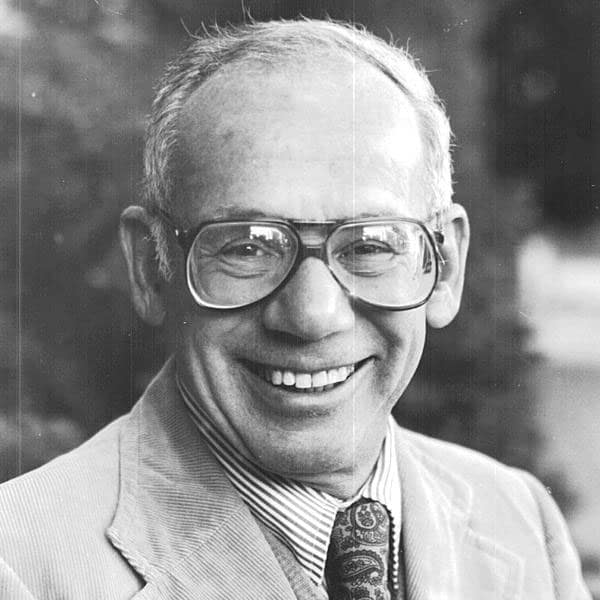
Todd Samuel Presner is a time traveler who combines modern technology and past knowledge in a way that might have astonished a Jules Verne or H.G. Wells.
The UCLA professor glides easily across the centuries by way of a construct he labels alternately as digital archaeology, information navigation, hypermedia and time-space documentation.
Along the way, he has tracked the interwoven histories of Jews and Germans during Berlin’s 800-year history and in the future plans to depict the many-layered history of Jaffa and its upstart neighbor, Tel Aviv.
The 35-year-old, self-described “techie-humanist” is an associate professor of Germanic languages and Jewish studies, and from a small book-jammed office in UCLA’s venerable Royce Hall, he helps direct the Center for Digital Humanities.
“Mankind has been telling its stories in many ways, first through oral tradition, then through the written and printed page and now through the interactive Web,” Presner said.
His current showpiece is “Hypermedia Berlin,” which allows even a computer-challenged visitor to uncover layer after layer of the German capital’s historic and physical evolution, from its initial human settlement in the 13th century through kings, emperors, dictators, composers and philosophers to the present.
He and a team of 18 students and scholars draw their underlying information from documents, paintings, archives, photographs and architectural drawings and carefully assemble the Web-based maps of Berlin at roughly 10- to 50-year intervals.
As in a stratified archaeological dig, layers of maps are superimposed on each other, allowing viewers at a glance to compare the street grid and landmarks of 17th century Berlin with the city’s expansion and infrastructure two centuries later.
Integrated with information on historical events and leading personalities of the different eras, the maps display the 18th century Jewish quarters and Frederick the Great’s “Charter of the Jews of Prussia” and later the Scheunenviertel quarter of East European Jewish immigrants after World War I.
A click reveals the location and appearance of Gestapo headquarters on the 1936 map, and later maps show the rise and fall of the Berlin Wall and, most recently, the city’s Holocaust memorial.
The multimedia and multitasking technique, which Presner labels hypermedia, “reveals the layers of the past and the evolution of cities,” he said.
His pathbreaking work on Berlin will be followed by similar hypercity models of Los Angeles, New York, Rome and Lima, Peru. Farther down the line, he hopes to explore Jaffa and Tel Aviv in cooperation with Tel Aviv and Ben-Gurion universities.
For the time being, he lacks the expert collaborators for the daunting task of recreating the deeply layered history of Jerusalem.
Presner traces his personal lineage to both Sephardi and Ashkenazi grandparents. He earned double doctorate degrees from traditional rivals, Stanford University (comparative literature) and UC Berkeley (art history, media studies).
His interest in the “deeply entangled and connected” history of Germans and Jews was triggered by his studies of the Holocaust.
Besides teaching a course on the cultural and urban history of hypercity Berlin, Presner also conducts a class on “The Holocaust in Film and Literature.”
The Holocaust course has quickly developed into one of the most popular on campus, drawing some 240 students. He estimates that only about a quarter of the enrollment is Jewish, while some 50 percent are Asian or Asian American students.
A wide-ranging and prolific researcher, Presner authored two books last year.
“Mobile Modernity” explores the interconnection among “Germans, Jews and Trains,” from the first railroad tracks in 1835 between heavily Jewish Fuerth to Nuremberg, where Jews could work but not live, up to the boxcars rolling toward Auschwitz.
Jumping nimbly to a different subject, Presner also wrote “Muscular Judaism: The Jewish Body and the Politics of Regeneration” (Routledge, 2007). Among other topics, the book examines the dichotomy between the traditional Jewish concern for intellectual pursuits and early Zionism’s emphasis on gymnastics and the sturdy physique. The book taps another of Presner’s interest: His parents sent him to gym classes for about 10 years, and he is now a dedicated rock climber.