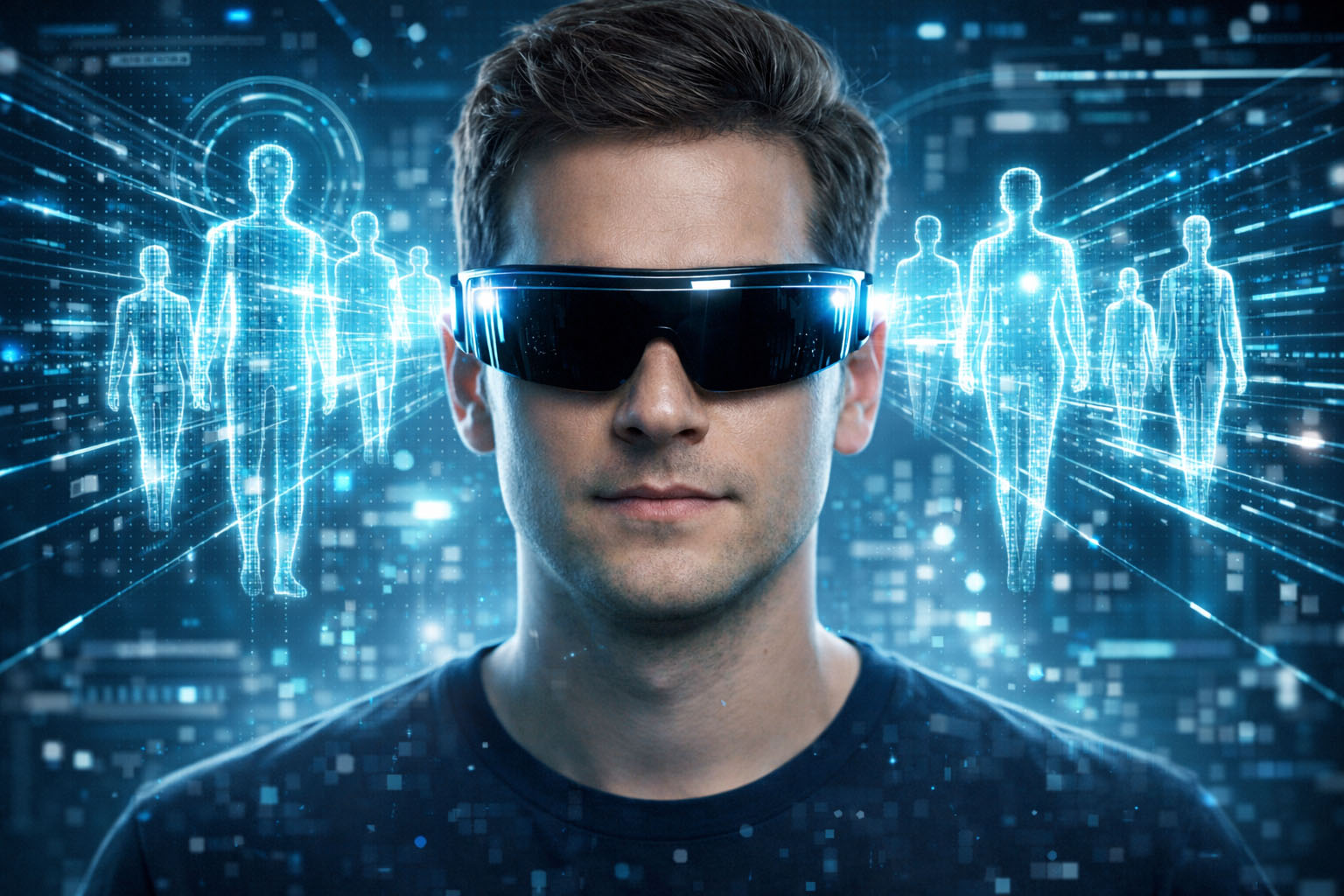
Mark Zuckerberg has this super cool gadget that promises to further blur the line between the real and the virtual.
It’s glasses.
He’s invested billions in the hope that this gadget will become humanity’s new best friend.
The glasses are so amazing they can do pretty much anything your smart phone does, with one major addition: through life-like holograms and a wide field of view, you’ll be able to create “human” gatherings or encounters at will. No exertion required. No more schlepping to cafes.
“The average person would like to have 10 friends, and they have two, right? Or three,” Zuckerberg said in a recent interview. “And there’s just more demand to socialize than what people are able to do given the current construct.”
For the man who brought us Facebook, meeting a friend at a café is a construct. So is inviting people over for dinner or going to the theater or hiking or visiting a museum or any other of the countless activities we share with people.
Thus, any interaction where you have to actually meet in person is a pesky “construct” that limits our social life and our circle of friends.
Zuckerberg’s pitch: Buy my new AI-powered glasses and your socializing will be limitless. You’ll finally be able to have those ten friends!
Hmm, can I get back to you, Mark?
I realize the train may have left the station on this latest techno miracle; that it’ll simply become too good for people to turn down.
“Meta reports that seven million people bought its A.I. glasses last year, and as competitors pile on, the product will continue to evolve,” Sam Anderson wrote last week in The New York Times. “But wherever it goes next — smart contact lenses, neural implants, nanobots injected straight into our corneas — the trend is clear. Silicon Valley is in the business of mediation. It wants to insert its products as directly as possible between us and the outside world.”
Let that sink in. There’s big money to be made by inserting products as directly as possible between us and the outside world. Anderson asks: “What does it mean for the human mind to be trained, constantly, to ask an external presence for help?”
It means, among other things, that a significant aspect of our humanity is stripped away.
I know what some of you are thinking: But what about the positives? Every new technology has good and bad.
My problem is precisely that the technology will be so good it will make some of us forget that everything we see through these glasses is virtual.
It’s not a real café. It’s not a real ocean. It’s not a real kitchen. It’s not a real theater. It’s all from that gadget on my face that saved me from schlepping to Santa Monica to stroll on the beach with a friend.
These glasses are so powerful an expert on X described the experience as “sees what you see, hears what you hear… a second mind sitting behind your eyes. Building context around every person in front of you, every room you walk into, every silence you’d otherwise sit in alone.”
It sounds both mesmerizing… and scary. I can almost imagine a scientist in a lab muttering: “I will make this more human than human!”
Zuckerberg calls the result “this feeling of presence, and this capability of really personalized intelligence that can help you.”
Well, yes, capitalism is all about “helping” consumers, isn’t it? Zuckerberg is simply offering us his version of a helpful product—a gadget with personalized intelligence that will create a “feeling of presence.”
There’s one thing Zuckerberg got right. We’ve never been more physically isolated and in need of human connection. The problem is that Silicon Valley doesn’t make any money when our human connections do not require their gizmos as mediators.
The irony is that we are more connected and more isolated at the same time. As the expert on X wrote, “That isn’t a contradiction. That’s what connection without presence produces… there’s a gap between being reachable and being there.”
He adds that “Zuckerberg is the first person with the capital, the hardware, and the AI to close [the gap]. Or to simulate closing it so convincingly that nobody checks.” In other words, “If a pair of glasses can make an empty room feel full, most people won’t go looking for the real thing. They’ll just put the glasses back on.”
That’s the scary part: a technology that simulates human connection so convincingly we won’t need to check whether it’s real or not.
But there’s a hopeful part. Just as techno wizards have the freedom to sell us their wares, we have the freedom to say “no thanks.”
I hope to be in that camp. You see, I actually enjoy shlepping to the beach or to cafes to meet friends, or meeting them over Shabbat dinner without needing to put anything on my face except a happy smile.
In the meantime, I can’t help wondering whether Zuckerberg will encourage his own kids to wear his miracle glasses so they too can have many friends.
Shabbat shalom.