“Why are we here? What’s life all about?/Is God really real, or is there some doubt? Well, tonight, we’re going to sort it all out,/For, tonight, it’s ‘The Meaning of Life.’What’s the point of all this hoax?/Is it the chicken and the egg time? Are we just yolks? Or, perhaps, we’re just one of God’s little jokes./Well, ça c’est le ‘Meaning of Life.'”
— From “Monty Python’s “The Meaning of Life.”
“Why are we here?”
Â
It’s a hot summer morning in August and I’m sitting in the office with my two editors.
Â
“You told me to come in today so we can talk about the High Holidays,” I say.
“No,” one of my editors says, “Why are we here?”
Â
I look at her out of the corner of my eye, pretending to take notes. Is she having a nervous breakdown? I know the job is stressful around the holidays, but … no, wait, she’s trying to outline a story idea:
Â
“This year in particular, with all the terrible things going on in the world — Israel and Lebanon, Darfur, the war in Iraq, Afghanistan, five years since the World Trade Center — how do people deal with everything? ‘What is the meaning of it all?'”
Â
“Forty-two,” I want to say, but I don’t, because they probably wouldn’t get it if they haven’t read “The Hitchhiker’s Guide to the Galaxy” series. If they had, they’d know that 42 is the answer to “the Ultimate Question of Life, the Universe and Everything,” provided after 7.5 million years by the supercomputer Deep Thought, which was created for just this purpose. The problem is, the protagonists have to go back to find the ultimate question to which 42 is the answer.
Â
My editor interrupts my thoughts. What if I were to embark on a quest, she prods, talk to rabbis and philosophers and regular people to find out what they are thinking. “With the High Holidays approaching, I just want to know,” she says, “what is the meaning of life?”
 
Quite frankly, I’m probably one of the last people on earth who should be investigating questions such as “Why are we here?” and “What is the meaning of life?” See, I’ve given up.
Â
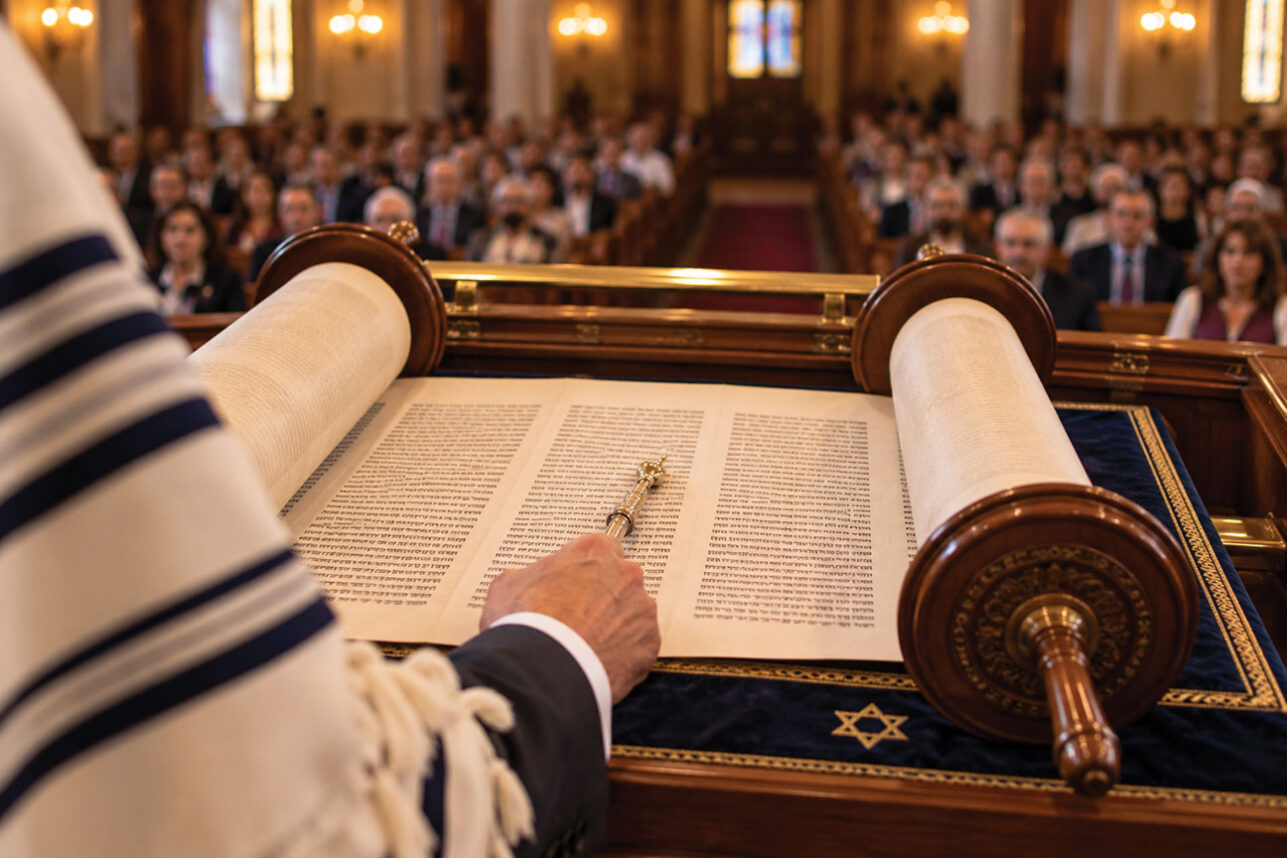
I was a student of these issues for most of my life. After all, what is Orthodox Judaism — all of Judaism — if not the blueprint for how to live your life? The Torah, the Talmud, the teachings of the rabbis for the last four millennia have been concerned with those very questions: How should man live his life?
Â
I had been schooled in this from yeshiva kindergarten through high school, topped off by a year of seminary in Israel and peppered by summers in religious sleep-away camps (“A Sports Camp in a Torah Environment”). Even in college, I minored in philosophy. I dabbled in Plato, Aristotle, Kant, Locke, Nietzsche, Heidegger, Sartre and Derrida (nowadays I ask myself, can a 21-year-old really understand Dasein, existentialism and Nihilism?).
Â
The point is, I cared. I read books like Rav Joseph B. Soleveitchik’s “The Lonely Man of Faith,” which I think was about the existential challenges of being a religious person, although it was so esoteric I’m not quite sure, and Milton Steinberg’s “As a Driven Leaf,” a fictional account of the first apostate in the Talmud, a book that had been deemed heretical, which made it an even more appealing must-read in the Modern Orthodox world.
Â
As an English major I was also reading secular books, but at the time I was primarily fascinated by biography and history, such as Golda Meir’s “My Life” and Natan Sharansky’s “Fear No Evil” as well as all of Leon Uris’ oeuvre, including “Exodus.”
Â
None of this is to say that I was any great scholar, because I wasn’t; but I was intensely interested in all issues related to the meaning of life and my place in and purpose in the world — so much so and to such a degree that a week after college I moved to Israel. This, I had decided, was where I could best fulfill my life’s purpose as a Jew, within the Jewish community.
Â
In Israel I worked for a man who believed he could revolutionize the country and its economy by creating a Free Trade Zone in Israel (don’t ask, it’s like nihilism). After more than three years, we failed. But I wasn’t sure I cared anymore. I decided I was finished realizing other people’s fantasies. I was tired of being told what to believe in anymore.
Â
For the next four years I worked as a journalist, mostly covering Jerusalem, the city that really is the intersection of the world’s three major religions, not to mention quite a few minor ones as well. I covered Jews, Muslims, Christians, Seventh-day Adventists and millennialists who were suspected of plotting to commit suicide in 2000 (they were deported).
Â
I covered right-wing settlers accused of harassing Palestinians, I covered left-wing secular people staging illegal marches through the city on Shabbat. And I grew tired. I grew tired of all the conviction. It wasn’t only that everyone was so sure of everything they believed in, it was the fact that they each believed their way was the only way. In the end it all started to blur.
Â
Had I asked a rabbi or a philosopher, they might have told me that just because everyone believed their way was the right way didn’t mean there is no one right way, but I wasn’t consulting any of those people. I had come to a point in my life where I was done with the Big Questions. I was done with Asking Why. I was done with Politics, I was done with Religion; I was no longer going to worry about The Meaning of Life. I was going to start living it.
Â
Which is why I might not be the best person to go searching for the meaning of life, because basically, I don’t care that much.