
Don’t come to “Ancient Child” expecting the anthemic lift of “One Day” or “King Without a Crown.” This is a quieter, more meditative album, his first since the Oct. 7 attacks.
Matisyahu, now 46, said when he wrote the song “Rockets,” he’s “never been this happy” — which sums up the headspace of the album aptly:
“Stand and deliver with an anthem
Hold up now keep ya pants on
All these thoughts so random and you cannot fathom
All these scars I bandage
Now I’m going on a rampage
Words they flow like champagne.”
When The Journal met him at last month’s Jewish American Summit, Matisyahu just finished performing a stripped-down set with guitarist Adam Weinberg. Sitting in an empty playground at Sephardic Temple, joint in hand, he described the record as a product of a world transformed. “I would say the album is more focused on being Jewish post Oct. 7,” he said. “It’s like all everywhere is Israel. Everywhere. Everything is connected. So it’s like a paradigm shift post Oct. 7, where before there was Israel — it was a thing for a lot of people — but it wasn’t the main thing. For the majority of Jews … after Oct. 7, literally the entire focus of the entire world is Israel.”
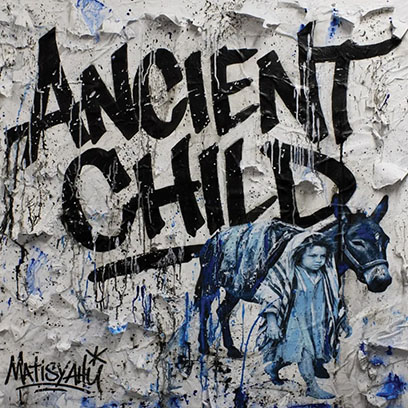 That shift, he said, is what led him to name the album “Ancient Child.” “That paradigm shift,” he said, “is the reason why I called the album ‘Ancient Child,’ because the ancient child is above nature. It’s the process of how we get there. The impetus for that might be a really negative thing or a strange thing, but the question is not what the cause is. The question is what happens next.”
Where earlier albums surged with uplifting reggae rhythms, Ancient Child carries a slower pulse. “Sun Come Up” was written during the pandemic on a back deck in Teaneck, New Jersey. He described it as his “stage” when there were no real ones left. “It was still COVID. I was living in Teaneck … I was sitting on my back deck, and that’s the first line of the new album: ‘This is my stage, this is my place, deck of my ship where I cruise over waves.’ It was like no shows during COVID. So it was like, this is my stage — the deck. I’m in my bathrobe with a mimosa at 10 o’clock in the morning, smoking a joint, just rapping to myself.” That image captures where his mind is these days — more grounded, while being cognizant of having balance. What could have been a bouncing arena anthem on a previous album, “Sun Come Up” is a more groovy, mellow sunrise ritual sound.
“I think that morning the baby had woken up at five, and I was walking down the street with a baby at five o’clock in the morning in Teaneck, watching the sun come up and thinking of the metaphor with my son and then writing that.”
In performance, “Sun Come Up” sounded even more fierce accompanied by only Weinberg’s acoustic guitar. In fact, the entire album would carry a punch even if every track was just his vocals and an acoustic guitar. “As we were putting it together, it was not necessarily lush, pretty chords behind it,” Matisyahu said. “It felt very power-chord, rapid-fire kind of vibe — choppy and fierce. It felt kind of punky.” Still, the electronic arrangements on the album have a meditative, reverb-heavy approach that also works. And his vocals are as sharp as ever.
“Wake Up” is the album’s most perilous song. It’s about losing faith as the “world keeps burning.” It opens with an arpeggiated acoustic guitar riff. It’s another one of the tracks that, with a touch of distortion, would fit on an early 1990s punk album about balancing apathy with angst.
The day of the summit, he connected this creative shift directly to the trauma and self-examination that followed Oct. 7. There was a “clear shift for me back into the role of saying, ‘I myself want to reconnect to my Judaism – not for anybody else or for any other reason.’ It’s not for religious reasons, but for the empowerment of knowing who I am and what my truth is. When there’s opposition and there’s a feeling that we have to unite, there is something that happens to all Jewish souls — except for the ones who run the other way.”
The only featured artists on “Ancient Child” are Florida rapper BLP Kosher and his two sons, Shalom and Lavy. He didn’t plan to include his family. “It wasn’t like, ‘Oh, I want to get a bunch of features.’ It just kind of naturally happened as I was recording my record. My sons were in the house, so whoever was around on that day would come to the studio with me … They would just come hang out in the session.”
He encouraged his sons to write their own lines in case inspiration struck: “If you come with me to the studio, write — because when you’re in the studio, if you’re inspired by the track, sit and write, because you never know when you’re going to get called in.”
Their friendship with BLP Kosher led to his appearance on the track “Anxiety,” which Matisyahu considers one of the album’s most revealing songs. “He could have kind of done anything he wanted on it, but he specifically wrote about the real things in his life that create anxiety – and also real-world things going on right now. He took it very seriously. It’s a very serious verse. Lyrically, he’s kind of a genius in the way that he uses wordplay and stuff. His swagger … is off the charts.”
Much of “Ancient Child” resists easy classification. Some tracks lean on hip-hop phrasing; others unfold like improvised prayers. He sees that fluidity as the album’s essence: “Different people based on their experience will sense the genre differently. You could listen and think punk rock, someone else might hear hip hop. It’s not categorizable; it’s above nature, which is what music is supposed to be.”
For all its calm, “Ancient Child” has an undercurrent balancing restlessness with presence as the days seem to go by quicker than ever before. “If I allow myself to get into it a little bit, it feels like right now is the time period that something massive in the world is going to change. And I feel like we are living through that period of time.”
That awareness gives the record its gravity. It’s not protest music or celebration; it’s a field recording of spiritual weather. Matisyahu isn’t trying to lift his audience this time — he’s inviting them to sit with him in stillness, to recognize what’s shifting, and to listen for what comes next.