
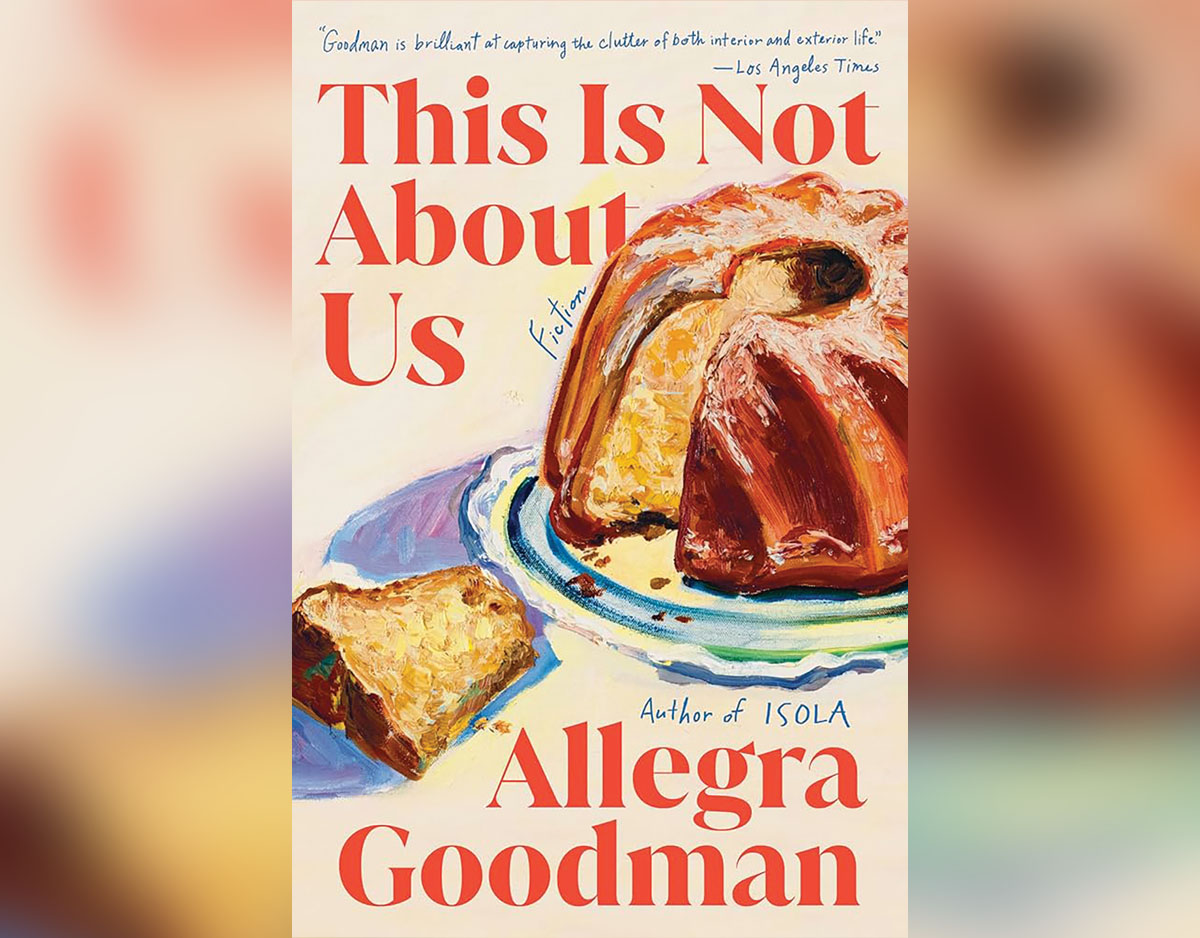
Allegra Goodman’s new book, “This Is Not About Us,” introduces us to three generations of the Rubenstein family, whose members deal with life’s problems and opportunities each in their own ways: divorce and midlife dating; parenting anxious or seemingly directionless children; adult sibling rivalries, surviving shared Jewish holidays; and feuding matriarchs.
The book is not a single narrative but a novel of interconnected stories, each laced with irony, poignancy and hilarity. In the opening story, “Apple Cake,” elderly sisters Helen and Sylvia dutifully visit their dying youngest sister, 74-year-old Jeanne, on home hospice in Boston. The nurses expect Jeanne to pass away within a few days, but she hangs on tenaciously and awkwardly, offering acerbic observations.
When Sylvia points out her latest beautiful floral arrangements, “Jeanne made a face. The flowers depressed her, especially those already wilting. When she looked at the mums, she felt she wasn’t dying fast enough.” When her sons ask about her final wishes, she tells one of them, “Stop pacing.”
As the family waits for Jeanne to make her final departure, Helen and Sylvia argue over cremation versus burial (Jeanne has given mixed signals), with Helen foisting an unwelcome visit from a rabbi to speak to Jeanne. But an even more ferocious duel erupts between the sisters: which of them bakes the better apple cake? Eighty-year-old Helen and 78-year-old Sylvia engage in a battle of flour, sugar and mixing bowls, each relentlessly baking at night and bringing sweets for the family the next day. Helen’s pecan bars can crack teeth and her brownies are quietly fobbed off on the help. Sylvia is the star baker, and her apple cake is devoured with gusto. The rivalry gets so out of hand that both sisters are made to promise not to bring homemade apple cake to the shiva house under any circumstances. They both agree. One breaks her promise. They stop speaking for years.
Many stories focus on timeless issues, such as relationships between and among parents and children, siblings, and marriage partners. Others focus on current issues, such as having to pivot professionally in midlife. In the story “$,” Steve is laid off after 25 years as a textbook editor and interviews with a tattooed, 20-something headhunter who specializes in “creatives.” Steve says, “I’m not sure I like being an adjective being turned into a noun.”
Several stories show how a contemporary Jewish family engages with Jewish ritual and practice. In the story “Redemption Song,” Jeanne’s sons Dan and Steve and their wives host Passover seders on consecutive evenings. Neither son enjoys the holiday because their father had been a survivor, “and he’d ruined the holiday because it meant so much to him.” Dan’s response has been to become a “control freak” about kashruth during Passover, though he is not kosher the rest of the year. Nor can he stand the progressive politics at Steve’s egalitarian seder, run by his wife, Andrea: “He hated off-road Judaism. The unscripted seder. The personal connection. Although he felt oppressed by the old rituals, he preferred them, which was why he brought his own Haggadah.”
Ironically, it is Dan and his wife, Melanie, who defer to their vegan daughter, Phoebe, and serve a plant-based moussaka for the seder meal, leaving everyone still hungry afterward. Phoebe also frets openly about cultural appropriation while others sing “Go down, Moses …” at her uncle and aunt’s house. This story is a tour de force, capturing the Jewish yearning to connect with tradition while also insisting on putting a modern political stamp on the Haggadah. It also touches on how children of survivors interpret and express their inherited trauma.
Another favorite story was “Nutcracker,” where Debra worries about the unforgiving standards at the dance academy where her two daughters, ages 12 and 16, are rehearsing for the annual “Nutcracker” performance. The academy is run by the aptly named Nastia, a tiny, fierce Russian cracking the whip and making the girls cry over the slightest error in form. Debra desperately wants to protect her girls from Nastia’s “abuse” (Nastia publicly yells at her older daughter, “No bread! Salad salad salad!”), yet her girls adamantly insist on staying at the academy and in the show. They find Nastia “thrilling — scary but awesome,” recognizing that they are being pushed toward excellence and willing to withstand even humiliation to shine on stage.
As a feminist, Debra thinks, “Mothering. Caregiving. It sucked resistance out of you. You woke up with a start and realized your daughters wanted to be princesses onstage — and you were financing gauze skirts and rhinestone crowns, even though you used to read them ‘Good Night Stories for Rebel Girls.’”
Goodman’s previous novels include “The Family Moscowitz,” which also focused on a multigenerational Jewish family, as well as
“Isola: A Novel”, “Sam” and “Kaaterskill Falls,” which explored life in a Jewish bungalow community in upstate New York during the 1970s. “This Is Not About Us” is a delightful, splendidly drawn book written in equal measure with profound insights about the human condition and the modern Jewish experience. It is a book I will be eager to read again.
Judy Gruen is the author of the memoir “Bylines and Blessings” and several other books, as well as a writing coach and editor, see more at judygruen.com

































