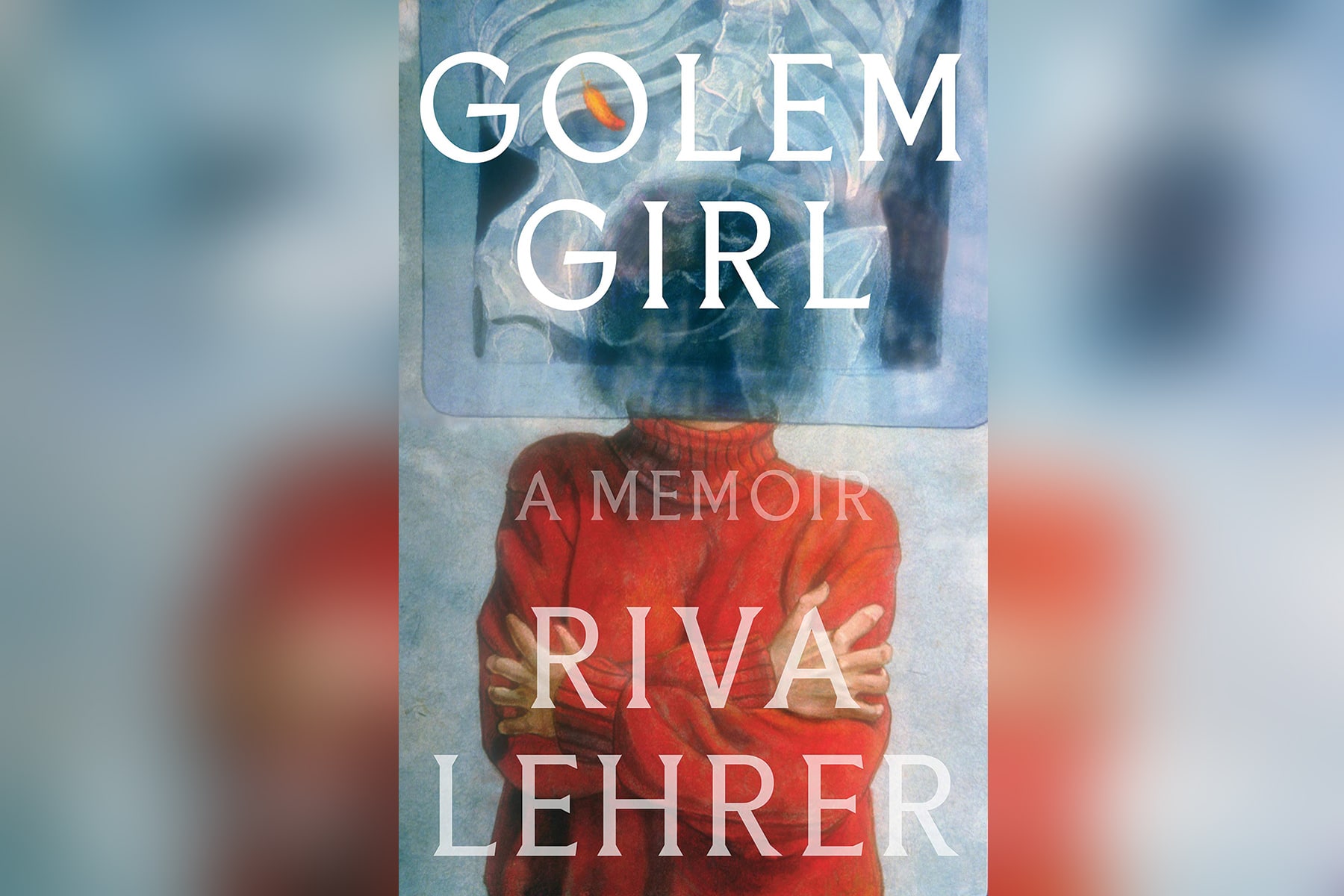
Memoirs and autobiographies often start with the very moment of the author’s birth. But the way that Riva Lehrer describes herself as a newborn is shocking and heartbreaking — a telling example of the both the power of her prose and the impact of the story she sets out to tell in “Golem Girl: A Memoir” (One World/Random House).
“The day I was born I was a mass, a body with irregular borders,” she writes. “Doctors foretold that I would be a ‘vegetable,’ a thing without volition or self-awareness.” She was spared from that dire fate by the skills of her surgeons. “I am a Golem,” she announces. “My body was built by human hands.”
“The thousand natural shocks that flesh is heir to” is not merely a line of Shakespeare in Lehrer’s experience. Rather, they are facts of life and the raw material of her memoir. When recalling her father’s combat service in World War II, for example, she observes that “[t]he Army traded a Purple Heart and a Bronze Star for the shattered jaw and the teeth left behind on the battlefield.” During the pregnancy that resulted in Lehrer’s birth after a series of miscarriages, the author’s mother “was afraid to as much as bump the furniture in case it pricked her skin and spilled her contents out onto the floor.” When her water broke, she “waited for the expected release of mangled tissue.” Riva was born alive but with spina bifida.
Lehrer overlays her memoir with a history of the treatment of spina bifida, a condition with an 85% mortality rate until the mid-1950s. Even these passages, however, strike us as highly intimate: “My own adulthood has only been possible for the last fifty years or so.” But she also reaches all the way back into prehistory to point out that mothers were customarily blamed for the birth of “monstrous” children: “A well-contained woman did not attend carnivals, where she might see the antics of a performing monkey and give birth to a baby covered in hair.” She widens the lens to show how the belief in “maternal imprinting” also served “as a tool to deny women their freedom of movement.”
The author did not leave the Children’s Hospital in Cincinnati until she was 2 years old. She was later enrolled in the Condon School: “Every child at Condon was a Golem, a little medical monster constructed by doctors.” She is quick to explain that “I’m not even saying that’s how they saw themselves; I am saying that’s how we were often treated in the world.” For example, the Condon School had Boy Scout and Girl Scout troops, which were meant to serve as a bridge to the mainstream, “not that we ever met up with other troops.” Indeed, when the school bus carried them on field trips, “there was no lack of people eager to scream, ‘Retard’ at the top of their lungs.”
Lehrer’s prose sometimes scans like verse, as when she describes one of the surgeries that continued through childhood and adolescence: “The hospital demands surrender. You accept the piercing, the cutting, the swallowing of noxious chemicals. You roll over and stand up even when it’s as impossible as flying around the ceiling.” A passage that begins “My life in scars” is a list of the surgical incisions and repairs she has endured. At a moment when she describes a particularly shattering loss, she mounts a poem like a jewel on the page:
“What I cannot think / It took the end of the world for me to be offered freedom / To open the only door I was ever going to get. But / when you are a monster, all the luck is / Dark luck / I step through anyway.”
‘Golem Girl’ is much more than a confessional memoir — it is the story of an artist whose life has been lived both bravely and beautifully.
But we also discover that Lehrer is as gifted as an artist as she is an author. Her role model was her mother, Carole. “Every Friday night, our mother took the warm wax from the Shabbos candles,” she recalls of the childhood she shared with her younger brother. “She pinched and pulled at the translucent lumps until they emerged as a pair of rough white angels, then put one on each headboard before we recited our evening prayer: Sh’ma Yisrael …”
When Lehrer set out to become a professional artist, “I expected (and fervently hoped) that art school would be a hotbed of eccentrics and mavericks, eager to welcome a fellow weirdo.” As it turned out, she was wrong: “My most pressing problem was that Art School didn’t want me to make art.” Yet the Golem Girl is, above all, a young woman of extraordinary courage and drive. The best evidence consists of the book’s color reproductions of Lehrer’s works of art — vivid, intense, sometimes realistic and more often surrealistic, and populated with human figures whose bodies do not resemble the Greek ideal of beauty. And, of course, that’s the whole point of her art and her book.
By the way, my use of the female pronoun to refer to the author is problematic. “Was I a girl? A woman? Come to that, a human being? Yes by birth and by biology; no by public consensus,” muses Lehrer. “Even now, when I reach for ‘she,’ it drips off the table like hot syrup and puddles on the floor.” Ultimately, Lehrer embraces the words “crip” and “queer,” both of which have been “reclaimed” as symbols of self-identification.
“I had spent years fighting against misogyny, homophobia, and anti-Semitism and yet I’d so easily believed that I should be ashamed of my body,” Lehrer reveals. “All these years later, I’m still wounded every day.”
Tellingly, “Frankenstein” was the author’s favorite movie in childhood, and she found in the Jewish traditions of the Golem a source of comfort and inspiration. “ ‘Frankenstein’ is the story of a disabled child and its parent,” Lehrer astutely observes. “It is also the story of a Golem.”
Lehrer’s memoir deserves to be saluted as an all-too-rare example of a book that shows us what a remarkable human being can be glimpsed if we only peel away the clinical label of “disabled.” Lehrer spares us no moment of intimacy, no moment of pain, but “Golem Girl” is much more than a confessional memoir — it is the story of an artist whose life has been lived both bravely and beautifully.
Jonathan Kirsch, author and publishing attorney, is the book editor of the Jewish Journal.