fbpx

October 8, 2020

Kick ‘em in the where? – A poem for Torah Portion Vezot Habracha

May the Lord …strike the loins of those who rise up against him
and his enemies, so that they will not recover.

Once in the Chicago airport, I took a picture of myself
in front of the Nuts on Clark store, under their sign
which read “Hot Nuts.”

I sent it to my nine year old, who is now a twelve year old,
because I knew he would delight in this image
at least as much as I did. This reference has been

an ongoing source of joy in our relationship.
Whenever I’m lucky enough to travel anywhere
he’ll ask me upon my return did you get some hot nuts?

and we’ll laugh about this all the way to the bank
which doesn’t mean anything since we do our banking
online and, frankly, he doesn’t even know what banking is.

So you can imagine my delight when I saw the holy text
in which Moses tells the people that God will strike
our enemies in the loins. It’s kind of nuts.

I’d like to provide a list of enemies who deserve this.
Most of them I know by name but have never been
in the same room with. People famous for tearing the world apart

for sowing division, for denying science, for swaggering around
in armored cars while hundreds of thousands die.
These are the enemies who have risen up

who deserve the Holy One up in their front.
so that they will not recover.
As we come to the end of our story –

Just a few more pages to go
before we read the whole thing again
Let these blessings and curses guide
the actions of our elected enemies.

We’ve got all the right protective gear on
as me, and my son, and everyone we’ve ever known
walk into the Promised Land.


God Wrestler: a poem for every Torah Portion by Rick LupertLos Angeles poet Rick Lupert created the Poetry Super Highway (an online publication and resource for poets), and hosted the Cobalt Cafe weekly poetry reading for almost 21 years. He’s authored 23 collections of poetry, including “God Wrestler: A Poem for Every Torah Portion“, “I’m a Jew, Are You” (Jewish themed poems) and “Feeding Holy Cats” (Poetry written while a staff member on the first Birthright Israel trip), and most recently “The Tokyo-Van Nuys Express” (Poems written in Japan – Ain’t Got No Press, August 2020) and edited the anthologies “Ekphrastia Gone Wild”, “A Poet’s Haggadah”, and “The Night Goes on All Night.” He writes the daily web comic “Cat and Banana” with fellow Los Angeles poet Brendan Constantine. He’s widely published and reads his poetry wherever they let him.

Kick ‘em in the where? – A poem for Torah Portion Vezot Habracha Read More »

Ruderman Foundation Honors Taraji P. Henson With Award for Inclusion of People With Disabilities  

The Ruderman Family Foundation, an internationally recognized disability inclusion organization, announced actress Taraji P. Henson as the recipient of its Morton E. Ruderman Award in Inclusion, for her advocacy and leadership in addressing mental health.

The critically acclaimed TV and film actress, filmmaker, activist and entrepreneur who is living with depression and anxiety, has been open and outspoken about her mental health. In 2018, she founded the Boris Lawrence Henson Foundation, named after her father, who experienced mental health issues after serving in Vietnam. The foundation’s goal is to eradicate the stigma surrounding mental illness in the African American community.

Her work also addresses the intersection between disability inclusion and other areas of civil rights and social justice. 

“As society continues to navigate through an incredibly tumultuous 2020, with a global pandemic and continued racial inequality issues, the conversation around mental health has arguably not been more important in decades,” Jay Ruderman, president of the Ruderman Family Foundation, said in a statement to the Journal. “When role models and influencers like Taraji are so vocal about their own experiences with mental illness, it has the potential to inspire millions of people to accept their own mental health issues and find healthy ways to address them.”

The Ruderman Family Foundation advocates for the full inclusion of people with disabilities and supports effective programs, partnerships and philanthropic initiatives advocating for and advancing the inclusion of people with disabilities throughout the country and around the world. The foundation works heavily in Hollywood to fight for more visibility and inclusion for those with disabilities. In July, Academy Award-winning actress Octavia Spencer joined the Ruderman Foundation calling for authentic casting of people with disabilities.

According to Henson’s foundation, 1 in 5 Americans live with mental illness;   African Americans are the least likely population to seek treatment. During the COVID-19 pandemic, Henson launched a campaign to assist African Americans, who are disproportionately affected by COVID-19, with access to free virtual therapy while the pandemic continues.

“The work that her Foundation undergoes is tremendously important,” Ruderman said. “We need more people like Taraji to continue to eliminate the stigma around mental health across all our communities in America and we’re honored to be awarding her our Morton E. Ruderman Award this year.”

Henson, an Oscar and Emmy nominee and Golden Globe winner, shared her thoughts about the award on Instagram on Oct. 8.

“I am so honored to receive the 2020 Morton E. Ruderman Award, from the Ruderman Family Foundation, who are leaders in advocating for the rights of people with disabilities across society,” Henson said on her Instagram story. “Like the Boris Lawrence Henson Foundation, they also recognize the impact that mental illness can have on a person, on a family, on a community. Thank you so much for this honor. And together, we will work to create change, one heart, one mind at a time.”

Now in its seventh year, the award was named after Morton E. Ruderman, a founder of the Ruderman Family Foundation. The award has gone to advocates from several sectors of society, including filmmakers Peter and Bobby Farrelly, gold medal-winning Olympic swimmer Michael Phelps, Academy Award-winning actress Marlee Matlin, former United States Sen. Tom Harkin (D-Iowa), disability self-advocate Ari Ne’eman and Harvard professor Michael Stein.

For more information about the Ruderman Family Foundation, visit its website. 

Ruderman Foundation Honors Taraji P. Henson With Award for Inclusion of People With Disabilities   Read More »

Letters: Keeping Up With the News, Politics, Proud to Be Jewish

Keeping Up With the News
A friend asked me if I’m keeping up with the news. Yes, I said. I read the newspapers religiously. And other than the prospect of a 6-3 court, a stolen election, the dissolution of the Constitution and the Bill of Rights and an imperial presidency, everything’s hunky-dory. Then I woke up (the day after the first presidential debate) and read the morning edition. And hoped I was still dreaming.
Hal Rothberg, Calabasas

Politics Shift in the Mideast
The Arab-Israeli conflict is over. The signing of diplomatic agreements between Israel and the United Arab Emirates (UAE) and Bahrain signals that the Arab world no longer will be held hostage to the Palestinian cause. (“It’s Time to Look at Palestinian-Israeli Conflict With Fresh Eyes,” online Sept. 26).

Other Islamic countries are expected to follow the UAE’s lead. Many of them have had dealings with Israel, the world leader in water and agricultural management, and a technological giant.

Although the Palestinian Authority (PA) wasn’t included in the drafting of the agreements between Israel, the UAE and Bahrain, it has refused to acknowledge its weakening position. It lost its veto.

The American “Peace to Prosperity” plan offers the PA a little more land than Egypt and Jordan occupied from 1949 to 1967, plus a $50 billion development fund. (The agreement signed by Israel and the UAE requires Israel to halt its controversial plan to annex land in the occupied West Bank that long has been sought by the Palestinians.) The exact borders will be determined by Israel and the PA. The starting point for discussion is no longer the 1967 armistice lines. It is the Americans’ map.

Arab states have lost patience with the PA’s intransigence and Iranian-backed terrorism. It’s time for all the players to compromise and move forward together for a brighter future.
Len Bennett, Deerfield Beach, Fla.

Proud to Be Jewish
The book “I Am Jewish” was featured in a column by Judea Pearl (“RBG on ‘Being Jewish,’ ” Sept. 25). Many voices in that book, from the famous to the everyday, tell us why they are proud to be Jewish. I want to do the same.

I was born with cerebral palsy. My earliest steps into the Jewish community were in the late 1950s. Day camp, Sunday school, a part in a play that was on TV — there was always a place for me. I belonged. The precepts of our heritage were not only taught to me, but were shown to me by how I was treated.
Susan Cohn, dictated to Lis Peery, via email

Trump, COVID-19 and the Limits of Hate
There is a vast difference between expressing joy when a head of state is assassinated and taking pleasure when one contracts a deadly virus he downplayed and denied; of which he ignored the advice from his own scientists and public health experts; and mocked those who heeded that advice to protect themselves and others.
After all, during the reading of the Book of Esther, we boo and make noise at the mention of Haman’s name.

I think those of us who were mocked as having Trump Derangement Syndrome should be allowed a moment of schadenfreude for having suffered through everything we feared when he announced his presidential campaign — and more — having come true, and now him being hoist by his own petard.*
I don’t want the president to die. I wish him a full recovery — physically, mentally and emotionally — so he is deemed fit to stand trial for the many crimes of which he will be accused when the next administration assumes office.

In our system of justice, one is innocent until proven guilty, but based solely on the published evidence with undoubtedly more facts yet to come to light, convictions for tax fraud, insurance fraud, violations of many laws governing executive actions and possibly giving secrets to our enemies, appear possible.

*For those who haven’t read Shakespeare, that is a reference to “Hamlet,” Act 3, Scene 4. A petard is a land mine. One who steps on his own petard steps on the land mine he has planted.
Daniel Fink, Beverly Hills 

Inspired by a Store Owner’s Resilience
I loved and sympathized with Nedjatollah Harounian when the Journal wrote about his sad story in the June 12 edition, and now I love him even more reading his quote: “If you’re not working, you’re not being useful” as he works to rebuild his life (“Out of the Ashes,” Oct. 2).
Warren Scheinin, Redondo Beach

The Flu
I knew from how my stomach felt,
I had some sort of flu.
So I called the family doctor,
And he told me what to do.

To start, he called the pharmacy,
And ordered me some pills.
Which would hopefully eliminate
The fever and the chills.

He said it was imperative,
To rest all day in bed.
So I followed what he told me,
And did exactly what he said.
I had the flu a couple of days,
And wasn’t getting better.
But I remembered my mother’s chicken soup,
And frantically tried to get her.

She came and made me chicken soup,
Nice and steaming hot.
It looked and smelled delicious,
So I finished the entire pot!

Sure enough I felt better,
Soon I was up and around.
I figure with all the soup I had,
The virus must have drowned!
Alan Ascher, via email

No Stars in the Streets

Berkeley, 1979. Gaunt-faced man, still as stone, sleeping in a doorway, rain or shine, smiles and tells me over coffee how he was a Berkeley student, took acid in ’Nam, tried to kill his mother with a hammer and waits for Satan to tell him what to do. … I ask the lady I work with at the ACLU if this is normal and she answers, “Who are we to say what’s normal? We’ve got no right to steal his freedom.”

Soon, right and left step together,
shut the mind hospitals

Never try to fix what’s broken.
2020. Day after day, my husband, healer of minds,

laments the ones with haunted eyes
forced onto the streets where no stars can shine.

No place for them to heal
among the garbage and the needles

While “prophets,” jugglers and fools
shoot up our minds with “feel-good” phrases

Turning ancient truths upside-down
And people keep dying.
When will we ever learn?
Mina Stern, Venice

CORRECTION

A credit accompanying a photo of AJU’s Brandeis-Bardin’s campus with a story about Sukkot (“AJU’S Brandeis-Bardin Campus Provides Weekend Getaways for Sukkot,” Oct. 2) should have read “Photo courtesy of AJU.”

Letters: Keeping Up With the News, Politics, Proud to Be Jewish Read More »

What I Learned at the Pence-Harris Debate

I watched the Pence-Harris debate last night in a state of virtual shock. After the embarrassing foodfight we saw last week between Trump and Biden, I guess I had forgotten about the power of civility.

We often associate shouting and bullying with strength. The debate last night showed the opposite. There were none of the personal insults, rude remarks, or attempts to bully we saw in the Trump-Biden slugfest.

Instead, both debaters made their points firmly but politely. Yes, there were interruptions, abuse of time limits, sharp attacks, and so on—but no one lost their cool. No one got angry. It’s precisely because they kept their tempers in check that they projected strength.

In the ultra-divisive year of 2020, when relationships get broken up over politics and anger is the emotion of the day, last night’s spectacle of respect was a highlight of the year.

If America lost last week in the Trump-Biden debate, America won last night in the Pence-Harris debate.

What I Learned at the Pence-Harris Debate Read More »

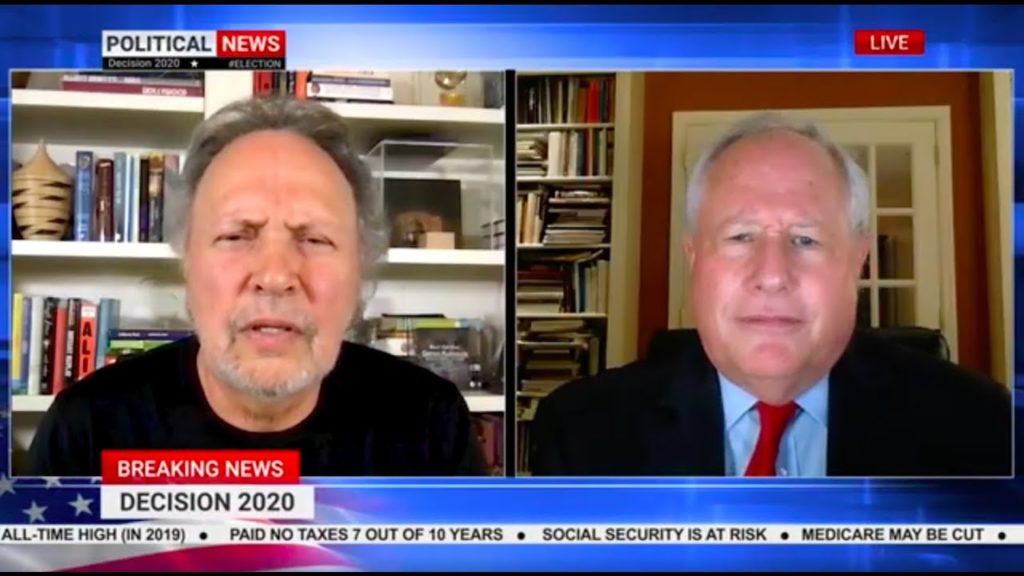
VIDEO: Billy Crystal and Bill Kristol Encourage Jews to Vote for Biden

Besides similar sounding names, comedian Billy Crystal and conservative political analyst Bill Kristol don’t have much in common. 

But in a new video, “2 Bills 4 Biden,” sponsored by the Jewish Democratic Council of America (JDCA), they teamed up to encourage Jewish Americans to vote for Democratic presidential candidate Joe Biden. 

“I’m a Republican and a conservative,” notes Kristol, who, like Crystal, is Jewish, in the video. “Well, I’m reform,” adds Crystal, referring to the Jewish denomination, noting he prefers the English text during services.

Despite their diverse positions on the political spectrum, comedy and, yes, baseball (Yankees vs. Mets), Kristol and Crystal “agree that we need a president who has a good plan to deal with COVID.”

Both Bills also agree that Biden is the best candidate who will “protect Medicare and Social Security.”  

Kistrol, founder of Defending Democracy Together and Republican Voters Against Trump, actively has been working with Jewish groups including the JDCA to get Biden elected.

According to the JDCA’s website, its goal is to promote policy consistent with socially progressive, pro-Israel, Jewish community values. 

After the vice presidential debate on Oct. 7 between Sen. Kamala Harris (D-Calif.) and Mike Pence, Crystal told late-night talk-show host Jimmy Kimmel that the comical political campaign ad was directed by legend Rob Reiner, who directed Crystal in “The Princess Bride,” in an effort to encourage seniors to get out and vote blue in Florida.

“It’s a spot for senior citizens in Florida because if we can get the seniors out to vote for Joe Biden, which is what we’re both about in the ad, then we can win Florida. Then there’s almost no way that Trump can win,” Crystal told Kimmel. “This was such great way to educate people … in a humorous way to get them to vote for the right guy.”

For more information on Biden’s policies and stances on Jewish ideals, visit JDCA’s website. 

Watch the video below:

VIDEO: Billy Crystal and Bill Kristol Encourage Jews to Vote for Biden Read More »

Embracing Uncertainty and Irrationality in ‘A Serious Man’

If this pandemic has proven anything, it’s that there’s no rational way to respond to an irrational situation. No matter how much we think we can govern and compartmentalize our own lives amid a global health crisis, nature has cunning, unpredictable ways of destroying our attempts to survive. Just when we think we’re moving forward, something beyond our control seems to set us 15 steps backward.

This existential tension between free will and determinism not only is the root of the human experience, but also of the Jewish experience. We are constantly asking questions about life that don’t always lead to finite or satisfying answers, creating a crushing, paradoxical cycle of philosophical curiosity and continual spiritual frustration. Whenever I have trouble parsing through the volatile mess of our world, I look to Joel and Ethan Coen’s 2009 sublime satire, “A Serious Man,” for guidance and comfort.

Released 11 years ago this month, “A Serious Man” remains a very timely, very Jewish tragicomedy that articulates the impossibility of certainty in an incoherent and morally bankrupt society. Although such a bleak theme may be too morbid for some to stomach, “A Serious Man” offers profound insights about faith and introspection that give clarity to the absurd series of life events to which we’re bound.

A TWENTIETH-CENTURY SHLEMIEL

“A Serious Man” begins with a Rashi quote, “Receive with simplicity everything that happens to you,” and a mysterious prologue set in a 19th-century shtetl during a snowstorm. Jewish husband Velvel (played by Allen Lewis Rickman) tells his wife, Dora (Yelena Shmulenson), that he invited a scholar named Reb Groshkover over for soup. Dora asserts Groshkover (Fyvush Finkel) passed away three years before and the man Velvel encountered was a dybbuk. According to Jewish folklore, a dybbuk is a malevolent spirit that, if it enters a Jewish house, means bad luck for the homeowner’s lineage.

But Groshkover does arrive, and he dismisses Dora’s accusation. Velvel apologizes on Dora’s behalf, but she is unconvinced and impales Groshkover with an icepick. Outraged and bleeding, Groshkover initially seems immune to Dora’s attack but quickly falls ill and exits the home into the snowy abyss. Although the opening acts as a self-contained story and is never referenced again in the film, Velvel’s inability to confront or even recognize his own ineptness suggests that we all have our blind spots, no matter how rational and righteous we think we are. It also sets an ominous precedent for what’s to come.    

“A Serious Man” subsequently shifts to 100 years later, to 1960s Minnesota. We meet Jewish physics professor Larry Gopnik (Michael Stuhlbarg), whose humdrum life suddenly crumbles before his eyes. His spouse, Judith (Sari Lennick), wants a divorce so she can marry charismatic widower Sy Ableman (Fred Melamed); one of Larry’s students bribes him to change a failing grade; his chances of getting tenure are threatened by anonymous hate mail; his racist next-door neighbor cuts the grass on his property; his lonely brother Arthur (Richard Kind) suffers from a gambling problem and gets in trouble with the law. As this chain of dilemmas escalates to the point of utter ludicrousness, Larry becomes more and more tormented with anguish and confusion about what to do.

Like Velvel, Larry is a classic example of a shlemiel, a common archetype in Jewish storytelling that translates to “incompetent fool” in Yiddish. A shlemiel often falls into unfortunate situations and, unlike a shmuck, cannot redeem himself, forever fettered to what he is. As a physics professor, the only way Larry can understand his environment is through rational thinking. But logic has its limits. He cannot use equations and mathematics to solve his very real — but also very strange — problems. Even when he does seek help, Larry balks at the idea that he deserves such misfortune, constantly repeating the line, “I haven’t done anything!”

Turning to his faith to extinguish his anxieties, Larry consults two rabbis at his synagogue. The first, fresh-faced Rabbi Ginsler (Simon Helberg), is well-meaning but naive. He advises Larry to simply change his perspective, using vague metaphors to justify his suggestion. The second, more experienced Rabbi Nachtner (George Wyner) tells Larry a compelling parable with no resolution. The rabbi claims the ending of the parable ultimately is insignificant, leaving Larry even more lost than before. He tries seeing the senior Rabbi Marshak (Alan Mandell), but Marshak’s apparent unavailability leads Larry to a dead end.

These scenes are funny on their own, but they also illuminate the occasional hollowness of American Judaism. The rabbis are just as bewildered by life’s randomness as Larry but are less concerned about meditating on it. Instead of offering compassion or wisdom, they incorporate interpretive devices like clichéd analogies and convoluted allegories in their counsel. 

While such a depiction may seem offensive and even contrary to practicing Jews, what the Coens communicate is not necessarily an indictment of organized religion in the modern age, but rather a symptom of a larger existential issue: Our world is becoming more inscrutable and, therefore, more alienating. Religion and storytelling may help us make sense of our lives, but considering Larry’s case, so-called universal truths can prove meaningless when unforeseen events threaten to disorient us.

DOING NOTHING

Employing their signature misanthropic, deadpan wit, the Coen brothers seem to delight in Larry’s series of predicaments, going so far as to portray his troubles through a macabre lens of schadenfreude. During a dream sequence, Ableman appears like the dybbuk from the prologue. He haunts Larry in a college lecture hall and questions Larry’s pragmatic worldview, before repeatedly bashing Larry’s head against a chalkboard, as if to physically shake him out of his misery. In another nightmare, Sy watches over Larry while Larry copulates with his hippie neighbor Mrs. Samsky (Amy Landecker). Even in his subconscious, Larry can’t escape the harrowing uncertainty that plagues his reality.

Watching Larry go through the humiliating, fruitless exercise of searching for meaning in his woes is equal parts hilarious and devastating, like witnessing a modern suburban retelling of the Book of Job. Larry’s journey captures our own primal urge for validation, our desire to confirm that life isn’t one great mystery, that problems always have solutions, and actions inevitably lead to consequences.

But life isn’t that simple. Problems will always provoke other problems that one solution cannot fix. And a lack of action can engender consequences, too. Larry believes he hasn’t “done anything,” but that is precisely the reason why he has ended up with such intense trouble. Doing nothing — and not seeing that you’re doing nothing — can be just as damaging as doing something.

SOMEBODY TO LOVE

Perhaps the most plausible answer to Larry’s issues exists within the film’s recurring motif of Jefferson Airplane’s “Somebody to Love.” The song appears multiple times in “A Serious Man,” often through the radio of Larry’s stoner son Danny (Aaron Wolff). The wailing, sonic psychedelia of “Somebody to Love” contrasts with Larry’s quiet, contented lifestyle and reflects the normalcy of his life coming undone. The song’s opening lyrics — “When the truth is found to be lies / And all the joy within you dies” — evoke Larry’s disappointment with his circumstances becoming increasingly more ambiguous and illogical.

But it’s the refrain “Don’t you want somebody to love?” that points to a potential understanding of Larry’s foibles: We can only ascertain true, tangible meaning in our lives through our relationships. We often fail to find purpose in the things we can’t control, such as the weather or sudden disruptions in our health. So, it’s probably best to search for it in the things we can control, like our connections with our loved ones and our individual contributions to society. Even Rabbi Marshak understands this, as he quotes “Somebody to Love” to Danny on the day of his bar mitzvah and tells him to “be a good boy.”

As someone who is obsessive and analytical about everything, I’m both reassured and unnerved by the Coens’ nihilism, the notion that life is a big cosmic joke, that nothing really means anything because we’re inevitably doomed, and that God laughs in our faces all the while. Given the unending cultural tumult of this year alone, trying to make sense of anything feels hopeless. We can try to contextualize our societal contagions or our own wrongdoings as much as possible, but that still might not be enough to alleviate our despair.

But I suppose that’s the point of A Serious Man: to approach the unsolvable puzzle of being alive with simplicity rather than constantly fixate on why bad things happen to us. There is sadness inherent in not knowing things, but there is also relief in not carrying the burden of asking unanswerable questions. 

Ultimately, the film surmises that accepting the grand and incomprehensible mystery of existence and relishing in the fact that we can’t know or solve everything is the only way to really experience and grapple with whatever this life throws at us. In 2020, a year where truly nothing is foreseeable, that’s certainly a lesson we should take to heart.


Sam Rosenberg, a University of Michigan alumnus, is a screenwriter and freelance writer.

Embracing Uncertainty and Irrationality in ‘A Serious Man’ Read More »

Pro-Israel Student Group Says It’s ‘Not a Coincidence’ That Swastika Was Found at Columbia Days After Passage of BDS Resolution

On October 6, a swastika was found on the campus of Columbia University following the passage of a Israel divestment resolution.

According to Columbia’s Office of University Life, the swastika was found on the steps of the Low Library, the university’s main library.

“The divisions that now roil our nation and the world have given rise to increasing acts of bias and hate in far too many communities,” the Office of University Life said in a statement. “Antisemitism does not have a place at Columbia, as our community strives every day to remain a welcoming and inclusive place where everyone is treated with dignity and respect.”

Students Supporting Israel (SSI) at Columbia University wrote in an October 8 Facebook post, “It is not a coincidence that this despicable act of antisemitism occurred only days after a BDS [Boycott, Divestment, and Sanctions] referendum was passed by undergraduates at Columbia. When one kind of antisemitism is normalized, all others follow. Passing the referendum is a dangerous precedent and it is a shame that the Columbia community did not listen when Jewish and pro-Israel students warned time and again that passing it would cause a rise in antisemitism on campus.

“We hope, but based on the past doubtful, that the administration will track and punish the racist bigots responsible for the swastika.”

https://www.facebook.com/SSIcolumbia/posts/1588915971288190

The referendum, which called on the university to “divest its stocks, funds and endowment from companies that profit from or engage in the State of Israel’s acts towards Palestinians” that “fall under the United Nations International Convention on the Suppression and Punishment of the Crime of Apartheid,” passed after the student body voted on it from September 22-25. Sixty-one percent of student voters voted in favor of it.

Other pro-Israel Twitter accounts weighed in.

“Last week, @Columbia’s student body voted in favor of a BDS referendum,” Bryan Leib, chairman of Jewish millennial group HaShevet, tweeted. “This week, a swastika was found at Low Library. I remember last year when far left progressive students painted swastikas on the dorm room doors of Jewish students after a BDS vote. This is the new normal!”

Maccabee Task Force Midwest Campus Director Lea Speyer similarly tweeted, “Last week BDS was passed at @Columbia. Today we learn a swastika was discovered on campus. BDS leads to increases of Jew hatred every damn time. Anyone who says BDS doesn’t harm Jews is a liar.”

The Columbia University Apartheid Divest, the group that sponsored the resolution, did not respond to the Journal’s request for comment.

Pro-Israel Student Group Says It’s ‘Not a Coincidence’ That Swastika Was Found at Columbia Days After Passage of BDS Resolution Read More »

Make Vintage Botanical Cards with Old Dictionary Pages

At least once a month, I realize it’s someone’s birthday and that I have totally forgotten about it. Instead of rushing to the store to pick up a card, I like to have a stack of cards ready for such emergencies. Since nice store-bought cards can average more than $5 each, handmade ones can save you a lot of money. I also find handmade cards to have a certain cachet. Have you noticed that the ones that look handmade in stores actually cost more than the standard ones? 

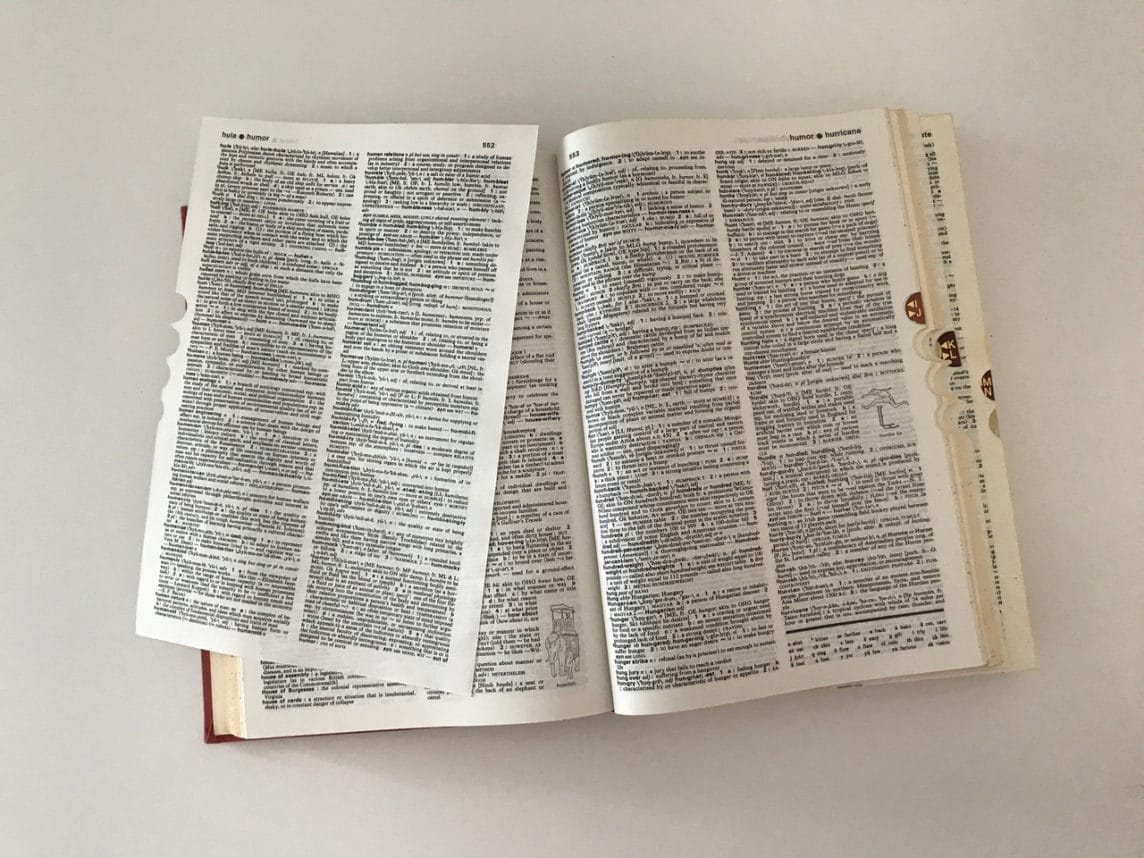
This card project is made using old dictionary pages. Now, before I get angry letters, I want you to know that I purposely seek out old dictionaries at thrift stores that I can use for crafting. I am giving them new life as art. You also can use pages from used books if you don’t have any old dictionaries. 

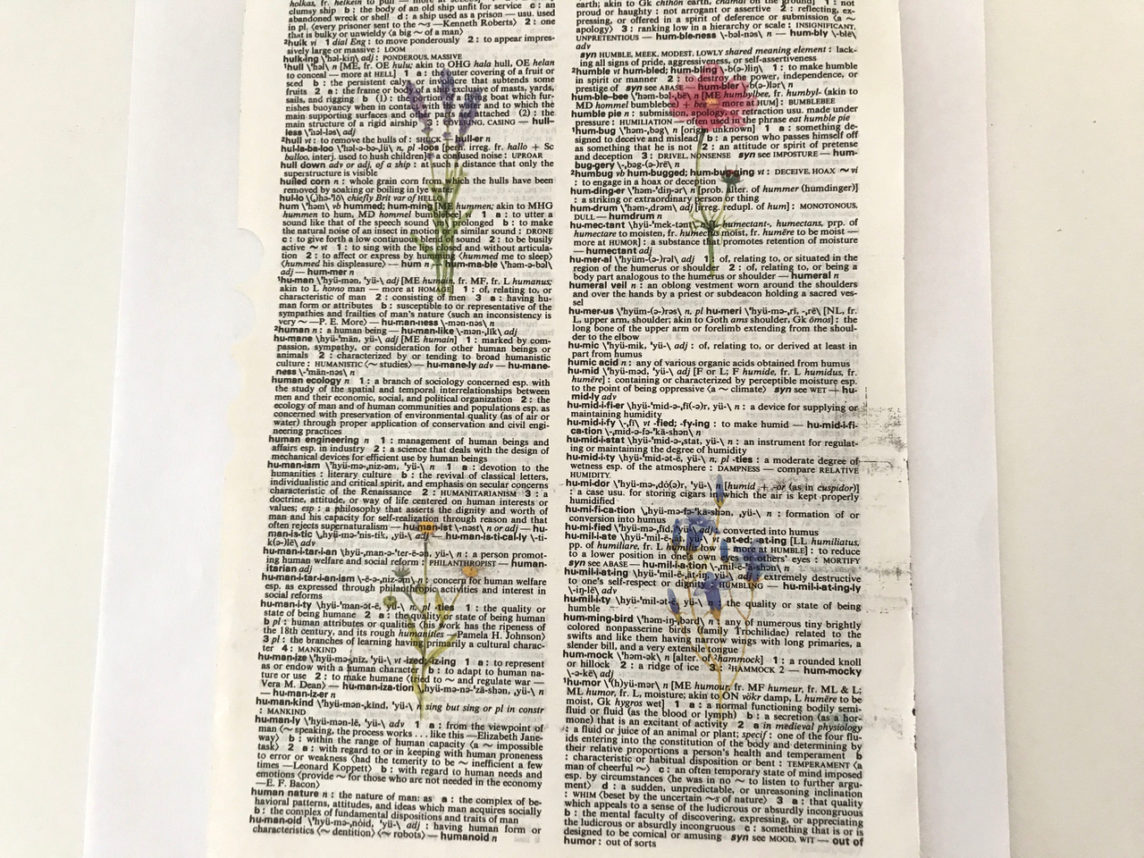
On these dictionary pages, I am printing images of botanicals, but don’t be limited by that idea. You can print monograms, photographs, cartoons — anything, really. You also can stamp or draw images if you want to bypass the printer. 

What you’ll need:
Dictionary page
8½-by-11-inch paper
Tape
Inkjet printer
Scissors
Cardstock
Glue stick


1. Cut out a page from an old dictionary.


2. Tape the top of the page to the top of a standard sheet of paper.


3. Print images on the paper using an inkjet printer. I fit four images on the paper.


4. Cut out the images and attach them to folded cardstock with a glue stick.

Make Vintage Botanical Cards with Old Dictionary Pages Read More »

Finding Ways to Enjoy Jewish Holiday Fun and Games, Even During a Pandemic

In the midst of the ongoing pandemic, Rabbi Sherre Hirsch, chief innovation officer at American Jewish University (AJU), noted, “It is so easy to be literally drowning in sorrow and anxiety and frustration.” However, she added, “There’s some level on which the [Jewish] tradition is demanding that we balance the intensity with joy.”

With that mission in mind, Hirsch hosted a virtual sit-down on Oct. 1 with Stacy Katz, co-inventor of the family-friendly card game Not Parent Approved. The two also happen to be fast friends. They first met at Camp Ramah, the Jewish summer camp in Ojai, when they were 12. Their conversation was streamed on B’Yachad Together, AJU’s 6-month-old online platform for learning, living and entertainment. 

“We’re trying to shine a light on the amazing things that Jewish people are doing in the world and bring that to the world,” Hirsch said. Notably, 20% of the 10,000 individuals who have tuned in so far to one of the 150-plus programs on B’Yachad Together are not Jewish.

The story of Not Parent Approved, which is marketed for ages 8 and up and sold exclusively on Amazon, began in 2015. Katz’s son, Bailey, was 7 at the time and in third grade. According to Katz, a Los Angeles native who lives in Westwood, she and Bailey were attending a back-to-school night at his elementary school. “It was just chaos,” she recalled. “I said to him, ‘The one thing you can’t do is run away.’ What happened? He ran away.”

The punishment Katz doled out will be familiar to many parents. She banned Bailey from screen time for an entire weekend. But she didn’t ban playdates. She ended up taking Bailey and his friends to what she described as “an avant-garde board game store” and spending $70 on various games. “I realize the irony of spending $70 on a punished kid,” she said.

 “[We’re talking about] how camp and those silly, joyful, powerful experiences of camp can be transcendent and worked into your Jewish holidays. This moment is begging us to go back to our playful selves.” — Rabbi Sherre Hirsch

Back at home, it took the boys a good 15 minutes to learn the game rules, she recalled. “At minute 20, they were throwing pieces at each other’s heads and telling me they were bored. Offline games could not compete with the allure and instant jolt of screen games.” 

Though hardly steeped in game design — Katz is a public relations professional specializing in consumer technology — she decided to try to come up with a better game, “something that will please an 8-year-old, 15-year-old, Grandma and yourself,” she said. However, she also wanted something that kids could play without adults, with straightforward, quick-to-learn rules and no complicated board or parts. 

Katz then partnered with game producer Maximina Revis, and in 2016, following a successful summer Kickstarter campaign, Not Parent Approved launched on Amazon in time for the summer holidays.

Katz said her time at Camp Ramah informed the game. “I wanted to capture that silliness, that naughtiness. We call it inappropriately appropriate.” The game, for example, begins with a “burp off,” either real or fake, among the players, to see who earns the title of “burp boss” and who gets to draw the first question card.

Though perhaps stopping just short of burp contests, it is that carefree spirit and tapping into it that Hirsch kept coming back to in her conversation with Katz. “[We’re talking about] how camp and those silly, joyful, powerful experiences of camp can be transcendent and worked into your Jewish holidays,” Hirsch said. “This moment is begging us to go back to our playful selves. Even if you don’t feel like it, almost acting as if.”

In addition to playing games, Hirsch and Katz pointed to music as a good way to tap into joy. Katz often lets her son choose the music, even though she doesn’t necessarily share his musical tastes. Hirsch, meanwhile, said her family makes playlists for every holiday. Usually, it’s her “musicphile” daughter, Alia, who heads up that effort.

Katz suggested allowing each person to bring one thing that might provide fun and stress relief into to the sukkah or to the holiday table. That’s especially important now for kids and teenagers stuck at home who have “so little autonomy.” 

“Just even having the intention to please bring me a moment of levity in this bananas world,” she said. “It’s an important value.”

Hirsch concurred. “So much of Sukkot, especially, is about intention,” she said. “What direction are we putting our heart in as we do these mitzvot of building a sukkah and building a lulav and shaking a lulav and etrog, which in itself is so silly.

She continued, “I think the sukkah is staring at us literally from the backyard, saying, ‘You know what? You just built a hut in the backyard in the middle of a pandemic. There is nothing sillier than that, in the middle of Westwood.’ ”

Finding Ways to Enjoy Jewish Holiday Fun and Games, Even During a Pandemic Read More »

What If There Were a BDS Vote and No One Came?

On college campuses, to be a Jew, particularly one who identifies as a Zionist, is difficult. Although boycott, divestment and sanctions (BDS) resolutions persist, even more pernicious are attempts by students, faculty and outside influences to equate the State of Israel and Zionism with a racist, oppressive product of European colonialism — often invoking anti-Semitic rhetoric. As an organized Jewish community, it may be time to rethink our collective response and, instead, respond strategically. We should consider choosing our battles and repositioning the discussion with greater focus and intention.

Consider BDS. Each time that resolution pops up at a college, activists converge. Supporters of various pro-Palestinian movements butt heads with pro-Israel  organizations and speakers in a series of proxy wars. The active involvement of non-students in opposing the resolution only exacerbates a narrative that “the Jews” are throwing all their resources at these losing battles.

There are several good reasons to do less in-fighting about BDS. First, many activists forget there often is no practical effect to their efforts; it’s just student government. The student government isn’t relevant to much of the student body.

To make matters worse, the Jewish community’s efforts to combat BDS provide free publicity through these debates. Local papers, campus media and sometimes national news organizations give attention to BDS, because we respond to a vote with no real consequence. Further, once passed, any BDS resolution becomes yesterday’s news.

Today, the sad fact is that issues of Israel and the Middle East are less relevant to most college students.

Another problem with fighting BDS is that activists are unlikely to change minds. It once was true that a broad group of undecided but engaged students was the audience of such activism. Today, the sad fact is that issues of Israel and the Middle East are less relevant to most college students. This ambivalence leaves pro-Zionist students debating primarily with antagonists already dead set in their positions.

Given these constraints in fighting BDS, is it worth devoting money, time and effort? Surely there are other, better ways to deploy resources. It is more important, for instance, to arm Jewish students not with the talking points for debating resolutions, but with the educational tools about the conflict, its origins, narratives and challenges, which they can employ in conversations with their peers. 

Pro-Israel student leaders should avoid a war-like stance with their contemporaries and instead, adopt a stated policy they repeat like a mantra:

“We are aware of the proposed action. We oppose it but will not engage in its debate. We will not appear at any hearing or meeting to defend our faith, the right to a nation of their own, or the actions of the Israeli government. The adoption of any resolution or the taking of any action will occur without any formal opposition in the forum you have chosen. We are, however, prepared to discuss the valid concerns of Israelis and Palestinians in a conversation that can be constructive and educational. That can only happen if both parties acknowledge the two valid narratives regarding the history of the conflict.” 

Deny BDS activists the platform to pontificate, deny them opposition to a kangaroo court debate, and save our breath and money for consequential fights.

Let’s deny BDS activists the platform to pontificate, deny them opposition to a kangaroo court debate, and save our breath and money for consequential fights.

Reference point: The BDS movement, which is modeled after the South African anti-apartheid movement that was founded in 1959 and expanded over the next several decades, urges action to pressure Israel to comply with international law, the Brookings Institution wrote in January.

When it comes to anti-Semitism, resisting the temptation to engage in debate is even more important. Consider a recent incident at USC, where a student leader who self-identified as a Zionist was hounded for it until she resigned her position. Carol Folt, the president of USC, issued a letter condemning anti-Semitic rhetoric and hatred on campus. It was a clear, definitive and kind statement. But a Black student group objected to the president’s defense of the student, particularly as it perceived to support Zionism. Jewish groups followed with statements about anti-Semitism on campus and aligned with the aggrieved student.

We should reconsider how we respond to nonviolent and non-physically destructive anti-Semitism. We need to realize that to most people, anti-Semitism is not the issue of the day. For many Jews, anti-Semitism is the worst of all ethnic injustices. But in the current historic moment, racial injustice and police brutality toward Black people and other People of Color are paramount in the public’s mind. This is not to suggest acts of anti-Semitism ought not be fought. Of course we cannot remain silent — but we must recognize that anti-Semitism is not the issue at the top of the agenda on campuses today, and some perceive claims of anti-Semitism as detracting from the current pressing issues of racial inequities.

Although there is never an excuse for an anti-Semitic attack, we need to understand there often are exogenous precursors to comments, often involving trivialities such as student government elections. When we take sides reflexively, we entangle ourselves in issues that may not concern us.

We should separate the words from the speaker. That someone opposing the settlements also says something we deem anti-Semitic doesn’t mean his or her basic position is anti-Semitic; rather, it is the words that are to be condemned.

We need to realize that to most people, anti-Semitism is not the issue of the day.

Rather than focusing on offensive language or anti-Israel rhetoric, we should concentrate on areas of common ground with other student groups, such as acknowledging the primacy of issues of racial inequity in the current political moment. Part of seeking common ground means we should educate — not argue. For example, we should confront with facts the argument that Israel is a Western colonial enterprise. We can acknowledge the damage the colonial period left in its wake, but we must point out the Jewish population in Israel is comprised of more than 50% of Jews from the Middle East, including those driven from their homes in Arab countries and their descendants.

When we say “anti-Zionist,” we mean opposition to the Jewish people’s right to a Jewish state. When others claim to be anti-Zionist, many clarify that means they are against current Israeli government policies and/or the lack of a Palestinian state. When there is a claim Zionism somehow thwarts the Palestinian right to self-determination, we should have a basic response not based on labels, but on a single, simplistic starting ground from which further debate can ensue:

“The Zionism we support is the right of the Jewish people to a state of their own in the land of their ancestors. Zionism does not negate the right of the Palestinian people to a homeland. Of course, we support the right of the Palestinian people to seek their own homeland; provided, they, too, do not seek to negate the right of the Jewish people to a homeland. These are not mutually exclusive concepts.”

Now is the time to develop a reasoned response to use in most instances when anti-Semitic statements are made or BDS resolutions are presented. One can agree with some of the arguments of people who oppose the current Israeli government without labeling them as anti-Zionists. Our arguments should focus on the facts. We should start each response with, “You have a point.”

That said, all ethnic hatred and all negation of a people’s right to a nation of their own must be called out — whether espoused by allies of the Palestinians or allies of Israel. By adopting this balance, we can focus on more pernicious acts of anti-Semitic violence and rhetoric. We should redirect discussions away from the semantic definition of Zionism and toward a conversation about Zionism’s dreams for the future alongside, and not in conflict with, Palestinian aspirations.


Glenn Sonnenberg is president of Latitude Real Estate Holdings. He is former president of Stephen Wise Temple and is on the boards of the Jewish Federation, the Children’s Institute, Wayfinder Family Services, Bet Tzedek and Center Theatre Group. 

What If There Were a BDS Vote and No One Came? Read More »