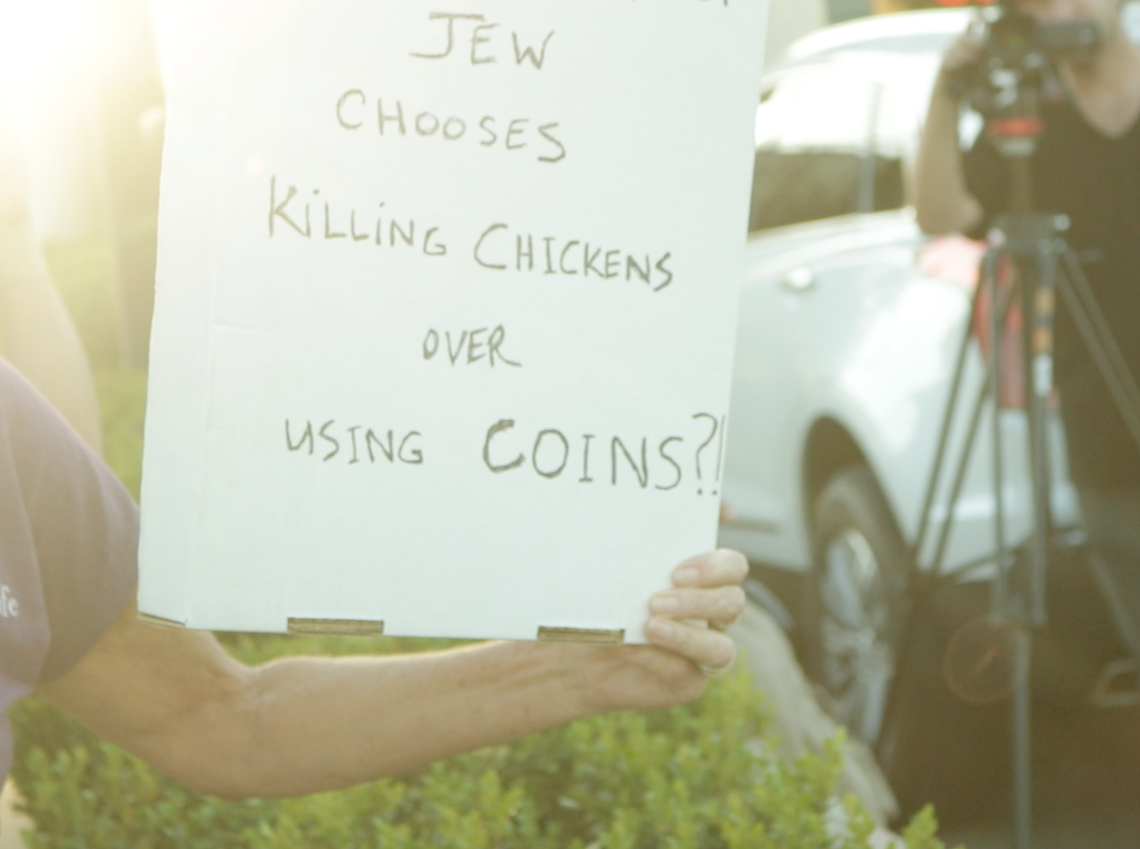
Hebrew Discovery Center is one of the remaining synagogues in Los Angeles County to observe kapparot, the ritual killing of chickens performed during the Days of Awe. On Wednesday and Thursday evening, September 27 and 28, the Center continued the ancient tradition, yet again- to the dismay of protesters who picketed, holding up signs, many of them written in Hebrew and Farsi.
“This is a holdout,” said Rabbi Jonathan Klein, co-founder of Faith Action for Animals. “This ritual has always been a questionable ritual within the Jewish community…there’s no shortcut to expiation of sin.”
Kapparot is not mentioned in the Torah or Talmud. Nobody knows for sure when kapparot started being practiced, but it’s first mentioned in the 9th century by Babylonian scholar Rav Amram Gaon, who said that kapparot is an old tradition. Yet, many rabbinic authorities have since denounced the ritual, including Ramban (Nachmanides) and Rabbi Joseph Karo, who banned the practice in his Jewish Code of Laws, the Shulchan Aruch.
Today some Orthodox circles still observe the custom…of course, not without backlash.
For Rabbi Netanel Louie of Hebrew Discovery Center, the controversy surrounding kapparot ignites his will to observe the ritual. To him, kapparot is a transference of sins. It cleanses the soul like ginger cleanses the palette.
“If they don’t like chickens being killed, they should protest a KFC,” said a 20-year-old who just observed kapparot with her friend at the Center. (Ironically, there’s an El Pollo Loco directly across the street.) This was her first time doing the ritual. Her friend, however, (donning a tichel, head wrap) said she’d been observing the custom her whole life. To her, kapparot means tradition.
The person observing kapparot will swing the fowl overhead three times while reciting a prayer before a shochet, ritual slaughterer, cuts the chicken’s neck with a ritual knife, a shechita. The blood is drained; the deed is done.
According to Louie, there is a hierarchy of existence. There is man and, then, there is chicken.
Many local synagogues have given up the ritual in lieu of a sin-absolving alternative: coins are wrapped in cloth and swung over the head three times; the coins are then donated to charity. Down the block, Klein made sure to mention, Sephardic synagogue Haichal Moshe, gave up the practice and opted for using coins instead of chickens. “What kind of Jew chooses killing chickens over using coins?” one protester wrote on a sign.
“Last year, everyone got a little too excited. There were some vandalisms. I think there’s a case that’s still going. Two people got convicted, it’s unfortunate,” said Lieutenant Warner Castillo, who was at the scene “to keep the peace.” Ten LAPD officers and three supervisors were also on-duty. Castillo said that The Animal Cruelty Task Force inspected the kapparot site earlier that day, “and they deemed it lawful and it is what it is.”
Kapparot takes place in the alley behind the Center. Israeli techno pounds through speakers as people filter in and out, taking turns observing the custom. The Center built a temporary structure to perform the ritual, which looks like a sukkah, a plywood edifice draped in blue tarp. Hours before the ritual took place, the chickens were fenced off in a coop, supplied with food and water.
About 30 protesters showed up Wednesday evening, one of whom was Israeli-born animal rights activist Ady Gil. “When you’re just stubborn and you just want to do it, of course it affects the neighborhood and it affects the people,” he said. Gil owns an animal conservation down the block. “It’s not even done correctly according to Jewish law because if you do it, you have to actually give the dead chicken to tzedakah, which is charity for food.”
Following Jewish tradition, the chickens, after kapparot is performed, are supposed to be donated to the needy. But since the slaughter conditions aren’t FDA approved, after the ritual is done, the city picks them up in sanitation trucks. Louie isn’t sure what happens after that, but he heard they become fish feed; he won’t disclose how they get their chickens, but he reasons that they slaughter chickens that no longer lay eggs- so they would’ve been killed anyway. To those protesters, that’s besides the point.