fbpx

September 29, 2017

As most shuls opt for coins, Kapparot Still Observed in Woodland Hills

Hebrew Discovery Center is one of the remaining synagogues in Los Angeles County to observe kapparot, the ritual killing of chickens performed during the Days of Awe. On Wednesday and Thursday evening, September 27 and 28, the Center continued the ancient tradition, yet again- to the dismay of protesters who picketed, holding up signs, many of them written in Hebrew and Farsi.

“This is a holdout,” said Rabbi Jonathan Klein, co-founder of Faith Action for Animals. “This ritual has always been a questionable ritual within the Jewish community…there’s no shortcut to expiation of sin.”

Kapparot is not mentioned in the Torah or Talmud. Nobody knows for sure when kapparot started being practiced, but it’s first mentioned in the 9th century by Babylonian scholar Rav Amram Gaon, who said that kapparot is an old tradition. Yet, many rabbinic authorities have since denounced the ritual, including Ramban (Nachmanides) and Rabbi Joseph Karo, who banned the practice in his Jewish Code of Laws, the Shulchan Aruch.

Today some Orthodox circles still observe the custom…of course, not without backlash.

For Rabbi Netanel Louie of Hebrew Discovery Center, the controversy surrounding kapparot ignites his will to observe the ritual. To him, kapparot is a transference of sins. It cleanses the soul like ginger cleanses the palette.

“If they don’t like chickens being killed, they should protest a KFC,” said a 20-year-old who just observed kapparot with her friend at the Center. (Ironically, there’s an El Pollo Loco directly across the street.) This was her first time doing the ritual. Her friend, however, (donning a tichel, head wrap) said she’d been observing the custom her whole life. To her, kapparot means tradition.

The person observing kapparot will swing the fowl overhead three times while reciting a prayer before a shochet, ritual slaughterer, cuts the chicken’s neck with a ritual knife, a shechita. The blood is drained; the deed is done. 

According to Louie, there is a hierarchy of existence. There is man and, then, there is chicken.

Many local synagogues have given up the ritual in lieu of a sin-absolving alternative: coins are wrapped in cloth and swung over the head three times; the coins are then donated to charity. Down the block, Klein made sure to mention, Sephardic synagogue Haichal Moshe, gave up the practice and opted for using coins instead of chickens. “What kind of Jew chooses killing chickens over using coins?” one protester wrote on a sign.

Last year, everyone got a little too excited. There were some vandalisms. I think there’s a case that’s still going. Two people got convicted, it’s unfortunate,” said Lieutenant Warner Castillo, who was at the scene “to keep the peace.” Ten LAPD officers and three supervisors were also on-duty. Castillo said that The Animal Cruelty Task Force inspected the kapparot site earlier that day, “and they deemed it lawful and it is what it is.”

Kapparot takes place in the alley behind the Center. Israeli techno pounds through speakers as people filter in and out, taking turns observing the custom. The Center built a temporary structure to perform the ritual, which looks like a sukkah, a plywood edifice draped in blue tarp. Hours before the ritual took place, the chickens were fenced off in a coop, supplied with food and water.

About 30 protesters showed up Wednesday evening, one of whom was Israeli-born animal rights activist Ady Gil. “When you’re just stubborn and you just want to do it, of course it affects the neighborhood and it affects the people,” he said. Gil owns an animal conservation down the block. “It’s not even done correctly according to Jewish law because if you do it, you have to actually give the dead chicken to tzedakah, which is charity for food.”

Following Jewish tradition, the chickens, after kapparot is performed, are supposed to be donated to the needy. But since the slaughter conditions aren’t FDA approved, after the ritual is done, the city picks them up in sanitation trucks. Louie isn’t sure what happens after that, but he heard they become fish feed; he won’t disclose how they get their chickens, but he reasons that they slaughter chickens that no longer lay eggs- so they would’ve been killed anyway. To those protesters, that’s besides the point.

As most shuls opt for coins, Kapparot Still Observed in Woodland Hills Read More »

This Yom Kippur, a synagogue will read the book of Jonah under a whale skeleton

One of the more colorful portions of the daylong Yom Kippur liturgy is the reading of the book of Jonah, an enigmatic narrative of a reluctant prophet, an indignant God and a giant fish.

But because of the service’s timing, relatively few people are around to hear it. So one rabbi is spicing up the reading by holding it under a 46-foot skeleton of a sperm whale.

The reading Saturday afternoon will take place at the Nantucket Whaling Museum, located on the Massachusetts resort island. A hub of the whaling industry in the 1800s, Nantucket was immortalized in Herman Melville’s classic novel “Moby-Dick” as the starting point for Ishmael’s journey.

“I read it [Jonah] as allegory, but the idea that it could happen captures the imagination more when you see maybe [the whale] is big enough that it could happen,” said Rabbi Gary Bretton-Granatoor of Congregation Shirat HaYam (Hebrew for “Song of the Sea”) in Nantucket. “We feel very comfortable going into the sea, but our biblical antecedents had a great fear. They would see great large fish and that would spark the imagination. I felt this would be the ideal place to talk about it.”

The short book is read in its entirety during the day’s afternoon service, coming after the exhausting Musaf service and before the climactic, closing Neilah service. The story is gripping: A man runs away from God, gets thrown off a ship and finds himself living in the belly of an enormous fish for three days. Jonah eventually (spoiler alert!) makes it to the sinful city of Nineveh, where he attempts to save the residents from the wrath of God.

Nantucket has remained connected to its maritime heritage even after the whaling industry faded. Many of the island’s large houses belonged to sea captains and ship owners. The island has hosted dramatic readings of “Moby-Dick,” and some of Nantucket’s wealthy vacationers moor yachts at the dock. The museum chronicles the island’s history and its whaling past. The giant skeleton, taken from a beached whale, is its crown jewel.

Shirat HaYam also hopes to pay homage to Nantucket’s heritage. Following a traditional Hebrew chanting at synagogue, an English reading will take place under the whale, and Bretton-Granatoor will give a lecture about how Jewish sages have viewed sea creatures throughout history.

As the Days of Awe draw to a close, Bretton-Granatoor hopes the reading will instill a biblical sense of awe into his congregants.

“The idea that I can take a biblical book and make it feel real, make it feel tangible, is very exciting,” he said. “The idea that something we read about now is tangible — here’s a whale above us — imagine what the writers of the Bible thought about if they ever saw something this size.”

This Yom Kippur, a synagogue will read the book of Jonah under a whale skeleton Read More »

When Jewish justices got the Supreme Court to shut down on Yom Kippur

Since 1995, the U.S. Supreme Court has not held public sessions on Yom Kippur. Since the court opens its term on the first Monday in October, it is not unusual for the Jewish Day of Atonement to arrive just as the court begins its public work.

How the Supreme Court came to observe the Jewish High Holy Day is a story about religious diversity on the court, the quiet perseverance of two justices and an unexpected illness.

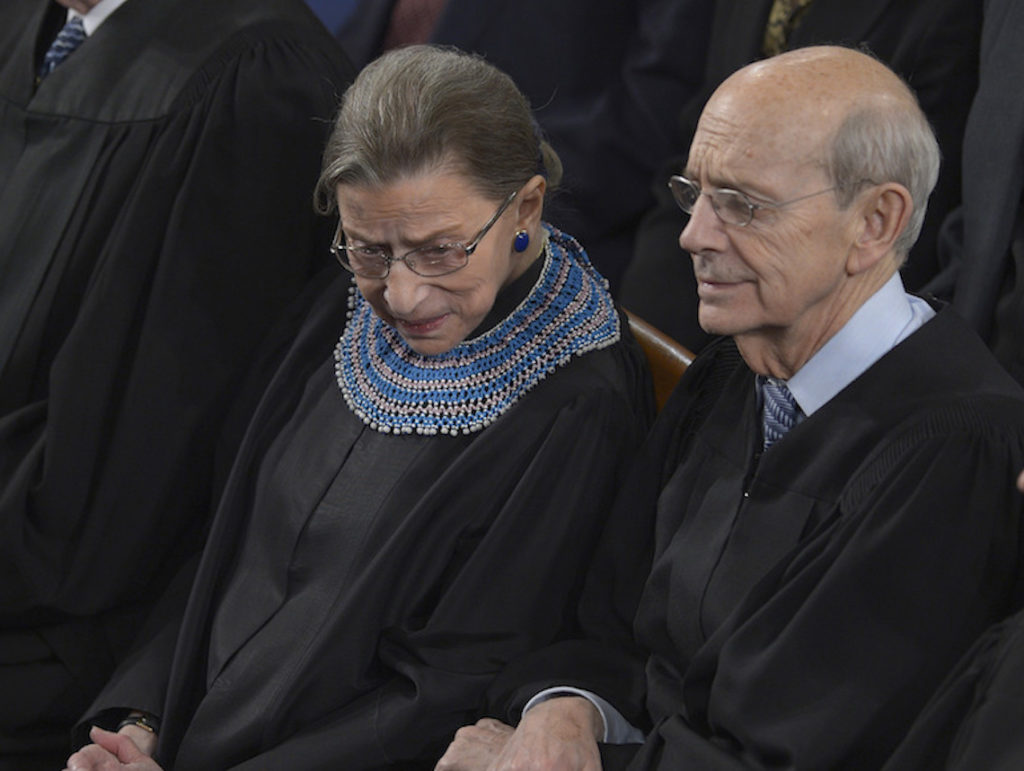
In an impromptu appearance at a synagogue here last week on Rosh Hashanah, Justice Ruth Bader Ginsburg recounted how she and fellow Jewish Justice Stephen Breyer approached Chief Justice William Rehnquist and explained that Jewish lawyers who had been “practicing their arguments for weeks” should not be required to choose between religious observance and representing their clients before the court. According to Ginsburg, Rehnquist agreed.

But Ginsburg was being respectful of the memory of Rehnquist – cognoscenti have slightly less gracious memories of his role in the change.

There were no Jewish justices on the Supreme Court in the almost quarter century between the resignation of Abe Fortas on May 15, 1969, and Ginsburg’s swearing-in on Aug. 10, 1993. (Breyer joined the court on Aug. 3, 1994.) I appeared before the court as private counsel a number of times between 1971 and 1994, and the Supreme Court clerk was always accommodating to Jewish religious observance. Cases in which I was scheduled to argue orally were scheduled for dates that would not conflict with Jewish holidays.

In 1994, I was scheduled for two appearances during a Supreme Court session in March that included Passover. At my request, the arguments were scheduled so as not to conflict with the first and last two days of the holiday.

A lawyer asking for an argument to be rescheduled was one thing; a Supreme Court justice sitting out an argument was quite another.

Yom Kippur in 1993 and 1994 came in September, so there was no religious conflict during Ginsburg’s first two years and Breyer’s freshman year on the court. But in 1995, Yom Kippur was on Oct. 4 – a Wednesday on which the court was scheduled to hear oral argument. No counsels apparently had requested that their cases be rescheduled. Although the court’s Hearing Calendar had arguments scheduled for that date, they were abruptly postponed. The court took the day off on Yom Kippur, as it has done ever since.

Those of us who followed the court closely and were battling for recognition of Jewish religious rights were curious as to how this happened. The story – as I heard it at the time from a knowledgeable source – did not portray Rehnquist as cordially accommodating to Jewish religious observance.

The account I heard then was that Ginsburg and Breyer had approached Rehnquist after oral arguments were scheduled for that Oct. 4. The two Jewish members asked the chief justice to be respectful of their religious identity and postpone the arguments scheduled for Yom Kippur.

Rehnquist, however, had not accommodated Jewish observance in a 1986 case in which I had argued on behalf of an Orthodox Jewish Air Force psychologist who wanted to wear a yarmulke with his military uniform. Rehnquist had written the Supreme Court’s majority 5-to-4 opinion rejecting the First Amendment claim.

Before she was nominated to the Supreme Court, Ginsburg as a judge on the U.S. Court of Appeals — along with Antonin Scalia and Kenneth Starr, judges at the time — had voted in favor of the psychologist’s motion to rehear the lower court’s rejection of the yarmulke request. (Following the high court’s rejection, Congress would enact a law, still in effect, that grants military personnel in uniform a statutory right to wear a neat and conservative religious article of clothing.)

In 1995, according to the version of the story I heard, Rehnquist turned down the request of Ginsburg and Breyer to reschedule the court date to accommodate Yom Kippur. He told them that they could, if they chose, absent themselves on Yom Kippur and still vote, pursuant to the court’s practice, after listening to the audio tapes of the oral arguments.

Soon thereafter, however, Rehnquist found that he, too, would be unable to sit with the court on Oct. 4 because his painful back condition required medical treatment on that day.

According to my sources, this gave the two Jewish justices an unexpected opportunity. They approached John Paul Stevens, the most senior justice who would be presiding if Rehnquist were absent. They pointed out to Stevens that if the two of them were not on the bench on Oct. 4, only six justices would sit to hear oral arguments on that day. Although that number is technically a Supreme Court quorum and the absent justices could vote after listening to audio tapes, Stevens agreed that the optics of such a diminished panel would be less than ideal. Stevens then postponed the Yom Kippur session, and the practice stuck.

This year’s Yom Kippur falls on Friday night and Saturday morning, Sept. 29-30, and the court won’t convene until Monday, Oct. 2.

But thanks to Justices Ginsburg, Breyer and Stevens, the next time a public session falls on Yom Kippur, a sign of respect for Jewish observance will again prevail.


Nathan Lewin is a Washington lawyer who has argued 28 cases before the Supreme Court and is on the adjunct faculty of Columbia Law School.

When Jewish justices got the Supreme Court to shut down on Yom Kippur Read More »

We Need to Have a Serious Talk About Political Correctness


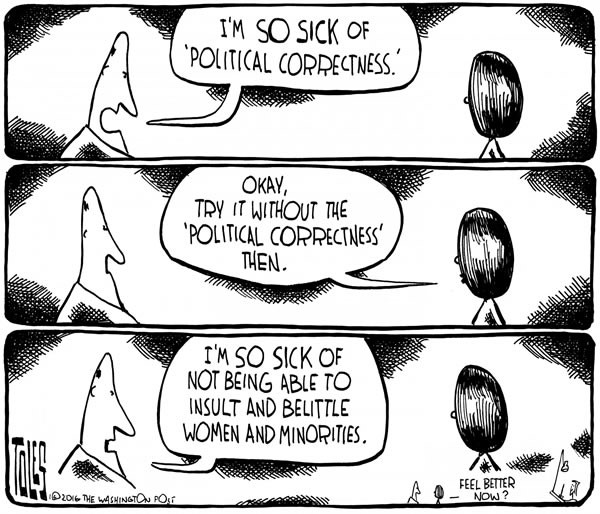
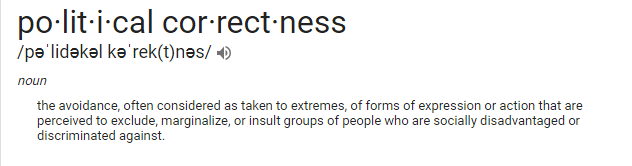
Political correctness is outdated, and to move into the future we need to understand what it was actually trying to accomplish. It is crucial that we are able to use and understand the driving ideas behind it to advocate for marginalized groups, and to advance our society in a positive direction. The term has been overused and co-opted as a propaganda tool, separating it from its intended meaning. One issue taken with the idea is that it is censorship. To clear the matter up, I would like to present the exact text of the 1st Amendment:

“Congress shall make no law respecting an establishment of religion, or prohibiting the free exercise thereof; or abridging the freedom of speech, or of the press; or the right of the people peaceably to assemble, and to petition the Government for a redress of grievances.”

The keyword here is “congress.” Criticism can often elicit a knee-jerk reaction, causing one to feel censored. What may feel like censorship is actually just more of the First Amendment. It guarantees that the government cannot legally restrict speech, but that doesn’t mean individuals or private institutions don’t have the right to criticize or boycott. Just because we have the right to free speech, it does not mean that everyone else is obligated to appreciate, support, or tolerate what someone might have to say.

https://www.timesofisrael.com/trumps-star-of-david-tweet-traced-to-white-supremacists/

Political correctness, as we know it today, has become a buzzword used to support, demonize, and devalue the lived experiences of marginalized individuals. In June of 2016 an image was shared by then presidential candidate Donald Trump’s Twitter account implying that there was a Jewish conspiracy influencing politics, a thousand-year-old anti-Semitic claim. According to the Times of Israel, a representative released a statement responding to criticism of the image saying that “the pushback over the image was ‘political correctness run amok,” even after the image was found to be sourced from a neo-Nazi website. Being upset by this is not bowing to political correctness—it is a rational response to a troubling situation. This rhetoric gaslights those harmed by anti-Semitic propaganda, turning the responsibility away from the perpetrators and onto those affected. In this way, one can use political correctness to distract from the underlying issues without losing any support for questionable actions or statements.

Both the Right and the Left practice forms of political correctness. When the President issued a statement condemning the violence of the Charlottesville riot, he stated, “You had a group on one side that was bad and you had a group on the other side that was also very violent. Nobody wants to say it, but I will say it right now.”

For clarity’s sake, one of the groups the president is referring to is the conglomeration of Neo-Nazis and Klan members calling for genocide while the other was a group of counter protesters. By citing violence on both sides as the issue and not condemning the violent actions of Neo-Nazis and racist vigilantes, the President is being P.C. in his own way. The effort to make a moral equivalency between Neo-Nazis and the KKK and counter protesters is a real example of “political correctness run amok.” Equating being upset and angry by things like rampant police violence, discrimination, racism, gender-based violence, and xenophobia with being politically correct dismisses the seriousness of the aforementioned issues. In actuality, these very real problems plague our society and affect our most vulnerable citizens.

One way political correctness has been misused is when it used to scare people. When a Sheriff blames a terrorist attack on political correctness, it ignites fear and puts the blame on concepts like political correctness rather than on what is really going on: xenophobia. The claim I’m referring to is that of Sheriff Murphree of Texas who said the following about the terrorist attack in Manchester, England in May, 2017: “This is what happens when you disarm your citizens. When you open your borders without the proper vetting…When you allow political correctness to dictate how you respond to an enemy that wants to kill you.” Such claims are effective attempts to strengthen xenophobic rhetoric and to incite fear. Sheriff Tracy Murphree is referring to President Barack Obama’s policy of not using the term “Radical Islam,” not in an attempt to be politically correct, but in an effort to draw a distinction between “terrorists and the world’s billion and a half Muslims.” What the Sheriff sees as an obsession with political correctness is actually an important effort to curtail stereotyping large groups of people and the incitement of mass hysteria.

The massive amount of focus placed on whether or not political correctness is a good thing distracts from the larger issues of social inequality and prejudice in our country and around the world. The longer the argument about “being P.C.” goes on, the harder it will be to combat our real problems. The first amendment calls for the right to freedom of expression, which is exactly what political correctness defends. It’s time we move past the buzzwords and political rhetoric and focus our energy on critically thinking about how our thoughts, words, and actions might be harmful to those around us, and how each of us can help make our society a better place to live.

Dayo Abels-Sullivan is a Youth Educational Programs Intern at the National Council of Jewish Women|Los Angeles and a sophomore at UC Irvine studying Social Ecology concerned with the intersection of law, psychology, and urban planning. His hobbies include interning.


We Need to Have a Serious Talk About Political Correctness Read More »

Rosner’s Torah Talk: Yom Kippur with Rabbi Arie Folger

Our special guest for this Yom Kippur talk is Rabbi Arie Folger, Chief Rabbi of Vienna. Rabbi Folger was ordained by Yeshiva University’s Rabbi Isaac Elchanan Theological Seminary, as well as by the Szmigrader Rebbe of Antwerp, Belgium, and he holds an MBA from NYU‘s Stern School of Business. Prior to his current position, he served as the senior rabbi of the Israelitische Gemeinde Basel and of the Israelitische Kulstusgemeinde of Munich and Upper Bavaria. Rabbi Folger is active in several organizations, such as the Conference of European Rabbis, the Rabbinical Council of America and the Orthodox Rabbinical Conference of Germany.

In this Yom Kippur discussion, we focus on Rav Kook’s understanding of repentance (Teshuva), an interpretation that is radically different from what most of us are used to.


Our past Yom Kippur talks:

Rabbi Walter Homolka on the relation between Yom Kippur and Tisha B’Av, on God as a source of forgiveness and on the different mindsets that lead us to atonement

Rabbi David Gelfand on the Kol Nidrei prayer and on the special power of the communal experience this prayer offers for members of Jewish congregations

Rabbi Meir Azari on the Book of Jonah and its relevance to Yom Kippur

Chatima Tova!

Rosner’s Torah Talk: Yom Kippur with Rabbi Arie Folger Read More »

Step into the shoes of Yonah this Yom Kippur

Ari Schwarzberg

One of the first Jewish ideas I can recall from my youth is that resting somewhere inside us, we each have a yetzer hara and a yetzer tov, an evil and good inclination. These figurative angels and demons account for our inner voices that compel us to be both our best and our worst each day of our lives. As we mature and grow older, we hope that we’ll be more angelic than demonic, but it’s  hard to imagine being able to simply hit the delete button on our dark side. Our “good” and “bad” sides constantly battle for proprietorship of our soul and much of our religious work is to redeem ourselves from the immoral thoughts and actions embedded in our genetic code.

This is all well and good. We know that we’re not meant to be perfect and that there’s work to be done.

But what do we do when our demons burden us? How do we respond when doubts or skepticism shake up our faith or when religious leadership and community fall short of our expectations? What about when the world we inhabit is tormented by one natural disaster after the next, leaving innocent people dead and homeless and cities ravaged and torn up? These are difficult questions for everyone, but for the believers out there, these can be testy times.

Surely, living a religious life requires the capacity to hold multiple feelings and ideas simultaneously: we believe and we question, we love and we hate, we’re both contemporary and ancient;. Judaism, in particular, has never been a simple person’s game. I’m sure I don’t just speak for myself, however, in saying that this year’s Yamim Noraim proved a bit more complicated than usual. A time where I usually find my spiritual burners to be revving, this year my theological demons wouldn’t stay under lock and key.

Despite the challenges, I was still deeply moved by the soaring tefillot of Rosh Hashana.  I felt the religious intensity in the air, and I loved being a part of my community. But, as Yom Kippur begins, my inner voices are asking questions about a world that seems more unjust than just and more merciless than merciful – these are crippling ruminations that I’d prefer go into hibernation this time of year. The last thing we want on Yom Kippur is swirling thoughts in our head that might pollute the holy work of the day.

Or is it?

What if we were to bring our most real and honest selves into shul this Yom Kippur and engage God not only with belief and faith, but also with the rawness of our vexations and difficulties that comprise an inextricable part of any religious consciousness?

If you’re not yet convinced, look no further than the curious selection of Sefer Yonah as the haftora for Minha on Yom Kippur afternoon. Often bestowed upon an honorable member of the community, rabbis and scholars have long wondered how a story about a rebellious prophet figures into the Yom Kippur liturgy. In short, the prophet Jonah begins his book by rejecting God’s request, and ends the story as a reluctant messenger of God, who despite fulfilling God’s demand does so God’s demand does so unwillingly, even angrily.

As dusk settles on Yom Kippur day, the image of Yonah provides a strange way to usher in the climactic moments of Ne’eila. Why are we bringing reluctance, rebellion, and anger into a day designated as kulo l’Hashem, a day steeped in holiness and enveloped by godliness?

But perhaps that’s it. Yonah’s role on Yom Kippur instructs us that a relationship with God isn’t always one of simple faith and submission. Sometimes, there are moments of clarity and purpose that bring us close to our Maker, and other times we are lost and troubled, feeling like God’s presence is anything but near.

For most of Yom Kippur we spend the day knocking on heaven’s door, a 25-hour existence that does its best to transcend the human realm. But then there’s about a ten-minute window late in the afternoon when we’re invited into the world of a troubled prophet who finds an unjust world intolerable. Yonah doesn’t mince words: in the final chapter he twice exclaims to God that “it is better for me to die than to live.” Even at the close of the story, after God does His best to show Yonah His ways, we are left wondering about Yonah’s reaction. The story closes on a cliffhanger with the reader unsure whether Yonah remains recalcitrant or is finally convinced of God’s preeminence.

The linchpin, however, is that despite all this Yonah is and remains a prophet. While many other prophets prove their prophetic worth by unquestionably heeding God’s demands, Yonah’s prophetic qualities are best understood in the inverse. Yonah’s constitution as a navi b’yisrael (a prophet of Israel) directly emerges from his boldness. Though he could have checked out or remained silent, Yonah demands a world that is better, his moral clarity ultimately furnishing an activism that could just as easily have faded into apathy. Rather than remaining asleep in the hold of a ship, Yonah brings his frustrations into a conversation with God. In fact, the climactic moment of the story occurs when Yonah channels His accusations into an actual tefillah:

וַיִּתְפַּלֵּל אֶליְהוָה וַיֹּאמַר, אָנָּה יְהוָה הֲלוֹאזֶה דְבָרִי עַדהֱיוֹתִי עַלאַדְמָתִיעַלכֵּן קִדַּמְתִּי, לִבְרֹחַ תַּרְשִׁישָׁה:  כִּי יָדַעְתִּי, כִּי אַתָּה אֵלחַנּוּן וְרַחוּם, אֶרֶךְ אַפַּיִם וְרַבחֶסֶד, וְנִחָם עַלהָרָעָה.

He prayed to the LORD, saying, “O LORD! Isn’t this just what I said when I was still in my own country? That is why I fled beforehand to Tarshish. For I know that You are a compassionate and gracious God, slow to anger, abounding in kindness, renouncing punishment.

This is the prayer par excellence of our tradition, the 13 attributes of God, a refrain we’ve been saying for weeks now and that we’ll say throughout Yom Kippur. Yet, Yonah inverts this tefillah, accusing God of being overly merciful at the expense of truth and justice (notice how אמת is glaringly absent in Yonah’s prayer). The point being that although Yonah vehemently disagrees with God, his consternation becomes a vehicle for tefillah, an instrument for a more honest and vulnerable communion with God.

Of course, God is right and Yonah is wrong. Our ability and need to question God is not a comment on His perfection. Still, this short story is retold on Yom Kippur as a reminder that a real relationship with God is not always harmonious.The prophet Jonah models the capaciousness, the ability to both believe and question, that any meaningful relationship demands. We both relate to Yonah’s firm declaration in Chapter One that “I am a Hebrew; and I fear the Lord, the God of heaven, who made the sea and the dry land (1:9),” while also sympathizing with Yonah’s disposition as described by the narrator: “This displeased Jonah greatly, and he was grieved.” Religious life is neither linear nor one-dimensional.

So, I invite you all to give it a shot. If you’re feeling troubled or frustrated with the world, if things haven’t been going the way you’d imagine them, step into the shoes of Yonah, and bring your complete self into your service of God this Yom Kippur. For such is the way of prophets.

Wishing you a G’mar Chatimah Tova.


Step into the shoes of Yonah this Yom Kippur Read More »