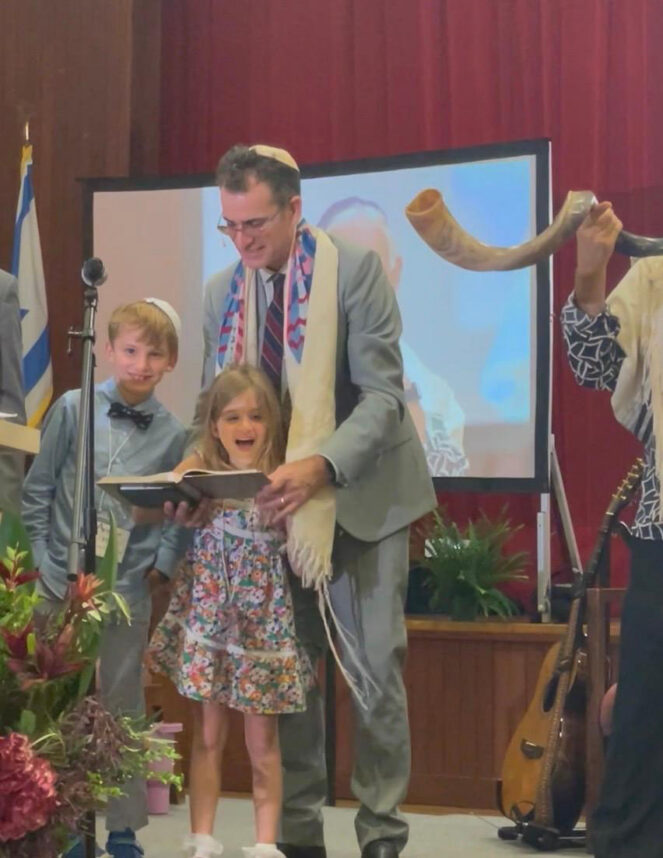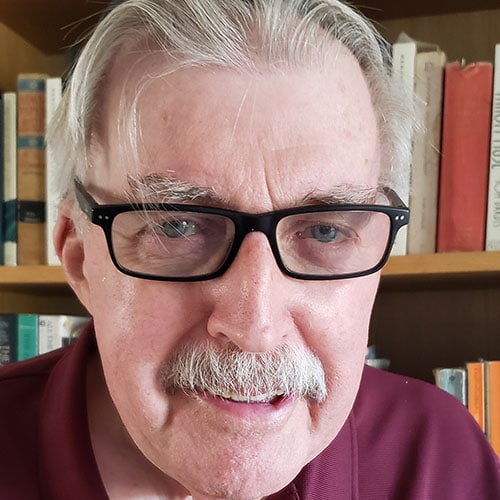

For the last decade, Rabbis Erez Sherman and Nicole Guzik have been the assistant rabbis at Sinai Temple, but when the nationally regarded Rabbi David Wolpe steps back to become rabbi emeritus on June 25, both Sherman and Guzik will succeed him as Senior Rabbis. Rabbi Sherman expects it will be a smooth transition.
The shift in leadership, he says, “will be more from the visionary aspect.” It’s not going to be a large shift, he adds, because “Rabbi Wolpe, as our senior rabbi and mentor, has already allowed us, even as assistant rabbis, to explore our vision.” But don’t expect them to make wholesale changes immediately. “Rabbi Wolpe likes to say, ‘you shouldn’t change the furniture too quickly.’” That shouldn’t be an issue, he says, because both Sherman and Guzik “love the furniture here. We love the music of Sinai Temple. We love the traditions of Sinai Temple. I think that will continue because we are not new to Sinai Temple and our congregation is not new to us.”
What will be new is having a husband-and-wife team serve together. He calls the rabbinic doubleheader “double the fun.” But, he explained, “you don’t need two rabbis to announce one page. So we will be able to offer different prayer experiences, different learning opportunities.” While they will both be at the temple, “we have different passions and we work with distinct affiliate communities.” Rabbi Guzik, who writes her popular “A Bisl Torah” each week in the Journal, is involved with Sinai’s Sisterhood, while Rabbi Sherman with the Men’s Club. She will also remain involved in the Sinai Temple Mental Health Center, which she started after earning a degree in marriage and family therapy. It fills what many regard at a vital need in the Jewish community.
Both husband and wife will continue to work closely with the Sinai Akiba Academy, where they have created relationships with families, students and the faculty. Rabbi Guzik will work with Atid, the shul’s young professionals’ group, while Rabbi Sherman will be deeply involved in Sinai’s religious school.
One change that will be immediately noticeable will be who delivers the sermon on the bimah. While they will try to share that duty equally, Sherman, who consistently refers to his wife as “Rabbi Guzik,” says “we have different voices we are excited to bring to the community. If Rabbi Guzik writes a sermon and I give it, it won’t sound right. It has to be from our own heart and soul … He recalled a Shabbat morning when his wife was not feeling well. “When she handed me a paper, I told her ‘I can’t say that because those are your words. They only can come from your heart.’” Sherman says that he and his wife have “both learned to create our own rabbinic identities working together over the last 10 years. We also have found points where we can work together and model the family experience within Judaism.”
Of his own family, Rabbi Sherman can’t think of anything that’s better than doing the job he loves together with his wife. “Usually we don’t see each other from nine-to-five, but every morning there’s a beautiful moment. We bring our three children (ages 11, 9, 7) to this building for their school and our rabbinic work together. And we walk home as well.”
Away from the bimah, Rabbi Sherman is happily involved in what he calls “the sports-and-faith world.” The connection might be a bit hidden, he says, but it can “create a lot of strong relationships in both the Jewish community and in the interfaith community.” He will continue his podcast, “The Rabbi on the Sidelines,” where he interviews people in the sports world: professional and college athletes and coaches, managers, fans, and the Shalhevet High School state basketball champions. Crucially, says Sherman, who is also a distance runner and has appeared on ESPN, “we don’t talk about sports but about the journey of their souls.”
His love of sports extends to his work. Whether it is the L.A. Rams’ Community Camp or the Sinai Temple Basketball Camp, what makes him happiest is seeing “hundreds and hundreds of people engaging in Judaism and faith through something they thought they could only do outside of a synagogue wall. It’s been fun.”
As Father’s Day approached, Rabbi Sherman’s thoughts turned to the gift of generations. ”From my father I received the gift of learning at his feet, of how to build a community.”
As Father’s Day approached, Rabbi Sherman’s thoughts turned to the gift of generations. “I feel the spiritual presence of my grandfathers, whom I would sit next to in the synagogue where my dad served as a rabbi,” he said. “They taught me the love of Jewish learning. From my father I received the gift of learning at his feet, of how to build a community. As a father, I have slowed down to cherish each moment of our childrens’ youth.”
The rabbi recalled one recent day when the family was strolling home from school and work and his 9-year-old son said, ‘I think I am going to send my children to Sinai, too.’ His father smiled. “He simply loves the community and the model this community shows about living a Jewish life.”
It’s true: The family that prays and plays together clearly prospers.
Fast Takes with Rabbi Sherman
Jewish Journal: What is your favorite Jewish food?
Rabbi Sherman: A pastrami sandwich.
JJ: What do you do on your day off?
Rabbi Sherman: I love to read historical nonfiction, autobiographies and narratives. I also like to get back into running. I ran the Jerusalem half-marathon in 2016.
JJ: What is your favorite movie?
Rabbi Sherman: “Father of the Bride, Part 2.”