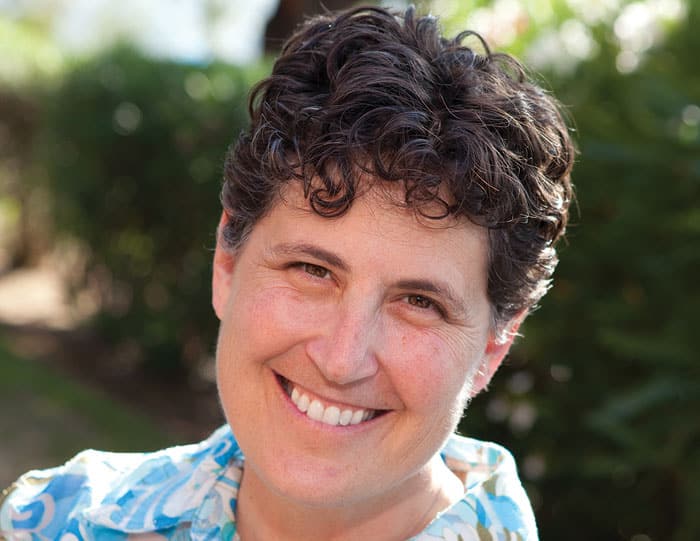
Rabbi Rochelle Robins grew up surrounded by spirituality. Her father was a rabbi in her hometown, San Jose, California; she would go to Hebrew school and Camp Swig and participate in B’nai B’rith and NFTY (The Reform Jewish Youth Movement). “I always felt connected to Jewish community, which was spiritual to me,” she said. “I’ve always felt connected to other beings, to nature and to God.”
Early on, she learned that helping other people was one of the most spiritual things she could do. “Being there for others is part of how we show divinity in the world,” Robins said. “Being present for people is the greatest purpose in the world for people and creatures. I grew up with those things as core values to my Jewish experience and responsibility.”
Today, it only makes sense that the rabbi is a chaplain, as well as vice president, academic dean of the rabbinical and chaplaincy schools at the Academy for Jewish Religion, California. It’s a job – and a calling – where the core mission is to help others.
“I didn’t know that chaplaincy existed until I went to rabbinical school,” Robins, who earned ordination at Hebrew Union College – Jewish Institute of Religion in New York, said. “It’s not only being present for people; it’s being present for people and helping them on their terms, without our own agenda.”
In the past, Robins served as a staff chaplain in Pennsylvania and New Jersey. In those positions, she learned how to assist people in need, whether that meant talking with them or making sure they knew she was there for them.
“In many situations, holding space with people is the most powerful contribution to their experience at the time,” she said. “A big part of the clinical training we offer at AJR is learning how to respond with appropriate and comfortable silence – and being comfortable with that as well.”
Being a chaplain involves helping patients and families with whatever emotional support they need. When Robins worked on staff as a chaplain, a patient wanted to talk about his life with her.
“He was dying from a cardiac issue and asked me to come into his room,” she said. “We spent an hour talking about the list of things on his mind and in his heart at the time. It wasn’t relegated to what people had done to him. It was things he had been suffering from as a result of being a human being and making mistakes. At the end of the visit and ensuing days, he communicated a great relief at the end of his life for being able to have someone sit with him so he could finally feel relief over carrying these things for so long.”
Robins believes that everybody could benefit from speaking with a chaplain. That’s why she co-founded Ezzree.com, an online platform that provides chaplaincy for underserved communities via Zoom. “People don’t have to be hospitalized to receive chaplaincy,” she said. “They can be wanting the presence of a spiritual care counselor within our own lives. “We feel there are so many affiliated and unaffiliated people who can use spiritual care.”
When Robins teaches other rabbis and chaplains at AJR, she makes sure to talk about caring for yourself. Being a chaplain can become emotionally draining, so she recommends focusing on self-care. “We have to protect ourselves,” she said. “We must guard ourselves from compassion fatigue and know what we need in our daily lives.”
One Jewish teaching that Robins goes back to time and time again comes from a Hasidic tale of unknown origin. It’s a story about how everything that exists within the world and within others also exists inside of us.
“The more aware we are of our own emotions and experiences and development, the more conscious we can be of the balances and imbalances within ourselves,” she said. “The more we reflect on these things, the better we are to providing care for other people and understanding others.”
In her work, Robins’ ultimate goal is to help people, no matter what they’re experiencing. “I want to provide care, connection and meaning to people,” she said. “I want to accompany people during the joyous times – and during the most challenging ones as well.”
Fast Takes with Rochelle Robins
Jewish Journal: What’s your favorite Jewish food?
Rochelle Robins: My sister married into a Moroccan family, and I love her Moroccan chamin, which is cholent. But we have Ashkenazi roots, so I like hot borscht too.
JJ: What do you do when you have a day off?
RR: I like to swim at the beach and in cold, glacial lakes.
JJ: If you could hang out with one person in Jewish history, who would that be?
RR: I would love to have a day with Chava Alberstein and talk about her music. That would be so fun.