fbpx

January 19, 2023

For a Small Fee – A poem for Parsha Vaera

Stretch forth your staff and strike the dust of the earth, and it shall become lice throughout the entire land of Egypt.
– Exodus 8:12

And, oh, yea, there was the time when
we dropped someone off at the summer camp
who, for the sake of avoiding embarrassment

will remain anonymous, but suffice it to say,
it was not myself or my beloved, and
oh, yea, shortly after delivering him

to the mountains, a communication came
from the mountains themselves, and it said
there is a plague in [redacted]’s hair

and would you like to come back to
the mountain and retrieve him and use
your magic (and health insurance) to

rid him of the plague? And we, with
plane tickets and passports in hand
prayed to The Lord for another way.

And The Lord answered and said
oh, yea, I will stretch out My hand and
banish the plague from [redacted]’s hair

so you can travel across the ocean
to your brief, and Japanese promised land.
And so it was done and the summer camp

called and said it is done but you must pay
a small fee and, in exchange, you will go
on your way and we will wash everything.

And the means to pay the fee were
already stored in the scrolls of the mountains
and we agreed and thus, the fee was paid

and we took our plane tickets and
our passports and we flew in the belly of
a dragon to our promised land where

we wandered for weeks doing nothing but
eating and looking and looking and eating
having earned this freedom. Thank You Moses,

Thank You God, Thank you peoples of the
mountains and the far east. There is no plague
we can’t overcome, with a small fee.


God Wrestler: a poem for every Torah Portion by Rick LupertLos Angeles poet Rick Lupert created the Poetry Super Highway (an online publication and resource for poets), and hosted the Cobalt Cafe weekly poetry reading for almost 21 years. He’s authored 26 collections of poetry, including “God Wrestler: A Poem for Every Torah Portion“, “I’m a Jew, Are You” (Jewish themed poems) and “Feeding Holy Cats” (Poetry written while a staff member on the first Birthright Israel trip), and most recently “I Am Not Writing a Book of Poems in Hawaii” (Poems written in Hawaii – Ain’t Got No Press, August 2022) and edited the anthologies “Ekphrastia Gone Wild”, “A Poet’s Haggadah”, and “The Night Goes on All Night.” He writes the daily web comic “Cat and Banana” with fellow Los Angeles poet Brendan Constantine. He’s widely published and reads his poetry wherever they let him.

For a Small Fee – A poem for Parsha Vaera Read More »

Judicial Crisis in Israel Caused by the Absence of Rules, Also Known as a Constitution

One of the stunning aspects of the judicial crisis that is roiling Israeli society at the moment is that it’s not about policy. No one’s arguing about illegal outposts or reducing the cost of living or who should serve in the IDF.

For now, the fight is over power and fundamental questions like: Who has final say on the country’s laws and how they should be enforced? Does the Supreme Court have a duty to review laws or just interpret them? Does the government have the right to override the Court? And so on.

In a way, this judicial grenade was bound to explode sooner or later, for the simple reason that Israel doesn’t have a constitution. What it has are Basic Laws. The problem with Basic Laws, however, is that any government can change them at will with a simple majority. The other problem is that, in the absence of a constitution, Israel’s Supreme Court has absorbed more and more power over the years, triggering a backlash from the political branch that is now trying to get that power back.

The current crisis, then, can best be described as a pendulum of power that swung too far in one direction, and is now swinging too far in the other. Both extremes fail the country. In the former, the people are asked to trust unelected jurists with too much power. And in the latter, the people are asked to trust politicians with personal agendas with too much power.

The current crisis can best be described as a pendulum of power that swung too far in one direction, and is now swinging too far in the other. Both extremes fail the country.

A constitution is the one mechanism that can prevent this destructive conundrum.

“Constitutions are important not only because they ideally reflect a country’s core principles, serving both as a mission statement and as an operating manual, but also because they represent a governing philosophy that sits above the messiness of politics,” Michael Koplow, Chief Policy Officer of Israeli Policy Forum, writes.

Indeed, what we’re seeing now in Israel, in an extreme and ugly form, is just that: The messiness of politics.

The new government kicked off the mess by announcing reforms that represent a radical shift in power from the courts to the politicians, calling it a “rebalancing.” When the opposition cried foul, they were met with cries that “the voters have spoken.” This further infuriated the opposition.

Both sides may claim that “democracy” is on their side, but it’s not that simple. For one thing, should democracy allow any future government with a majority of 61 seats to remake the judicial rules to its liking?

As Koplow argues, “In order for democracy to work, there has to be confidence on both sides of the political spectrum that… losing one election or even a series of elections does not mean that things will inalterably change.” The animating feature of constitutions, he writes, is that “they are supposed to reflect the unchanging nature of the system itself.”

This argument goes deeper than, “We won the election so we can do what we want.” As Koplow argues, “democratic politics is a necessary basis for democratic legitimacy but it is not the only one nor a sufficient one.”

At the very least, the opposition ought to put a concrete alternative on the table.

Meanwhile, the opposition has missed the opportunity to make a calm argument about the flaw in Israel’s system and the need for reasonable reforms. At the very least, the opposition ought to put a concrete alternative on the table.

The ideal person to bring the warring sides together in this endeavor is Israeli President Isaac Herzog. Just as a constitution aims to be above the fray of politics, so does the office of the president. The truth is, both sides are victims of a flaw in the Israeli system, and until a constitution is finally established, both sides will need to compromise.

The number one obstacle to compromise, as usual, will be human nature.

The ideal person to bring the warring sides together is Israeli President Isaac Herzog…The number one obstacle to compromise, as usual, will be human nature. Power is intoxicating.

Power is intoxicating. The new coalition, angry that the Courts have had too much power for too long, are salivating to grab that power back. They’re not in the mood to hear anything about compromise. The latest example of this fervor is Interior and Health Minister Aryeh Deri’s refusal to follow the High Court’s ruling that it is “unreasonable in the extreme” for Deri to hold a minister position, given the Shas leader’s multiple convictions.

Like a Shakespearian tragedy reaching its climax, the Deri drama has taken center stage. It has no easy resolution. For a nation that is used to living on the edge, the next few days will offer all they can handle.

My friend Yossi Klein Halevi once described the typical Israeli mindset as “neurotic Zen.” They may look calm and happy, but they never forget that a disaster can happen any minute.

I hope President Herzog will bring his best Zen energy when he brings the sides together. He might want to start as follows: “This crisis is no one’s fault. We need a better system to establish the fundamental rules of the game. For now, however, we must work in good faith and in a spirit of compromise. This is the one question we must address for the good of the country and for the good of all voters: ‘What would reasonable legal reforms look like?’

“Turkish coffee anyone?”

Judicial Crisis in Israel Caused by the Absence of Rules, Also Known as a Constitution Read More »

Constitutional Revolutions With No Constitution

The furious debate over Israeli Justice Minister Yariv Levin’s proposed judicial reforms that is now roiling Israeli state institutions and society—evidenced by shouting matches in the Knesset’s Constitution, Law, and Justice Committee, speeches from Supreme Court President Esther Hayut and responding speeches from Levin, and close to 100,000 people protesting in Tel Aviv, Jerusalem, and Haifa—is confusing. To begin with, the details are not easily accessible to those who are not steeped in constitutional law and political theory, let alone the specific peculiarities of the Israeli system, with its Basic Laws and reasonableness tests. Furthermore, it seems strange that the fundamental rules of the game are still open for debate 75 years after Israel’s founding. The fight taking place is not over a specific policy—at least not yet—but over whether the Supreme Court should have the ability to deem legislation out of bounds, and whether the Knesset should have the ability to ignore the Supreme Court if it chooses. For Americans in particular, this is unfamiliar terrain, even if we have gone through our own institutional upheaval in recent years.

The heart of Israel’s problem is that it went through what was deemed a constitutional revolution and is now in the throes of a potential constitutional counterrevolution, all without actually having a constitution. Constitutions are important not only because they ideally reflect a country’s core principles, serving both as a mission statement and as an operating manual, but also because they represent a governing philosophy that sits above the messiness of politics. Democracies will have fights over policies that lead to drastic swings depending on changes in power and changes in societal values, but the animating feature of constitutions is that they are supposed to reflect the unchanging nature of the system itself. It is why constitutions work best when they are written and passed with a wide consensus from across the entire spectrum, and why constitutional changes should be subject to an extremely high barrier, as with the process for amending the U.S. Constitution.

The Knesset

And this is before getting to a lower-level set of issues with regard to U.S. concerns and priorities that are viewed as belonging to Israel’s domestic domain but that implicate shared values and support for democracy, such as the proposed changes to the oversight power of Israel’s Supreme Court or statements from Israeli ministers and coalition MKs threatening the status of minority rights. Administration officials undoubtedly blanched a couple of days ago while hearing one Likud MK talk about his preference for Jewish murderers over Arab ones, or reading an Otzma Yehudit MK’s exhortation to arrest opposition heads Yair Lapid and Benny Gantz while accusing them of treason.

This all leads to the question of what tools the administration has at its disposal beyond public and private admonitions if it wants to avoid specific Israeli policy moves or signal its displeasure at erosions of democratic norms. One of the easiest ones to wield—which is not punitive and does not implicate the U.S.-Israel security relationship—is treating high-level political visits not as routine activity, but as the political gifts that they are. The U.S.-Israel relationship is institutionalized at nearly every level, with political appointees and career officials constantly traveling to each other’s countries, constantly conversing, and constantly coordinating. The daily business of U.S.-Israel strategic planning, intelligence sharing, defense coordination, and economic interchange does not involve Biden or Netanyahu, operates without interruption, and is largely immune to the politics on either side.

Israel has no constitution, the reasons for which would take up far too much space in this column. But it has tried to have things both ways, coming up with a system of Basic Laws that is supposed to serve as a quasi-constitution while also not holding these Basic Laws to any higher standard than normal legislation. A constitution is meant to be shielded from short-term public opinion, but Israel’s Basic Laws are passed with a majority of the MKs who happen to be in the Knesset plenum when they are voted on. This has created two problems: Basic Laws do not necessarily rise to the level of things that sit above the messiness of politics or reflect a broad political and societal consensus, and the Israeli Supreme Court’s effort to treat them as such causes its own set of controversies and opposition.

In order for democracy to work, there has to be confidence on both sides of the political spectrum that they will always have the opportunity to come into power and to set policy that comports with their worldview, and that losing one election or even a series of elections does not mean that things will inalterably change. The way to instill this confidence is counterintuitive, which is to make political institutions—their structure and the scope of their authority—not actually democratically accountable to the voters and their representatives in office. What this means in practice are constraints on changing the system that prohibit whoever holds power from undermining political institutions’ unaccountability to them; in other words, enacting constraints on the majority that do not bind their hands on questions of normal policy, but that bind their hands on questions of the system. In the U.S., this means our Constitution, which creates the basic system of checks and balances, sets out which branch has authority over what, and does its best to create a system of institutional barriers that keep the majority from exercising its power directly and completely. Perhaps the most important principle that emerges from this—one that seems increasingly glossed over and little understood—is that democratic politics is a necessary basis for democratic legitimacy but it is not the only one nor a sufficient one.

The Supreme Court

The Israeli system has never fully grasped how this works. From not creating a constitution at the outset, to creating Basic Laws that do not have any greater institutional legitimacy than regular laws, to the Supreme Court creating the authority to review—rather than interpret—legislation arising out of its interpretation of a Basic Law, to the new effort to make the Knesset effectively unaccountable to any other institution by proposing a simple majority in order to override the Supreme Court; all of this is a recipe for a muddied and muddled system that would eventually break down. The crisis that Israel is now undergoing—and it is absolutely a crisis—is due to the combination of poor institutional design from the outset and radical politicians today. You would not have what is currently taking place without both of these elements.

It is unlikely that Israel will suddenly rectify one of its original errors and write a constitution. In the current political environment, it wouldn’t even be possible. But the various weaknesses of the unbalanced and unchecked system—many pointed out by my colleague Alex Lederman, such as a unicameral legislature, the functional conflation of the executive and legislative branches, and of course the absence of a constitution—make some sort of compromise agreement over the judicial reform proposals even more necessary than it seems at first glance. A Knesset that is functionally free from all judicial oversight makes no sense, but neither does a Knesset that has zero recourse to address Supreme Court limitations on its legislation. And the idea that this government might allow the Knesset to override the Supreme Court while the next one reverses that decision, and that such a fundamental element of the system depends on who controls the Knesset, should make anyone who cares about the health of Israeli democracy and governance quake in their boots. Screaming “the will of the voters!” over and over again is not a credible argument when it comes to systemic and institutional changes, and there will be real and long-lasting consequences in the form of damage and crises of confidence in Israel’s political system.

The Knesset plenum

That those who want judicial reform have a legitimate point is not the point. They do, and they still have the ability to bring everything crashing down while they insist on the rightness of their cause. Fixing a broken system isn’t done by breaking it even more beyond repair. Israel’s attempt to have constitutionalism without a constitution is precisely why the new government needs to proceed with maximum caution, and make sure that their zeal to enforce democratic legitimacy does not actually crater it.


Michael Koplow is Israel Policy Forum’s Chief Policy Officer, based in Washington, D.C. To contact Michael, please email him at mkoplow@ipforum.org.

Constitutional Revolutions With No Constitution Read More »

Mar-a-Lago Is Not on the Way to Auschwitz

A new record may have just been set—for the most Hitler analogies in a 24-hour period.

From Moscow to Mar-a-Lago, public figures this week were inappropriately invoking Nazi-related terms to denounce developments that did not at all resemble those of the Nazi era.

Russia’s foreign minister, Sergei Lavrov, declared that the United States and its European allies are attempting to solve “the Russian question” in the same way that “Hitler wanted a ‘final solution’ to the Jewish question.”

Meanwhile, more than five thousand miles away, former president Donald Trump tweeted that the FBI agents who recently removed classified government documents from his Mar-a-Lago residence were “the Gestopo” (as he spelled it).

Before the news cycle was done, a former Israeli attorney general called proposed judicial reforms in that country “a pogrom,” and New York Times columnist Thomas Friedman described those proposals as a “putsch,” the term commonly associated with Adolf Hitler’s failed coup attempt in 1923, known as the Beer Hall Putsch.

Whew!

If such outbursts were an aberration, it would be bad enough. But there have been numerous such remarks flung about in public discourse in recent months—just not all in a single 24-hour period.

Filmmaker Ken Burns, speaking on CNN about Holocaust-era immigration policies, said the decision by Florida’s governor to fly fifty migrants to Martha’s Vineyard was “straight out of the authoritarian playbook.”

Not to be outdone, the Republican nominee for governor of Illinois, Darren Bailey, declared that “the attempted extermination of the Jews of World War II doesn’t even compare on a shadow of the life that has been lost with abortion.”

And Robert F. Kennedy Jr. said last year that America’s Covid vaccination policies are even more dangerous than Hitler’s policies, since in Nazi Germany there was (he claimed) the option of “hiding in an attic, like Anne Frank did.”

At least Kennedy retracted and apologized for his comment. That’s rare among those who use Nazi analogies as political weapons.

Five years ago, the United States Holocaust Memorial Museum announced that it “unequivocally rejects efforts to create analogies between the Holocaust and other events, whether historical or contemporary.”

It issued that statement after one of its staff historians, Rebecca Erbelding, expressed support for the claim by Rep. Alexandra Ocasio-Cortez that U.S. immigration facilities resemble “concentration camps.” Erbelding’s statement was made “in a personal capacity” and “does not reflect the position of the Museum,” the museum emphasized.

Given the sudden proliferation of comparable statements by public figures, at home and abroad, this might be a good time for the Holocaust Museum to publicly reiterate its opposition to Nazi analogies.

Such analogies both exaggerate contemporary controversies and minimize what the Nazis did. Policies concerning issues such as immigration, abortion, or Covid restrictions naturally generate intense debate. But it should be possible to discuss even the most sensitive issues without resorting to absurd and insulting historical comparisons. Abortion is not another Holocaust. America’s immigration facilities do not resemble Dachau. And Mar-a-Lago is not on the way to Auschwitz.

Dr. Medoff is founding director of The David S. Wyman Institute for Holocaust Studies and author of more than 20 books about Jewish history and the Holocaust. His latest is America and the Holocaust: A Documentary History, published by the Jewish Publication Society & University of Nebraska Press.

Mar-a-Lago Is Not on the Way to Auschwitz Read More »

A Moment in Time: “It’s Not What Goes Into our Mouths – It’s What Comes Out”

Dear all,

The Jerusalem Post reported this week that Israel’s Chief Rabbi, David Lau, has declared that “cultured” meat is “parve.” In other words, meat that has been produced from stem cells is considered vegetarian, and can therefore be eaten along with milk. (Traditional laws of kashrut/ keeping kosher call for a complete separation of milk and meat). This is groundbreaking, as the laws of kashrut have been a cornerstone of Jewish identity for millennia. We have yet to see how this will unfold.

While kosher originally is a term used with regard to food, it also can be used with regarding to anything that is “fitting.”

Now, while we should certainly be cognizant and interested about what we put into our bodies. my hope is that we give even more consideration to what comes out.

Are our words fit to be heard?

Are our actions fit to be seen?

Are our texts fit to be read?

Are our emails fit to be sent?

All it takes is a moment in time to consider what comes out of our mouths. Once it’s out there, it’s out there!

So let’s ensure that what we share and do abide by the laws of kashrut as well!

With love and shalom,

Rabbi Zach Shapiro

A Moment in Time: “It’s Not What Goes Into our Mouths – It’s What Comes Out” Read More »

Meet the First Israeli American Elected to an RNC Position

The first ever Israeli American was elected to a Republican National Committee (RNC) position on January 16.

Attorney Sigal Chattah, who ran for state attorney general in 2022 and lost, was elected by the Nevada Republican Central Committee by a vote of 222-147, beating out Pauline Lee to serve as Nevada’s Republican National Committeewoman. Lee was the preferred choice of newly elected Republican Governor Joe Lombardo. 

“Lombardo’s candidate was an establishment-type candidate,” Chattah told the Journal in a phone interview. “Nevada Republicans are just not establishment. They don’t like the establishment. The establishment has sold them out over and over and over again.”

Chattah said that she ran after her best friend, Michele Fiore, was appointed to a county judicial position, thus prompting Fiore to resign from her position as committeewoman. Fiore urged Chattah to run as her replacement.

She went onto say that it’s “amazing” to be the first ever Israeli to server in the RNC. “The Republican Party has gotten such a bad rap for being the party of antisemitism, and I think it’s just so wrong to call Republicans antisemitic because they’re not,” Chattah said. 

Chattah’s first action as committeewoman was to co-sponsor a resolution condemning all forms of antisemitism and opposing “any antisemitic elements that seek to infiltrate the Republican Party.” “It’s almost like the hand of God,” she said. “I’m the first Israeli-American to serve [and] the first resolution that comes across my desk to co-sponsor is a resolution denouncing antisemitism on behalf of the Republican Party.”

Chattah also aims to strengthen Nevada’s ties to the RNC, viewing herself as an ambassador of sorts between Nevada Republicans and the RNC, maintain a strong brand for Nevada Republicans, and be able to fundraise for Republican candidates in the state.

The 2022 election saw a Republican (Lombardo) unseat an incumbent Democrat (Steve Sisolak) in Nevada’s gubernatorial race, whereas the Republican senate candidate (Adam Laxalt) narrowly lost to incumbent Democrat Senator Catherine Cortez Masto. “What we saw in Nevada was a mixture of a failure to have a ground game that was comparable to the Democrats because the Democrats have been ballot harvesting for many, many years,” Chattah said, adding that Republicans haven’t been able to keep up with the Democrats’ ground game with regard to universal mail-in ballots. However, “a lot of it had to do with a secretary of state that did nothing to clear the voter rolls,” she said. “There were a lot of moving parts as to what happened in Nevada.” 

Chattah said she is backing attorney and RNC member Harmeet Dhillon to replace Ronna Romney McDaniel as the head of the RNC. “All I could go by is what I saw last election,” she said. “I ran for close to two years and I never once met Ronna. There was absolutely no support from the RNC directly to the America First candidate. We were completely marginalized by consultants that worked for the RNC.”

Meet the First Israeli American Elected to an RNC Position Read More »

Rabbis of LA | Rabbi Rochelle Robins: Learning to Be There for Others

Rabbi Rochelle Robins grew up surrounded by spirituality. Her father was a rabbi in her hometown, San Jose, California; she would go to Hebrew school and Camp Swig and participate in B’nai B’rith and NFTY (The Reform Jewish Youth Movement).  “I always felt connected to Jewish community, which was spiritual to me,” she said. “I’ve always felt connected to other beings, to nature and to God.” 

Early on, she learned that helping other people was one of the most spiritual things she could do. “Being there for others is part of how we show divinity in the world,” Robins said. “Being present for people is the greatest purpose in the world for people and creatures. I grew up with those things as core values to my Jewish experience and responsibility.”

Today, it only makes sense that the rabbi is a chaplain, as well as vice president, academic dean of the rabbinical and chaplaincy schools at the Academy for Jewish Religion, California. It’s a job – and a calling – where the core mission is to help others. 

“I didn’t know that chaplaincy existed until I went to rabbinical school,” Robins, who earned ordination at Hebrew Union College – Jewish Institute of Religion in New York, said. “It’s not only being present for people; it’s being present for people and helping them on their terms, without our own agenda.” 

In the past, Robins served as a staff chaplain in Pennsylvania and New Jersey. In those positions, she learned how to assist people in need, whether that meant talking with them or making sure they knew she was there for them.

“In many situations, holding space with people is the most powerful contribution to their experience at the time,” she said. “A big part of the clinical training we offer at AJR is learning how to respond with appropriate and comfortable silence – and being comfortable with that as well.”

Being a chaplain involves helping patients and families with whatever emotional support they need. When Robins worked on staff as a chaplain, a patient wanted to talk about his life with her.  

“He was dying from a cardiac issue and asked me to come into his room,” she said. “We spent an hour talking about the list of things on his mind and in his heart at the time. It wasn’t relegated to what people had done to him. It was things he had been suffering from as a result of being a human being and making mistakes. At the end of the visit and ensuing days, he communicated a great relief at the end of his life for being able to have someone sit with him so he could finally feel relief over carrying these things for so long.” 

Robins believes that everybody could benefit from speaking with a chaplain. That’s why she co-founded Ezzree.com, an online platform that provides chaplaincy for underserved communities via Zoom. “People don’t have to be hospitalized to receive chaplaincy,” she said. “They can be wanting the presence of a spiritual care counselor within our own lives. “We feel there are so many affiliated and unaffiliated people who can use spiritual care.”

When Robins teaches other rabbis and chaplains at AJR, she makes sure to talk about caring for yourself. Being a chaplain can become emotionally draining, so she recommends focusing on self-care. “We have to protect ourselves,” she said. “We must guard ourselves from compassion fatigue and know what we need in our daily lives.”

One Jewish teaching that Robins goes back to time and time again comes from a Hasidic tale of unknown origin. It’s a story about how everything that exists within the world and within others also exists inside of us. 

“The more aware we are of our own emotions and experiences and development, the more conscious we can be of the balances and imbalances within ourselves,” she said. “The more we reflect on these things, the better we are to providing care for other people and understanding others.”

In her work, Robins’ ultimate goal is to help people, no matter what they’re experiencing. “I want to provide care, connection and meaning to people,” she said. “I want to accompany people during the joyous times – and during the most challenging ones as well.”

Fast Takes with Rochelle Robins

Jewish Journal: What’s your favorite Jewish food?

Rochelle Robins: My sister married into a Moroccan family, and I love her Moroccan chamin, which is cholent. But we have Ashkenazi roots, so I like hot borscht too. 

JJ: What do you do when you have a day off?

RR: I like to swim at the beach and in cold, glacial lakes.

JJ: If you could hang out with one person in Jewish history, who would that be?

RR: I would love to have a day with Chava Alberstein and talk about her music. That would be so fun. 


Rabbis of LA | Rabbi Rochelle Robins: Learning to Be There for Others Read More »

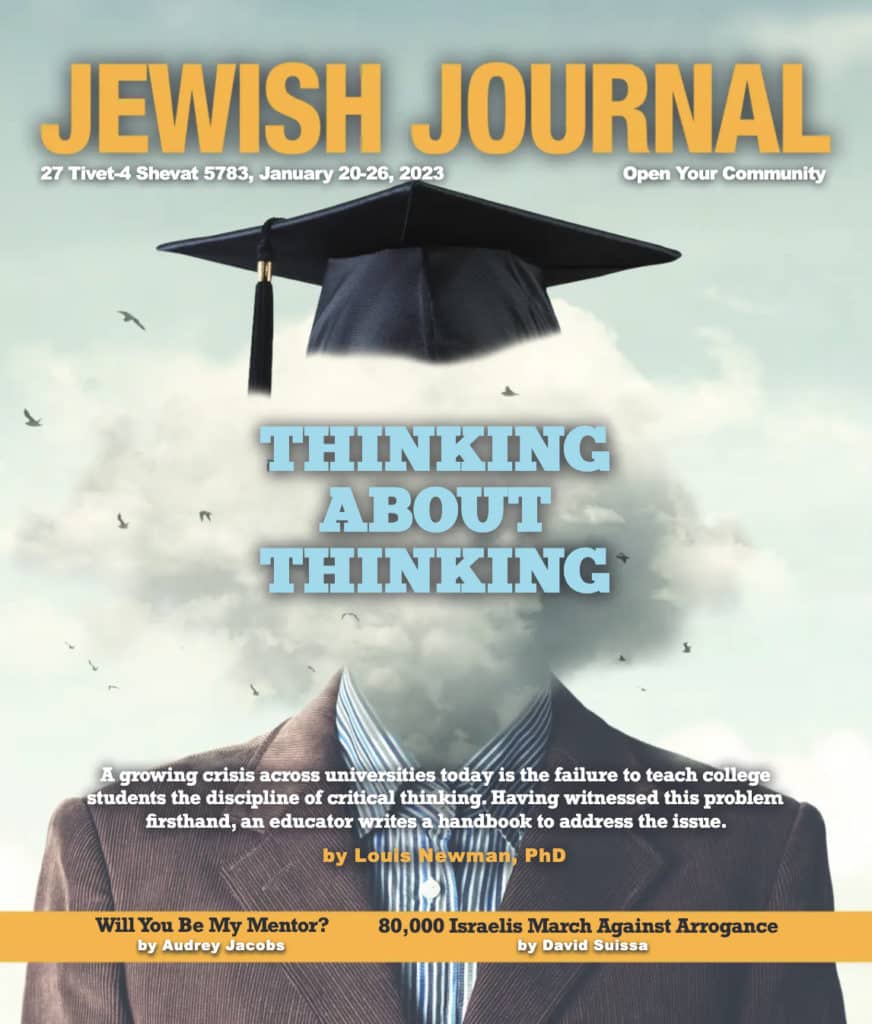
Print Issue: Thinking About Thinking | January 20, 2023

CLICK HERE FOR FULLSCREEN VERSION

Print Issue: Thinking About Thinking | January 20, 2023 Read More »

Can Thinking Make a Comeback?

Human beings are the only species who can think about thinking. Animals can think instinctively to satisfy their appetites, but humans are blessed with the ability to reflect on the very art of reflecting, as I am doing now.

It’s hard to imagine a more urgent time to consider the act of thinking, at a moment when deep thought is decidedly under siege. On social media, we’re encouraged not to think but to react, to peck like little birds at our likes and dislikes. In politics, we’re way past the point of honoring deep thought, hypnotized as we are by the lust to crush our political rivals by any means necessary.

And in academia, that supposed bastion of free thought and open inquiry, we’re encouraged to think only to the extent that our thoughts will conform with the progressive dogma that has hijacked so much of our culture.

“The shaping of campus political rhetoric happens primarily through exclusion and drowning out of different voices,” sophomore Darren Chang wrote in the Cornell Daily Sun as far back as 2018. “Students who bring positions that don’t fit with the primary narrative of liberal progressivism are shouted down and insulted, as if their background and political orientation should be rejected prima facie.

Of course, since Chang wrote that op-ed, things have gotten progressively worse. 

“Thinking for yourself has never been easy, but the question of whether it is still possible at all is of some moment,” philosophy professor Michael Ignatieff wrote this month in a must-read essay in Liberties Journal. “The key ideals of liberal democracy — moral independence and intellectual autonomy — depend on it, and my students will not have much experience of either if they end up living in a culture where all of their political and cultural opinions must express tribal allegiance to one of two partisan alternatives; where they live in communities so segregated by education, class, and race that they never encounter a challenge to their tribe’s received ideas, or in a society where the wells of information are so polluted that pretty well everything they read is ‘fake news.’”

The crux of the problem is that if we use our minds solely to serve an ideology, an ambition or an appetite, there’s really no need to engage in deep thought, especially if that thought may lead to truths that will disrupt the balm of our certitude and introduce that dreaded enemy called doubt. 

The crux of the problem is that if we use our minds solely to serve an ideology, an ambition or an appetite, there’s really no need to engage in deep thought, especially if that thought may lead to truths that will disrupt the balm of our certitude and introduce that dreaded enemy called doubt. 

It’s disheartening to think that human nature may partly explain this aversion to reflection. But Judaism, as we know, calls on us to do the hard work of transcending our natures in favor of higher ideals, such as the search for truth.

That’s why the Jewish community, whether right or left, religious or not, should be particularly concerned with the postmodern assault on the ancient art of thinking. If any act describes our tradition, it would be the act of asking questions, of “turning and turning” ideas in the constant search for deeper truths.

The Jewish community should be particularly concerned with the postmodern assault on the ancient art of thinking. If any act describes our tradition, it would be the act of asking questions, of “turning and turning” ideas in the constant search for deeper truths.

This art of asking questions lies at the heart of “Thinking Critically in College: The Essential Handbook for Student Success,” a new book by Louis Newman and the subject of our cover story this week. 

Newman, longtime Dean of Academic Advising and Associate Vice Provost for Undergraduate Education at Stanford University, takes a nonideological, pragmatic approach to the discipline of critical thinking. Instead of bemoaning issues like groupthink, he prefers to lay out practical advice for cultivating better learning habits, habits that he argues colleges are failing to provide. 

As he writes, “Colleges promise to teach skills that endure long after specific facts fade … [but they] aren’t delivering on that promise. According to a 2019 study from the Society for Human Resource Management, nearly two-thirds of employers surveyed indicated that it was difficult to find college grads with adequate critical thinking skills.” 

The value of Newman’s approach is that he takes critical thinking so seriously that he virtually turns it into a discipline of its own, like a carpentry class with rules and tools.

“All students need explicit instruction in these academic tools of the trade,” he writes. “Students will not become effective learners and rigorous thinkers by osmosis. If faculty aren’t highlighting these habits of mind, students are unlikely to acquire them independently.”

If I were head of a school, Jewish or otherwise, high school or college, I would seriously consider using Newman’s handbook to shape a mandatory class on critical thinking. It would probably be the only instruction these students would ever get on this quintessential human activity that we so often take for granted.

Considering that our thoughts permeate every aspect of our lives, and that the world around us is pushing us further and further away from that activity, it’s hard to think of a more critical class.

Can Thinking Make a Comeback? Read More »

Keep Reading to Your Older Kids

Among my most cherished memories of raising our kids are the incalculable hours I spent reading aloud to them. Not just during the toddler and early childhood years, with endless recitations of Dr. Seuss’s books, Goodnight Moon, and the Berenstain Bears, though I enjoyed those immensely. I kept reading to our four kids till they were as old as twelve. They loved it and so did I.

Reading with them provided time to bond, cuddle, and talk. They grew to love reading as their vocabularies expanded and attention spans grew. We’d sometimes make a bit of theater out of it, with each of us reading the lines of various characters from “Charlotte’s Web,” “Henry and the Clubhouse” or “From the Mixed-Up Files of Mrs. Basil E. Frankweiler.” These books are wonderful classics; try them and see if your kids don’t love them also. We also read plenty of Jewish books, including junior parsha readers as well as novels. As the kids became tweens, we dipped into “Harry Potter,” but without some wizardry, I feared that they’d all have their drivers’ licenses if we read to the end. (We didn’t.) 

When I texted my daughter, Yael, to ask if she had any special memories of those evenings reading together, she replied Yes, absolutely!  

“I remember that you sat on the floor and leaned against my bed and read whatever I wanted you to read to me,” she told me on the phone. “It was soothing, knowing that was how I was going to end my day at bedtime. It wasn’t just about the reading. You were making time for me. I was the priority. I really looked forward to our reading time. I was sad when you had to go out and couldn’t read to me.”  

Yael is now a learning specialist in a private school in Dallas, with a master’s degree in teaching and training in dyslexia language therapy. She encourages parents of her students to read to their children, because “research shows that skill in reading needs to be developed between the ages of five and nine,” she explained. “There is tremendous value in spending time reading to your children. It will encourage their becoming lifelong readers. And unless a kid is a natural reader, having a parent read to them can help them discover the kinds of stories they like.” 

Yael added that for any kids who have language-based learning differences, “reading on their own may not be something they are ever comfortable with, but reading to them is one of the greatest things you can do. Even my eighth-grade students love it when I read stories to them in class.”  

However important I felt it was for me to read to my independent readers “back in the day,” as one of my sons likes to say, I think it’s urgently needed now. Our phones and other digital devices are separating us from one another. Too many kids are going to bed with an iPhone instead of a book. Educators are desperately trying to cope with the disastrous fallout of kids’ much shorter attention spans and spiking anxiety levels, problems that researchers consistently link to kids in isolation, focused on a screen. 

The good news is that these issues can begin to be healed through real face time, when parents and children share the magic of storytelling. This activity can help keep kids feeling attached to you and safe with you just when you might begin to feel them slipping away. Reading with your kids also gives them a chance to ask questions about what they’re reading — or, in fact, about anything at all that might be on their minds when they are relaxed enough to pop out with it. These are golden opportunities to have meaningful conversations with your child.

In a time of high anxiety for so many kids, taking the time to park your phone in another room and park yourself next to your child to read and talk is an investment that will pay huge dividends.

In a time of high anxiety for so many kids, taking the time to park your phone in another room and park yourself next to your child to read and talk is an investment that will pay huge dividends, while creating beautiful memories that you both will always treasure.


Judy Gruen’s most recent book is “The Skeptic and the Rabbi: Falling in Love With Faith.”

Keep Reading to Your Older Kids Read More »