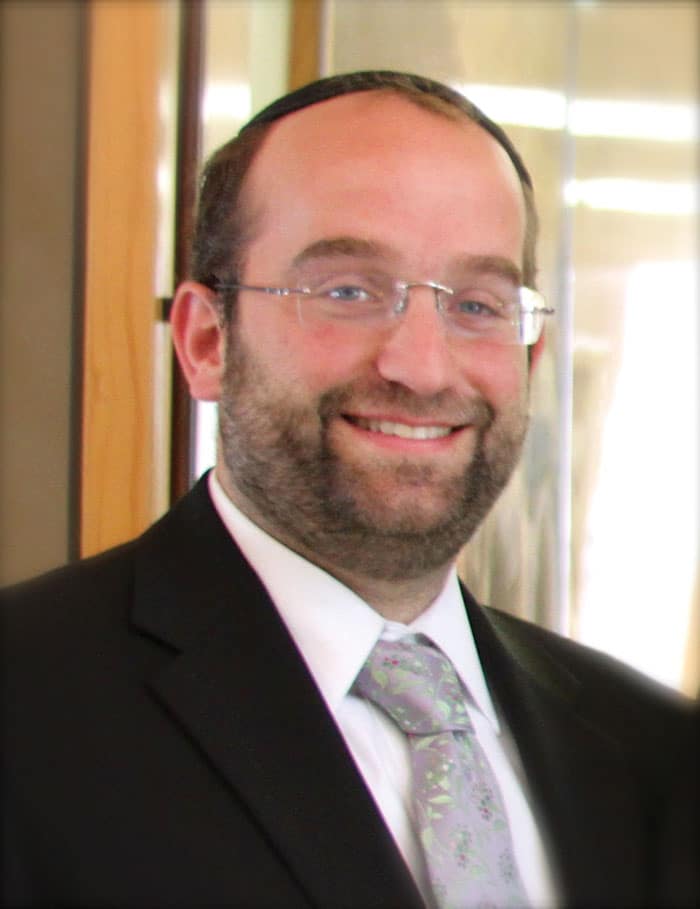
When you speak with Rabbi Shlomo Einhorn, dean of Yavneh Hebrew Academy and rabbi of its congregation, you’re going to hear all about his love of Torah and his strong belief in the Jewish way of life. But you’re also going to get some tidbits you wouldn’t expect from an Orthodox rabbi – like a story about that time he got thrown into the trunk of a car in Abu Dhabi.
“I went to set up important meetings, and the people there wanted to make sure I didn’t see where I was going,” he said. “I didn’t know it was going to happen. I knew it was going to be clandestine, but I didn’t expect it to be that clandestine.”
Einhorn, who received smicha from Yeshiva University and moved back to his native Los Angeles in 2012 to work at Yavneh, is used to trying “crazy things,” as he calls them. He currently holds the world record for the longest ever Torah class given; he taught for 19 hours straight on Lag B’Omer in 2018, touching on out-of-the-box topics like “Was There Ever a Female Chassidic Rebbe?” and “The Grassy Knoll: Great Jewish Conspiracies.”
“Within an Orthodox setting, I try to make my teachings as colorful and inclusive as possible,” he said. “I don’t want anybody feeling that there is one way to do things or one way to live. I want people to find their space easily within what we do in our community.”
“I don’t want anybody feeling that there is one way to do things or one way to live. I want people to find their space easily within what we do in our community.”
Growing up in the Fairfax-Hancock Park area, Einhorn comes from a Modern Orthodox and Hasidic background. His parents were the children of Holocaust survivors, with his mother’s family belonging to the Satmar community. His father’s family emmigrated to France right after the war, settling in St. Louis because, Einhorn said, “It was the most French-sounding city in America.”
In high school, the rabbi, a YULA grad, held leadership positions and wanted to combine that work with his love for Torah. Still, it took him some time to decide to become ordained.
“I was about to become a lawyer,” he said. “I took the LSAT and was ready to go to law school, and my in-laws talked me out of it. They said to follow my passion.”
Along with working at Yavneh, Einhorn was an intern rabbi in Manhattan’s Lincoln Square Synagogue and head rabbi of New York’s West Side Institutional Synagogue, and he helped out at-risk teens one-on-one. These days, he is busy heading the school and congregation, but he still seeks out opportunities to serve the teen population.
Recently, he released the first ever Jewish bible for teens called “The Koren Lev Ladaat Humash,” and he worked on it with Rabbi Lord Jonathan Sacks before he passed away. The book contains Sacks’ translation of the chumash and includes Einhorn’s commentary specifically for teens.
“The end of each section raises questions that teens ask like, ‘How do you prove the existence of God?’” he said. “The types of things that inspire teens are much different than what would inspire someone who has been learning this for 20 years.”
The Jewish teaching Einhorn most resonates with and influences what he does appears in the Torah portion Ki Tavo, where the core and holy notions of trust in God and following God’s commandments and statutes are elucidated.
“Everything we’re doing is because of this notion that God wants us to be filled with joy and kindheartedness,” he said. “God said, I’m not giving you these rules to oppress you or throwing things at you to break you down. I want you to find your bliss.”
The rabbi wants to help others find their bliss as well.
“I try to enable people to see that Judaism is in many ways a lot of fun,” he said. “It’s an enjoyable way of life, and I try to have fun with it.”
Fast Takes with Shlomo Einhorn
JEWISH JOURNAL: Is there a rabbi whose teachings really influence you?
SHLOMO EINHORN: It’s a combination of Rav Hershel Schachter, Rebbe Nachman of Breslov, Rav Abraham Isaac Kook and Rabbi Chaim Kanievsky. I tried this crazy experiment to see if I could live like Rabbi Kanievsky, like sleeping for an hour and a half a night. I was sick within a couple of weeks.
JJ: What do you do for fun?
SE: I study Torah. And I write music.
JJ: What book are you reading right now?
SE: Aside from the Torah books, anything Neil Gaiman.
JJ: What’s your favorite Jewish dish?
SE: Cholent. My wife won the award for best cholent from Chef Katsuji Tanabe from Mexikosher.
JJ: Who is your favorite band?
SE: Queen. They are so over the top. That’s how I give shiurim.