fbpx

November 10, 2021

Table for Five: Vayeitzei

One verse, five voices. Edited by Salvador Litvak, the Accidental Talmudist

And Jacob awakened from his sleep, and he said, “Indeed, the Lord is present in this place, and I did not know it!”

-Gen. 28:16


Rabbi Ilana Grinblat
VP of Community Engagement, Board of Rabbis of Southern California

Simchat Torah is my favorite holiday. I love dancing the hora with the community. Approaching the second Simchat Torah in the pandemic, I faced a dilemma. I wouldn’t feel comfortable returning to synagogue to dance the hora holding hands with people as before, nor did I want to be online again for the holiday. I chose Open Temple’s celebration on the beach, where we danced on the sand socially distanced — on our own but together. Dancing and watching the sun set over the ocean, I experienced Simchat Torah in a new place and in a new way. Rather than being upset and missing how I previously observed, I experienced something entirely novel instead. 

During the pandemic, I’ve attended many services in unusual places. I experienced Open Temple’s Shabbat Services in a kayak on the Venice Canals and on bicycle in Venice. From my backyard, I moderated The Jewish Federation of Greater Los Angeles’ virtual Rosh Hashanah celebration with 20 civic leaders and 105 community members. I spent the High Holidays with Nashuva in Temescal Canyon and Clover Park and did Tashlich on the beach at sunset. 

As Jacob woke up from his dream, I hope that we too someday awaken to a day when the nightmare of this pandemic is behind us. When we do, I hope that — like Jacob — we will have found God in new places and ways, so that we too can say, “God is present in this place, and I did not know it.” 


Rabbi Zach Golden
Der Nister Downtown Jewish Center

While God is everywhere, we call some places sacred – kadosh – holy. What is kadosh, what is holiness? Kadosh is an ancient Hebrew root that means separate – meaning separate from us. Whatever is kadosh, whatever is holy, is God’s possession.

A synagogue, a sacred space, carries the expectation that you are a guest in God’s home. People there often feel compelled to feel and to speak how God would want them to, how they imagine that to be. We willingly go to this place that is not ours, perhaps, because it is also our spiritual home. For a few moments, we can sit with our souls. 

Sometimes it is not clear where we are, and what the rules and expectations are of the place we enter. People need to learn what about themselves fits into their environment. This is as true with a boardroom presentation as it is a party. Are we confident? Are we sociable? If we are confused, it is because those aspects within us are not yet brought to our consciousness. 

The Midrash of Bereishit Rabbah suggests that Jacob did not awaken from his dream; rather, he was transformed. He did not discover where he was – he discovered himself and his spiritual being – and in doing so, gained the capacity to recognize the sacredness of the place. No longer fearing the physical threat of his brother Esau, he saw angels come up and down a cosmic ladder, and learned that he was at home with God.


Rabbi Chanan (Antony) Gordon
Inspirational Speaker 

Rebuilding the Holy Temple one rung at a time. One of the most important epiphanies in the Torah occurs in parshas Vayeitzei when Yaakov awoke from his sleep following a dream in which he saw a ladder reaching to Heaven upon which angels were ascending and descending. Yaakov’s immediate reaction was to say – “Indeed, the L-rd is present in this place, and I did not know it! (Gen 28:16). 

Our Sages teach that “this place” was the physical location that was destined to house the Holy Temple, the physical manifestation of G-d’s presence, the bridge between the physical and spiritual worlds. 

The Commentators explain that the ascending and descending of the angels is a reminder that our connection to Hashem is a two-way relationship. Not only do we beseech Hashem for guidance and assistance, but G-d reciprocates and sends us messengers and messages to help us navigate the most meaningful life path. 

In light of the aforementioned explanation, we can appreciate the reason we mourn the destruction of the Holy Temple and pray for its return. The destruction of the Holy Temple was not only the loss of the symbol of national sovereignty, but also the dismantling of the bridge that had connected our physical plane with the spiritual realm beyond. 

May we all internalize the image shared by Yaakov and each ascend up our unique respective spiritual ladder until we as a nation have the merit to see the restoration of the Holy Temple, soon in our days!


Rabbi Miriam E. Hamrell
Ahavat Torah Congregation

Or Chaim (Morocco 1696-1743) questions the Torah’s Hebrew word “Achen”, meaning indeed or certainly. When Jacob awoke from his dream he became very emotional. Why did he apologize or why was he surprised? What bothered Jacob? He bemoaned “God was here and I did not know it”. Had he been aware of the significance of that holy site he would have surely prepared himself mentally for a divine revelation. Maybe he would have stayed up so he could have been the recipient of God’s message while awake instead of while dreaming. 

Is this a case of “if you snooze you lose”?

In HaKtav VeHaKabalah, Rabbi Yaakov Tzvi Mecklenburg, (German scholar, 19th century) writes that Achen comes to explain that Jacob’s soul, after experiencing the dream, was ready to encompass the Godliness within him. It was as if the gates of Jacob’s soul were Achen and opened to comprehend the glory and majesty of the place. It became clear to him that Achen where he had slept was destined to build the Holy Temple. Realizing that this was the meaning of the dream, he renamed Luz to be known as Beit El, the House of God. 

On a personal note, when I first laid my eyes on the majestic Grand Canyon tears spontaneously were running down my face. I felt like Jacob at Achen. God was present and I did not realize it then. May we all be blessed with experiencing (at least) once in our lifetime the sensation of an “I and Thou moment” of Achen. Amen.


Rabbi/Cantor Eva Robbins
Co-Rabbi, Nvay Shalom & Faculty, AJRCA

There are many kinds of fear and Hebrew has different words to define them: 1. ‘pachad,’ physical fear of being hurt like being chased by an animal; 2. ‘ayom,’ the emotion of threat or dread; 3. ‘chashash,’ a sense of apprehension; and 4. ‘yirah,’ the spiritual fear of G-d experienced as reverence or awe. 

Jacob has just run away from his home after stealing the blessing that his older brother was to receive. His mother tells him that Esau wants to kill him so he must run away. He is sent to family carrying the fear of physical harm, ‘pachad.’ He stops as the darkness enfolds him and must spend the night, alone, in a strange place, probably causing him ‘aimah’ a sense of dread. Using stones as a pillow, he sleeps and dreams of a ladder with ‘malachim,’ angelic messengers of G-d, ascending and descending, while G-d stands over him. 

Upon awakening, he no longer has ‘pachad,’ or ‘aimah,’ he now has ‘yirah,’ awe of holiness and sanctity. He had no sense of reverence at home, yet now, in this place, (‘makom’ is another name for G-d) he has been transformed and so has his fear. We often have fears that influence our view of the world, limiting our choices. If we too can transform them into a sense of awe and reverence, we find we are not alone. Just like with Jacob, G-d has been with us all the time, but we may not have known it. 

Table for Five: Vayeitzei Read More »

A Literary Tribute to Stuart Schoffman

This week we lost a true renaissance man. Stuart Schoffman’s untimely passing at the age of 74 leaves a big void in the Jewish world. Many of us knew Schoffman through the 17 years he spent as a founding editor and columnist for The Jerusalem Report. I remember anxiously waiting for my copy of the Report in the mail (remember those days?), eagerly anticipating Schoffman’s next column. No matter the topic – politics, religion, Israeli society, the Jewish world, literature, poetry or people – Schoffman opened our minds to a deeper understanding of complex issues. He wrote from a deeply educated place, blending his vast and diverse knowledge with a soulful style and charming sense of humor. 

The definition of “renaissance man” is “a person with many talents or areas of knowledge.” Such was the life of Stuart Schoffman.

Born in Brooklyn, New York on December 19, 1947, and educated at Harvard and Yale, Stuart’s professional life spanned the worlds of journalism, film, university teaching, speaking and translating literature.

Before moving to Israel in 1988, he worked as a writer for Fortune and Time magazines, and as an editor at The Los Angeles Herald Examiner. His talent with the pen also took him to Hollywood, where he was a successful screenwriter. He taught history, screenwriting and film at prestigious universities across the United States.

After making aliyah, his columns in The Jerusalem Report, as well as his later articles in The Jewish Review of Books and other publications, made him one of the Jewish world’s most beloved, respected and widely read thinkers. He continued his work in film, writing the script for “Eyes Wide Open,” a documentary exploring the experience of American Jewish visitors to Israel. He served as a consultant to the joint Israeli-Palestinian production of ”Sesame Street,” and taught film at Tel Aviv University and the Sam Spiegel School of Film and Television in Jerusalem.

With all of his talents, Schoffman had one especially deep passion. He fell in love with Zionism’s greatest revolution: the advent of Hebrew as a spoken language. 

With all of his talents, Schoffman had one especially deep passion. He fell in love with Zionism’s greatest revolution: the advent of Hebrew as a spoken language. His cinematic ode to modern Hebrew was writing the script for “The Wordmaker,” an Israeli television drama about Eliezer Ben- Yehuda, Zionism’s “founding father” of modern Israeli Hebrew. 

But his greatest expression of love for modern Hebrew came in the written form, except in this case, his name never had top billing. It was always beneath or alongside an original writer. Meet Stuart Schoffman, translator of Israeli literature par excellence.

A google search of Schoffman’s name presents hundreds of original articles written “by Stuart Schoffman.” An Amazon Books search shows his name listed together with A.B. Yehoshua, Aharon Appelfeld, David Grossman and Meir Shalev, four of modern Israel’s greatest and most complex writers. Schoffman’s critically acclaimed translations into English of nine of their novels and two children’s books display his linguistic talents in English as well as his complete mastery of the Hebrew language. 

“If literature isn’t everything, it’s not worth a single hour of someone’s trouble” said Jean-Paul Sartre. One of society’s prevalent myths and misconceptions is that fiction writers merely tell stories while philosophers tell the truth. In modern Israeli society, writers such as those translated by Schoffman are widely regarded as much more than lyrical artists. Through their novels, they have emerged as Israel’s thinkers, philosophers, political commentators, theological inquirers and moral voices. 

By translating these writers for an English- reading audience, Schoffman did more than provide readers the opportunity to enjoy quality literature from a foreign country. He invited them into the heart and soul of Israeli society, where they could experience Israel in its full gamut of emotions, challenges and complexities. In his translations of Yehoshua, Appelfeld, Grossman and Shalev, Schoffman presented his American readers — especially the Jewish ones who seek a deeper connection to Israel — a literary looking-glass through which they can gain a more intimate relationship with Israeli society.

The Israeli topics explored in the novels translated by Schoffman include the tragic effects of war, the ongoing trauma of the Holocaust, the divisive religious-secular debates, Sephardi identity in a still heavily Ashkenazi society, the dangers of excessive power, and – like in all societies – the human journeys of love, friendship, loneliness and aging. Schoffman wrote columns on many of these issues, and by translating novels that brought them to life through plots and characters, he brought the issues closer to our hearts. Through his columns, he made us think, but through his poetic translations, he invited us to feel.

In Grossman’s children’s book “The Hug,” lovingly translated by Schoffman, a little boy feels lonely until his mother’s hug comforts him. Israel and the Jewish world need a hug. We’ve lost a great voice, one that spoke beautifully, both in the original and in translation.


Rabbi Daniel Bouskila is the International Director of the Sephardic Educational Center and the rabbi of the Westwood Village Synagogue.

A Literary Tribute to Stuart Schoffman Read More »

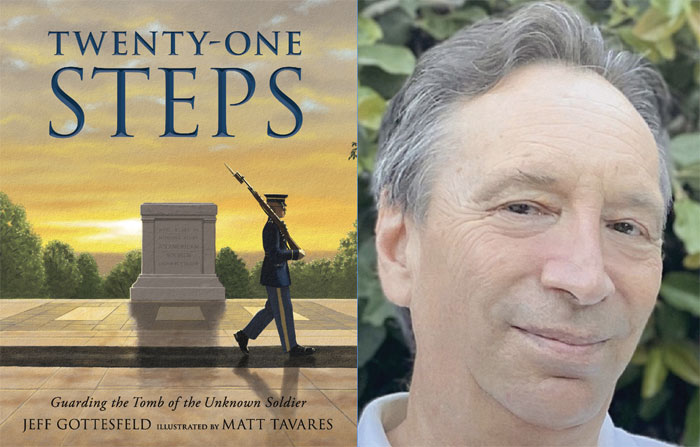
Kids’ Book Tells the Story of the Tomb of the Unknown Soldier

One hundred years ago, on November 11, 1921, after the end of World War I, the first Unknown Soldier was interred at Arlington National Cemetery. Since the site of the white marble memorial provides a stunning view of Washington, D.C., families soon began visiting it and having picnics there, not remembering the meaning behind it.

That all changed at midnight on July 2, 1937, when a soldier began walking in front of the memorial. The soldier took 21 steps down the black mat that was behind the tomb, turned, faced east for 21 seconds, turned and faced north for 21 seconds and then took 21 steps down the mat. The soldier repeated the process over and over again to symbolize the 21-gun salute, which is the highest military honor a member can receive. Since 1937, a soldier has always stood guard, never leaving the Unknown Soldier alone.

In his new kid-lit book, “Twenty-One Steps: Guarding the Tomb of the Unknown Soldier,” author Jeff Gottesfeld explains the 21 steps from the perspective of the Unknown Soldier buried in the tomb.

“The Tomb reminds us that freedom is not free. The Tomb Guards remind us that to strive for perfection means doing better than we ever might have dreamed.” — Jeff Gottesfeld

“The contemplation of sacrifice by others has the potential to bring out the very best in ourselves,” Gottesfeld told the Journal. “The Tomb reminds us that freedom is not free. The Tomb Guards remind us that to strive for perfection means doing better than we ever might have dreamed.”

The author grew up during the Vietnam era and was antagonistic towards the American military. Then, as he got older, he said he started to respect it and wanted to learn more. 

“I came to believe over time that the United States military is one of the greatest forces for good in the history of the planet, and remains so. It’s a big institution with a gigantic history, so like all big institutions it has its problems and dark moments. So do I. In general, though, our armed forces have been and are a blessing to the world.”

Every year, on Memorial Day, Gottesfeld made it a tradition to visit national cemeteries wherever he lived. Now a North Hollywood resident, he was at the Los Angeles National Cemetery on Memorial Day of 2016 when he came across a headstone that said “UNKNOWN.” Then, he saw another.

“I flashed back to a collegiate years visit to the Tomb of the Unknown Soldier, remembered the Tomb Guards and realized how little I knew about each [one],” he said. “And if I knew little, then the average third or fourth grader had to know less. I’m telling you, by the time I left the cemetery that afternoon, I was determined to write this book.”

“Twenty-One Steps” is deeply moving, giving readers the truly devastating story behind the fallen soldiers. It begins, “I am an Unknown. I am one of many. We fell for the last time in the Argonne Forest. At Somme. Belleau Wood. Facedown in trenches, face up on hillsides. We fell a thousand ways. In life, we were our mothers’ sons. In death, we are faded photos on the mantel, empty chairs at Thanksgiving, prayers in the dark before dawn. We are known but to God.”

Gottesfeld envisioned that the soldier was lonely in his grave, until he heard the 21 steps: “Late one half-moon night, I heard footsteps. The sharp click of heels. Silence. Another click. More silence. Twenty-one footsteps. Click. Twenty-one seconds of silence. Click. Twenty-one seconds of silence. Twenty-one more steps. With each step, my war was over.”

Since releasing the book this past February, Gottesfeld, who has written three other kid-lit books including “The Christmas Mitzvah” and “The Tree in the Courtyard,” has read it aloud to second graders through high schoolers and to adults and senior citizens. 

“It resonates,” he said. “No matter the age, people get it on a gut level.”

When people read his book, Gottesfeld wants them to come away with an appreciation for American values and the selfless sacrifices soldiers make.

“I would hope that everyone who reads ‘Twenty-One Steps” — not just kids — will first learn the facts of how the closest thing we have to a national shrine came to be, then why the Tomb Guards are there to protect it and finally considers how the values that the Tomb represents still matter in twenty-first century America,” he said. “Because they do.”

Kids’ Book Tells the Story of the Tomb of the Unknown Soldier Read More »

david suissa shanni suissa podcast

Are Sweat Pants the Biggest Threat to the Jewish Future?

A Boomer and a Millennial go at it– and sparks fly.

In the kickoff episode of Season 4 of the David Suissa Podcast, titled “Conversations with Shanni,” David and his twentysomething daughter wonder why the world seems to be going out of control, and whether sweat pants are the biggest threat to the Jewish future.


Follow David Suissa on FacebookTwitter and Instagram & Shanni Suissa on InstagramTwitter and TikTok


example one
example two
example two

Are Sweat Pants the Biggest Threat to the Jewish Future? Read More »

Murderer of Holocaust Survivor Mireille Knoll Sentenced for Life

A French court sentenced Yacine Mihoub to life in prison for murdering Holocaust survivor Mireille Knoll, 85, in March 2018.

Knoll was stabbed 11 times and partially burned after a fire was set in her apartment. Mihoub, who was Knoll’s neighbor, is alleged to have shouted “Allahu Akbar” while killing her. Mihoub will not be eligible for parole in 22 years. The court concluded that Knoll’s murder was antisemitic because Mihoub believed she had “hidden treasures” since Knoll was Jewish. Additionally, a second man, Alexander Carrimbacus, was sentenced to 15 years in prison for theft with antisemitic intent.

Knoll’s family lauded the court’s sentence as “just.” Jewish groups also praised the verdict.

“Mireille Knoll survived the Holocaust only to die as the victim of violent antisemitism,” Anti-Defamation League CEO Jonathan Greenblatt tweeted. “My thoughts are with her loved ones as the trial comes to an end and the perpetrator is sentenced to life in prison. May her memory forever be a blessing.”

“The murderer of Mireille Knoll, an 85-year-old French Holocaust survivor killed in a brutal antisemitic attack in 2018, has been sentenced to life imprisonment,” the American Jewish Committee tweeted. “Nothing can bring her back, but at the very least justice has been served. Our thoughts are with her family today.”

Dr. Shimon Samuels, Director for International Relations at the Simon Wiesenthal Center, said in a statement, “There should be no reduction of sentences for such a heinous crime. We expect that – taking into account the antisemitic circumstances – this will represent a new step for French jurisprudence. The police and judges now have access to the [International Holocaust Remembrance Alliance] Definition and hate-crime legislation.”

StandWithUs Israel Executive Director Michael Dickson tweeted, “Antisemitism is deadly. May Mireille’s memory be a blessing.”

Murderer of Holocaust Survivor Mireille Knoll Sentenced for Life Read More »

Don’t Put My Salad Dressing on the Side

Being a white woman of a certain age means that people make assumptions. They figure I’m still paying for cable, belong in the slow lane, and when I meet my ladies for lunch, I want my dressing on the side.

“Stereotypes are so wrong!” I feel like shrieking. Not only do I want my salad coated with dressing, I want all the cheese, anchovies and whatever other crunchy bits come with those bland leaves. After all, isn’t it the other ingredients that give a bowl of grains or lettuces pizazz? As you’ve probably already guessed, I never turn down the bread and butter plate either. Why leave hungry?

Like most women of a certain age and class, I’ve had to develop a lifetime strategy around eating. I’ve  had to reconcile the dichotomy between wanting to taste everything delicious in the world and knowing when to stop to maintain a healthy body that I can live with when I look in the mirror. 

Like most women of a certain age and class, I’ve had to develop a lifetime strategy around eating. I’ve  had to reconcile the dichotomy between wanting to taste everything delicious in the world and knowing when to stop to maintain a healthy body that I can live with when I look in the mirror. Unlike most of my friends, I have a very short history of dieting. After trying the chocolate cookie diet at about seven—the one where you go on a hunger strike and eat only cookies—I flirted with hunger pains one other time. 

At about 15, while searching for bargains at Loehmann’s in the Bronx and hoping to squeeze myself into sample sizes, I had a revelation. In the dressing room, I was suddenly seized by stomach pangs and felt so light-headed that I had to stop tossing rejects in a heap on the floor and rest on top of them. When it occurred to me that I was experiencing hunger pains because I had skipped a meal, a bulb lit up in my brain.

I realized that if I skipped meals and focused intently on not eating, I could be thin, fit into all the best clothes, and probably marry well—a fairy tale clearly hatched in the 1950s. Thankfully, my brief flirtation with anorexia ended as soon as my mother served up her perfectly rare roast beef with baked potatoes that weekend. Forget the Jewish mother stereotypes, my modern mother did not push anyone to eat more or less than they wanted. Weight obsession was not one of her hang-ups. She threw herself into eating, cooking, baking, and going to restaurants with abandon. In fact, if there was one place where she would not scrimp, it was food. Only the best passed her lips.

Eating too much was not something that crossed my mind until later in life. Since I was a skinny kid who had to be reminded to eat rather than to stop, I wouldn’t really need a strategy until after my first pregnancy. The one where I gained 60 pounds by keeping a half gallon of full fat chocolate milk nearby at all times. After hiking in the hills with a baby strapped to my chest and skipping meals for six months straight, the weight was finally gone, and in its place was a waistline that I’m still trying to find. 

Later, I went back to my wanton ways in spades. By middle age, I was being paid to eat several meals a day as a cookbook/food writer, until I finally had to quit at about age 50. Time was running out on my excellent metabolism.

That’s when I crafted this strategy for eating well:

  • Never follow a diet. Ever since being sent home from junior high for daring to wear culottes, I have been horrified by following any rules. “Don’t eat more than one slice of bread a day; never eat anything bigger than your hand; chocolate in the house is forbidden; non-fat cheese is a weekend treat, etc.” The story hasn’t changed in 50 years and it’s boring. If these rules worked so well, why do we still need them?
  • Don’t get hung up on weights and measures. Yes, I know that Jean Nidetch, the founder of Weight Watchers, made a fortune by telling people to measure their food and weigh themselves compulsively—and in front of others. But unless you’re an accountant, keeping a little notebook full of numbers is soul-crushing. You know why the poets warn against measuring a life in teaspoonfuls? It is joyless.
  • Think ahead to your next meal, as soon as you finish your current meal. Are there other, more important things to think about? Looking forward to and anticipating what exactly you feel like eating next is an important part of being human. It’s not just raw meat, raw  meat, raw meat with a chaser of dry grass day after the day for us anymore. Want turmeric sea bass with lemongrass confit for lunch? Go for it!
  • Always search out the best. This is the pure nugget that came from my mom. Or as a chef once explained, “When it comes to eating, every bite should be delicious.” Since we eat about  80,000 meals in a lifetime, why not make the effort to make each bite good? Sounds like more fun than weighing out your next portion of steamed broccoli, right?

In these post-COVID days, when a woman or man of a certain age may be carrying some extra weight, I recommend easing off on the self-imposed deprivations. This is not the time. Try eating whatever delights, in moderate portions, surrounded by good friends and family. And please, dress the salad!


Los Angeles food writer Helene Siegel is the author of 40 cookbooks, including the “Totally Cookbook” series and “Pure Chocolate.” She runs the Pastry Session blog. During COVID-19, she shared Sunday morning baking lessons over Zoom with her granddaughter, eight-year-old Piper of Austin, Texas.

Don’t Put My Salad Dressing on the Side Read More »

Alon Wald: In Pursuit of His Heroic Father Since the Six-Day War

Alon Wald was 10 months old in June 1967 when the Six-Day War started — and ended. It permanently configured his life journey. Hours after multiple Arab armies invaded Jerusalem, Rami Wald, 32, the father he would never know, responded to an emergency call for military help. Shortly afterward, pierced by three enemy bullets, Rami was killed.

“I was actually born into a story,” the now 55-year-old Alon told the Journal during a visit to Los Angeles to address the Jewish National Fund-USA Women for Israel. “The story became the central mission of my life. I did not have a father. He fell while liberating Jerusalem. He was one of the patriots who paved the way into Ammunition Hill, which eventually became the pivotal battle that led our nation to reunite Jerusalem.”

In advance of Veterans Day, JNF-USA Women for Israel hosted a reception commemorating the reunification of Jerusalem and the 55th anniversary of the Six-Day War, its first in-person event in 18 months. Ammunition Hill honors Jewish men and women who have served or currently serve in their country’s militaries around the globe (including the U.S.) through an initiative called the Wall of Honor. Fifteen years ago, JNF recruited Alon to join the Ammunition Hill Heritage Center and Museum it sponsors. It’s Jerusalem’s No. 1 memorial, attracting 500,000 visitors annually.

“He was one of the patriots who paved the way into Ammunition Hill, which eventually became the pivotal battle that led our nation to reunite Jerusalem.”
— Alon Wald

Alon has led an accomplished life. As a major and a commanding officer of an elite IDF paratroopers unit, he established the Maglan unit, a special forces group that operates deep in enemy territory. He was recruited by Israel’s Secret Service, oversaw the security personnel of Israel’s embassies in Cairo and Vienna and was an air marshal for El Al Airlines. 

“I felt that my father was with me all the time, pushing and supporting me,” Alon said.

Alon recalled that when he was five years old and starting school, he ran in the trenches “of this amazing battlefield, without realizing I am part of an epic story, Ammunition Hill.”

He continued, “I was angry with my father, because I was told volunteers had to go to war. My father was a reservist. He had been told before the war he had done enough. I wanted answers since I was the only kid in class who had no father. I was curious.”

Alon showed his JNF audience pictures of two of his three daughters atop Mt. Kilimanjaro, which his father once conquered. “I did not mourn my father, but I wanted to know him,” he said. “I wanted to know my part in this journey.”

After the war ended and Jerusalem was reunited, Rami’s fellow soldiers stepped in to look after Alon. “They literally adopted all the orphans of Ammunition Hill and the campaign over Jerusalem,” said Alon. “They became my fathers, my uncles, my older brothers. But they did not ask for titles.”

“I did not mourn my father, but I wanted to know him. I wanted to know my part in this journey.”
— Alon Wald

While his widowed Russian immigrant mother Givat, now 81 years old, lovingly guarded young Alon, “I wanted to know my father through his comrades-in-arms,” he said. “These guys escorted me all over my life. At Ammunition Hill, the cemetery, at elementary school when you needed to bring your father to talk about his amazing career. I had 10 options to bring every year. Bar mitzvah, getting married, going into the army, [when] my wife gave birth to our first daughter — somebody always was there — filling the gap my father left. I can tell you today proudly that I know my father – much better than kids who have a father they take for granted.”

With an historian’s eye, Alon said, “the story of my life is the story of Ammunition Hill, a place that started in a bloody battle, a place that was literally bleeding for the first four years after the war. For 40 years, [Ammunition Hill leaders] spoke of death and sacrifice in the battlefield. We changed everything when we came in.” 

Wartime was only 1% of the soldiers’ lives, Wald said, and “we wanted to share the other 99% of our fathers’ lives because people need to be inspired at Ammunition Hill.”

Alon Wald: In Pursuit of His Heroic Father Since the Six-Day War Read More »

AJU Board Leader Virginia Maas Honored for Lifetime of Service to the Community

Virginia Maas, the immediate past chair of the American Jewish University (AJU) Board, was honored at the university’s annual Gala, held at the Beverly Hilton October 28th. If the impact a leader had in their community can be measured by the amount of gratitude shown when they step down, Maas left a deep impression.

For over 45 years, Maas has been a  pillar of positivity and a staunch advocate of investing in the next generation. Before getting actively involved with the AJU in 1986 (then known as University of Judaism), she had been a past president of Temple Beth Am, a past president of the Westside Jewish Community Center and three-time past president of the Beverly Hills school board.

“She paved the way for the rest of the women [and] she created an atmosphere where there’s such inclusiveness and diversity on their board.” — Debbi Kaner Goldich

“Virginia is very smart,” said Debbi Kaner Goldich, current vice-chair of the Ziegler School of Rabbinic Studies Board of Advisors and president of the Women’s League for Conservative Judaism. “At a time when many women were not serving on boards and not as chairs of very important universities and specialty universities, Virginia was the chair of the Ziegler School of Rabbinic Studies and soon after, the chair of AJU. She paved the way for the rest of the women [and] she created an atmosphere where there’s such inclusiveness and diversity on their board.

“She listens, she comments and never makes anyone feel that their comments were unimportant or insignificant,” Kaner Goldich said. “She doesn’t speak often. She’s one of those people that when she speaks, you listen, because you know she has something important to say. She doesn’t speak for the sake of speaking.”

Maas spoke briefly, and used her time to commend AJU’s staff, students and supporters. She thanked them for their confidence in her. No boasting of numbers, awards or superlatives—just pure adoration for an institution she believes in.

“My role as chair of the board of the AJU has been the most meaningful position I have held in all my years in leadership in the Jewish community,” Maas said.

Maas also led AJU’s Academic Affairs Committee, and had leadership roles on the Miller Introduction to Judaism Advisory Board, Whizin Center for Continuing Education Advisory Board, Patrons Society and School for Jewish Education and Leadership Advisory Board. And was elected chair of the AJU Board of Directors in 2016.

One of the major changes that occurred during Maas’ time at AJU  was the “sunsetting” of the school’s undergraduate program in 2018. For any university, this is a colossal change. The speciality schools within AJU remain both active and influential. But Maas and her husband Frank went above and beyond in investing in the future of the university.

In early 2020, The Maas Center for Jewish Journeys was established with a generous gift from the couple as a way to, “inspire and support thousands as they explore their Jewish faith,” the Center’s mission states. Ultimately, the Center unified several programs within the AJU. One of the programs, Miller Introduction to Judaism, converts more people than any other program in the United States. According to AJU, the Maas Center has already reached 18,000 Jewish learners in its first two years. 

The speakers were effusive in their praise for Maas. Catherine Schneider, AJU’s Chief Development Officer, called Maas “the real Wonder Woman,” adding that “Israel has Gal Gadot, but we have Virginia Maas.” Jeff Herbst, AJU’s President since 2018, remembered Maas fondly. “I’ll be forever grateful that I had Virginia as a partner. She allowed us to embark on a new path and create a new type of university to seek to meet North American Jewry where it is today.” Harold Masor, who is succeeding Maas as the chair of AJU’s board, “Beyond what Virginia has done for AJU and the Jewish community, she is a dear friend, trusted colleague, and a gracious mentor…Now as I step in to fill Virginia’s very large shoes, I look forward to continuing the path of growth and diversification of our board that Virginia set in motion.”

When asked what advice she had for future leaders, Maas paused, looked around at the several hundred attendees and began to reflect. 

“You have to be passionate about your involvement,” she said. “I think you do have to want to make a difference, whether it’s small or large. You don’t have to be a chair of the board [and] you don’t have to be a president of an organization. You just have to want to do good.”

AJU Board Leader Virginia Maas Honored for Lifetime of Service to the Community Read More »

Fish to Fry

The Bondi Fish House on Campbell Parade in Bondi Beach has been selling the best fish and chips for longer than I can remember. In February 2020, when I was lucky enough to find myself in Sydney, Australia for my cousin Ari’s wedding, that was my first stop. Happily clutching my package of beer battered fried cod and chips, lemon wedges, malt vinegar and tomato sauce (Australian for ketchup), I crossed the road to the grass above the beach. I found a picnic table with a breathtaking view of the southern Pacific Ocean. I sat there, watching the surfers, the swimmers and the sunbathers enjoying a late summer day at the beach.

I unwrapped the butcher paper package and inhaled the fabulous smell. Fending off a few voracious (and chutzpahdik) seagulls, I dug into the perfection of the light crispy and flaky white cod. The creamy chips (French fries) just added to the bliss. 

There are fish and chip shops everywhere in Sydney, especially at the many beaches along the pristine coastline and the little bays that dot the beautiful world-famous harbor. From Doyle’s in Watson’s Bay to the ones Rose Bay and Double Bay, these shops were the purveyors of the happiest food memories in my childhood. To this day, whenever I am at the beach, I crave fish and chips. Needless to say, we are frequent customers at the Fish Grill on Pacific Coast Highway in Malibu.

I discovered that this quintessentially British food was actually Sephardic in origin. The fish recipe was brought from the Mediterranean world by the Spanish and Portuguese Jews who settled in England in the 17th century. 

Later in life, I discovered that this quintessentially British food was actually Sephardic in origin. The fish recipe was brought from the Mediterranean world by the Spanish and Portuguese Jews who settled in England in the 17th century. The flour and water battered fish was known as ‘Pescado frito.’ In England it was referred to as “fish cooked in the Jewish manner.”

Enterprising Jews would sell the cold cooked fish from trays with leather straps hanging over their shoulders. Somewhere along the way, fried potatoes were added to the menu and beer was added to the batter. Around 1860, Joseph Malin opened the first fish and chip shop in London. An iconic British food was born and the rest is history. 

— Sharon

Fried fish is very common in the Moroccan kitchen. For lunch, my mother would serve cold fried fish topped with a sauce made from fresh herbs, garlic, paprika and vinegar. When my children were younger, I would fry fish all the time and they loved it. Now that the children aren’t home as much and Neil and I are trying to be more health-conscious, I don’t make it so often. It’s a special treat when I do. 

Neil enjoys his fish with creamy Agristada Sauce, a recipe from pre-Inquisition Spain. Similar to a béchamel sauce, this non-dairy sauce includes lemon, eggs, flour and oil.

In Spain, the ‘pescado’ was fried in olive oil, but in Turkey, the olive oil was too expensive, so they fried their fish in sunflower oil. That’s exactly what Sharon and I used to fry up our delicious cod. We serve our fish with a dill mayonnaise and an amba aioli. 

Rachel

Fried Fish Recipe

2 pounds cod, seabass, sole or halibut,
fillets, cut into pieces
1 teaspoon kosher salt
¼ teaspoon freshly ground black pepper
1 teaspoon garlic powder
2 large eggs
1 cup flour
Sunflower oil for frying
2 small carrot sticks

  • Wash the fish fillets, arrange on a plate and pat dry with paper towel.
  • Sprinkle with salt, pepper and garlic powder.
  • In a small bowl, whisk the eggs, then set aside.
  • Dredge each fish fillet in flour, coating all sides.
  • Dip fillets into the egg and create a light batter.
  • Preheat the oil in a large skillet over medium-high heat. Add the carrots to prevent the oil from burning.
  • Working in small batches, slip the fish into the hot oil. Fry, turning once, until golden and crisp, about 4-5 minutes. Transfer to a tray lined with a brown paper bag to absorb excess oil.
  • Keep in a warm place until serving
  • Best when served piping hot with sauce of your choice.

Rachel Sheff and Sharon Gomperts have been friends since high school. They love cooking and sharing recipes. They have collaborated on Sephardic Educational Center projects and com munity cooking classes. Find recipe video clips and recipes on Instagram SEPHARDIC SPICE GIRLS and Facebook SEPHARDIC SPICE SEC FOOD.

Fish to Fry Read More »

“When the Budget Passes, Bibi Goes.” Really?

It is difficult to know what is going through the mind of a former prime minister who is expected to spend many more days as opposition leader, and perhaps as many as a defendant in a trial. Maybe Benjamin Netanyahu is looking for a way out. Maybe he’s considering retirement. Maybe. His speech in the Knesset last week, when the government passed the budget and ensured its survivability for at least another year, certainly did not look like that. But there can always be surprises. Either way, it seems that leaders in the coalition are building on a scenario that will rid Israel of Netanyahu’s long shadow. Either he will resign voluntarily, or a great revolt within the Likud party will finally materialize. 

Is Netanyahu finally on the way down? We will leave the prediction, or prophecy, to others, and concentrate on a few numbers—the numbers that work against Netanyahu, and those he can look at with hope: 3, 59, 35, 8. 

The Number 3

The budget is a done deal. The coalition remains intact. But for how long? That’s the important question. If we are talking about another half year, or a year, the members of Likud can stand it. If, on the other hand, the coalition is about to last much longer—say, three years—well, that is a long time. A long time in the opposition for a party that isn’t used to being in the opposition. A long time to ponder the question of what would have happened had Netanyahu not been the head of Likud but rather someone else. 

Some Likud members believe that the budget is not securing the government, but rather the beginning of its end. Until now it had a clear, shared target: the budget. Now, the infighting begins. Members of Likud hope that the government will disintegrate before Yair Lapid is slated to replace Naftali Bennett as Prime Minister. Netanyahu must make sure that such hope is preserved, to keep his party unified. 

The Number 59

This is the maximum number of seats the Likud and its partners have received in the last two months of polls. In most polls the right-religious bloc of parties gets less than this number. Namely, less that close to the necessary number of 61. 

What parties are in the bloc? The parties that are willing to sit with Netanyahu in a coalition: Likud, Religious Zionism, and the two ultra-Orthodox parties, Shas and United Torah Judaism. If this bloc is Netanyahu’s only option, he currently has no viable option to form a government. Not even according to the most flattering public opinion polls. Last week, in the Knesset, Netanyahu spoke about the “dissatisfied masses.” Indeed, there are such masses. But there are even more masses who do not want their representatives to sit under Netanyahu. Netanyahu, in his well-crafted speech, mocked Bennett’s disappearing projected seats. Certainly Bennett does seem to gain support for his party. He was made the PM with six seats in parliament, and still gets a similar, or lower, number of seats in the polls. But Netanyahu also has a ceiling that he does not break—the ceiling erected by the other bloc, the non-Bibi bloc. 

What is Netanyahu’s problem? The more than one coalition that the Likud could form without Netanyahu. A coalition with Yamina (Bennett), and a coalition with Yamina and Blue and White (Gantz). There are several more options, if and when Netanyahu vacates his seat as head of Likud. 

The Number 35

Look at the Likud’s seat graph (below). These are the number of seats the Likud party gets in the polls conducted since the last election. The graph speaks for itself. Netanyahu may not have a coalition, but he is gaining more and more voters. And if he has voters, those who hope for his quick removal have a problem. It is far from clear that they could garner support for such a move within the party. It is far from clear that they could have the support for such a move of party voters. As long as Netanyahu and the Likud are gaining seats, the dream of the sixty-one-seat coalition option is also alive and possibly within reach. Maybe there is no feasibility of a coalition yet, but if the graph continues to climb the way it did in the last few months, at the end there could be such feasibility. In short, the fact that the Likud is not losing but rather gaining seats will make it very difficult for Netanyahu’s opponents who want to challenge him.

The Number 8

This is our last number, and it is another one that speaks volumes about internal dynamics among Likud voters. The data-journalism website themadad.com has a constantly updated feature that measures the level of trust in the PM, government ministers, and also the head of opposition, Netanyahu. A few days ago, I asked my colleague, Noah Slepkov, to isolate the ranking of Likud voters. The rating is from 0 to 10, and Netanyahu’s overall score is quite low: 4.29. 

Why so low? Because all the voters who oppose him have very low trust in him. Labor voters rate their trust in him 1.7. New Hope voters put him at 2.6. But what about Likud voters? Have they lost faith in him? The leaders of Likud may grumble about him, and wait impatiently for him to move on, but not Likud voters. Their trust in him is at 8.5. This is much more than what they give any other leader. This is more than most voters of most other parties give their own leaders. Simply: it is difficult to identify any erosion in Netanyahu’s standings among his voters, and as long as these are the numbers, it is difficult to see Netanyahu go involuntarily. Bennett can still hope (he projected such an outcome in his own Knesset speech) that after the budget (of him) comes the fall (of Bibi). But for now this seems more like a wish than anything resembling a certainty.

Something I wrote in Hebrew

The Attorney General Mandelblit forced the Finance Minister Lieberman to accept that Charedi Rabbinic students will keep getting subsidies for the children’s schooling—because they study a “profession.” Here’s what I wrote:

Lieberman is materially right. Mandelblit is legally right. The representatives of the ultra-Orthodox parties, and their supporters in the opposition as well as some in the coalition, are well aware of this gap, and know how to use it to their advantage. What they do is completely legitimate. They believe that it is more important to preserve the world of Torah, to enlarge it, than to send students to do real work (that is, work that isn’t about being a rabbi). This is a debate on national priorities. It is an important and legitimate debate. The ultra-Orthodox lose this debate in public opinion but often win it in actual policies. 

A week’s numbers

A reader’s response

Dan Morenoff responded to the U.S. Jerusalem consulate article from last week:

“This one [is an issue] where the [Israeli] government has the only say: they don’t have to convince anyone else. It’s their prerogative (and supported by a broad, national consensus).”


Shmuel Rosner is senior political editor. For more analysis of Israeli and international politics, visit Rosner’s Domain at jewishjournal.com/rosnersdomain.

“When the Budget Passes, Bibi Goes.” Really? Read More »