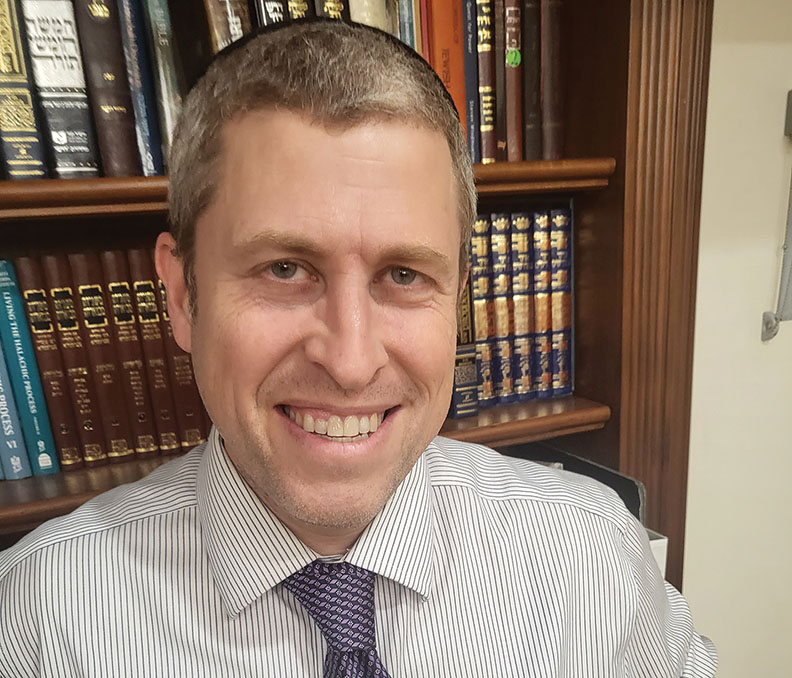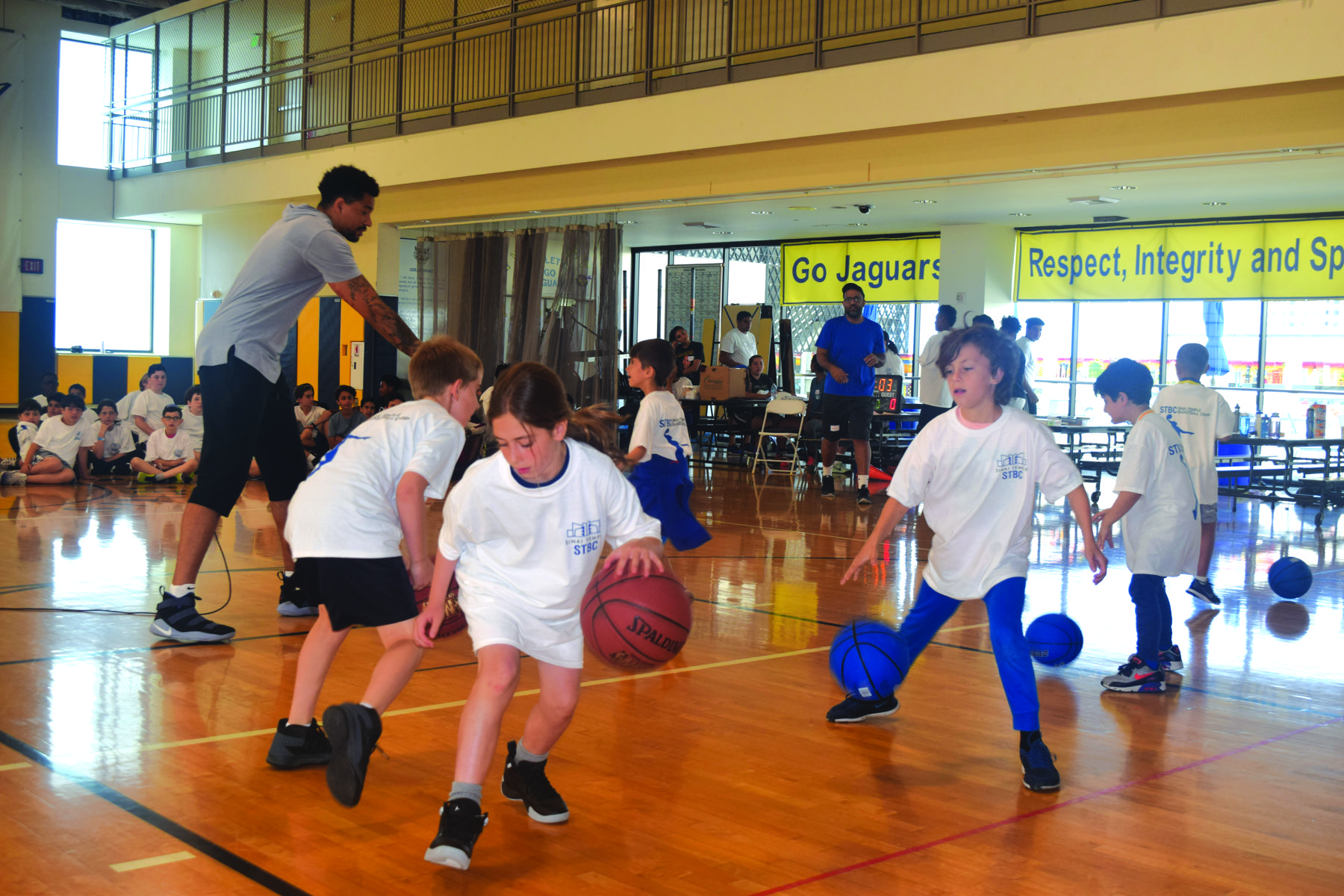
You won’t find a bigger basketball fan than Rabbi Erez Sherman of Sinai Temple. Growing up in Syracuse, N.Y., and watching the likes of Carmelo Anthony play, “basketball and religion were sometimes on par,” he said. In fact, activities at the local synagogue where his father was also a rabbi were planned around the Syracuse University basketball schedule, and not just because one of the coaches was a synagogue member.
Sherman also played high school hoops. “And then I had a brother who passed away last year,” he added. “He was a quadriplegic. What basketball did for our family in terms of bringing us together and entertainment and giving us purpose is really an amazing thing.”
So when Sherman became aware several years back that many Sinai kids were going to various basketball summer camps in and around West Los Angeles while the gymnasium at the synagogue sat empty, he had an epiphany: Why not start a camp? But not just another basketball camp, rather one that had high-quality basketball instruction and a “Jewish slant.”
Three years ago, he and religious school director Danielle Kassin started Sinai Temple Basketball Camp (STBC). Thirty campers enrolled in the weeklong day camp. Since then, the camp, which is open to anyone, has expanded to three separate weeklong sessions for kids in grades 2 through 8. (For families still looking for summer activities, spots remain in both the second and third sessions.)
Some campers are ballers already. Others are beginners. Eighty kids attended the first session this summer, including a handful of “Littles” from Jewish Big Brothers Big Sisters of Los Angeles, for whom all fees are waived.
Sessions begin with all campers collaborating on their own 10 commandments for the week. Examples include: “Share/pass the ball” and “Great players don’t brag!” On Fridays, the campers make challah. At every session, Sherman brings in elite players who are Jewish or have connections to Israel, players such as David Blue, Terrence Roberts and Talia Caldwell.
“Israel has one of the best leagues outside of the NBA,” Sherman said.
Perhaps the thing that distinguishes STBC from other basketball camps is the prominent social activism component, including a book collection for Bienvenidos, an agency that works with at-risk children, a food drive for SOVA, the Jewish Family Service food pantry, a card-writing campaign for residents of an assisted living facility nearby, and this year, a collaboration with KEEN (Kids Enjoy Exercise Now) Los Angeles, which serves a diverse group of young people with a range of disabilities.
“Early on, people would ask me, ‘You’re a rabbi. Why are you spending all your day on a basketball court?’ I said, ‘I am engaging with more of our congregants through basketball, having these conversations about God, Shabbat, illness, everything.’ ” — Rabbi Erez Sherman
For the last two years, Sherman has run a basketball clinic for KEEN athletes twice a month on Sunday afternoons at the temple. This year, he decided to bring STBC and KEEN together. And so, for a couple of hours on the third morning of the camp, the director of KEEN trained the eighth-grade STBC campers how to run a special needs basketball clinic. The next day, seven KEEN campers joined STBC, including one who is blind and another who has cerebral palsy and uses a wheelchair.
Sherman admits that initially there was some hesitancy on the part of both groups, but it didn’t take long for everyone to get past that. “I watched a kid who would usually cry if he lost a game,” he said. “Instead, he went over to his special needs friend.”
Sherman hopes to continue the collaboration with KEEN at the remaining two camp sessions.
Since STBC is a basketball camp, campers do lots of conditioning and drills and scrimmages. Sherman is not the coach. That job belongs to Jelani Bandele, but Sherman is often out there, on the sidelines, or playing ball with the kids.
“It’s just really cool to see him on the bimah one day and on the court another,” said Levy Shaked, 13, a student at Sinai Temple’s Alice and Nahum Lainer Day School. “It defies the stereotype of a rabbi.”
“Early on, people would ask me, ‘You’re a rabbi. Why are you spending all your day on a basketball court?’ ” Sherman said. “I said, I am engaging with more of our congregants through basketball, having these conversations about God, Shabbat, illness, everything. If I was sitting at my desk, I would not see these people.
“STBC has lit a spark in our synagogue community,” he continued, “demonstrating that one can play high-level basketball within a system of Jewish values and not sacrifice either one.”