Wilshire Boulevard’s stature as the grand concourse of Los Angeles is due in part to its many architecturally distinct synagogues and churches. Those located in the Wilshire Center district, between LaFayette Park and about Western Avenue, are some of the most notable and serve some of the city’s oldest congregations.
The boulevard in the 1920s was the natural place for the institutions and their members to relocate. They saw that, in the future, downtown’s narrow, congested streets would no longer be the center of the community. Los Angeles was turning into a driving city, and Wilshire became the nation’s first Automobile Age thoroughfare. Religious establishments that wished to be part of the exciting future moved to Wilshire Boulevard.
On the boulevard of big dreams they constructed edifices on a grand scale to suit the surroundings. It was in the same era that architects gave Los Angeles proud, new symbols of aspiration, such as the marvelous City Hall and the museum-quality Bullock’s Wilshire department store. The new houses of worship also aspired to greatness. Their membership typically numbered in the thousands, and the pews were filled with mayors, judges, publishers and other movers.
Congregations didn’t need to advertise their addresses, just the corners: Wilshire at Berendo Street for Immanuel Presbyterian, Wilshire at Harvard Boulevard for St. Basil’s Catholic Church, Wilshire at St. Andrews Place for St. James Episcopal. They formed a community that crossed denomination lines. During the years around World War II, the Christian churches joined for an annual procession on Easter Sunday. At the conclusion of services, worshippers would jam the sidewalks to watch cars promenade along Wilshire.
Neighbors took care of one another. The congregation at Wilshire Boulevard Temple welcomed offers to hold High Holy Days services in the larger sanctuary at Immanuel Presbyterian, a few blocks to the east. The temple also held services inside the gorgeous Wilshire Christian Church, built at Normandie Avenue on land donated by the Chapman family, for whom Chapman University is named.
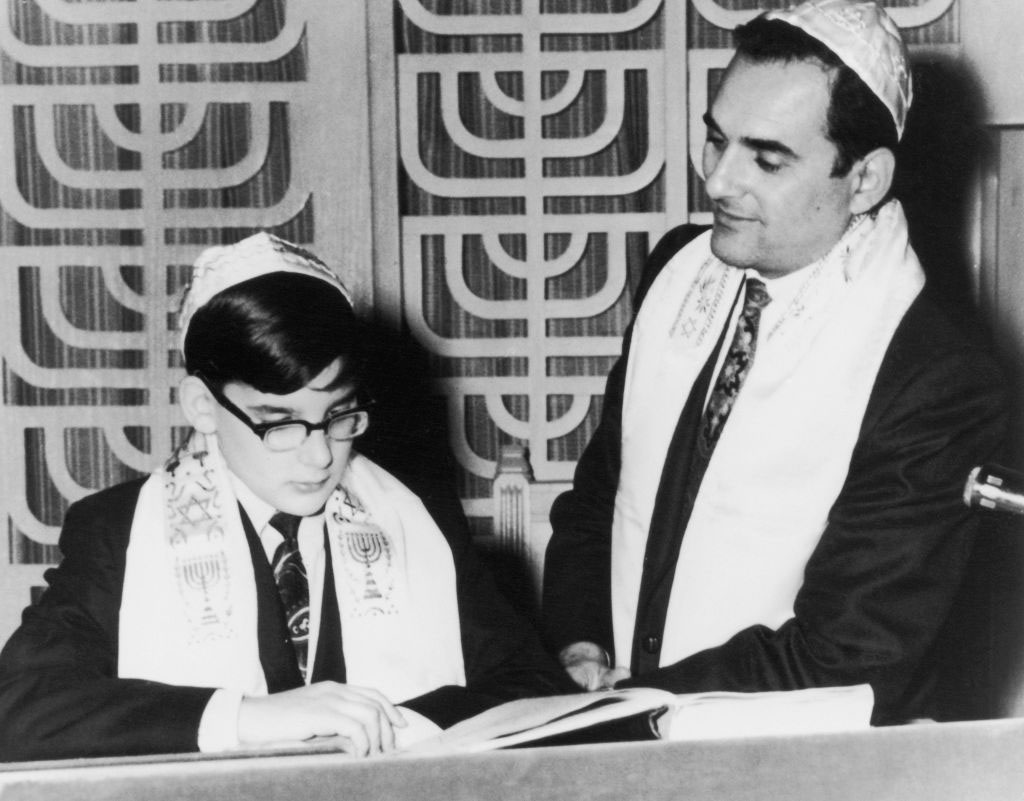
Likewise, when the original St. Basil’s burned down, Wilshire Boulevard Temple invited parishioners to worship in its sanctuary until a new Catholic church was finished. At the dedication of new St. Basil’s in 1969, Rabbi Edgar F. Magnin sat as an honored guest at Mass alongside John Francis Cardinal McIntyre.
Congregation B’nai B’rith had been the leading downtown synagogue at the time its members voted to relocate at Wilshire and Hobart boulevards. The new Wilshire Boulevard Temple served some of the city’s most respected and influential Jews.
At the dedication in 1929, banker Marco Hellman presented the ark, and Jack Warner, one of the studio-owning Warner brothers, bestowed colorful murals depicting the history of the Hebrew people painted by Hugo Ballin. The artist, whose work also decorates Griffith Observatory in Los Angeles and the lobby of the Los Angeles Times Building, painted on canvas in his Santa Monica studio, then mounted the murals around the 100-foot-high, mosaic-inlaid dome in the octagonal sanctuary.
Placing such prominent artwork in the synagogue was not typical of the time. But Rabbi Magnin hoped it would add warmth and an element of mysticism to the surroundings. The temple’s architecture by David Allison and Abraham Edelman is regarded as a work of art in itself. With Italian and Belgian marble, carved mahogany and inlaid gold, it is the only Wilshire Center religious home listed on the National Register of Historic Places.
Allison was the Wilshire architect of choice in the 1920s. He is credited with designing the cathedral-like First Congregational Church on Commonwealth Street, across from LaFayette Park, the similarly regal Wilshire United Methodist near Windsor Square and the imposing First Baptist Church off the boulevard behind Bullock’s Wilshire. Allison also contributed the design for several of the original Italianate buildings at UCLA, including the stunning Royce Hall.
Like Wilshire Boulevard Temple, Immanuel Presbyterian opened in 1929. The acquisition of the land five years earlier had stirred up controversy among the members. Some opposed the idea of giving up the prestige of being downtown to start over as a country church. Today, Immanuel Presbyterian is the most Gothic-looking structure found along Wilshire, dark and brooding with a soaring bell tower and windows by the historic Judson Studios and Dixon Art Glass Co. Gothic chandeliers hang inside the massive sanctuary, capable of seating 2,000 worshippers.
These days, the congregations in mid-Wilshire are not as large as at the district’s peak. But their establishments all stand as important monuments to the dreamers who saw where Los Angeles was headed and knew how to get there.
Adapted from “Wilshire Boulevard” by Kevin Roderick, to be published next year.