

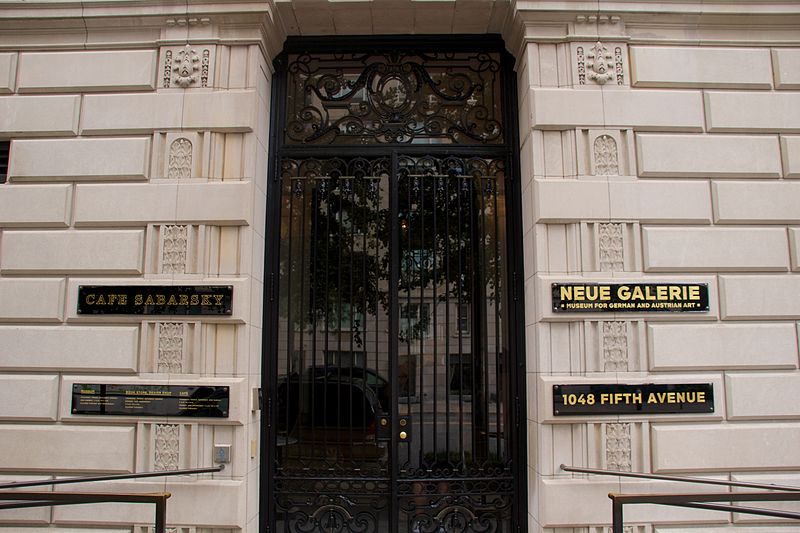
Walking around the Neue Galerie on Fifth Avenue, one cannot help but notice the purity of art that doesn’t feel obligated to have a “message” in order to be relevant. It is a freedom we have largely lost today.
The Neue Galerie, which is actually more of a museum than a gallery, houses businessman, philanthropist and World Jewish Congress President Ronald Lauder’s stunning collection of early 20th-century German and Austrian art. The landmark building, completed in 1914, was once the home of society doyenne Grace Vanderbilt.
The current exhibition, “The Luxury of Beauty,” presents a major retrospective of the Wiener Werkstätte (Vienna Workshops): a collection of artists and craftsmen that produced artisanal furniture and homewares in Vienna from 1903 until 1932. The Werkstätte’s historical significance cannot be overstated: It essentially transformed the realm of design.
Founded by painter Koloman Moser, architect and designer Josef Hoffmann and Fritz Waerndorfer, a Jewish textile magnate who provided the funding and management, the Werkstätte had a single, fairly ambitious intent: the beautification of everyday life. Their goal was to elevate everyday objects to the stature of art, and for that art to reach the broadest possible audience. The Werkstätte was the first to create and implement a democracy of beauty.
Author Hermann Broch called fin de siècle Vienna “a joyful apocalypse,” in which an old order was crumbling and a new, uncertain one was emerging. As a result of the Vienna Secession, an avant-garde movement that began in 1897, part of that new order was a desire to unify art and design, to eliminate the distinction between fine and applied arts — to counter the impersonal character and low quality of goods made by industrial means. An elevation of design, the Secessionists believed, would elevate lives.
With more than 400 objects in four rooms, the Neue Galerie’s exhibition surveys the entirety of the Werkstätte’s extensive output in a variety of media — ceramics, drawings, fashion, furniture, glass, graphic design, jewelry, metalwork, textiles and wallpaper. Guided by the genius of Hoffmann and Moser, many of the pieces hit what I consider the sweet spot of design; they feel simultaneously innovative and timeless, modern and classic. They touch the soul of beauty.
Consider, for instance, Hoffmann’s exquisite glassware. The simple lines belie a sensuality that remind me of a quote from Goethe: “The soul that sees beauty may sometimes walk alone.” Fortunately, many of Hoffmann’s glass pieces are still being produced by J. & L. Lobmeyr, and can be ordered through the Neue Galerie’s website.
Just as fresh are the graphics of Moser. If you peel back five layers of what we have come to call Art Nouveau, you will find Moser’s crisp yet ethereal reinterpretations of the patterns of nature. In Moser’s work, you can also vividly feel the Secessionist motto: “To every age its art, every art its freedom.”
A desire to again create beauty for beauty’s sake.
With its emphasis on craftsmanship, the Werkstätte struggled financially from the beginning. It was supported by a small group of artists and wealthy Austrian Jews. The appeal for both was the emphasis on individual artistic statements. “The Austrian style,” writes curator Christian Witt-Dörring in the opulent accompanying catalog, “offered the assimilated Jewish population the potential of a feeling of belonging that was not defined in terms of nation.”
Financial issues finally forced the Werkstätte to close in 1932, but its legacy of everyday beauty lives on in our gorgeously designed spatulas, toaster ovens and linens. The genius of the artists also can be seen in how hard it is today to find that sweet spot — the soul of beauty. We travel back and forth from soulless modernism to overdesigned postmodernism, neither of which can elevate the spirit as exquisitely as soulful beauty.
Perhaps this magnificent retrospective, on view until Jan. 29, will inspire artists and designers to reach for that timeless ideal. Perhaps it also will inspire a new freedom for 21st-century artists: a desire to again create beauty for beauty’s sake. After all, as Phil Ochs put it, in such ugly times, the only true protest is beauty.
Karen Lehrman Bloch is a cultural critic and author. Her writings have appeared in The New York Times, The New Republic, The Wall Street Journal and Metropolis, among others.

































