fbpx

January 10, 2018

Letters to the Editor: Mensch List, Jerusalem, Settler for Peace, Nonviolent Protests, and Lorde

Author Was Indeed a Mensch

While your annual “Mensch List” issue (cover story, Jan. 5) highlighted people who embody the Jewish community’s future, we would like to honor someone who touched a future she knew she wouldn’t live to see.

Last year, author Amy Krouse Rosenthal died. Days before succumbing to ovarian cancer at age 51, she received acclaim for her New York Times essay “You May Want to Marry My Husband.” It was a beautiful and touching love letter to her about-to-be-widowed husband, Jason, creatively penned as a dating profile for him so that “another love story begins.”

She touched many more lives as a children’s book author — an underappreciated art for which she had a special talent. Her book “Uni the Unicorn,” an imaginative story about a unicorn who believes that little girls are real, is one of our 5-year-old daughter’s favorite bedtime books, alongside “Goodnight Moon,” “Chicken Soup With Rice,” “Sylvie,” “If Kisses Were Colors” and “A Giraffe and a Half.” Rosenthal’s books “Spoon” and “Little Pea” are adorable, too. She was an exceptionally gifted writer and storyteller, and through her books, she will continue to touch the future.

Shoshana and Stephen A. Silver, San Francisco


Jerusalem as the Capital of Israel

Here is a proposal I’ve not yet seen. I’m sure someone will tell me why.

Israel swaps the West Bank for the Gaza Strip, minus a narrow passage to the sea. Each state shares Jerusalem as its capital. What becomes of the settlements and the property of Gaza is a problem with many solutions, none beyond the capacity of negotiation. Each party will object, no doubt, but the status quo benefits neither. The proposal gives the Palestinians more territory than they are likely to obtain any other way and freedom at last. Israel expands its territory, less in quantity than by annexing the West Bank, but more in quality. Currently Israel has one friend. With its occupation over, it can devote its energies to being a good neighbor and a positive participant in the United Nations.

Start talking. There is nothing to lose.

Robert Ragaini, Santa Monica and New York


Moses and Nonviolent Protest

While enjoying all of the discussions of this weekly parsha, Rabbi Denise L. Eger’s comments resonated with my own longstanding understanding of the developmental story of the life of Moses and especially of his significant emotional conflict: his unbridled rage! (“Table for Five,” Jan. 5). It ultimately kept him out of the Promised Land. Lost was the first opportunity for the exposition of the power of a nonviolent protest.

True leadership calls for thoughtful reflection and not impulsive, incendiary behaviors. We are living in a time when national leadership demonstrates provocative words and threatens dangerous actions. These, too, are demonstrations not of strength but of disqualifying Mosaic immaturity. The Talmud offers a guide to keep in mind when selecting leaders: “Who is mighty? One who conquers one’s passions, as it is said: One who is slow to anger is better than the mighty, and one who rules over one’s spirit is better than one who conquers a city.” (Pirkei Avot 4:1)

Sheldon H. Kardener via email


A Settler for Peace

Caroline Schuhl Schattner’s efforts to bring Palestinians and Israelis together are indeed courageous and inspiring (“Settler Opens Her Home to Peace,” Jan. 5) but the Journal’s story portrayed her as a lone actor while, in fact, she represents Roots-Shorashim-Judur — the joint Israeli-Palestinian grass-roots initiative for peaceful coexistence and transformation based in Gush Etzion.

Readers who are inspired by Schattner’s work should visit friendsofroots.net to see how the work of this small, dedicated group, mostly volunteers, is slowly changing life on the ground in the West Bank.

Dave Paller via email


FROM FACEBOOK:

‘Settler Opens Her Home to Peace,’ Jan. 5:

Does (Caroline Schuhl Schattner) know she is living in a land that a Palestinian family was kicked out of, their home demolished and a new home built for people like her? In other words, she is living in a stolen land. It will be much appreciated if she gives her home back to a Palestinian family and does this from France.

Hassan Basma

The problem is that so many (especially Jews) still believe that this attitude is uncommon among Jewish residents of Judea and Samaria. It isn’t. The vast majority live, work, play, desire peace from and coexist with their Arab neighbors every day.

Yad Yamin

The real peace is possible only when Palestinians really want it. If they deny terrorism, stop hatred, put down their arms, Israel will be the first to stretch her hand to them. Palestinians will have everything: education, prosperity, economy, jobs, you name it. But the problem is they don’t want peace.

Alex Lapidus

This is a wonderful article and I hope she will be truly blessed in her quest. It’s just so disheartening that this well-intended article has to be met with so many negative comments. It surely is the root of the problem. God bless her.

Nechama Shana Kulszan

‘Pixar and the Zohar,’ Jan. 5:

Loved this movie (“Coco”) and so did my husband and 7-year-old (boy/girl) twins.My granddaughter totally got it. She said, “This is a movie of family love.”

Grace Borenstein

“Coco” is a beautiful movie. Día de los Muertos is a beautiful tradition. Mexican, Mexican indigenous, Spanish and Jewish teachings (part of the Talmud and part of the Zohar) speak about communicating with the departed and their continued presence or visits among us (especially on ritual occasions at certain ceremonies). People who look at the world through only one cultural lens tend to view everything that way, even though it may be in fact about another people. Since at an energy/spirit level, all dynamics/laws are basically the same, this is not wrong, only confusing for those who see only a switching or scrambling of categories.

Yma Marton

‘Meet the Fosters,’ Jan. 5:

This reminded me of our foster parenting days — filled with joy and sadness, love and pain. So often when asked how we could return them to their parents, our response was that they are like library books; love them, treat them as if they are your own, but always remember they really do belong to someone else.

Judith Apfelbaum

‘“For We Are Glorious,” ’ Jan. 5:

Karen Lehrman Bloch is an emerging and important voice in expounding on the values of classic liberalism while exposing conflicted progressive ideologies and faux liberals.

Sasha Juno

‘Where’s #MeToo for Persian Victims,’ Jan. 5:

You’d think Western feminist groups would be standing up and speaking out for the brave Iranian women who are rejecting masculine imposed limitations, but for some reason, they are not. I can’t imagine why.

Alex Bensky

‘Oh, Lorde,’ Jan. 5:

There are three possible responses to the weak-minded people who succumb to BDS pressure: denial, derision or engagement.
Denial is obviously the wrong choice.

Engaging these artists on its face appears the most responsible and high-minded. However, when the Israeli ambassador to New Zealand tried to do that by inviting Lorde to meet and discuss, he was roundly condemned for pressuring and bullying the poor girl.

So, in this anti-intellectual age of tweets and sloganeering, derision turns out to be the better response. Disgusting but true.

Yoni Shiran 

Israel doesn’t need Lorde and would do well to withdraw any future invitations to perform there.

Gary Coren

No, her young fans are not socially conscious because they did not ask her to boycott Russia. It’s time for Jews to stop being polite and nice when people call you baby killers.

George Naftali Muenz


CORRECTIONS

In the Jan. 5 edition of Movers and Shakers, the Shalom Institute in Malibu was mistakenly referred to as the Jewish Community Foundation of Los Angeles’ Shalom Institute in Malibu. The programs are unaffiliated.

Alana Yakovlev’s name was misspelled in an article about her pro bono work (“Law Isn’t Just a Profession — It’s a Calling,” Jan. 5).

Letters to the Editor: Mensch List, Jerusalem, Settler for Peace, Nonviolent Protests, and Lorde Read More »

The Problem With Jewish Education

When I enrolled my first child in Jewish day school almost 20 years ago, I was enthralled with the prospect that he would be educated “Jewishly.” I imagined that the wisdom of the Torah would illuminate his mind through a Judaic curriculum of Jewish history and Torah subjects. I believed that Jewish schools would reflect Torah tenets and values in their teaching methods, and that the esteemed rabbis and learned teachers of Judaism would transmit Torah with Torah wisdom. After all, this transmission survived thousands of years through most unfavorable odds.

I sadly became disillusioned as my children progressed through the system and I witnessed firsthand that our delivery of Jewish subjects in Jewish schools was not only far from optimal but decidedly not Jewish.

Follow the yellow brick road

Just as Dorothy and her hopeful crew followed the yellow brick road to find self-completion, Jewish day school students are skipping down a path of good intentions. The happy ending occurs only after Toto pulls back the curtain to reveal the Wizard’s true identity. He could only grant his petitioners their wishes once he relinquished his false bravado and delivered authentically from his heart. Similarly, our Jewish day schools mean well but are confusing educational objectives operating under a cloak of secularism. Jewish learning is most effective and impactful when the Jewish essence of humble core values and tradition are revealed and developed as the basis.

A secular education model is based on accomplishment, as it should be. When we go out into the work world, our salaries and promotions are based on how well we succeed in achieving stated goals. It is no problem if our kids understand that a “C” in math reflects average work. School requires children to be generalists and later to become specialists. Delivering a message of academic strengths and weaknesses is appropriate preparation for a career, and judging ability is consistent with the competitive work world.

But the purpose of Jewish studies is not to prepare our kids for the workplace. When you apply this model to Jewish studies, it is a recipe for disaster, or at best diminishing returns. Unlike the secular model of reward based on measurable, overt accomplishment, the goal of learning Torah is very different. In Pirkei Avot 5:26, we read explicitly, “The reward is in proportion to the exertion.” This idea of rewarding effort is further reinforced in Pirkei Avot 6:1, one of many references from which we derive that the merit of Torah study is awarded to those who learn for “its own sake,” meaning without any ulterior motive.

There is no value in comparing one to another when it comes to Jewish studies. Yes, there are skills to acquire, but ultimately the prize is happiness generated by internal growth, understanding of one’s mission in the world and connection to our Creator. “Do your best,” a parent says reassuringly to a child approaching a challenge.

Each according to his ability is what God wants from us. We don’t develop our Jewish selves through competition. The endgame is not to perform better than the next person. Jewish growth happens only through stretching ourselves, surpassing self-expectations and ultimately fulfilling one’s unique potential. What a different premise for an educational model that is!

It is no surprise then that the intended purity and accessibility of Jewish learning is compromised when Judaic classes are treated just like subjects on the schedule.  Fraught with the same frustration accompanying their secular subjects’ accomplishment-driven grading, students are learning Judaism in quite an un-Jewish way.

“Why are they grading us? It’s our lifestyle,” I overheard one high school student lamenting. Another chimed in, “I’m not very good in Gemara [Talmud], I get C’s.” Judge a high school student as average in a Jewish subject and it will likely effect how the student views himself fulfilling his Jewish life and his Jewish mission. His self-esteem is at risk, and it’s unlikely he will view himself as a lifelong learner. His self-identity teeters as his confidence as a productive and contributing Jew diminishes. Some tragically transition from a positive Jewish identity in lower school to a negative sense of Jewish self-worth in middle and high schools. They resent that their grades in Judaic subjects can bring down their GPAs and limit their college options. Students instinctively recognize the discord between the inherent sweetness of Jewish learning and the bitter flavor that the system delivers.

How far we have come from the candy held out to the child learning the alef bet, that the Torah should be sweet to the distaste of a curriculum of subjects that are disconnected from its relevance, higher purpose and source. We even limit the “A” student from reaching her highest potential. Shame on us that students who easily receive high grades in Judaic subjects are held back from attaining the highest levels of greatness because the system rewards achievement, not effort. Those students are at risk of being bored and frustrated when great potential is left untapped by a system in which they have satisfied requirements by uniform measures. And double shame on us that we put our future at stake by tacitly accepting less than optimal conveyance of an optimal curriculum.

We need to grab hold of the ideals that have sustained us and reimagine Jewish education.

How did we get here?

The honest answer is, I don’t know. We, the Jewish people, are the smartest innovators and primary thought leaders on just about everything. We have been at the forefront of meaningful movements throughout history, including civil rights, women’s rights and all kinds of reform. We are lauded as the greatest thinkers and entrepreneurs, effective in proportion way beyond our small numbers. And yet we have settled for transmitting our greatest assets, the Torah and our history, to our precious children by copying a secular model that weakens and attenuates core Jewish teachings and values. We fail when we allow any Judaic class to be “boring” and then wonder why kids are turned off. I am dumbfounded as to how we allowed this to happen and how we settle for such a compromised outcome.

We survived every hostile community in which we thrived throughout history by maintaining a commitment to distinct ideals and lifestyle. In fact, we have thrived throughout the ages by putting the world’s offerings under the umbrella of Torah and prioritizing our tradition. When the Hellenists worshipped the physical, we stayed out of the sports arenas and modeled how to appreciate our bodies with morality and humility. When the Romans sacrificed the physically and mentally challenged, we maintained the sanctity of all human life. When the rest of the world proliferated child labor, we were not seduced by material gain at the expense of educating our children. It’s why on a recent trip to Asia, my husband was told that Koreans are studying our Talmud in their schools hoping to unlock the secret of our improbable sustainability and influence as a “small people.” And yet, comes the Industrial Revolution and we exchange our most powerful tools of creating a distinct identity in a shifting world for a foreign education model, which obscures our core wisdom.

Can we find our way home?

Day schools need to look introspectively and re-evaluate the mission of Jewish education. Rabbis and teachers need to demand that the sanctity of Torah subjects be upheld through a transmission system that is consistent with Torah ideals. Community leaders need to reject mediocrity and object to status quo models that aren’t designed to maximize the potential of each student. We need to shout from the rooftops that the Jewish souls we hand over to our schools are our future and need to be handled with the utmost care and properly cultivated.

We need to grab hold of the ideals that have sustained us and reimagine Jewish education. That may mean a model that blends Torah wisdom with 21st century tools. God gives us incredible capability to discover how to absorb more, faster and clearer, and we should utilize those gifts to bolster Jewish learning. Let’s be clear with our goals for Jewish education and avoid vague mandates and meaningless public statements.

Jewish leaders must pave the way for collaborative efforts on achieving those goals uniformly throughout the more than 800 Jewish day schools in North America. We have the collective talent and creativity to reinvent the Jewish education model. We just need the chutzpah to say “enough” to settling for a feeble system that produces puny results relative to its capacity. In summation, avid support of innovative thinkers in the Jewish education field must replace support of the status quo. If we use our collective resources to urgently encourage innovators to come forward with new models for Jewish learning, we can uncloak our eternal wisdom and find our way home. It’s going to take more grit than three clicks of the heels of Dorothy’s ruby slippers, but when have the Jewish people ever been afraid of a challenge?

Isaiah (8:20), “For the Torah and for the testimony: If they will not say the likes of the thing, that it has no light.” If we speak for all of those who upheld our Torah and tradition for generations past and do not reflect the actuality of our Torah and tradition, then we have no light. It is time to turn on that light again.


Manette Mayberg is a philanthropist whose latest initiative is the Jewish Education Innovation Challenge. This article originally appeared in Washington Jewish Week.

The Problem With Jewish Education Read More »

Mrs. Maisel and the Jewish Revolution

I was delighted when “The Marvelous Mrs. Maisel” won the Golden Globe for best television series — but not for the reason you think. “The Marvelous Mrs. Maisel” is as Jewy as it gets. It is witty and humorous and deserves its award. But more than its laughs and giggles, Hollywood — and the rest of us — really need the very serious and timely message hidden in this overtly Jewish show.

We are witnessing a massive cultural shift in Hollywood and Western culture. For decades, abusive behavior and mistreatment, especially toward women, went unchecked. As the most powerful people in Hollywood summarily announced at the Golden Globes, “Time’s up.” The revolution is well underway.

The trouble with revolutions, though, is the extremist nature of revolutionaries. People who upheave society are not just rebels, they are zealots. Average people don’t take on city hall. Hollywood and Western culture desperately needed drastic change, and it took the strength, courage and near-recklessness of incredibly brave revolutionaries to inspire this transformation.

As is often the case with revolutions, initially the #metoo movement brought everyone together. But the subsequent hedging and handwringing by more moderate voices was inevitable. The pushback began. It was then followed by the pushback to the pushback as people quickly retreated from the harmonious center to their partisan corners.

“Mrs. Maisel” embodies the Jewish secret to resolving this vicious cycle.

In the show, 20-somethings Miriam and Joel Maisel are living out their scripted lives along with their two children in 1950s New York City. Everything changes when Joel confesses to an affair and Miriam, or Midge, as her friends call her, kicks him out. As per “the script,” Midge’s parents expect a quick reconciliation, but when Joel apologizes and begs for a second chance, Midge goes off-script and says no. Viva la revolución!

The trouble with revolutions, though, is the extremist nature of revolutionaries.

Midge’s rebellion leads her on a winding road to a bright future as a trailblazing female comic and a strong, powerful woman. The most impressive part of Midge’s personal cultural revolution is that her path is entirely original, yet she manages to include multiple parts of her previous, scripted life in her new life. In other words, Midge does not innovate at the expense of her entire past. She rejects all that is bad in the script and embraces all that is good. Her parents, her family, her fashion, her etiquette, her femininity, her Judaism and her sentimentality are all brought along into Midge’s journey.

In the season’s final scene (mild spoiler alert), Midge confirms her identity is independent from her past but also rooted in that same past when she creates her stage name: Mrs. Maisel. Despite the fact that she is divorcing Mr. Maisel, and despite the fact that she is an independent woman, Midge appropriates the name she was given and turns it into the name she chose.

In some ways, this frames Midge as a moderate revolutionary — a feminist hero toppling society’s conventions, gently. Midge’s foil in the show is her manager and adviser, Susie Myerson. She is the other kind of revolutionary. Susie is completely cut off from her family, she dresses and acts androgynously, and she has enough chips on her shoulder for herself and for Midge. There’s nothing gentle about Susie.

Some may think that a gentle revolutionary is weaker than a scorched-earth revolutionary. But the historic Jewish cultural revolutions of deity, ritual, philosophy, literacy and justice were not scorched-earth revolutions. We validated and valued the past while molding the present to create a better future. We have adapted and adopted from every culture we have visited on our 2,000-year Diaspora journey. We have created Judaisms that are unique to their time and place, interpretations specific to different academic spirits, and rituals that connect us to our surroundings. We are the gentle revolutionaries.

“The Marvelous Mrs. Maisel” is the story of Jewish revolutions retold for a postmodern world. To inspire Hollywood’s cultural revolution, we needed scorched-earth revolutionaries. Now, to make Hollywood’s cultural revolution stick, we need gentle revolutionaries.


Eli Fink is a rabbi, writer and managing supervisor at the Jewish Journal.

Mrs. Maisel and the Jewish Revolution Read More »

The Jews of Ecstasy

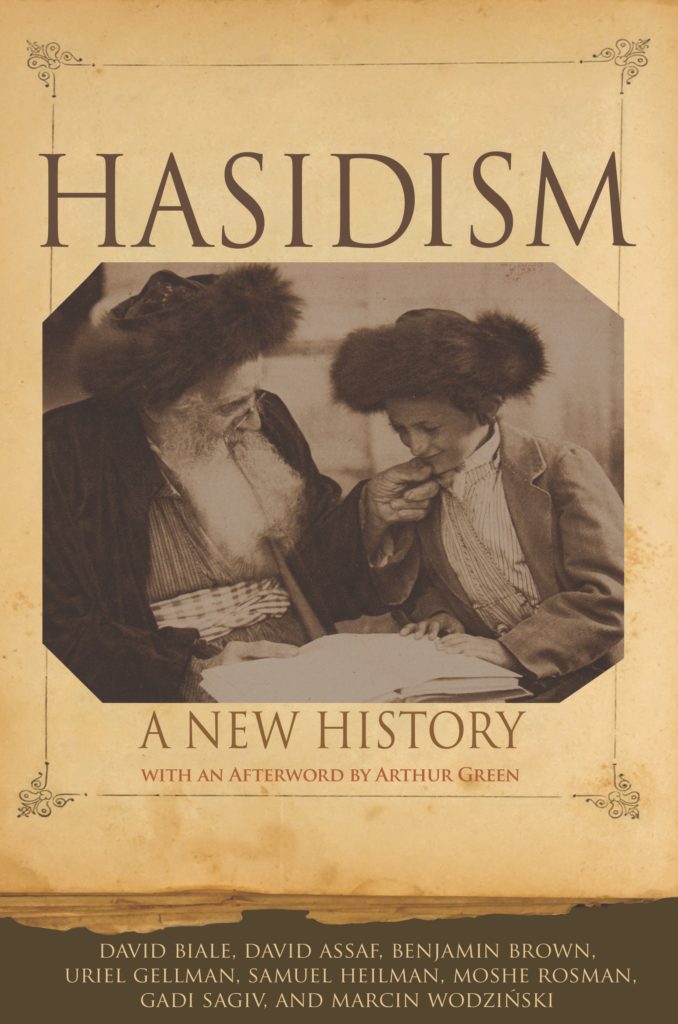
Thanks to its media-savvy outreach, which includes an annual telethon and a full-featured website, Chabad is the face of Hasidism in America and elsewhere around the world.  But, as we are reminded by the authors of “Hasidism: A New History” (Princeton University Press), the Hasidic movement is deeply rooted in Jewish culture and extraordinarily diverse in belief and practice.

Not  the least remarkable fact about “Hasidism” is that the 875-page book is the work of a team of eight co-authors from three countries: David Biale (University of California, Davis), David Assaf (Tel Aviv University), Benjamin Brown (Hebrew University of Jerusalem), Uriel Gellman (Bar-Ilan University), Samuel Heilman (Queens College and Graduate Center, City University of New York), Moshe Rosman (Bar-Ilan University), Gadi Sagiv (Open University of Israel) and Marcin Wodziński (University of Wroclaw).  Working under the auspices of the Israel Institute for Advanced Studies and the Simon Dubnow Institute in Leipzig over nearly a decade, they offer us a highly readable and illuminating account of one of the glories (and mysteries) of Jewish civilization.

Hasidism presents itself (and is often regarded by others) as an older and more authentic form of Judaism that has somehow survived into our times.  The authors of “Hasidism,” however, are quick to point out the irony in that idea.  Starting at a time in history when the Enlightenment was already casting its light into the ghetto and the yeshivah, a hard core of rabbis and their followers took a stand against the modern world in which they lived. In that sense, precisely because Hasidism is a reaction to modernity, “even the most seemingly ‘orthodox’ or ‘fundamentalist’ forms of religion are themselves products of their age,” as the authors explain.

“The southeastern corner of the Polish-Lithuanian commonwealth was certainly an improbable place for a ‘modern’ religious movement to be born,” they write. “Yet it was there, starting sometime in the middle of the eighteenth century, that small circles of Jewish pietists coalesced around rabbis who would come to be called, in Hebrew, tsaddikim (“righteous men”) or, in Yiddish, rebbes.  From these modest beginnings emerged a movement that eventually named itself Hasidism (‘piety’).”

Yet the spiritual roots of Hasidism are found in ancient Jewish mystical texts and practices. The man who is conventionally regarded as the founder of Hasidism, Israel Ben Eliezer (better known as the Ba’al Shem Tov or the “Besht”), was “originally employed by his community as a practitioner of practical Kabbalah,” that is, a magic-worker and folk-healer. “The Besht’s tools were ecstatic trances, amulets, incantations, adjurations, special prayers, exorcisms, and potions.” But the authors literally put a question mark at the end of the phrase “Founder of Hasidism?” to signal  that while the Besht was “the axis around which the group formed,” it was only after his death that “the new Hasidism [evolved] from a collection of mystical havurot to a self-conscious confederation of courts.”

As a further irony, it is only the time and place where Hasidism first took up the fight against modernity explain why Hasidim look and act the way they do today.  Members of some Hasidic movements still dress like Polish courtiers of the 18th century — fur hats, velvet knee pants, and white silk stockings — but only because that’s how all Jews dressed at the time when the court was founded.  As time went by and styles changed, “Hasidim retained their traditional garb as distinctively Jewish,” the authors explain. “Clothes and appearance thus would serve as a visual market of separation.  However, only at the end of the nineteenth and beginning of the twentieth centuries did this dress come to signify Hasidism specifically.”

Yet another irony is that, because each Hasidic “court” is convinced of the enduring rightness of its own rebbe’s teachings and traditions, they are often as combative toward each other as they are toward the modern world itself.  When Schneur Zalman, the founder of Chabad, was arrested by the tsar’s police in 1798, he readily acknowledged the diversity within Hasidism and explained that “there were various styles of preaching among different tsaddikim, and each one of these adopted a distinct method of leadership,” as the authors explain.  Yet they also point out that “he believed that jealousy over his success and his moral honesty caused him to be denounced, incarcerated and investigated.”

As the story moves through time and around the world, we are confronted with both the sublime and the tragic aspects of Hasidic history.

As the story moves through time and around the world, we are confronted with both the sublime and the tragic aspects of Hasidic history.  Joy is both “a major value” and “the most visible feature” of what the authors call “the Hasidic ethos,” and it is manifested in “music, dance, and ecstatic performance of prayer.”  Thus we come to realize that those handsome young men whose ecstatic dancing is featured on the annual Chabad telethon are demonstrating and preserving one of its oldest expressions: “Music and dance are possibly more characteristic of Hasidism than any other religious phenomenon in Judaism,” the authors insist.

Yet the authors do not shrink from describing the heartbreaking events in the history of Hasidism. “The heartland of Hasidism — Poland, western Soviet Union, Slovakia, and Hungary — was where the Germans inflicted some of their highest death tolls during the Holocaust, or what Hasidim (together with other ultra-Orthodox Jews) call khurbn (Yiddish for destruction),” they write. One artifact that survives from Auschwitz is a journal in which a rebbetsin from Slovakia denounced the Hasidic leaders who, as she puts it, “ran away to the Land of Israel, saving their own skins while leaving the Jews to be taken like lambs to the slaughter.”  So, too, did the Satmar rebbe and a few members of his court manage to win a place on the train that Adolf Eichmann allowed to take some 1,680 Jews to safety in Switzerland.

A charming tale is told about the Septuagint, an ancient translation of the Torah into Greek. Each of the 70 scholars, it is said, worked separately and yet all of them came up with identical translations of the sacred text.  I was reminded of the tale when beholding what the eight authors of “Hasidism” have accomplished. Scholars are notoriously single-minded about their own scholarship, and yet these eight modern sages managed to produce a fascinating book that embodies their collective wisdom and style in a seamless and highly illuminating work of authorship. This, too, strikes me as something of a miracle.


Jonathan Kirsch, author and publishing attorney, is the book editor of the Jewish Journal. He is the author of, among other books, “The Woman Who Laughed at God: An Unofficial History of the Jewish People.”

The Jews of Ecstasy Read More »

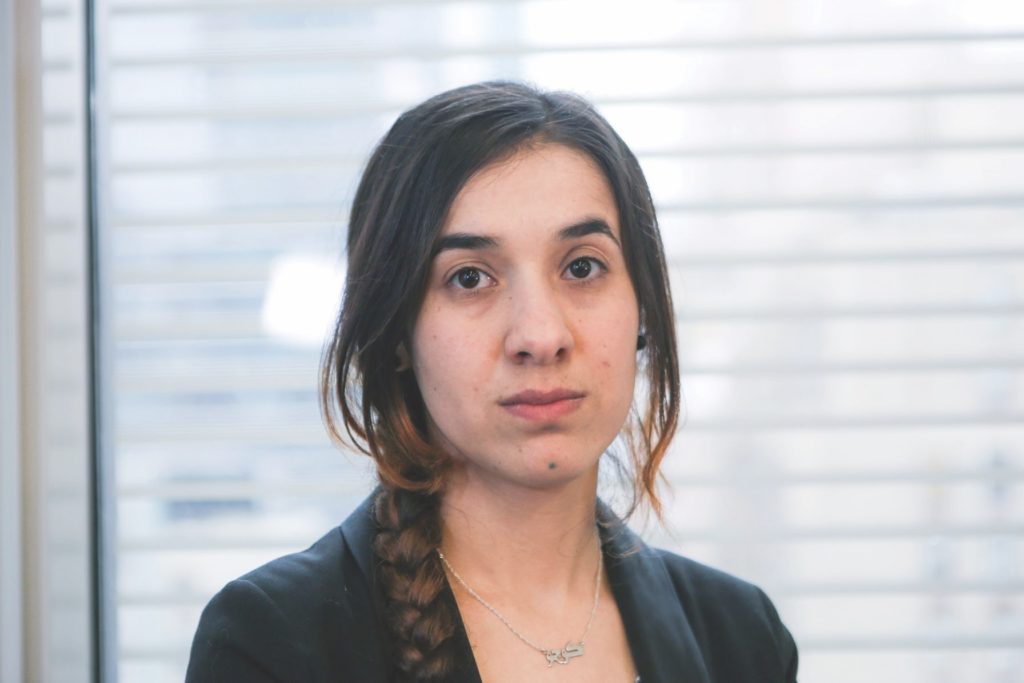
Nadia Murad Wants to Be ‘The Last Girl’ to Face Sexual Slavery

Jews revere the late Holocaust survivor and author Elie Wiesel for his ability to render plainly the unimaginable and give voice to the suffering of his people. With her new book, “The Last Girl” (Tim Duggan Books), Nadia Murad has assumed the stature of a Wiesel for her people, the ancient ethnic religious minority in Iraq known as the Yazidis.

A firsthand account of her sexual enslavement by the Islamic State of Iraq and Syria (ISIS), “The Last Girl” cements Murad’s place as a formidable advocate for the Yazidis, and will hopefully go a long way toward awakening the world to their plight.

Hers is the story of thousands, a responsibility she recognizes and lives up to in the book. The ultimate achievement of “The Last Girl” is that it turns her suffering into strength, rescuing from anonymity the voices of all those targeted by ISIS for systematic rape and murder. Rather than succumbing to the attempted spiritual annihilation by her onetime captors, Murad has seized her story like a weapon to be wielded for her cause.

Before Murad was a human rights icon and a United Nations Goodwill Ambassador, she was the daughter of a large farming family in a frontier town of mud brick homes called Kocho. Her existence was limited to the grassy plains of Sinjar, a financially poor but culturally rich region that until recently was home to most of the world’s Yazidis. Rather than grappling with the continued survival of her people, she mainly concerned herself with her family members, their livestock and daily household chores.

Though Murad describes a happy if impoverished childhood, Kocho’s location at the fringe of Yazidi homeland — “closer to Syria than to our holiest temples, closer to strangers than to safety” — was not without its anxieties.  But the true extent of their danger wouldn’t become clear to the villagers until it was too late. The book opens with ISIS spreading up from Mosul like a menacing shadow in the summer of 2014. Yazidi shepherds and their livestock go missing as the terrorist group stokes centuries-old hatred among Kocho’s Sunni Muslim neighbors.

But before Murad’s story descends into the depths of ISIS depravity, it dwells on the Yazidis’ culture, history and even their theology. As much as it is an account of the Yazidi genocide, the book is also a loving ode to a way of life that has now been all but obliterated, detailing the customs, economy and family life practiced by Yazidis prior to the killings. Murad’s book is historic in that it introduces the Yazidis for the first time to a mass, non-Yazidi audience.

Perhaps more pressingly, though, Murad captures the stories of genocide victims, including her family and neighbors, but also examples from across a broad cross-section of Sinjar’s Yazidis.  One indigent elderly woman who refused to leave her mud brick shed was set on fire by ISIS militants, Murad writes.

Overnight, Murad — who at the time was in her early 20s — is transported from her former life to that of a sabiyya, literally “the spoils of war,” a sex slave transferred from darkened halls to slave markets to ISIS flophouses.”

Ultimately, the story of persecution is her own. As Murad and her niece are stacking bales of hay after dusk, they watch a line of ISIS trucks snake insidiously across Sinjar’s plains and envelop their village. After a two-week siege, the entire population of Kocho is gathered up in the schoolyard and separated by age and gender. The men are machine-gunned and the unmarried women rounded up onto trucks. Women rush to claim their nephews and younger siblings as their children to avoid the fate of those being herded onto the beds of pickups.

Even just as a straightforward eyewitness account of genocide, the book proves surpassingly valuable. But it goes further: Readers are invited to share in Murad’s probing disbelief at her ordeal — to attempt, perhaps futilely, to reason through it with her. The account is colored by Murad’s incredulity at the inability and the simple unwillingness to help the Yazidis, for instance when she and her fellow captors were driven through the bustling streets of Mosul. “We couldn’t have looked normal, stuffed into the backs of trucks, crying and holding on to one another,” she writes. “So why wasn’t anyone helping us?”

Overnight, Murad — who at the time was in her early 20s —  is transported from her former life to that of a sabiyya, literally “the spoils of war,” a sex slave transferred from darkened halls to slave markets to ISIS flophouses.

She recounts her ordeal without shirking from even its most heinous moments, such as when a captor punishes her attempted escape by allowing a group of guards to gang rape her. She remembers — and recounts — horrifying details that a less courageous author might omit or obscure, including the faces and manners of her rapists. “Morjeta acted like a child who had been allowed a treat he had been whining for when he came to rape me,” she writes, “and I will never forget the other guard’s glasses, the way he was so gentle with them and so vicious with me, a person.”

Throughout, Murad reckons with the crimes committed against her and the people who stood by while it happened. Her feelings about Iraqi Muslims are often indeterminate and contradictory, complicated by the fact that it was Sunni Muslims who helped her escape, but her verdict is ultimately a damning one. “Families in Iraq and Syria led normal lives while we were tortured and raped,” writes Murad, who now lives in Germany. “They watched us walk through the streets with our captors and gathered on the streets to witness executions.”

Even more than a simple account of mass, calculated rape, “The Last Girl” is a plea to the community of nations and citizens to revisit their sense of morality. Murad exhorts to the 21st century to live up to the promise of the 20th: that international law reign and genocide not go unpunished. The lessons of the Holocaust ought to compel all audiences — but especially Jewish ones — to take heed of Murad’s call by reading her account and speaking out on behalf of Yazidis.

The book ends on a note of hope rather than condemnation, with Murad recounting a speech she gave in Geneva to a room full of human rights advocates.

“I told them that I wanted to look the men who raped me in the eye and see them brought to justice,” she writes. “More than anything else, I said, I want to be the last girl in the world with a story like mine.”

Nadia Murad Wants to Be ‘The Last Girl’ to Face Sexual Slavery Read More »

Hitler Car Sale to Help Wiesenthal Center

A 1939 Mercedes-Benz 770K Grosser Offener Tourenwagen used by Adolf Hitler will be put up for auction on Jan. 17 and 10 percent of the sale price will go to the Simon Wiesenthal Center (SWC).

“We’re quite comfortable the Hitler car is not going to be auctioned and sold to a hater, a neo-Nazi or Klansman, or a group like that, that would glorify Nazism,” the Wiesenthal Center’s dean and founder, Rabbi Marvin Hier, said in an interview. “We are happy with their decision that 10 percent should go to Holocaust education and we intend to use it exactly for that. Adolf Hitler would turn over in his grave if he knew 10 percent of the sale of a car that once belonged to him was donated to SWC, an organization named for the world’s most famous Nazi hunter.”

Worldwide Auctioneers in Scottsdale, Ariz., will conduct the auction.

Rod Egan, chief auctioneer at Worldwide Auctioneers, said he expects the Mercedes-Benz 770K, which is usually valued at about $5 million, to sell for more than $10 million, given its historical significance.

The vehicle, just one of five surviving vehicles of its kind in private hands, was ordered by, built for and used by Hitler, according to the auctioneer’s website. It was delivered to Berlin on July 29, 1939, and made its public debut on Oct. 6, 1939, in a large motorcade designed to maximize Hitler’s safety, the website says.

The vehicle “remain[s] quite likely the world’s greatest achievement in terms of automotive design, engineering, and construction,” the website says.

The U.S. Army seized the vehicle in 1945.

“It’s a trophy,” Egan said. “Hitler lost and we took his flagship car, really is what it comes down to.”

After World War II, the car was used in the U.S. military motor pool before the Greenville, N.C., branch of the Veterans of Foreign Wars obtained the vehicle. Egan discovered the car’s existence when it was owned by Las Vegas hotelier Ralph Engelstad. In 2004, a European buyer purchased the car. Worldwide Auctioneers company obtained the vehicle for consignment after a client a couple years ago expressed interested in buying a Mercedes-Benz 770K.

Egan declined to identify the vehicle’s current owner.

“Adolf Hitler would turn over in his grave if he knew 10 percent … was donated to … an organization named for the world’s most famous Nazi hunter.” — Rabbi Marvin Hier

Rabbi Hier said the money the SWC receives from the auction would be used to record speeches Holocaust survivors deliver at schools.

“We’re going to videotape those speeches and make sure they endure for posterity, so when visitors come to the SWC, no matter what day they come, they always will be able to hear the speech of a Holocaust survivor telling them why it is important to be mindful of haters,” Hier said.

Egan said he was pleased a portion of the sale from the company’s auction would benefit SWC.

“The fact that it [SWC] has international reach was a big factor for us as well, and frankly, when you look at how we earmark funds and why we do it in the first place, the Center checked all the boxes: anti-Semitism, hate, terrorism, human rights,” he said. “In today’s world, today’s climate, it is more important every day.”

Hitler Car Sale to Help Wiesenthal Center Read More »

A Moment in Time: You Can’t Look at a Rainbow and NOT be Happy!

Dear all,

This past Tuesday, my social media feed lit up with photo after photo like the one above.  In the midst of the terrible rainstorms in Southern California, this rainbow appeared.  Each photo made me smile.
You can’t look at a rainbow and not be happy!
What I find so meaningful is that rainbows are both bridges and towers. They lift us and they ground us.  They connect us as humans.  They embrace us from heaven.
They remind us of the promise to Noah.
They inspire us to collect the many colors, shapes, and sizes of divine creation into a big group hug.
The miracle of the rainbow, however is not that it happens and not that it makes us feel good.  The miracle occurs when they inspire us to take a moment in time each day to reach in, to reach up, and to reach out, bridging the world with goodness.
With love and shalom,
Rabbi Zach Shapiro

A change in perspective can shift the focus of our day – and even our lives.  We have an opportunity to harness “a moment in time,” allowing our souls to be both grounded and lifted.  This blog shows how the simplest of daily experiences can become the most meaningful of life’s blessings.  All it takes is a moment in time.
Rabbi Zach Shapiro is the Spiritual Leader of Temple Akiba, a Reform Jewish Congregation in Culver City, CA.  He earned his B.A. in Spanish from Colby College in 1992, and his M.A.H.L. from HUC-JIR in 1996.  He was ordained from HUC-JIR – Cincinnati, in 1997.

A Moment in Time: You Can’t Look at a Rainbow and NOT be Happy! Read More »

Jews and Muslims Seek Relief in Laughter

At a recent stand-up comedy show at Temple Emanuel of Beverly Hills, headliner Ahamed Weinberg welcomed the crowd with “Salaam aleikum.” About half of the audience responded “Aleikum salaam,” prompting Weinberg to remark: “Everyone who didn’t answer, get out. This is a Muslim temple now.”

The crowd laughed. Weinberg then explained that his mother, born Irish Catholic, and his father, born Jewish, both became Muslim. They met as “the only white people in the mosque,” he said. “They locked eyes and said, ‘Let’s make the weirdest kid possible, whose only career option is stand-up comedy.’ ”

The Jan. 4 show, titled “Night of Too Many Stars and Crescents,” featured Jewish and Muslim comics. It was organized by YoPro, the young professionals group at Temple Emanuel. Two of the comics were Jewish and female, two were Muslim and male. All were aware that they were performing in the chapel, in front of an ark holding Torah scrolls.

“Historically, Muslims and Jews have not always been BFFs [best friends forever],” said YoPro member Danielle Soto, who produced the event that attracted an audience of Muslims and Jews of varying ages. “I wanted a comedy event that lets our community know that if you’re down to laugh, eat, drink, make friends and be open to other cultures, YoPro’s door is wide open to you.”

Refreshments included wine and nonalcoholic drinks for the comfort of Muslims and other teetotalers.

“I feel like Muslims are the new Jews in comedy,” said Rabbi Sarah Bassin, Temple Emanuel’s associate rabbi. “They are drawing on the experience of being minorities to hold up a mirror to our culture at large. There’s something really meaningful about being able to share that perspective with another religious group that gets it.”

Comedian Atif Myers talked about being “a s—-y Muslim” for loving pepperoni pizza. He confessed that he’s on a Jewish dating app, JSwipe, as a Muslim. “How else are we supposed to get Mideast peace, guys?” he asked.

During her set, comedian Alex Powers — whose biological father was a Sephardic Jew but whose adoptive parents were Catholic — displayed her tattoos: a Star of David and a crescent moon on her fingers and a hermit crab on her hand. After a raunchy bit, she explained, unapologetically, “I’ve got a tattoo of a bottom feeder. This never was going to be kosher.”

When he took the stage, Weinberg — who proclaimed himself “the only Muslim who went on Birthright” — turned around and touched the ark. Recoiling, he made a sizzle noise and said “Ouch!”

Jewish comedian Sami Sutker said in her performance that she was uncomfortable being at a temple. “I can feel my bat mitzvah coming back all over again,” she said, mentioning the mustachioed and mulleted cantor who helped her prepare. “Maybe this explains how my Judaism fell apart.”

“I feel like Muslims are the new Jews in comedy.” — Rabbi Sarah Bassin

Bassin said the goal of YoPro and Temple Emanuel “is to build community that reflects our values of inclusion and openness. We’re particularly excited for this comedy event to do some good as we make people laugh.”

Part of that “good” is Temple Emanuel’s participation in “The Big Fill,” a campaign involving several Los Angeles synagogues in collecting clothing, medical supplies and other essential items for the Save the Syrian Children organization’s relief efforts. A table in the back of the room at the comedy show was designated for donations of new and used clothing.

Soto added that she and her friends at YoPro “genuinely care about bettering our community and beyond.”

“I consider having the ability to make people laugh a gift,” Soto said. “Giving back to the community through organizing shows is my way of showing gratitude for this gift.”

Jews and Muslims Seek Relief in Laughter Read More »

They’re Here, They’re Queer and the Persian Pride Fellows Want L.A. to Get Used to It

On a bright, clear December morning, about a dozen individuals, most of them Persian Jews, gathered on plush sofas in the wood-paneled den of a large home in north Beverly Hills, hoping to start a movement.

Arya Marvazy, one of the gathering’s organizers, sat on a high stool facing the semicircle of attentive faces and introduced the event, a monthly meeting of the inaugural cohort of the JQ Persian Pride Fellowship, “a nine-month leadership, activism and training program for Iranian LGBTQ individuals and allies,” he said.

About two years after Marvazy came out as a gay man in a Facebook video that quickly went viral in his Persian-Jewish community, the 31-year-old is leading a cohort of 12 fellows, including himself and fellow organizer Amanda Maddahi. The group, whose members range in age from 20s to early 40s, includes Muslims and Jews, as well as two fellows who identify as allies rather than LGBTQ.

Marvazy said in an interview that the fellowship’s aims lie in “moving our community forward and getting the good message of queer equality out to the Persian masses,” thereby opening a conversation that the largely conservative community often prefers to leave closed.

The main components of the fellowship, according to Marvazy, an assistant director for the West Hollywood-based Jewish LGBTQ organization JQ International, include leadership and activism training sessions, panel discussions such as the Dec. 17 parlor meeting and, eventually, programs organized by fellows.

While guests picked at a bagel breakfast set out on a bar in the back of the room, Marvazy introduced the morning’s speakers: Joseph Harounian, an openly gay Persian man and founder of a West Los Angeles wellness center; Mastaneh Moghadam, a social worker who has worked with the Iranian LGBTQ community for more than a decade; and Vennus Zand, an Orange County-based therapist who discussed a qualitative study of the coming-out process for gay Persian men that she conducted after her brother came out to her.

Moghadam started the discussion, recounting the atmosphere when she first started to talk to people about LGBTQ issues in the local Persian community 15 years ago. “It was so dark and not talked about, and ‘nobody can know about it,’ ” she said. “It was such a closed conversation.”

She described how she struggled to book family members of gay and lesbian Persian youth to speak on KIRN, a local Persian-language radio station. “Everybody’s feedback to me was ‘Mastaneh, nobody will come. Mastaneh, the community isn’t ready.’ ”

Nonetheless, she persisted, and the feedback was encouraging.

“One mother who appeared on the KIRN show said to me, ‘This was so therapeutic. I wish we could do this every week.’ And I said, ‘We can,’ ”  Moghadam said.

“The idea that I can perhaps inspire someone else to see that it’s OK to be yourself and to be open makes me want
to keep going.” — Matthew Nouriel

That conversation was the seed of a long-running support group for Persian people struggling to understand a family member’s LGBTQ identity. Often, when members were reticent to return to the group, Moghadam said she reminded them, “This is more than a support group. This is a movement.”

Harounian spoke about his coming-out experience when he was in his early 30s. For years he struggled while hiding his identity from his family, frequently making excuses for why he wouldn’t date the women they set him up with. Finally, in 2000, he couldn’t do it any longer.

“I woke up one day and said, ‘Enough is enough,’” he said. “‘Life is too short. I need to start living.’”

Others in the room shared similar stories of struggling with their families’ lack of knowledge and acceptance.

Shirin Golshani, a 30-year-old occupational therapist, joined the fellowship after watching her friend, organizer Maddahi, struggle to obtain the acceptance of her family and community after coming out.

“I felt so bad that there was nothing I could do but just be there for her,” Golshani said in an interview. “And I think that this fellowship is such an amazing way of getting educated.”

Growing up in the Beverly Hills Persian community, Golshani maintained a neutral attitude on LGBTQ topics but heard people close to her express opinions ranging from indifference to distaste. While her parents remain positive about her decision to join the fellowship as an ally, she said she senses their wariness.

“I think they’re even still trying to warm up to the idea that their Persian Jewish daughter is so closely tied to this community,” she said. “And I know that in a sense they’re wondering, ‘Are people going to think she identifies as LGBTQ?’ Even though I don’t.”

Marvazy said he hopes the fellowship, which began in November, will be the template for many more cohorts to come. He said in March, which JQ International has declared its third annual Persian Pride Month, fellows will be responsible for organizing their own projects in the community.

For some, the fellowship reinforces their informal roles as mentors for younger people with similar difficulties.

Matthew Nouriel, who came out as gay at 15 after moving to L.A. from London and now performs as a drag queen, said he sometimes receives messages online from other LGBTQ Persian people seeking advice and encouragement.

Matthew Nouriel, also known as “The Empress,” dressed in drag for a JQ International event. Photo courtesy of Matthew Nouriel.

Recently, for instance, he began counseling an 18-year-old gay man in Iran who found Nouriel on Instragram, sharing tips on how to navigate coming out or staying closeted, as well as offering makeup pointers. Nouriel said he encouraged the young man to put his safety first when deciding whether to come out. He believes his mentee benefits from their talks.

“The more I put myself out there, the more I feel like those walls are being broken down, even if only a little,” Nouriel wrote in an email to the Journal. “The idea that I can perhaps inspire someone else to see that it’s OK to be yourself and to be open makes me want to keep going.”

In a way, the fellowship reverses the isolation he felt growing up gay and Persian, he wrote.

“I felt the need to retract myself from the community when I was growing up. Having this fellowship has introduced me to a whole group of people I otherwise may have never met,” he wrote, adding, “Strength in numbers!”

They’re Here, They’re Queer and the Persian Pride Fellows Want L.A. to Get Used to It Read More »

Iranian-Americans Rally for Freedom

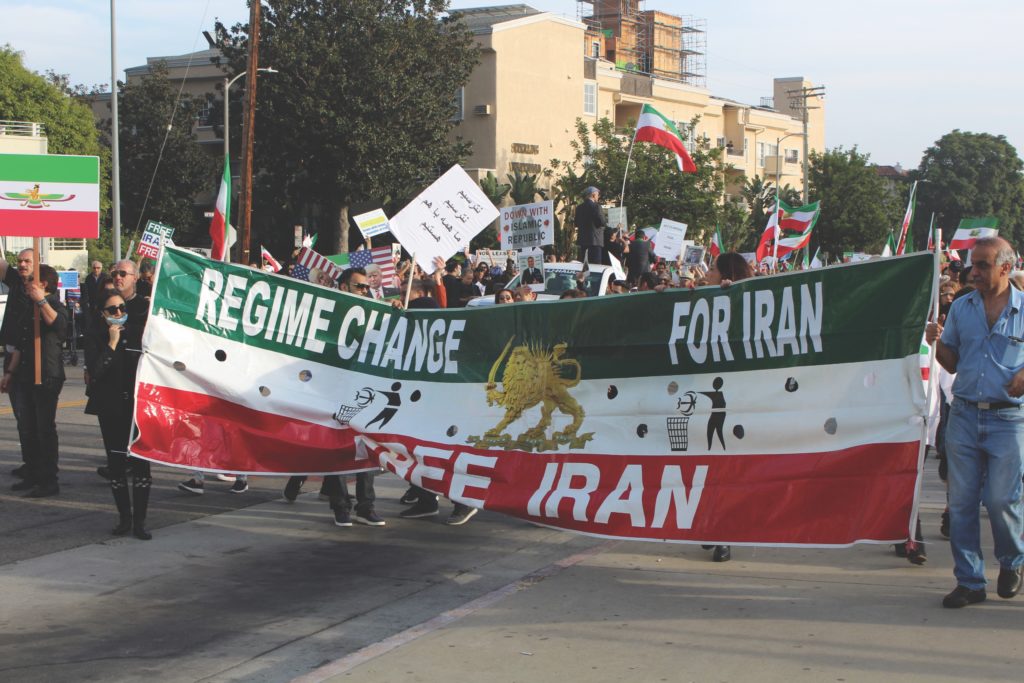
Waving large Iranian flags and signs, nearly 6,000 passionate Iranian Americans of various faiths gathered outside the Federal Building in Westwood on Jan. 7 for a rally in support of their countrymen who have been protesting and rallying for freedom in dozens of Iranian cities since late December.

Protests in Iran broke out almost spontaneously on Dec. 28 in a few cities in response to high food costs and a lack of economic opportunities. Outbreaks quickly spiraled into massive protests in major cities.

Iranian citizens called for “death to the supreme leader” and for the overthrow of Iran’s Islamic regime. Videos of protesters being shot, beaten and arrested in Iran have gone viral across social media sites. They caught the attention of many Iranian Americans in Southern California, including Frank Nikbakht, an Iranian-Jewish activist and head of the Los Angeles-based Committee for Minority Rights in Iran.

“When we see the people of Iran demanding regime change, this is something we here have been demonstrating for the last 39 years,” Nikbakht said. “We feel we are one with them. We must use our voices here to support the downtrodden and the oppressed inside Iran.”

Nikbakht was among many L.A. Iranian Jews protesting at the rally. They were marching side by side with Iranian Muslims, Christians, Zoroastrians and Baha’is. Sharing a common language and culture, Iranians of various faiths, in Southern California and elsewhere in the United States, long have maintained close friendships and a mutual feeling of tolerance.

Chanting in unison in Farsi and English, the protesters referred to Iran’s supreme leader, Ayatollah Ali Khamenei, and a Shiite militant group as they waved signs and flags and shouted, “Death to Khamenei! Death to Hezbollah! We want human rights for Iran! We want democracy for Iran!”

Some Iranian protesters had come from as far as Orange County and Bakersfield for the Westwood rally.

Los Angeles police and Los Angeles County Sherriff’s officers were out in force. They closed off sections of Wilshire Boulevard between Westwood and Sepulveda boulevards, as well as sections of Westwood Boulevard and Veteran Avenue to allow the throngs to march safely in the streets.

Protesters in Iran say more than 20 people have been killed, including a 13-year-old boy. Hundreds have been injured, more than 1,000 arrested by Iranian police, militia forces and Revolutionary Guards Corps.

Access to the internet and social media sites has been shut down by the regime in an effort to discourage or halt protests, to block protesters from sending their footage out of the country and to prevent new protests from being organized.

On Jan. 4, the Simon Wiesenthal Center in West L.A. became one of the first national Jewish organizations announcing support for the protesters.

“We say to the Iranian people who are protesting, we stand with you,” said Rabbi Marvin Hier, founding leader of the Wiesenthal Center. “We wish you every success. We will do everything to bring your plight to the attention of the world.”

Local Iranian-Jewish activist George Haroonian, not representing any Iranian-Jewish groups, also spoke at the Wiesenthal Center press conference. He shared the sentiments of the protesters in Iran who have posted different messages on social media for help from the outside world.

“We must use our voices here to support the downtrodden and the oppressed inside Iran.” — Frank Nikbakht

“The protestors are very grateful for the support they’ve received from the Trump administration and from members of Congress,” Haroonian said. “What they are asking for is help with their communications to get the word out to the world about what the regime is doing to them in the country during the protests.”

Haroonian and other Iranian-Jewish activists are in the minority for being more vocal in their support of the protestors in Iran. While the vast majority of Southern California Iranian Jews oppose the regime in Iran, community leaders and organizations have remained quiet about any formal support of the protests. They fear what they say may be used as an excuse by the Iranian government to retaliate against the 5,000 to 8,000 Jews still living there.

Protests in Iran come at a sensitive time for Iranian Jewry, following a Dec. 24 incident in which two old synagogues in the Iranian city of Shiraz were vandalized. Five Torah scrolls and numerous prayer books were damaged or destroyed by unknown assailants.

The Iranian government still has not launched a formal investigation. No suspects have been arrested.

California is home to the largest population of Iranians outside of Iran, nearly 1 million. Forty thousand are Jews, primarily living in Southern California.

While the majority of the Iranian ex-pat community in the United States strongly opposes the Islamic regime that has ruled since 1979, in recent days, many have taken to the streets across the U.S. They have staged similar rallies in New York, Washington, D.C., Atlanta, Dallas, San Diego, Boston and Dallas in support of protestors in Iran.

Khamenei denounced the protestors in Iran and blamed the civil unrest on “Zionist and American spies.” He said they were conspiring to cause chaos in the country. Likewise for publicity purposes, in recent weeks the Iranian government has sponsored smaller rallies with its “supporters” marching in the streets of Tehran.

Calls to the Permanent Mission of the Islamic Republic of Iran to the United Nations in New York were not returned.

Iranian-Americans Rally for Freedom Read More »