fbpx

January 10, 2018

Using MLK Day to Engage and Enlighten

When Rachel Fine and seven teenagers, ages 17-18, arrive in Los Angeles from Detroit this weekend, they plan to honor Martin Luther King Jr. Day in various ways. They will plant urban gardens at churches. They will have conversations about race. They will compare issues facing Angelenos to those facing people in Detroit.

“It’s not just about MLK Jr. but racial justice and fighting for equality,” said Fine, who as the teen engagement manager at Repair the World, a Jewish social services organization, is using a grant dedicated to exposing Jewish youths to Jewish communities around the country. “I think it is a good time to create a campaign around something that means a lot.”

Repair the World is one of many Jewish organizations that will be marking the MLK Jr. Day holiday on Jan. 15 with special programs over the next two weekends.

While many Jewish schools and all public schools will be closed for the federal holiday, the modern Orthodox Shalhevet High School will have a regular school day, during which teachers will place the holiday in historical context and students will engage in activism. Shalhevet English Department Chair Michelle Crincoli has created a curriculum encouraging students to reach out to elected officials about issues that are important to them.

“On MLK Day, Shalhevet High School honors his legacy with continued activism. The goal of our school-based program is to cultivate the voices of the future, helping students to recognize the power of their lived experiences,” said Daniel Weslow, general studies principal at Shalhevet. “In doing so, his legacy lives on in each student as they broaden his humanitarian mission through their agency.”

“What we wanted to do was reignite, re-establish that relationship that we had for so long between the Black community and the Jewish community, to stand together as we did in the ’60s.” — Chazzan Mike Stein

On Jan. 12, deToledo High School will honor King and Rabbi Abraham Joshua Heschel with a student-led service, during which students will read quotes from the two civil rights leaders.

“We celebrate these two civil rights champions because the work of healthy race relations is not yet done,” said Cheri Mayman, director of marketing at deToledo High School.

The service will conclude with a rock band performing the U2 song “Pride (In the Name of Love).”

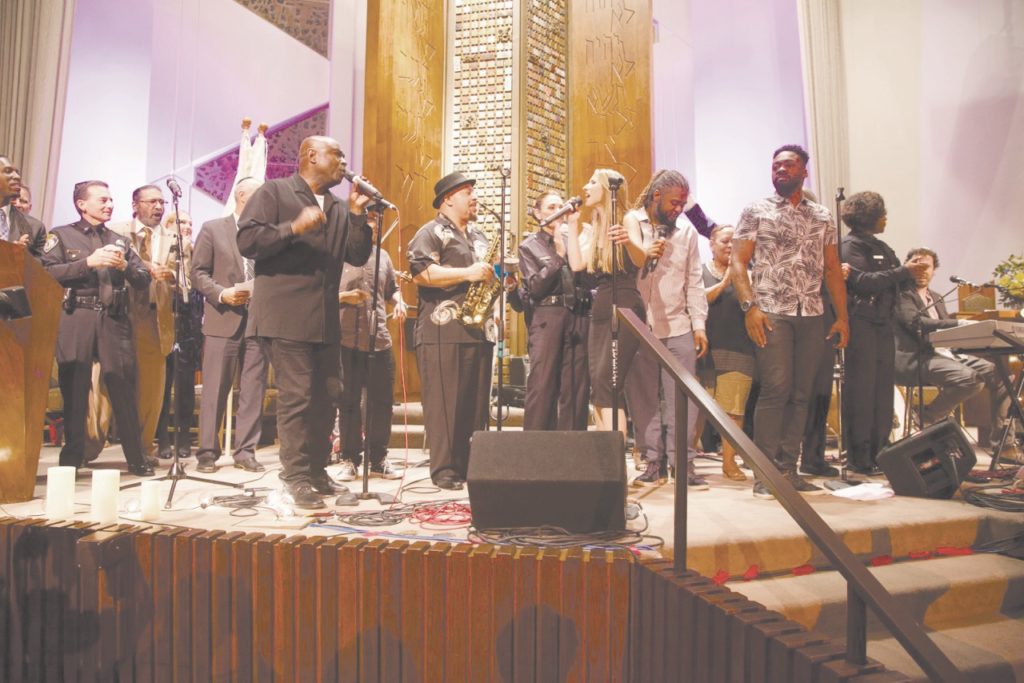
On Jan. 19 in Woodland Hills, Jewish, Muslim and Christian communities will come together at Temple Aliyah for an interfaith MLK service, featuring Temple Aliyah Chazzan Mike Stein, who said he expects the event to celebrate the historic partnership between Jews and African-Americans on civil rights issues.

“What we wanted to do was reignite, re-establish that relationship that we had for so long between the Black community and the Jewish community, to stand together as we did in the ’60s, when Rabbi Heschel and Martin Luther King stood together,” Stein said. “We wanted to see what we could do to help each other.”

Similarly, Sinai Temple will host MLK-inspired services on Jan. 12-13 that honor the moment when the two communities banded together toward creating a more just world.

“The event harkens back … to a certain sentimental relationship the Jewish community of L.A. has with the African-American community,” event organizer Craig Taubman said.

Rev. Mark Whitlock, senior minister of Christ Our Redeemer African Methodist Episcopal (AME) Church in Orange County, will be participating in the Sinai Temple service on Jan. 13. He said the event would commemorate King’s legacy and focus on healing injustices in the world, from the millions of people who lack access to quality health care to the thousands of people sleeping on the streets in Los Angeles County.

Whitlock believes both issues would pique King’s interest if he were alive today.

“King would say the ACA, the Affordable Care Act, Obamacare, was a step in the right direction for our country when it comes to public health care. … [And] this challenge of poverty in the city of Los Angeles, which has the largest homeless population in the country, I think King would be absolutely angry about the amount of people living in the street,” he said.

Leo Baeck Temple will hold an MLK Shabbat service that will be about creating partnerships between the African-American and Jewish communities beyond the bimah. Rabbi Ken Chasen said he anticipates his temple’s service to foster greater engagement in social justice work among his congregants.

“This is a natural outgrowth for us, another way for us to deepen our ties together in the community so that as we back away from the symbolism of the beautiful Shabbat service and go back into the trenches of making Los Angeles a more just place, we have experience of having prayed with another, as well,” Chasen said.

The focus of all the events and initiatives will be on what brings communities together as opposed to what divides them.

“AME Church and the Jewish community are coming together not to just celebrate Dr. Martin Luther King,” Whitlock said. “It is coming together as a community, coming together to share our stories, struggles and the celebration that we believe the God that we both worship will liberate us from bondage.”

Using MLK Day to Engage and Enlighten Read More »

Sandra Bullock, Cate Blanchett, Me and Borscht

What do Sandra Bullock, Cate Blanchett and I have in common? We all spent a day at Veselka, an iconic Ukrainian restaurant in Manhattan’s Lower East Side. The actresses were filming a trailer for their upcoming girl-power caper, “Ocean’s 8,” and me, well, I spent a far more exciting day watching the borscht-making process in Veselka’s 63-year-old kitchen.

My guide for the day, Veselka’s Ukrainian-born executive chef Dima Martseniuk, a French Culinary Institute graduate and veteran of some of the city’s most competitive kitchens, showed me around the various stations that churn out absurd amounts of Eastern European classics like pierogi, cabbage rolls (sarma) and stroganoff, but I was here for another classic: Veselka’s world famous borscht, of which 5,000 gallons a year are made by one powerhouse Polish grandmother named Malgorsia.

The day I stepped into Veselka’s seemingly endless, underground kitchen happened to be the day that a cataclysmic blizzard dubbed the “bomb cyclone” befell the city starting at 5 a.m. Stabbing icicles of snow and wind made visibility grim when I reached the restaurant in the morning. But inside, sheltered by the warmth and coziness of Veselka, with the sweet smell of stock and savory meat all around me, I met a cyclone of a different variety and no less powerful.

Polish-born Malgorcata Sibilski, affectionately known as Malgorsia, has been making Veselka’s iconic staple, as well as all its other soups, for more than three decades. For five hours straight, I watched the diminutive 71-year-old grandmother of five lift, chop, paddle, schlep, taste, stir, hoist and smile. She didn’t talk much, so I just watched her until a bit past noon, when, in the middle of the lunch-rush chaos, she disappeared up the stairs for a few moments leaving me to contemplate my lack of energy in her wake.

Four minutes later, she reappeared with a plastic pitcher of coffee, two chipped Veselka mugs and a brown paper bag. She poured us coffees, adding cold milk from the walk-in fridge behind me and downed hers, her first of the day she told me, in a matter of seconds. She unfolded the paper bag, offered me a slice of bread from it and proceeded to shove half a slice into her mouth, tucking the other half into the pocket of her white chef’s coat, presumably for later.

There was no sitting, no resting, not even a moment to lose because there were 100 gallons of borscht to prepare for the weekend. All the while, workers trudged in and out of the kitchen, wearing coats, hats and scarves, remarking about what I assume were the weather conditions, speaking Polish, Russian, Ukranian and a language that one of the workers informed me is Malgorsia language, a mashup of Polish and English with a sprinkling of Ukrainian.

All the while, Malgorsia was stirring and talking, smiling, charming and stopping for a second to kiss a cheek here and there and greet workers who come or go during their shifts. She beckoned me to an enormous eight-burner stove, all burners bearing 25-gallon soup pots bubbling away with various fragrant liquid concoctions.

I followed her in an overwhelmed daze and watched as she explained in broken “Malgorsiaspeak” the various contents of the pots. One pot was full of cabbage and other vegetables that I watched her chop by hand the whole morning. Another, with huge white lima beans in a different broth, potatoes and onions in another swimming in meat stock. Yet another contained shredded beets with vinegar (for color I was  told), and a final pot containing a strong version of beet juice that was squeezed the previous Sunday and was reducing. The meat has been cooked and is in the cold room waiting to be chopped because it is “easier to slice when it’s cold.”

She stood on tiptoes and used an oar about the size a person would use to paddle a canoe, but with a shorter handle. Martseniuk, the head chef, tried to help her reach the pots on the back burners but failed to get the stirring technique exactly right. He told me that he can’t quite use the oar the way she does although he is bigger and stronger; only she can paddle the soup with the oar in the right way.

I asked him what would have happened if the weather had prevented Malgorsia from coming to work that day, seeing as she lives 35 miles away in New Jersey and the cyclone bomb had some people sheltering in place that day. Martseniuk laughed and said, “No chance of that. War, no war, rain, snow, cyclone bomb, nothing would keep Malgorsia from work. Nothing!”

“What would we do without her to make
the borscht?” — Tom Birchard

Later, Veselka’s owner, Tom Birchard, told me that Veselka employs a high percentage of older workers and is being given an award later in the month by Columbia University for being a leader in the industry in this regard. “Older workers are mature and have an incredible work ethic, as you can see. What would we do without her to make the borscht? Can you believe her passion and dedication?” he asked me. I admitted to him that Malgorsia has astounded me with her speed, efficiency and passion for her “art,” as she called it.

“This is my play,” she said when we finally were ready to put together the borscht eight hours later, six pots and pans of cooked ingredients in front of us along with her trusted paddle, to be mixed into a huge cauldron and then separated into 50, one-gallon empty plastic Hellman’s mayonnaise containers.

For five minutes, she mixed and seasoned until finally she stuck one of her gloved pinkies into the soup for a taste. I looked at her expectantly. Silently, she handed me a spoon the size of my head and nodded toward the pot. “Try,” she said.

I got the feeling it was a test to see what I’m made of, and sure enough, to me, the soup needed salt and acid, so I told her so. A smile broke across her face, an indication that I didn’t fail her. “Bravo!  Yes, we add,” she said as she mixed in some more vinegary beet juice and Maggi. “Now we play until we are happy.”

Upstairs in the restaurant, after the woman The New Yorker dubbed the “Queen of Borscht” had played with her soup enough to be happy, I was served a steaming bowl of “Veselka Red” (a real term in New York) beet soup with chunks of potatoes, lima beans and tender meat. On the side were two perfect slices of the house-baked challah and a dollop of sour cream that seems to have come from some heavenly planet.

I contemplated the snowy wonderland outside the steamy windows, and the huge “Veselka is Love” sign made out of foot-tall red, wooden letters hanging above my head. I was surrounded by young and old people speaking many languages, some laughing and some just sitting in quiet meditation in this little piece of old New York on Second Avenue. I raised a spoon to my mouth and remembered a sentence from the Talmud: “A person will be called to account on Judgment day for every permissible thing he might have enjoyed but did not.”

Rest assured, at Veselka, full enjoyment regularly ensues — and with great abandon.

Stay tuned next week for Veselka’s borscht recipe.


Yamit Behar Wood, an Israeli-American food and travel writer, is the executive chef at the U.S. Embassy in Kampala, Uganda, and founder of the New York Kitchen Catering Co.

Sandra Bullock, Cate Blanchett, Me and Borscht Read More »

The Father, the Son and the Unholy Spirits (and Strippers)

“It is a family matter,” argued White House spokesman Scott McClellan. The year was 2001, and President George W. Bush’s twin 19-year-old daughters had just been caught by the police as they were trying to buy alcohol illegally at a Mexican restaurant.

It is a “witch hunt,” complained Israeli Prime Minister Benjamin Netanyahu when a tape surfaced, documenting how his son Yair got drunk, associated with the offspring of wealthy Israelis, attended strip clubs and appeared to offer these fun bodies sexual favors from a female friend in exchange for money.

The Netanyahu scandal is louder. And it rests on several separate pillars of unease: 1. Netanyahu the son was having fun with the son of a tycoon who highly benefited from decisions made by Netanyahu the father. 2. The son is protected by Israel’s security agencies. 3. He was going to strip clubs and was having a night of debauchery that civilized people rightly condemn.

Yair Netanyahu is private citizen. He has no official role. On the other hand, it is well known that he lives in the official residence of the prime minister, that he advises his father, that he is involved in the wheeling and dealing of his father’s politics. Israelis pay his rent, they pay for his security.

This is a nasty affair. It is gossipy. It leaves an aftertaste.

This is a nasty affair. It is gossipy. It leaves an aftertaste. The behavior of a group of young and privileged Israelis is exposed, and it is disgusting. The prime minister’s son sounds like a punk, and one would hope that he is truly ashamed of it, as his statement seems to suggest: “These words do not represent who I am, the values I was raised on, or the principles I believe in. I regret saying them and apologize if anyone was offended by them,” young Netanyahu stated.

Other than that, there is very little substance to this scandal. The banter concerning Israel’s gas deal — Netanyahu asks the son of a businessman to “spot him” pocket money in return for the gas deal that benefited the tycoon businessman — is, well, banter. The strip club visit is something that many other young, and older, Israelis do. The dirty talk and denigrating comments are no worse than those uttered by the sitting president of the United States. We could feel for the security guards, tasked with wasting their nights watching this guy, but the issue with them is strictly professional: If there is an Israeli interest in protecting Netanyahu’s son, then they must be there.

In fact, the most troubling aspect of this affair is the impact it could have on the prime minister. On the night the scandal broke out, the Knesset passed highly controversial legislation that could ban the opening of stores on Shabbat. On that same night (and this is more serious), Israel — reportedly — sent its air force to attack an army base outside Damascus.

When such decisions are made, Israel needs an experienced and cool-headed leader, and what this leader’s son does, or how he behaves, or what language he uses, is completely irrelevant. Let Netanyahu the father be the prime minister. Ignore his son, one of many rotten apples. But there is another side to this equation: When such decisions are made, Israel needs a clear-headed leader. It needs a leader who is not too preoccupied with investigations (Netanyahu serves under the cloud of several investigations), it needs a leader who is not too preoccupied with the need to discipline his son, or to draft statements responding to reports of his son’s ugly behavior.

Of course, such preoccupation with side shows is a double dagger. Netanyahu argues that the news media, by wasting the time of citizens and his own time on nonsense such as Yair’s strip club affair, are disserving Israel. He is certain that everything said against him is connected: the police investigations, the family scandals, the Tel Aviv rallies against corruption — all are part of a mounting effort by his rivals to dethrone him. His rivals make the opposite argument: The police investigations, the family scandals, the Tel Aviv rallies all prove that Netanyahu can no longer be prime minister. That he can no longer function. That he can no longer be trusted to make decisions based on Israel’s interests, as his main motivation is political survival.

Hence, the scandal. Hence, the debate over whether the scandal is worthy of its scandalous status.

The Father, the Son and the Unholy Spirits (and Strippers) Read More »

The Dead

You know when you squint
at a star and the light shines
out in a series of lines
giving the star legs and arms?

What if it’s because all the souls
that once came forth here on Earth
remain watching over from the sky?

Indeed their lives, however many
light years away, have already
passed and all we see
are their echos; but is not the same
to be said for our dead?

Echoes that remain, sounding
off the wall-less walls of my heart
to a graveyard of stars light years away.


Hannah Arin is a junior at Pitzer College pursuing a double major in religious studies and philosophy.

The Dead Read More »

IMAGE OF THE WEEK: ‘Indians Drop Swastika’

FROM THE ST. LOUIS POST-DISPATCH, MARCH 3, 1940:

Text of the proclamation:

“Because the above ornament which has been a symbol of friendship among our forefathers for many centuries has been desecrated recently by another nation of peoples.”

“Therefore it is resolved that henceforth from this date on and forever more our tribes renounce the use of the emblem commonly known as the swastika or flyfot on our blankets, baskets, and objects, sandpaintings and clothing.”

Source for the text: Smithsonian – https://www.si.edu/object/nmnhanthropology_8433588 Newspaper clipping found by Shimon Steinmetz

IMAGE OF THE WEEK: ‘Indians Drop Swastika’ Read More »

What Would My Father Say?

People often ask me how many years it has been since my father’s death. I never want to answer. For them, it may be counted in years or even decades — such a long time. For me, it feels like yesterday. Some might say the trauma of his death is still with me, but I would say that his presence remains so vivid in my life that talking about his death feels odd and unreal.

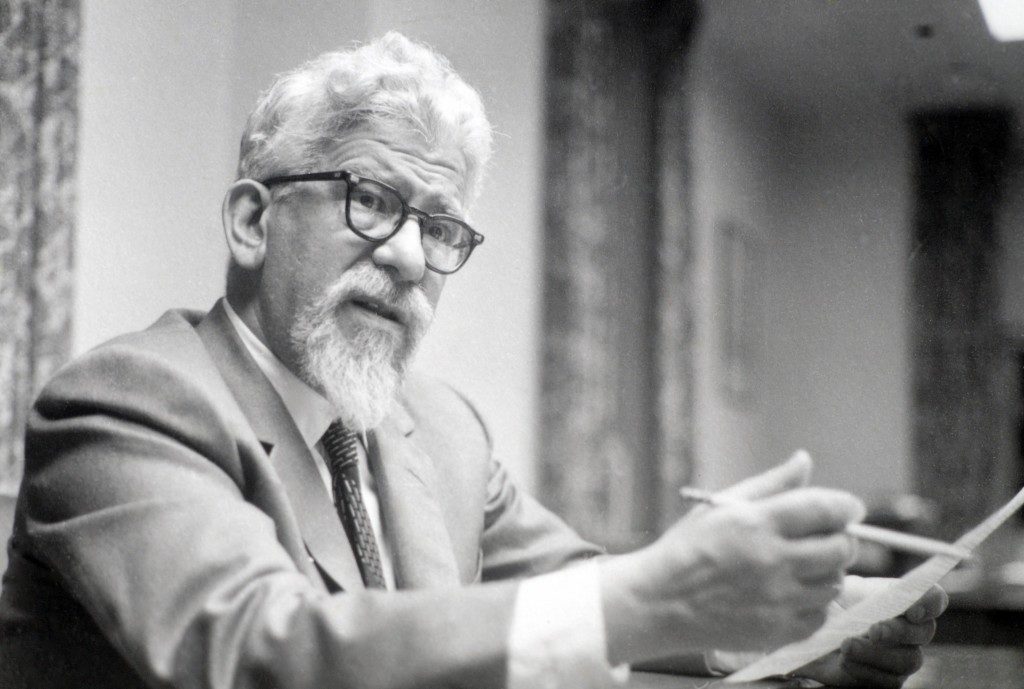
My father, Rabbi Abraham Joshua Heschel, has been present in my life this past year with particular strength because of the many horrors that I know would have been devastating for him to witness. He always used to reassure me that the Nazis were defeated, that the United States was safe, that what happened would never happen again. To see the KKK marching in the streets, neo-Nazis celebrating, with ugly racism coming from the White House — and so much more — I know he would again be pacing the floor, unable to sleep, as he was pacing and sleepless over the horrors of the Vietnam War.

Today the Jewish world seems horrifically engaged in a kind of internal civil war, a war that is anything but civil. For my father, life was precious, every moment. He used to say, time is life, and to “kill time” is to commit murder. He was intensely engaged at every moment. The efforts today by Jews to attack and try to destroy one another out of political disagreements would have horrified my father. Zionism was supposed to unite us, not divide us. Racism he called blasphemy, satanism, unmitigated evil. There are Jews who confuse the Code of Laws with God. Some people try to be religious the way their grandparents were religious — my father called that ‘spiritual plagiarism.’ Selfishness, indifference, a cold heart — this was the opposite of a religious person, for whom awareness of God begins with wonder.

What is a religious person? A person who is maladjusted; attuned to the agony of others; aware of God’s presence and of God’s needs; a religious person is never satisfied, but always questioning, striving for something deeper, and always refusing to accept inequalities, the status quo, the cruelty and suffering of others.

What is a religious person? A person who is maladjusted; attuned to the agony of others … never satisfied, but always questioning.

My father was grateful for allies. He always listened, and he sought bridges with those who disagreed. Yet he was also often lonely and hurt — by colleagues and academic politics, by students who complained when he rescheduled a class in order to attend a demonstration, and most of all, by the callousness he encountered.

Yet he never despaired — despair is forbidden, he used to tell me with a smile. You must have faith and hope, he would say. In his presence, I always did.

Where did my father find his faith and hope? In prayer, most of all. I loved to sit in his study while he prayed, just to be near him and feel enveloped by his prayers. I think of him, praying with tallit and tefillin, and I feel his warmth and love. More than anything, he was a person of enormous depth; you could talk to him about anything, he was so open and able to feel so deeply. His empathy was extraordinary.

God was rarely present in the Shabbat services we attended at the Jewish Theological Seminary. Instead, he would daven at the Gerer shtiebl on the Upper West Side, led by Rabbi Cywiak. During the week, his spirits would be renewed when he spoke by telephone with his brother in law, my uncle, the Kopycznitzer rebbe, one of the kindest, most gentle and loving people I have ever met. My father discussed everything with him, including the war in Vietnam, his involvement in Vatican II, his protests on behalf of Soviet Jews, his collaboration with Martin Luther King, Jr.

My father’s voice is always needed, but these days I feel most strongly that I need him for strength and hope. There are so many wise people delineating the horrors we are now facing, and we know that we have to muster our strength for a long and difficult struggle to preserve our democracy, to save our planet, and most of all to protect the many human beings whose lives are being destroyed by American militarism, racism, xenophobia, antisemitism, and cruel, inhumane economic “policies.”  The mendacity that my father saw in the United States government has increased, but so has our ability to recognize it and fight back.

My father’s yahrzeit follows the Torah portion Vayechi (Genesis 47:28-50:26), about the death of Jacob and the blessings he gave to his sons and grandsons. Where are the daughters, I ask? My father had only one child, a daughter, but he gave me blessings the Torah gives to sons. The haftarah of Parashat Vayechi comes from I Kings 2: 1-12, about the death of King David and the blessing he gave to his son, Solomon, while on his deathbed. My father dedicated his book “Who Is Man?” to me by quoting the parallel passage in I Chronicles 28:20: “Be strong and of good courage and act. Do not be afraid or dismayed; God is with you.”

I share that blessing with all those who strive to follow in my father’s footsteps, imbued with his teachings and fortified by his faith and hope.


Susannah Heschel is the Eli Black Professor of Jewish Studies and chair of the Jewish Studies Program at Dartmouth College. This piece was written for The Shalom Center. (theshalomcenter.org)

What Would My Father Say? Read More »

Going Naked in 2018

Eat healthier. Exercise more. GET more sleep. Meditate. Read more books.

It’s been years since I’ve made New Year’s resolutions. I used to relish the opportunity to set intentions from a clean slate. But after my diagnosis, my scale of what mattered in life forcibly recalibrated.

None of the prior resolutions held much weight. Quite frankly, it all seemed silly. Battling a chronic disease, I no longer had the luxury of seeing life through short-term, annual goals. I was forced to take the long view. I had to resolve to find a way to survive emotionally while my body deteriorated physically.

It took a couple of years to learn how to navigate the process. I hid for a while. I didn’t know how to accept what was happening to me nor share it with others. I was stuck in wishing it weren’t true, in wishing people wouldn’t find out. Back then, I was still able to hide underneath some layers.

Layer by layer, I’ve been undressing in front of others.

I can’t quite remember when I peeled off the first outer layer. Maybe it was when I burst into tears sitting in my residency program director’s office, sharing my diagnosis. Or maybe when I stood on the street corner in front of my office building, spontaneously telling my new suitemate my secret.

Regardless, once I learned to shed my outerwear, I felt more comfortable. I went a little further. Two years into my diagnosis, I gave a “coming out” speech at the inaugural Neuromuscular Disease Foundation (NDF) gala. I cried in front of 600 guests, sharing my most intimate feelings of living with this disease. It was uncomfortable and liberating. Scary and reassuring. Ultimately, it was a tremendous relief. This was who I was, this was what was happening to me. Now everybody knew. Five years in, I wrote my first blog post.

Layer by layer, I’ve been undressing in front of others. In 2017, after 12 years of trying to prevent any kind of digital footprint connecting me to my disease, I wrote my first piece for the Jewish Journal. A few months after that, I became an official contributor for The Mighty. I’ve even added a photo and bio to my anonymous blog.

Here’s what happened when I stripped down to (what felt like) almost nothing in 2017:

I received a voicemail from an 80-year-old retired OB-GYN thanking me for my article. He said he admired me and that he didn’t have “one tenth of the courage” I had.

A regular blog reader shared one of my posts with an artist friend who was going through a hard time. She was inspired to create a piece of art titled “Locking Eyes with the Beast of Pain and Loss.”

A woman in New York who lost her daughter to a genetic disease nine years ago came across my article about feelings. She was moved by how deeply it resonated with her own grieving process. She posted it on her Facebook page. “What amazes me about this article is the author’s understanding that feeling her emotions (her sadness, anger, pain) is the only way to feel gratitude and meaning in her life.”

I only learned about her post because she is the cousin of a dear friend and NDF board member here in L.A.

My friend in Israel is an autism specialist who has been working with families internationally for over 20 years. She dedicated a video blog to my piece about cultivating happiness in the face of uncertainty, believing members of her community would benefit from it.

Finally, the senior rabbi at my temple invited me to speak to her “LifeQuest” group — congregants who are navigating life’s transitions after age 60 — to share my strategies on coping with change, from a professional and personal standpoint.

I share the above to illustrate one fundamental truth: We are all the same naked on the inside, just different shapes and sizes. Yes, from the exterior we seem different, but on the inside we are far more similar than not. Not one person who was touched by something I wrote is personally struggling with a progressively debilitating, muscle-wasting disease. Yet everyone could relate to the pain, grief and loss. It is a universal experience.

Don’t be afraid to reflect that in how you live your life. Now, more than ever, we need to feel connected to one another. We need to have compassion for each other. We need to be there for each other.


Dr. Jennifer Yashari is a board-certified psychiatrist in private practice in Los Angeles.

Going Naked in 2018 Read More »

The Soul of Beauty

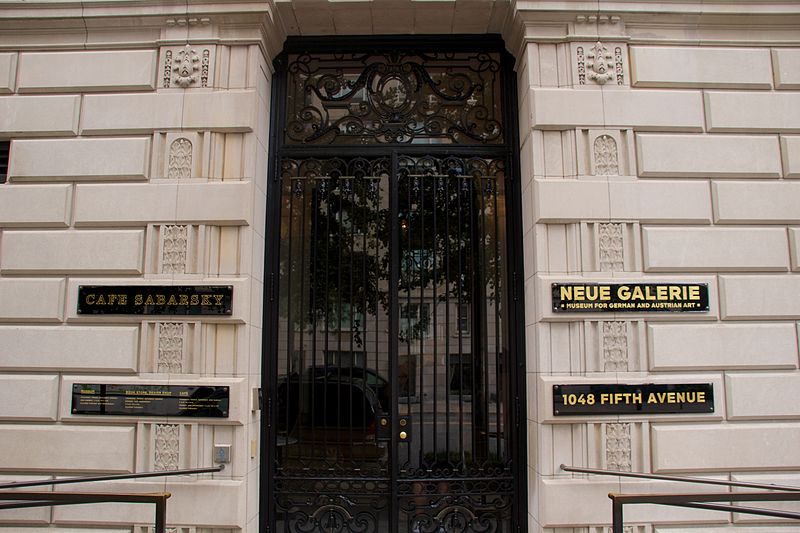
Walking around the Neue Galerie on Fifth Avenue, one cannot help but notice the purity of art that doesn’t feel obligated to have a “message” in order to be relevant. It is a freedom we have largely lost today.

The Neue Galerie, which is actually more of a museum than a gallery, houses businessman, philanthropist and World Jewish Congress President Ronald Lauder’s stunning collection of early 20th-century German and Austrian art. The landmark building, completed in 1914, was once the home of society doyenne Grace Vanderbilt.

The current exhibition, “The Luxury of Beauty,” presents a major retrospective of the Wiener Werkstätte (Vienna Workshops): a collection of artists and craftsmen that produced artisanal furniture and homewares in Vienna from 1903 until 1932. The Werkstätte’s historical significance cannot be overstated: It essentially transformed the realm of design.

Founded by painter Koloman Moser, architect and designer Josef Hoffmann and Fritz Waerndorfer, a Jewish textile magnate who provided the funding and management, the Werkstätte had a single, fairly ambitious intent: the beautification of everyday life. Their goal was to elevate everyday objects to the stature of art, and for that art to reach the broadest possible audience. The Werkstätte was the first to create and implement a democracy of beauty.

Author Hermann Broch called fin de siècle Vienna “a joyful apocalypse,” in which an old order was crumbling and a new, uncertain one was emerging. As a result of the Vienna Secession, an avant-garde movement that began in 1897, part of that new order was a desire to unify art and design, to eliminate the distinction between fine and applied arts — to counter the impersonal character and low quality of goods made by industrial means. An elevation of design, the Secessionists believed, would elevate lives.

With more than 400 objects in four rooms, the Neue Galerie’s exhibition surveys the entirety of the Werkstätte’s extensive output in a variety of media — ceramics, drawings, fashion, furniture, glass, graphic design, jewelry, metalwork, textiles and wallpaper. Guided by the genius of Hoffmann and Moser, many of the pieces hit what I consider the sweet spot of design; they feel simultaneously innovative and timeless, modern and classic. They touch the soul of beauty.

Consider, for instance, Hoffmann’s exquisite glassware. The simple lines belie a sensuality that remind me of a quote from Goethe: “The soul that sees beauty may sometimes walk alone.” Fortunately, many of Hoffmann’s glass pieces are still being produced by J. & L. Lobmeyr, and can be ordered through the Neue Galerie’s website.

Just as fresh are the graphics of Moser. If you peel back five layers of what we have come to call Art Nouveau, you will find Moser’s crisp yet ethereal reinterpretations of the patterns of nature. In Moser’s work, you can also vividly feel the Secessionist motto: “To every age its art, every art its freedom.”

A desire to again create beauty for beauty’s sake.

With its emphasis on craftsmanship, the Werkstätte struggled financially from the beginning. It was supported by a small group of artists and wealthy Austrian Jews. The appeal for both was the emphasis on individual artistic statements. “The Austrian style,” writes curator Christian Witt-Dörring in the opulent accompanying catalog, “offered the assimilated Jewish population the potential of a feeling of belonging that was not defined in terms of nation.”

Financial issues finally forced the Werkstätte to close in 1932, but its legacy of everyday beauty lives on in our gorgeously designed spatulas, toaster ovens and linens. The genius of the artists also can be seen in how hard it is today to find that sweet spot — the soul of beauty. We travel back and forth from soulless modernism to overdesigned postmodernism, neither of which can elevate the spirit as exquisitely as soulful beauty.

Perhaps this magnificent retrospective, on view until Jan. 29, will inspire artists and designers to reach for that timeless ideal. Perhaps it also will inspire a new freedom for 21st-century artists: a desire to again create beauty for beauty’s sake. After all, as Phil Ochs put it, in such ugly times, the only true protest is beauty.


Karen Lehrman Bloch is a cultural critic and author. Her writings have  appeared in The New York Times, The New Republic, The Wall Street Journal and Metropolis, among others.

The Soul of Beauty Read More »

Standing Up for Freedom

For the tens of thousands of Iranian protesters who have taken to the streets across Iran to demand freedom, it’s déjà vu all over again. The last time Iran’s maltreated populace tried to break free from Islamofascism during the Green Movement in 2009, the mullah regime orchestrated a brutal crackdown with the tactical consent of the impotent West.

Almost a decade after that fateful, bloody summer, the Iranian people are still being held hostage by the same clerical regime. That’s right, President Hassan Rouhani is a moderate in name only, who proudly carries on the torch of Khomeinism.

Something has changed, however, in that a new man has entered the White House, giving protesters a fighting chance to stand tall in the face of absolute tyranny.

President Donald Trump has come down on the right side of history. Breaking with his predecessor’s appeasement policy toward Iran, Trump has firmly thrown his weight behind the people’s noble quest for freedom.

Meanwhile, the reactions of other Western governments have been at best scandalously muted, and at worst shockingly indifferent or even morally ambiguous.

The U.K.’s foreign minister, Boris Johnson, said his government “regret[s] the loss of life that has occurred,” which sounded more like condolences to a tragic accident than a clear message to a regime mowing down its own citizens. His German counterpart, Sigmar Gabriel, drew an equivalence between the oppressed and their oppressors when he called on “all sides” to show restraint.

Europe’s moral myopia makes America’s leadership all the more critical. We can lead the way by burying, once and for all, the destructive myth brought to life by the Obama administration, that the mullah regime is a legitimate partner. By kicking the nuclear accord back to Congress, the president has taken a critical first step.

“Hungry” is a word protesters chant over and over again to describe the Iran of today. They are hungry because they are suffering from poverty, and they are hungry for freedom. Supporters of the nuclear deal predicted that the billions of dollars released to Iran from sanctions relief would inject new life into the ailing Iranian economy and usher in an era of political reforms.

But instead of bringing food to the table, the mullahs have exported chaos and destruction to the region — funding the killing fields of Syria, supporting the Houthi insurgency in Yemen, and building precision-weapons factories in Lebanon.

As much as we may like it to, the Iranian regime is not going to fall tomorrow. What is playing out on the streets of Iran is only the beginning of a long, painful process.

Iran’s clerical tyrants have survived mass demonstrations before. If the Iranians are to stand a chance in their fight against their oppressors, America must take concrete steps to hit the regime where it hurts. Some steps we can take alone; others we must take in partnership with our allies.

The U.S. and its allies must cut off the financial bloodlines the regime uses to fund its atrocities: The Central Bank of Iran, and the personal business empire of Iran’s supreme leader, Ayatollah Khamenei.

What is playing out on the streets of Iran is only the beginning of a long, painful process.

We must also work with social media giants WhatsApp, Telegram, Twitter and other platforms to prevent the regime from using their codes to identify and persecute activists with prolonged prison sentences or even death. It’s also important to work around the regime’s cyber-ban that cuts off Iranians from the outside world.

It is crucial to isolate Iran on the international diplomatic stage. European governments must no longer roll out the red carpet for the architects of the clerical regime in hope of lucrative business deals. And universities and media companies must no longer give Iranian officials a free pass as long as journalists, academics and activists remain in jail without due process.

In short, if Iran wants to be treated like a normal country, it must act as a normal country.

One cannot help but wonder how Iran would look today if the West, spearheaded by the Obama administration, had not been so accommodating to the Iranian regime in the summer of 2009. We need freedom-loving people everywhere to stand with the Iranian people and correct the mistakes of the past.


Sarah Stern is founder and president of the Endowment for Middle East Truth, a pro-Israel-American think tank in Washington, D.C.

Standing Up for Freedom Read More »

Missing College Student’s Body Found in Orange County

UPDATE: The body of Blaze Bernstein was discovered Jan. 9 in Borrego Park in Lake Forest. His death is currently being investigated as a homicide and no suspects have been identified yet.

ORIGINAL STORY:

Blaze Bernstein, a 19-year-old  pre-med student at the University of Pennsylvania who returned home to Orange County for winter break, disappeared on Jan. 2. His sudden disappearance has shaken his family and the community.

His parents, Jeanne Pepper and Gideon Bernstein, immediately launched  a Facebook group called “Help Us Find Blaze Bernstein” hoping to find out what happened to their son and bring him home.

From what little they know, Blaze asked a high school friend late on the night of Jan. 2 to drive him to Borrego Park in Foothill Ranch to meet a third person. Blaze left the house without telling his parents and went with his friend to the park, located about five minutes away.

According to the friend, Blaze got out of the car around 11 p.m. while the friend went to use a restroom. When the friend returned, Blaze was gone and has not been seen since.

“Everyone has been so supportive — teachers, students, all the community.” — Gideon Bernstein

The friend sent text messages to Blaze but got no response. The friend then left the park but returned at 4 a.m. to look again.

Eventually, the location device on Bernstein’s phone, which he had borrowed from a relative, stopped functioning and the phone was turned off at 11:30 p.m.

The Orange County Sheriff’s Department said it doesn’t suspect foul play, and that the friend is a witness, not a suspect.

Blaze’s parents told the Journal they are hopeful their son will return home.

“It’s surreal. We have been waiting for him to come in the door any minute now,” Gideon Bernstein said. “We are trying to do everything we can to get his picture out there and hope that someone recognizes him.”

Gideon Bernstein, who serves as the chairman of the board of the Jewish Community Foundation of Orange County, said the help the family has received from the community has been overwhelming.

“There is no downtime. We are constantly busy,” the father said. “Right now, we have people downstairs who are working on the Facebook page we opened for Blaze. Only late at night, when everyone leaves and we are alone in our room, we let ourselves break down and cry.”

“He left our house that night with no wallet, no money, no identification, no credit cards, no keys, no eyeglasses,” Jeanne Pepper said. “This is someone that needs to wear eyeglasses.”

Gideon Bernstein said he hadn’t noticed anything amiss with his son. “He recently became managing editor of the foodie magazine at the University of Pennsylvania, called Penn Appétit,” he said. “So, he was very excited about that. He was working on that over the winter break and showed us the magazine they just published, which he significantly contributed to.”

Blaze, he said, was planning to declare a major in psychology with a minor in chemistry and “pursuing it with a pre-med focus.”

“He was having a good time with us and in good spirits,” he said.

Blaze’s parents didn’t know their son was missing until the next morning, Jan. 3, when they realized he hadn’t slept in his room.

Two dozen reserve sheriff’s deputies conducted an extensive, three-day search around the the 2,500-acre park at Whiting Ranch but found no clues, said sheriff’s spokeswoman Carrie Braun.

During the search, Blazes parents also used camera-equipped drones to comb the area.

The couple’s other two children, 14 and 17, returned to school this week with the help of a therapist. “Everyone has been so supportive — teachers, students, all the community,” Gideon Bernstein said. “Some celebrities also picked up on the story and are trying to spread the word. Kobe Bryant highlighted us — Keyshawn Johnson, Jeremy Piven, the Housewives of Orange County and Matisyahu.”

Gideon Bernstein said he doesn’t want to speculate about what happened to his son.

“My message to Blaze is simply that we want him home, at all cost, and we don’t care why and what happened. We just want him home.”

Missing College Student’s Body Found in Orange County Read More »