








fbpx

The Stem Cell Slippery Slope Fallacy

[additional-authors]
March 9, 2009

Of all the ” title=”man-on-dog” target=”_blank”>man-on-dog sex,” I suppose I shouldn’t be surprised.

The anti-stem-cell slippery slope argument goes like this: If you permit scientists to destroy human embryos for the purpose of research, it’s a slippery slope from there to killing human fetuses in order to harvest tissue, and from there to euthanizing disabled or terminally ill people to harvest their organs, and from there to human cloning and human-animal hybrids, and if making ” title=”tiny human being” target=”_blank”>tiny human being with a soul, and anything that stops it from becoming a fully-developed person is evil and must be outlawed.  This way of thinking leads not only to ruling out exceptions for abortion in cases of rape, incest, a fatal genetic disorder or a threat to the mother’s health; it also means a ban on in vitro fertilization, because that technique also leads to the destruction of superfluous embryos, unless of course you’re the octo-mom, but let’s not go there just now.

The when-life-begins argument is about logical consistency.  Life is life, period, and no compromise, even for the most compassionate of reasons, is possible.  How then do its adherents justify, say, killing people in self-defense, or in war?  The answer is that those circumstances are sanctioned by the Bible, every word of which was divinely written.  If that’s fundamentally what you believe, then there’s no slippery slope to be concerned about, because you never need to make exceptions to the rules, because all the rules come straight from the Creator.

But the slippery slope argument is all about exceptions.  It doesn’t require believing that legal rules come from moral rules that in turn come from on high.  Instead, it’s about what you believe coming from down below, from our innards and our evolutionary forebears.  Call it hardwiring, or call it psychology; it doesn’t matter.  What counts is a fundamentalism about human nature.

This view of how people are, deep down, is implicit in the metaphor itself.  Picture a person on a steep mountaintop.  Then imagine him taking a step off the summit and onto an ice-covered slope.  (Please don’t be offended that I’m not saying “him or her”; this guy has got to be pretty stupid to take that step.)  And following that step comes a cartoonish blur of whirling legs and arms, and before you know it the guy is tumbling ass over teakettle down the slope, a human snowball banging into trees, helplessly accelerating toward the fatal crevasse below.

What this case against stem cell research is saying is that people are basically animals, slaves to their appetites, incapable of restraining themselves, biologically unequipped to make complex rules, or draw fine distinctions, or debate exceptions, or enforce differences.  If we make one exception, and permit a scientist to culture stem cells from discarded human blastocysts, then when that scientist wants to make cowumans and humabbits, society will be totally flummoxed, completely paralyzed, incapable of drawing a legal line and saying no.

If this were actually true, then the message society sends when police don’t stop everyone over the speed limit on the freeway is that it must also be OK to be a hit-and-run driver.  You know, there’s a slippery slope between not arresting someone for smoking a joint and letting drug cartels destroy our cities.  If you can restrict the sale of semi-automatic rifles, then you can ban the right to bear arms.  If a shoplifter gets off easy, what’s to stop a Bernie Madoff from being allowed to walk?  If you make hate speech a crime, then it won’t be long before free speech is a crime.

During George W. Bush’s long summer vacation in 2001 – the summer when he dismissed the CIA briefer who told him that Bin Laden was determined to strike in the United States with “All right, you’ve covered your ass now” – the big news out of Crawford was his Solomonic decision to permit federally-funded research only on the 78 stem-cell lines already created in privately-funded labs.  Those murders, he signaled to his base, had already been committed, so we might as well get some good out of the crimes.

It turns out that only about 20 of those lines were actually usable in laboratories.  As a result, over these last 7 1/2 years, when stem-cell researchers might have been racing toward therapies for diseases like juvenile diabetes, cystic fibrosis and muscular dystrophy, they have instead had federal anvils chained to their ankles. 

Today, some of those protesting President Obama’s reversal of President Bush’s limits are saying that we don’t need any new lines of embryonic stem cells, because recently discovered techniques, like reprogramming human skin cells into iPS – induced pluripotent stem cells – make it unnecessary to depend on embryos.  But the

Did you enjoy this article?
You'll love our roundtable.

Editor's Picks

Latest Articles

A Bisl Torah — All Over Again

Repenting includes examining and admitting our mistakes. Seeking forgiveness. Determining to do better. Being better. Every single day.
Hanging Out at the Jewish American Summit

Among the speakers, Adam Milstein, a real estate investor, philanthropist and co-founder of the fast-growing Impact Forum, urged attendees to frame antisemitism as an American issue and not just a Jewish issue.

A Festive French Roast

One of my favorite things to cook for the Jewish holidays is a beautiful French roast. It’s so very festive and is perfect to feed a hungry crowd.

The Genius of the Marx Brothers

Like the greatest satirists, such as Jonathan Swift and Mark Twain, they chose comedy over accusation to mock the folly of society and add levity to dark times. But their aim was not levity alone.

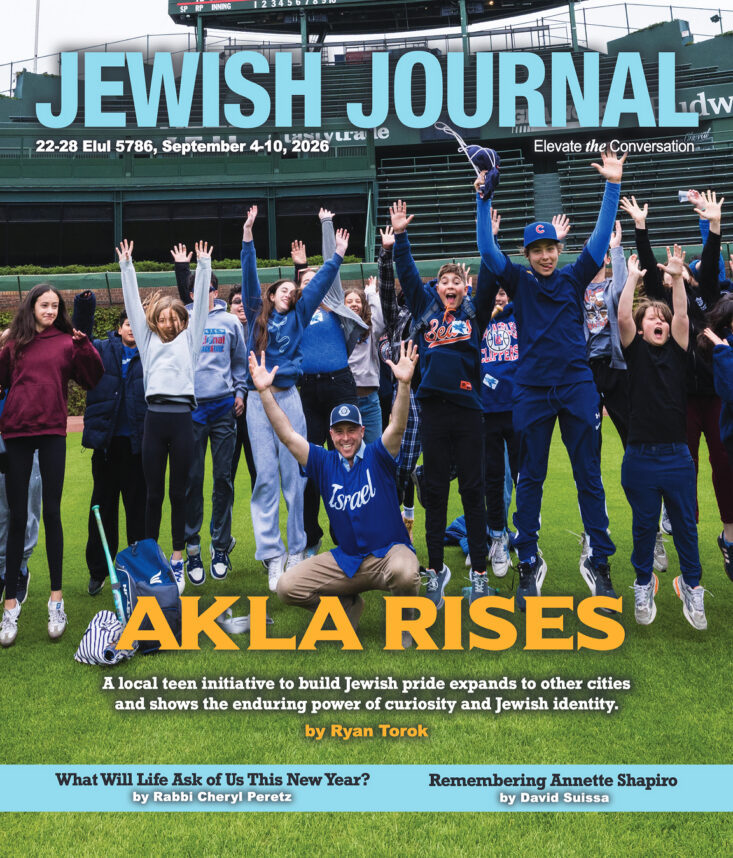
AKLA Rises

From a Local Experiment to a National Program: AKLA Expands Its Vision for Jewish Teens

Better Kisser Than a Cook

Sometimes love arrives ahead of you, in spite of you. Cooking slowly became a way of being there for the people I love. A wordless language that says: I see you. I hear you. You’re worth the onion-chopping.

Israel’s Brain-Drain Debate Is Asking the Wrong Question

If an experienced professional with rare expertise leaves Israel, the impact cannot be understood simply by adding another person to a brain-drain statistic. The more relevant question is how many people with comparable experience remain, how essential that expertise is and how easily it can be rebuilt.

A New Borscht Belt?

If renewed exclusion teaches us only to become more protective of Jewish work, we will have learned the wrong lesson from the original Borscht Belt.

More news and opinions than at a Shabbat dinner, right in your inbox.