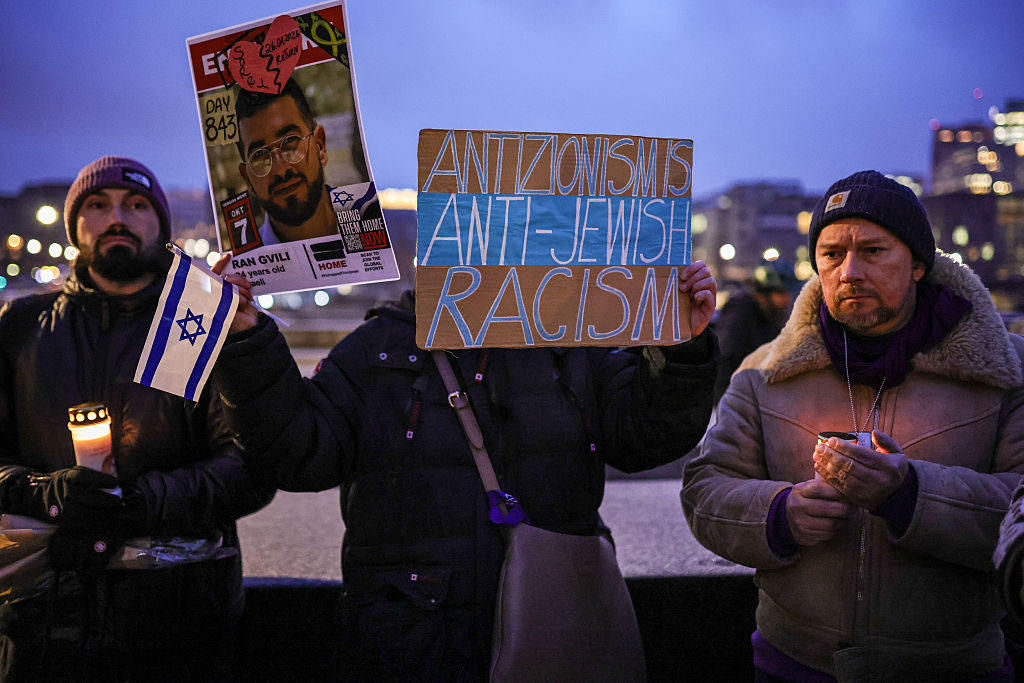
One of the toughest nuts to crack in the pro-Israel world is how to deal with the alarming rise in the hatred of Zionism, what is commonly known as anti-Zionism.
Given that Israel is the Jewish state, this hatred of Zionism inevitably bleeds into the hatred of Jews. I won’t bore you with something we’re all too familiar with— to avoid the ugly charge of anti-Semitism (which is still taboo), Jew-haters need only hide behind the bashing of Zionism.
Simply put, it sounds a million times better to say I’m against Zionism than to say I’m against Jews.
But just as Jew-haters use anti-Zionism because it’s not taboo, defenders of Israel use anti-Semitism because it is taboo.
Even when it’s true (as it often is), the problem for Israel defenders is the convenient rebuttal: I’m not against Jews, I’m against Zionism. And since Zionism has become such a dirty word, that rebuttal tends to resonate.
Indeed, Zionism has become so toxic that we’re not hearing much these days about the IHRA definition of anti-Semitism, which incorporates things like “denying the Jewish people their right to self-determination” and applying double standards against Israel. Especially since Oct. 7 and the war in Gaza, the hurricane against Zionism has trammeled virtually everything in its path.
Israel defenders are left with only tough choices: either continue to lead with anti-Semitism (which is easy to rebut), or make the case that anti-Zionism itself is a sin of its own– as taboo as anti-Semitism.
Two initiatives have emerged that aim to do just that: Movement Against Antizionism (MAAZ) and Stop Antizionism (SAZ). (Both groups spell antizionism without a hyphen).
On its website, MAAZ has a short and long definition of antizionism.
The short one: “Antizionism is hatred of Israel.”
The long one: “Antizionism is an ideology that treats the existence of Israel as an inherent crime. It emerged from three key sources: the Nazi-Islamist axis of the 1930’s-1940’s, postwar Soviet-Arab-nationalist propaganda (1956-1989), and Western academic settler-colonial theory (1990’s-present). Synthesizing these lineages, antizionism advances three core libels—colonizer, apartheid, and genocide—circulated not as contestable claims but as axioms that preempt debate. This ideology works to justify the elimination of Israel, normalize campaigns of isolation and terror, and extend repression beyond Israel itself by marking Jews worldwide as ‘Zionists,’ a category used to justify exclusion, intimidation, purges, and violence.”
Similarly, Stop Antizionism, which held a major conference recently in Toronto, describes antizionism as a “libel-driven hate movement,” the latest manifestation of the world’s oldest hatred.
On its activist website, it includes a declaration and educational tools, and identifies the “core tactics” of antizionism:
- Libel: Most often, blood libels such as “genocide,” “colonizer,” or “apartheid.”
- Conspiracy Theories: Claims about Jewish/Zionists world domination.
- Scapegoating: Blaming Jews/Zionists for conflicts or problems unrelated to them.
- Stigmatization: Isolating and excluding Zionists as unacceptable in public and private spaces.
- Denial: Dismissing or minimizing attacks and suffering of Jews (October 7 denial is one example).
- Justifying Violence: Asserting that harm to Israelis/Jews/Zionists is warranted or deserved.
- Dehumanization: Portraying Israelis/Jews/Zionists as subhuman, demonic, or uniquely evil.
- Tokenization: Using antizionist Jews to launder or shield hate.
- Eliminationism: Calling, explicitly or implicitly, for the destruction of the state of Israel or expulsion/murder of its citizens.
Both MAAZ and SAZ describe the complex historical connections between Zionism and Jews, but in a way that clarifies the singular sin of antizionism. Antizionism, in other words, is wrong whether or not it is antisemitic.
Conveying that message is crucial for the future of world Jewry; we can’t allow the antizionist libels and hate to go unanswered and endanger Jews.
At the same time, it’s also a bedeviling mission: How does one make antizionism a sin when much of the world already sees Zionism itself as a sin– when calling someone “antizionist” feels like a compliment?
There’s no magical answer, but one weapon we might add is to turn the tables and show Zionism as a blessing rather than a sin.
I’ve written about this in the past, so allow me to quote from a 2025 essay titled, “Zionism is Great for the World.”
As I wrote: “Just as there is plenty of truth to challenge the libelous accusations against Zionism, there is plenty of truth to support the claim of Zionism’s value to the world.”
I noted the shock value: “The country that is most maligned on the planet — the Zionist state — turns out to be one of the top contributors to that same planet.”
I brought the receipts– the overwhelming evidence.
“Zionism is about building, about creating, about prevailing against all odds, about having faith in our strength and our destiny.”
I quoted my friend Gil Troy: “Zionism is one of the most successful forms of liberal democracy ever invented — a kind of nationalism that has created a productive society and a happy people — rooted in the past, thriving in the present and helping to invent a better future.”
Then I doubled down on the evidence:
“Go down the list of the world’s biggest problems — health care, cybersecurity, food insecurity, climate change, harnessing solar and wind power, fighting diseases, helping people with special needs, dealing with mental trauma, among so many others — and you will find Zionists who are delivering at the highest levels.”
You get the idea.
This pro-Zionism angle is by no means a replacement for the important campaigns against antizionism, which convey critical truths.
Rather, it’s a complementary weapon that might help us crack the nut while boosting Zionist morale.
And in the process, maybe even shock and rattle a few antizionists.