fbpx

August 6, 2026

Beyond the Nebbish: New Hollywood Initiative Seeks to Transform Jewish Representation on Screen

For generations, Hollywood has been filled with Jewish voices — but Jewish identity itself has often been portrayed through a limited lens. The familiar neurotic Jewish character who complains, worries or turns traditions into a punchline has become a recurring presence on screen. The humor is often brilliant, and self-deprecation is deeply rooted in Jewish culture, but Allison Josephs believes Hollywood has rarely explored another side: ordinary Jews from all walks of life who are openly proud of and connected to their heritage.

Josephs, a writer, producer and Jewish advocate, has spent nearly two decades working to change the way Jews are portrayed in media. In 2007, she founded Jew in the City, an organization created to challenge misconceptions about Orthodox Jews through storytelling. In 2021, she expanded that mission by launching the Jewish Institute for Television & Cinema (JITC) Hollywood Bureau, an initiative dedicated to promoting authentic and nuanced portrayals of Jews, Judaism and Israel in film and television while challenging stereotypes in entertainment.

“I think there has always been a reticence in Hollywood to show Jews just unapologetically enjoying being Jewish,” Josephs said. “What you have is a certain archetype of our Larry David character who’s whining, kvetching, complaining that the service is too long and the sermon is so boring. We have Jon Stewart with a bit about why Easter is so much better than Passover, they have chocolate bunnies and chocolate eggs, and we have hard-boiled eggs. And yeah, it’s funny. Chocolate is better than a hard-boiled egg. But at the same time, why do we always have to dunk on ourselves?”

That question — how to expand the range of Jewish stories being told in Hollywood — is at the heart of JITC’s new Jewish Roots Screenwriters Collective, a fellowship designed to help working writers develop film and television projects rooted in Jewish identity, ethical traditions and moral values.

The idea began taking shape in the aftermath of Oct. 7, 2023, when concerns about rising antisemitism were growing in Hollywood and beyond. At the Variety Antisemitism Summit in 2023, philanthropist Daniel Loeb delivered a message that stayed with Josephs.

Loeb, who is deeply committed to Jewish life but is not traditionally observant, spoke about the power of Jewish learning and encouraged the audience not simply to respond to antisemitism with complaints, but to reconnect with Jewish wisdom and texts. For Josephs, the message raised an important question: Could Jewish learning serve as a source of inspiration for Hollywood storytellers?

At the same time, Josephs was examining what had worked for other communities in improving representation in entertainment. When she launched the JITC Hollywood Bureau, her goal was to create for Jews the kinds of programs that other groups had successfully used to bring more authentic stories to the screen. But she quickly realized that the challenge facing Jewish representation was different.

Many existing writers’ labs were designed to help underrepresented groups gain access to the industry and secure opportunities. But that was not the primary obstacle for Jewish creators, Josephs noted.

“I couldn’t say to the studios: Jews need jobs. Jews don’t work in the industry — that’s not true. From the start, Jews have always had jobs in the industry,” she said. “I needed a different angle.”

Josephs said the answer was to create an initiative that would help Jewish writers reconnect with the depth of their own heritage and draw from Jewish history, traditions and values as a source of creative inspiration.

The goal was not simply to create more Jewish characters, but to encourage writers to bring more of their own heritage and lived experience into the stories they tell.

Research conducted by JITC and the Norman Lear Center’s Media Impact Project helped confirm some of Josephs’ concerns. The study found that Jewish characters were often portrayed through stereotypes and that Jewish identity was frequently minimized or hidden rather than explored in meaningful ways. It also revealed disparities in representation, including that Jewish women were less likely to be cast in Jewish roles compared with their male counterparts.

“The study gave us proof of the hunches that we had,” Josephs said. “We had hunches that stereotypes were prevalent … but what we were not expecting was that Jewish identity was hidden.” The findings helped define the purpose of the collective: helping writers draw on thousands of years of Jewish history, ethics and tradition.

The concept moved quickly from an idea to reality. Applications opened soon after the announcement, and the inaugural cohort brought together 10 working writers whose credits include “Grey’s Anatomy,” “The Good Doctor,” “Physical,” “Upload,” “A Small Light,” “Dickinson,” “S.W.A.T.,” “Robot Chicken” and “Kung Fu.”

For Josephs, the program also addresses a much older tension in Jewish American history: the relationship between visibility and assimilation. For generations, many immigrant and minority communities learned to downplay aspects of their identities in order to avoid discrimination. Josephs pointed to a pattern of “covering” — changing names, altering appearances or hiding cultural practices in order to fit into the mainstream.

“Historically, different minority groups would cover when they came to work,” Josephs said. “They would use their English name instead of their ethnic name, they would straighten their hair, they would bring in American food instead of ethnic food. There was a sense for many decades in this country that the way that you protect yourself from discrimination is by flattening your identity and erasing your identity and kind of becoming more of the American norm.”

Other communities, she said, have since moved away from that model, embracing the idea that visibility and pride can lead to greater acceptance. Josephs believes Jewish representation is now at a similar crossroads. For many early Jewish Hollywood pioneers, assimilation was often viewed as a path to safety and success. Many of Hollywood’s founders were Jewish immigrants who escaped antisemitism in Europe only to encounter discrimination in the United States.

“There were industries that shut Jews out — real estate, law, medicine and others,” said Josephs. “So Jews went out and built their own institutions, including hospitals, law firms and, eventually, Hollywood. But the message they received was that even in America, they would be safer and more accepted if they were a little less Jewish.” And so, while Hollywood has always been very Jewish, you could never be too explicitly Jewish.  “That was exactly frowned on,” said Josephs.

The Jewish Roots Screenwriters Collective was created, in part, to challenge that legacy by giving writers new creative tools. Rather than relying on familiar tropes, participants explored Jewish texts and traditions as a foundation for developing characters, conflicts and narratives.

The workshop was organized around core Jewish values, including courage, joy, shalom bayit (peace in the home) and teshuvah (return or transformation). Writers examined how these concepts appeared in Jewish sources and how they could inform contemporary storytelling.

Could a character draw courage from the example of King David? Could a story explore the importance of choosing peace over resentment within a family? Could Jewish traditions around joy, responsibility and repairing relationships inspire new kinds of characters? By reconnecting writers with these sources, Josephs hoped the program would provide not only inspiration for their work, but also a deeper connection to Judaism.

The projects that emerged reflected a wide range of genres and perspectives — from young adult stories and science fiction to historical dramas and contemporary relationships. Several writers explored the relationship between Black and Jewish communities, a topic Josephs said felt particularly timely as many people seek ways to strengthen connections between the two groups.

One project explored a love story that, at its core, could resonate with any audience — but featured characters from different Jewish ethnic backgrounds. For Josephs, that captured the larger goal: creating Jewish stories that are universal in their themes while allowing Jewish identity to exist naturally within the narrative.

Josephs said writers were encouraged not to make Judaism itself the central conflict, but to tell stories in which Jewish characters experience the same universal emotions, relationships and challenges as everyone else. She noted that this reflects a broader shift in Hollywood, where other communities have also pushed for stories that are not defined solely by identity struggles.

“The story and the conflict should be a human conflict, a universal conflict,” Josephs said. “The tapestry of the story is the identity that just folds in.”

The same philosophy applied across genres, including a sitcom centered around a family — a story designed to appeal to a broad audience, with Jewish identity woven naturally into the characters and their world.

The response, Josephs said, exceeded expectations. The writers described the experience as personally meaningful, saying it strengthened their connection to Judaism, influenced the stories they wanted to tell and helped build a new sense of community. Industry executives and producers who participated as mentors and panelists were also impressed by the range and originality of the projects.

For Josephs, the question of representation extends beyond Jewish characters to portrayals of Israel and Israelis on screen. She believes there has been a shift in recent years, particularly after Oct. 7, with Israeli characters increasingly depicted through the lens of violence and brutality.

Historically, Israeli characters in Hollywood were often associated with military or security roles — the Mossad agent, the soldier or the character skilled in Krav Maga — but they were generally portrayed as protagonists or figures audiences were meant to support. Josephs believes that portrayal has changed.

“We are seeing an increase in Israeli characters being more violent in recent years,” she said. “We are seeing the blood libel and the viciousness of the violence being directed at Israeli characters when they used to be characters basically involved in fighting but they were the good guys.”

Asked whether such portrayals influence viewers’ perceptions of Israel and Israelis, Josephs said the impact of media representation is well documented. “One thousand percent,” she said. “There is a ton of research showing from other communities, and we’re working on more research now since the Norman Lear study, that what people see on the screen influences what they think of the group.”

Josephs pointed to research showing that positive and complex portrayals can help humanize communities that audiences may not otherwise understand. She cited studies examining the impact of shows such as “Will & Grace” on attitudes toward LGBTQ people, as well as research on the representation of Black and Muslim communities.

“These are called impact studies,” she said. “The good representation makes people think better about the community, and the bad representation makes people feel worse about the community.”

As the inaugural cohort moves forward with their projects, Josephs hopes their work will help expand the way Jewish stories are imagined in Hollywood — moving beyond stereotypes and toward characters whose Jewish identities add depth to their stories rather than define them completely.


Beyond the Nebbish: New Hollywood Initiative Seeks to Transform Jewish Representation on Screen Read More »

Bringing Israeli Doctors Back

Israeli physicians and scientists leave the country for fellowships, postdoctoral work, medical school and research jobs that can last several years. Overseas hospitals and institutions may offer them positions, salaries can be higher and their children begin building lives abroad. By the time they consider returning, a temporary move may have become permanent.

ScienceAbroad works to keep those departures from becoming permanent. The Israel-based nonprofit was founded in 2006 to support Israeli scientists and physicians before they leave, while they work overseas and when they consider coming back. Its programs include medicine, biotechnology, engineering and academia communities, conferences, webinars, job listings, employer introductions. They also coordinate flight grants and help navigate with Israeli bureaucracy. Nadav Douani, ScienceAbroad’s CEO since September 2019, is leading those efforts.

“They’re spending another two to three years abroad, and the kids grow up,” Douani told The Journal. “They’re becoming American or Canadian citizens. They may try to come back to Israel, but they’re staying abroad.”

Douani, a former senior advisor in Israel’s Ministry of Science and Technology, said ScienceAbroad’s mission is to bring Israeli physicians and researchers home and connect them with Israel’s healthcare and scientific institutions. He also sees a return to Israel as a chance for physicians to serve patients through the country’s public healthcare system.

ScienceAbroad estimates that about 70% of the scientists who have participated in its overseas communities have not returned to Israel. A 2024 study of 297 Israeli physicians who pursued fellowships abroad found that 156, or 52.5%, were living outside Israel at the time of the survey. Forty-eight of those physicians had completed their fellowships and remained abroad. Among those physicians who remained abroad, 69% reported medium or low confidence that they would return. Higher salaries, Israel’s political and social climate and better work-life balance were the leading factors encouraging them to stay overseas. A guaranteed job in Israel was associated with 8.6 times greater odds of high confidence in returning. A position that would use skills acquired during the fellowship was associated with 3.5 times greater odds.

Douani said physicians may find higher salaries and a different work-life balance in the United States. In Israel, he said, shifts can last 24 or 36 hours. “So this is a gap that we in Israel were not able to cover,” Douani said.

ScienceAbroad works with two groups in medicine: physicians who leave Israel for fellowships and Israeli students who attend medical school in Europe. Douani said Israel does not have enough medical-school seats for every qualified applicant. The Knesset Education Committee reported in 2025 that 1,448 students were expected to begin medical school in Israel during the 2025–26 academic year, compared with about 1,100 in 2023–24. The Health Ministry has set a goal of training 2,000 first-year medical students per year by 2030. “A lot of Israelis are moving to Europe, to the Czech Republic, Italy, Hungary, Romania, those kinds of countries,  to learn to be physicians over there,” Douani said. Some Israeli students spend five or six years studying medicine in Europe before returning to take Israel’s licensing examination.

Douani said a Ministry of Health loan program can reduce or forgive tuition debt for physicians who return to needed specialties or regions. A physician entering geriatrics at Ziv Medical Center in northern Israel may qualify for full support, while a doctor entering a field with less demand in central Israel may have to repay the loan. “So the Israeli government tries to encourage people by paying almost all their tuition, this is the word, by paying all the tuition, but it depends what they’re going to do,” Douani said.

Douani said while returning physicians can work in Israel’s public and private healthcare systems, Israel cannot match some American salaries. “If you’re a physician and you are obligated to the oath and you see yourself as someone that serves everyone and wants to save lives and help people to have a better life, in Israel you can do that,” Douani said.

Patients in Israel’s public system can wait three to six months for some specialists, Douani said. Patients who pay for private care may receive an appointment within a week. Asked whether Israel was prepared to meet the demand for mental-health care created by war, attacks and years of rocket fire, Douani gave a direct answer. “No, it’s very simple,” Douani said. Wounded soldiers, survivors of the attacks in southern Israel and children raised under rocket fire need care.

“We say all the time that Israel is a country in a trauma, that we are all suffering in some way from a trauma,” Douani said. “So I can say this is a very radical way of saying that, but I’m saying that people need help, and unfortunately there is not enough.”

Douani said medication alone could not meet the full need. “This is not a way to support,” Douani said. “You need to take care of their health, their mental health by understanding and give them ways to support that.” The ScienceAbroad Global Israeli Applied Science Symposium is scheduled for Sept. 8, in Tel Aviv, with online participation available. The agenda includes research in medical imaging, cancer immunotherapy, genome editing, robotics, tremor treatment, brain stimulation involving ADHD and PTSD drug development.

“We are on our side doing two missions,” Douani said. “One is to bring back those Israelis that move abroad to do their fellowship, make sure they’re not staying and stuck. This is one. Second, is to have the Israelis that move abroad to do their Israeli students that move to Europe and bring them back, convince them to come back to Israel. I think it’s a privilege to live in Israel, work in Israel, raising your kids here, feeling safe, even though sometimes we’re under a war here, but you feel safe in the street, and this is important.”

Bringing Israeli Doctors Back Read More »

More Than Flavor: The Healing Power of Herbs and Spices

This week, Rachel and I share our column with our good friend Jill Sharfman. She and I became friends when we were both young singles on the Upper West Side of Manhattan. I returned to Los Angeles and she moved here too. While our paths crossed in social situations, it was when Rachel and I started writing this column that we reconnected with Jill. Jill, who trained as a holistic nutritionist, always shares invaluable insights into food and health. (Actually we’re a little jealous of her clients because she has a really sensible and calming approach to eating and nutrition!)

We hope you enjoy Jill’s recipes as much as we enjoyed making them with her.

—Sharon

At my Hungarian grandmother’s house, Shabbat didn’t begin on Friday night. It began days earlier.

By Thursday night, the table was already set, and the refrigerator was filled with enough food to feed a small army. There was stuffed cabbage, chopped liver, gefilte fish, sweetbreads or tongue polonaise, chicken soup with matzah balls, cabbage soup, mushroom barley soup, krautpletzle, roast chicken, pot roast, veal, potato kugel, sweet noodle kugel, salt-and-pepper kugel and so much more.

My grandmother Martha was an extraordinary cook, but fresh herbs and spices were rarely part of her repertoire. Born and raised in Brooklyn, she cooked the way many home cooks of her generation did, relying on the ingredients that were readily available. Salt and pepper carried most of the flavor. While traditional Central European cooking often includes herbs like caraway and tarragon, they may not have been easy to find at the time. She wasn’t grabbing handfuls of fresh rosemary or oregano from the garden, but she knew exactly what a generous spoonful of Hungarian paprika could do.

Today, our spice racks tell a different story. Beyond adding flavor, herbs and spices have been used for centuries in traditional cultures for their medicinal properties. Modern research is beginning to confirm what generations before us understood long before science could explain it.

First, a quick kitchen lesson. Herbs are the leafy part of a plant and can be used fresh or dried, while spices come from the bark, roots, seeds, flowers, or fruit. Cinnamon comes from bark, turmeric is a root, cumin is a seed, and peppercorns are actually dried fruit. Because they come from these concentrated parts of the plant, spices generally pack a bolder flavor.

Here are a few of the most valuable members of my spice rack:

Cumin

A member of the parsley family, cumin has flavored dishes for centuries while quietly supporting digestive health. Research also suggests it plays a role in weight loss, and managing diabetes, making this earthy spice a small ingredient with impressive potential.

Turmeric

The golden spice of Ayurvedic medicine, turmeric gets its superstar status from curcumin, a compound widely studied for its ability to support a healthy inflammatory response. Pair it with a pinch of black pepper to help your body absorb more of its beneficial compounds.

Cinnamon

Looking to sweeten your oatmeal without adding more sugar? Cinnamon helps control blood glucose levels in Type 2 diabetes and lowers blood pressure all while adding warmth and flavor to everything from breakfast to roasted vegetables.

Rosemary

Rosemary has quite a history. It was once used to embalm mummies, and ancient scholars believed it sharpened memory by tucking sprigs into their hair while studying. Today, research suggests it enhances cognitive function, reduces anxiety, fortifies the immune system and supports GI health.

Garlic

Botanically, fresh garlic is a vegetable, but in the kitchen it acts more like an herb or spice, adding bold flavor in small amounts. Much of the research on garlic’s benefits, including its role in supporting healthy cholesterol levels and immune function, has been conducted using fresh garlic. To maximize its beneficial compounds, chop or crush fresh garlic before using to help release allicin.

Oregano

More than a pizza topping, oregano is rich in antioxidants, bacteria-fighting elements, and antifungal compounds. It has long been valued for defending against infection while bringing bold Mediterranean flavor to everyday cooking.

Cayenne Pepper

Its fiery heat comes from capsaicin, a natural compound studied for its role in boosting metabolism, providing pain relief, and calming inflammation. A little cayenne goes a long way.

Paprika

If my grandmother reached for one spice, it was paprika. Beyond its beautiful color, paprika is rich in carotenoids that support eye health and delivers a healthy dose of antioxidants.

What I love most is that none of this requires an expensive supplement or a complicated wellness routine. You’re already cooking dinner, so why not let your seasoning do a little extra work? Simply reaching for a few extra pinches makes everyday meals more flavorful while adding an extra layer of nourishment.

As different as our kitchens may look today, I like to think my grandmother would appreciate that herbs and spices are doing double duty, adding both great flavor and lasting health benefits to the meals we prepare for the people we love.

Years ago, my father told me that of all his children, I cook the most like my grandmother. Considering the meals that came from her kitchen and the memories she created around her table, it remains the highest compliment I have ever received. I may reach for fresh rosemary, oregano, turmeric, cinnamon or ginger where she reached for paprika, but the goal is exactly the same: to gather family around the table and feed them food that nourishes both body and soul.

– Jill H. Sharfman, BCHN

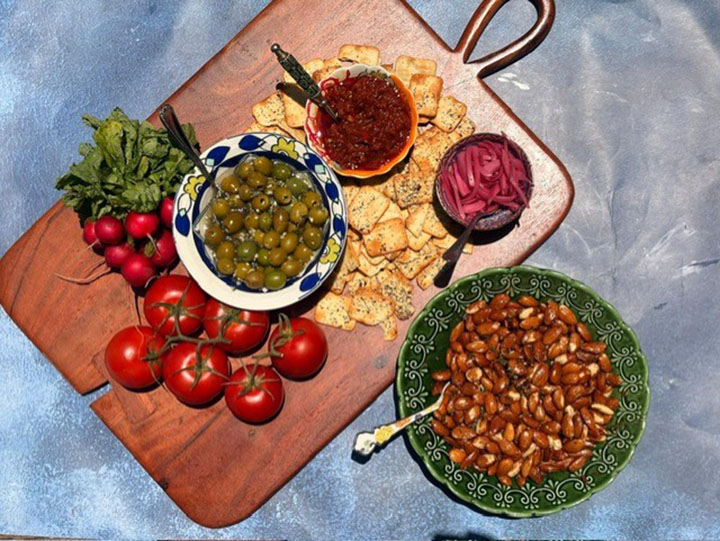
Rosemary Almonds

If you’ve ever been to my house for Shabbat dinner, there’s a good chance you’ve nibbled on one or both of these during the meal. They’re easy to make ahead, and they’re a delicious reminder that a few fresh herbs and spices can transform everyday ingredients into something special.

Makes: 8 servings

INGREDIENTS

4 cups whole almonds

1/3 cup extra-virgin olive oil

3 Tbsp fresh rosemary, finely chopped

1 tsp garlic, finely minced

Sea salt, to taste

1. Preheat the oven to 350°F.

2. Spread the almonds on a large baking sheet and toast for 12 to 15 minutes, or until fragrant.

3. While the almonds are toasting, combine the olive oil, rosemary, garlic and sea salt in a large bowl.

4. Add the hot almonds to the bowl and toss until evenly coated. Taste and season with additional sea salt, if needed.

5. Serve warm or at room temperature. Store in an airtight container or freeze for longer storage.

Marinated Garlic Olives

Makes: 4 servings

INGREDIENTS

1 Tbsp dried oregano

½ cup apple cider vinegar

2 tsp extra-virgin olive oil

4 cloves garlic, chopped or minced

2 cups pitted green olives

1. In a bowl, whisk together the oregano, apple cider vinegar, olive oil and garlic.

2. Add the olives and stir to coat evenly.

3. Transfer to a glass jar or airtight container and refrigerate overnight before serving.


Sharon Gomperts and Rachel Emquies Sheff have been friends since high school. Their cooking and storytelling project has grown into a devoted following on Instagram @sephardicspicegirls and on Facebook at Sephardic Spice SEC Food. Website ssephardicspicegirls.com/full-recipes.

Register to join them at their Sweet & Salty Simanim cooking demo for @yesh_tikva.org, September 1, 2026 7pm-9pm

Jill H. Sharfman, BCHN, is a board-certified holistic nutritionist based in Los Angeles. She was also the co-host of the Let My People Eat podcast. Follow her on Instagram @jill.sharfman.

More Than Flavor: The Healing Power of Herbs and Spices Read More »

Table for Five: Re’eh

One verse, five voices. Edited by Nina Litvak and Salvador Litvak, the Accidental Talmudist

However, be strong not to eat the blood, for the blood is the soul; and you shall not eat the soul with the flesh.

– Deuteronomy 12:23


Dini Coopersmith

Speaker and Trip Director, www.ReconnectionTrips.com

“Be strong”? Not to eat blood? With any other negative commandment, to abstain from something, the Torah uses the words “Hishamer lecha – “Guard yourself,” or “be warned against.” Blood seems like a distasteful substance, which most people would naturally abhor. Why is “strength” necessary to refrain from eating it? The Torah continues to explain – blood is the soul of the animal, the life force within it, that carries the character of the animal. It almost has a live energy, an animalistic force or frequency. The Ramban comments interestingly that people used to eat blood as part of a black magic practice or witchcraft, essentially a form of idol worship, to obtain prophetic abilities, or even demonic powers, gleaned from the energy or consciousness within the blood!

This reminded me of an article I just read, about our modern age pursuit of psychoactive drugs or psychedelic-assisted therapy, which enhance consciousness and provide a spiritual experience or healing through inhaling, ingesting or smoking. The resulting insights occur almost instantaneously, miraculously, not as a result of real inner work and learning. And if belief in a shaman or a healer is necessary, this process seems to involve more than a whiff of idol worship …

Hashem says: Don’t go for the quick fix, do the real inner work of growth, change and connection to God. Trust that Hashem wants your best. Don’t resort to superstitious practices or occult traditions to reach insights or to foretell the future. And for this, one certainly needs to “be strong!”


Rabbi Bentzion Kravitz

Founder and Jerusalem Director of JewsForJudaism.org

An evangelical street preacher at UCLA drew a jeering crowd by shouting insults at ethnic groups and minorities. When he screamed “The Jews killed Jesus and are damned to hell” unless they accept Jesus as Lord and savior, a distraught student begged me to defend Judaism.

So, I demanded proof of his claim, and he argued that Jesus’ miracles proved his divinity. I countered using this week’s Torah portion, Re’eh. Specifically Deuteronomy 13 which warns that false prophets can perform signs to test our faith. So, miracles don’t prove someone is God or the messiah. I seized the opportunity to refute another missionary argument that misquotes Leviticus 17:11 as saying “There is no forgiveness of sin without the shedding of blood.” The verse correctly says, “blood makes atonement.” But it is not the only way! The Torah teaches that charity and prayer also provide atonement.

The focus of Leviticus 17 is about the prohibition of not consuming blood because it has a higher purpose. This is repeated in this week’s parsha that states “Be strong not to eat the blood, for the blood is the soul; and you shall not eat the soul with the flesh.” There are two takeaways. First, the passages must be read in context and correctly translated to determine their correct meaning. Second, reconciliation with God is never out of reach. God is merciful and provides numerous ways to repair our bond with Him, as Malachi 3:7 proclaims, “Return to Me and I will return to you.”


Dr. Erica Rothblum

Head of School, Pressman Academy

This verse comes in the middle of the Torah’s discussion of eating meat. The Torah could have simply prohibited eating blood. Instead, it offers, “Be strong,” reminding us that living intentionally requires discipline as well as gratitude. The Torah insists that we never become so accustomed to satisfying our physical needs that we forget the sanctity of the life that sustains them. Rabbi Samson Raphael Hirsch suggests that while the Torah permits us to benefit from life, it refuses to let us believe that life belongs to us. There is a difference between using God’s creation to sustain ourselves and claiming ownership over life itself.

We often think that holiness is found in designated moments or places. But this pasuk reminds us that holiness is cultivated in the ordinary. By placing boundaries around eating, the Torah teaches that a meaningful life is not built through occasional moments of inspiration but rather through daily habits of intention. Even in the simple act of eating, we are invited to remember the sacredness of life.

Perhaps this is one of the deepest purposes of ritual. We wash our hands before bread, recite blessings before and after meals, and observe the laws of kashrut not because eating itself is holy, but because these practices interrupt our routines just enough to awaken our awareness. Ritual rescues us from living on autopilot. It transforms consumption into gratitude and habit into mindfulness, until even lunch becomes an opportunity to remember that life itself is sacred.


David Brandes

Award-Winning Screenwriter and Writing Coach

A few days before Passover. Kemptville, a small Ontario rural village. It’s 1951. A tired Jew with a long graying beard shows up at our driveway unannounced but expected. He fills a cardboard box with sand and waits. Several crates, filled with squawking chickens soon arrive – enough for the ten Jewish families preparing to celebrate the holiday. The shochet pulls out his chalef (ritual knife), mumbles a quiet blessing, cuts the jugular of the first bird, and lets it bleed out over the box … A grisly sight for a six-year-old. One that stayed with me … particularly the gushing of the blood on to the dirt.

I came to learn that according to the Torah we were meant to be plant eaters in a harmonious world of humans and animals. Sadly, man’s evil nature got in the way of this utopian notion – just as it usually does. So, after the flood God reset the enterprise. Henceforth man would be allowed to eat meat but with an ethical boundary. The blood, the soul of the animal must be returned to the ground from which it came. This emphasizes our kinship with animals; and distances us from primitive notions that drinking blood empowers the drinker with the life force of the animal as well as assorted demonic forces. The late Rabbi Jonathan Sacks captures it best: “These genetic residues from earlier times which – because they are not rational – cannot be cured by reason alone, but only by ritual, strict prohibition and habituation.”


Rebbetzin Miriam Yerushalmi

CEO, SANE; Counselor; Author, “Reaching New Heights”

In Chassidus, blood represents vitality and Binah (understanding) — the spiritual wisdom that generates true joy. Just as this joy enlivens the body and improves blood circulation, investing time in the spiritual activates the soul’s warmth and life. Flesh, by contrast, symbolizes unrefined materialism. Combining the two — consuming blood with flesh — represents the impossibility of mixing pure spiritual enthusiasm with ravenous, self-indulgent physical desire; the two cannot coexist. Diving mindlessly into physical gratification numbs the senses, building a barrier that buries the soul.

Yet, as the Lubavitcher Rebbe emphasized, we must care for the body because it is the sacred vessel housing the soul. Because “you are what you eat,” physical intake directly impacts both body and spirit. By separating the blood from the flesh, the Torah teaches us to elevate physical life without letting coarse materialism consume our spiritual vitality.

The Baal Shem Tov interpreted Jacob’s blessing of his son Issachar, “Yisas’schar chamor garem,” “Issachar is a large-boned donkey,” as, “Yesh sachar chomer garam,” “There is reward caused by physical matter.”

This reward can come from eating properly, or from refraining from eating improperly. I was once at an all-you-can-eat-buffet restaurant near the Dead Sea. Another patron commented on the fact that from their extensive menu of culinary indulgences, I had taken a first serving of only salads. I just smiled in response, but I thought, “I’m happy to be at the Dead Sea, alive and able to resist the foods that aren’t good for me. You are what you don’t eat, too.”

Table for Five: Re’eh Read More »

The Antizionist’s Dilemma

It’s not easy being an antizionist these days. Especially if you’re determined to live in accordance with your most important moral imperative: the denigration of the world’s only Jewish state.

Let me show you why.

Karyn L. is having a dinner party for a dozen friends. She’s an excellent cook, and this morning she went to her local co-op to purchase produce.

Her meal will consist of Middle Eastern specialties: baba ghanoush, hummus with techina, an assortment of grilled meats marinated in olive oil and za’atar and a large salad that will sit in the middle of a long table as a centerpiece. It consists of Persian cucumbers, feta cheese and cherry tomatoes.

Just before her guests arrive, she learns that many of the modern cherry tomato varieties now sold in supermarkets were developed by Israeli agricultural researchers—a country she abhors.

Does she throw out the salad? Pluck out the tomatoes and leave just the cucumbers and feta? Or quietly hope no one notices?

Edward F. is late for a critical business meeting somewhere outside Salt Lake City. It could mean the difference between a substantial raise and losing his job.

He finds a paper map from the rental car agency in the glove compartment and struggles to unfold it across the passenger seat. He can’t drive and navigate at the same time. At this rate, he’s almost certain to arrive late.

“I’ll just use Waze,” he tells himself. “There’s still plenty of time.”

He’s right.

Or rather, there would have been.

Just as he starts the engine, a friend calls.

“Dude, Waze was built in Israel,” the friend says. “It’s bitch-ass Zio tech.”

Edward places his phone in the cupholder and searches the map for Interstate 80.

Alex T. owns an organic vineyard in central California. Two consecutive years of drought have pushed him to the brink of bankruptcy.

An agricultural specialist recommends installing drip irrigation, a technology pioneered in Israel that has transformed farming in arid regions around the world. It would dramatically reduce water usage, improve yields and perhaps save the vineyard his grandfather planted.

But Alex has pledged never to benefit from anything that comes from Israel.

He ponders whether it’s better to let the vines wither and die.

Angela M. has spent the last five years urging everyone she knows to boycott Israel.

This afternoon she’s driving her teenage son to look at a college in the Hudson Valley. Somewhere along the Taconic Parkway, she glances down for just a second to take a sip of coffee. Her car begins swerving into the next lane.

Instantly, the steering wheel nudges itself and gently guides the car back into position.

Later she learns that the driver-assistance technology that may very well have saved both their lives was developed by Mobileye, an Israeli company.

Should she disable the feature?

Robert H. has been experiencing unexplained internal bleeding for months. His gastroenterologist recommends a PillCam — a swallowable capsule developed in Israel that contains a tiny camera capable of photographing parts of the digestive tract that standard endoscopes often cannot reach.

Robert has long supported a complete boycott of Israel.

He thanks the doctor and asks whether there is a “less Zionist” way to look at his innards.

The doctor thinks for a moment.

“There are other tests,” he says. “I just don’t think they’re as good for what we need to see.”

Robert nods and stares blankly at the doctor.

Daryl B. is having a rough go of it this morning.

His mother is undergoing treatment for an aggressive form of cancer, and her doctor has recommended a promising new course of treatment. Daryl has taken on the role of liaison between physician and patient. The data suggest the treatment may be particularly effective against the very form of disease his mother is suffering from.

Ordinarily, this wouldn’t be a big deal. But Daryl, a longtime advocate of BDS — the Boycott, Divestment and Sanctions movement against Israel — understands the treatment’s potential, yet he’s deeply troubled to learn that an important component of the technology behind it was developed in Israel.

He now finds himself weighing his mother’s health against his disdain for the Jewish state.

Come what may, stalwart antizionist Jeremy C. has made the decision to live entirely in accordance with his principles.

Zero Israeli products.

Zero Israeli technology.

Zero Israeli innovations.

He sits down at his computer to make a list of everything Israeli he needs to eliminate from his life.

He gets no further than turning it on.

“The goddamn chips,” he mutters. “They’re all developed in Israel.”

Wearing an uneasy expression, he goes in search of a stone and chisel.


Peter Himmelman is a Grammy and Emmy nominated performer, songwriter, film composer, visual artist and award-winning author.

The Antizionist’s Dilemma Read More »

A Brave Voice: Why Boy George Risked His Career to Stand With the Jews

For an artist’s manager, few moments are scarier than watching a client make a decision that could put his career at risk. For Paul “PK” Kemsley, Boy George’s manager and close friend, the release of “We Will Dance Again” was one of those moments.

“You say genocide, I say war / When you’re attacked, that’s what the army’s for,” George sings in the reggae-style song, a tribute to the victims of the Nova music festival massacre and a statement of support for Israel. The song continues with lyrics criticizing what George describes as selective memory, online propaganda and musicians who have taken positions against Israel.

One can only imagine Kemsley’s reaction when he first heard the song. As George’s manager, he immediately understood what could follow: public backlash, criticism on social media and possible professional consequences.

But as a friend — and as a Jew — he said he could not have been prouder.

“He made a brave statement,” Kemsley said in a phone interview with The Journal. “He’s getting abuse on social media, but he doesn’t care. He stands by it. He was never afraid to say what he thinks and believes in. An artist should be able to express himself,” he said. “I will always support him and love him.”

Kemsley has managed George for 12 years, beginning in 2014, and later expanded his role to include management duties for Culture Club. Over the years, their professional relationship has developed into a close friendship, with Kemsley becoming a trusted confidant who has supported the singer through career highs and challenges.

Just an hour after our conversation, Kemsley released a statement on Instagram announcing that George would withdraw from the London production of “Jesus Christ Superstar.”

“George has never been afraid to stand by his personal convictions, and I have always respected him for that,” Kemsley wrote. “Equally, I believe it is my responsibility to make decisions that are in the best interests of my artist while also showing respect to others. In this instance, I felt it was right to step aside, allowing the production to remain the focus, while ensuring everyone involved can move forward with mutual respect and goodwill.”

George was scheduled to play King Herod in the West End production at the London Palladium. Although the production did not officially say that his departure was connected to the controversy surrounding “We Will Dance Again,” the announcement came as public criticism of the song intensified.

As expected, the song quickly sparked backlash online. Many pro-Palestinian activists and anti-Zionists were quick to attack George, accusing him of using his platform to promote a pro-Israel political message. Some called him a “genocide denier” and labeled him a “Zionist” — which, in today’s online discourse, has become a casual insult thrown around by some who do not even understand what it means.

But for many Israelis and members of the Jewish community around the world, the British singer became an instant hero. Here was an artist with no personal stake in the Israeli-Palestinian conflict, who understood the potential consequences of publicly taking a position, yet chose to publicly support Israel and what he believed was right.

At a time when many celebrities remained silent or avoided taking a clear stance out of fear of criticism, George’s willingness to speak out resonated deeply. To many Jews, his decision represented more than a song — it was a rare moment of solidarity from an unexpected voice, and a reminder that they were not alone.

Long before George became controversial for his political views, he was controversial for simply being himself. When he emerged in the early 1980s as the frontman of Culture Club, he challenged ideas about gender, fashion and identity. With his colorful clothing, makeup and androgynous appearance, he forced audiences to rethink what a pop star could look like.

Decades later, he is challenging a different expectation: that celebrities should keep quiet rather than risk criticism for expressing an unpopular opinion.

George’s willingness to support Israel did not begin with “We Will Dance Again.” Years earlier, he had already faced criticism from boycott activists after deciding to perform in Israel, a decision many artists have avoided over the years amid pressure from pro-Palestinian groups and concerns about alienating fans.

In 2017, when George performed in Tel Aviv with Culture Club, he was targeted by BDS activists who urged him to cancel the concert. Instead of backing down, he defended his decision, explaining that he performs for his fans, not politicians. For George, refusing to perform in Israel would mean turning his back on the people who wanted to see him.

That experience would later lead to another public expression of his connection with Israel: his collaboration with Israeli artist Asaf Goren on the Hebrew-English song “Rainbow in the Dark.” Released in 2020, the song came after George had received criticism and hostile messages following his performance in Israel. According to Goren, George knew that collaborating with an Israeli musician could bring further attacks, but he chose to move forward anyway.

Boy George with Asaf Gorgen

In an interview with The Journal from 2020, Goren, a singer and dancer who moved from Israel to Los Angeles in his early 20s and has appeared on “So You Think You Can Dance,” “The Challenge” and “RuPaul’s Drag Race,” recalled how surprised he was when the British star discovered his music and reached out to collaborate. “One morning, I woke up and saw that George tagged me on Instagram with my picture and a song from my new album,” Goren recalled. “I was shocked. In Israel, some artists like to say that I’m [just] a reality TV star, but here is George posting my music and wanting to collaborate with me. Now, that says something.”

“Rainbow in the Dark” was more than just a musical collaboration — it was George’s response to those who had tried to pressure him not to perform in Israel. And so it became another example of George’s willingness to stand by his choices, even when he knew they could provoke criticism.

“He was always a supporter of Israel,” Goren told The Journal last month. “He knew the repercussions of making a song about Israel, standing with the Jews, and even back then, making a song with an Israeli musician like me, and still he always stood with us.” The two artists recorded another, unreleased, song, which was also recorded in Hebrew and English.

For Goren, it’s not about picking a side. “It’s about being human,” he said. “I know George personally, and he doesn’t care about fame, views, or monthly listeners … He’s a true artist who loves to create from the heart and from the soul. He’s amazing. He’s really a hero for us. It’s so easy to go against us, to hate us, and blame us for everything that is wrong in the world. But this guy is looking at the bigger picture, and he is standing with us regardless of the backlash he receives.”

Goren also recalled conversations in which George expressed admiration for Israel’s democratic values and its openness toward the LGBTQ community. “He used to say, ‘How can I not love the only democratic state in the Middle East?’” Goren said.

George’s support for Israel has extended far beyond his music. In recent years, he has repeatedly used his public platform to push back against campaigns targeting Israel and against fellow artists who have taken a hostile position toward the Jewish state.

During the controversy surrounding Israel’s participation in Eurovision this year, when activists and some artists called for Israel to be excluded from the competition, George was among the voices who rejected attempts to isolate the Israeli delegation. Rather than remain silent, he made clear that he believed Israeli artists had the same right as any other performers to participate on an international stage.

He also did not hesitate to confront one of the most outspoken critics of Israel in the music world: former Pink Floyd frontman Roger Waters. After Waters appeared in a video message to an anti-Zionist conference in Ireland, where he said that the “experiment” of Israel was coming to an end, George responded publicly, criticizing the musician’s views and calling him a “sanctimonious t—.” George used the same expletive after Waters questioned evidence surrounding sexual violence committed during the Oct. 7 Hamas attack, telling him: “Go to the Nova Exhibition you t—!”

George also spoke out in support of Lady Gaga after an old video resurfaced of her 2014 performance in Israel, in which she told the audience, “I love Israel.” As some social media users criticized her for the comment, George responded on X, writing: “I love Israel too. Blaming an entire people is moronic. You can be against war and still love humanity. Good for her. She loves her Israeli fans. Like I do. Some of them were probably killed on Oct. 7. I have DJ’d in Tel Aviv a number of times. I hope I will in the future.”

George has already earned his place in music history with unforgettable hits like “Karma Chameleon” and “Do You Really Want to Hurt Me.” But for many in the Jewish community, he will be remembered for more than his extraordinary voice and stage presence.

He will be remembered as an artist who was willing to stand up for what he believed was right, even when doing so came with financial, professional, and personal price, and who showed that he is not only an amazing performer but also a true mensch.

A Brave Voice: Why Boy George Risked His Career to Stand With the Jews Read More »