
fbpx

August 6, 2026

The Antizionist’s Dilemma

It’s not easy being an antizionist these days. Especially if you’re determined to live in accordance with your most important moral imperative: the denigration of the world’s only Jewish state.

Let me show you why.

Karyn L. is having a dinner party for a dozen friends. She’s an excellent cook, and this morning she went to her local co-op to purchase produce.

Her meal will consist of Middle Eastern specialties: baba ghanoush, hummus with techina, an assortment of grilled meats marinated in olive oil and za’atar and a large salad that will sit in the middle of a long table as a centerpiece. It consists of Persian cucumbers, feta cheese and cherry tomatoes.

Just before her guests arrive, she learns that many of the modern cherry tomato varieties now sold in supermarkets were developed by Israeli agricultural researchers—a country she abhors.

Does she throw out the salad? Pluck out the tomatoes and leave just the cucumbers and feta? Or quietly hope no one notices?

Edward F. is late for a critical business meeting somewhere outside Salt Lake City. It could mean the difference between a substantial raise and losing his job.

He finds a paper map from the rental car agency in the glove compartment and struggles to unfold it across the passenger seat. He can’t drive and navigate at the same time. At this rate, he’s almost certain to arrive late.

“I’ll just use Waze,” he tells himself. “There’s still plenty of time.”

He’s right.

Or rather, there would have been.

Just as he starts the engine, a friend calls.

“Dude, Waze was built in Israel,” the friend says. “It’s bitch-ass Zio tech.”

Edward places his phone in the cupholder and searches the map for Interstate 80.

Alex T. owns an organic vineyard in central California. Two consecutive years of drought have pushed him to the brink of bankruptcy.

An agricultural specialist recommends installing drip irrigation, a technology pioneered in Israel that has transformed farming in arid regions around the world. It would dramatically reduce water usage, improve yields and perhaps save the vineyard his grandfather planted.

But Alex has pledged never to benefit from anything that comes from Israel.

He ponders whether it’s better to let the vines wither and die.

Angela M. has spent the last five years urging everyone she knows to boycott Israel.

This afternoon she’s driving her teenage son to look at a college in the Hudson Valley. Somewhere along the Taconic Parkway, she glances down for just a second to take a sip of coffee. Her car begins swerving into the next lane.

Instantly, the steering wheel nudges itself and gently guides the car back into position.

Later she learns that the driver-assistance technology that may very well have saved both their lives was developed by Mobileye, an Israeli company.

Should she disable the feature?

Robert H. has been experiencing unexplained internal bleeding for months. His gastroenterologist recommends a PillCam — a swallowable capsule developed in Israel that contains a tiny camera capable of photographing parts of the digestive tract that standard endoscopes often cannot reach.

Robert has long supported a complete boycott of Israel.

He thanks the doctor and asks whether there is a “less Zionist” way to look at his innards.

The doctor thinks for a moment.

“There are other tests,” he says. “I just don’t think they’re as good for what we need to see.”

Robert nods and stares blankly at the doctor.

Daryl B. is having a rough go of it this morning.

His mother is undergoing treatment for an aggressive form of cancer, and her doctor has recommended a promising new course of treatment. Daryl has taken on the role of liaison between physician and patient. The data suggest the treatment may be particularly effective against the very form of disease his mother is suffering from.

Ordinarily, this wouldn’t be a big deal. But Daryl, a longtime advocate of BDS — the Boycott, Divestment and Sanctions movement against Israel — understands the treatment’s potential, yet he’s deeply troubled to learn that an important component of the technology behind it was developed in Israel.

He now finds himself weighing his mother’s health against his disdain for the Jewish state.

Come what may, stalwart antizionist Jeremy C. has made the decision to live entirely in accordance with his principles.

Zero Israeli products.

Zero Israeli technology.

Zero Israeli innovations.

He sits down at his computer to make a list of everything Israeli he needs to eliminate from his life.

He gets no further than turning it on.

“The goddamn chips,” he mutters. “They’re all developed in Israel.”

Wearing an uneasy expression, he goes in search of a stone and chisel.


Peter Himmelman is a Grammy and Emmy nominated performer, songwriter, film composer, visual artist and award-winning author.

The Antizionist’s Dilemma Read More »
A Brave Voice: Why Boy George Risked His Career to Stand With the Jews

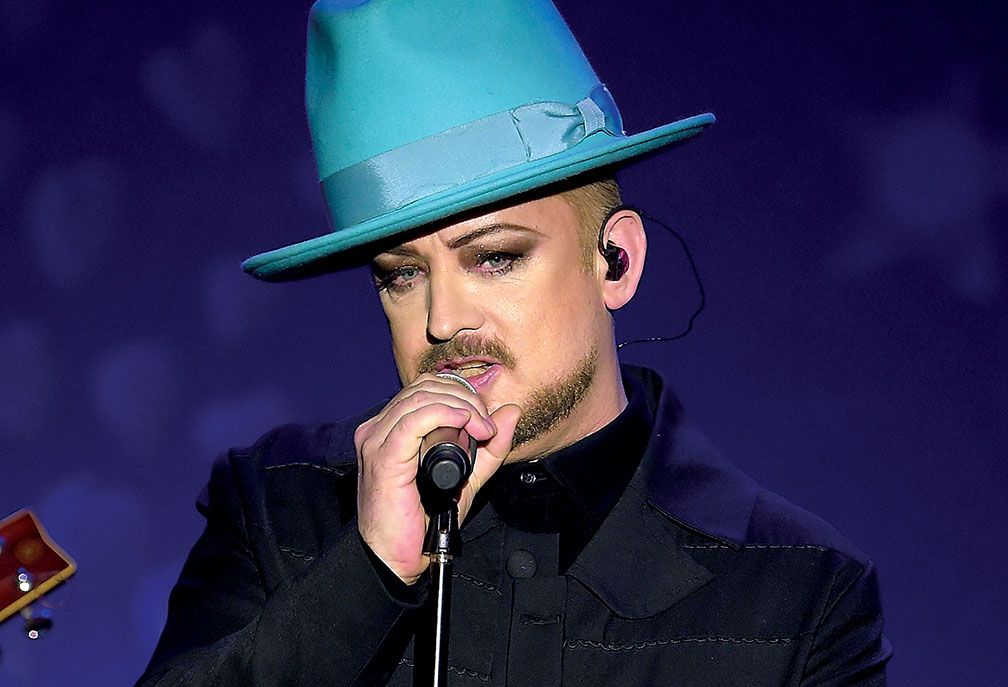
For an artist’s manager, few moments are scarier than watching a client make a decision that could put his career at risk. For Paul “PK” Kemsley, Boy George’s manager and close friend, the release of “We Will Dance Again” was one of those moments.

“You say genocide, I say war / When you’re attacked, that’s what the army’s for,” George sings in the reggae-style song, a tribute to the victims of the Nova music festival massacre and a statement of support for Israel. The song continues with lyrics criticizing what George describes as selective memory, online propaganda and musicians who have taken positions against Israel.

One can only imagine Kemsley’s reaction when he first heard the song. As George’s manager, he immediately understood what could follow: public backlash, criticism on social media and possible professional consequences.

But as a friend — and as a Jew — he said he could not have been prouder.

“He made a brave statement,” Kemsley said in a phone interview with The Journal. “He’s getting abuse on social media, but he doesn’t care. He stands by it. He was never afraid to say what he thinks and believes in. An artist should be able to express himself,” he said. “I will always support him and love him.”

Kemsley has managed George for 12 years, beginning in 2014, and later expanded his role to include management duties for Culture Club. Over the years, their professional relationship has developed into a close friendship, with Kemsley becoming a trusted confidant who has supported the singer through career highs and challenges.

Just an hour after our conversation, Kemsley released a statement on Instagram announcing that George would withdraw from the London production of “Jesus Christ Superstar.”

“George has never been afraid to stand by his personal convictions, and I have always respected him for that,” Kemsley wrote. “Equally, I believe it is my responsibility to make decisions that are in the best interests of my artist while also showing respect to others. In this instance, I felt it was right to step aside, allowing the production to remain the focus, while ensuring everyone involved can move forward with mutual respect and goodwill.”

George was scheduled to play King Herod in the West End production at the London Palladium. Although the production did not officially say that his departure was connected to the controversy surrounding “We Will Dance Again,” the announcement came as public criticism of the song intensified.

As expected, the song quickly sparked backlash online. Many pro-Palestinian activists and anti-Zionists were quick to attack George, accusing him of using his platform to promote a pro-Israel political message. Some called him a “genocide denier” and labeled him a “Zionist” — which, in today’s online discourse, has become a casual insult thrown around by some who do not even understand what it means.

But for many Israelis and members of the Jewish community around the world, the British singer became an instant hero. Here was an artist with no personal stake in the Israeli-Palestinian conflict, who understood the potential consequences of publicly taking a position, yet chose to publicly support Israel and what he believed was right.

At a time when many celebrities remained silent or avoided taking a clear stance out of fear of criticism, George’s willingness to speak out resonated deeply. To many Jews, his decision represented more than a song — it was a rare moment of solidarity from an unexpected voice, and a reminder that they were not alone.

Long before George became controversial for his political views, he was controversial for simply being himself. When he emerged in the early 1980s as the frontman of Culture Club, he challenged ideas about gender, fashion and identity. With his colorful clothing, makeup and androgynous appearance, he forced audiences to rethink what a pop star could look like.

Decades later, he is challenging a different expectation: that celebrities should keep quiet rather than risk criticism for expressing an unpopular opinion.

George’s willingness to support Israel did not begin with “We Will Dance Again.” Years earlier, he had already faced criticism from boycott activists after deciding to perform in Israel, a decision many artists have avoided over the years amid pressure from pro-Palestinian groups and concerns about alienating fans.

In 2017, when George performed in Tel Aviv with Culture Club, he was targeted by BDS activists who urged him to cancel the concert. Instead of backing down, he defended his decision, explaining that he performs for his fans, not politicians. For George, refusing to perform in Israel would mean turning his back on the people who wanted to see him.

That experience would later lead to another public expression of his connection with Israel: his collaboration with Israeli artist Asaf Goren on the Hebrew-English song “Rainbow in the Dark.” Released in 2020, the song came after George had received criticism and hostile messages following his performance in Israel. According to Goren, George knew that collaborating with an Israeli musician could bring further attacks, but he chose to move forward anyway.

Boy George with Asaf Gorgen

In an interview with The Journal from 2020, Goren, a singer and dancer who moved from Israel to Los Angeles in his early 20s and has appeared on “So You Think You Can Dance,” “The Challenge” and “RuPaul’s Drag Race,” recalled how surprised he was when the British star discovered his music and reached out to collaborate. “One morning, I woke up and saw that George tagged me on Instagram with my picture and a song from my new album,” Goren recalled. “I was shocked. In Israel, some artists like to say that I’m [just] a reality TV star, but here is George posting my music and wanting to collaborate with me. Now, that says something.”

“Rainbow in the Dark” was more than just a musical collaboration — it was George’s response to those who had tried to pressure him not to perform in Israel. And so it became another example of George’s willingness to stand by his choices, even when he knew they could provoke criticism.

“He was always a supporter of Israel,” Goren told The Journal last month. “He knew the repercussions of making a song about Israel, standing with the Jews, and even back then, making a song with an Israeli musician like me, and still he always stood with us.” The two artists recorded another, unreleased, song, which was also recorded in Hebrew and English.

For Goren, it’s not about picking a side. “It’s about being human,” he said. “I know George personally, and he doesn’t care about fame, views, or monthly listeners … He’s a true artist who loves to create from the heart and from the soul. He’s amazing. He’s really a hero for us. It’s so easy to go against us, to hate us, and blame us for everything that is wrong in the world. But this guy is looking at the bigger picture, and he is standing with us regardless of the backlash he receives.”

Goren also recalled conversations in which George expressed admiration for Israel’s democratic values and its openness toward the LGBTQ community. “He used to say, ‘How can I not love the only democratic state in the Middle East?’” Goren said.

George’s support for Israel has extended far beyond his music. In recent years, he has repeatedly used his public platform to push back against campaigns targeting Israel and against fellow artists who have taken a hostile position toward the Jewish state.

During the controversy surrounding Israel’s participation in Eurovision this year, when activists and some artists called for Israel to be excluded from the competition, George was among the voices who rejected attempts to isolate the Israeli delegation. Rather than remain silent, he made clear that he believed Israeli artists had the same right as any other performers to participate on an international stage.

He also did not hesitate to confront one of the most outspoken critics of Israel in the music world: former Pink Floyd frontman Roger Waters. After Waters appeared in a video message to an anti-Zionist conference in Ireland, where he said that the “experiment” of Israel was coming to an end, George responded publicly, criticizing the musician’s views and calling him a “sanctimonious t—.” George used the same expletive after Waters questioned evidence surrounding sexual violence committed during the Oct. 7 Hamas attack, telling him: “Go to the Nova Exhibition you t—!”

George also spoke out in support of Lady Gaga after an old video resurfaced of her 2014 performance in Israel, in which she told the audience, “I love Israel.” As some social media users criticized her for the comment, George responded on X, writing: “I love Israel too. Blaming an entire people is moronic. You can be against war and still love humanity. Good for her. She loves her Israeli fans. Like I do. Some of them were probably killed on Oct. 7. I have DJ’d in Tel Aviv a number of times. I hope I will in the future.”

George has already earned his place in music history with unforgettable hits like “Karma Chameleon” and “Do You Really Want to Hurt Me.” But for many in the Jewish community, he will be remembered for more than his extraordinary voice and stage presence.

He will be remembered as an artist who was willing to stand up for what he believed was right, even when doing so came with financial, professional, and personal price, and who showed that he is not only an amazing performer but also a true mensch.

A Brave Voice: Why Boy George Risked His Career to Stand With the Jews Read More »