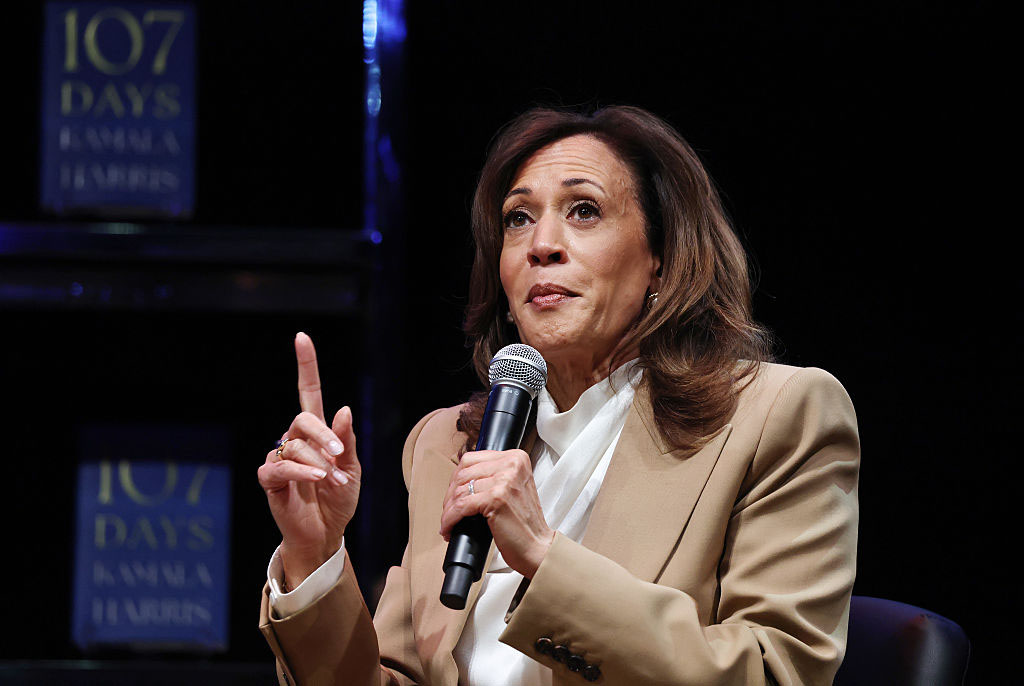
Some politicians write books in order to build bridges. Kamala Harris used hers as an opportunity to burn them. The once presidential candidate used her memoir of her abbreviated 2024 presidential campaign as an opportunity to appropriately point out that 107 days is an unrealistically short period of time for a presidential candidate to get to know the American people. And there’s no question that Joe Biden’s belated decision to withdraw from the campaign in late July left Harris in an extremely difficult position.
But it can also be argued that she did not take maximum advantage of that small window. Harris is skilled and smart. But she is also extremely cautious, and that unmercifully small time frame may have required a candidate more comfortable acting boldly — and even occasionally taking risks. She often came across as a frontrunner hoping to protect her lead, rather than a candidate scrambling to take advantage of every opportunity in an excruciatingly close race.
Harris also devoted much of the book to what seemed like score-settling, including criticism of both Biden and his White House staff. Even more noticeable – and potentially damaging to her political future — were her broadsides against several other potential Democratic presidential hopefuls.
She called out California Governor Gavin Newsom for not returning her phone call after she announced her candidacy, but didn’t mention that he issued an enthusiastic endorsement of her within hours. Influential Democratic governors Gretchen Whitmer of Michigan and JB Pritzker of Illinois received similarly harsh treatment for their initial hesitation to immediately announce their support in the middle of a historically chaotic series of events. Whether they should have signed on with her right away or deserved time to understand the rapidly shifting political landscape is a matter of legitimate debate: the downside of attacking potential political allies (or foes) is more apparent.
Harris saved her most inexplicably unflattering commentary for her potential running mates. She explained that her first choice was Pete Buttigieg, but felt that it was “too big a risk” to run a Black woman and a gay man on the same a ticket. But as history tells us, risk is often a necessary ingredient of progress.
Some of Biden’s advisors may have felt that there was risk involved in naming a Black woman as his running mate four years earlier, or that Walter Mondale and John McCain heard similar concerns before selecting their vice presidential nominees. And of course, Harris herself was one of many Democratic leaders who took a significant risk in supporting Barack Obama for president in 2007. (Although Obama himself preferred the term “audacity.”)
She passed over Arizona Senator Mark Kelly because she felt that he was not sufficiently prepared for a harsh campaign against Trump, using a scatological term to describe what she felt was the absence of an unexpected moment of adversity in his career. The near-assassination of Kelly’s wife, former Representative Gabrielle Giffords, apparently did not meet the test of dealing with such pressure, nor did his lengthy military career or his four flights to outer space.
Even worse was Harris’ dismissal of Pennsylvania governor Josh Shapiro, who she felt was overly ambitious. This is an odd assessment coming from someone who announced her presidential candidacy barely two years after being elected to the Senate. She recalled that he “mused that he would want to be in the room for every decision,” without noting that every running mate for almost half a century has made similar requests for access and input.
But there were other relevant factors here that Harris did not mention. As I wrote at the time, “(T)he ugly attacks leveled against … Shapiro from the Israel-haters who occupy the Democrats’ most extreme left flank represented the first serious test that Harris faced as her party’s nominee.”
A year later, it’s worth wondering whether that pressure had more of an impact on Harris’ decision than her unhappiness that an aspiring vice president might someday want to be president. It’s also worth concluding that a 2028 Harris campaign now seems much less likely.
Dan Schnur is the U.S. Politics Editor for the Jewish Journal. He teaches courses in politics, communications, and leadership at UC Berkeley, USC and Pepperdine. He hosts the monthly webinar “The Dan Schnur Political Report” for the Los Angeles World Affairs Council & Town Hall. Follow Dan’s work at www.danschnurpolitics.com.